
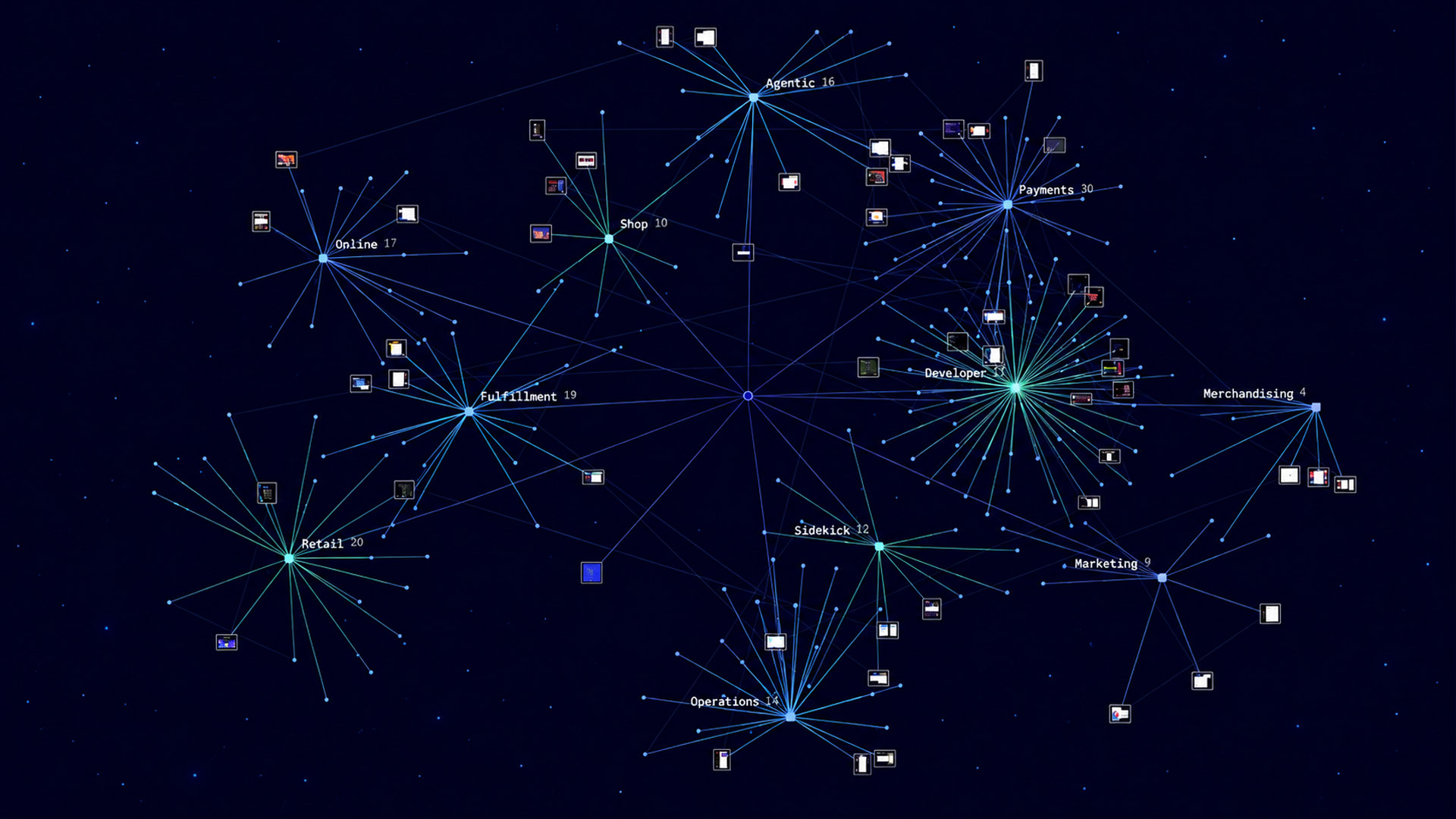
Shopify released its Fall ‘26 Edition, dubbed “Exponential,” the first ever edition to come between its usual twice-yearly releases, which it’s put out since 2022. The theme of the Fall ’26 Edition, which has the tagline “Everything new for non-linear growth,” is how the network effect of a platform full of independent merchants “makes every business on Shopify exponentially more capable.”
If you’re unfamiliar with Editions, historically twice a year, Shopify releases a mega showcase of its latest features. I’ve covered all of their Editions including Spring ’26, Winter ’26, Summer ’25, Winter ’25, Summer ’24, Winter ’24, Summer ’23, Winter ’23, and Summer ’22 (the first one). It seems that changes and improvements to the platform are coming at such an accelerated pace that Shopify feels a quarterly Edition best serves merchants and developers (or shareholders, LOL). I’m guessing we should expect both a Spring ’27 and Summer ’27 next year, but we’ll see.
Here’s what’s new in Fall ’26 Edition. Some of these updates you’ve seen me talk about in recent editions and others were announced for the first time:
- Shop Pay for AI agents – The centerpiece of the edition is that Shop Pay checkout now runs inside third-party AI agents like Meta’s Muse, Claude Duet, and Instinct, including in some agents for brands that don’t host their stores on Shopify. When stores aren’t on Shopify or don’t specifically accept Shop Pay at checkout, the wallet takes a shopper’s saved payment info and creates a single-use tokenized card number through Visa, Mastercard, or Discover (with Amex coming soon) that works at practically any store. This is one of the most brilliant moves I’ve ever seen a digital wallet make, and I wouldn’t be surprised if PayPal, Apple Pay, and Google Pay are quick to follow with similar functionality, as many of them already have the building blocks in place to make it happen. It also wouldn’t surprise me if Shopify expands the functionality outside of just AI agents via its mobile app or browser extensions, letting shoppers themselves (not just their agents) pay with Shop Pay anywhere.
- Shop.md – Shopify launched a new skill that lets any AI agent act as a personal shopper tied to the buyer’s Shop account, so agents no longer need a direct partnership like the one Shopify struck with Meta’s Muse in September. Once a shopper signs in, the agent can search the entire Shopify Catalog, read past orders to learn a shopper’s sizes and preferences, and check out with Shop Pay inside the chat. Shoppers can set their own rules and criteria, such as a max budget or how fast they need the item delivered, but they still have to approve each purchase before it happens by default. The big thing: Agents don’t have to register or partner with Shopify to gain access to the skill and only have to identify themselves with a profile URL on each request. That’s more fair by nature, since no one wants more gatekeepers deciding which agents get to shop and which don’t, but unfettered access also means Shopify is opening the door to every agent out there, including poorly built ones that buy the wrong size, and malicious ones that try to game the system.
- Selling in Google AI Mode and Gemini – Shopify merchants can now sell directly in Google’s AI Mode and the Gemini app, with checkout powered by Shopify. However, subscriptions, bundles, customizable products, and B2B-only items aren’t supported yet, which rules out some Black Friday offers.
- Shopify connectors for AI agents – Merchants can now manage products, inventory, orders, and performance from inside nine AI agents: ChatGPT, Claude, Claude Duet, Copilot, Gemini, Grok, Grok Bot, Muse, and Perplexity. They can also pin Shopify to the ChatGPT sidebar to see sales, sessions, and conversion rate.
- Knowledge base and Catalog eligibility – Merchants can review and publish the store facts that AI agents receive, like return windows, shipping destinations, and gift services, from a new Knowledge base under Sales channels > Agentic. Shopify drafts those facts from the storefront and suggests updates, but agents only receive what the merchant approves. A new eligibility check also shows whether a store qualifies for Shopify Catalog or what’s blocking it.
- Rebuilt Sidekick – Shopify rebuilt Sidekick to write code, run calculations, search the web, and remember what merchants teach it. It can now stage dozens of changes under a single approval, like rewriting descriptions across an entire collection, and test its own recommendations on simulated shoppers using SimGym before merchants apply them. Sidekick also now floats on every page of the admin like a cat who pushes the door open and follows you into the bathroom.
- Canvas – A new store design tool that lets merchants see every page of their store in one Figma-style view and have Sidekick make anything from small tweaks to full redesigns. The editor is in early access, and themes edited in Canvas don’t support app blocks yet.
- New and Improved Rollouts – Rollouts, which launched in April, now let merchants schedule launches, events, and experiments that bundle theme, checkout, catalog, and discount changes together, then A/B test them across the online store, POS, Google Shopping, the Shop app, and headless builds. Catalog rollouts can also revert prices by market automatically when a promotion ends, so merchants no longer have to manually unwind Black Friday pricing at midnight.
- Shopify Protect – Shopify bundled its fraud and dispute tools into one suite that includes a Rule Builder for writing custom fraud rules and backtesting them against past orders, automatic blocking of high-risk checkout attempts, and AI-written chargeback responses for each bank. Shopify says its payment network already blocks more than 12,000 high-risk payments every minute, and fraud signals from one store now protect the others. Several features are still rolling out.
- Seven new local payment methods – Shopify Payments added Alipay, WeChat Pay, MB WAY, OXXO, Satispay, Scalapay, and GrabPay, with most able to work online with Shop Pay and in-store on POS.
- Universal Checkout – Shoppers can now fill one cart in the Shop app with products from multiple Shopify brands and pay for all of them at once with Shop Pay, while each merchant still processes its own order and maintains ownership of the customer. (Yet, Shopify is not a marketplace. LOL.) The same multi-merchant checkout runs on Shopify’s Universal Commerce Protocol endpoint, so outside developers can request early access to add it to their own AI shopping agents.
- The new Shop.com – Shopify moved its Shop app’s web home from shop.app to Shop.com, a domain it bought from Market America in September for a reported $100M. The relaunched site adds shoppable posts, editorial collections, personalized sections, and package tracking, and Shopify says Shop’s web traffic is now growing faster than its app traffic.
- In-store customer recognition on POS – POS can now identify more in-store shoppers through the Shopify Payments network of hundreds of millions of past buyers, and staff can pull up a known customer’s abandoned online cart and finish the sale in person. Shopify says known in-store customers have more than 60% higher lifetime value than unknown ones.
- Shop Promise expansion – Shopify grew eligibility 20x for Shop Promise, the free badge that highlights reliable delivery and returns on product pages, checkout, and the Shop app. Badged products may also rank higher in Shop search and in the Catalog data that AI shopping agents use.
- Campaign Autopilot expansion – Shopify’s AI-run ad campaigns now reach Microsoft Advertising and Snapchat, with X Ads coming soon. Merchants can also advertise inside ChatGPT conversations through a new ChatGPT Ads app, and select businesses can run TikTok Buy Direct ads with checkout powered by Shopify.
- Redesigned admin – Shopify gave the admin new colors, typography, spacing, and icons, along with a collapsible side navigation that holds search, notifications, and the store picker. The redesign is rolling out to all pages, along with passkeys, folders for files, and automatically generated store policies that stay in sync.
You can check out the rest of the updates in the full Fall ’26 Edition.