
Hi Shopifreaks
It’s that time of year again… predictions time!
Each year at Shopifreaks, I publish a report featuring the best e-commerce predictions in our industry, and this year marks our fifth annual edition. Here’s last year’s 2026 E-commerce Predictions report if you’d like to see who got theirs right and wrong so far (though there are still seven weeks left in the year for a few of them to pan out). Personally, I only made one prediction last year, and I nailed it.
We’re getting started a little earlier than usual this year, by popular demand. A number of you have already reached out to ask whether I’m doing the report again, which of course I am! It’s been a Shopifreaks tradition since 2022. And since many of you take your submissions seriously and want to put real thought into them, I figured I’d give you some extra time to get them in.
🔮 What are your 2027 predictions?
Hit reply and let me know what major changes, trends, or milestones you see on the horizon. How about surprise mergers and acquisitions? Who are the sleeping giants that are about to awaken in 2027? What breakthrough technology is going mainstream next year?
All predictions are welcome. Have yours in by Dec 11th for inclusion in this year’s report. You can keep them short and sweet or get as detailed as you’d like. And if you’ve already published your predictions, feel free to send me a link to the post.
Now let’s stop thinking about the future and take a look at what happened during the past week.
In this week’s edition I cover:
- Google clicks are more valuable than ChatGPT clicks
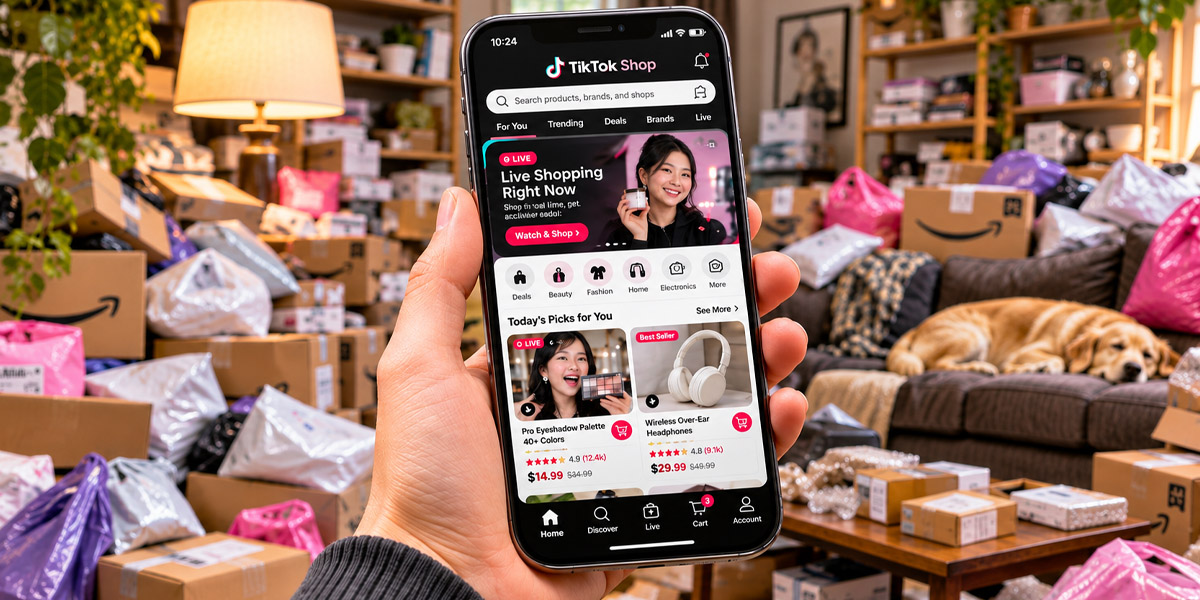
- A standalone TikTok Shop app
- Reddit search ads
- Amazon ditches Grubhub for Uber Eats
- You can now text Alexa
- Amazon lets merchants manage products on Shop Direct
- OpenAI’s upcoming analytics dashboard
- EU’s €2 handling fee
- Shopify’s new channel mapping
- Amazon helps shape Google’s UCP
- AI crawlers shutting down websites
All this and more in this week’s 303rd Edition of Shopifreaks. Thanks for subscribing and sharing!
Stat of the Week
Shoppers who clicked ChatGPT ads brought US retailers $0.89 in revenue per visit, compared with $2.45 from Google search ads, according to a working paper by researchers at the Frankfurt School of Finance & Management and the Vienna University of Economics and Business. The gap primarily comes from conversion, since ChatGPT ad visitors bought 0.37% of the time against 1.17% for Google, even though they spent more per order. By the researchers’ math, ChatGPT clicks would have to drop to roughly $0.26 to pay off as well as Google’s, but the largest known advertiser in their data paid $1.72.

1. TikTok launches a standalone app for TikTok Shop in Southeast Asian markets
TikTok quietly released a standalone TikTok Shop app for iOS and Android in Singapore, Malaysia, Thailand, and the Philippines, as spotted by social media consultant Matt Navarra. The app offers a feed with personalized product recommendations, in-app shopping via livestreams and short-form videos, order tracking, and integrated customer support, allowing shoppers to discover products, make purchases, and manage their existing orders without ever visiting the main TikTok app.
To encourage users to try the new dedicated shopping app, TikTok is offering deals like free shipping and first-order discounts. It’s a similar playbook to the one TikTok used with PineDrama, its standalone microdrama app: give users a taste in the main TikTok app, then nudge them toward the dedicated one.
TikTok hasn’t said whether it plans to bring the app to other markets, including the US.
It’s an interesting experiment, but will it work?
One reason TikTok Shop is so successful is that users never had to visit it with shopping intent. The shopping videos were mixed in with entertaining videos on the main feed, and the experience felt like true discovery. That’s why, I believe, Amazon Inspire was a flop — it lacked the entertainment to keep people scrolling.
It’s also not the first time ByteDance has tried a standalone shopping app.
Douyin, the Chinese version of TikTok, launched a dedicated shopping app called Douyin Mall in March 2024, with a heavy emphasis on ultra-low-priced products. That app is still running.
Earlier attempts flopped, though. ByteDance launched a standalone e-commerce app called Douyin Box at the end of 2021, focused on fashion, but shut it down in 2022. It also experimented with standalone overseas shopping apps, including Fammo, Dmonstudio, and If Yoouu, which are no longer operating.
Then again, TikTok Shop is a LOT bigger now than it was in 2022. There’s also nothing to indicate that shopping is leaving the main app, so the Shop app isn’t necessarily a replacement. The dedicated app could simply provide a better shopping experience for those who want one, and of course, a hub for TikTok’s future AI shopping tools.
Like a lot of things TikTok does, I think it’s a brilliant move. Why put all your eggs in one app’s basket? Now, for the first time, users can take a break from (or even delete) the main TikTok app and still have access to TikTok Shop. Meanwhile, TikTok gets a direct pathway to its most engaged shoppers and can improve the shopping experience in ways it can’t on the main app, which has to serve many purposes.
Early 2027 Prediction: TikTok launches a standalone TikTok Local app for the Local Feed it rolled out in the US in February, along with an app for its TikTok GO travel bookings.
2. Reddit begins testing ads in search result pages
Reddit began testing ads that appear in search results, aimed at people who use the site for shopping recommendations. For example, a search for an espresso station might show ads for beans, mugs, or espresso machines. A search for a home office setup could surface ads for monitors, desks, or office chairs. And a search for “feet pics” might show… Dr. Scholl’s sneakers? Well, I guess we’ll soon see how contextually accurate Reddit’s algorithm is.
Only a small group of advertisers can buy the format during the first round, and Reddit hasn’t said how often the ads will appear, but its screenshots show them near the top of results. The test comes a week after Reddit said Google’s AI Mode had cut its search referrals and announced plans to require visitors to log in to view content, which CEO Steve Huffman said would improve ad targeting.
Reddit has been on an advertising frenzy since its IPO in 2024:
- Apr 2024: Dynamic Product Ads entered beta, which automatically pull products from a brand’s catalog and show them next to related conversations. They rolled out to all advertisers in May 2025.
- Jan 2025: AMA Ads, which let brands promote their Ask Me Anything sessions with RSVPs and reminders.
- Jun 2025: Conversation Summary Add-ons, which put positive user posts under brand ads, plus the Reddit Insights listening tool.
- Jul 2025: An optimization score and recommendations in Ads Manager.
- Nov 2025: Interactive Ads with quizzes, countdowns, and mini games, tested with Paramount, EA, Red Bull, and the Ad Council.
- Jan 2026: Max campaigns, an AI-automated campaign type, launched in beta.
- Feb 2026: AI shopping carousels tested in search.
- Mar 2026: Collection Ads, Community and Deal Overlays, and a Shopify integration for Dynamic Product Ads, which rolled out to all merchants in June.
- Apr 2026: Reminder Ads went live for all advertisers.
- Jun 2026: Shopping Listing Ads, its first ad unit with products from multiple brands (in alpha), plus a free-form ad generator and Redditor Highlights to all advertisers.
- Oct 2026: A campaign planner that forecasts reach and cost, plus a campaign-level optimization score.
- Nov 2026: Ads in search results.
If you’ve ever wondered what ad-shittification looks like on a platform, there’s a glimpse! And of course, that doesn’t even count all the shilling that goes on within the subreddits themselves.
🔥 Partner News
ReFiBuy launched early access to support for Meta’s Muse, letting brands and retailers in the US and Canada find the gaps in their product data that make Muse less likely to recommend them. ReFiBuy’s agents draft product descriptions, Q&A, and attributes such as who an item is for and what occasion it suits, then a commerce team approves what goes live, and approved changes sync back to Shopify stores. ReFiBuy then monitors whether those products appear in Muse answers, where they place next to rival products, and whether Muse describes them correctly, something ReFiBuy already tracks on ChatGPT, Alexa for Shopping, Google AI Mode, and Copilot. Meta said on its Q3 call that over 10 million people set up Muse in its first six weeks and that shopping is its most common use.
3. Amazon replaces Prime’s free Grubhub+ perk with Uber Eats
Amazon replaced Prime’s free Grubhub+ membership with an Uber Eats benefit that lets US members order restaurant delivery in the Amazon Shopping app or on Amazon.com, with no delivery fee on orders of $25 or more. Ouch! And on the same day Grubhub filed for an IPO? That’s got to sting. (Well, technically it’s the IPO of Grubhub’s parent company, Wonder, but you get the point.)
Members don’t need an Uber account or the Uber Eats app to use the new benefit, because they sign in and pay with their Amazon account and receive delivery updates within the Amazon app. The benefit, which is also included in the half-price Prime for Young Adults and Prime Access tiers, covers nearly 10,000 US cities and towns.
Is it that big of a perk?
It’s a decent freebie, but it’s a downgrade from the Grubhub perk it replaced because customers now have to spend $25 instead of $12 — though realistically, what can you order for less than $25 on Uber Eats anyway? The perk is also weaker than what Uber One members already get, which is free delivery on restaurant orders of $15 or more, up to 10% off at participating stores, and credits back on Uber rides.
The question for existing Uber One members becomes: Do I get more value out of my existing Uber One perks or from saving the $9.99 per month by canceling my membership, since I now get a decent perk through my Amazon Prime? First world problems at their finest!
Why’d Amazon make the switch?
Amazon had offered Prime members Grubhub+ for free since 2022 and waived delivery fees on orders over $12 until the partnership ended on November 5, but it didn’t say why it switched to Uber. It could have to do with the growth trajectory of each company.
Since 2022, Grubhub has shrunk to about 8% of US meal delivery spending, according to Bloomberg Second Measure, and Just Eat Takeaway sold it to Wonder for $650M in early 2025, a fraction of the $7.3B it paid for it in 2021. Meanwhile, Uber’s delivery gross bookings grew 23% YoY to $28.5B in Q3 2026, and Uber Eats holds about 23% of US meal delivery spending, behind only DoorDash.
Does Walmart offer anything comparable?
Walmart doesn’t currently have a deal with Uber, DoorDash, Grubhub, or any other delivery app. It’s instead building restaurant delivery itself on its own Express Delivery network, which now covers 2,400 restaurant locations. So while Amazon is taking the partnership route, Walmart is building the food delivery network in-house.
What are your thoughts? Is Uber Eats a better perk than Grubhub? Hit reply and let me know.
4. Amazon lets shoppers text Alexa for Shopping to find and buy products
Amazon began offering some customers the ability to text its AI shopping assistant, Alexa for Shopping, to find products, build shopping carts, and complete purchases. Sponsored products can also show up in the replies Alexa texts back, obviously, because it’s Amazon, which only launches new shopping channels if it can create new real estate for its ads. However, Amazon isn’t charging advertisers for those placements yet, according to Digiday.
The feature is initially only available to a small group of US customers by invitation, but Amazon said it will expand the option to more shoppers during the holiday season ahead.
Great, but why?
How is that any easier than shopping through the Amazon app on a phone? Or am I just the only person who hates texting?
Rajiv Mehta, Amazon’s VP of Conversational Shopping, said:
“Customers often jot down what they need the moment they think of it in their notes, in their messages, in their group chats. Now with Alexa for Shopping, your personal shopping agent is just a text away. Message it what you need, and Alexa goes to work on your behalf—searching, comparing, and buying so you can get on with your day.”
Ah yeah, okay, that makes sense. I’m sold! However, I hope they bring it to WhatsApp too because that’s where most of my texting happens nowadays.
Here’s what else texting Alexa can do:
- Text your to-do list for Alexa to get to work on, such as “I’m currently on the toilet and out of toilet paper, I need a very cheap birthday gift for my wife’s sister (but one that looks expensive), and we’re low on dog food.”
- Set up a weekly grocery order or text a photo of a recipe to add all the ingredients to your cart.
- Reorder household products like laundry detergent or aluminum foil, based on your orders from previous months.
- Personalize your shopping experience, such as telling Alexa to add items to your cart automatically or only show organic options.
- Send a photo of something you discover in the wild and Alexa will find a similar product on Amazon.
- Check on existing orders to learn when they shipped or when they will arrive.
- Get notified about new releases, when products are back in stock, or when an item hits your price target.
- Just be sure to save the assistant as “Alexa” in your contacts, and not “Sweetie ❤️” so your wife doesn’t question who you’re texting all day!
Does Walmart offer shopping by text?
Yes, for a while now. Walmart launched Text to Shop publicly on December 14, 2022, after running it for a year as an invite-only beta. Before that, Walmart tried a $600/year text concierge called Jetblack in New York in 2018. (Aww, isn’t that cute that people were willing to pay for the privilege of shopping by text back then?)
Would you use Alexa’s new text-to-shop feature? Or are you too old and wish instead that Amazon had a 1-800 number you could call to talk with a real live person to do your shopping? Because that’s probably coming too, minus the “real live person” and plus an “AI voice chatbot.”
5. Amazon launches a self-serve portal for merchants to manage their products on Shop Direct
Ready for one more feature story about Amazon? They had a lot going on this week…
Amazon launched a free self-serve portal called Shop Direct Merchant Workspace, where merchants can join Shop Direct and manage products that surface through the program.
Quick Backstory: Shop Direct is Amazon’s AI discovery experience that shows products from outside its own marketplace by integrating with third-party feed syndicators and indexing the greater web. It launched in beta in February 2025 and now includes over 250M product listings.
Amazon has faced backlash over Shop Direct for several reasons:
- Merchants are included by default and have to opt out, and many didn’t know their products were listed.
- Listings have shown wrong product names, details, or information.
- Some listings link to unauthorized resellers instead of the brand’s own site.
- Buy for Me, the feature that lets Amazon complete a purchase on a merchant’s site for the shopper, places orders using Amazon’s own e-mail addresses, which keeps Amazon in the middle between merchants and their customers.
The new Shop Direct Merchant Workspace aims to solve at least some of those issues.
Merchants can submit the same product feeds they already use elsewhere, either directly or through providers like Feedonomics, Salsify, CEDCommerce, and VersaFeed, which should cut down on listings with wrong details. They can also choose which products to include and see which ones are currently live on Amazon. Merchants keep handling pricing, fulfillment, and returns, pay no fees, and can opt out at any time.
However, the Workspace doesn’t fix the biggest complaint, since merchants are still included by default unless they opt out. Though at this point, the world seems to have accepted that AI participation is opt-out by default, so Amazon is just following the pack on that one. Amazon’s announcement also doesn’t mention traffic reporting, which it told The Information it’s building, or any change to how Buy for Me places orders.
Either way, I applaud Amazon for launching a portal that gives independent merchants more control over how their listings appear (or don’t appear) through Shop Direct. It should’ve been offered from day one, but better late than never.
6. OpenAI is building a ChatGPT analytics dashboard for businesses to view impressions and clicks
OpenAI is building an analytics tool inside ChatGPT that will show businesses how many times they appear in its answers and how many people click through to their websites, according to e-commerce analyst Juozas Kaziukėnas, who spotted an unannounced “Claim your business in ChatGPT” banner last week.
The analytics sit inside ChatGPT’s Business Hub, which is only open to businesses that verify ownership, such as by linking a Shopify store. Registering lets them add their latest products and keep their business details up to date, as well as set up an agent that answers customer questions using information the business controls. The dashboard will only show the number of mentions and clicks, but not which prompts led to a mention or how a business compares with competitors, at least initially. Maybe some of those features will become premium add-ons in the future.
Last month, I reported that ChatGPT stopped adding a utm_source tag and referrer data to its links after OpenAI released GPT-6, causing visits it sent to websites to be counted as direct traffic in Google Analytics and similar tools. The issue lasted for a week, and OpenAI said it was a bug, but I suspected otherwise, predicting that it was a test in preparation for the company launching an analytics platform that forces website owners to register with them in order to get accurate analytics. It’s the same play Google ran more than a decade ago — strip the keyword data out of referrals, then hand it back through Search Console in exchange for verifying your site. I wrote:
Was it actually a bug though? Or was it a test?
I’m not yet convinced either way. On one hand, why would OpenAI want to make it difficult for website owners to track how many visits ChatGPT sends them? If anything, they’d want to inflate that number, not obscure it.
On the other hand, forcing website owners to register for its (currently fictitious) analytics platform to track those clicks would offer a more accurate way to deliver the data, as it’d be coming from ChatGPT itself instead of having to be tracked by third-party platforms via an imperfect attribution mechanism. I’d imagine that even before the “bug,” some of that Direct traffic was coming from ChatGPT, and it wasn’t getting credit for the referral.
So, new theory unlocked: It wasn’t a bug. It was a test. OpenAnalytics coming soon.
You know, when I’m right, I’m right! Although, when I’m wrong, I’m wrong! 😂
Now before you say, “but Paul… UTM source parameters are back, and OpenAI hasn’t started requiring businesses to register for their analytics dashboard in order to unlock click and visit data!” — just remember the dashboard hasn’t even officially launched yet. Things could change!
7. The EU’s €2 handling fee is now live on every non-EU e-commerce order
The EU began charging a €2 “Union handling fee” on November 1 on e-commerce orders shipped to consumers from outside the bloc. Unlike the €3 customs duty that’s been in place since July, the new fee applies to orders of any value, so a $300 order from a US brand pays it too.
Both charges apply per type of item rather than per package. For example, a €25 parcel holding a phone charger, a phone case, and a screen protector owes €9 in duty plus €6 in handling fees, so €15 before VAT, while a package with two identical phone cases owes just €5. The seller, platform, or shipper filing the customs declaration legally owes the fee and can pass it on to the buyer, but the fee isn’t refunded when an order is returned, even if the item is faulty.
Quick Backstory: For decades, parcels worth €150 or less entered the EU duty-free. That loophole became the backbone of Shein, Temu, and AliExpress’s European business, much like in the US, which formerly had its own de minimis exemption. The EU estimates that 5.8B low-value parcels entered the region in 2025 alone, up 26% from the year before, which led to pressure from local retailers and trade groups for change.
Here’s a brief timeline of events that led up to this new €2 fee:
- December 2025 – EU countries agreed to scrap the €150 de minimis exemption and charge a temporary €3 flat duty starting July 1.
- March 2026 – France started charging its own €2 per-item tax on small parcels, then suspended it once the EU-wide duty took effect.
- July 1, 2026 – The €3 duty took effect on parcels worth €150 or less.
- September 2026 – The EU gave final approval to its customs overhaul, which makes non-EU platforms like Temu and Shein the legal importer of what they sell, and the Commission set the handling fee at €2.
- November 1, 2026 – The €2 handling fee took effect, along with mandatory product identifiers on low-value parcels.
- July 2028 (upcoming) – The temporary €3 duty is scheduled to end when the EU’s new customs data hub goes live and normal tariffs kick in. The handling fee has no end date.
Is it working?
The €3 duty has already made a dent in the number of small parcels entering the bloc, which immediately fell 30% to 40% after July, according to French customs figures, and between June and July, sales volumes fell 50% on Temu, 37% on AliExpress, and just 15% on Shein. The Commission also estimates the fees could raise €6B a year for the EU budget from 2028 to 2034, according to a document seen by Reuters.
Shein’s sales dropped the least because it had already started moving inventory into a warehouse in Poland ahead of the €3 duty, and Temu is now rebuilding its European fulfillment network the same way it did in the US when we abolished the de minimis exemption.
As you can see, there’s the big catch: Goods that are already sitting in an EU warehouse when a customer orders them don’t owe the duty or the handling fee. Effectively, the EU is saying, “Ship in bulk and sell retail from within the region, or pay for the privilege of selling factory direct.”
Shein and Temu have the money to play by those rules and are already doing so. However, the independent brand in New York or London shipping a few orders a day to Europe likely doesn’t, and now owes €2 per item type on every order and a €3 duty per item type on all orders under €150, the former of which it doesn’t get back when a customer returns an order.
The fee was pitched as a way to tackle what Dirk Gotink, the MEP who led the customs reform, called “a highly toxic business model” of cheap, non-compliant imports from China — a label I agree with. However, in practice, the platforms it targeted like Shein and Temu saw it coming and moved their inventory to warehouses within EU borders, leaving smaller cross-border merchants to pay the duties and fees.
Time will tell whether the duty and fee accomplish their intended goals, or whether companies simply find a way to bypass them. However, in the meantime, it’s at least making a dent in the insane number of products being shipped into the bloc individually, which is objectively terrible for the environment.
8. Shopify’s new channel mapping lets merchants send different product data to each sales channel
Shopify launched channel mapping, a feature that lets merchants decide what product, variant, and metafield data each individual sales channel receives without impacting the product title, description, or details on their online store. For example, a merchant could keep a short brand-focused title on its storefront while sending Google and ChatGPT a long one that combines the title, color, and key features of the product.
Merchants can create rules that apply to every product published on a specific channel and/or write unique values for each product. Prices, however, cannot be customized through channel mapping (but can be through Markets), and oddly enough, Shop App and Shopify Collective don’t yet support the feature. Channel mapping was actually announced in Shopify’s Fall ’26 Edition, but I missed it in my recap and felt it was important enough to cover a week late.
Here’s how the feature stacks up against third-party feed management tools like DataFeedWatch and Feedonomics:
- Cost: Channel mapping is built into Shopify at no extra cost. Feed management tools are paid subscriptions, usually priced by the number of products, feeds, or channels.
- Where the data lives: Channel mapping works directly on your Shopify product, variant, and metafield data, so there’s nothing to sync. Feed tools pull your catalog into their own platform and push it back out on a schedule.
- Channel reach: Channel mapping only covers eligible sales channels installed in your Shopify store, including the Shopify Catalog that feeds AI agents. Feed tools can build feeds for hundreds of channels, including regional marketplaces, comparison shopping engines, and ad networks that don’t have a Shopify sales channel.
- Source of truth: Channel mapping treats Shopify as your master catalog, whereas some feed tools can treat Shopify as just another destination, syncing product data in from an ERP, PIM, or other system, allowing the master catalog to live outside Shopify entirely.
- Rule complexity: Channel mapping applies the same mapping for each field to every product on a channel, with per-product overrides. Feed tools let you build conditional rules by category, brand, price, or any attribute, like “if the product is in Shoes, add the material to the title.”
- Prices: Channel mapping can’t change prices. Feed tools can usually apply price and sale-price rules per channel.
- Monitoring: Channel mapping shows a preview and how complete each field is. Feed tools track errors, disapprovals, and feed health for each channel.
- Multi-store and multi-platform: Channel mapping works one store at a time. Feed tools let agencies and brands manage multiple stores, and stores on other platforms, from one dashboard.
So while Shopify’s channel mapping doesn’t serve all use cases, it definitely covers what merchants need if they just want to customize product data on channels they’ve connected through Shopify, which is a healthy amount of merchants.
9. Other e-commerce news of interest
Amazon is working to help extend Google’s Universal Commerce Protocol to support marketplaces, according to e-commerce analyst Juozas Kaziukėnas, who spotted recent GitHub contributions by Amazon’s Greg Smith that point to the updates. One proposal would let a marketplace’s catalog listings and checkouts show both the storefront brand and the specific seller behind each offer. The second would carry that information through carts, checkouts, and orders, so a platform can record which seller actually sold each individual item in a transaction. Kaziukėnas said, “No idea when any of this is going to go live or indeed whether Amazon wants that for automated buying from other marketplaces rather than making its catalog available to agents.”
ChatGPT now handles roughly 20% as many search-like queries as Google, according to OpenAI’s consumer product lead Adam Fry at a company dinner in New York. Fry said OpenAI counts a search each time a question sends ChatGPT out to the web, but he conveniently didn’t say which Google figure, time period, or regions he was comparing against. E-commerce advisor François Maingret posed an interesting question about the stat on LinkedIn, “This sounds odd. I wonder if one prompt on ChatGPT triggers multiple queries, inflating the volumes measured.” For example, if every behind-the-scenes lookup counts as its own query, how many “search-like queries” does ChatGPT process when you ask it to find you the “best new 7-passenger SUV under $40,000”? Is that like 80 queries? Google hasn’t responded to the comparison, but Alphabet CEO Sundar Pichai said in the company’s Q3 results that Google’s query growth is the fastest it has been in five years.
Home Depot will welcome AI agents to shop on behalf of customers, as long as they identify who they are and what customer they’re shopping for, according to CIO Angie Brown. She told Business Insider, “We want to know you’re not a bot, and we actually want to know if it’s you. That’s something that Muse is working on right now, to self-identify.” She added that while Home Depot is open to the idea of AI agents, it doesn’t want to lose its connection with loyal customers — which is the biggest risk that agents pose to brands. When customers do their shopping through agents, retailers will ultimately be downgraded from “retailer” to “merchant of record” — because the customer belongs to the agent at that point. Today, that agent sells your products. Tomorrow, someone else’s. Remember, agents (and the companies that control them) can do what they’d like with their customers. Read my rant on LinkedIn for a glimpse at what’s coming to the DTC market.
TikTok Shop added a new report called Brand LIVE Impact that counts sales for up to two weeks after someone engages with a product during a livestream, including orders from the brand’s DTC website. The company argues that brands judging streams only on sales made during the broadcast underestimate their actual ROI, because many viewers discover a product during the stream but don’t buy it until after the broadcast ends. The new total adds purchases from the same shop within 24 hours, purchases through product cards, videos, and carousels on TikTok within 14 days, and website orders within 14 days tracked by a TikTok Pixel, which means a stream’s metrics can change for up to 14 days. The report is only available to select US brands, and it only counts livestreams hosted on a brand’s own Official and Marketing accounts.
OpenAI signed supply-side ad platforms Magnite and PubMatic as partners to sell ChatGPT ad space that would otherwise go unsold, according to The Information. Advertisers can set budgets, place bids, and upload ads through either company’s platform, but OpenAI still controls where and how the ads appear, and it’s only giving the two a limited amount of ad space to start. The two firms join a growing list of companies that sell ChatGPT ads outside of its own Ads Manager that launched in May, including Criteo, which became OpenAI’s first ad tech partner in March, and Amazon, which started letting its DSP advertisers buy ChatGPT ads in September. OpenAI said ChatGPT ads hit a $1B annualized revenue run rate at the end of August, and over 100,000 businesses had advertised on ChatGPT by October 21. (Though the trillion-dollar question will be: How many advertise twice?)
Poshmark sellers, once again, are unable to reliably cash out their earnings, just weeks after experiencing similar payout delays, which Poshmark blamed at the time on a change of banking partners. The company marked the incident as resolved on October 14, but direct deposit, Instant Transfer, Venmo, and PayPal withdrawals are still failing or getting canceled as of November 1, according to Value Added Resource. Poshmark support told sellers it’s working on a technical issue hitting several withdrawal methods, but its public status page still shows every system running normally. It hasn’t said how widespread the problem is or when it will be fixed.
Amazon launched a $25 Thanksgiving meal through Amazon Grocery, available with free same-day delivery in over 2,300 US cities and towns. The meal includes a frozen 8lb Butterball turkey, Stove Top stuffing, gravy mix, cranberry sauce, and Kraft Mac & Cheese, plus potatoes, green beans, corn, crescent rolls, pie crusts, and pumpkin puree from Amazon’s private label. Hot damn, Amazon came out swinging this year for Thanksgiving! Does it have to be just Thanksgiving though? If Amazon offered a $25 meal deal like that every day, it’d be the company’s #1 best seller by a landslide. This is the second year Amazon has offered a version of a $25 Thanksgiving dinner to compete with Walmart, which announced a 2026 Holiday Meal Basket in late October that serves up to 10 people for $35.
Depop now requires every new US listing to use Depop Shipping, its USPS-based label service, which ends the “Other” option some older accounts used to buy their own postage, according to Value Added Resource. The platform launched Depop Shipping several years ago, but up until recently it was an optional service. The change took effect the same day eBay, which bought Depop for $1.4B in July, said on its Q3 call that it’s using its carrier contracts to cut Depop’s parcel costs and pay for shipping promotions. Sellers have raised concerns about losing the ability to offer cheaper shipping on low-priced items, where postage can make up a big share of the total price, and some say Depop is pushing lightweight items into larger, more expensive package sizes.
The European Commission issued preliminary findings that TikTok’s For You feed breaches the Digital Services Act by leading users into “rabbit holes” of videos about sadness, isolation, and body image once they begin watching and liking similar content. Honestly, TikTok does that for ALL types of videos, not just videos in those categories. I watched and engaged with one fucking video about the US faking the moon landing in 1969, and now my For You feed thinks I’m a conspiracist and serves me all sorts of nonsense. Then there was the week where every video was a South Park clip! The Commission said that TikTok’s existing safeguards, like tapping “not interested” on a video, don’t actually change the feed because the algorithm puts viewing time ahead of what users say they want, and it wants TikTok to lean on stated preferences and stop ranking videos by viewing time.
Amazon’s revenue from seller fees and advertising reached $66.1B in the third quarter, or 96.6% of the $68.5B it earned from its own online store sales, up from 89.3% a year earlier, according to Marketplace Pulse. Prime Day’s move from July to June helps that comparison, but even counting Q2 and Q3 together, the gap between seller fees and ads and Amazon’s own store sales fell by half, from $12.7B to $6.2B. On a trailing 12-month basis, seller fees and ads are on pace to overtake Amazon’s own store sales around spring 2028. Amazon still competes with its sellers for each sale, but what it charges them for access to its shoppers, warehouses, and ad placements is growing at nearly double the rate of its own retail sales.
Shopify is replacing the tier system in its Partner Program for agencies on January 1, 2027, after partners told it the current setup, introduced in January 2025, had too many requirements to track. Each new tier will depend on only two numbers, attributed GMV and attributed shops, starting with Silver at $25K and one shop and topping out with a new Diamond tier at $500M and 25 shops. Promotions will also move from quarterly to daily, with partners keeping an earned tier for six months or longer. The new model also stops rewarding agencies for landing Plus and Enterprise merchants specifically, since the current tiers require a minimum number of those stores while the new ones count any shop that earns a partner revenue share, regardless of plan.
ThredUp CEO James Reinhart warned on a recent earnings call that aggressive spending by competing secondhand fashion marketplaces like Vinted and Depop is putting pressure on his business, but that they won’t be able to keep it up in the long run. He estimated that rivals could spend up to $500M on marketing and other subsidies in the second half of 2026 to attract buyers, which he called “wholly irrational,” and said that ThredUp was built “very specifically to be different than these business models.” Honestly, his comments feel a bit like a child saying, “That’s not fair!” when their brother has more Monopoly cash and is buying up all the properties, especially given the fact that ThredUp has been building the same type of peer-to-peer resale model since 2024 that he criticized on the call.
Wix introduced a new AI-native website editor called Studio Two that combines AI site generation, drag-and-drop design, and direct code editing into one continuous workflow. The editor is designed so that designers and developers can export and import projects as standard code between Wix and other AI platforms and editors, and then run the finished site on Wix or any other platform. So basically “Wix-friendly,” but not “Wix-required” sites. The editor also supports MCP, which lets outside AI agents like Claude and Cursor manage a site’s business tools, including Wix Stores and Wix Bookings. The move is part of Wix’s recent efforts to shift its business from primarily offering a website editor to selling the hosting and integrated business tools that sites run on, as AI begins to consume the site-building experience.
Amazon closed its Virginia Beach fulfillment center for a day and a half after a 19-year-old man shot and killed an 18-year-old woman in the facility’s outdoor picnic area and then killed himself, according to police. Investigators are treating the shooting as a domestic homicide between two acquaintances and haven’t said whether either of them worked for Amazon, though I’d assume at least one of them did because why else would they be in Amazon’s picnic area? Workers inside moved to a shelter area after hearing the shooting while managers scanned badges to account for everyone, and they were then sent home for the rest of the day. Amazon kept the facility closed the next day, said it will pay employees for any missed shifts, and offered counseling.
Google expanded direct checkout in AI Mode and the Gemini app to shoppers in Canada, letting them buy from retailers including lululemon, Shoppers Drug Mart, and Simons, as well as select Shopify merchants without leaving the chat, with more Canadian retailers rolling out next year through a simpler setup in Merchant Center. Google has offered the same checkout in the US since February, when Etsy and Wayfair went live first, and automatically enrolled eligible US Shopify merchants in September. Google said it will also work with Canadian retailers over the coming months to let shoppers apply loyalty rewards at checkout, a feature it’s offered in the US since March.
In lawsuits this week…
- Amazon secretly charged advertisers up to 250% more than their winning auction price on Prime Day and Black Friday in recent years, then blamed the higher costs on increased competition when they asked, according to newly unredacted parts of the FTC’s lawsuit.
- Amazon must face a class action lawsuit from eBay and Walmart shoppers who allege that they paid more for products on those sites because Amazon punished sellers for charging less elsewhere, even after it dropped its price parity clause in 2019.
- Lastly in Amazon lawsuits… The company agreed to refund $3M to Arizonans who struggled to cancel Prime, plus pay another $4M in state fees, legal costs, and food bank donations, to settle Attorney General Kris Mayes’ 2024 consumer fraud lawsuit, though Amazon denies that it broke any state law.
- Block reached a preliminary deal to pay the DOJ $764M, after $200M in credit for earlier settlements, in exchange for the DOJ holding off for three years on prosecuting claims that its anti-money laundering program violated the Bank Secrecy Act.
- Snap settled with the last two plaintiffs in the second Los Angeles social media addiction bellwether just two days before opening statements, sparing CEO Evan Spiegel from testifying. The deal follows settlements by Meta, TikTok, and YouTube in the same case.
- Sundar Pichai, Larry Page, Sergey Brin, and 10 other Alphabet leaders are being sued by an Alphabet shareholder who alleges that leadership knowingly let Google train AI models on copyrighted songs and people’s voices without licenses because it was easier to pay damages than to obtain lawful licenses or permission from copyright holders.
- Google is also being sued by the parents of a 13-year-old North Carolina girl who allege that Gemini, mostly through AI Mode on her school-issued Chromebook, drew her into months of conversations about depression and suicide and coached her to hide her self-harm from her family.
- OpenAI and Sam Altman are being sued by a man whose wife tried to poison him, alleging that ChatGPT fed her growing paranoia about him over months and then helped her plan his murder.
In layoffs this week…
- Block laid off an undisclosed number of workers in its customer operations, risk operations, and learning and content teams, mostly at Cash App, in its second round of cuts this year after eliminating about 4,000 jobs, or roughly 40% of its staff, in February.
- Squarespace laid off about 300 employees, or 19% of its workforce, mostly on its product and engineering teams, two years after private equity firm Permira took the company private.
- Canva is laying off, relocating, or changing the roles of 1,271 employees, about 22% of its workforce, after CEO Melanie Perkins said growth slowed for the first time in a decade.
- SUSE, the EQT-owned enterprise Linux company, is laying off about 10% of its roughly 1,900 employees after CEO Dirk-Peter van Leeuwen told staff that AI and automation have “greatly diminished” the need for some roles.
- Angi, formerly Angie’s List, is cutting about 300 jobs, mostly middle managers and support staff, in its second round of layoffs this year after revenue fell 9% and the number of leads it sent to contractors dropped 18%.
- Google has been offering voluntary buyouts to some staff in Canada, France, Germany, Japan, and Switzerland since June, extending a program it started in the US and UK last year while again appearing to leave out its Google Cloud and DeepMind teams.
In corporate shakeups this week…
- OpenAI hired Uber President Jill Hazelbaker as its chief corporate affairs officer to run global communications, filling a role that has sat empty since Hannah Wong left in January.
- OpenAI also hired Dan Driscoll, who stepped down as Army Secretary in September after months of friction with Defense Secretary Pete Hegseth, to advise on how AI can strengthen US national security and cybersecurity and to help US allies adopt it.
- Commerce CFO and COO Daniel Lentz is leaving Nov. 13 after eight years at the company to become CFO of mobile ad tech company DT, formerly Digital Turbine, with finance SVP Tyler Duncan stepping in as interim CFO.
- The Trade Desk brought back co-founder Dave Pickles, who stepped down as CTO in 2023 but stayed on as an adviser, to create and lead a new CTO Council that will guide its technology and product roadmap, including AI agents.
- Dozens of Google DeepMind employees in London are pushing Google to remove clauses in their contracts that bar them from criticizing the company for life, even though Google has already dropped the post-employment part for new hires and said it won’t enforce it against people who’ve left.
- Google UK signed a deal letting the Prospect union recruit inside its offices among about 7,000 employees, including YouTube staff but not DeepMind, after new UK rules gave unions a legal right to access workplaces.
🏆 This week’s most ridiculous story… Meta’s AI crawler sent more than 550,000 requests over two days to the website of Chelsea Paulus, a children’s book author and illustrator, which used up most of the CPU allowance on her SiteGround plan and nearly knocked her site offline. To put that into perspective, that’s more than 3 visits per second by Meta’s bots, for a site that probably changes every few weeks. The fuck? Paulus edited her robots.txt file and put up a firewall, and SiteGround gave her a hidden file to block the crawler, but the relief was only temporary. By mid-week, another Meta bot arrived and pushed her hosting resource usage back to 100%. So let me get this straight… AI is driving up the cost of computer hardware for consumers and small business owners, consuming their traffic with AI answers, training on their copyrighted work, taking their jobs, and now accessing their websites so often that it’s shutting them down? We are subsidizing these AI companies in more ways than most people realize.
10. Seed rounds, IPOs, & acquisitions
Faire, an online wholesale marketplace that connects independent brands with retailers, is preparing for an IPO that could come within the next year, according to Fortune. Faire was last valued at $5.2B through a $100M tender offer in November 2025, which is less than half of its $12.6B peak valuation in 2022. CEO Max Rhodes said the company chased vanity metrics during that boom and later dropped many brands, cut jobs, and shifted its focus to getting retailers to reorder. In its latest quarter, Faire’s annualized revenue rose 49% to $750M, and it reached EBITDA breakeven for the first time.
Salesforce agreed to acquire Cresta, an AI customer service platform that provides voice agents and real-time coaching for contact center teams, for an undisclosed price that The Information reported to be about $2.7B. Cresta’s software can either resolve a call from start to finish on its own or coach a human rep while the conversation is happening. (“You’ve got this, Paul! Keep at it!” LOL) Salesforce plans to fold Cresta into Service Cloud but said the platform will continue to work with the contact center and phone systems its customers already use.
Zipline, a drone delivery startup whose aircraft carry retail orders, food, and medical supplies, raised $1.5B in a round co-led by Paradigm, WCM Investment Management, and Layer Global at a $21.5B valuation, nearly triple the $7.6B valuation from its $600M round in January. Alongside the round, the company announced that it signed a multi-year deal with Walmart to open 300 more drone delivery sites around the US, with room to add more, but neither company said where the sites will go or when the first one opens. Zipline plans to spend the funds on hiring and expanding its US manufacturing facilities to build out a nationwide delivery network.
Meta raised $15B in dollar bonds and €9B in euro bonds, its first debt sale since April and its first ever in euros. The dollar bonds drew $58B in orders and the euro bonds drew more than €62B, a record for any corporate bond deal in Europe, but Meta had to pay significantly higher yields than it did in April, as investors have grown wary of how much Big Tech is borrowing for AI and now want better returns. The bond sale came a week after Meta sold $25B of common stock and $12.5B of preferred shares to pay for its AI buildout.
OpenAI raised roughly $11B from investors including Coatue Management, T. Rowe Price, SoftBank, and Sequoia Capital, at a $1.25T valuation. The remainder of the round, which could go as high as $20B, is expected to be completed in the coming weeks, according to Bloomberg. OpenAI initially aimed to raise $30B at a $1.4T valuation, but it scaled back both numbers after AI stocks took a beating over the past few weeks.
Wonder, the food delivery company founded by Marc Lore that owns Grubhub, Blue Apron, and a chain of multi-restaurant kitchens, confidentially filed for an IPO, but hasn’t yet set a share count or price range. The company last raised $650M at a $9B pre-money valuation to fund new restaurants, its marketplace, and investments in robotics and AI. The IPO filing came the same day Amazon replaced Grubhub with Uber Eats as its free food delivery perk for Prime members.
Journify, a platform that sends sales data back to Google, Meta, and TikTok so brands can target ads better, raised $12M in a Series A round led by Al Mada Ventures. The company already works with more than 100 businesses, including some of the biggest retailers in the Gulf region, and tracks sales and signups across hundreds of millions of dollars in annual ad spend. It plans to use the money to expand into the US and Europe and improve the AI it uses to spot and fix broken data connections.
Claimlane, a warranty claims platform that helps retailers process customer complaints about faulty products and route them to the right supplier or repair shop, raised €5.6M in a Series A led by Verb Ventures. The company will use the funds to build custom AI agents for each customer’s products, warranty terms, and supplier contracts, so the agents can check a claim and then arrange the repair, replacement, refund, or credit, without human intervention, except in the most difficult cases. Its network spans more than 20,000 retailers and brands, including Black Diamond, which used it to build a paid repair program that also sells refurbished gear.
Dropbox agreed to acquire Tigris Data, a startup founded by former Uber storage engineers that sells cloud storage for AI workloads, for about $350M in cash. Tigris automatically stores data closer to the users and servers that need it, which makes it faster for apps to access, and its tech will power DBX Agent Cloud, a new Dropbox storage service for companies building AI apps and agents. Dropbox expects the deal to close in Q4 and told TechCrunch it has no plans to cut jobs because of it, a month after laying off about 9% of its staff.
QuestionPro, a survey and customer experience platform, acquired Contlo, an AI marketing platform for e-commerce brands, for undisclosed terms. Contlo manages customer data and runs automated campaigns over e-mail, SMS, WhatsApp, and web push, which QuestionPro plans to feed into its shopper feedback data so AI agents can choose what each shopper gets next, whether that’s a product recommendation, a support reply, or a follow-up, and then adjust based on what the shopper does. Contlo co-founders Ishaan Bhola and Mukunda NS are joining QuestionPro as AI advisors to help steer its agentic commerce plans.
RepSpark, a B2B wholesale ordering platform used by golf and apparel brands, acquired Tee Commerce, a platform that builds club-branded online stores for golf courses and country clubs, for an undisclosed price. The deal comes three months after RepSpark raised $22M from Headlight Partners to expand its enterprise products, add ERP integrations, and build out its AI tools. RepSpark plans to let pro shops pick products from brands they already order from on its platform and list them in their own online stores, so it can handle both their wholesale orders and their online sales to customers.
OpenAI agreed to acquire Pierre Computer Company, a code storage and review platform for developers, for undisclosed terms. The deal comes two days after OpenAI unveiled Pando, its own in-house source control system built to let multiple AI agents work on the same codebase at once. Codex’s file browsing and change views already run on Pierre’s open-source Trees and Diffs libraries, and Pierre’s team will now work on Codex’s Git workflows, as OpenAI tries to make Codex cover everything from an agent’s first branch to deployment.
Not to be outdone… Meta acquired Conductor, a desktop app that lets developers run multiple AI coding agents at once, including Claude Code, Codex, and Cursor, for undisclosed terms. The team will work under chief AI officer Alexandr Wang and Meta Superintelligence Labs product head Nat Friedman, adding to Meta’s push into coding after it released its own coding agent, Muse Code, in August. Conductor stopped taking new users after the deal and its cloud service will shut down on November 20, but customers can keep using its Mac app until early 2027.
firmly, a tool that connects stores to AI shopping assistants, marketplaces, and social platforms without any coding, raised $15M in a Series A led by Squarepoint Capital, bringing its total amount raised to $20.2M. Alongside the round, the company launched Ask Agent, a shopping assistant for a merchant’s own website that recommends products from the store’s live catalog and lets shoppers check out without leaving the chat. firmly plans to use the funds to add more merchants to its network and additional shopping channels to its platform.
WPBeginner Growth Fund, the investment arm backed by OptinMonster and WPForms maker Awesome Motive, acquired Drip, an e-mail and SMS marketing platform, and Sleeknote, the conversion optimization and popup tool Drip acquired in February 2022, for undisclosed terms. Both products will continue operating as an independent unit under Drip CEO Mogens Møller, with no change in service for customers. Awesome Motive’s internal e-mail team plans to work with Drip on developing more AI features and improved connections to WPForms and MemberPress, which is also a WPBeginner Growth Fund portfolio company.
Bilt, a loyalty and financial platform that lets tenants earn points on rent payments, acquired LAVA, a membership platform that lets sports teams and entertainment venues offer personalized perks to fans, for $300M. The deal gives Bilt access to LAVA’s relationships with 56 professional sports teams across the NFL, NBA, MLB, NHL, and MLS, along with more than 300 integrations that connect to the teams’ existing ticketing, payment, and point-of-sale systems. Bilt plans to connect those teams’ fan programs to its network of more than 50,000 local merchants, so fans can use their team perks at neighborhood restaurants and shops.
Snaplii, a digital wallet that AI shopping agents can use to spend at over 500 brands, raised $15M in a round led by Hat-Trick Capital. Users load money into a Snaplii wallet and set a spending limit, and the agent pays merchants with Snaplii gift cards instead of the user’s real card so that their payment information is never revealed to either the agent or the merchant. Snaplii, which launched in 2020 as a cashback gift card app, says its wallet already has more than 350,000 users and processes over $100M in transactions a year.
Affle, an India-based mobile ad tech platform that charges advertisers only when an ad produces a converted user, agreed to acquire Perion, an Israeli ad tech platform that runs campaigns across search, retail media, connected TV, and digital billboards, for $420M in cash. The deal gives Affle a bigger presence in markets like the US and Europe, where it plans to pair its mobile ads with Perion’s upper-funnel brand campaigns to grow its pay-per-conversion business beyond India and other emerging markets. Affle is paying a 34.5% premium to Perion’s October 30 closing price for a company whose revenue fell from $743M in 2023 to $440M in 2025.
Thanks for being a Shopifreak!
If you found this newsletter valuable, please leave a review on Google and share the newsletter with your friends and colleagues to help us grow.
See you next Monday,
PAUL
Paul E. Drecksler
🌐 Shopifreaks.com
🧑💼 Add me on LinkedIn
📧 [email protected]
📱 +1-828-273-3031
⭐ Leave A Review
PS: Why was the road upset? Because the chicken crossed it.