

Hi Shopifreaks
Help me out! Next week I’m interviewing Commerce CEO Travis Hess. What should I ask him? Hit reply and let me know what questions I should bring to the table about the future of BigCommerce, Feedonomics, and Makeswift.
I’ll curate the best questions and present them to Mr. Hess, who’s agreed to conduct this interview on livestream while connected to a lie detection machine. Okay, just kidding about that part. But I’m excited for the opportunity to get your biggest questions answered in this one-on-one sit down with Commerce’s top dog.
On that note, I’ll be at CommerceLive next week in Chicago and look forward to meeting many of you for the first time in-person. See you there!
And now, get ready for one of my best editions of the year.
In this week’s edition I cover:
- Will X Money destroy the world?
- Never log in to Salesforce again
- UPS goes RFID nationwide
- OpenAI introduces cost-per-click ads
- Amazon Autos sells Jeep Wranglers
- Google launches side-by-side browsing
- Amazon was aware of price-fixing
- Allbirds is an AI company now
- Meta will surpass Google in global ad revenue
- QVC Group is bankrupt
- Uber will make your in-store returns for you
- eBay auctions are once again final
All this and more in this week’s 274th Edition of Shopifreaks. Thanks for subscribing and sharing!
Stat of the Week
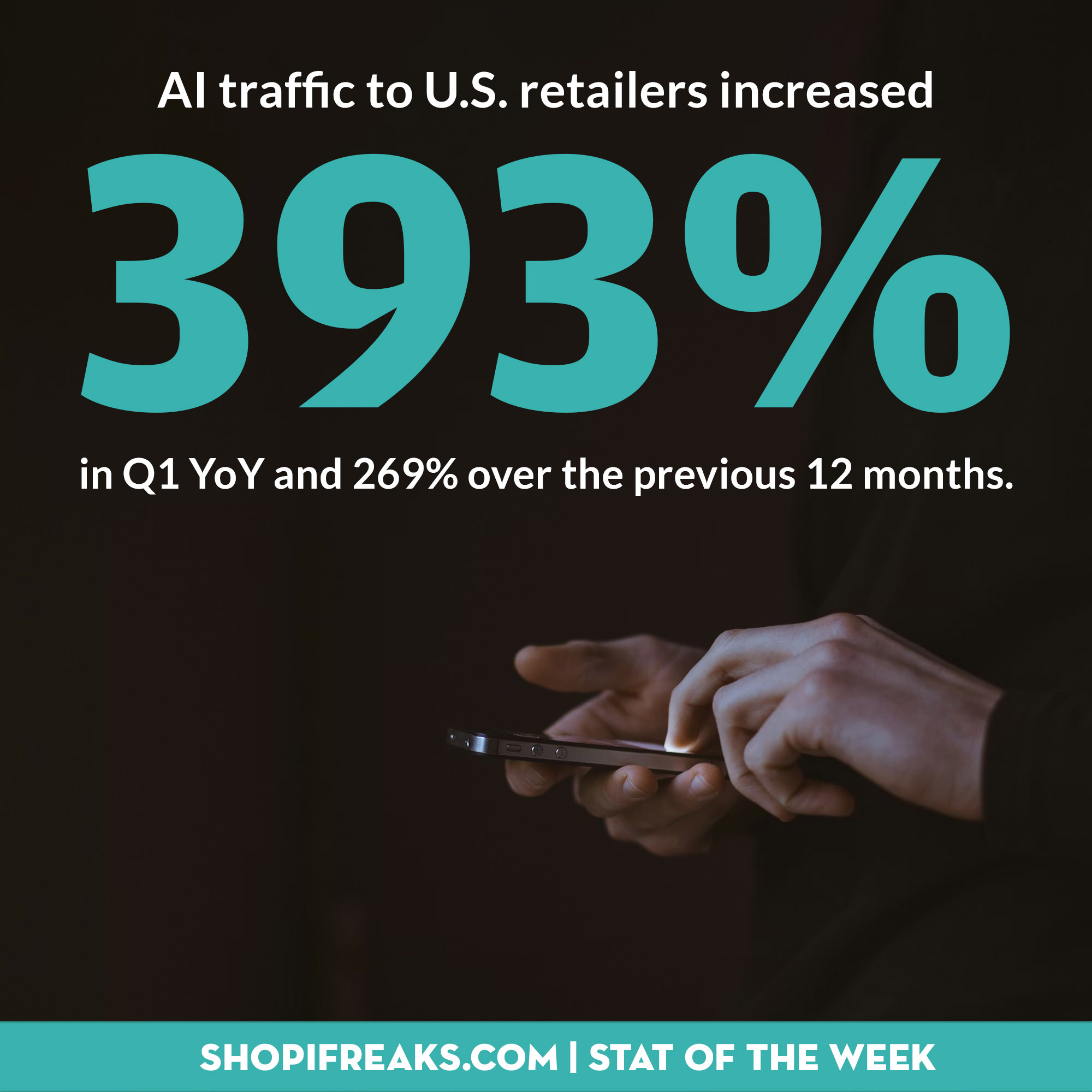
AI traffic to U.S. retailers increased 393% in Q1 year-over-year and 269% over the previous 12 months, according to Adobe data. Visitors who arrive from AI search spend 48% longer on the website, browse 13% more pages per visit, and generate 37% more revenue per visit than those who arrive from other sources.
1. Senator Warren raises concerns about X Money before launch
Senator Elizabeth Warren sent a letter to Elon Musk, raising concerns about the upcoming launch of X Money. Apparently this upcoming digital wallet that no one uses yet could destroy America as we know it. Warren wrote:
“If your track record operating X is any indication of how you’ll operate X Money, consumers, our national security, and the stability of the financial system may be at risk.”
At first, I dismissed her inquiry, solely on the basis that I don’t imagine X Money ever growing large enough to reach the point that it has the influence she describes. However, she does raise some legitimate concerns. Highlights from the letter include:
“The launch comes just one year after you, working with Acting Director Russ Vought, pushed to dismantle the CFPB, the agency responsible for policing financial products like X Money.”
Note: As of April 2026, the CFPB is not technically dismantled, but it exists as a shell of its former self. Musk’s urgency and desire to shutter the bureau certainly raises questions when he’s simultaneously planning the launch of a financial product.
“X Money may partner with Cross River Bank to offer some of the banking products and services. As I’m sure you’re aware, Cross River Bank was subject to a serious enforcement action by the FDIC in 2023 for unsafe and unsound practices related to fair lending. The bank is a repeat offender, as it was subject to a previous FDIC enforcement action in 2018 for unfair and deceptive practices.”
To be fair, are there any U.S. banks left that don’t have dirt on their hands? Cross River Bank may be a “repeat offender,” but they’re all offenders.
“X Money preview materials suggest that users can earn up to 6% APY on deposit accounts. It is unclear what risky investments, intrusive data monetization activities, or gimmicks either X Money or Cross River may intend to engage in to pay that yield when the target Federal Funds Rate is 3.5-3.75%.”
This one struck a chord with me. There are plenty of legitimate investments that could earn that yield. Just because other banks keep the spread for themselves doesn’t mean the vehicles don’t exist. Characterizing the investments as “risky” or “gimmicks” before even learning what they are feels like an attempt to color the narrative before it’s been written.
“Your failure to operate X in a safe and responsible manner does not breed confidence in your ability to safely expand into consumer finance. X has been criticized by policymakers for ‘systemic’ issues related to the circulation of child sexual abuse material (CSAM) on its platform, including CSAM images generated by Grok, X’s artificial intelligence chatbot. Minors have also sued xAI after Grok generated pornographic images of them.”
That’s a completely fair criticism in my opinion. Adding a financial transaction layer to a platform already riddled with CSAM doesn’t feel like a very safe idea. Is Musk about to unintentionally create the world’s largest CSAM marketplace?
As many of you know, Elon Musk was the founder of X.com, one of the Internet’s original payment systems, which later merged with Confinity’s PayPal product and eventually took on the PayPal name. Decades ago, Musk was very much at odds with his partners at PayPal, almost ousted as CEO at one point, and it’s been very well documented since then that he always planned to one day build his original vision of a financial platform. He took a few side quests along the way, building electric vehicles, rocket ships, underground tunnels, chips that connect to your brain, and of course buying a social network, but it’s interesting to see him follow through on his original X Money vision years later.
Could it be a disruptor to the banking industry? Yes, absolutely. Is that necessarily a bad thing? Maybe not, but that’s to be determined.
All I can say today is that there’s a huge spread between what banks take in and what they dish out, and the industry is ripe for disruption. X Money could put some much needed pressure on legacy banks to make their financial products more attractive for your average customer. There isn’t a hard-and-fast rule that says the rest of us should have to settle for 3.5% on our deposits just because that’s the rate banks have decided puts the most money in their own pockets.
2. UPS rolls out RFID package sensing across its entire U.S. network
UPS announced that RFID sensing technology is now installed in all U.S. package delivery vehicles, across its domestic delivery facilities, and in all 5,500+ UPS Store locations, automatically tracking packages throughout their journey without requiring manual scanning at each handoff. The company invested over $100M into the project, which could one day save workers from having to manually scan 18M packages per day, which I’d say is well worth the investment!
UPS wrote in its announcement:
- RFID pickup sensing confirms packages have been picked up and are in UPS’s possession. No other carrier can offer this assurance across its U.S. network.
- Packages are automatically sensed as they move through the network and customers gain greater transparency into where their shipments are and how they are progressing.
- With more and better data, UPS responds faster when conditions change such as weather and other unexpected events.
UPS said that it’s the first major logistics provider to broadly roll out RFID technology across its integrated network — and I had to do some digging, but that’s true.
While major retailers like Walmart and Zara use RFID for inventory management inside their stores, and Amazon uses RFID within its fulfillment centers, no other major U.S. carrier has implemented the technology as a universal standard across its entire package journey — from the moment of pickup to the delivery vehicle and to the final doorstep.
Will RFID be used on all packages moving forward?
Technically it could, as of today, but it’ll be a gradual roll out. Most shippers still don’t have the hardware needed to “print” these RFID chips yet, though UPS is working with high-volume shippers to equip them with it. As for smaller warehouses or home-based businesses, it doesn’t quite make financial sense yet, as the RFID printers can cost a couple grand or more, but the costs will likely continue to go down.
3. Unsealed court documents prove Amazon was aware of its fixed-pricing tactics
Newly unsealed court records have revealed what most Amazon sellers already knew and have been saying for years — Amazon punished sellers if their prices were lower on other websites. The documents include internal e-mails, deposition testimony, and confidential corporate presentations that California Attorney General Rob Bonta obtained as part of a civil case his office launched in 2022 accusing Amazon of large-scale price-fixing.
The Guardian obtained and reviewed the documents, which contain evidence that:
- Amazon removed a seller’s Buy Box access for selling his $19.99 item just one cent lower on Walmart.
- Sellers were forced to raise their product prices on other marketplaces and websites or risk having their sales plummet by 80% on Amazon.
- Sellers were forced to set up Minimum Advertised Prices for their products on other websites or risk having their items suppressed on Amazon.
- Amazon employees have proactively sought to undermine market competition and were aware of the effects of their actions on prices.
For years, Amazon has defended that its pricing policies were part of the company’s “commitment to featuring low prices to earn and maintain customer trust.” However, by simultaneously charging sellers higher fees than other platforms and punishing those sellers when they try to offer lower prices elsewhere (because they have the margin to do so), Amazon has effectively set a price floor across the entire Internet. And that my friends, is an abuse of market power.
The trial in the California attorney general’s lawsuit against Amazon is scheduled to begin on January 19, 2027.
4. OpenAI moves towards a CPC advertising model
OpenAI is beginning to price some ChatGPT ads on a cost-per-click basis instead of a cost-per-impression model, which is how it launched the offering, according to The Information sources.
The source also said that OpenAI plans to introduce ads aimed at getting people to take a specific action like making a purchase or downloading an app, though the company hasn’t put a timeline on when that could happen. Wait, its original ads weren’t designed to get people to take an action? Does OpenAI know what “ads” are?
Since launching ChatGPT ads in early February, OpenAI has only provided early advertisers with general data such as impressions, clicks, and spend, which has made it difficult to tell if the ads are working. Some experts believe that this performance ambiguity is holding many advertisers back from advertising with OpenAI.
To support the shift toward performance-based advertising, Digiday reports that OpenAI is building a conversion tracking pixel that fires a signal back to the ad platform when a user completes an action on an advertiser’s website after seeing an ad. The pixel is already live for select advertisers in the pilot and supports event types including lead created, order created, page viewed, subscription created, and trial started.
The immediate challenge with OpenAI launching a tracking pixel is that the technology is already outdated, as JavaScript pixels are often blocked by privacy-first browsers and ad blockers, which is why every major advertising platform has had to build alternate tracking solutions like server-side tracking. However, at the moment, there’s been no information released on if / how OpenAI plans to tackle server-side tracking.
Honestly, it feels like OpenAI has continually been putting the cart before the horse with its advertising endeavors, collecting checks from partners before it’s had the technology or process in place to best serve them. In general, they seem very lackadaisical with their partnerships — making promises that they don’t deliver on, backpedaling on product releases, and ultimately wasting their partners’ time and money as if they’ve all just had their own $110B funding rounds. The “move fast and break things” model worked in the late 90s and early 2000s, but the industry has matured. Companies expect more from their tech partners, and as of now, OpenAI hasn’t delivered.
5. Amazon Autos now sells Kia, Mazda, Subaru, Chevrolet, and Jeep
Amazon has quietly expanded its Amazon Autos car sales program, which launched in late 2024 starting with Hyundai, to now include Kia, Mazda, Subaru, Chevrolet, and Jeep across more than 130 U.S. cities. The platform lets customers browse inventory from nearby participating dealerships and complete most of their financing paperwork without spending the whole day at a showroom. Technically, due to local and state laws, customers can only purchase cars from dealerships in some regions, and Amazon Autos helps streamline the process between the two parties.
Here’s a brief timeline of Amazon Autos’ major milestones:
- December 2024 – Amazon Autos officially launches with Hyundai as its first brand partner across 48 U.S. cities.
- August 2025 – Amazon partners with Hertz to sell certified pre-owned vehicles across four cities.
- November 2025 – Ford joins Amazon Autos as the first non-Hyundai new brand partner, offering certified pre-owned vehicles in three cities.
- March 2026 – Amazon adds Kia, Subaru, and Mazda to Amazon Autos in select U.S. locations.
- April 2026 – Chevrolet and Jeep are added to the platform, bringing the total new car brands to seven: Hyundai, Ford, Kia, Mazda, Subaru, Chevrolet, and Jeep. The platform is now active in 130+ U.S. cities with hundreds of participating dealers.
- Upcoming – Amazon has confirmed plans to launch Amazon Autos in the U.K., though no specific date has been given.
That’s some impressive growth in just 16 months! My daughter was still wearing diapers at that age.
Why does Amazon care about auto sales?
Ads, baby! Car companies are projected to spend over $30B on ads this year, and Amazon Autos is a way for Amazon to capture some of that market.
I’ve predicted the future of what impact Amazon Autos will have on the auto industry and backed my theories with recent evidence, so I’ll spare you the lecture in today’s edition. Plus, it sounds like my “I told you so” moment is coming sooner than expected anyway. In the meantime, best of luck to all these dealerships. Toys ‘R Us sends their regards.
6. Google releases side-by-side browsing with Chrome and AI Mode
Google rolled out two new features for AI Mode on Chrome desktop including a side-by-side browsing view and the ability to add open tabs, images, or files directly into AI Mode searches. Both features are available now in the U.S. with plans to expand to additional regions.
With side-by-side mode, Google says its goal is to make it easier to explore websites, compare details, and ask follow-up questions without losing the context of your search. For example, if you were searching for a new phone, you can click on a link to open the retailer’s website alongside AI Mode and then ask specific questions like, “Does this have a 3.5mm headphone jack?” AI Mode will then use context from the page and from across the web to answer your questions.
Google wrote in a blog post:
“Our early testers loved that they didn’t have to constantly switch tabs to get help with a comprehensive article or a long video. And they found that having both Search and the web side-by-side helped them stay focused on their tasks while exploring useful web pages.”
Google also revealed a new way to search across open Chrome tabs, letting users tap a new plus menu on the New Tab page to add tabs, images, or files like PDFs directly into their AI Mode searches and mix and match multiple sources for more contextually relevant answers. For example, if you were searching for things to do while visiting Cuenca, Ecuador with kids and found a few activities that look fun, you can add those tabs to your search and ask for similar kid-friendly activities nearby.
So basically now you never have to leave Google and they can show you ads all the time!
Yes, I see the value that side-by-side mode adds for users when researching the web. However, also yes, I recognize the huge incentive for Google to create a web surfing environment where you never actually leave Google — a browsing habit that’s been the bane of its existence since introducing ads to its search results in 2000!
For the past two decades, Google has slowly introduced features such as Rich Snippets, Knowledge Panels, hotel & flight results, and AI Overviews that are designed to keep you on Google longer. Side-by-side mode is essentially the culmination of that trajectory.
As a user, I’ll admit, I love it. As an advocate for an open web, I have concerns.
7. Allbirds rebrands itself as an AI infrastructure company
So as you might have heard… Allbirds, the D2C shoe company that lost 99% of its market value since its 2021 IPO and recently sold its brand and footwear assets to American Exchange Group for $39M, announced that it is changing its name to “NewBird AI” and pivoting its business to AI compute infrastructure, with a long-term vision to become a fully integrated GPU-as-a-Service and AI-native cloud solutions provider.
The company has obtained $50M in financing to fund the new venture, news of which sent the stock soaring over 500% into “meme stock” territory. It has since settled to around $11.40 per share, or about 350% higher than where it started.
There’s been a lot of chatter surrounding this news during the past week, and a lot of it has been hilarious. After all, it is a fairly unexpected pivot that’s easy to poke fun at. My buddy Jarek messaged me on LinkedIn after the news broke, “Can’t wait to read your write up on allbirds 😆 wtf” — which I’m happy to share below.
To summarize my thoughts on the pivot: “Sure, why not?”
I’m a huge fan of pivoting as a business, and have made some successful pivots myself over the years (albeit not as drastic as switching industries altogether). Some of the biggest household names in history have had major pivots themselves:
- Nokia started as a paper mill and rubber boots company, and Samsung began as a noodle and grocery trading company, before both became phone and technology giants.
- YouTube originally launched as a video dating site.
- Instagram started as a check-in app called Burbn before pivoting to photo sharing.
- Twitter began as a podcast directory called Odeo before pivoting to microblogging and later evolving into a CSAM marketplace.
- Wrigley started selling soap and baking powder, gave away gum as a bonus, then pivoted to gum.
- 3M started as a mining company before pivoting to sandpaper and eventually Post-it Notes.
- OpenAI started as a non-profit AI research lab before eventually pivoting into an Anthropic clone. LOL, burn!
The list of companies that have successfully pivoted their businesses into completely different products, oftentimes serving completely different industries, is extensive. Then again, so is the list of companies that have failed…
I strongly believe that having an audience is the most valuable currency a business can have in today’s world, and Allbirds has built one that it can leverage into eyes on its next business venture.
All that said, can Allbirds pull it off? Nah, probably not. They couldn’t even make it in e-commerce. They’re going to get eaten alive in AI infrastructure, especially trying to go at it with just $50M in the bank. Sam Altman eats $50M for breakfast.
8. Salesforce Headless 360 launches so you never have to log in again
Salesforce launched Headless 360, a major platform overhaul that exposes its core capabilities as APIs, MCP tools, and CLI commands so that AI agents can access data and workflows directly, without requiring a human to navigate a UI. The company wrote:
“Two and a half years ago, we made a decision: Rebuild Salesforce for agents. Instead of burying capabilities behind a UI, expose them so the entire platform will be programmable and accessible from anywhere. If your platform requires humans to click through UIs or write code directly to make progress, it is not ready for the Agentic Enterprise.”
Changes to the platform include:
- 60+ new MCP tools and 30+ preconfigured coding skills giving AI agents direct access to Salesforce data, workflows, and business logic
- Agentforce Experience Layer, which lets agents deliver interactive components like approval cards and decision tiles that render natively in Slack, Claude, ChatGPT, Gemini, Teams, and any MCP-compatible client
- Agentforce Vibes 2.0, an AI development partner built natively inside Salesforce with full org awareness, multi-model support including Claude Sonnet and GPT-5, and the ability to understand your business context, not just your code
- Native React support for developers who want full custom UI control built on top of the platform
- Testing Center and Custom Scoring Evals for evaluating agent behavior before launch
- Observability and Session Tracing for monitoring agent behavior after launch
- Agent Fabric for governing multiple agents across vendors under one control plane
- AgentExchange marketplace with 10,000 Salesforce apps, 2,600+ Slack apps, and 1,000+ Agentforce agents
Salesforce is taking a big bet on agentic commerce — but it’s one they’ll likely get right. Later in this edition, I share a story about how Amazon is dealing with a ton of bloated AI-built software and duplicate data, which is becoming a very real problem for companies leveraging AI to build out functionality. Salesforce Headless 360 aims to solve that problem by making its data directly accessible to your agents so that it doesn’t have to be duplicated across dozens of platforms.
9. Other e-commerce news of interest
Meta is projected to surpass Google in global ad revenue for the first time in 2026, expected to generate $243.46B this year compared to Google’s $239.54B, according to Emarketer. If that happens, it would be the first time that Google has lost the top spot, with Meta’s ad revenue growing 24.1% compared to Google’s 11.9%. Will it actually happen? Let’s check back in January next year and see if they were right. Meta says that its AI-powered recommendation systems and Reels have been the primary growth drivers, with Reels having surpassed a $50B annual run rate and Advantage+ on track toward a $60B run rate.
QVC Group, the parent company of QVC and Home Shopping Network, filed for Chapter 11 bankruptcy, entering into a restructuring support agreement to reduce its debt from $6.6B to $1.3B. Good lord… who in their right mind kept lending to QVC?! The company posted an operating loss of $809M in 2024, with sales down more than 30% from their $14B peak in 2020. QVC Group says that it will continue to operate its TV shopping channels and social media presences as normal, with plans to emerge from the restructuring in less than two months, but even if they do, they’re facing an uphill battle after that. Every influencer on the planet has become a mini-QVC, hawking goods on live streams. Although QVC has grown its TikTok presence to over 1M followers, at this point, it’s just another livestreaming account.
WPP, Publicis, and Dentsu agreed to a consent order with the FTC and a handful of U.S. states over allegations that the trio has illegally colluded since 2018 to implement brand safety standards that direct advertisers away from certain media platforms and publishers, leading to a boycott of conservative media platforms. Moving forward, the companies agreed not to coordinate with one another on restricting ad spend based on perceived political viewpoints or shared brand safety standards. The order follows a similar consent order applied to Omnicom as a condition of its $13.5B acquisition of IPG last year. The FTC has scrutinized advertising and media groups heavily since 2024 when a congressional investigation found that members of GARM colluded to withhold ad spend from conservative outlets like Fox, The Daily Wire, and Breitbart, which led to Elon Musk’s X suing the organization’s parent company, eventually leading to GARM shutting down.
Lovable launched Lovable Payments, enabling builders to add native monetization to their apps through integrated Stripe, Paddle, or Shopify connections, with support for subscriptions, one-time payments, and VAT and tax handling across 200+ countries. Paddle serves as merchant of record for those who choose it, handling global tax compliance automatically, while Stripe offers more flexibility for those who want direct payment processing. The launch aims to position Lovable as an idea-to-revenue platform by reducing the time it takes for builders to begin selling their products after creating them on the platform.
Triller, the TikTok alternative that raised over $420M going public in 2024, reported zero revenue from its social media and streaming businesses in 2025, with all of its roughly $22M in revenue coming from a financial services business tied to the Hong Kong firm it merged with. LOL, really? $0.00? You couldn’t sell ONE single ad? Or embed Google Adsense into your platform or something? The company’s app was reportedly unable to load videos as of December, its auditor cited “substantial doubt about the Company’s ability to continue as a going concern,” and Nasdaq delisted the stock in December for failing to file its quarterly and annual reports on time. Triller has provided no explanation in its filing for why its media businesses generated no revenue last year or why its app remains unusable, but we can go ahead and conclude that it’s over for the once-promising TikTok competitor.
eBay is testing AI-generated fashion model images by adding them to seller listings without the seller’s knowledge or approval, with at least one seller discovering an altered image in their listing that distorted sleeve details and changed the collar from their original photo. Liz Morton of Value Added Resource notes that the tests are the latest in a pattern of eBay inserting AI-generated content into listings without seller consent, including AI-generated FAQs in search results, AI description summaries shown on Facebook Marketplace, and AI item detail highlights added to listing pages, none of which sellers can opt out of.
Speaking of unwelcomed AI features… Etsy is developing an unreleased AI Highlights feature that would generate short summaries of item listing details to help listings stand out to shoppers, and is showing some sellers a pop-up asking them to review and rate the accuracy of the summaries for their items. Early testers report the pop-up appears but shows no actual summary content, leaving sellers uncertain about what the feature will look like and raising questions about whether they will be able to correct inaccurate AI-generated details or receive protection from returns and negative feedback when the AI gets things wrong — which it likely will very often.
Amazon opened its first Global Warehousing and Distribution center in Shenzhen, China, an all-in-one logistics hub that handles local storage, customs clearance, cross-border shipping, and inventory transfers for Chinese sellers targeting U.S. customers. The company claims it will cut storage costs by up to 45% compared to holding inventory in U.S. warehouses, which could help it keep up with Chinese rivals who operate a similar model. The move comes as Temu’s share of the global cross-border e-commerce market surged from less than 1% to 24% last year, putting it on par with Amazon according to an International Post Corporation survey. Amazon plans to extend the model to the Yangtze River Delta and expand distribution to Europe and Japan.
World, the company co-founded by Sam Altman known for its iris-scanning orbs, launched a new standalone World ID app and announced new and expanded integrations with companies including Shopify, Zoom, DocuSign, Tinder, Okta, and VanEck. The expanded platform introduces three new capabilities through its AgentKit developer toolkit including Agent Delegation, which lets users authorize an AI agent to act on their behalf with a verified human identity attached, Human in the Loop, which creates a cryptographic proof that a real human approved a specific action without storing any personal data, and Agentic Commerce, which lets merchants verify that a purchase is backed by a unique human to prevent bot-driven fraud on limited inventory drops. Now it just needs to convince the world that submitting their biometrics to a Sam Altman-owned company is a trustworthy proposition.
Uber launched a returns feature through its Uber Eats app that lets customers schedule a driver pickup for items they want to return to a store, with a fee calculated based on the driver’s time and distance, and receive an instant refund for the item as soon as the driver picks it up. The items must have been originally purchased through Uber Eats and have a minimum $20 value to be eligible for returns pickup. The feature builds on Uber’s “Return a Package” option, which launched in 2023 and lets customers send up to five packages to USPS, FedEx, or UPS locations. Initial retailers at launch include Target, Best Buy, Dick’s Sporting Goods, Petco, At Home, and several others, with more to be added over time. Unfortunately for drivers, they are required to go directly from the customer’s home to the store in order to complete the active trip and accept additional gigs. It’d be great if Uber allowed drivers to complete the return within a set timeframe, say 24 hours, so they could fit it in between other rides rather than having to make a dedicated trip to the store.
Google is rolling out two new AI Mode features in the U.S. over the coming weeks, including the ability to have its agentic AI call local stores on your behalf to check whether a specific item is in stock and track prices for individual hotels directly in Search. For example, you can describe what you need, such as, “I’m going to a wedding in two hours and I just sharted in my only pair of dress pants. Which stores near me have a pair of 34×32 ivory white dress pants in stock, and can I get there before the ceremony starts?” Google will then make the calls and send you the details afterwards. (Do any businesses actually pick up calls from Google anymore?) Additionally, you can now track the prices of a specific hotel location and receive e-mail alerts if the price changes during your chosen dates.
eBay buyers in the U.S. will no longer be able to cancel orders after they win an auction, starting May 13th, reversing a several year old policy that allowed buyers to cancel their order up until the seller shipped the item. The company told sellers that all auction sales will be final moving forward and that it will support them in declining any cancellation requests buyers make directly, as well as protect them from negative feedback if they decline a cancellation. Buyers will still be able to reach out directly to sellers and request cancellations, but the sellers will not be obligated to approve them. Good move for sellers, as many buyers were treating bids like an “Is this item still available?” button instead of a contractual obligation to make a purchase.
RedNote, the Chinese social platform that briefly went viral in early 2025 when Americans thought TikTok was going to be banned, is now opening offices in Palo Alto and New York, hiring founding team members, and launching RedShop, a cross border marketplace selling Chinese goods to consumers in the U.S., U.K., Australia, and Canada. RedNote, which was founded in Shanghai in 2013, has grown from a shopping and lifestyle app in China to an “everything app,” with more than 300M monthly active users, and reportedly profited over $3B in 2025, higher than the profits of Pinterest and Snap for comparison. However, it’s got an uphill battle ahead of it in the U.S., as English-language content is currently scarce on the platform and Google search interest for the app has diminished since early last year.
eBay is planning to close its San Francisco office when its lease expires at the end of September and reassign the 198 software engineers, applied researchers, directors, and financial analysts that work there to the company’s San Jose headquarters. The closure follows eBay’s February layoff of roughly 800 employees, including 28 workers at the San Francisco location and 243 in San Jose. The two cities are about 50 miles away from each other so most employees won’t necessarily have to move homes. They just might end up with a longer commute, or a shorter one depending on where they live.
Google is replacing Dynamic Search Ads, automatically created assets, and campaign-level broad match with AI Max for Search, an AI-powered advertising platform that uses landing pages, keywords, and creative assets to understand user intent in real time rather than relying on manual adjustments. Google says campaigns using AI Max’s full suite of features generated an average of 7% more conversions at a similar cost per action compared to legacy settings by combining an advertiser’s existing assets with better signals and advanced controls, proactively tailoring responses to specific queries so they are aligned with the business’s goals. The rollout began last week with voluntary upgrade tools for DSA users, with a second phase in September that will automatically migrate all remaining eligible campaigns, at which point advertisers will no longer be able to create new DSA campaigns.
Amazon’s push for employees to use AI tools internally has resulted in bloated software and data duplication, according to an internal document obtained by Business Insider. The document said that AI “dramatically lowers the barrier to building new tools,” which is “making our tool duplication problem worse. More duplication is being created faster, and less of it is being cleaned up.” The company’s solution — more AI! LOL. The company is exploring ways to use AI to identify and flag the duplicate tools and encourage teams to consolidate them before the overlap becomes too hard to unwind.
More than 50 delivery drivers for Pave it Forward Logistics, an Amazon Delivery Service Partner in Lebanon, Tennessee, were left without pay after the company abruptly closed on March 31 with no advance notice, leaving some workers owed up to $2,000 in wages and PTO. Owner Jerame Stout claims Amazon withheld $600,000 in account receivables that left him without funds to pay workers, which Amazon did not directly address, though it provided a statement saying that DSP owners are independent business owners responsible for their own payroll and has been facilitating connections between the affected drivers and other DSPs in the area. Former workers say Stout has been unresponsive to their requests for payment and plan to sue, which Amazon wants no part of.
Analysts estimate that enterprise clients account for less than 5% to 10% of Shopify’s revenue, with the vast majority of its business still coming from small and medium-sized merchants, though the company doesn’t publicly disclose the breakdown. Analyst Liam Gallagher notes that although Shopify began its push for enterprise clients in 2023, the slow ramp is partly structural, as the sales cycle for large clients takes 12 to 18 months, and enterprise brands tend to adopt Shopify’s tools à la carte rather than migrating their full operations to the platform, which equates to less revenue for Shopify. Honestly, 5-10% isn’t too shabby for a relatively new enterprise offering. My guess is that graph of enterprise clients is about to see a very sharp spike!
A Texas man was sentenced to 23 years in prison and ordered to pay restitution to victims after being found guilty of helping to orchestrate a crypto scam that ultimately defrauded $20M from nearly 1,000 investors. Robert Dunlap served as a trustee of a project that sold the fictional token Meta-1 Coin (unrelated to Meta Platforms), which he claimed was backed by a $1B art collection made up of works by Pablo Picasso and Vincent van Gogh and $44B in gold, and used automated trading bots to artificially inflate the market price and trading volume of the coin. However he never actually distributed the coins and instead used the investor funds to buy a Ferrari and other things for himself. Well, I’m sure it was fun while it lasted.
In lawsuits this week…
- Google is facing up to $218B in mass arbitration claims from advertisers after federal courts ruled it illegally monopolized both the online search and ad tech markets, with the first claims expected to be filed this week. Mass arbitration, where 25 or more claims are pooled together, gives claimants more leverage and a greater likelihood of settlement awards than individual claims, so Google might actually take a big hit on this one.
- Shein and Temu are facing class-action lawsuits accusing them of pocketing “windfall profits” by raising prices up to 377% to offset tariffs that the Supreme Court later struck down as unlawful, with plaintiffs arguing customers are entitled to refunds. The lawsuits are part of a broader wave of similar litigation hitting retailers including Costco, Lululemon, and EssilorLuxottica, after courts ordered Customs and Border Protection to refund $166B in now-invalidated tariff payments.
- Two former Amazon employees filed a proposed class-action lawsuit alleging the company systematically underpaid women by classifying their roles as lower-paying “non-tech” jobs even when they performed identical work to higher-paid male colleagues. The complaint closely mirrors a 2023 class-action filed by three women on Amazon’s Worldwide Communications team that survived a dismissal attempt in 2024 and is still ongoing.
- Amazon is facing a proposed class-action lawsuit alleging that it intentionally made early versions of its Fire TV Stick devices obsolete over time “before the expiration of their useful life.” I have a feeling Amazon is about to face a similar lawsuit for bricking its original Kindles.
- Aptoide, a Lisbon-based alternative mobile app store, filed a lawsuit against Google for allegedly using its market position to suppress third-party app stores on Android, seeking an injunction against the practices and unspecified damages. The lawsuit follows Aptoide’s 2014 EU antitrust complaint against Google and comes shortly after Google resolved its separate dispute with Epic Games last month by reducing Play Store commission rates to 20% and announcing plans to support sideloading of third-party app stores.
- Amazon filed a lawsuit against a Telegram-based group called RBK for orchestrating a refund fraud scheme that stole over $4M in products including graphics cards, laptops, and drones by submitting fake police reports about missing packages to trick Amazon customer service into issuing refunds. RBK charged customers up to 30% of the refund value for its services and had over 1,000 Telegram subscribers potentially involved in the scheme.
- Google, Meta and Apple are urging a federal appellate court to throw out claims that they facilitated online gambling by processing in-app payments for virtual casino currency, arguing Section 230 shields them from liability. A district court judge ruled last year that payment processing falls outside Section 230’s protections as a “generic business activity” rather than a publishing act, which the platforms are now asking the 9th Circuit to reverse.
In layoffs this week…
- eBay laid off the remaining team members from KnownOrigin, an NFT marketplace it acquired in June 2022 for a reported $68M and subsequently shut down by the end of 2024, alongside other Web3 staff in its Manchester office. Wow! Who could’ve guessed that the entire NFT market would quickly collapse?
In corporate shakeups this week…
- Route, a post-purchase platform offering package protection, order tracking, and returns management for e-commerce brands, appointed Arman Panjwani as CFO and Alexandria Orr as VP of Enterprise Revenue. Panjwani previously served as Chief Strategy and Financial Officer at LawnStarter, while Orr comes from enterprise sales roles at Shopify and Salesforce.
- Google hired Khartoon Weiss, who most recently served as VP and GM of Global Business Solutions at TikTok, to serve as its VP of U.S. Mid-Market Sales, Commerce to oversee the company’s mid-market advertising clients in retail and e-commerce.
- Google also hired Pete Metcalfe, former chief marketing officer of THG Beauty, as director of retail for the UK and Ireland.
- OpenAI hired Tom Duff Gordon, who spent nearly four years as Coinbase’s VP of international policy, to lead its policy operations across Europe, the Middle East, and Africa.
- Anthropic appointed Vas Narasimhan, CEO of Swiss pharmaceutical company Novartis, to its board of directors, as it expands its enterprise push into healthcare.
- Anthropic’s Chief Product Officer, Mike Krieger, resigned from Figma’s board after reports that Anthropic would be launching a design tool, which it did.
- Meta’s director of engineering in trust and safety at its London office, Patrik Torstensson, left after nearly four years to join Lovable as head of engineering, telling Business Insider he felt like “more of a passenger than a driver” at Meta.
- Meta poached its fifth founding member from Mira Murati’s Thinking Machines Lab, hiring Joshua Gross, the engineer who built the company’s flagship product Tinker from scratch, to lead engineering teams at Meta Superintelligence Labs.
- OpenAI’s head of Sora, Bill Peebles, is leaving the company after OpenAI wound down the video generation tool last month, with VP of AI for Science Kevin Weil also departing and his Prism scientific workspace being folded into the Codex desktop app.
TikTok Shop appears to be gearing up for expansion into Poland, the Netherlands, Belgium, and Nordic countries, based on job listings for its strategic readiness team that specifically reference those markets, as well as customer solutions manager roles requiring fluency in Dutch or Polish. TikTok has already created references to seller account pages for those regions, though they are not yet live. The expansion would extend TikTok Shop’s European footprint beyond its current six markets, which includes the UK, Spain, Ireland, France, Italy, and Germany, where TikTok Shop captured 15% of consumers within a year of launch in the country.
The European Commission is threatening to force Meta to stop using WhatsApp policies that allegedly block competing AI companies from offering their services through the platform. Regulators believe that Meta is using its control over the messaging platform to give its own AI an unfair advantage by making it harder for rivals like OpenAI to reach businesses through the app. Meta’s defense is that the EU is trying to let big tech companies use WhatsApp Business for free, which would shift the cost onto the small businesses already paying for it, but that’s extremely misleading. The Commission is merely asking Meta to revert back to its previous terms, which treated competing AI companies like any other business client and charged them the same rate, not give them free access that would shift the cost to small businesses.
Bangladesh, which imports nearly 95% of its petroleum, has been experiencing severe fuel shortages since early March when the U.S.-Iran war disrupted oil tanker shipments, forcing the country’s ride-hailing drivers to spend hours in line waiting to fill their gas tanks. The gas station queues have resulted in drivers spending hours of their work day waiting for gas, cutting their income nearly in half. Platforms like Uber and Pathao have maintained the same commission rates and fares throughout the crisis, leaving drivers to absorb the full financial impact of time lost waiting in line and reduced trip volumes. To help ease the pain, Bangladesh’s government launched a QR code-based Fuel Pass rationing system at seven stations in Dhaka, but drivers say the registration website is frequently inaccessible due to server problems.
India’s government decided not to move forward with a proposal to require Apple, Samsung, Google, and other phone makers to preinstall the country’s biometric identification app, Aadhaar, on phones. Aadhaar is a 12-digit biometric ID tied to fingerprints and iris scans held by nearly 1.34 billion Indian residents and used widely for banking, telecom, and airport verification, but has faced criticism from privacy advocates over past data leaks. India’s IT ministry reviewed the proposal and said it “is not in favour of mandating the pre-installation of the Aadhaar App on smartphones,” but gave no reason for the decision.
Hokodo, a European B2B buy now pay later platform that served more than 100,000 business buyers across 10 countries, has ceased operations after more than eight years in business during which it facilitated more than €500M in financed invoices, and just one year after raising €10M. The company’s founders attributed the shutdown to scaling before the business had truly earned it, taking too long to narrow focus, and building too much product complexity. Co-founders Louis Carbonnier, Richard Thornton, and Sami Ben Hatit have moved on from the business and announced the launch of Liquidity Labs, a consulting firm helping B2B companies modernize their trade credit and cash flow operations using AI. Wait, were you guys busy launching a new business instead of saving your existing one?
🏆 This week’s most ridiculous story… A worker died at Amazon’s distribution center in Troutdale, Oregon on April 6th, and managers instructed employees to turn away from the scene and keep working. While a coworker attempted to perform CPR on the lifeless man, one supervisor told staff to “just turn around and not look, let’s get back to work.” Supervisors reportedly kept the information that someone had died from most employees for several hours, and then eventually sent them home at the end of a 3:45pm break with no explanation and without a full shift’s pay. Amazon was quick to provide a statement attributing the worker’s death to a pre-existing medical condition. Does working under extreme conditions in an Amazon distribution center count as “pre-existing” in this scenario?
10. Seed rounds, IPOs, & acquisitions
AppDirect, a B2B subscription commerce platform, acquired PartnerStack, a partner relationship management platform with a network of more than 138,000 affiliates, channel partners, and co-sell partners, for an undisclosed amount. The deal positions the combined company as a full-stack platform for B2B distribution across direct sales, partner-led growth, and marketplace channels, and follows AppDirect’s recent acquisition of Tackle.io, a cloud go-to-market platform. PartnerStack CEO Bryn Jones framed the combination as particularly relevant to AI search visibility, arguing that third-party content from partner networks is a primary driver of how companies appear in AI platforms like ChatGPT and Gemini.
Neato, a Las Vegas-based 2P e-commerce operator that partners with consumer brands as their exclusive online retailer by purchasing inventory directly and managing listings, advertising, logistics, and brand protection end-to-end, raised $25M in a round led by Advantage Capital. The company will use the funds to build two new operations centers in Las Vegas and Chicago, grow its AI agent stack, and expand beyond Amazon into additional online marketplaces. Neato primarily serves upper-middle-market CPG brands across pet, hard goods, grocery, beauty, and personal care, positioning itself as an alternative to traditional agencies or in-house teams for brands looking to scale on Amazon.
OpenAI acquired Hiro Finance, a two-year-old AI-powered personal finance startup that helped users model financial decisions based on salary, debts, and monthly costs, for an undisclosed amount. The company will shut down its app and cease operations on April 20, as its founder Ethan Bloch and his team of roughly 10 employees join OpenAI. Hiro, which was specifically trained to excel at financial math and included a feature that let users verify the accuracy of its calculations, launched its tools just five months before the acquisition, making it one of the shortest runways from launch to exit in recent AI startup history.
Bluefish, an enterprise marketing platform that helps brands track and influence how AI platforms present their products, raised $43M in a Series B round co-led by Threshold Ventures and NEA, bringing its total amount raised to $68M. The company claims that 10% of Fortune 500 companies across financial services, pharmaceuticals, and consumer goods are already using its platform and plans to use the funds to accelerate the rollout of its Agentic Marketing Platform to enterprise companies.
Instacart acquired Instaleap, a global grocery fulfillment and enablement platform operating in nearly 30 countries across Europe, Latin America, and the Middle East, for an undisclosed amount. The acquisition aims to help Instacart accelerate its international push, as Instaleap already has relationships with nearly 100 grocery retailers and marketplaces outside of North America. Instaleap will initially operate as a wholly-owned subsidiary while Instacart plans to expand its enterprise offerings to Instaleap’s retail partners over time, including its Storefront Pro commerce platform, Caper Cart smart carts, and Carrot Ads retail media tools.
Recursive Superintelligence, a London-based startup founded by former Google DeepMind, Salesforce, and OpenAI researchers that is developing AI that can continuously improve itself without human intervention, raised at least $500M in a round led by GV at a $4B valuation. The round was so oversubscribed that the company could raise as much as $1B in total before it ends. Recursive has not yet officially announced its existence, but a UK filing shows that it was incorporated at the end of last year. It’s amazing that a company with no product and no revenue could be worth $4B just because of who started it.
PayTabs Group, a Saudi Arabia-based payment orchestration company serving the MENA region, acquired TAPn’GO, a UAE contactless payment platform that enables smartphone-based checkout, for an undisclosed amount. Following the acquisition, TAPn’GO will be integrated into PayTabs’ Super App, giving merchants across retail, hospitality, healthcare, and entertainment a unified in-store and digital payment experience.
Solidroad, an AI platform that reviews 100% of a company’s customer interactions to automate quality assurance and generate personalized agent training simulations, raised $25M in a Series A round led by Hedosophia. The company’s platform, which is used by Ryanair, ŌURA, and Crypto.com, aims to reduce manual review hours and drive higher customer satisfaction through continuous, data-driven coaching. Solidroad will use the new funds to expand its teams across its Dublin and San Francisco offices.
GobbleCube, an AI platform that helps consumer brands manage digital commerce operations like demand forecasting, pricing, supply chain, and performance tracking across multiple marketplaces, raised $15M in a Series A led by Susquehanna Venture Capital. The company, which was founded in 2022 and currently serves more than 400 brands in India, MENA, and LATAM, plans to use the funds for product development, hiring, and global expansion, competing on a global scale with retail intelligence platforms including CommerceIQ, Profitero, and NielsenIQ.
Amazon entered into a definitive agreement to acquire Globalstar, a low-earth-orbit satellite company that provides Internet and radio communications services to consumers, enterprises, and governments, for $11.57B. The acquisition gives Amazon Leo access to Globalstar’s spectrum licenses, direct-to-device satellite infrastructure, and its existing partnership with Apple, which relies on Globalstar to power Emergency SOS and other off-grid communication features on iPhones and Apple Watches, and positions Amazon Leo as a more credible competitor to SpaceX’s Starlink, which already serves more than 9M users globally. The deal could also eventually allow Amazon to extend satellite connectivity to its own ecosystem of devices and services, including Kindle, Echo, and Ring products, as well as its AWS cloud infrastructure, giving enterprise customers a way to push satellite data directly into storage, AI tools, and analytics.
Backcountry, an outdoor specialty retailer operating online and across nine U.S. retail locations, acquired Coalatree, eco-focused outdoor apparel brand known for community-driven product development and sustainability-focused clothing, for an undisclosed amount. The acquisition is the first brand added to Backcountry Garage, the retailer’s newly launched incubator platform designed to help early-stage outdoor brands scale through resources, expertise, and distribution. Coalatree will continue selling through its own direct-to-consumer site while select items, including its fan-favorite Trailhead Pants, will now also be available on Backcountry.com.
Mudflap, a fintech that provides fuel discount solutions to carriers via a location-aware mobile app and fuel card, acquired Parade, a capacity management and carrier relationship platform, for an undisclosed amount. The deal gives Parade’s broker customers direct access to Mudflap’s network of more than 515,000 drivers across over 100,000 verified carriers and a platform that has facilitated more than $40B in cumulative freight transactions.
Thanks for being a Shopifreak!
If you found this newsletter valuable, please leave a review on Google and share the newsletter with your friends and colleagues to help us grow.
See you next Monday,
PAUL
Paul E. Drecksler
🌐 Shopifreaks.com
🧑💼 Add me on LinkedIn
📧 [email protected]
📱 +1-828-273-3031
⭐ Leave A Review
PS: How do you make gold soup? You use 24 carrots.