

Hi Shopifreaks
Today I’m celebrating my 300th consecutive weekly edition of Shopifreaks! Since starting this newsletter in January 2021, neither travel, nor Ecuador’s rolling blackouts, nor even the birth of my daughter has kept me from publishing a single edition. (Though thankfully she was born on a Wednesday, not a Monday. LOL)
To celebrate the milestone, I’m giving away $300 worth of t-shirts from my new product line, Shopifreaks Tees, a humorous collection of slogan t-shirts for e-commerce nerds. The fun part? I’m not going to show you the shirt design before I send it. Just take my word for it that you’ll love the tees.
Want a free Shopifreaks Tee? Reply to this e-mail with your Style (Men/Unisex or Women’s cut) and your Size (XS through 3XL) for a chance to win.
I’ll randomly select winners between now and next Monday and will e-mail you for your shipping address if you win.
My sincerest thank you for your readership of this newsletter for the past 300 editions (or for however long you’ve been a reader). If you love Shopifreaks, please leave a review on Google to help the newsletter continue to grow.
In this week’s edition I cover:
- Google’s Universal Cart goes live in the US
- Shopify welcomes any and all AI agents
- Amazon launches two Bee listening devices
- ChatGPT dropped its UTM tags for a hot minute
- Etsy tests capping shipping rates
- OnlyFans creators are jealous of Muse
- India delayed its new UPI fees
- Meta wants to keep your ad clicks in-app
- AI development is keeping interest rates high
- Square launched a self-ordering kiosk
- Careful with Facebook’s little-known ad option
- Plus, people are “Zucking Off”?
All this and more in this week’s 300th Edition of Shopifreaks. Thanks for subscribing and sharing!
Stat of the Week
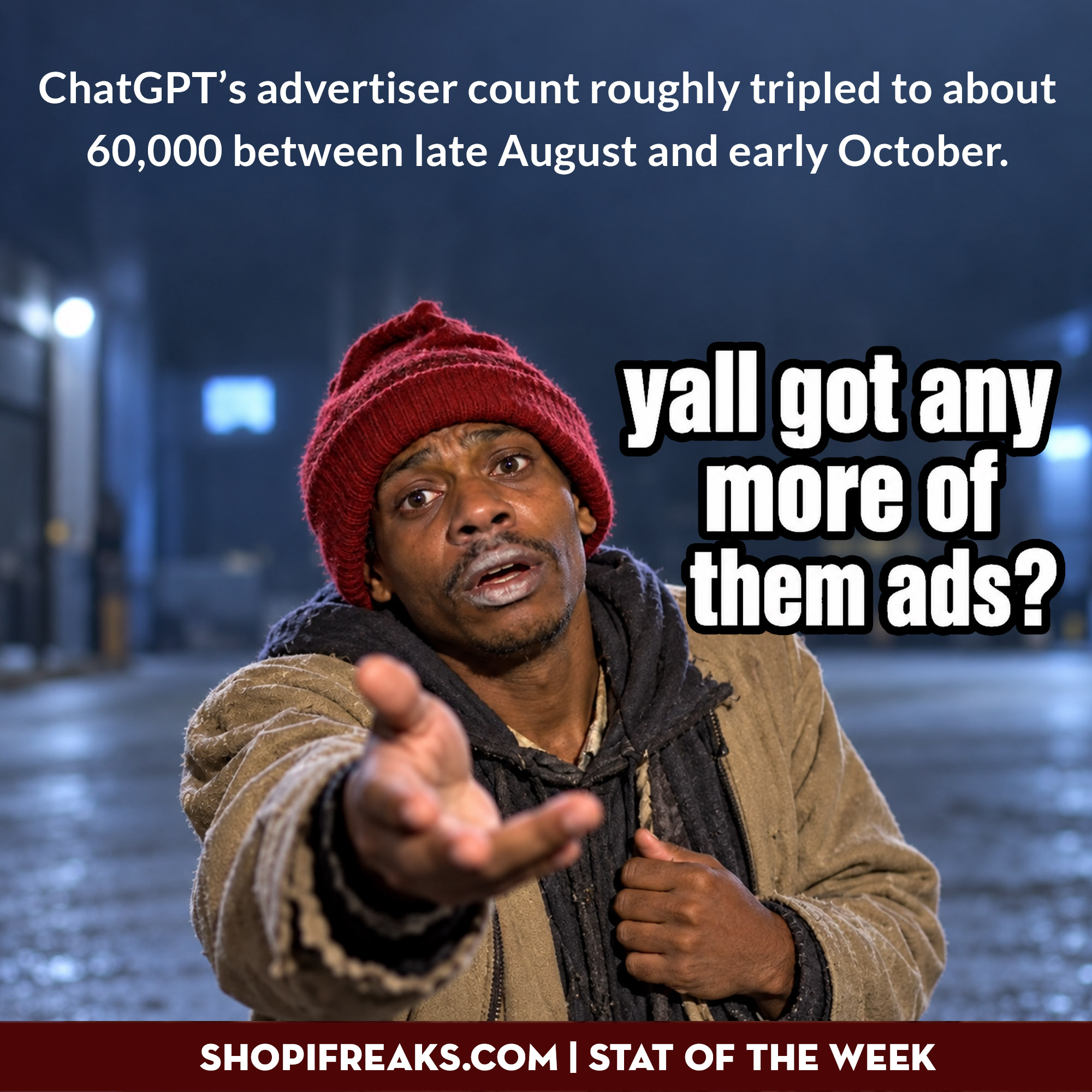
ChatGPT’s advertiser count roughly tripled to about 60,000 between late August and early October, according to New Street Research. The growth came after OpenAI cut ad prices and hired close to half of its roughly 140 ad employees in the third quarter, more of them from Meta than from anywhere else.
1. Google launches Universal Cart, a single cart for products from multiple retailers
Google launched Universal Cart in the US across AI Mode in Search and the Gemini app, a single cart that holds products from multiple retailers and lets shoppers check out over Universal Commerce Protocol.
Quick Backstory: Google and Shopify launched the Universal Commerce Protocol in January as an open standard for letting AI agents check out on websites, developed with partners including Etsy, Wayfair, Target, and Walmart. It seemed promising at the time, but initially lacked several key features, such as multi-item carts, live product details like inventory and pricing, and account linking for loyalty perks, so agents could only check out one item at a time as an anonymous shopper. Google added some of those features in March, but carts were still limited to a single store. Google then previewed Universal Cart at its I/O conference in May, which promised to solve that issue. It was supposed to launch this summer, but it only launched last week.
Here’s what we know about Universal Cart so far:
- It syncs across Google products, so items saved in AI Mode or the Gemini app stay in the same cart, with YouTube and Gmail versions coming later.
- Major retailers and platforms are on board, including Walmart, Target, Nike, Sephora, Ulta Beauty, Wayfair, and many Shopify merchants.
- The cart can track prices and inventory and sends alerts when a saved item drops in price or comes back in stock.
- The cart can find promo codes and show them right in the cart. (There goes your e-mail funnel.)
- It’s built on Google Wallet, so it knows a shopper’s card perks and can suggest which payment method is best.
- At some stores, shoppers pay with Google Pay inside the cart. At others, the items transfer to the merchant’s own cart to finish on its site.
- Merchants stay the seller of record and handle order confirmations and customer support.
Honestly, I don’t like it.
Universal Cart is good for Google, but not for merchants. What about our e-mail captures, upsells and cross-sells, and well-crafted PDPs that share the story of our products with videos, educational content (outside of the main product description), and UGC? What about our ability to create a shopping experience far beyond the sterile, all-white user interface that Google’s AI delivers?
I didn’t ask for every discovery channel to become its own marketplace, and neither did you. We were sold on AI agents shopping on our websites on behalf of customers. What we got was a redesigned discovery layer that keeps shoppers away from our own storefronts — our online presence reduced to product data that powers a listing we have no control over.
What happened decades ago to brick-and-mortar retail is now happening again to e-commerce. In the old days, merchants would open a physical storefront on Main Street to sell their wares. Then department stores and mega retailers took over, and the best that merchants could hope for was space on someone else’s shelf. (If they paid the endcap fee in many cases.) D2C e-commerce is experiencing a similar phenomenon, and if these AI firms have it their way, no one will visit your storefront and the best you’ll be able to hope for is space on their digital shelf.
Google used to give directions. Now it’s built a dome around the city and has declared itself the destination. And Shopify doesn’t care, as long as it keeps getting a slice of the payments. What happened to arming the rebels?
It’s not all doom and gloom though. I love this industry and am excited about the new opportunities that AI legitimately brings to merchants. However, I fear that the big search and AI players (which are effectively the same thing now) are beginning to build a moat around our storefronts and will eventually start charging for space to put up a sign big enough for customers to read from across the water. Universal Cart is a novelty today, but once it becomes the de facto way that shoppers engage with products when searching on Google, it’ll very quickly become pay-to-play to get discovered.
What are your thoughts on Universal Cart? Hit reply and let me know.
2. Shopify lets any AI agent shop its catalog and check out with Shop Pay
Shopify launched a new skill that lets any AI agent act as a personal shopper tied to the buyer’s Shop account, so agents no longer need a direct partnership like the one Shopify struck with Meta’s Muse in September.
Once a shopper signs in, the agent can search more than a billion products in Shopify Catalog, read past orders to learn sizes and tastes, and check out with Shop Pay inside the chat. Shoppers can set their own rules and criteria, such as a max budget or how fast they need the item delivered, but they still have to approve each purchase before it happens by default.
Agents can also use Shop Pay to buy from stores that don’t run on Shopify. In those cases, the shopper approves the store, the purchase, a saved card, and a spending limit inside Shop, and Shop Pay issues a single-use card that only works for that checkout. It’s a smart safeguard, and it also shows how Shopify is positioning Shop Pay to be the default wallet for all agentic commerce, not just for Shopify stores. (Sorry, PayPal.)
The big thing: Agents don’t have to register or partner with Shopify to gain access to the skill and only have to identify themselves with a profile URL on each request. That’s more fair by nature, since no one wants more gatekeepers deciding which agents get to shop and which don’t, but unfettered access also means Shopify is opening the door to every agent out there, including poorly built ones that buy the wrong size, and malicious ones that try to game the system.
Shopify also opened the Shop MCP behind the skill to developers through shop.dev, giving them one API for catalog search, Shop sign-in, Shop Pay checkout, and order tracking, with orders going straight into the merchant’s admin.
Shopify and Amazon are taking wildly opposite approaches to third-party agentic commerce.
Amazon is busy playing whack-a-mole with every AI agent that tries to shop on its platform, while Shopify is across the street with one of those wacky waving inflatable arm flailing tubemen inviting them in the front door.
Not only is Shopify welcoming agents, it’s also laying the groundwork for them to make money, like digital influencers. Through a program called Promoted Placements, currently in an invite-only preview, developers can show promoted products in their agent’s search results and earn a commission when shoppers buy them. Shopify is paying a 0.3% base commission for now, which comes out of its payment processing fee (ie: not paid by the merchant), but merchants will eventually be able to add their own commission on top.
We’re definitely moving towards a pay-to-play scenario with agentic commerce, and Shopify is leading the way.
3. Amazon launches two Bee wearables that turn your conversations into summaries
Amazon launched two AI devices from Bee, the wearable startup it acquired in 2025, that listen to conversations and turn them into summaries, to do lists, and reminders.
Bee Frontier is a personal AI device that you can wear on your wrist or clip to your clothes. It’s water-resistant, can last up to seven days on a single charge, and is designed to stay with you and record conversations throughout the entire week “so it can take note of what matters and ignore what doesn’t, even in noisy environments like a crowded restaurant or open office.” Frontier is available now for $74.99.
Bee Eclipse is a slim device about the size of a credit card that attaches to the back of your phone magnetically. It lasts more than 21 days on a single charge, and effectively serves the same function as Frontier, but in a more streamlined package, connected to your phone, which you already take everywhere, including the toilet. (Yeah, I hear you scrolling TikTok in the stall next to me. Well, at least when I pause my TikTok long enough to hear yours.) Eclipse will be available soon for $99.99.
Basic summaries, recaps, and 14-day memory come free on either device, but the $11.99 monthly Bee Pro plan is needed to unlock unlimited conversation memory and to connect Bee to Alexa+ and Amazon.com, which uses Bee’s data to recommend products on its homepage. (Of course it does. LOL.) Amazon says audio is deleted once it’s processed and that each transcript is locked with an encryption key controlled by the owner’s device.
Remember Humane? The wearable pin company that launched with $240M in funding and an incredible amount of fanfare, and then sold itself to HP for parts less than a year after the pin started shipping? The founders must be spinning in their graves right now with all these new wearables to hit the market. Humane was ahead of its time and lacked the backing of a powerful enough audio-focused LLM to get the job done that it promised.
What about privacy? No, not your privacy. You’ve obviously already given that up just by having a Bee device. I’m talking about everyone else’s privacy. People are already raising red flags.
Jeff Williams, a former AWS senior principal security engineer who’s now CISO at Sigma360, wrote on LinkedIn that Bee asks the wrong person for consent, since the only consent prompt appears on the wearer’s phone, while the people being recorded have no way to say no. About a dozen US states, including California and Washington, generally require everyone in a private conversation to consent before it’s recorded. Williams says Bee should omit other people’s voices from the transcripts by default, unless they’ve enrolled their voices and agreed to be recorded, which is a pretty good idea, but not likely to happen.
Remember when people used to theorize that their phones were listening to their conversations so that Big Tech could serve more personalized ads? Everyone has at least one story from when they were talking about something they’d never searched for, and then suddenly they were being served ads about it.
Well now, between Alexa devices, Bee wearables, Meta smart glasses, and other always-listening devices, we’re simply handing Big Tech the conversations on a silver platter. I look forward to the stories about ads for divorce lawyers or baby clothes popping up in someone’s feed after a private conversation with their friend, because that’s coming.
4. ChatGPT stopped adding UTM parameters to outgoing links for a little while
ChatGPT stopped adding a utm_source tag and referrer data to its links after OpenAI released GPT-6, causing visits it sent to be counted as direct traffic in Google Analytics and similar tools, starting around October 8.
Adobe’s Cedric Huesler tracked about 500 pages that got at least 5% of their visits from ChatGPT and found that ChatGPT traffic fell by about 31,000 visits a day in the week after the launch while direct traffic rose by about 26,000 on the same pages, almost a one-to-one exchange. (I said almost.) SEO researcher Tomek Rudzki found that ChatGPT was also including direct website links far more often after GPT-6, and that 54% of them went to a homepage instead of the specific page with the answer.
The issue led to insane conspiracy theories across the web.
For example, one lunatic predicted on LinkedIn that the reason OpenAI began stripping UTM parameters is because it’s about to launch an analytics platform that forces website owners to register with them in order to get accurate analytics. It’s the same play Google ran a decade ago — strip the keyword data out of referrals, then hand it back through Search Console in exchange for verifying your site. (Okay, that lunatic was me.)
It turns out, the issue was a bug, or so OpenAI says. By October 15, they started rolling out a fix in stages, and by mid-morning, Huesler reported that ChatGPT clicks were back to roughly 95-100% of where they were at the same hour a week earlier.
Was it actually a bug though? Or was it a test?
I’m not yet convinced either way. On one hand, why would OpenAI want to make it difficult for website owners to track how many visits ChatGPT sends them? If anything, they’d want to inflate that number, not obscure it.
On the other hand, forcing website owners to register for its (currently fictitious) analytics platform to track those clicks would offer a more accurate way to deliver the data, as it’d be coming from ChatGPT itself instead of having to be tracked by third-party platforms via an imperfect attribution mechanism. I’d imagine that even before the “bug,” some of that Direct traffic was coming from ChatGPT, and it wasn’t getting credit for the referral.
So, new theory unlocked: It wasn’t a bug. It was a test. OpenAnalytics coming soon.
5. Etsy tests capping shipping rates and covering the difference on some US orders
Etsy is running a randomized test that caps shipping charges on some qualifying US orders that use calculated shipping, with Etsy paying the difference so that sellers still receive their full rate.
For example, on a $10 calculated rate with a $7.99 cap, the buyer pays $7.99 and Etsy pays the remaining $2.01, which appears in Order Details as “Etsy-funded shipping.” Etsy hasn’t said whether $7.99 is the actual cap it’s testing or if it’s just a number for the example it provided in the announcement, or whether its fees on shipping revenue apply to the full rate or the lower amount buyers pay.
Either way, Etsy won’t stop trying to subsidize shipping.
In August 2024, the company began covering shipping up to $20 per eligible item as part of its Etsy Insider membership. At the time, I criticized them heavily for the move:
“Are they aware that Amazon effectively loses money by offering free shipping with its Prime Membership? And we’re talking about Amazon here — meaning they do things to scale like no other. Plus they run their own warehouses and fulfillment network. Are we about to see brightly colored Etsy trucks delivering to neighborhoods nationwide this year? Of course not!”
I predicted that the shipping subsidization would be a “money pit” — which turned out to be exactly what it was. About a year later, Etsy cut the perk to $6 after current CEO Kruti Patel Goyal, then its chief growth officer, said the original version “didn’t provide scalable economics.” A calculator and a spreadsheet could’ve told them that!
Etsy can’t seem to figure out that they’re not Amazon and don’t own a fulfillment network. Go partner with Stord if you want to give sellers an Amazon-style fulfillment option. Quit trying to recreate it on your own by subsidizing shipping.
6. OnlyFans creators ask why Meta’s Muse can sext, but humans can’t post sexual content
OnlyFans creators are asking why Meta lets its Muse AI agent sext with adult users while it keeps restricting their own Instagram accounts, according to Wired. (And yes, in case you’re out of the loop, Meta confirmed that it does in fact allow the behavior.)
A New York creator who goes by the name Vanniall, whose Instagram account has more than 100,000 followers and is currently restricted, told Wired:
“It’s not fair that they get to pull money out of people with their sexually active AI agent, but they won’t let real people, real adults, engage in any sort of sensuality or sexuality.”
Though to be fair, I can only imagine that Vanniall tries to show off more than just her “sensuality” or “sexuality” in her Instagram posts. Shane Gillis would have a field day…
Adult film performer Tony Genius said he has gone through seven Instagram accounts in five years, and that navigating Meta’s platforms is frustrating but critical to staying visible online.
These, um, creators, bring up a fair question: Why does Meta’s AI get to offer sexually explicit content on its platforms, while human creators don’t?
And Meta has a fair answer: Muse runs on a private virtual machine that only the user can reach, and users are explicitly asking for the content when they prompt it. In other words, it’s not displaying pound cakes unless a user asks for recipes, unlike content posted to a feed, which can unwittingly show up through recommendations.
Then again, it seems like an easy thing to tag and exclude from recommendations and/or offer behind an NSFW tab, instead of the main feed. Meta has the tools to responsibly serve sexual content to its users through Instagram and Facebook. It just chooses not to. And to be clear, I’m not saying that it should have to. There’s a time and a place for that type of content, and Meta has no responsibility to bring it to its social feeds, but that doesn’t preclude the company from offering it through its other products.
All I know is that whenever I jerk off to Muse sexting, I like to imagine that Mark Zuckerberg is personally in his office writing replies to me. It’s a role-playing sexual kink I like to call “Zucking Off”.
What are your thoughts? Should Muse and other AI chatbots engage in sexually explicit conversations with users? How many have you engaged in? Hit reply and let me know.
7. India delays its new UPI fees until after Diwali
The National Payments Corporation of India, which runs the country’s UPI payments network, postponed the start of a 0.4% merchant fee on payments above ₹2,000 (about $21) and said that the fee will instead now begin after Diwali out of respect for the holiday shopping rush. The delay came after retailers and petrol pump operators pushed back on the fee, with some threatening to stop accepting UPI payments altogether if it took effect.
NPCI posted on X:
“UPI and Services Steering Committee today decided that, keeping in mind the festive season, Merchant Discount Rate (MDR) on select Person-to-Merchant (P2M) UPI transactions, shall be implemented immediately post Diwali at a date to be notified separately.”
In September, I reported that India planned to end the free processing that UPI has offered since 2020. NPCI said that the network costs about ₹200B ($2.1B) a year to operate and that the new fees will fund infrastructure, security, and fraud prevention.
At the time I wrote:
I thought the whole point of UPI now was to offer “free” payment processing?
Did they not know how much it costs to operate a payment network before making the “free” mandate in 2019? It feels bait-and-switch and borderline anticompetitive to disrupt the entire economy on the promise of “free” and then pull the rug out from under merchants. Plus, starting to charge a fee, no matter the amount or threshold, is a slippery slope that causes merchants to lose confidence in the future of the network. Today, a ₹2,000 purchase carries a fee. Tomorrow, what else?
In my opinion, India just killed the credibility of UPI with this move and should’ve found a different way to continue subsidizing the operational costs of the project, which was originally designed to benefit all consumers and merchants.
I also questioned whether the major payment companies lobbied for the change, as they have the most to gain, and expressed my disappointment over the new fees. I do understand that there’s a cost to absorb with payment processing, but the greater economic impact of having a free way to transmit money digitally more than outweighs it.
Frankly, every country needs to offer a government-subsidized way to move money digitally, especially since many are pushing their citizens towards cashless societies. Economies aren’t stimulated when money sits still.
8. Meta to send ad clicks to in-app product pages by default starting October 28
Meta will be switching on product browsing in Facebook and Instagram ads on October 28, unless advertisers opt out before then, according to a notification sent to businesses. When the feature is enabled, tapping an ad will open a full-screen catalog page inside the app that shows the brand’s products, prices, and descriptions, and shoppers will have to tap another button to visit the brand’s website.
The feature has been available as an optional setting that could be turned on manually, but moving forward, advertisers will be auto-opted-in and have to manually opt out via a per-ad toggle in Advantage+ Creative and Destination settings.
Wait, so now Meta wants me to pay them to NOT drive the first click to my website?
Meta says a test with roughly 117,700 advertisers in August raised conversions 3% on average, but is that number based on total ad clicks or just how many users eventually landed on the advertiser’s website, which has higher intent anyway? Meta didn’t say.
Either way, it’s an obvious first step that will soon be followed by adding a “Buy Now” or “Add to Cart” button to the catalog page, as platforms simultaneously shove their agentic commerce features down our throats and up our butts. It’s an easy call to make, given that Meta already offered in-app checkout on Facebook and Instagram at one point in 2025.
In Story #1, I wrote about how Big Tech is building a moat around our storefronts and forcing users into their own shopping experiences. This is another example of a push in that direction.
9. Other e-commerce news of interest
Meta is rolling out a new algorithm personalization feature that lets users explain exactly what they want to see in their feed via “interested” and “not interested” lists, as well as a text prompt to describe in their own words what they want to see. “Less ads and AI slop.” LOL. Meta says that “LLMs can incorporate the interests, context, and intent behind natural language, unlocking an algorithm you can actually talk to.” The company launched similar changes on Instagram earlier this year. What’s interesting is that Meta could’ve offered feed personalization tools for years now, with or without LLMs, but they simply chose not to. Why now? I’ll give you one guess…
Splitit is launching a credit card called the Splitit World Mastercard that midsize banks and credit unions can issue under their own brand starting in early 2027. Cardholders will be able to pick a dollar threshold in the app that automatically splits purchases above that amount into monthly installments, and they’ll be able to switch any purchase to full payment or change its plan before the statement is due. Splitit is supplying the installment technology and an online experience that banks embed in their own apps, while the banks extend the credit to their customers. The card aims to let smaller lenders offer pay-over-time without having to build the technology themselves. Though at this point, they could probably just vibe code it over the weekend.
American Express launched the Intent Intelligence Framework, which records what a shopper told an AI agent to buy, including from which merchant, a budget cap, and product preferences, before the agent pays. The shopper then verifies their identity and approves those instructions, and Amex issues an Intent ID and a Proof of Intent Token, which the agent exchanges for a digital payment credential to use instead of the actual card number. Amex can then stop a purchase that doesn’t match the shopper’s instructions, such as an agent attempting to buy Adidas sneakers after being instructed to buy Nikes. The same records can also help settle fraud claims and disputes, which will inevitably increase once we let agents loose in the wild with our credit cards. Amex, like every company and their brother that’s launched a framework in recent years, wants Intent Intelligence to become an industry standard.
Central bankers at the IMF and World Bank meetings in Bangkok last week said the AI boom has set off a global competition for capital that could keep interest rates higher for the foreseeable future. For a decade after the 2008 crisis, policymakers worried that people were saving too much and prices were rising too slowly, which sounds like a weird fucking thing to worry about if you’re not an economist, but it can lead to deflation, which has its problems too. Now tech companies are spending so much on chips, data centers, and power grids that they’re competing with everyone else for electricity, materials, and workers, pushing up prices, which Fed Chair Kevin Warsh called a “shock” to the economy. Policymakers’ solution is to keep interest rates high, which makes money more expensive to borrow and helps keep prices stable. So in other words — not only is the AI race taking your current job, it’s also making it more expensive to borrow capital to launch your own startup. Thanks AI!
Square launched Square Kiosk, a self-ordering display for restaurants that pairs a 21.5-inch touchscreen with an AI voice assistant that knows each seller’s menu. Customers can ask the kiosk about allergens or vegetarian options, request substitutions, and switch between talking and tapping mid-order, and the kiosk can do cool things like suggest add-ons based on what sells best at that store at that hour. “Sorry, our ice cream machine is broken.” The kiosk accepts tap-to-pay and chip payments, offers a barcode scanner for gift cards, and lets diners sign in to their accounts to earn Square Loyalty rewards. Each kiosk costs $1,999 plus a $99 monthly software fee, and requires a Square Plus or Premium plan. Does it end each transaction by “just asking a quick question,” and if so, who gets the tips when your front-of-house staff is all robots?
Shopify’s merchants and partners drove over $1.2 trillion in economic activity worldwide and supported about 9.6M jobs over the past year, more than double and nearly triple their 2022 levels, according to Shopify’s new Entrepreneur Effect data hub. Shopify built those estimates from its own platform data, surveys of merchants and outside respondents, and economic modeling, and then parsed the data through its AI assistant Sidekick, so now it’s all completely wrong. (Just kidding about that last part. A little “Sidekick sucks” joke to start your day.) The hub also says that from April to June, shoppers who arrived from AI tools converted 80% more often than those from organic search and spent 14% more per order, with three-quarters of AI-referred sales going to merchants outside the 100 product categories most common on Shopify.
Facebook Marketplace has a little-known ad option called Cost per Sale that’s supposed to charge sellers only when a boosted listing leads to a sale, but a test by Liz Morton at Value Added Resource found it set up much larger campaigns behind the scenes. Morton boosted a $50 listing at a 20% rate, which Facebook said would cost her no more than $10 if the item sold, but when she opened the ad in Meta’s ad tools, she found that a campaign had been created that was set to run nonstop at $400 a day, and a second test at 30% came back at $600 a day. WTF Meta?! $10 contingent on the item selling versus $400 a day forever is quite the difference! When Morton asked Meta’s AI assistant how the boosts were billed, it said they were charged by impressions rather than by sales. Other sellers have posted on Reddit and in Facebook groups that they chose Cost per Sale and were still charged without making a sale.
Shopify briefly raised the annual-billing price of its Grow plan from $79 to $89 a month and its Advanced plan from $299 to $359 a month on October 15, then switched both back the next day, according to pricing tracker PricingSaaS. The increase only hit annual billing, so monthly-billed prices and the Basic plan stayed the same. JPMorgan analyst Bryan Smilek flagged the increase in a note to investors and estimated that the higher prices could add more than $40M in annualized revenue if Shopify rolled them out globally. If they don’t roll out the prices, can you imagine being the only schlemiel stuck paying an extra $720 for the Advanced annual plan because you happened to launch your e-commerce business on Shopify testing day? Well, now if you read Shopifreaks, you’ll be hitting up Shopify support for that refund before the end of this senten…
An OpenAI engineer was charged with attempting to intercept oral communications after staff found a recording device wrapped in toilet paper and plugged in behind a TV in a conference room at the company’s San Francisco office. (I feel like the device would’ve been less conspicuous if it wasn’t wrapped in toilet paper, as what’s TP doing attached to a TV?) Prosecutors later revealed that Abdulrahman Alfozan, a Saudi national who joined OpenAI in July 2025, had booked one-way flights to Saudi Arabia for himself and two family members for October 12, three days after his arrest. Alfozan was only charged with illegally intercepting conversations rather than espionage or trade secret theft, though the Justice Department is treating the arrest as a counterintelligence case. I guess to be fair, it’s not “theft” if the device never made it out of the damn office! OpenAI had already been training staff to spot spies before the incident, warning them about strangers at playgrounds asking about their work and agents who use romance to get close, which apparently is working.
TikTok permanently suspended the ad account used to promote Alex Gibney’s documentary “Musk,” citing repeated violations of its political content rules, according to The Hollywood Reporter. The ban, which landed Friday, stops the distributor, Bleecker Street, from buying ads or boosting posts on its unpaid account, which is still up. TikTok had already been rejecting the trailer and other paid spots, including an ad joking that moviegoers should delete their X accounts at intermission, but it didn’t tell Bleecker Street which post(s) specifically triggered the suspension. A few weeks ago, I reported that TikTok, Meta, YouTube, and X had all rejected ads for the film, with the first three citing political content and X simply not giving a fuck. However, Meta later called the rejections an “error” and YouTube cleared the ads after review. Now TikTok has gone from rejecting specific ads to banning the ad account altogether.
Zip, the Australian BNPL provider, is preparing to launch a new lending program called Zip Cash, which will loan users up to $500 for expenses that happen outside of an e-commerce checkout. (You know, the same ‘expenses’ that send you to the ATM at 3am to meet up with your ‘buddy’ at the back of a Publix parking lot.) Each loan carries a single flat origination fee that’s shown to the customer before they accept it, approval won’t require a hard credit check, and the money can reach a linked bank account the same business day. Borrowers can request to move their repayment date, but anyone who misses a payment can’t take another Zip loan until it’s paid. More than 100,000 customers have joined the waitlist, over 40,000 of them in the first 72 hours, which says a lot about the state of the economy.
Mastercard and BVNK launched Global Money Platform, giving banks, fintechs, and businesses one API to hold, spend, and send both stablecoins and regular currency. Accounts on the platform can keep stablecoin and fiat balances side by side and convert between them almost instantly, and businesses can issue cards tied to those stablecoin balances in more than 130 countries. Stablecoin balances can also be paid out as local currency to recipients’ bank accounts through Mastercard Move, which the company expects to cover more than 40 currencies in over 200 countries by 2027. It’s the two companies’ first product since Mastercard closed its acquisition of BVNK in August, with Nuvei and Marqeta among the first to integrate the platform. Companies could already do much of this through providers like Bridge and Circle, or by stitching together a crypto custodian, a card issuer, and a separate payout service, but this is the first time a card network has offered all of it through one API.
Bank of America agreed to pay over $1.2B in Treasury penalties after admitting to willful Bank Secrecy Act violations, which included going years without reporting over $5B in suspicious transactions. More than $1B of that money was tied to priority risks such as the southwest border and Chinese money laundering networks. The total includes a $750M penalty from the Office of the Comptroller of the Currency, its largest ever, which said the bank never fixed the problems flagged in a 2024 cease-and-desist order. Treasury also said the bank favored revenue over compliance and relied on law enforcement and other banks to spot suspicious activity for it. Y’all realize that real people run Bank of America — it’s not just some faceless organization — yet no one has been criminally charged over the activity? It’s a classic “slap-on-the-wrist” / “cost of doing business” scenario for a bank that still made $6.9B in Q3 even after paying the fine.
Apple introduced a new smart home display called HomeView (not iHome?) that features a 7-inch screen attached to a speaker and comes in tabletop and wall-mounted versions. The device recognizes up to six household members by their faces, gives each person their own home screen, and only shows someone’s Messages or Calendar when it visibly sees them and their paired iPhone is nearby and unlocked. HomeView runs Siri AI, which can use a paired iPhone to pull in a user’s apps and personal context, but unlike Alexa devices, the device has no App Store, and Apple hasn’t yet announced a way to shop or order from it. The Safari browser is preinstalled, so web shopping is technically possible, but nothing about the device is explicitly built for it. Honestly, it’s not that exciting of a device and does less out the gate than what a mounted iPad could do, if Apple let it. I’ll put HomeView next to my iPhone Duo that I also didn’t buy.
Google began testing ads for branded prescription drugs in AI Overviews and AI Mode in the US this month, according to Adweek. The drug ads can only run as Text or Shopping formats in sections labeled “Sponsored,” and Google is keeping them out of its more experimental formats, including ones that let AI Mode rewrite ad copy. Drugmakers were left out of the healthcare ad test Google started in AI Mode earlier this year, partly because the AI surfaces didn’t support the side-effect disclaimers that drug campaigns are required to carry. Advertisers that participate still have to follow Google’s existing prescription drug rules, including certification for drugmakers, online pharmacies, and telehealth companies.
Speaking of AI Mode and AI Overviews… Google is changing its AI answers so that embedded links show up more often and closer to the top. It’s also testing a block above some answers that links to the official website for a task, such as the State Department’s passport page when someone asks how to renew a passport. Google says the goal is to help people find the right links to click, but site owners still can’t see whether any of those clicks happen because the generative AI reports Google added to Search Console in June only show impressions and not clicks. Google says it’s still consulting with site owners over which metrics would help and plans to add more later, but it hasn’t committed to click data or a date. LOL, Google is still asking which metrics they want? Clicks, Google. Clicks.
Meta updated its commercial terms to now allow it to crawl the websites linked to any business account and use what it finds to develop and train its products, with the only way to opt out being to stop using Meta’s business tools. Don’t tempt me with a good time! The terms also let Meta create “test credentials” to reach the content, which experts warned could enable it to get past paywalls. Meta said it was only consolidating crawling language from older policies and that site owners can still block its crawlers with robots.txt. However, the older crawling rights only covered advertisers, whereas the new language covers every business account and could let Meta train on publishers’ work without paying for a license. You know what? I believe them! I mean, Meta has never lied before about this kind of stuff…
Elon Musk posted “Maybe we should start a competitor to Amazon” on X on Thursday, replying to a user who said Amazon won’t let Grok bots buy anything on its site. The user wrote that one of their Grok bots does nothing but handle their Amazon returns, then asked followers whether they’d switch stores for their bot and suggested Musk open an “X Shop.” Musk didn’t elaborate, and neither Amazon nor xAI has confirmed that Grok is being blocked, but it’s likely, given that Amazon has already shut out Meta’s Muse along with agents from Google, OpenAI, and Perplexity in recent months, saying unidentified bots put customer accounts at risk.
Amazon expects to more than double its fleet of robotic arms by year’s end, according to CFO Brian Olsavsky in the company’s July earnings call, adding to a warehouse fleet that already tops 1M robots. Amazon says the robots spare workers the most punishing tasks, such as its newest arm, Vulcan, using touch sensors to work the top and bottom rows of storage pods that people would otherwise need a ladder or bend down to reach. A 2025 study in the ILR Review found Amazon’s robot-equipped warehouses had 40% fewer severe injuries than older sites but 77% more strain injuries, which coauthor Brad Greenwood of George Mason University attributed in part to the faster pace the robots set. Amazon has called reports linking its robots to higher injury rates outdated, and it says its recordable injury rate has dropped 43% since 2019.
Lovable, the AI app builder, launched growth tools that let users ask it how to find customers for an app and then carry out the plan it proposes. The platform connects to a user’s Google Ads or Meta account, installs conversion tracking, and generates the copy, images and videos for campaigns on Search, YouTube, Maps, Facebook and Instagram, but no campaign goes live until the user approves it. From there, users can ask Lovable to pause campaigns, change budgets, or try new copy, but Lovable won’t make any changes on its own without being prompted to do so. It can also now audit an app’s SEO and pull keyword data from its Semrush integration to draft landing pages. Developers still pay Google or Meta directly for the ads, with no additional Lovable fee added, but generating strategies and ad creative requires Lovable credits, which is how they get their slice.
The FTC sent OpenAI and Anthropic civil investigative demands, each more than 50 pages long, seeking documents on safety incidents, safeguards, marketing and privacy policies as part of a consumer protection probe, according to Axios. The demands move forward an investigation first reported two weeks ago, which followed cases where both labs’ unreleased models broke into websites or behaved deceptively in testing. (Yeah, you know the ones.) The FTC also intends to make leading AI executives testify and said it will send demands to outside AI organizations later. OpenAI said it still puts safety first as more people rely on its models and that it will “engage constructively with the FTC.”
Seven Democratic senators on the Senate Finance Committee, including Ron Wyden, Elizabeth Warren and Sheldon Whitehouse, wrote to Mark Zuckerberg questioning the $6.6B in federal research tax credits Meta has claimed over the past three years, calling it a violation of the “spirit and, potentially, the letter of the tax law.” The New York Times reported in September that Meta had told the IRS its AI data centers are experimental so their chips can qualify for a credit meant for research, which made Meta the largest user of the credit in the US. The senators want Meta’s accounting behind the claims and how much came from chips and other data center equipment. Meta spokesman Andy Stone said AI data centers require testing and experimentation that can’t be simulated.
United Airlines merged the media sales and operations team at Kinective Media, its two-year-old ad network, with the partnerships team at MileagePlus, its loyalty program, according to Mitchell Parton at Adweek. CCO Andrew Nocella told employees in a letter that Kinective is profitable but can’t succeed at scale until every United plane has Starlink Wi-Fi and seat-back screens, and until the airline builds its own software for customer data, ad delivery and in-seat measurement. Until then, Nocella wrote that United gets its best return from promoting its own credit cards and MileagePlus partners. United says Kinective isn’t shutting down, but it wouldn’t say how many jobs are affected after several of the unit’s leaders left this year. Delta, take note!
eBay announced that it will ban all gift card sales in Australia starting November 12 due to fraud and misuse, and a seller e-mail posted on Reddit shows a nearly identical US ban taking effect four days later, according to Liz Morton at Value Added Resource. The Australian ban covers digital codes, prepaid gaming cards, and store credit, and extends to empty or expired cards that collectors buy as memorabilia even though they hold no value. eBay hasn’t confirmed the US change, and its US gift card policy still allows collectible cards and listings up to $500 in face value. The ban goes beyond eBay’s decision in June to stop selling its own gift cards, when it said sellers could keep listing other brands’ cards.
UK Chancellor John Healey is expected to use this month’s Budget to make online marketplaces like Amazon, eBay and Temu collect VAT for every seller with more than £90k in annual sales, according to The Times. Marketplaces already collect VAT for overseas sellers, but foreign retailers have been registering UK shell companies to get around the rule. The Treasury expects the change to bring in about £1B, which it would use to cut business rates for high street shops, after Healey reportedly dropped a warehouse tax that retailers opposed. Amazon and eBay back the plan, but Amazon estimates it would raise closer to £700M, not £1B. Tax Policy Associates founder Dan Neidle said the shell companies will find another way around the rules unless marketplaces collect VAT on every sale, which is a fair call.
In lawsuits this week…
- OpenAI is being sued by Iowa, Kansas, and six other states, which allege that ChatGPT coached users, including teenagers, to harm themselves or others and helped some plan violence, including mass shootings. The suits, which follow a similar Florida case in June, seek penalties, damages, and changes to ChatGPT.
- OpenAI is also being sued by the family of a 15-year-old and two other users, who allege ChatGPT drove the teen to suicide and pushed the others into psychosis, and by a mother whose proposed class action claims it trained its models on her children’s private chats without parental consent. Instead of ordinary damages, the class action asks to be paid for the data in OpenAI equity or the cash equivalent.
- Google and UPS are facing a proposed class action alleging that clicking the Track button in Google Search’s package tracking box sends a user’s browsing history, location, purchase behavior, and device details to Adobe, Meta, Microsoft, The Trade Desk, and Yahoo. The plaintiffs say Google tells users that clicking the button only sends UPS the tracking number, but that it actually hands their data to ad companies that can add it to the profiles they already keep on users, in violation of California’s wiretap law.
- Apple is “highly likely” to win a preliminary injunction against OpenAI in its trade secrets suit, a judge said a day after ordering OpenAI to hand over the materials it used to interview Apple employees for hardware roles. OpenAI agreed in court not to use Apple’s alleged trade secrets, and separately accused a former employee who returned to Apple of taking over 100 confidential files about an unreleased OpenAI device.
- MIT sued Amazon, claiming AWS infringes two university patents on physical unclonable function (PUF) technology, which AWS uses to create unique cryptographic keys. MIT filed a similar suit against Microsoft in May, which is still pending.
- Anthropic asked the D.C. Circuit to rehear its challenge to the Pentagon’s “supply chain risk” label, which bars defense contractors from using its models in their Pentagon work, after a divided panel upheld the designation in September. The company says it was punished for refusing to allow “mass surveillance of Americans or lethal autonomous warfare,” and argues the 2-1 ruling ignored evidence that the Pentagon was retaliating against its public stance on AI safety.
- Temu is being sued by Missouri Attorney General Catherine Hanaway for its app allegedly collecting location data and accessing phone cameras and microphones without users knowing, and then changing its own behavior after installation to avoid detection. The state also accuses Temu of misleading pricing and of selling unlicensed goods that use Chiefs, Cardinals, Budweiser, and University of Missouri trademarks.
In layoffs this week…
- Netflix is cutting about 1,000 jobs, or about 6% of its staff, mostly in product, tech, legal, and HR, in its deepest cuts since 2022. The move comes after viewing on the service grew only 2% in the first half of the year and its shares lost more than 40% of their value over the past 12 months.
- Kroger plans to cut 3,000 corporate jobs over the next three years as it leans more on AI to “reduce duplicative work.” CEO Greg Foran, who ran Walmart’s US business from 2014 to 2019, took over in February, after courts blocked Kroger’s merger with Albertsons. Is it just me, or does announcing upcoming layoffs over such a long window of time feel like a way to get employees to start hunting for jobs now so that Kroger can trim its workforce without severance payouts?
In corporate shakeups this week…
- Anthropic posted a £145k job for a human assistant at its London office to manage calendars, inboxes, travel, and expenses for its go-to-market leaders, which ironically is much of the same work that the company is supposedly building Claude to handle.
- Google is hiring engineers to build agents that write AI-generated stories for Discover, which more than 500M people use daily, and check them for accuracy, freshness, and tone before recommending them to users. So get ready for AI slop to take over your Discover feed I guess.
- OpenAI is planning to hire 200 more people at its European headquarters in Dublin, bringing its total hiring in Ireland to 450, and will open its second applied AI lab there to help businesses build products on its models.
- OpenAI named Uday Ruddarraju, a former xAI executive who became its CTO for compute in July, to run its infrastructure business, replacing former Intel CTO Sachin Katti, who will stay on as an adviser.
- Apple hired Meta’s longtime litigation chief Scott Tucker to run its commercial and patent cases worldwide, reuniting him with general counsel Jennifer Newstead, who was Meta’s top lawyer before joining Apple in March. The hire comes as some Apple executives feel the company has underperformed in court, particularly in App Store cases whose losses have already forced it to change how it charges developers and threaten growth in its services business.
- Anthropic reported that junior engineers fell from 27% to 9% of its technical hires since early 2025, with 20% of employees claiming their job has shifted from doing work to managing Claudes. The report also found meeting time per employee is up 20% from a year ago. Wait, so AI just gives us more time to have meetings? Uh oh…
🏆 This week’s most ridiculous story… You know that big fear of yours that voice-activated technology is secretly recording your conversations? Well, it is, or it was, depending on who you believe. Meta is taking heat after multiple owners reported that their Ray-Ban smart glasses were recording them without anyone having said “Hey Meta” to prompt the devices to listen. Meta indirectly confirmed that this unsolicited recording was indeed happening by simply saying that it fixed the issue, but it didn’t explain what went wrong. Isn’t that considered wiretapping in most places? My favorite comment on the Reddit thread that started it all was, “Woah a company that makes money by invading your privacy is invading your privacy! Can’t trust anyone these days.”
10. Seed rounds, IPOs, & acquisitions
Character.ai, an AI chatbot app that lets users create and chat with custom AI personalities, filed for Chapter 11 bankruptcy and may sell some of its assets to Disney for $20M in a deal that would give Disney a perpetual, non-exclusive license to its technology. In 2023, the company was valued at $1B after raising $150M in a Series A, but CEO Colin Adams said in a court affidavit that the company’s revenue never topped $5.3M a month, and that despite cost-cutting measures, it was losing $8M to $9M a month as of August. The chatbot app will stay online during the sale, which is expected to close in late November or early December, and will be wound down if no buyer emerges for the platform.
Loops, a Turkish startup that offers AI search, a shopping assistant, product data enrichment, and virtual try-on tech for online retailers, raised $3.5M in seed funding from a group of investors that includes a16z speedrun and NTT Docomo. All four tools run on the same catalog data, so what the shopping assistant learns from customer questions feeds back into enrichment and search, which co-founder İlker Selim Zorluoğlu says beats buying “five different AI products that each understand one slice of the customer.” The company will put the money toward product development and international expansion, with plans to build versions of the system for financial services and energy next.
Amazon is in talks to acquire Decart, an AI startup whose software moves AI workloads between different kinds of chips, for roughly $7B, up from the nearly $4B the startup was valued at in May, according to The Wall Street Journal. The biggest barrier to getting developers to move away from Nvidia and adopt Amazon’s custom AI chip Trainium is switching costs, and the deal would give Amazon control of software built to lower those costs, along with the ability to prioritize Trainium over other chips. AWS already gave Decart early access to its Trainium3 chips in 2025, so the startup has had more than a year building on the hardware. Bloomberg reported in August that Anthropic was negotiating to buy Decart for about $6B, but the WSJ says Amazon could close its deal soon as long as the talks hold and no rival bidder steps in.
Anthropic told prospective investors at a pre-IPO meeting that its third-quarter revenue reached $16.8B, up about 45% from $11.6B in the second quarter and more than triple the $4.7B it brought in during the first. While objectively impressive growth, it’s a sharp slowdown from the more than 140% jump between the first and second quarters, so some attendees now think bankers should aim for a valuation below $1.5T in the November IPO, rather than the $2T some have floated. Anthropic also said it was cash-flow positive in the quarter and profitable on an adjusted basis, with an 11% operating margin that leaves out stock-based pay. The company estimated that 5% to 7% of its revenue comes from distillation, meaning other companies paying to query Claude so they can build rival models, and said it expects that share to shrink.
Clueso, an AI platform for producing marketing, product training, and customer support videos, raised $10M in a Series A round led by Dharana Capital, with over 80% of the round coming from its early seed investors. Clueso’s agents click through a company’s product on screen to record workflows, then go back and re-record them when the product changes, so tutorials and demos don’t become outdated. Users can then edit the videos in a browser or by chatting with an agent, and an MCP server lets assistants like Claude and ChatGPT create and edit videos through its platform. Clueso launched less than three years ago and says it’s been cash-flow positive almost from the start, now with more than 1,000 organizations using its platform.
Scanntech, a Uruguay-founded platform that collects sales data from in-store checkout systems across Latin America, raised $180M in a Series F round co-led by L Catterton and Partners Group. Instead of estimating sales from samples like traditional market research firms, Scanntech captures every transaction at the registers it connects to, building data points that consumer goods companies, retailers, and distributors use to set prices, plan promotions, choose what to stock, and manage inventory. The company plans to use the funds to build AI analytics tools and expand into new countries and product categories.
ID Finance, a Barcelona-based consumer lending company that operates in Spain and Mexico, raised €545M in debt and equity from investors including i80 Group, Kingsway Capital, and Washington University’s investment office. The company will use the funds to grow Plazo, its consumer credit app, and Turrón, a BNPL product it launched in July that pairs a digital wallet and debit card with interest-free installments at partner merchants online and in stores. It plans to market Turrón to Plazo’s more than 400,000 existing customers so that it doesn’t have to exclusively rely on its integration with merchants to acquire new customers.
Symbotic, an automation company that builds AI-powered robotic systems for warehouses, acquired cellumation, the maker of a modular conveyor system that sorts packages using hundreds of hexagonal cells that can move items in any direction, for an undisclosed amount. Symbotic plans to sell the conveyor system as a standalone product, while also building it into its own warehouse systems as a replacement for conventional conveyor sortation that takes up more floor space. The deal marks Symbotic’s third acquisition this year after Fox Robotics, which makes autonomous forklifts that load and unload trucks, and ARMS Innovations, whose software coordinates workers and robots in automated warehouses.
Anthropic was urged by New York City Comptroller Mark Levine to delay its IPO, which is expected as soon as next month, until it fully deals with the safety and governance risks of AI that the company itself has warned about. Levine, who oversees city pension funds holding more than $325B, argued that a major safety incident after the listing would hurt the stock, and subsequently impact the index funds that the city holds, which would automatically buy the stock once it’s added to indexes like the Russell 3000. Levine recognizes that there could also be problems for the market if the IPO is delayed, but feels that it’s a bigger risk if Anthropic goes public and then has an incident. Anthropic has since opened talks with Levine, who told Bloomberg Television he couldn’t describe the discussions.
Miracly.ai, a Stockholm startup that tracks how brands appear in AI assistants like ChatGPT, Claude, and Copilot and writes content to improve their rank, came out of stealth with the announcement of a $2M pre-seed round led by Beenext Ventures and Lotus. The founders said they built the tool after agencies quoted them $10K just to audit search and AI visibility for Wild Palace, a home decor brand their company also owns, without even fixing the problems they found. Miracly will use the funds to add an agent that plans social, PR, and paid campaigns, alongside a module for agencies to manage multiple clients.
Cohere, a Canadian AI firm, signed a letter of intent to acquire Aisle, a startup that uses AI to find previously unknown software vulnerabilities and help fix them, for undisclosed terms. Cohere sells AI models to governments and regulated businesses that want to run them on their own servers, sometimes fully offline, and it says Aisle’s tools would make those deployments more secure. Aisle CEO Ondrej Vlcek, who previously ran antivirus maker Avast, would lead a new cybersecurity unit called Cohere Cyber, while its two other founders would also take senior roles.
Marklo, an AI marketing calendar and revenue planning platform for Shopify brands, raised $5M in a seed round led by Forerunner. The platform combines a brand’s Shopify sales and inventory with data from Klaviyo, Attentive, Meta and Google to show which past promotions drove sales, then suggests what to push next based on what’s in stock, competitor promotions and social trends. The company was started by Stella & Dot founder Jessica Herrin, who said she built Marklo because other AI tools would make mistakes such as suggesting that she rerun a strong Fourth of July promotion after the holiday had already passed or when inventory was gone. The company has no revenue yet after a pilot with more than 100 brands and is now opening to all Shopify merchants ahead of the holidays.
Duvo, an AI startup that automates back-office operations work like monitoring products for stock shortages and auditing vendor invoices, raised $32M in a Series A round led by Balderton Capital, bringing its total amount raised to $48M. Co-founder Tomáš Čupr, who also founded the online grocer Rohlik, said he stopped judging AI by how many people it could replace, and started focusing instead on how it could help with the work no one previously had time to perform, such as continually checking all products at risk of a shortage, instead of just periodically checking a select few throughout the day. Duvo will use the funding to expand into the US, starting by selling freight and invoice audits to retailers and consumer goods companies.
Billion Dollar Boy Group, a creator marketing agency that runs influencer campaigns for consumer brands, acquired Creator Authority, an agency that runs LinkedIn creator campaigns for B2B brands, for undisclosed terms. Creator Authority’s co-founder and CEO Brendan Gahan will become BDB Group’s SVP of B2B, with co-founder Cassie Jackson running client accounts for brands like Amazon, Adobe, IBM, and HubSpot. BDB Group plans to fold Creator Authority’s work into Companion, its AI influencer marketing platform, and expects the combined company to top $100M in revenue in 2027.
Thanks for being a Shopifreak!
If you found this newsletter valuable, please leave a review on Google and share the newsletter with your friends and colleagues to help us grow.
See you next Monday,
PAUL
Paul E. Drecksler
🌐 Shopifreaks.com
🧑💼 Add me on LinkedIn
📧 [email protected]
📱 +1-828-273-3031
⭐ Leave A Review
PS: Yesterday someone complimented my nose. I said, “Thanks! I picked it myself…”