
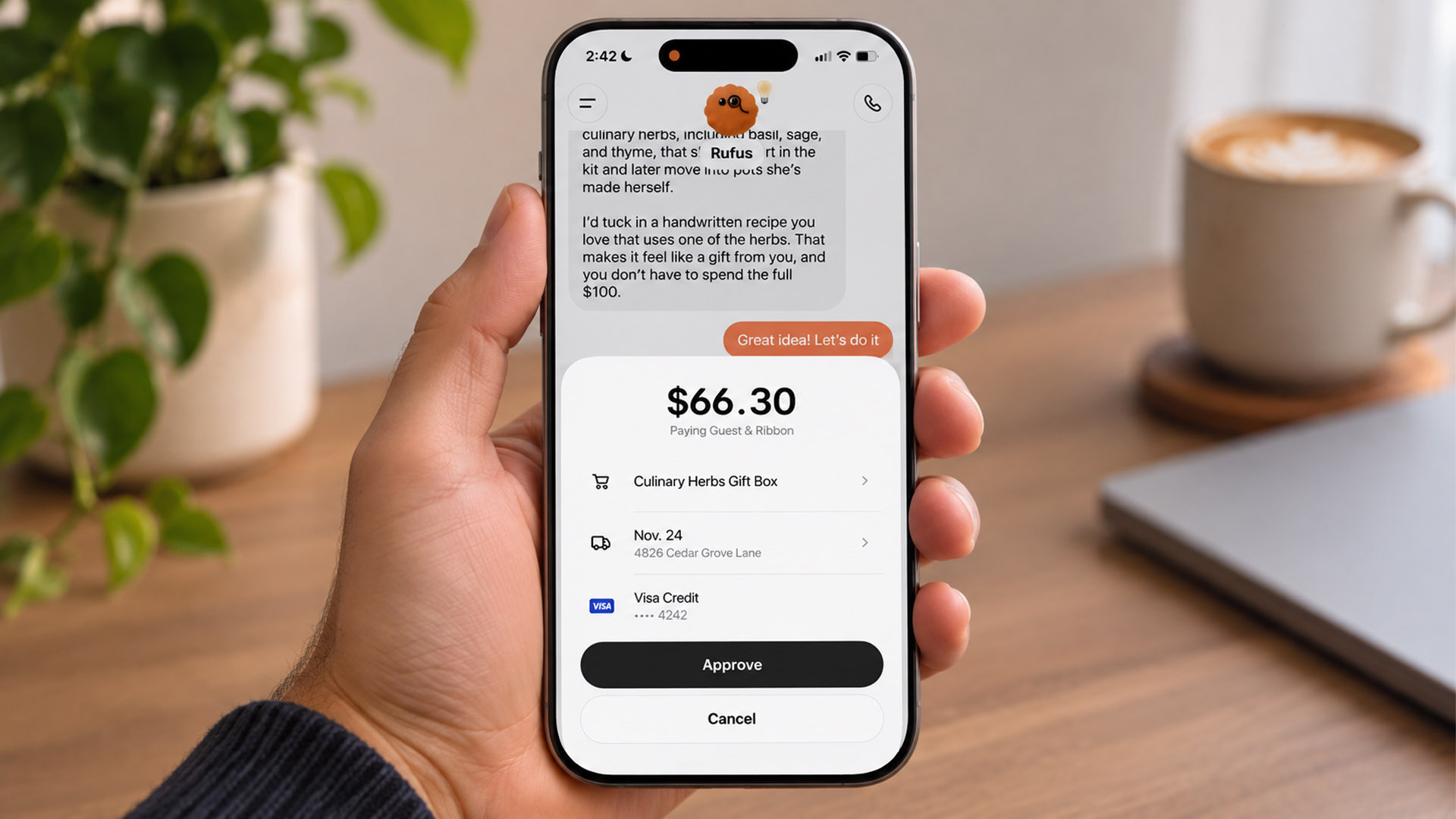
Three days after launching Business Hub, OpenAI introduced ChatGPT Wallet, a payment layer that lets its dots agents complete purchases on a user’s behalf without having access to their actual card details. The wallet rolls out first to ChatGPT Pro subscribers in the US, with expansion on the horizon as the company works with “businesses, banks, and payment networks to learn from early use.”
OpenAI wrote in its blog post:
“It’s the first wallet that lets agents pay without access to users’ actual card details and that requires a security check for every purchase, while also preserving existing card rewards and protections for eligible disputes.”
That’s a generous use of the word “first” though.
- Shopify already lets AI agents check out with Shop Pay at its merchants’ stores and on non-Shopify stores with single-use tokens.
- Stripe’s Link lets agents request approval for each purchase without seeing the user’s real card.
- Google’s agentic checkout pays with encrypted Google Pay tokens after the user confirms.
- Meta’s Muse also stops and asks for approval before any purchases are made.
- Card rewards and dispute protections aren’t unique either, since they come from the card issuer and carry over to any wallet that uses tokens to charge your real card.
The only distinction OpenAI can really claim as the “first” is making a biometric check mandatory on every single purchase, and doing it with its own wallet so its agents don’t have to rely on Shopify, Google, or Stripe to finish a sale.
Don’t get me wrong, ChatGPT Wallet is still a smart move for the company. It’s just not a revolutionary move in the industry.
Here’s what else we know about ChatGPT Wallet:
- Users add a card once through a secure form in settings, never in the chat itself. Before each purchase, the dot shows the merchant, items, total, and card, and waits for the user to approve the purchase with Face ID or a fingerprint scan. Each order has to be approved individually.
- Instead of the real card number, the card network (American Express, Mastercard, and Visa) issues a single-use payment token for each unique purchase, so neither the agent nor the merchant ever sees the actual card details.
- Only credit cards can be added at launch, not debit or virtual cards.
- The order is made directly with the merchant, and the agent pays through the merchant’s existing checkout. OpenAI says it’s working with Adyen, Checkout.com, and Stripe so their systems recognize legitimate agent purchases and don’t block them for being powered by a bot.
- There are no spending limits yet, but OpenAI plans to add controls like spending caps, purchase categories, time periods, and eventually pre-approved purchases.
- Wallet only works with dots for now, not in regular ChatGPT chats.
This is OpenAI’s second attempt at getting its chatbot to complete purchases.
Instant Checkout, its first attempt that tried to get shoppers to check out with merchants directly in ChatGPT, launched in September 2025, but shut down in March 2026 because it was a terrible idea. Instant Checkout reportedly planned to charge merchants a 4% fee on every order, but this time OpenAI isn’t taking a cut. It’s also not trying to own the entire checkout. Instead, it’s merely providing its agents with a secure way to pay on a merchant’s existing checkout, which is a much easier ask of retailers than trying to get them to integrate with ChatGPT and hand over a percentage of every sale.
Instant Checkout was doomed from the start, but ChatGPT Wallet is going about it in the right way, which is in the same direction that the rest of the industry is headed.