
Hi Shopifreaks
🎉 Before we begin, I’m excited to present a new pitch from my video series 90 Second Pitches — a channel that helps you discover innovative e-commerce technology from the most promising startups. You can subscribe to the channel on YouTube & LinkedIn.
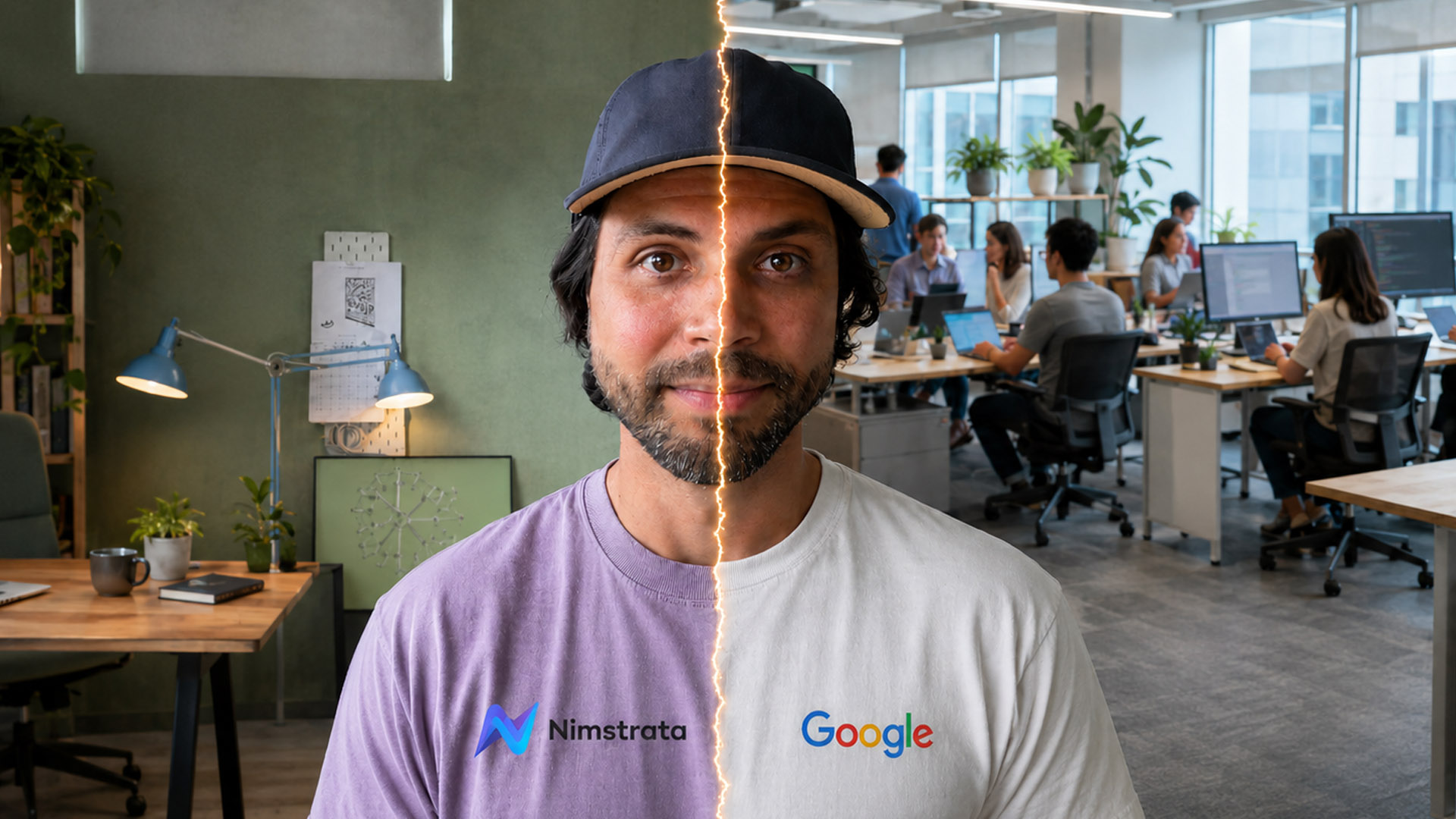
Today’s 90 Second Pitch comes from Sebastian Hooker at Nimstrata, a Shopify app that brings the power of Google’s AI Commerce Search to your Shopify store — allowing merchants to power their search and collection pages with the exact same AI that powers Google Shopping.
It’s the same search and discovery technology that stores like Macy’s, Nordstrom, and Overstock employ on their e-commerce websites, except it can be yours without having to spend hundreds of thousands of dollars to integrate it with your store like they did.
Sebastian used to work at Google, selling cloud services to retailers, which at the time required professional services and developers. There was no easy or cost effective way for a retailer to get started with Google AI Commerce Search, which he likened to “building an airplane without the runway.”
That’s where he noticed a gap in the market and thought to himself, “What if implementation wasn’t so expensive and complex? What if we made this integration layer a repeatable product?” So he left Google to build the solution himself.
Nimstrata’s pitch is simple: Get Google quality search results on your Shopify store, without the headache of building a custom integration.
Watch Sebastian’s 90 Second Pitch below and then let him know in the comments if you’re going to add Nimstrata to your tech stack.
90 Second Pitch:
▶️ Watch On YouTube | ▶️ Watch On LinkedIn
Nimstrata:
🔗 Website | 🔗 Shopify App
Want to pitch your startup? Hit reply and show me what you’re working on. I’ve got more great pitches coming your way soon, and I’d love to feature your e-commerce app or SaaS solution too. Hope you enjoy the new series!
And now onto your regularly scheduled programming…
In this week’s edition I cover:
- HubSpot’s data-sharing whiplash
- The launch of Open USD
- Shopify settled its lawsuit with Shopline
- OpenAI wants to give the government 5% equity
- Walmart’s ad business is BOOMING!
- Google had an expensive week
- Square goes after DoorDash, Uber Eats, and Grubhub
- Amazon may finally be accountable for its Prime Video ads shenanigans
- OpenAI is launching new ad formats
- TikTok advertisers can now embrace microdramas
All this and more in this week’s 285th Edition of Shopifreaks. Thanks for subscribing and sharing!
Stat of the Week
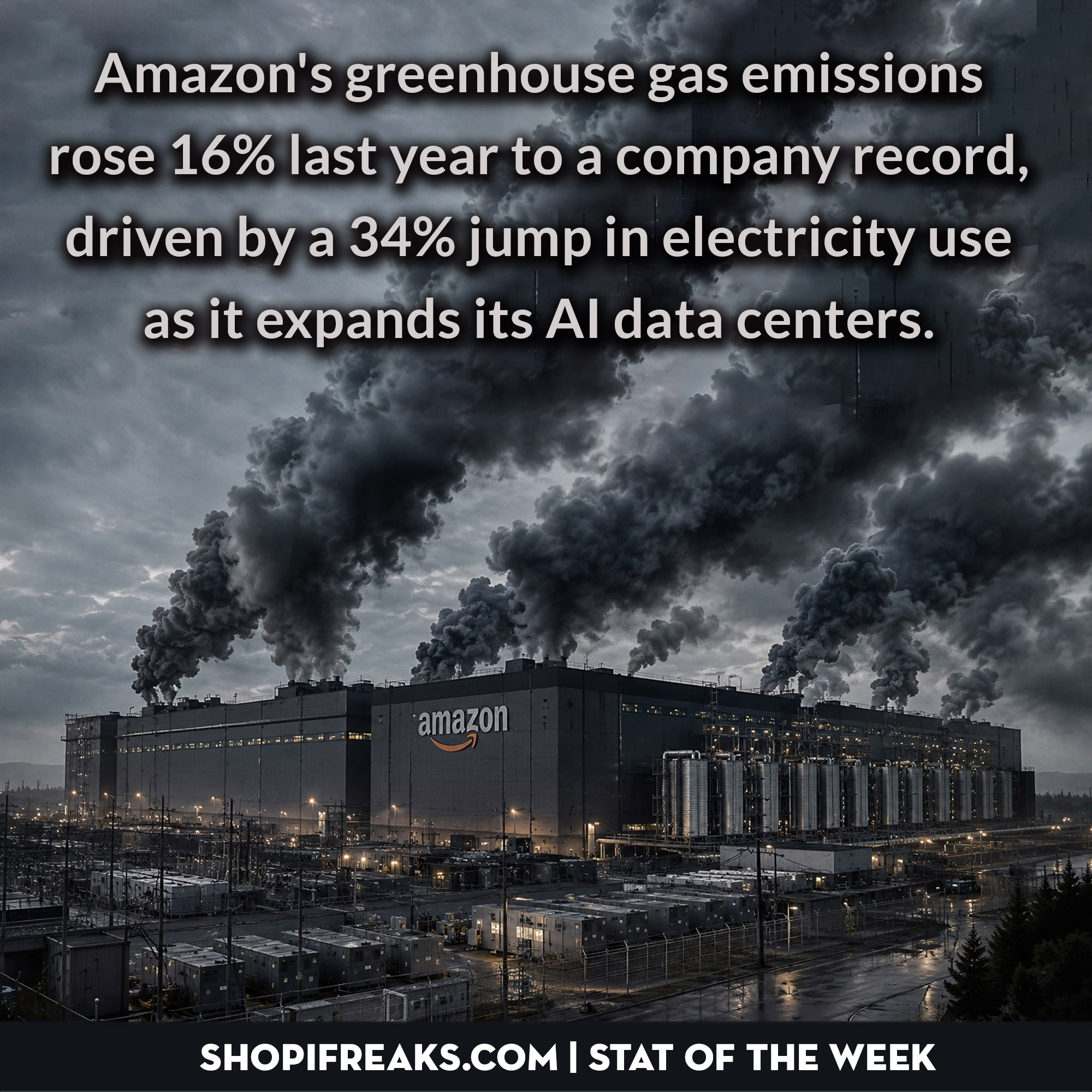
Amazon’s greenhouse gas emissions rose 16% last year to a company record, driven by a 34% jump in electricity use as it expands its AI data centers. On top of that, Amazon’s data centers withdrew nearly 2.5B gallons of water in 2025, while indirect emissions from its manufacturing and supply chains climbed 10% YoY and more than 21% since 2019. The rise in emissions comes despite Amazon’s pledge to reach net-zero carbon emissions by 2040.
1. HubSpot immediately reverses course on its new data-sharing policy change
Last Wednesday, HubSpot announced changes to its Terms of Service in regard to how it shares customer contact data. The move centered around its upcoming feature Contact Discovery, which will let customers find, verify, and add new contacts to their CRM using a pooled (shared) dataset from other customers. The update triggered immediate backlash from HubSpot users and partners, as well as other industry professionals, who began labeling the move as a violation of privacy and trust.
What was actually changing?
HubSpot has a new vision for prospecting, which it calls Trusted Prospecting, which uses customer data from one customer, or likely a group of customers, to enrich the datasets of other customers. The company wrote in its announcement:
“When you opt into enrichment, some of your business contact data helps keep that dataset current. Everyone who participates gets more accurate data back in return.”
The shared data included business contact info (like e-mail and LinkedIn profile), company data (like employee count and annual revenue), engagement signals (like opens, clicks, and bounces), and tracking-code and intent signals, while excluding notes, deal data, call recordings, and custom fields. HubSpot also added three new sub-processors, including Baseten Labs, Bright Data, and Exa Labs.
Why were people pissed?
Customers began rightfully fearing that their proprietary contact data could begin feeding their competitors. Imagine spending two decades building a robust digital Rolodex in HubSpot, only to have your contact data used to “enrich” a startup competitor!
Critics of the change argued that HubSpot had shifted overnight from a permission-based CRM to a shared commercial data model without explicit customer consent. A CRM contact list is a company’s competitive asset, and pooling it felt like a betrayal.
To make matters worse, HubSpot’s “opt-in” policy on data enrichment was a blatant mischaracterization of what “opt-in” truly means. Following the update, customers would’ve been opted in by default unless super admins actively opted out. To make opt-out even more convoluted, customers would’ve had to do so via three separate toggles for enrichment, AI training, and tracking-code / intent sharing in order to fully retain control of their data.
What happened next?
HubSpot reversed course on the rollout, with Chief Product & Technology Officer Duncan Lennox issuing an apology on the company’s blog entitled, “We Got This Wrong. And We Are Fixing It.” He wrote:
“We made a mistake. Nothing matters more to us than the trust of our customers, and with our recent terms of service update we let you down. We are sorry about that. We will not move forward with the terms of service changes we communicated on July 1, 2026. You control your data. This has always been our policy and will not change.”
He went on to talk about how HubSpot specifically got it wrong in terms of their data sharing changes:
“We should have been clear about what we were proposing and how it would work. While we always intended for enrichment to remain strictly opt-in, we should have communicated better how that opt-in works, and importantly, how you as a customer could ensure you remain in control of that choice.”
Here’s the thing though about opt-in: it doesn’t really need explanation. Either it’s “opt-in” or it’s “opt-out” — a binary choice. HubSpot designed it as “opt-out” and called it “opt-in” instead. Frankly, they’re lucky shit hit the fan before the changes went live or they’d likely have faced a lawsuit afterward. Now, they’ve just got a PR disaster to clean up.
One important caveat about the apology and change of course: HubSpot backpedaled on its original launch terms, but is not changing its plans to move forward with its shared dataset product. Lennox wrote that they are “reassessing how to make opting into contact enrichment clearer, more easily governable, and simpler to manage,” and that “when we introduce new enrichment capabilities,” they will be “fully and transparently opt-in.”
While many folks were supportive of the company’s quick recognition and ownership of the mistake, others were not so forgiving in the comments of Lennox’s LinkedIn post:
- “Glad the mistake is being owned. It still begs the question how this made it past countless approvals, iterations, and more.”
- “Calling this ‘wrong’ undersells it… That’s not an accident you stumble into, it’s an intentional plan 2 years in the making that got walked back once you got caught.”
- “We got it wrong = we thought our clients were too distracted or too dumb to notice us trying to flip a switch to steal all their data… BUSTED!”
- “Mission backfired, will try again later.”
It’s understandable why HubSpot wants to offer pooled data enrichment. The industry around it is moving towards this type of model, and HubSpot arguably has one of the biggest business datasets on the planet. It’s an untapped value add-on for customers and revenue stream for HubSpot. That doesn’t necessarily mean their customers like it, or that HubSpot should’ve gone about releasing the product in this manner. Either way, it’s coming.
What are your thoughts on HubSpot’s pooled data enrichment plans and on its recent announcement and subsequent apology? Hit reply and let me know, or join the conversation on LinkedIn.
2. Major tech companies, retailers, and banks back a new stablecoin called Open USD
Remember when everyone and their brother started launching (or announcing the launch of) stablecoins following the passing of The GENIUS Act, which established the first U.S. federal framework for regulating dollar-backed cryptocurrencies?
The space immediately became saturated with announcements from banks and fintechs like SoFi, Fiserv, Klarna, and Western Union, while retailers like Walmart and Amazon were said to be exploring their own stablecoin projects — setting the stage for a volume of proprietary coins that could quickly become a hassle for customers to manage. Instead of one single digital wallet that holds, uh, money that can be used anywhere, customers can soon hold a shitcoin (I mean, stablecoin) for every company they shop or bank with!
The disparate stablecoin ecosystem I describe above is what Open Standard aims to reconcile with the launch of Open USD, a new stablecoin backed by more than 140 major tech players including Visa, Stripe, Mastercard, Shopify, Google, DoorDash, BlackRock, and other household names.
The company shared three key design principles of Open USD in its announcement:
- Build for scale. Businesses can mint and redeem Open USD at no cost and with no artificial limits on volume.
- Earn by default. Partners receive all of the earnings from Open USD’s reserves, less a small management fee to cover Open USD’s operational costs.
- Govern collaboratively. Open USD will be operated by Open Standard, an independent company with a board made up of Open USD’s partners, ensuring decisions are made for the collective interest, not a single entity.
CEO Zach Abrams wrote that while existing stablecoins “have great strengths,” businesses need a coin that’s “open, low-cost, high-throughput, broadly accessible, and aligned to their interests” — not one that is designed for one company’s needs. Open Standard says that the coin will go live later this year, but no specific date has been given.
If the above sounds like an advertisement or endorsement for Open USD — believe me, it’s not. Although I respect their mission of creating a universal partner-driven stablecoin that serves the needs of various businesses and use-cases, I’m still not jumping on the stablecoin bandwagon.
The U.S. needs to update its existing fiat infrastructure to best serve the needs of businesses and consumers for the next 100 years — not allow major institutions to build a private layer on top of it. Privately issued stablecoins, no matter how many big name partners are on board, are not the solution to modernizing our digital financial infrastructure. Though I will admit that Open USD is the best stablecoin solution project I’ve seen so far, as it aims to simplify the ecosystem for consumers.
3. Shopify settled its lawsuit with Shopline for allegedly copying its Dawn theme
Shopify settled its copyright lawsuit against Shopline after the rival e-commerce platform agreed to stop distributing an allegedly cloned version of its Dawn theme and pay Shopify an undisclosed amount.
The story began in May 2024, when Shopify sued Shopline, a Singapore-based subsidiary of the Chinese technology company JOYY Inc, in federal court over illegally copying its software to build its own e-commerce platform. Shopify said in the lawsuit that Shopline created a “thinly disguised knockoff” of its Dawn theme, which it claims “forms the backbone of the way an e-commerce site appears and functions.”
The lawsuit even says that the “Shopify” name still appears in the code of various versions of Seed that Shopline is distributing, and that Shopify found a Chinese webpage hosted by JOYY with the title “Seed Theme” that still carries headers reading “dawn-test” — which is just plain sloppy! Shopline deserved to lose this case for its lazy copyright infringement, if nothing else.
Shopline denied the allegations and argued that Dawn was not copyrightable because it was built with code that is “publicly available, widely known and routinely used across the web.” Though apparently that argument didn’t hold up well in court.
Shopify general counsel Jean Niehaus said about the settlement:
“Shopline copied our Dawn theme, rebranded it, and sold it against us. We took them to court and they’ve been ordered to stop and to pay us. Open source is built on trust and we’ll defend that every time someone treats it as a free pass to steal.”
Though technically, despite Shopify and its leadership using the term “open source” to describe the Dawn theme (including in its developer changelog and Unite keynote), it’s not really open source, according to criteria established by the Open Source Initiative. Because Shopify puts restrictions on how and where the theme’s code can be used, Dawn actually falls under the category of “source-available” software — though that nuance wasn’t enough to save Shopline, since Dawn’s license explicitly outlines restricted uses right next to the code.
Either way, kids — don’t steal from Shopify! That’s the lesson they’d like you to take from this.
4. OpenAI proposes giving the U.S. government a 5% equity stake
OpenAI discussed giving the U.S. government a 5% stake in its business, while proposing that other AI firms do the same, according to the Financial Times. Sam Altman initially discussed the proposed stake in 2025 with President Trump, Commerce Secretary Howard Lutnick, and Treasury Secretary Scott Bessent, according to sources, and more recently met with Bernie Sanders over the matter in June 2026.
The idea is not completely out of left field. OpenAI has previously proposed a “public wealth fund” to invest in AI companies and distribute returns to American citizens, and Anthropic has suggested a “digital dividend” that would offer payments to Americans funded by taxes on the AI sector, according to Reuters.
It would also not be the first company (or companies) that the Trump administration has taken a stake in. Others include Intel (10%), MP Materials (15%), Lithium Americas (10%), and Trilogy Metals (10%). In total, the U.S. government now reportedly owns a stake in more than a dozen public companies, as part of an aggressive economic policy strategy to secure vital domestic supply chains.
Historically, the U.S. government has only taken equity stakes in companies as a last resort during economic emergencies, such as the 2008 banking bailouts and the 2020 pandemic airline rescues. However, those positions were later fully divested, whereas these recent holdings appear to be long term.
It’s important to note two key factors that would distinguish the OpenAI proposal from the deals above:
- The 5% equity from OpenAI (and potentially other AI companies) would be placed into a dedicated public wealth fund with a primary mandate to generate financial returns that are directly distributed to American citizens to offset the economic disruptions and job displacement caused by AI. Or as OpenAI tries to frame it — to “let the public share in AI’s upside.”
- The 5% stake in OpenAI would be worth around $42.6B, based on the company’s $852B valuation in March, but unlike Intel, which gave up 10% equity for $8.9B, OpenAI would be giving up equity for nothing in return — only goodwill. Or was it for political favors? Hard to keep track.
There are over 70 major sovereign wealth funds globally, managing a combined total of nearly $13 trillion in assets, almost always purchased with cash from exporting oil, gas, and minerals, or from trade surpluses. OpenAI voluntarily gifting equity to the U.S. government, instead of selling it to them, would be an unprecedented act.
🔥 Partner News
DataFeedWatch, the product-feed management platform that optimizes and syndicates merchant catalog data across shopping channels, is joining Revmatics.ai, an AI-native marketing platform built on over a decade of data and AI experience. Revmatics extends the platform’s feed foundation with full-funnel marketing tools spanning conversion-rate optimization, audience and creative intelligence, and real-time retail intelligence across store performance, inventory, and location-level stock. Merchants and agencies can expect the same DataFeedWatch product, support, and team that have run since 2013, now with Revmatics’ AI marketing tools available on top. More details about the acquisition in Section #10.
5. Walmart’s advertising revenue grew 37% in Q1 compared to last year
Walmart now earns more revenue from selling ads than Snapchat or Pinterest and is positioned to become even bigger in the industry, according to The Information.
The company’s ad revenue reached nearly $6.4B in fiscal 2026, which ended January 31, 2026, accounting for around 4.3% of its e-commerce revenue, which last year surpassed $150B. In comparison, advertising accounted for around 12% of Amazon’s digital revenue last year, which excludes AWS and Amazon’s physical stores, indicating that as a proportion of total revenue, Walmart’s ad business has a ton of potential growth ahead of it.
Walmart has been in the digital advertising business for about a decade, but has recently been diversifying its ad unit with several acquisitions including Vibe last month and Vizio in 2024.
Walmart Chief Financial Officer John David Rainey told investors in February:
“If you look at our advertising as a percent of GMV, we are still very much kind of middle of the pack. We have a tremendous amount of opportunity to grow that through our own capabilities, but also the denominator is growing as well, as we’re growing that GMV.”
Then in April, Rainey said on another investor call that Walmart can “easily double what we’re doing today to get to what best in class is, in terms of advertising as a percentage of GMV.”
Wow! Remember when Walmart didn’t take e-commerce that seriously and sat back for more than two decades as Amazon grew into an online behemoth? Well, those days appear to be gone, and now that Walmart’s got a taste for the high-margin addiction of retail advertising, they don’t appear to ever be coming back. In other words, get ready for more sponsored listings in your Walmart search results!
I guess there’s money to be made from advertisements? And now, a word from our sponsor…
6. Google loses major lawsuits costing it billions, with proposed government regulation potentially costing it even more
Tough week for Google! The company took heat in every direction from losing multi-billion-dollar lawsuits to having its search and mobile operating system monopoly challenged. Here’s a recap of what went down last week in the world of Google.
1) Google lost its final appeal against a €4.1B EU antitrust fine over its Android operating system.
The EU’s Court of Justice dismissed the company’s last challenge, leaving no further route to contest the fine. Regulators had previously ruled that Google shut out search competitors by making Android licenses conditional on phone makers like Samsung and LG bundling Google Search, Chrome, and the Play Store onto their devices. Google appealed multiple times, but this was its last available attempt. The ruling closes one of the last major cases from the EU’s first wave of Big Tech antitrust enforcement, which has since shifted toward ongoing gatekeeper obligations under the Digital Markets Act and Digital Services Act rather than one-off fines.
2) Google was ordered to pay PriceRunner nearly $2B in damages for favoring its own comparison-shopping services.
A Swedish court ordered Google to pay Klarna’s price-comparison subsidiary PriceRunner nearly $2B in damages, finding that Google favored its own comparison-shopping service over competitors. The ruling ties back to 2017 when the European Commission fined Google €2.4B for abusing its search dominance, which set off a wave of follow-on lawsuits. Judge Linda Kullberg called the award undoubtedly the largest ever in a Swedish competition case, though it covers harm across Sweden, Denmark, and the UK. Google said it disagrees and is weighing its legal options, with an appeal likely on the horizon. The roughly $1.97B figure equals about 25% of Klarna’s market capitalization, so it’d be a big win for the company, potentially funding a lot of BNPL loans!
3) The UK’s Competition and Markets Authority wants to loosen Apple and Google’s collective monopoly on mobile platforms.
The CMA is challenging what it calls the “effective duopoly” that the two companies hold over mobile platforms, considering rules that would let developers steer users to outside websites to make purchases and bypass app-store commissions of up to 30%. The regulator argues that consumers and app owners are being let down by restrictions on spending outside the two stores, which run on at least 90% of UK mobile devices, and pointed to Spotify forcing users to subscribe via desktop to dodge Apple’s fees.
The proposed changes would still let Apple and Google charge fees on steering users toward external payment systems that are “fair, reasonable, and lower than current app store charges.” Google says it already complied by rolling out its own steering fees last week. The open question is whether those fees are low enough to give developers a real escape from the 30% commission, or just reproduce it under a new name.
Personally, I think it’s insane that an OPERATING SYSTEM can charge fees in this manner at all! Can you imagine if Windows charged Adobe a 30% commission for subscribing to its Creative Suite on a Windows laptop? What the fuck is wrong with the mobile operating ecosystem and how did we let it get this bad? Things need to change immediately.
4) The European Commission plans to force Google to share certain data with EU competitors.
The rules, which could come as early as this month, could see Google forced to share its anonymized search data (queries, rankings, and click rates) with rival search engines and AI chatbots, and to open up Android so competing AI assistants like ChatGPT and Claude can access the same system-level features it reserves for Gemini. (The first is ridiculous to me. The latter is fair.)
Google warns that the regulations could create serious security and privacy risks, with VP of security engineering Heather Adkins telling Wired the changes could drive a significant rise in EU fraud within weeks of taking effect. The company argues that data anonymization is hard and that its own teams have re-identified such data in as little as two hours through linkage attacks, making smaller EU firms holding it a target. The Commission expects a binding decision on July 27 under the Digital Markets Act.
Like I said… tough week for Google! Something tells me my YouTube Premium is about to get more expensive…
7. Square launched a ChatGPT app and Claude plugin that take AI-agent orders from restaurants
Square launched a ChatGPT app and Claude plugin that lets hungry consumers discover restaurants and place orders directly inside the AI chatbots, with eligible U.S. food-and-beverage sellers auto-opted in and no setup or new APIs required.
The system pulls a restaurant’s menu, pricing, inventory, and modifiers (like “extra BBQ sauce”) live from Square, so that agents never show out-of-stock options, and routes orders into the merchant’s existing POS terminal and kitchen display.
Even better for restaurants, Square doesn’t charge any marketplace commission on these AI orders, only its standard online processing fee of roughly 2.9% plus 30 cents, versus the 15% to 30% cuts DoorDash, Uber Eats, and Grubhub take. For orders needing delivery, Square uses a white-label courier network charging a flat $7 to $10 fee rather than a percentage of the basket, which typically comes out better for restaurants and/or is an easier cost to absorb for customers.
Here’s how it works:
- A customer prompts ChatGPT or Claude with a query like, “Find me a Jewish deli nearby with a Reuben sandwich and chopped liver.”
- They can then browse results, make their selection, and finalize the purchase using Order by Cash App, without leaving the chat interface.
- The order then routes to the restaurant’s systems, same as if it were made in-store or on their website. However, the order is clearly tagged as AI-originated.
Great idea, Square! The fees from delivery apps have gotten completely out of hand — with drivers not seeing enough of the upside, but that’s a different story. Any move that puts margin back into the hands of restaurant operators is a win in my book.
8. Amazon faces an Australian lawsuit for bringing ads onto Prime Video
Amazon’s Australian unit is being taken to court by the country’s competition regulator over Prime subscription contracts that allegedly contained unfair terms letting it add advertising to Prime Video. Amazon launched ads on Prime Video in the U.S. in January 2024 and in Australia in July 2024, alongside an ad-free tier that cost extra in both markets.
The ACCC says that between November 2023 and August 2025, Amazon used those terms to make negative changes for more than a million annual subscribers without compensation, and that after July 2024 anyone wanting to keep ad-free streaming had to pay an extra A$2.99 a month despite already paying A$79 upfront. The regulator also alleges Amazon.com Services LLC (the U.S. company) was knowingly involved in the conduct, and is seeking declarations, penalties, and consumer redress.
Finally! Can someone please stick it to Amazon for arbitrarily adding ads to an ad-free subscription that users already paid for? I’ve been arguing this for years. It’s one thing to create a new cheaper ad-supported tier and simultaneously raise the price of the premium tiers upon renewal (which other streaming services have done), but it’s another thing to pull the ad-free experience from users who are already subscribed to the premium tier. That’s deserved of a class-action lawsuit and compensation to users.
In fact, people in the U.S. tried to take Amazon to court over the matter twice, but both cases were dismissed with one judge ruling that adding ads wasn’t technically a price increase because the base cost of Prime remained the same, but was rather a “benefit modification,” and that Amazon’s TOS reserved the right to “add or remove Prime membership benefits” at its sole discretion. The judge noted that Amazon never explicitly legally promised that Prime Video would always be ad-free. (“Always” is a stretch. I’m just arguing that they should’ve been free for the duration of the user’s annual membership term.)
Australian consumer law has incredibly strict protections against “unilateral variation clauses” — which are fine print that lets a company change a deal after a customer has paid — which means Amazon’s fine print might not protect them there the way it did in the States. I certainly hope it doesn’t. I’m still bitter about this — and I’m not even an Amazon Prime subscriber! I’m simply a man of the people and call “fair” as I see it. What Amazon did was certainly not fair to members.
9. Other e-commerce news of interest
OpenAI is expanding into ad formats that include image, video, and interactive conversations, according to three job listings on its careers page spotted by Digiday. The company is looking for an ad formats software engineer with at least seven years of experience for a “foundational role” that’s responsible for building the infrastructure and tooling, defining how the ads are structured, and delivering them across different surfaces, platforms, and media types. The other two jobs are for similar ad format software engineering roles that only require four years of experience. All three roles list upholding “the highest levels of safety, privacy, fairness and policy compliance,” with two listings that reference building “policy-aware UX patterns.” I look forward to seeing what type of new ad formats they come up with, as their current offering felt a bit dated upon launch. I’m sure they can think of something more exciting than their current text ads.
AWS is investing $1B to create a Forward Deployed Engineering organization that embeds thousands of its engineers directly inside customer teams to co-build and deploy agentic AI systems in days rather than months. The engineers work alongside a customer’s business, engineering, and security teams using purpose-built agents, and structure engagements around business outcomes rather than billable hours. AWS says the model leaves customers self-sufficient, deploying a semantic layer into the customer’s own AWS account, so that the customer is not reliant on its services in the future. Early customers include the Allen Institute, Cox Automotive, the NBA, the NFL, Ricoh, and Southwest Airlines. The move follows OpenAI and Anthropic announcing their own Forward Deployed Engineer companies earlier this year.
Private credit firms including Blue Owl, KKR, and Elliott are pre-purchasing billions of dollars of BNPL loans before they are made, through “forward-flow agreements” that fund installment loans at Klarna, Affirm, and PayPal, according to Bloomberg. The arrangements let fintechs offload risk, collect fees, and free up capital for new lending, while giving private credit buyers short-term consumer loans that mature in weeks to diversify against their longer-term holdings like multiyear corporate loans and buyout debt. Former CFPB director Rohit Chopra warns that the model incentivizes churning out more loans and draws comparisons to the originate-to-sell practices behind the subprime mortgage crisis, noting that those repayment expectations broke down once before. Klarna doubled its Elliott deal to $2B in March to fund up to $17B in loans, while Affirm now draws about 46% of its funding capacity from forward-flow agreements across roughly 20 institutional buyers.
Amazon agreed to pay $2.25M to settle FTC charges that it knowingly violated the Fair Credit Reporting Act by refusing to give identity-theft victims records of fraudulent transactions made in their names. Section 609(e) of the act requires companies to hand over such records within 30 days at no cost, but the FTC said Amazon even denied requests from law enforcement acting on victims’ behalf and had no written policy for handling them until early 2025, after learning of the investigation. Many consumers who contacted Amazon to report fraud were told by its customer service agents that they could not provide the records for “security” or “privacy” reasons, while other times they claimed they couldn’t access the records at all. In addition to the fine, the order will require that Amazon cut the crap moving forward and provide records lawfully requested by identity theft victims and law enforcement agencies acting on their behalf.
Google Maps may soon let users order food from restaurants inside the app for pickup, according to Android Authority, which found hidden code in the latest Android version. The code strings, which are tied to Google’s Gemini-powered Ask Maps assistant, include “ask Maps to order food” and point to agentic ordering that would place orders on the user’s behalf, even while traveling. It’s unclear how much autonomy the AI would have, or whether Google would compete with DoorDash and Uber Eats or partner with them for pickup, dine-in, and delivery, but I’d imagine it’ll be the latter, given that Google already routes users to both services in Maps today. Google hasn’t launched the feature, which could be limited to newer Pixel phones, and its next big reveals are expected around the Pixel 11 launch in August.
TikTok is now letting brands create and promote branded microdramas through its new Growth Max ad format. The microdrama format has been an early hit with TikTok’s audience, generating $1.3B in the U.S. in 2025, mostly through direct viewer payments, according to Business Insider. Brands can now publish episodic, soap-opera-style content directly on the platform and amplify it to drive discovery, engagement, and conversion. TikTok has leaned into the microdrama trend with a dedicated Minis section and a standalone microdrama app called PineDrama that launched in the U.S. and Brazil early in 2026. I’ve seen the microdramas on TikTok, and honestly they are so very, very bad! However, given how much people love bad TV (as demonstrated by the success of reality TV and modern sitcoms), I can certainly understand why the microdramas are so successful.
Base44, the vibe-coding platform that Wix acquired for $80M last year, launched its first proprietary AI model, Base 1, now in production and serving users on the platform. The company built the model on its own dataset drawn from tens of millions of real user interactions, pitching it as a general-purpose agent that handles both conversation and coding tasks rather than a single-purpose model, applying expertise developed when training its Wix Harmony model. The move is in contrast to other popular app-building platforms, like Lovable, which are often powered by frontier models from OpenAI or Anthropic. Owning the model stack gives Base44 direct control over output quality and compute and inference spend, which it expects to improve margins over time as it phases the model in across traffic. The move comes amid an ongoing discussion in the AI community over whether building a business on top of frontier models is sustainable and defensible in the long term.
Meta is developing plans for a cloud infrastructure business to sell outside customers access to AI computing power and models, a direct competitor to AWS, Microsoft Azure, and Google Cloud, according to Bloomberg. One plan under consideration would sell access to AI models hosted on Meta’s infrastructure, including its own Muse Spark model, similar to AWS’s Bedrock, while another would rent raw computing capacity like neocloud providers such as CoreWeave. The effort is part of an internal initiative called Meta Compute and offers a potential way to earn a return on the hundreds of billions of dollars Meta has committed to data centers and chips, with CEO Mark Zuckerberg telling shareholders in May that selling excess compute is “definitely on the table.” I thought Meta didn’t have enough compute for itself? Now it’s selling extra?
TikTok Shop published a formal gambling policy that places the gamification layer of live commerce under hard compliance rules for sellers and creators. The platform now treats casino-style games and pay-for-a-chance mechanics as gambling, including lucky spins, raffles, sweepstakes, wheel spins, and mystery scoops, even when the payoff is a free giveaway. The policy also prohibits eight specific “break” formats, which are the livestreams where a seller rips open sealed packs of trading cards and hands out the contents to viewers who paid in. The ones getting cut are those that run like a game of chance or a contest, while the plain buy-a-pack-and-keep-what’s-inside breaks can continue for approved sellers. About time if you ask me! It feels like every platform is becoming a gambling site lately.
In other TikTok news… The company launched Agentic Hub, a marketplace of first-party and third-party AI Skills that let AI agents create, manage, analyze, and optimize TikTok ad campaigns with less manual work. The Skills run on TikTok for Business MCP, a system that lets AI agents securely connect to TikTok Ads and handle campaign management, performance reporting, and creative work through plain instructions without API credentials or coding. Advertisers can access and use ready-made Skills, build custom ones, or connect their own agents directly to the MCP layer. Platforms including HubSpot, Wix, Constant Contact, and Innovid have already published Skills covering campaign creation, creative generation, catalog management, and performance diagnostics.
Google Ads CPC for European e-commerce advertisers rose 15% YoY, about €0.06, while ROAS fell more than 40%, according to a benchmark of €1.38B in spend across 10,000-plus advertisers from Channable. ROAS dropped 43% on Standard Shopping and 46% on Performance Max, driven by the higher click costs and a dip in Performance Max conversion rates, leaving brands paying more for weaker returns. So the cost to run ads went up, while the ROI went down. That’s not a very sexy value proposition for advertisers, which is why I’m constantly pushing the need for more ad platforms in this newsletter, as more competition tends to drive prices down. CPC climbs even higher heading into the holidays, running 9.1% above Q1 levels while total ad spend jumps 47.9% in Q4 as brands raise their budgets for Cyber Week and the holiday season.
Remember the biopic film “Artificial” that paints OpenAI CEO Sam Altman in a negative light? The one that Amazon (now an OpenAI investor, which dropped the film mid-way through its $50B OpenAI deal) abandoned, and that Netflix, Warner Bros., and A24 (backed by Google, and by Thrive Capital, whose Josh Kushner sits on OpenAI’s board) then passed on? Well, there’s a chance you might be able to see it because the independent film studio Neon purchased it and plans to release the film, which features Andrew Garfield playing Altman and Ike Barinholtz playing Elon Musk. The price they paid was undisclosed, but I’d imagine any price is better than not getting distribution at all, as long as it covers the $40M that the filmmakers spent to create it. I, for one, look forward to seeing it.
Depop is scrapping its 10% seller commission in Australia on July 22 and shifting more of the cost to buyers, who will take on a new marketplace fee of as much as 5% of the sale price plus A$1. Australian sellers will still be responsible for the payment processing of 2.6% plus A$0.30 through Depop Payments, the Stripe-powered checkout that is now required to list and sell, as the company phases out PayPal. Other marketplaces in Australia including Vinted, eBay, and Tise (which is owned by eBay) have all gone fee-free for sellers during the past few years, pivoting to charging buyers instead. The fee overhaul comes as eBay’s planned $1.2B cash acquisition of Depop from Etsy awaits UK clearance, with a Competition and Markets Authority ruling due by August 6, after Australia’s ACCC cleared it in May.
Online sellers who tried to game USPS’s new discounted rates are being hit with price adjustments after falsifying the weight of their shipped packages. The crazy part is that they OVER-declared the weights, which you’d think would’ve cost them more, but that’s not the case, as Value Added Resource reports. Two weeks ago, sellers began noticing that rates for packages weighing 3-5 lbs were costing less to ship Ground Advantage than lighter packages due to newly imposed USPS discounts, which isn’t typically how it works, leading shippers to overstate the weight of their packages to save money on shipping. USPS noticed the discrepancy through its Automated Package Verification system and hit the shippers with a costly rate adjustment. Sellers are now reportedly seeking new ways to game the system, such as adding extraneous weight to their packages before shipping. So if you randomly receive a package from an eBay seller with garden rocks in the box, now you know why.
X is trying to end its FTC-required data-privacy audits that were put in place in 2022, prior to Elon Musk acquiring the company, but 15 privacy and consumer groups, including the EFF and EPIC, are urging the agency to reject the bid, arguing that Musk’s AI push makes oversight more necessary, not less. Quick Backstory: From 2013 to 2019, Twitter asked more than 140M users for their phone numbers and e-mail addresses for “account security” purposes, and then fed their contact info into its ad-targeting systems without disclosure, which the FTC called a “digital bait-and-switch.” This wasn’t Twitter’s first major offense, which is why it resulted in a $150M civil penalty and other requirements, including having to perform independent third-party audits and 30-day breach reporting under FTC oversight until 2042. X says the four-year-old order is burdensome and outdated because it rebranded from Twitter and now answers to the EU’s GDPR. The privacy groups counter that X runs the same ad-targeting business as Twitter, that GDPR does not replace FTC oversight, and that X is under EU investigation for training Grok on Europeans’ data without valid consent.
Amazon will close its Mechanical Turk marketplace to new customers on July 30, 2026, ending an early microtask crowdsourcing service it launched in 2005, according to The Register. AWS added the service to its “Services in Maintenance” list last week, and Amazon later confirmed that it will stop accepting new jobs, though existing users aren’t immediately affected. In 2018, Mechanical Turk added AI data labeling as a service, but Amazon now pushes competing tools like SageMaker Ground Truth, leaving little need for the Turk service. Amazon didn’t say why it’s retiring Turk, as workers report their accounts being cut off with little notice.
President Trump reported $1.4B in crypto-industry revenue since he retook the White House, including $636M from his $TRUMP memecoin, according to The New York Times. Trump and his partners collected fees on every $TRUMP trade regardless of the coin’s fate, and 58 early traders each cleared over $10M while roughly 764,000 mostly small wallets lost money after the coin crashed. World Liberty Financial, a separate Trump crypto venture, added $799M, including a stake the UAE quietly bought as he returned to office, even as its $WLFI coin has since sunk over 80%. Trump’s administration eased the path for these ventures to take place, with the SEC declining to treat memecoins as securities and Trump signing a law expanding U.S. stablecoin use months after World Liberty issued its own stablecoin, though the White House said he has no conflicts of interest. Trump dismissed questions about how much money he’s made since returning to the White House, suggesting that he’s left personal investment decisions to others since beginning his second term.
In lawsuits this week…
- Anthropic is facing a $75M lawsuit from 100 authors who claim the company pirated more than 500 books to train Claude. These particular authors opted out of a previous class action lawsuit against the company, which resulted in a $1.5B settlement in September 2025.
- TikTok is finalizing a settlement in a lawsuit alleging that major social media platforms are addictive to minors, avoiding a jury trial set for July in Los Angeles, according to Bloomberg. The settlement amount is confidential, and Meta and Snap remain defendants in that July trial, while Google’s YouTube settled with the plaintiff, known as R.K.C., earlier this month.
In layoffs this week…
- Elementor, the WordPress visual website-builder, is cutting about 100 employees, roughly 30% of its workforce, as it shifts to a flatter AI-driven operational structure. CEO and co-founder Yoni Luksenberg told staff the company underestimated the speed of technological disruption and the AI shift, and is refocusing on its core product and user community while preparing for AI agents and the next generation of the web.
- TikTok laid off more than 450 people from the technology team at Tokopedia, the Indonesian e-commerce marketplace where it bought a controlling stake in 2024, and shifted the tech behind Tokopedia and TikTok Shop to ByteDance staff in China, describing the layoffs as an R&D realignment for long-term growth. The company is also weighing plans to cut around 300 jobs at its Dublin European headquarters, mainly across AI data services and operations, roughly a year after cutting a similar number of roles there.
- Mark Zuckerberg pushed back on fears that AI will drive widespread job losses during an interview on Complex’s Idea Generation series, claiming that “there should be more jobs in the future, not less,” despite having laid off 10% of Meta’s workforce in May. He added that there is a “path forward that can be very positive,” forgetting to end his sentence with “it just won’t be at Meta.” LOL.
In corporate shakeups this week…
- Shopify audit committee chair Prashanth Mahendra-Rajah, who is currently Uber’s CFO, resigned from the board effective immediately on July 2 after accepting a full-time role with the U.S. Department of Commerce. Board Chair and Lead Independent Director Joe Natale, who joined the board in 2025, is expected to take over the role overseeing financial reporting and compliance.
- Meta named its CMO Alex Schultz as the company’s first chief data officer, tasking him with overseeing AI analytics across its global operations. VP of consumer marketing and growth Denise Moreno will take his position after helping grow Threads to over 500M users.
- Anthropic hired Stanford economics professor Chad Jones, who once wrote a paper modeling a roughly one-in-three chance of human extinction from AI as an acceptable tradeoff for the economic growth AI might unlock, as its newest economist at the Anthropic Institute, the research group it launched in March 2026 to study AI’s systemic effects on the economy and society. The company also hired Jelani Nelson, an acclaimed UC Berkeley computer science professor and former chair of its computer science division, to join the company’s pretraining team.
Google argued in a 21-page policy paper that training AI models on publicly available web data should remain protected as fair use, contending copyright concerns are best addressed at the level of outputs rather than how a model was trained. Does that mean I can steal a book and read it, as long as I never say anything remotely similar to what I read? The paper, written by global affairs president Kent Walker, likens training to an art student taking inspiration from a gallery, and says enforcement should target whether a specific output actually copies an existing work, rather than automated similarity filters. Independent artists sued Google in March over training its Lyria 3 music model on YouTube recordings, a case Google moved to dismiss by arguing the artists licensed their music through YouTube’s terms, so the company has its own agenda behind the argument.
Amazon said it will take “appropriate action,” once a police investigation concludes, against a third-party delivery partner in India over a recent fire that killed two workers, and that it has launched its own internal probe into the site, which police say had no valid fire safety clearance, alarm, smoke detectors, or proper exit. Amazon said worker safety is its top priority and that its supplier code lets it suspend or terminate contractors for violations, but the Amazon India Workers Union demanded an independent judicial investigation into the deaths, not some lackluster self-policing internal investigation. Here’s a question: Where was Amazon’s urgency and prioritization towards worker safety before the fire? How about some pre-emptive checks at your partners’ facilities?
The EU introduced a €3 customs duty on e-commerce parcels worth up to €150 imported from outside the bloc, effective July 1, in a move targeted at Chinese platforms like Shein, Temu, and AliExpress, which have flooded the region with low-value inbound packages for years. The charge replaces the previous de minimis exemption that let low-value parcels enter duty-free, and applies per item by tariff classification rather than per parcel, so a package with five t-shirts draws one €3 charge while a t-shirt and a watch draw €6. Sellers, importers, or their representatives pay it in most cases, not shoppers directly, though it is expected to push up prices across the platforms. The temporary duty runs until July 2028, when the EU expects to move to a permanent tariff system applying normal category-based duties. France took it one step further, passing a national law the same week that hits Chinese marketplaces with per-item environmental fines of €0.25 to €6 this year (on top of the EU fees outlined above) that will rise to as much as €10 by 2030. However, the law spares European fast-fashion chains like Zara and H&M, and still needs President Macron’s sign-off before it can take effect.
🏆 This week’s most ridiculous story… Meta hired hundreds of contractors to pose as teenagers and ask ChatGPT, Gemini, and Character.AI questions about suicide, sex, drugs, and eating disorders to see how their models would react. Covalen, an Irish content-moderation and AI-training outsourcer, ran the effort using dummy under-18 accounts earlier this year, claiming that the project offered “comprehensive AI safety benchmarking” and that it delivered “critical datasets for model comparison and compliance.” Meta defended the work as routine safety testing, calling it an “industry-standard practice.” One contractor who worked on the project told WIRED, “Everyone I knew who worked on this project was completely gobsmacked by some of the text they were asking us to test. Like, surely we are going to get in trouble for doing this?” Good lord! Someone needs to confront Mark Zuckerberg in his living room and say, “Why don’t you have a seat right over there?”
10. Seed rounds, IPOs, & acquisitions
Revmatics, an AI marketing platform that combines audience intelligence, creator marketing, and automated CRO tools, acquired DataFeedWatch, a product-feed management platform that optimizes and syndicates merchant catalog data across shopping channels, from Cart.com for an undisclosed amount of cash and stock, with Cart.com taking an early equity position in Revmatics as part of the deal. Revmatics CEO Ricky Ray Butler framed DataFeedWatch’s distribution reach as the on-ramp for layering its intelligence suite on top, pitching a combined full-funnel engine spanning audience targeting, creative, pricing, and landing-page conversion. DataFeedWatch, founded in 2013 by Jacques van der Wilt, will continue operating as its own product with the same support. (Disclosure: DataFeedWatch is one of our News Partners.)
Bending Spoons, a Milan-based company that buys and rebuilds struggling software businesses including AOL, Vimeo, WeTransfer, Evernote, and Remini, raised $1.68B in its Nasdaq IPO. The stock closed at $40.50, nearly 40% above its $29 list price, giving the company a $25.7B market value, up from an estimated $14.5B in a 2025 funding round. The offering was led by Goldman Sachs, JPMorgan, and Allen & Co., with the 10 biggest investors taking roughly 85% of the shares. Of the $1.68B raised, only about $954M went to Bending Spoons itself, with roughly $684M going to existing shareholders selling into the offering.
HubSpot entered into an agreement to acquire Warmly, an AI sales-intelligence startup whose technology identifies buying intent, de-anonymizes website visitors, and automates prospect outreach by continuously monitoring customer signals, for an undisclosed amount. The deal advances HubSpot’s push to turn its CRM into an AI-powered customer platform, adding intent detection and AI-driven sales execution without having to build the capabilities in-house. Warmly, founded six years ago by Maximus Greenwald, Carina Boo, and Alan Zhao, is best known for person-level website intent that identifies more than half of visitors who never fill out a form, as well as its Inbound Agent and TAM Agent tools that turn that identification into outreach. Existing Warmly customer contracts, pricing, and product experience will remain unchanged, with deeper HubSpot integration planned over time.
NielsenIQ, the retail-measurement firm spun off from TV-ratings company Nielsen in 2021, acquired YiMian, Flywheel’s China and Southeast Asia eCommerce Data & Insights business, for an undisclosed amount. The acquisition expands NielsenIQ’s capabilities across China and Southeast Asia and strengthens its ability to measure consumer behavior across retail, e-commerce, social commerce, and digital environments. The move is part of NielsenIQ’s mission to deliver “The Full View,” or what it calls the most complete understanding of consumer behavior across online and offline channels.
Pie, an AI-powered growth platform for small businesses, raised $19.5M in a Series A round led by Lightspeed Venture Partners, bringing its total amount raised to $23.7M. Alongside the funding round, the company emerged from stealth with the launch of Front Desk, an AI product that answers calls, takes bookings, and handles customer questions around the clock. Pie was founded by former Square and Toast operators Syed Ali and Akhil Mantripragada, with a focus on generating new demand for local merchants across AI search platforms and local directories like ChatGPT, Claude, Google, Yelp, and Nextdoor, pitching itself as a cheaper alternative to agencies charging thousands of dollars a month. The company’s new Front Desk product extends Pie beyond lead generation into appointment booking and customer support.
Addi, a Colombian BNPL and financial-services platform, raised $85M in a Series D round led by Citius. The fintech recently won authorization from Colombia’s financial regulator to operate as a regulated, deposit-taking entity, and in April closed a $150M credit facility led by JPMorgan that pushed its total debt commitments past $680M. It plans to use the funds to expand its AI-first credit platform and financial products for consumers and merchants in Colombia.
Shein confidentially filed a new listing application with the Hong Kong Stock Exchange in late June, reportedly targeting a valuation around $40B with Goldman Sachs and Morgan Stanley advising, according to EqualOcean sources. The target raise sits well below the $100B Shein commanded at its 2022 peak and follows failed IPO attempts in New York and London, as well as an earlier stalled Hong Kong effort, amid scrutiny over shareholder disclosure and governance. The timing landed days before the EU scrapped its €150 de minimis exemption on July 1, a change targeted at Shein and Temu that directly undercuts their direct-from-China business models.
Quantum, a London-based affiliate marketing company that connects consumers with brands across online gambling and finance, acquired the Cashback.co.uk and JoinCustard.co.uk rewards brands plus the Custard mobile app from performance marketing firm Submission Technology for an undisclosed amount. The deal marks Quantum’s first move beyond affiliate marketing into DTC cashback and rewards, a pivot toward owned products that the company plans to scale through its proprietary Qi technology platform. Cashback.co.uk is an established UK rewards platform, while JoinCustard.co.uk launched in October 2024 as a gamified site where users earn by completing surveys, playing games, and shopping online.
Higgsfield AI, a San Francisco startup whose platform generates and edits images and videos from text prompts, is in talks to raise $300M to $500M at a $5B pre-money valuation, nearly quadrupling its January valuation, according to The Information. The company was founded in 2023 by CEO Alex Mashrabov, who previously led generative AI at Snap, and recently hit a $500M revenue run rate, more than double its $200M run rate in January, with roughly 70% of platform activity now coming from enterprise customers. DST Global, the firm founded by early Facebook investor Yuri Milner, has been in talks to invest, though the round hasn’t closed and could exceed its target.
SoftBank reopened talks with Goldman Sachs, JPMorgan, and Mizuho for a $10B loan backed by its OpenAI stake, after earlier attempts stalled over the difficulty of valuing private companies, according to Reuters. To reassure the banks, SoftBank is now offering to guarantee repayment, giving lenders recourse if the pledged OpenAI shares lose value, which is a major concession from its original ask to back the loan solely with the shares. SoftBank has committed more than $60B to OpenAI and related infrastructure like the Stargate venture, and currently faces a March 2027 deadline to repay a $40B bridge loan that helped finance its OpenAI investment, a debt that may become more difficult to cover with OpenAI’s IPO reportedly getting pushed into 2027 rather than this year.
Kroger agreed to acquire Giant Eagle, a family-owned food and pharmacy retailer with 197 supermarkets and 11 standalone pharmacies across the Midwest and Mid-Atlantic, for $1.65B comprised of $1.25B in cash plus the assumption of $400M in outstanding liabilities. Giant Eagle will keep its name, leadership, and myPerks loyalty program while operating as a division of Kroger, with the deal expected to close in 2027. The acquisition is the first under new CEO Greg Foran, a former Walmart executive, and Kroger’s first major deal since its $25B merger with Albertsons collapsed in 2024 over antitrust concerns.
Comcast is splitting into two companies, spinning off its NBCUniversal entertainment business including the Peacock streaming service, its film and TV studio, and its growing theme parks unit. The move comes 15 years after Comcast acquired NBCUniversal from General Electric on the logic that owning the broadband pipes made it worth owning the content flowing through them, a distribution-plus-content thesis that AT&T and Verizon also tried and abandoned. The split follows Comcast’s earlier spinout of its declining cable networks into a business called Versant, and leaves Comcast exclusively focused on its broadband and wireless business.
MGX, an Abu Dhabi private investment firm founded in 2024 with sovereign fund Mubadala and G42 as anchor backers, closed its debut Fund I at $49B, exceeding an initial $45B target. Fund I covers the full AI stack across semiconductors, infrastructure, and AI-enabling platforms, and has already backed 14 companies including Anthropic, OpenAI, and xAI. MGX runs as a private firm built to draw outside institutional capital rather than deploy state money like a conventional Gulf sovereign wealth fund, giving it room for bigger deals as it targets more than $100B in assets under management.
Thanks for being a Shopifreak!
If you found this newsletter valuable, please leave a review on Google and share the newsletter with your friends and colleagues to help us grow.
See you next Monday,
PAUL
Paul E. Drecksler
🌐 Shopifreaks.com
🧑💼 Add me on LinkedIn
📧 [email protected]
📱 +1-828-273-3031
⭐ Leave A Review
PS: I asked my mailman why he works so hard for so little pay. He said, “It’s not about the money. It’s about sending a message.”