
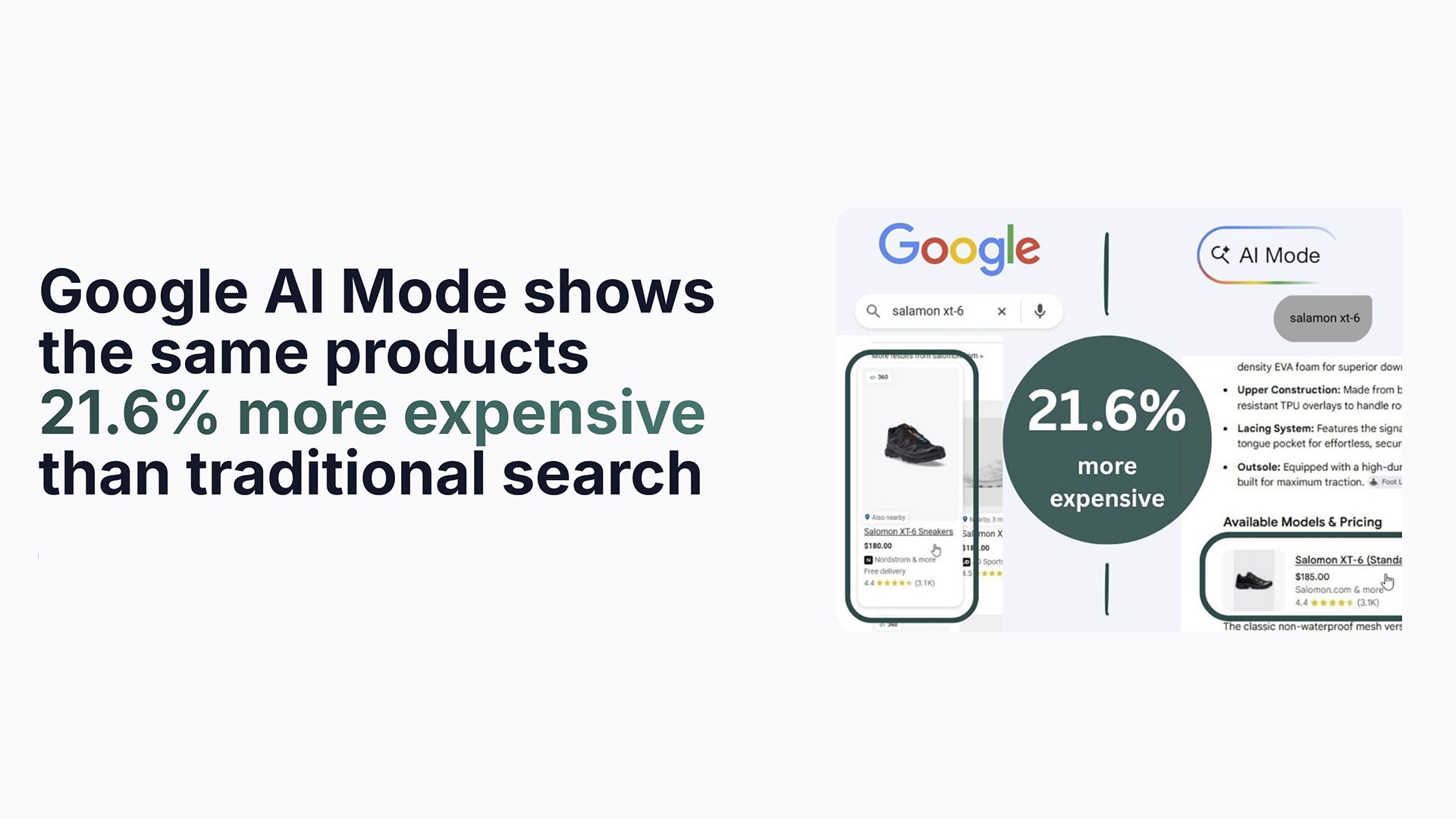
Products that turn up in both Google’s AI Mode and standard search are priced 21.6% higher in AI Mode on average, according to a new Productrise study that tracked over 2M product listings in August. The study found:
- For matched products ranking in both AI Mode and traditional search, AI Mode is 21.6% more expensive.
- Looking at all products on each side (not just the matches), AI Mode listings sit 49% higher than traditional search listings.
- Only 1.28% of products ranking in traditional search also appear in AI Mode for the same search on the same day.
- Matched products show a price discrepancy 38.1% of the time; when they do, AI Mode is more expensive 68.4% of the time.
- The main seller differs on 49.6% of matched products.
The study showcased examples such as searching for a “metal bidet attachment” on Google Shopping surfacing a Brondell attachment at Home Depot for $119.07, while AI Mode surfaced the same device at Walmart for $149.99. Another search for “manual grinder stainless steel” surfaced a hand grinder from one retailer for $159.99 on Google Shopping, and the identical product from another retailer on Google AI Mode for $189.99.
It’s important to note that only 1.28% of products ranking in traditional search also appeared in AI mode, which means each channel has its own method of determining which product is best for the user. Which one is actually best though?
Productrise shared the risk of this practice in their report:
“Shoppers tend to assume AI Mode is working on their behalf, surfacing the best option the way regular search has done for years. The lead price isn’t the only one available: click a product in either AI Mode or traditional search, and a knowledge panel opens in the sidebar listing other sellers and their prices. But that takes a deliberate click, and most people won’t make it. When the main listing is presented as the recommended choice, it’s reasonable to assume it already carries the best price, so there’s little reason to go hunting for a cheaper seller. The number shoppers see first is the number most will act on, and in AI Mode that number tends to be higher.”
Google responded to the study by saying:
“While we haven’t verified the accuracy of the claims in this report, all shopping results on Google Search, including AI Mode and the search results page, are powered by the same data source: our Shopping Graph. Shoppers can easily click into a product listing to compare prices for that product across retailers and choose the best option for them.”
They didn’t address why they were displaying higher priced items as the main result though. My guess is that the issue is a technical one, not a deceptive practice. After all, what does Google gain by showcasing higher priced items within their AI Mode results? Especially when there’s no ad involved, which would certainly change the dynamic.