
Hi Shopifreaks
Last week I had the pleasure of attending Commerce Live in Chicago and meeting several Commerce team members, including CEO Travis Hess, who was kind enough to do an AMA with me and answer reader-submitted questions. Watch the first video here and connect with me on LinkedIn to see the rest of the Q&A videos go live this week.
My plan was to play a drinking game throughout the two-day event during which every time an executive from Commerce used the words “AI” or “agentic” — I’d take a shot of whiskey. However, by the end of the opening speech, I was rushed away to the hospital in an ambulance with severe alcohol poisoning. (LOL, just kidding. I don’t drink.) My joke is that those two words came up quite frequently throughout Commerce Live.
A few quick thoughts about Commerce after attending the event:
- I think they’re headed in the right direction. A lot of industry folks are critical of the company, and some of that criticism is deserved, however, other criticism misses the full story. Commerce’s product roadmap speaks for itself. (More on that in Story #2.) They’re focused on the future, while recognizing that they’ve still got some catching up to do in certain areas.
- On that note, they are unapologetically pivoting. Promises that were made decades ago are no longer beneficial to the company or its merchants in today’s e-commerce landscape. As Travis told me at one point, “The apology tour is over.”
- Commerce (BigCommerce in particular) doesn’t have to be #1 in terms of market share to best serve its clients. Avis was famously #2 behind Hertz for several decades and used that position to its advantage. (Although pay no attention to what’s happened to Avis during the past few years when considering my analogy.)
- I believe in
Harvey DentTravis Hess. I feel that he’s got a solid plan for the company and knows how to properly execute change across an organization of this size. Then again, maybe he’s just a likable guy, and I drank the Commerce Kool-Aid. Either way, I’m heavily invested in CMRC and am along for the ride at this point. What matters next is execution.
What are your thoughts about the future of Commerce? Hit reply and let me know.
In this week’s edition I cover:
- eBayStop or GameBay?
- Commerce Live announcements
- Shopify wants to be a money transmitter
- Jack Dorsey reboots Vine
- Stripe Sessions announcements
- OpenAI makes data-sharing official
- China says no to Meta & Manus
- Elon Musk testifies at the OpenAI trial
- Amazon’s 365 day price tracking
- Shopify’s Managed Payment Methods
- TikTok launches Campus Hub
- Ads are coming to Gemini
All this and more in this week’s 276th Edition of Shopifreaks. Thanks for subscribing and sharing!
Stat of the Week
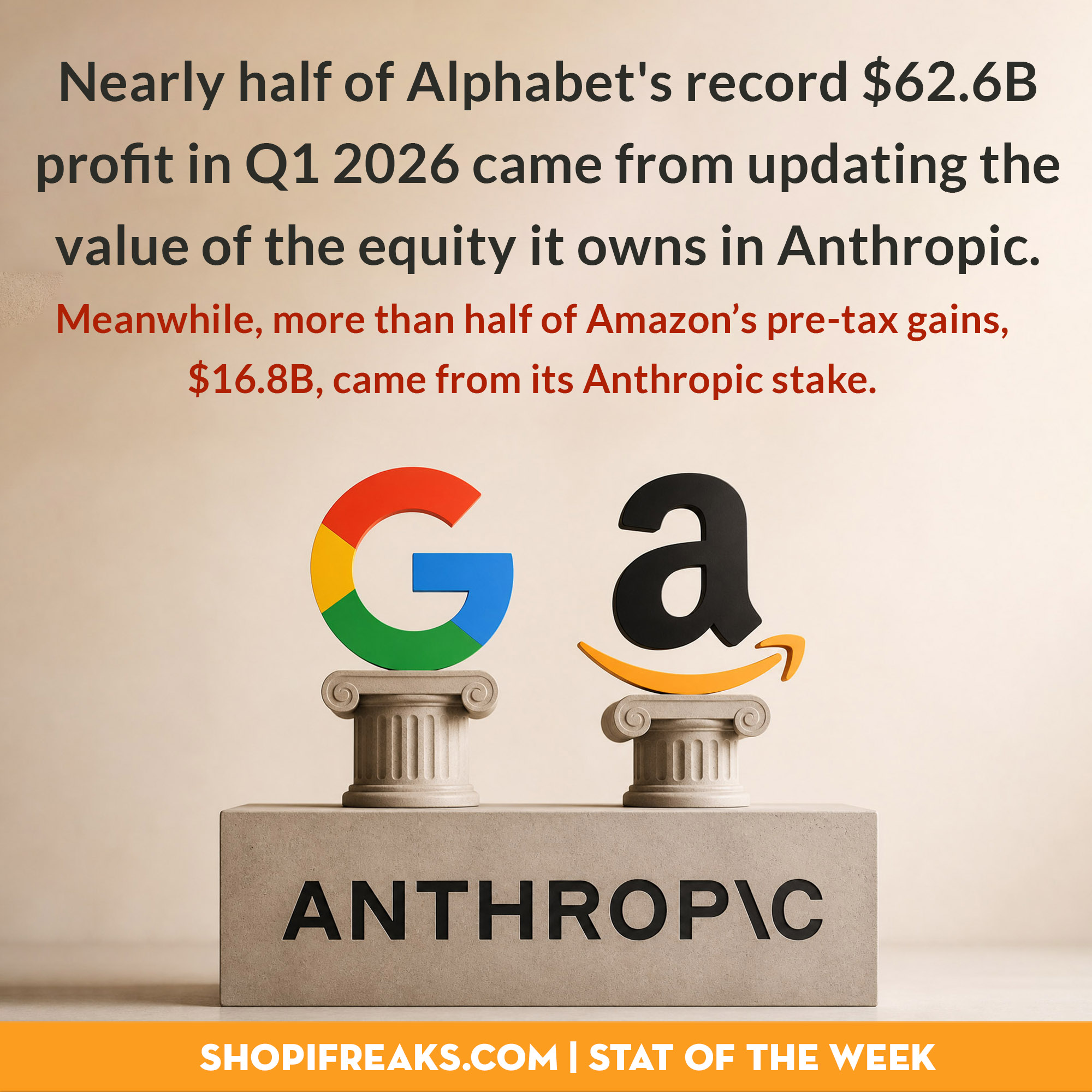
45.8% of Alphabet’s record $62.6B profit in Q1 2026 came from Alphabet updating the value of the equity it owns in private companies, primarily Anthropic, of which Alphabet holds a 14% stake and growing. Amazon disclosed pre-tax gains of $16.8B from its investment in Anthropic, more than half of its profit for the quarter. Amazon told Fortune the markup was triggered by Anthropic’s Series G funding round and the conversion of some convertible notes into preferred stock, with the company’s $8B investment now worth more than $70B.
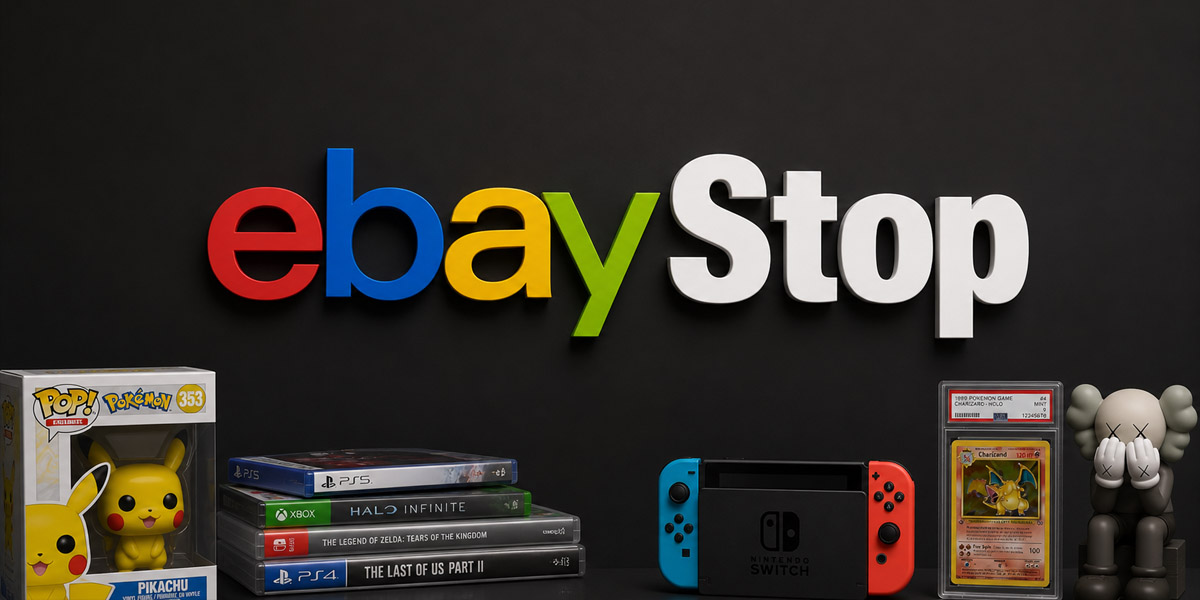
1. GameStop makes an unsolicited offer to buy eBay for $56B
GameStop made an unsolicited offer to buy eBay for $56B, or $125 per share, in cash and stock, a roughly 20% premium to its closing price on Friday and a 46% premium to eBay’s unaffected closing price on February 4, 2026 before the rumors of the offer had circulated, driving the price up. The offer is backed by a $20B debt commitment from TD Bank to help make a deal possible.
The first question I had when I read the news was… What’s with all the unsolicited offers lately to buy companies from people who can’t actually afford to do so? First Rezolve AI tried to buy Commerce. Now GameStop is trying to buy eBay. What’s next? Shopifreaks tries to buy Shopify for $200B? Hold my coconut water while I get my checkbook…
eBay confirmed that it received the unsolicited proposal and would review with its board and financial advisers, but noted that there were no discussions with or outreach from GameStop before receiving the offer. eBay added that its due diligence would take into consideration “the ability of GameStop to deliver a binding, actionable proposal.” Meaning, they don’t think they can afford it either.
GameStop CEO Ryan Cohen said:
“eBay should be worth—and will be worth—a lot more money. I’m thinking about turning eBay into something worth hundreds of billions of dollars… There is nobody who is more qualified, based on my experience, to run the eBay business. I’m going to be as focused on eBay and as personally involved as I have been in the GameStop turnaround for the next few years. It could be a legit competitor to Amazon.”
Cohen told the Wall Street Journal that putting his videogame retailer and eBay under one roof could create opportunities to cut costs and improve earnings, given that the two companies have some overlap already, including a focus on selling collectibles and trading cards. Though to be fair, eBay has been doing that since 1995, while GameStop just entered the business in 2024.
In GameStop’s press release, Cohen points to the fact that $2.4B was spent on Sales & Marketing at eBay in fiscal 2025, but only one million net active buyers were added to the platform, a net increase of less than 0.75%, while promising to deliver $2B in annualized cost reductions within twelve months of closing. He also noted how GameStop’s 1,600 U.S. retail locations would give eBay a national network for authentication, intake, fulfillment, and live commerce — which is an excellent point. Everyone else is going omnichannel. Why not eBay? This was my plan for RadioShack 20 years ago, but no one was listening to me back then.
I’ve enjoyed the public criticism of the plan, particularly from Brittain Ladd who wrote on LinkedIn that “eBay should do what any sane board would do when a wannabe shows up waving a term sheet he can’t actually afford and a story that doesn’t add up: politely thank him for his interest…. and ignore him completely.”
However, I’m less skeptical than Ladd about this deal. eBay has been in desperate need of a shakeup for two decades, and although they’ve recently gotten back on track with new ideas surrounding AI and livestream, I think that some fresh blood in the C-Suite could do the company well. However, is Ryan Cohen the right man for the job? Sure, why not! Let’s give him a shot.
What are your thoughts? Hit reply and let me know.
2. Commerce announces product updates at Commerce Live 2026
Commerce announced a slate of product updates at Commerce Live 2026 spanning core platform improvements, B2B tools, payments, and new agentic commerce capabilities. Announcement highlights from the event include:
- PayPal Store Sync Integration – Lets BigCommerce merchants connect their product catalogs, inventory, and order management to AI shopping surfaces including Microsoft Copilot, Meta, and Perplexity through a single PayPal-powered integration, with PayPal handling checkout, fraud detection, and dispute resolution while merchants remain the merchant of record.
- AI Distribution Channels – Distribution across AI-driven discovery surfaces including ChatGPT, Gemini, Microsoft Copilot, Perplexity, PayPal, and Stripe.
- BigCommerce Companion – An AI-powered merchant assistant that supports day-to-day operations, kind of like a, umm, sidekick…
- Agent-Ready Product Data – Enriched product data through Feedonomics for AI-driven discovery surfaces. This was a big focus throughout the event, as product data is the foundation for many other products offered.
- Conversational Search – AI-assisted shopping experiences on the merchant’s own storefront. No third-party app required.
- B2B and B2C Unification – Commerce is unifying its B2B and B2C platform experiences so merchants who sell to both can manage everything from a single control panel and build on one storefront API layer — a brilliant move given the overlap of the two worlds for most merchants.
- Expanded B2B Capabilities – New tools for complex B2B operations including AI-driven purchase order automation, event-driven webhooks, and advanced pricing logic through cascading price lists.
- Feedonomics Surface Expansion – The self-service feed management solution now supports Microsoft Ads, TikTok, and Pinterest, in addition to Google and Meta.
- Native Hosting for Catalyst – Coming to open beta this summer, this provides production-ready hosting on Cloudflare, managed through a simple CLI interface, with log retention and custom domain support at no additional cost.
- Multi-Language Capabilities – Expanded global selling support with translation APIs, localized URLs and sitemaps, and native translation management tools.
- Advanced Promotions Management – New features including promotion banners, multi-coupon stacking, bulk coupon generation, and shipping method discounts.
- Faster Checkout Performance – Checkout load times reduced by one full second, delivering a measurable increase in conversion rates.
Like I said in the intro, execution is what matters next. Commerce has laid out an ambitious roadmap that addresses both the agentic commerce wave and long-standing platform gaps. The product team is headed in the right direction, but the question is whether they can ship fast enough to keep up with the industry.
3. Shopify seeks regulatory approvals to act as a money transmitter
Shopify is seeking regulatory approvals across the U.S. to act as a money transmitter and provider of prepaid access, according to government records viewed by The Information. The company has already obtained licenses in 18 states and Puerto Rico while applications are under review in remaining states including California and New York.
The licenses would let Shopify hold and move merchant funds itself rather than rely on partners like Stripe or PayPal, giving it more control over how money moves through its platform and the potential to generate more revenue from the transactions it processes for merchants. This could lead to the company offering new capabilities like merchant-to-merchant payments or even its own end-to-end payment processing, adding more margin to its payments business.
Technically, the licenses could also allow Shopify to let customers hold money in their Shop Pay accounts like a digital wallet, instead of Shop Pay just serving as a payment method, which would put Shop Pay in competition with Venmo, Cash App, and other consumer payment apps.
A Shopify spokesperson said:
“Shopify has provided financial products and payment services for years. Obtaining licenses will allow us to keep building on our existing tools that help merchants run their business. Our payment partnerships are foundational to that work, and millions of merchants rely on the infrastructure we’ve built together.”
While in the process of obtaining licenses, Shopify is also hiring for roles to build out a “money movement platform,” including a Luxembourg-based position requiring experience in BIN sponsorship, which lets fintechs tap into a bank’s infrastructure.
Seems like a smart move. Why hasn’t Shopify done this sooner?
Pushing deeper into financial services could increase Shopify’s margin on payment transactions by cutting out intermediaries, but it comes with compliance staffing and other costs such as KYC verification systems, audit teams, and capital reserves required by state regulators. Perhaps, with Shopify’s GMV nearing $380B last year (an almost 30% increase from 2024), it’s just now starting to make financial sense to explore bringing things in-house.
Plus, with Shopify’s Merchant Solutions business (which includes payment processing) responsible for 75% of its total revenue, it’s smart not to have such an integral part of its business exclusively in the hands of another company.
Last but not least, obtaining money transmitter licenses would enable Shopify to act as the primary middleman between its merchants and AI shopping platforms, rather than splitting that role with a third-party payment processor.
4. Jack Dorsey reboots Vine with a new six second video app
Jack Dorsey is rebooting Vine, the six-second video app that Twitter acquired in 2012 and shuttered in 2017. The new version is called “Divine” and brings back 500,000 videos from nearly 100,000 original Vine creators. I know it sounds like a lot of content, but at six seconds per video, that’s only like 833 hours, or roughly 34 days of continuous watch, which is nothing for modern-day doomscrollers.
Relaunching a new video app with archived content from more than a decade ago without the consent of the original creators — is kind of fucked up!
Many of those creators are in their 30s and 40s now and probably had some questionable material on the original app that’s suddenly about to resurface. Imagine if Tom rebooted Myspace and republished your original profile from a public archive. (Though he never would because Tom is the GOAT.)
While I appreciate the nostalgia of bringing back Vine, I definitely don’t like the idea of doing it with the original app’s content. Not to mention, the video quality is probably horrendous!
Divine should relaunch in style, with a collection of new six-second videos from top creators pre-published on the app before its official launch. Some of them could even recreate their original viral hits to add to the nostalgia.
The resurfacing of old content by a new entity that was never given the rights to the original content feels like a lawsuit waiting to happen.
What’s your take? Hit reply and let me know or join the conversation on LinkedIn.
5. Stripe announces new products & features at Stripe Sessions
Stripe announced 288 new products and features at its annual Stripe Sessions conference, which is way too many at once! Luckily for you, I’m here to help share the highlights. Some of these items were announced for the first time, while others you’ve seen me write about in previous editions.
- Streaming Payments – A new AI-native business model combining Metronome and Tempo that allows businesses to get paid the instant value is delivered.
- Checkout Studio – A new way to configure, analyze, and optimize checkout pages with an AI assistant, live transaction replay, A/B testing, and personalized recommendations.
- Stripe Database (preview) – Real-time Stripe data in a managed, hosted, read-only Postgres database, deployable with one click.
- Treasury Rewards – U.S. Treasury balances will now earn Stripe credits that can be applied toward processing fees.
- Free Instant Transfers – U.S. businesses on Stripe can now transfer funds to each other for free, instantly.
- Stripe Card with 2% Cashback – U.S. users can now spend their settled Stripe earnings with a Stripe card powered by Mastercard.
- Stripe Reader T600 – A new countertop terminal device with an 8-inch screen that can run custom apps for loyalty and upsells.
- Agentic Commerce Suite – Sellers can now upload product catalogs and manage agent access directly from the Stripe Dashboard, and platforms can make their connected accounts agent-ready through a single integration.
- Meta Partnership – Native checkout inside ads on Facebook so discovery and purchase happen in one flow.
- Google Partnership – Customers will soon be able to buy products in AI Mode and the Gemini app via the Universal Commerce Protocol.
- Link Agent Wallet – Users can grant agents permission to pay via Link with spending approvals and full purchase visibility.
- Issuing for Agents – Businesses and agentic platforms can programmatically issue single-use virtual cards so agents can make autonomous purchases.
- Stripe Console (preview) – An agentic execution environment built into the Dashboard that lets customers ask business questions in plain language for structured diagnoses, or assign tasks it carries out with confirmation.
- Bot Abuse Prevention (preview) – Designed to distinguish legitimate AI agents from fraudulent actors.
For the full list of 288 announcements, including detailed roadmap items through Q1 2027, check out Stripe’s full Sessions 2026 recap.
6. OpenAI makes data-sharing official and prepares for EU ad expansion
OpenAI updated its privacy policy in the U.S. on April 30 to formalize data-sharing arrangements with advertisers and marketing partners, explicitly acknowledging that it receives purchase data from advertisers to measure ad effectiveness and shares user information with partners for third-party targeting.
The updated policy marks a shift from OpenAI’s prior stance that it would never sell user data, though a company spokesperson told Adweek that “nothing about our policy of not sharing people’s conversations or other private user content with advertisers has changed” and that it only shares limited identifiers like cookie IDs or device IDs.
It’s worth noting that cookie IDs and device IDs can be matched against data broker databases to identify individuals by name, address, and detailed behavioral history. The CCPA and GDPR both classify these identifiers as personal data. So while cookie IDs and device IDs sound relatively anonymous, they’re exactly what ad tech companies use to build full personal profiles.
OpenAI also updated the code on its ChatGPT conversion tracking pixel to add a consent management system and a country data field, indicating that it is building the technical groundwork to run advertising in the EU. The update lets advertisers ask users for permission before tracking and stops tracking when permission is withdrawn, features required under EU privacy law that are not needed in the U.S. where tracking operates on an opt-out basis. Then again, maybe the company is voluntarily updating its U.S. code to support consent because it’s the right thing to do? I wouldn’t put my money on it…
ChatGPT’s ad pilot is extending beyond the U.S. to include Canada, Australia, and New Zealand in the coming weeks, and Digiday reported last week that the company is looking for executives for its ads team in London and Tokyo.
7. China orders Meta to unwind its $2B acquisition of Manus AI
In December 2025, Meta acquired Manus, a Singapore-based AI startup with roots in China, for over $2B. The deal closed quickly, investors were paid, and Manus employees have already joined Meta’s AI team.
Quick History: Manus AI, originally called Butterfly Effect, was founded in China in 2022, two months before ChatGPT’s public launch. The company released its first product, a ChatGPT-powered browser extension, in 2023 and closed its Series A round in 2024. In June 2025, the company moved its headquarters from Beijing to Singapore and laid off most of its Beijing-based staff, with the rest moving to Singapore. By December 2025, when Meta acquired it, Manus had reached over $125M in ARR.
Well, fast forward four months, and China wants the two companies to unwind the deal — though no one is exactly sure at this moment how that would work or whether the order can actually be enforced. Manus co-founders Xiao Hong and Ji Yichao have been barred from leaving China since March while China’s National Development and Reform Commission has been investigating the deal over potential violations of China’s technology export control laws, and now the commission has ordered the deal to be unwound.
That’s got to suck, right? To become an instant billionaire and then have China be like “nuh uh, uh!” and ban you from leaving the country.
A Meta spokesperson said in a statement:
“The transaction complied fully with applicable law. We anticipate an appropriate resolution to the inquiry.”
So what’s China’s argument then?
China believes that even though Manus relocated to Singapore in mid-2025, its intellectual property and technical team were developed in China with state support, making the AI agent subject to Chinese export control and foreign investment laws. The NDRC’s position is that jurisdictional control follows where technology is built and who builds it, not where a holding company is incorporated, and that Meta and Manus failed to notify Chinese authorities before finalizing the deal.
It’s worth noting that this is the first time China’s NDRC has ordered the unwinding of a closed deal under its Foreign Investment Security Review mechanism, setting a precedent that could affect any U.S. company looking to acquire a Chinese-founded startup, including startups incorporated abroad.
8. Elon Musk takes the stand in the OpenAI trial
Elon Musk spent more than seven hours on the witness stand across three days last week in his federal lawsuit against OpenAI, which accuses CEO Sam Altman and President Greg Brockman of betraying the company’s original nonprofit mission when they converted it into a for-profit venture.
Musk, who donated $38M of OpenAI’s earliest funding before leaving the board in 2018 over a power struggle with Altman, is seeking $150B in damages and an order forcing OpenAI to unwind its for-profit conversion, as well as the removal of Altman and Brockman from their leadership positions.
During the trial, Musk’s lead attorney Steven Molo argued that Altman and Brockman “stole a charity,” comparing today’s OpenAI to “a museum store that has taken over the museum.” OpenAI’s lead counsel William Savitt countered that Musk filed the lawsuit out of “sour grapes” because he didn’t get his way at OpenAI, pointing out that Musk himself proposed taking OpenAI for-profit and folding it into Tesla in early discussions.
Here are some highlights from the trial so far:
- “It’s not OK to steal a charity.” Musk repeated that throughout the trial, telling the jury that if he loses the case, “it will give license to looting every charity in America.”
- No written agreement. Musk acknowledged under cross-examination that he never had his representatives draft a contract laying out the conditions of his donation to OpenAI. His defense was, “I reviewed the corporate charter, which said it is a nonprofit.”
- AI doomsday talk banned from the trial. Judge Gonzalez Rogers ruled that the trial would not address whether AI could destroy humanity. “We are not going to get into issues of catastrophe and extinction,” she said, adding, “I suspect that there are a number of people who do not want to put the future of humanity in Mr. Musk’s hands.”
- Musk admits xAI distilled OpenAI’s models. When asked whether xAI used “distillation” techniques on OpenAI to train Grok, Musk said, “Generally A.I. companies distill other A.I. companies.” Asked if that meant yes, he said, “Partly.” Distillation is prohibited under OpenAI’s terms of service.
- “I was a fool.” On day two, Musk said, “I was a fool who provided them free funding to create a start-up. I gave them $38 million of essentially free funding to create what would become an $800 billion company.”
- Microsoft “felt like a bribe.” Musk testified that when he raised concerns to Altman about Microsoft’s $10B investment in 2022, Altman offered him an opportunity to buy stock in OpenAI, which Musk said “felt like a bribe.”
- The xAI hypocrisy. When asked why he didn’t start a nonprofit if he believed nonprofits were the right structure, Musk replied, “I thought I had started a nonprofit with OpenAI but they stole it.”
- The Brockman “diary.” Musk’s most damaging evidence comes from Brockman’s personal notes. In a September 2017 entry, Brockman wrote, “This is the only chance we have to get out from Elon… Financially, what will take me to $1B?” After a November 2017 meeting where he and Altman assured Musk that OpenAI would remain a nonprofit, Brockman acknowledged in writing that Musk’s “story will correctly be that we weren’t honest with him in the end about still wanting to do the for-profit just without him.”
- The $97.4B failed bid. Musk’s family office head Jared Birchall testified that Musk’s February 2025 $97.4B bid for OpenAI’s assets was designed to “prevent the diminishment of the value of the foundation” by setting a market value for it.
Why did Greg Brockman keep a diary with incriminating evidence about a case that he inevitably knew would one day make it to the courtroom? Does he talk about his work crush in the diary too?
The trial is expected to continue through late May with Altman, Brockman, and Microsoft CEO Satya Nadella all on the witness list. The jury’s verdict will be advisory with Judge Gonzalez Rogers issuing the final ruling. If Musk wins, OpenAI could be forced to unwind its for-profit conversion, which could jeopardize its planned IPO in 2026.
9. Other e-commerce news of interest
Amazon’s built-in price tracking tool now allows customers to see how much a product’s price has changed over the past year, up from 30 and 90 days, with the expansion now available in the U.S., U.K., and India. Users can access the feature by opening the Amazon app, selecting the “Price history” button next to an item’s price, or by asking Amazon’s AI assistant Rufus. The expansion comes just weeks ahead of Amazon’s annual Prime Day event, which will give customers a better idea of whether they’re actually getting a deal or simply seeing a marked down version of an inflated price.
Shopify is launching Managed Payment Methods, a feature that will automatically enable and display local payment methods at checkout for stores using Shopify Payments, with no additional fees beyond standard Shopify Payments rates and no third-party integration required. The feature will dynamically determine which payment methods appear and in what order using signals like buyer location, purchase history, and local payment trends, with the goal of showing each shopper their most preferred and most likely-to-convert payment option — though something tells me that Shop Pay will be prominently featured in most circumstances. Shopify is planning to automatically enable Managed Payment Methods on May 27 and is advising merchants to review any existing payment method sorting customizations before that date as they may break. Merchants can disable individual methods or the entire feature in Settings under Payments.
Shopify quietly launched a free tool that lets merchants enter any store URL and receive a scored assessment of how ready their site is for AI shopping agents like ChatGPT and Microsoft Copilot, with no login required. The tool runs 31 checks across five categories including AI discoverability, product schema, transaction readiness, trust signals, and operational maturity, flagging issues like missing JSON-LD structured markup for product reviews, shipping policies that exist on the site but aren’t exposed in structured data, and absent LLM.txt files that AI agents use to navigate storefronts. Merchants who score poorly can use the tool’s impact-effort matrix to identify which fixes will have the greatest effect on their AI discoverability. At the time of publication, the tool was not functioning.
TikTok launched a new “Campus Hub” featuring dedicated college group chats of up to 300 verified classmates and personalized feeds that surface content posted by students and content related to their university. The hub builds on TikTok’s campus verification feature, which it launched last August through a partnership with student verification platform UNiDAYS and lets users add their college to their TikTok profile and browse fellow students. Instagram rolled out a nearly identical feature last year that also allows students in the U.S. to add their college to their profile banner and browse a list of students at their school. I’m old enough to remember when Facebook was exclusive to college students and you had to have a .edu e-mail address to create a profile. That was about the same time period when Kanye West was still performing at college campuses.
Chinese companies cannot legally fire employees to replace them with cost-saving AI, according to a court ruling in the country. The court decided that a tech firm had illegally fired one of its workers after he refused to take a demotion when his job was automated by AI and that the termination “did not fall under negative circumstances such as business downsizing or operational difficulties.” In a separate statement, the court said that companies cannot unilaterally lay off employees or cut salaries due to technological progress. The decision is a win for Chinese workers, but it also puts startups at a significant advantage over legacy players, given that they can launch with an AI-first approach and a smaller workforce from day one. As always, there are positive and negative consequences to every policy.
Google is open to putting ads in its Gemini app, according to Chief Business Officer Philipp Schindler who said on a recent earnings call, “Our focus right now is on AI Mode, but it’s fair to say that we really believe a format that works well in AI mode would transfer successfully to Gemini app.” Wait, so the ad company is open to putting ads in its products? Say it ain’t so! Google has also previously featured ads in AI Overviews within its Search results, but the standalone Gemini experience has so far remained ad-free, and Google’s VP of global ads told Business Insider in January that there were “no plans” for ads in Gemini. Plans change, I guess.
Whatnot, the U.S.-based livestream shopping app that hosts auction-style video shows, launched a direct integration with Shopify that lets merchants automatically sync products, inventory, and orders between the two platforms instead of duplicating catalogs or manually tracking stock. Product descriptions, pricing, condition, inventory, and other data can be managed within the Shopify admin, while live shows are run through Whatnot. Orders made during the livestream are then sent back to Shopify where the merchant can manage fulfillment alongside their orders from other channels. Sellers on Whatnot saw $8B in sales last year, more than double 2024, and the company says that one in eight sellers now operate full-time on the platform.
Amazon launched “Join the Chat,” an interactive feature that allows customers to ask AI hosts questions via text or voice while listening to an audio summary of a product, to which the host answers in real time and then picks back up where they left off. At any point in the podcast episode, the listener can ask a question like, “Is this coffee maker good for beginners?” or “Will these boxers make my balls itch?,” and the host will incorporate the question into the conversation using information from the product’s details and customer reviews, while taking into consideration what’s already been covered so that they can respond with new, relevant information. The feature is part of Amazon’s “Hear the Highlights” service, which offers short-form audio product summaries from AI-generated hosts.
Meta is exploring CTV ad expansion, holding a series of exploratory meetings with supply-side players including Magnite and FreeWheel and TV manufacturers, according to Digiday sources. While no product has been formally announced and the plans remain fluid, the conversations allude to the idea that Meta is seeking ways to extend its advertising demand into third-party CTV inventory, allowing advertisers to use Meta’s targeting and optimization tools to reach users on streaming inventory beyond its own apps. The push would target Meta’s SMB advertiser base, which has historically been priced out of TV advertising, and would put Meta in direct competition with Amazon Prime Video and YouTube in the CTV space.
YouTube entered into an exclusive partnership with SiriusXM Media to sell its “audio-first” advertising inventory in the U.S., covering impressions generated when users listen to content on the platform rather than watch it. Last year, YouTube approached SiriusXM with data on how much listening-only streaming was happening on its platform and concluded that it didn’t have the expertise to monetize those streams in-house, which eventually led to the partnership. Audio accounts for around 30% of media time but attracts only 4% of ad spend, which is a gap the partnership aims to close.
Amazon’s Prime Air MK30 delivery drones, which have been operating in select U.S. cities since late 2024, are dropping packages from 10 feet in the air rather than gently lowering the items, resulting in damaged products. One customer recorded a video of a drone dropping a package containing glass bottles of syrup, which exploded on impact, while other videos show drone propellers blowing previously delivered packages into the street. Amazon said incidents like these are rare and that it has invested in purpose-built packaging engineered to protect items during flight and delivery. Didn’t we all do this in 8th grade science class with an egg drop? I’m willing to license my impact-resistant popsicle-stick delivery box to Amazon if they’re in need.
Look under your seats… everyone’s getting an Oprah Winfrey podcast! You get a podcast! And you get a podcast! Oprah agreed to a multiyear licensing deal with Amazon that will bring her podcast to Prime Video, Amazon Music, Fire TV channels, and Audible starting in July, when it expands from one to two episodes a week as part of the agreement. The deal also covers specials tied to Oprah’s Favorite Things and Oprah’s Book Club, plus all 25 seasons of The Oprah Winfrey Show, though Oprah and Amazon have not yet determined how to repurpose the talk show, and new podcast episodes will continue appearing on YouTube and other platforms. Variety reported that Oprah’s Book Club will tie into Audible, Kindle, Goodreads, and the Amazon storefront, and that Winfrey and Amazon will split sales and ad revenue.
Amazon’s retail division is monitoring AI tool adoption across more than 2,100 engineering teams, tracking weekly deployments per engineer, monthly active users, net promoter scores, and a metric called “Value Deriving Event” that measures how frequently engineers generate outputs or provide feedback using AI tools, according to an internal document viewed by Business Insider. Wow, that’s a very Meta-esque thing to do! Amazon’s goal is for 80% of its retail engineering teams to adopt AI-native practices, with about 60% already there as of February and some teams expected to boost output tenfold this year. The rollout has created internal friction within the division, with engineers flagging concerns about top-down mandates, complicated onboarding, overlapping tools, and unclear success metrics, prompting Amazon to shift toward “collaborative AI practices” and automated reporting rather than requiring use of specific tools.
Sezzle, the Minneapolis-based BNPL provider, is considering adding a checking account, a secured credit card, post-purchase split payments, and an AI shopping assistant to its mobile app. The moves are part of CEO Charlie Youakim’s plan to build a “super app” that gives customers a more complete financial services platform, building on Sezzle’s earlier expansion into mobile phone plans and subscriptions, both launched since mid-2025. Sezzle is also exploring an industrial loan company charter, likely through Utah, though Youakim acknowledged approval is unlikely this year. The company’s stock has climbed roughly 59% over the past year, making Youakim, who holds a 43% stake, a billionaire.
Block published its first proof-of-reserves report disclosing total bitcoin holdings of 28,355 BTC worth approximately $2.2B as of the end of March 2026, confirmed by third-party auditors. Of the total, 19,357 BTC worth roughly $1.5B were held on behalf of customers through Cash App and Square, while corporate treasury holdings totaled 8,997 BTC worth approximately $692M. Block said it adopted the proof-of-reserves approach because users “shouldn’t have to trust that their bitcoin is there, they should be able to verify it,” using on-chain signatures that allow anyone to independently confirm the company’s holdings.
Ask.com, the search engine originally founded as Ask Jeeves, officially shut down after 25 years, as of May 1st. The search engine was launched in 1997 by Berkeley students a year before Google debuted to the masses, and was one of the most popular search engines at the time before Google completely took over. Ask Jeeves was acquired by American holding company IAC in July 2005 in an all-stock deal valued at $1.85B, and the “Jeeves” name was dropped in February 2006 when the search engine was rebranded to just Ask.com. Honestly, I’m surprised they kept it running as long as they did, as it must’ve gotten dozens of searches each day. IAC will continue to run its other digital publications including People, Investopedia, Allrecipes, Travel + Leisure, and others.
Amazon executives have held internal discussions about rebooting Donald Trump’s old reality show “The Apprentice” with the President’s oldest son Donald Trump Jr. as the host, according to Wall Street Journal sources. Discussions are in early stages and Amazon has not yet approached the Trump family, which would likely jump at the opportunity. Amazon inherited the show’s back catalog of 14 seasons through its 2022 acquisition of MGM, so it could launch both the original and the reboot on Amazon Prime Video at the same time if it wanted, as well as use clips from the old show at will. If this does actually happen, I vote they put Barron Trump in the host chair instead. That, I might actually watch!
In lawsuits this week…
- Temu was hit with a class action lawsuit in California accusing the company of using false subject lines, misleading header information, and spoofed domains to push shoppers into opening commercial e-mails. The complaint estimates that Temu is responsible for more than 10,000 spam e-mails to Californians each year, which is probably a wild underestimate! LOL.
- The families of victims of a February school shooting in Tumbler Ridge, British Columbia filed seven lawsuits against OpenAI in federal court in San Francisco, alleging that the company’s inaction regarding the shooter’s use of ChatGPT allowed the incident to happen. The 18-year-old shooter had her ChatGPT account flagged and banned in 2025 for misusing the product for “violent activities,” but OpenAI later determined the account “did not pose an imminent and credible risk of serious physical harm to others” and therefore did not report the activity to law enforcement.
- Meta threatened in a court filing to block access to Facebook, Instagram, and WhatsApp in the state of New Mexico if the court orders the child safety reforms sought by Attorney General Raúl Torrez in the remedies phase of his lawsuit, which begins Monday and is expected to last three weeks. The threat follows a March jury verdict ordering Meta to pay $375M in civil penalties after finding the company misled consumers about platform safety and enabled harms including child sexual exploitation, with Torrez calling the withdrawal threat a “PR stunt,” though Meta defends that the reforms are unfeasible.
- Sherri Hill, Inc., a designer of prom, pageant, and formal gowns, filed a federal lawsuit against Medon, SheIsMe, and related entities that operate the KissProm.com and SheIsMe.com websites for allegedly using copyrighted Sherri Hill photographs and design elements without authorization in advertising and selling formal dresses on e-commerce platforms, with certain images altered and displayed without permission. The company is seeking injunctive relief, damages, and other remedies.
Mark Zuckerberg told Meta employees that the company’s planned layoffs are tied to rising AI capital expenditures and declined to rule out further cuts beyond a planned round this month that will eliminate about 10% of its workforce. Zuckerberg said during a company town hall meeting, “We basically have two major cost centers in the company: compute infrastructure and people-oriented things. If we’re investing more in one area to serve our community, then that means we have less capital to allocate to the other. So that means we do need to take down the size of the company somewhat.” Sounds like it was a very motivating speech…
Salesforce CEO Marc Benioff said that the company is hiring 1,000 new grads and interns to build its Agentforce and Headless 360 agentic AI platforms, while AWS CEO Matt Garman said Amazon will hire 11,000 software development interns in 2026, even as AI reshapes both companies. The announcements were meant to push back on predictions that AI will obliterate entry-level work, but given recent layoffs at both companies, this looks more like a way to replace higher-paid engineers with entry-level roles. Amazon has cut roughly 30,000 corporate roles between October 2025 and January 2026, the largest layoffs in its history, while Salesforce laid off about 1,000 employees in February 2026 with cuts hitting the Agentforce team itself, which Benioff now says he’s hiring 1,000 grads to build.
Microsoft and OpenAI came to an agreement to end Microsoft’s exclusive right to sell OpenAI’s AI models, clearing the way for the AI firm to pursue deals with cloud computing rivals including Amazon Web Services, which it had already announced a deal with. In exchange for dropping exclusivity, Microsoft will no longer pay a revenue share on OpenAI products it resells, though OpenAI will continue paying Microsoft a revenue share on its own product sales through 2030 regardless of whether OpenAI achieves artificial general intelligence, removing a provision in the prior deal that would have ended payments upon reaching that milestone. Additionally, Microsoft remains OpenAI’s primary cloud provider and will receive first access to new OpenAI products on Azure. Honestly, it feels like a fair deal, and Microsoft wins either way, as it holds a 27% ownership stake in OpenAI.
The U.S. Defense Department announced AI procurement contracts with seven tech firms including Amazon Web Services, Google, Microsoft, Nvidia, OpenAI, SpaceX, and the startup Reflection AI, which raised $2B in funding last year. Noticeably absent from the list is Anthropic, which Defense Secretary Pete Hegseth designated as a supply chain risk in March after the company declined to let the Pentagon use Claude for “all lawful” purposes, though Axios has previously reported the Defense Department is using Anthropic’s Claude Mythos Preview model despite the ban. The contracts cover AI products for use in classified Impact Level 6 and Impact Level 7 environments and will be made available through the Pentagon’s internal GenAI.mil portal, which has been adopted by more than 1.3M Defense Department personnel since launching last year.
Speaking of Anthropic… The company more than doubled its public estimate of average daily Claude Code spending from $6 to $13 per developer, noting that costs stay below $30 per active day for 90% of users. Anthropic head of growth Amol Avasare wrote on X that “engagement per subscriber is way up” and that the company’s subscription plans “weren’t built for this,” following last week’s user outcry when Claude Code briefly appeared to no longer be listed as available for Pro subscribers. Classic play, right? Get ’em hooked, then up the price.
🏆 This week’s most ridiculous story… An Amazon driver was caught on camera squatting and pissing between two vehicles parked on a customer’s driveway in California after she delivered his packages. The homeowner said he was “surprised” by what he saw in the footage, which he likely watched dozens of times with his blinds tightly shut. He said that he “probably would have let her” use his bathroom if she had asked since she’s “working crazy hours with no restroom nearby,” but instead, he shared the footage with his local news station, which will likely get the driver fired. Sure, no one wants human piss on their driveway (myself included), but I can only imagine that the driver was facing an emergency situation and had to act fast. A little compassion could’ve gone a long way here before submitting the footage to the news.
10. Seed rounds, IPOs, & acquisitions
Recharge, a subscription and loyalty platform for Shopify merchants, acquired Skio, a competing subscription and loyalty Shopify app, for $105M in an all-cash deal, according to Skio’s founder Kennan Frost. The deal will combine the two companies into a single subscription commerce platform that powers more than 20,000 merchants and processes over $20B in annual GMV. Frost, who stepped back from running Skio about two years ago, is now working on a new startup called Icon that offers an ad-generation product called AdMaker.
Fun, a startup that builds deposit and withdrawal infrastructure letting users move between crypto and fiat currencies on platforms like Polymarket, raised $72M in a Series A round led by Multicoin Capital and SignalFire, bringing its total amount raised to $75.9M. The platform, which launched in 2022, processes more than $18B in yearly payments volume and has built deposit infrastructure for Polymarket, crypto derivatives platform Lighter, and lending app Aave, with more than 20 clients total. The company plans to use the funds to add to its staff of almost 30 employees.
Peter Thiel’s Founders Fund raised $6B for a new fund focused on later-stage investments, marking the firm’s largest haul ever, with $4.5B coming from limited partners including sovereign wealth funds and the remaining $1.5B from senior management and employees including Thiel. The new fund, which is the firm’s fourth growth-stage investment vehicle, is expected to be deployed over two to three years and back about a dozen startups. Thiel’s previous $4.6B fund, which was assembled just one year ago, backed seven companies with average checks of roughly $600M, including a $1.25B bet on Anthropic at a $350B valuation and a $1B investment in Anduril.
Anthropic is entertaining investor offers for a new $40B to $50B funding round that would value the company at more than $900B, according to Bloomberg sources. The new round would more than double Anthropic’s current $380B valuation set in February and would surpass OpenAI, which was most recently valued at $852B in a funding round completed in March, as the world’s most valuable AI startup. Anthropic had previously resisted several inbound proposals from investors for a new round at a valuation of $800B or more and is also considering an IPO as soon as October.
Adobe finalized its acquisition of Semrush, a 17-year-old brand visibility platform with more than 28M marketers, for $1.9B in an all-cash deal at $12 per share, with plans to fold Semrush into the CX Enterprise agentic AI system that it unveiled at Adobe Summit 2026. The deal pairs Semrush’s SEO tools with Adobe’s generative engine optimization and agentic search optimization capabilities across its suite of products, giving marketers a single view of how their brands are discovered and engaged with from initial visibility through to conversion. The deal was first announced in November 2025 and was awaiting approval by the Board of Directors of both companies.
Swanky, a UK-based full-service Shopify Platinum agency, secured a £7.6M investment from YFM Equity Partners’ Buyout Funds to fund continued growth in talent and service capability, along with selective mergers and acquisitions. The agency, which was founded in 2010 and named one of Shopify’s first Plus Partners in EMEA in 2016, has grown to about 70 employees under CEO Dan Partridge with operations across the UK, Europe, and Australia. As part of the deal, former Havas Creative Group Global CEO Chris Hirst will join the company as chair while Elly Adams joins the board as CFO.
Mojro Technologies, an India-based AI logistics platform that optimizes route planning, fleet utilization, and supply chain efficiency, raised $5.5M in a Series A round led by IAN Alpha Fund and Dallas Venture Capital. The company claims that its platform helps customers achieve up to 20% reduction in logistics costs while improving service levels and decision-making. It plans to use the funds for global expansion and product innovation.
Thanks for being a Shopifreak!
If you found this newsletter valuable, please leave a review on Google and share the newsletter with your friends and colleagues to help us grow.
See you next Monday,
PAUL
Paul E. Drecksler
🌐 Shopifreaks.com
🧑💼 Add me on LinkedIn
📧 [email protected]
📱 +1-828-273-3031
⭐ Leave A Review
PS: Where do math teachers go on vacation? … Times Square