
Hi Shopifreaks
I had an influx of new readers this week, so welcome everyone! Thanks for taking the time to reply to my welcome e-mail and introduce yourself. I read all your replies and greatly appreciate knowing who’s on the other side of these e-mails, although apologies that it sometimes takes me a few weeks to get back to you.
If this is your first edition with me, you’re in for a treat. I’ve got an absolutely jam-packed edition for you today, so let’s dive right in.
In this week’s edition I cover:
- Amazon pushes deeper into visual search
- Google launches Search Profiles
- Shopify doesn’t want AI regulation
- Walmart now delivers Subway sandwiches
- Meta launches AI business agents
- Summer sales events kick off in June
- Amazon brings ads to Prime Music in India
- MegaCap IPOs won’t make it to the S&P 500 right away
- U.S. retailers had a strong Q1
- Google tests healthcare ads in AI Mode
- Shopify went down for 2 hours
- Temu heavily slashed its U.S. ad spend
All this and more in this week’s 281st Edition of Shopifreaks. Thanks for subscribing and sharing!
Stat of the Week
OpenAI’s heaviest internal token user burns more than 100B tokens a month, according to Sam Altman. That number is up from 100k tokens six years ago. At 100B tokens per month, I’d be asking for equity in the company at that point!

1. Amazon launches real-time AI images as you type in the search bar
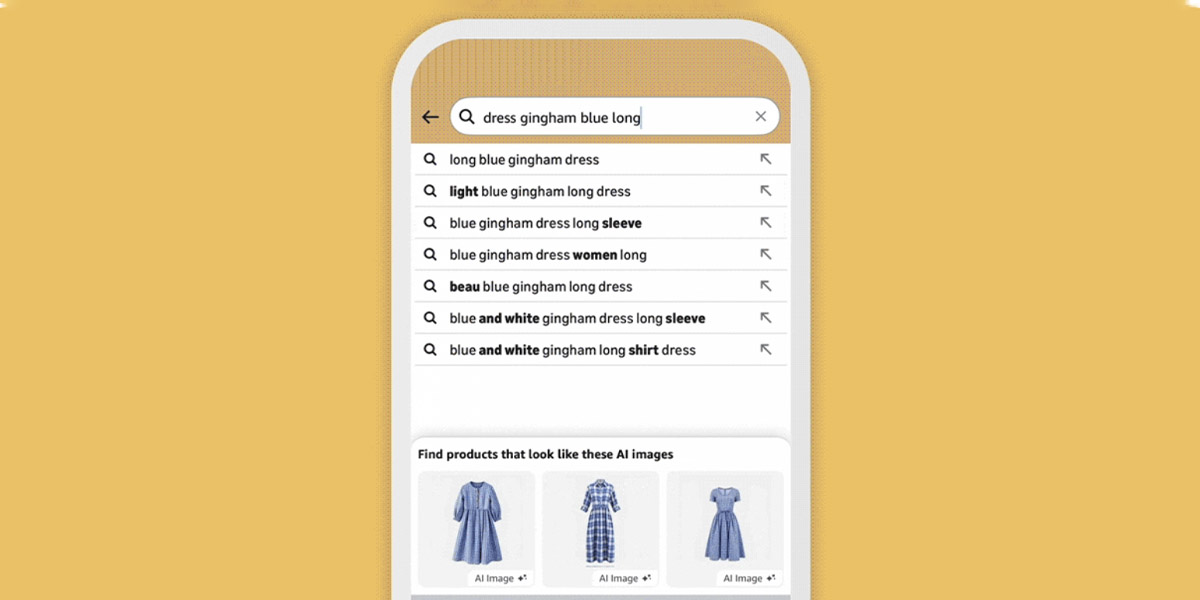
Amazon began rolling out a U.S. feature that displays AI-generated images in real-time when shoppers type product queries into the search bar, meant to illustrate concepts and refine searches rather than showcase actual items for sale. The goal is to help shoppers who don’t know the precise terminology for what they want, such as “cowl neck” for a draped collar or “rattan” for woven furniture, with tapping an image leading to more tailored results instead of specific products.
Reporters threw a lot of shade at this feature:
- PPC Land called it a “trust experiment nobody asked for.”
- TechCrunch said “it’s somewhat bananas for a retailer to make up fake products as a way of guiding users to search results,” claiming that it could be “potentially misleading” because customers may “think they’re being directed to a page where they could find that exact dress, then be disappointed when it isn’t available.”
- 9to5Google called the feature “wildly wasteful in terms of the use of AI resources” and “remarkably dumb.”
- Thurrott was unconvinced, writing, “I’m not exactly sure how showing fake products to potential customers can really drive sales.”
Other critics questioned why Amazon would generate fake product images when millions of real catalog photos exist, and warned that shoppers could fixate on an AI image only to find the item isn’t actually for sale.
Personally, I think the feature is quite innovative and helpful!
One complaint I’ve had with AI chatbots thus far is that despite having the ability to ask qualifying questions before spitting out a giant wall of text — they don’t. ChatGPT especially will go off the rails with long, detailed answers before fully understanding my search intent, when it could easily generate a quiz or follow-up questions before burning through tokens. (Claude has gotten good at doing this in recent months.)
Plus, as a shopper who admittedly doesn’t know all the words for the various styles of fashion or home goods, I appreciate a visual representation of what I’m trying to search for. The classic quote “a picture is worth a thousand words” is particularly true when shopping online. This is why Airbnb CEO Brian Chesky wants to build his own AI lab that focuses on UI and design for travel and e-commerce. More on that in Section #9.
Lastly, in regard to misleading customers, Amazon couldn’t make it more obvious that these are not real products, with a section title of “Find products that look like these AI images” and then labeling each thumbnail “AI Image” for added disclosure. Though to be fair, an estimated 1 in 5 adults in the U.S. are functionally illiterate, so written disclosures only get you so far. But then again, that could also be an argument for needing more visuals.
In addition to the real-time AI images, Amazon announced 7 other visual shopping features, some of which I’ve covered in previous editions, and others that are new.
2. Google launches Search Profiles for creators and publishers
Google launched Search profiles, a single shareable page for publishers and creators to “shape their presence” on Search and give readers one spot to track a source’s recent articles, clips, and posts. Users can follow a source straight from its profile and then see more of its work surface in Discover, with the profiles reachable through a knowledge panel, from Discover, or via direct link.
Publishers and creators with a “sizable following,” which Google defines as over 100k followers on YouTube, Instagram, or X or more than 300k followers on TikTok, can claim and customize their profile, which then generates a knowledge panel for those who don’t already have one.
Obviously, this is in direct response to backlash that Google is being hit with over its AI Mode and AI Overviews taking traffic away from publishers. Now Google can defend itself by saying — we provide a direct portal within our search, discover, and AI platforms to engage directly with creator and publisher content.
It’s also a way for Google to further tap into the creator market without having their own social network, by effectively organizing the creator and publisher world in the same way they organized local business markets in the past. The move is incredibly smart, as aside from a personal website, there really isn’t a major platform that pulls a creator’s online presence from various platforms into one panel.
I look at these new Search Profiles as sort of like Google Business Profile for creators and publishers, and it wouldn’t surprise me if the two worlds merged at some point in the future, given the overlap. (ie: Businesses are creators and vice versa.)
The feature is rolling out in the U.S. first, with wider expansion and added features planned. You can see if you’re eligible for a Search profile here.
3. Shopify wants governments to stay out of its way with AI regulation
Shopify is asking governments not to create AI-specific regulations, arguing that policymakers should instead update existing privacy, competition, and other rules where necessary and recognize voluntary industry-developed standards. Keyword there being “voluntary.”
The company also wants governments to reject “duplicative or jurisdiction-specific” statutes in favor of globally compatible rules, and to avoid requiring firms to audit and obtain pre-approval before launching AI applications. So basically, stay out of its way?
The company wrote:
“Shopify exists to make entrepreneurship more common. That is the principal lens we apply to AI regulation. From it, the question on every proposed law is simple: does this make it easier or harder to start a business? Most of what is being written today fails that test.”
I respect Shopify’s AI ambitions, but this is a horrible take, as AI impacts the world in many, many more ways than starting a business. Existing laws around privacy and competition are already outdated. The U.S. and other governments don’t just need new AI addendums layered on top of archaic laws; they need an entire new AI constitution.
Shopify also wrote in its blog post to “address the risk, not the tool” — which seems fair on the surface, until you realize that every example they offered up as legitimately high-risk is conveniently outside their lane: hospital diagnoses, court sentencing. They never name a single high-risk AI use in commerce.
And there are obvious ones sitting right in their market:
- AI-driven dynamic/surveillance pricing
- algorithmic credit and BNPL decisioning
- AI ad targeting and dark patterns
- recommendation systems that can defraud or manipulate
- models trained on merchant and shopper data without consent.
Any of those could carry real consumer harm. By drawing the risk line so the dangerous stuff is always somebody else’s industry, “regulate the risk, not the tool” quietly becomes “regulate everyone’s risk but ours.”
I do agree with Shopify that simple, universal AI regulation would be better than overlapping national and regional laws, but unfortunately that’s not realistic in 2026. The current U.S. administration has all but abandoned consumer and worker protection agencies. And on a global scale, the World Trade Organization can’t even come to a consensus about how to tax digital commerce moving forward. What makes Shopify think world powers can agree on how to govern AI?
On one hand, big tech companies talk about how game changing and impactful AI will be on the world as part of their sales pitch. “There’s never been any technology like it.”
On the other hand, they downplay the potential negative consequences of that impact in regard to the need for proper regulation. “Not all AI uses are equally risky.”
AI regulation shouldn’t be about convenience. It should be about fairness, consumer and worker protection, and respect for the collective knowledge AI is built on. Sorry if that adds a few roadblocks to the next AI-powered industry-killing machine.
What are your thoughts on AI regulation? Hit reply and let me know or join the conversation on LinkedIn.
4. Walmart adds express delivery for in-store restaurants, starting with Subway
Walmart is entering the restaurant-delivery business with the launch of a new 30-minute delivery option from 1,400 in-store Subway locations this summer. Yippee! I can have a $15 sub sandwich delivered!
That’s just the beginning though. Eventually Walmart wants to also deliver meals from restaurants located near its stores (not just in them), according to executives. And from there, the sky’s the limit in terms of its delivery reach.
Senior VP of E-commerce Fulfillment Transformation Greg Cathey said:
“You can draw a circle around most Walmart stores and almost all quick-service restaurant brands are within 5 miles. We think it’s a natural evolution over time.”
The move would of course put them in direct competition with DoorDash, Uber Eats, and other restaurant delivery apps, which the WSJ notes is a “highly competitive business” with “thin margins.” But that wouldn’t stop Walmart, as the company has built its entire trillion-dollar business operating on thin margins. You could argue that no one navigates thin margins better than Walmart.
Subway is Walmart’s largest in-store restaurant tenant, and its sandwiches are quick to make and they travel well, so it makes sense that they begin the service on their own turf. Other Walmart locations offer in-store Domino’s, Taco Bell, and McDonald’s restaurants, which I’d imagine means they are next to offer the express delivery.
5. Meta launches AI business agents to book appointments and close sales
Meta globally launched an AI agent for businesses across WhatsApp, Instagram, and Messenger that can answer customer questions, make product recommendations, book appointments, and close sales, with future capabilities like market research and calendar management planned. Meta called it “AI that lets every business show up for every customer as if they had an infinite team behind them.”
Meta says that more than one million businesses are already using a Meta Business Agent on WhatsApp and Messenger to respond to customers, and now the tools are available to all businesses globally, as well as on Instagram for the first time. Businesses will initially be able to access the tool for free, but Meta plans to charge a subscription fee for access in the coming months.
Alongside the Business Agent offering, the company is launching a broader “Business Agent Platform” that enables companies to build their own custom AI agents that help them manage their operations elsewhere. The platform connects to hundreds of systems like Shopify, Zendesk, and Shopee where its agents can be deployed, while providing enterprise businesses with deeper controls, guardrails, and measurement options.
Meta’s head of product Naomi Gleit told Reuters:
“We actually want to take actions now. We actually want it to be able to complete the payment, to process the booking, to place the order… This is definitely an enterprise play. The number one thing I hear, especially from small businesses, is ‘I just want to go to one place that can do all the things.'”
Meta will spend as much as $145B this year on AI infrastructure, and its new Business Agents are a way to help the company recoup its investment. Time will tell if it will pay off as well as its investment in the metaverse.
6. Summer sales events kick off with Amazon Prime Day announcement
Every year, the same thing happens: Amazon announces its summer Prime Day sales event, and then every other major retailer falls in line behind them with their own sales event announcements, which often intentionally overlap with or begin right before Prime Day. This year is no different.
Amazon announced that its annual summer shopping event will run four days again, from June 23 to 26, with deals dropping across more than 35 categories for Prime members. Jamil Ghani, Amazon’s VP of Prime, said that groceries and household items will be a “real focus” of this year’s promotions, with shoppers seeing produce, hot dog buns, and meats for as low as $1, while certain personal care items like soap are expected to be 50% off. He noted, “We’re sensitive and cognizant that there’s economic uncertainty and everyone’s trying to make their dollar, their euro, their rupee stretch further.”
Shortly after Amazon’s announcement, every other major retailer made their own:
- Target announced that its Target Circle Deal Days would last four days and run from June 23 to 26, same as Prime Day. The company shared upcoming deals across kitchen, bedding, and bath items, back-to-school essentials, outdoor gear, and clothing. Plus, the company is offering new one-day-only offers throughout the event including 40% off or more from brands like Crocs, Igloo, and Sun Bum.
- Walmart’s Deals event will return on June 22 for Walmart+ members, one day before Prime Day begins, and June 23 for all shoppers, and run through June 28, according to Today and 9to5toys. 9to5toys attributes the dates to Walmart directly, while Today references a press release it doesn’t link. I couldn’t find that release or any official Walmart announcement, so take it with a grain of salt for now.
- Best Buy is reportedly running its Tech Fest Sale from June 22 to 28, offering up to 50% off major tech alongside extra cash-back rewards for members.
If anyone has a publicly verifiable source that can substantiate those event dates for Walmart, please let me know by replying to this e-mail or commenting on my LinkedIn post.
7. Amazon brings ads to its Prime Music tier and launches a paid ad-free plan in India
Amazon will begin playing ads on its Prime Music tier in India as of July 2, which is included with a Prime membership but previously offered ad-free, on-demand listening with offline downloads. Simultaneously, the company launched Music Unlimited in India for the first time, steering users who want to “continue listening ad-free and offline with HD and Spatial Audio” toward the paid tier.
Users in Australia reported receiving similar e-mails. For now, the rollout does not affect subscribers in Canada, Mexico, or the U.S., but without a doubt, it’s headed their way soon. If Polymarket or Kalshi had a bet on this, I’d go all in!
Is it just me, or is Amazon Prime becoming an ad-supported trial of the company’s premium services?
In recent years, Amazon has continually gutted the value of its Prime membership. For example…
- Prime Video used to be ad-free by default. Now ad-free costs extra.
- Amazon Music used to offer 2 million songs on demand. Now the bigger catalog is mostly shuffle-only unless you pay for Music Unlimited.
- Twitch Prime used to include universal ad-free Twitch viewing until Amazon removed it.
- Free Prime Shipping used to be its highest and fastest shipping tier. Now Amazon sells faster delivery on top of Prime, such as Same-Day Delivery or Amazon Now (30-minute delivery).
- Amazon grocery delivery from Whole Foods and Fresh stores used to be an included Prime perk. Now it’s a paid delivery add-on.
- Prime shipping used to be shareable with friends and extended family outside your home. Now the “Prime Invitee” program is dead and you can only share the benefits with one other adult in your household.
All the while, Amazon Prime has gotten 40% more expensive during the past 10 years, and technically 100% more expensive if you include paying for the ad-free add-ons to Prime Video. None of that feels very Prime to me.
What are your thoughts? Hit reply and let me know or join the conversation on my LinkedIn post.
8. SpaceX, OpenAI and Anthropic won’t make it into the S&P 500 immediately after IPO
The S&P Dow Jones Indices decided not to change its guidelines for when “megacap” companies like SpaceX, OpenAI, and Anthropic are included in its stock indexes, terminating a proposal it had floated in April to fast-track the three companies.
The idea had been to shorten the “seasoning period” so that megacap companies, which S&P defines as the 100 largest in its Total Market Index or roughly $157B in market cap, could join soon after going public. Instead, the committee left its rules untouched, which means the three most hyped IPOs of the year will still go through the same purgatory as other companies that go public.
Historically, to qualify for the S&P 500, a company has to trade publicly for at least 12 months, post four consecutive quarters of positive GAAP earnings, and have enough shares floating in the public market — criteria which all three companies fail on multiple counts. None of the companies have traded for more than a year, none are profitable, and SpaceX plans to only float small slices of its shares.
On April 30, S&P Dow Jones Indices opened a “Consultation on the Treatment of MegaCap Companies” public consultation, where it proposed cutting the seasoning period from 12 months to 6, waiving the four-quarters-of-profitability requirement, and waiving the public-float minimum. Its job is to keep the S&P 500 representative and useful to trillions in funds that track it directly or are benchmarked to it, and the conversation was centered around whether waiting a year or longer to include companies of this unprecedented size would be unrepresentative of the market. Ultimately, they decided to reject all three rule changes and keep things as-is.
Why does it matter if they’re included or not?
Inclusion in major index funds releases a tidal wave of forced buying. Every index fund and ETF that tracks the S&P 500 has to buy a stock the moment it joins, regardless of price. Bloomberg Intelligence estimated that automatic demand at around $14B for SpaceX, more than $8B for OpenAI, and about $4.6B for Anthropic. Getting in early would have meant billions in guaranteed inflows, which immediately impacts the retirement savings of ordinary Americans. Roughly $7.5T in 401(k)s, pensions, and index funds passively track the S&P 500, which means that the day one of these companies joined, tens of millions of people would automatically own a slice of it, bought at whatever price the market set, profitable or not, whether they wanted that exposure or not.
The flipside of the coin is that it means S&P investors sit out on potentially the biggest growth story of the decade, while rivals like Nasdaq and FTSE Russell, which loosened their own rules, scoop up the IPOs within weeks.
Obviously there are pros and cons to the average American retiree having exposure to these stocks, but as someone who’s bearish on the current market value of these AI companies, I think they came to the right decision. What about you? Hit reply and let me know.
9. Other e-commerce news of interest
U.S. retailers posted a strong fiscal first quarter, with sales and profits rising across major chains, though analysts warn higher-than-usual tax refunds and record BNPL use likely masked underlying consumer weakness. Target’s same-store sales jumped 5.6%, its first positive quarter in five, while Ross saw comparable sales surge 17% and Burlington estimated refunds added 1.5 to 2 points to its 6% growth. BNPL adoption hit new highs across income groups, with 15% to 17% of shoppers earning up to $150k using the services, per Consumer Edge data. Retailers including Walmart, Ross, TJX, and E.l.f. Beauty issued cautious Q2 guidance, with Walmart’s CFO warning consumers will feel more strain from high fuel prices as the tax-refund boost fades. E.l.f.’s CEO said “the consumer is suffering.”
Google has begun a small test of healthcare-related ads in the U.S. across both AI Mode and AI Overviews, with PMax, AI Max, Shopping, and broad-match Search campaigns all eligible to serve. Google Ads Liaison Ginny Marvin disclosed the move in response to a question on LinkedIn, noting that the first iteration is limited to creatives that don’t use pinning or text disclaimers. Last week, I reported that OpenAI was expanding its ChatGPT advertising platform to small businesses, but that ads would not appear near sensitive topics like health and politics. I wrote, “I imagine the ‘health’ stance will change in the future, as that’s a valuable advertising sector.” Let’s see how fast it changes now that Google broke the seal.
Shopify experienced a two-hour outage on Wednesday morning, with merchants and customers encountering issues with admins, checkouts, storefronts, POS systems, and access to support. The outage was fixed within a couple of hours, but Shopify did not provide any information about what caused it beyond vaguely calling it “an infrastructural issue.” Also, why does Shopify NEVER fucking apologize? Like, literally, EVER! The only thing the support account posted on X was, “This has now been resolved. Thank you for your patience.” Thanks for my patience? What freshman “how to sound corporate” textbook did you pull that one from? On that note, I’m still waiting for my apology from Cyber Monday 2025 – when Shopify experienced a major outage that lasted more than half the day, and not a single company account or leader apologized for it. You have no idea how much their lack of apologies pisses me off. I’m actually mad typing this right now. I’m a Shopify shareholder, partner, and store owner — and I have higher expectations for the company.
Temu slashed its U.S. ad spend across nearly every major social media platform in the first half of 2026, according to Sensor Tower and reported by Digiday. The company went from being X’s largest advertiser by a landslide between January and May 2025 to the 51st largest during the same months in 2026, reducing its budget by 95% YoY. Temu also reduced its spend on YouTube by 74%, TikTok by 74%, Snapchat by 46%, and Instagram by 10%. The only platform that it upped its ad spend on was Pinterest by 66%, which now accounts for 12% of Temu’s total U.S. ad spend. However, despite the steep advertising cuts, Temu’s downloads have held steady between 5.5M and 6.8M on average every month, and its U.S. monthly active users rose 21% YoY. It makes sense, right? Tariffs made it more expensive to play in the U.S. market, and the cuts had to come from somewhere. At the same time, Temu has grown to be a household name, so it might not require the same level of advertising anyway. It’s not like TikTok still runs ads on Facebook and YouTube anymore either.
The U.S. Justice Department disrupted more than 1.4M social media and e-mail accounts tied to Southeast Asian scam networks in a first-of-its-kind operation called “Disruption Week” that brought tech and crypto firms together with federal and foreign investigators. The effort, which ran from May 18-21, had companies including Apple, Meta, Coinbase, Google, Microsoft, and SpaceX voluntarily interrupt accounts used by criminal groups running “pig butchering” crypto investment scams, in which fraudsters build trust with victims before steering them into fake investment platforms. Coinbase used blockchain records to help freeze more than $3M in stolen crypto, while the operation as a whole led to 63 arrests and thousands of Starlink kits terminated. The crackdown comes as reported U.S. crypto investment-scam losses climbed to over $7.2B in 2025, up from $5.8B the year before.
Senator Bernie Sanders proposed the American AI Sovereign Wealth Fund Act, new legislation that would impose a one-time 50% tax, paid in shares, on OpenAI, Anthropic, and xAI, and deposit the equity into a public fund that gives ordinary Americans voting rights, board representation, and eventually dividend checks. It should include Google and Meta too, right? Why should they get a free pass? Might as well include Nvidia and other chip manufacturers benefiting from the gold rush while they’re at it. Sanders argues that because AI was trained on the public’s collective work, the public should share in its profits, which is an argument echoed by Senator Elizabeth Warren’s AI tax proposal. Fortune notes that the White House has already taken equity ownership stakes in 20 private companies since President Trump took office, according to estimates, so it could potentially be in favor of the legislation. However, a notable difference is that the Trump administration hasn’t begun distributing profits back to Americans yet and doesn’t plan on it as far as I know, which would be a key part of Sanders’ legislation. The concept of a sovereign wealth fund is not new, as dozens of countries around the world already have one, including Norway’s fund, which is worth over $2 trillion.
Remember a few weeks ago when the news broke that Meta planned on installing a software program on all of its employees’ computers that would track their keystrokes, mouse clicks, and movements, and capture screenshots of apps and websites as they were in use? Pepperidge Farm remembers. The announcement drove intense criticism and backlash from reporters, employees, and the industry at large, as it should have because it’s really, really fucked up. At some point, employees started circulating flyers in meeting rooms, on vending machines, and atop toilet paper dispensers at Meta’s offices that asked, “Don’t want to work at the Employee Data Extraction Factory?” Well, Meta heard the concerns loud and clear and made a few extremely small concessions, including allowing some staff to request exemptions (wow, a real live request?) and giving employees an option to pause the tracker on their computers for 30 minutes at a time during lunchtime porn sessions. So basically, moving forward with the plan as-is.
Amazon unveiled a next-generation version of its autonomous Proteus warehouse robot, a Roomba-looking device that can move heavy carts throughout an entire facility, controlled by workers using plain, conversational language. (And unlike its human workers, it won’t steal hundreds of thousands of dollars worth of items from the facility.) The robots are part of a more than €10B commitment to expand and modernize the company’s European fulfillment network, which also includes expanding two other robotic systems, Vulcan and tote-handler STARK, as well as plans to grow Amazon’s human workforce in the region by 25,000.
The Trump administration proposed new tariffs of 10% or more on dozens of major trading partners, following a U.S. Trade Representative probe that found 60 countries failed to impose or enforce bans on importing goods made with forced labor. Countries including Canada, Mexico, Taiwan, and the UK would face an additional 10%, while China, Japan, India, South Korea, Brazil, and Switzerland would face 12.5% on certain products. Didn’t the Supreme Court already determine that Trump’s tariffs were illegal? Haven’t we been down this road before? Yes, but this time, the duties were brought under Section 301 of the Trade Act, a strategy that lets Trump sidestep the limits the Supreme Court placed on his tariff power in February. The tariffs wouldn’t take effect immediately, as public hearings are set to begin July 7. Actually, I’m happy about these tariffs because just the other day I was thinking about how things aren’t expensive enough right now…
Airbnb CEO Brian Chesky is starting a new AI lab to build his own models, with an early focus on user interaction and design, according to Bloomberg sources. Chesky will stay on as Airbnb’s CEO and won’t run the lab, which is still in early funding stages, so details could shift. Chesky has long argued that AI for travel and e-commerce needs a rich user interface rather than the text-based chatbots from OpenAI and Anthropic, which is why Airbnb, unlike rivals Expedia and Booking, has declined to build a ChatGPT plug-in. He’s planning to build the AI lab while simultaneously reshaping Airbnb into a “do-it-all” travel app with unspecified add-on services he’s betting could eventually pull in $1B or more a year.
Google is testing a way to send search queries straight into AI Mode, bypassing the standard results page and its blue links to individual sites, according to Windows Report, which found a hidden flag in the experimental Chrome Canary browser. With the flag on, a search drops you into something that behaves more like a chatbot conversation than a results page, rather than the current setup where an AI Overview sits above the links and AI Mode is a separate tab. The author of the flag’s code left a note saying it is only for exploration with no current plans to ship it, which Google’s VP of Search Engineering, Rajan Patel also confirmed. Though you never really know, especially given Google’s recent AI push.
Klarna CEO Sebastian Siemiatkowski likened his BNPL company to American Express nine times during his 51-minute conversation with analyst Harshita Rawat at a Bernstein investor conference, claiming that both are customer-focused lifestyle brands rather than banks. Where Amex leaned on travel and dining during its climb against Visa and Mastercard in the 1990s and 2000s, Klarna is growing through fashion and beauty merchants like Macy’s, Sephora, and Ulta Beauty, where purchases are smaller but happen more often. Siemiatkowski says his company can use that base to expand into bigger-ticket financing and everyday spend like groceries. He also argued Klarna’s 120M users are a marketing draw for merchants the way Amex’s base is, and brushed off worries that agentic commerce could sideline payment brands, saying customer preference will hold. Just curious, but he knows that Amex is still a company, and that it also offers its own BNPL product, right?
SpaceXAI made its first move into consumer commerce by teaming up with Gopuff, an on-demand instant commerce platform that delivers everyday essentials from its own micro-fulfillment centers. The two companies launched Go, an agentic shopping assistant powered by SpaceXAI’s models that assembles and fills a cart for customers rather than waiting for them to search, drawing on Gopuff’s order data and real-time signals from X alongside each shopper’s habits, time of day, location, and order history. It also adds a TikTok-style shoppable feed that drops products into context-aware scenes such as wings and drinks on game day or hot chocolate on a snowy afternoon, as well as a voice mode that lets customers build a cart hands-free with requests like “snacks under 100 calories.” Orders arrive within 15 minutes from Gopuff’s more than 400 micro-fulfillment centers.
Lawsuit news this week…
- OpenAI and CEO Sam Altman are being sued by Florida for allegedly concealing ChatGPT’s dangers to society in order to inflate the company’s valuation. The suit wants Altman held personally liable over the chatbot’s alleged role in mass shootings, suicides, and the addiction of minors.
- Amazon’s Ring is facing a proposed class action over Familiar Faces, the AI feature that scans and identifies guests, workers, and passersby without consent. The plaintiff is seeking an injunction against the practice and at least $5M for millions of affected Americans, alleging violations of the FTC Act and Virginia law, which both bar companies from quietly collecting personal data without consent. Ring already disabled the feature in Illinois, Texas, and Portland, Oregon, where biometric rules are more strict.
Layoff news this week…
- Private employers added 122,000 jobs in May, according to an ADP report, beating the 110,000 jobs economists expected and marking the strongest hiring month of the year, while job openings climbed to a near-two-year high of 7.6M. However, the information sector, which includes software publishing, data processing, telecommunications, broadcasting, and film and sound recording, shed 9,000 jobs, the steepest cut of any sector, while workers who kept their jobs only got 4.4% raises, the crappiest in the economy.
- Google quietly laid off employees across its Cloud division, including its Threat Intelligence Group, which publishes research tracking hackers, and Mandiant, the cybersecurity firm it acquired in 2022. The exact number of people affected and the reason for the timing aren’t clear, though in at least one case Google cited the need to invest more money into AI.
Corporate shakeups this week…
- Meta hired Jim Shepherd, Snap’s former director of global content partnerships, to bring more celebrities and high-profile creators into its AI device strategy. At Snap, Shepherd built relationships with musicians, sports stars, and other influencers, and he’ll now use those connections to get more big names wearing Meta Ray-Bans and posting content filmed through the glasses.
- OpenAI hired Jason Boehmig, a former corporate attorney who co-founded contract-management firm Ironclad in 2014 and ran it as CEO until 2025, to lead product for its newly created legal vertical, the company’s first move into legal-specific AI tools. Boehmig said the legal industry is grappling with generative AI across firms, in-house teams, bar associations, pro bono groups, and law schools, adding that “it’s a mistake to believe that any one player can do it alone, even a frontier lab.”
- Condé Nast appointed Violaine Gressier, formerly Meta’s global head of luxury partnerships, as commercial director for France to oversee advertising and partnerships across the group’s French portfolio, including Vogue France, GQ, Vanity Fair, and AD.
OpenAI is expanding Codex beyond software development with six new role-specific plugins aimed at non-developers, including plugins across data analytics, creative production, sales, product design, public equity investing, and investment banking that work alongside tools like Salesforce, HubSpot, Figma, Canva, and Snowflake. For example, the creative production plugin lets marketing teams turn a brief into campaign boards, display ad variations, and images for e-commerce. The company also previewed Sites, which lets businesses create and share interactive hosted dashboards and tools via URL, with early partners including Wix, Figma, Webflow, and Replit. OpenAI says that non-coders now make up 20% of its 5M weekly users and are growing more than 3x as fast as developers, who are all switching to Claude. LOL.
The EU is planning to impose strict criteria for cloud computing for certain government projects that could exclude Amazon, Microsoft, and Google as cloud providers. The proposal, which is part of the European Commission’s Cloud and AI Development Act, is part of a push to reduce the bloc’s dependence on U.S. tech by introducing mandatory “non-price” criteria for public tenders in sensitive sectors like banking, energy, and healthcare, including requirements for EU-developed software and hardware. The plan still needs backing from the EU’s 27 countries and the European Parliament. In other EU tech sovereignty news, the European Parliament will stop using Google as the default search engine on its inhouse computers, switching to French search engine Qwant.
The UK’s Competition and Markets Authority ordered Google to attribute publishers’ content more clearly in its AI-generated search results and to let publishers opt out of having their content used in AI features like AI Overviews and AI Mode. The opt-out, which the CMA called a world first, also covers using publishers’ content to train and ground Google’s broader generative AI, and Google is barred from retaliating by downranking sites in regular search that opt out of AI features. The rules come as publishers worldwide see click-through rates collapse under AI search, with the CMA framing them as a way to give news organizations more leverage in negotiating content deals with Google, which handles more than 90% of UK searches. Google will have nine months to comply with the new requirements, but the CMA says it “expects important parts of the controls to become available to publishers well before that deadline.”
🏆 This week’s most ridiculous story… A startup named Foyer that makes an AI browser tool and companion app says it keeps its monthly AI coding bill near $3k by buying each of its roughly 25 employees a personal OpenAI and Anthropic plan instead of an enterprise seat. CEO Pratyush Rai told Business Insider that the same usage on pay-as-you-go enterprise plans would run $30k to $40k a month, since the consumer “pro-sumer” tiers carry generous usage limits the labs appear to be subsidizing as a loss leader. Meanwhile, every other business owner doing this right now is collectively like, “SHUT THE FUCK UP PRATYUSH!” Couldn’t keep a good thing to yourself, could you? Had to get that 15 seconds of fame on Business Insider. You can frame the article on your wall, right next to the upcoming Anthropic and OpenAI terms of service changes that will likely put an end to this practice once too many companies start abusing it. Enjoy it while it lasts, I guess.
10. Seed rounds, IPOs, & acquisitions
Anthropic confidentially filed for an IPO, tapping Morgan Stanley and Goldman Sachs as lead underwriters, with JPMorgan Chase also joining the deal. They did not disclose timing or size in the filing, only noting that the deal would depend on market conditions. However, technically by filing now, the public offering could happen as soon as this fall, putting Anthropic ahead of OpenAI, which is expected to file within weeks. OpenAI CEO Sam Altman downplayed the idea that the two companies are racing each other to go public, telling CNBC, “I think there is a race to deliver the best technology, build the best business,” but that “going public is a financing event, and I don’t think that’s one that we’re focused on the timing of.”
Alphabet plans to raise $84.75B in equity capital to fund the rising cost of AI compute and global infrastructure to meet what it called “unprecedented customer demand” for its AI products. The raise includes about $18B in underwritten stock, roughly $16.75B in mandatory convertible preferred shares, a $40B at-the-market program (meaning Alphabet can sell the shares gradually into the open market over time, rather than all at once), and $10B from Berkshire Hathaway through a private placement, with Goldman Sachs, JPMorgan, and Morgan Stanley serving as joint book-running managers. The move ranks among the largest equity raises ever by a U.S. company, as Alphabet races against its AI peers to expand data-center capacity.
Meta is considering raising tens of billions of dollars in a stock offering to fuel its AI ambitions, according to the Financial Times. What a surprise! Company executives have reportedly been exploring “creative” ways to raise cash as it prepares to dramatically increase AI-related expenses. Last October, Meta filed for its largest bond offering ever of up to $30B and also struck a $27B financing deal with Blue Owl Capital, but this new raise would likely be in addition to those expenditures. However, a Meta spokesperson later said that the reports were “pure speculation,” but that the company will “continue focusing on raising capital in the most flexible ways to support” the “huge opportunities” that lie ahead in AI. Of course, back in March, Meta also dismissed reporting on planned layoffs as “speculative,” only to confirm an 8,000-person cut about six weeks later, so you can’t really take their denials at face value.
Ramp, a corporate card and spend-management platform, raised $750M in a round led by ICONIQ, GIC, and Ontario Teachers’ Pension Plan at a $44B valuation, bringing its total amount raised past $3B. Ramp grew its total payment volume 170% YoY in March, helped by an expansion beyond expense tracking into AI tools, including ones that give businesses visibility into their AI token spend. In the past few months, Ramp released 70+ products and major features, closed two acquisitions including Billhop and Juno, and announced it would start serving companies in the UK and Europe this summer.
Salesforce signed a definitive agreement to acquire Contentful, a composable, headless content platform used by more than 4,800 brands including nearly 30% of the Fortune 500, for an undisclosed sum reportedly around $1B to $1.5B, per The Information. The deal, which is expected to close in Q3 of Salesforce’s fiscal 2027, adds an enterprise-grade content layer to its Customer 360 and Headless 360 platforms and gives Agentforce a native engine to dynamically assemble and deliver AI-driven, personalized content across channels. Contentful will keep operating with the same platform, APIs, and support model, with deeper Agentforce integration on the roadmap. Contentful was founded in Germany and valued at over $3B in its last funding round in 2021, and will now come under U.S. law, which may raise digital-sovereignty concerns for some European customers.
Tilt, a London-based live shopping auction app founded in 2021 by ex-Revolut employees, raised $26M in a round led by Vinted Ventures, bringing its total amount raised to over $50M. The app lets buyers scroll through livestream auctions by category, such as womenswear or trading cards, while sellers showcase products and viewers bid in real time, a format often described as QVC for the social media generation. Tilt uses AI across the selling process, including a Snap tool that creates a listing when a seller holds an item to the camera and auto-generates descriptions and pricing, plus a real-time seller “copilot” and an agentic search function for buyers. The funding will go toward more AI products, team scaling, and expansion across Europe and into the U.S. as it aims to compete with Whatnot, TikTok Shop, and eBay Live.
Rep AI, an AI sales and customer-experience platform for e-commerce brands that offers a behavioral chatbot that engages shoppers and guides them from browsing to purchase, raised $6.2M in a strategic follow-on round led by Silicon Road Ventures, following its $8.2M Series A round in August 2024. The platform pitches itself as a unified “AI operating system” for e-commerce, spanning pre-purchase intent detection, conversion assistance, and post-purchase support, aiming to replace the fragmented stack of single-purpose tools brands typically run. What sets Rep AI apart from a standard chatbot is its focus on in-session conversion, using behavioral signals to detect hesitation or exit intent and engage shoppers before they leave, rather than chasing them with post-purchase recovery e-mails.
Interluxe Group, a luxury marketing agency that specializes in experiential and immersive brand experiences for high-end brands, acquired adMixt, a performance marketing agency that runs paid search and paid social campaigns to drive sales for premium and luxury brands, for an undisclosed amount. The deal creates an end-to-end luxury marketing offering spanning strategy, creative, experiences, communications, media, and performance marketing, with more than 200 team members across North America and Europe, and strengthens Interluxe’s Optima platform, a proprietary engine that unifies first-party data and audience intelligence to reach affluent consumers. adMixt CEO Kevin Simonson joins Interluxe as President of Performance Marketing, while founder Zach Greenberger becomes CTO.
Scotch, an AI-first POS and inventory platform for liquor retailers, raised $20M in a Series A round led by VMG Partners. The company aims to modernize the point-of-sale and inventory systems used by liquor retailers by automating manual work like invoice reconciliation, cost-change detection, and SKU standardization, in a category where large retailers juggle 10,000 to 25,000 SKUs from more than 30 distributors. The company, which was founded by alumni of convenience-store startup Skupos and Uber-acquired alcohol-delivery company Drizly, has surpassed a $1B annual run rate in payment volume and will use the funding to expand its engineering and go-to-market teams.
Variant, an early-stage crypto venture firm founded by ex-Andreessen Horowitz and Mediachain investor Jesse Walden, raised $222M for Variant 4, a new early-stage fund focused on crypto and blockchain technology. Walden argues that while the “Web 3” vision never fully materialized, its decentralization principles took hold in finance through DeFi platforms like Uniswap and Morpho, validating a broader thesis he calls “autonomy,” which includes any application like AI agents that give users more agency. He predicts crypto will disappear as a standalone investment category within four years and become the “plumbing” that enables products rather than the product itself, and that companies will increasingly hire crypto talent to navigate the blockchain rails financial transactions are moving onto.
CommerceClarity, a Milan-based AI platform that helps enterprise retailers and brands structure and enrich their product-catalogue data, acquired Katalogo.ai, a Barcelona-based platform that offers AI styling agents that analyze a retailer’s catalog to generate curated outfit and product recommendations, for an undisclosed amount. The acquisition, which is CommerceClarity’s first, comes 18 months after the company’s founding and six months after it raised €2.7M. The deal adds complementary technology that CommerceClarity’s CEO said attacks the same product-data problem from the merchant side while his company focused on enterprise infrastructure. Katalogo.ai founder Luca Cozzolino, a former Shopify and Zalando product leader, joins as chief product officer.
FirstClub, an Indian quick-commerce app founded by former Flipkart executive Ayyappan R, raised $55M in a Series B round led by Peak XV Partners and Sofina, bringing its total amount raised to $86M. Unlike speed-focused rivals, the company pitches a “quality-first” approach, screening produce for defects, lab-testing staples like milk and paneer, and banning over 200 harmful ingredients before listing products. Founded in September 2024 and now operating in Bengaluru and Hyderabad, FirstClub crossed one million orders in its first year, and will use the funding to expand into new cities and add categories like beauty, home essentials, and pet care.
Sitecore, an enterprise content and digital-experience platform, acquired Scrunch, a platform that tracks how brands show up across AI systems, for an undisclosed amount reportedly around $225M, according to Bloomberg sources. The combined platform will enable customers to see how they’re represented in AI responses and act on it automatically by adjusting their content so AI tools and autonomous agents are more likely to surface and cite them. Scrunch counts enterprise clients including Lenovo, Skims, and Headspace, and had raised $26M, including a $15M Series A last summer led by Decibel.
Shopify’s board approved an additional $3B share repurchase authorization, bringing its total buyback program to $5B, just months after launching the initial $2B program in February. As of June 1, the company had already repurchased roughly $1.45B worth of shares under the existing authorization. The move comes as Shopify’s stock has fallen about 27% in 2026 over fears that AI poses an existential threat to its business. CFO Jeff Hoffmeister framed the buyback as a vote of confidence, citing consistent operating cash flow and strong quarterly results that let the company return capital to shareholders “especially during periods of market volatility” while still investing in merchant-focused products. Shares rose about 1.5% in after-hours trading on the news.
Meta is spinning out Supernatural, the subscription VR fitness app it acquired as part of a $400M deal for studio Within in 2021, into an independent company called Supernatural Health. The move follows Meta’s January pullback from VR gaming, which had left the app without fresh content, and the founders and coaches are now leaving with it to rebuild the app from the ground up as a smaller company. The current version winds down December 3, including existing subscriptions, with a new app expected on Quest’s Horizon Store this fall at a higher $20/month rate, up from the current $10. Meta’s original purchase had drawn an FTC antitrust suit claiming it was monopolizing VR fitness, which the agency dropped in early 2023.
The Canada Pension Plan Investment Board committed $1.7B over two years to fund Affirm’s installment loans, with the option to raise that to $2.2B. The deal deepens a relationship that has seen CPP Investments buy nearly $14B in Affirm assets since 2019 through forward-flow agreements and asset-backed securitizations. Paras Vira, the fund’s head of Americas structured credit, said Affirm has consistently produced the kind of credit performance the fund looks for in a long-term partner, and CPP Investments invests the money it doesn’t need to pay current Canada Pension Plan benefits.
Willow, an Israeli platform founded by former Wix engineers that lets enterprises see and control how AI agents access internal systems, data, and tools, emerged from stealth with $7M in seed funding led by Hetz Ventures, following angel backing from Wix’s CEO Avishai Abrahami and President Nir Zohar. The company pitches itself as a way out of the trade-off between locking AI down and letting agents run with unrestrained access, offering visibility into which agents employees use, monitoring of risky integrations, and granular, task-scoped permissions. It connects agents like Claude, Cursor, ChatGPT, and Gemini to internal systems through a marketplace of more than 1,000 connectors, and runs as SaaS, dedicated cloud, or self-hosted. Willow has been deployed across more than 5,000 Wix employees and is currently expanding deployments with multiple enterprise customers in industries like cybersecurity, real estate, and fintech.
NMI, an embedded-payments infrastructure company that provides white-label payment processing and money-movement technology to banks, software vendors, and payment resellers, acquired Fee Navigator, an AI-powered merchant-pricing intelligence platform for payment providers, for an undisclosed amount. The deal expands NMI’s AI capabilities by adding pricing-intelligence tools and helps position the company’s channel partners against larger direct-to-merchant platforms and self-service tools increasingly competing for the same merchants. It follows the acquisition of Dwolla two weeks ago, which extended the company into account-to-account and real-time payments.
Zuvees, a Dubai-based AI-powered cross-border gifting platform, raised $1.6M from IvyCap Ventures as part of its ongoing Series A round, bringing its total amount raised to $3.3M. The platform aims to address challenges in the industry around product quality, delivery reliability, and cross-border gifting with features like AI recommendations, video approval before dispatch, and a customer satisfaction commitment policy. Since launching commercial operations in early 2025, Zuvees has reached an annualized revenue run rate of over $3M and currently serves customers in more than 50 countries, with a significant share of orders originating from international customers sending gifts across borders.
Thanks for being a Shopifreak!
If you found this newsletter valuable, please leave a review on Google and share the newsletter with your friends and colleagues to help us grow.
See you next Monday,
PAUL
Paul E. Drecksler
🌐 Shopifreaks.com
🧑💼 Add me on LinkedIn
📧 [email protected]
📱 +1-828-273-3031
⭐ Leave A Review
PS: I got an e-mail about how to read maps backwards. It was spam.