
Hi Shopifreaks
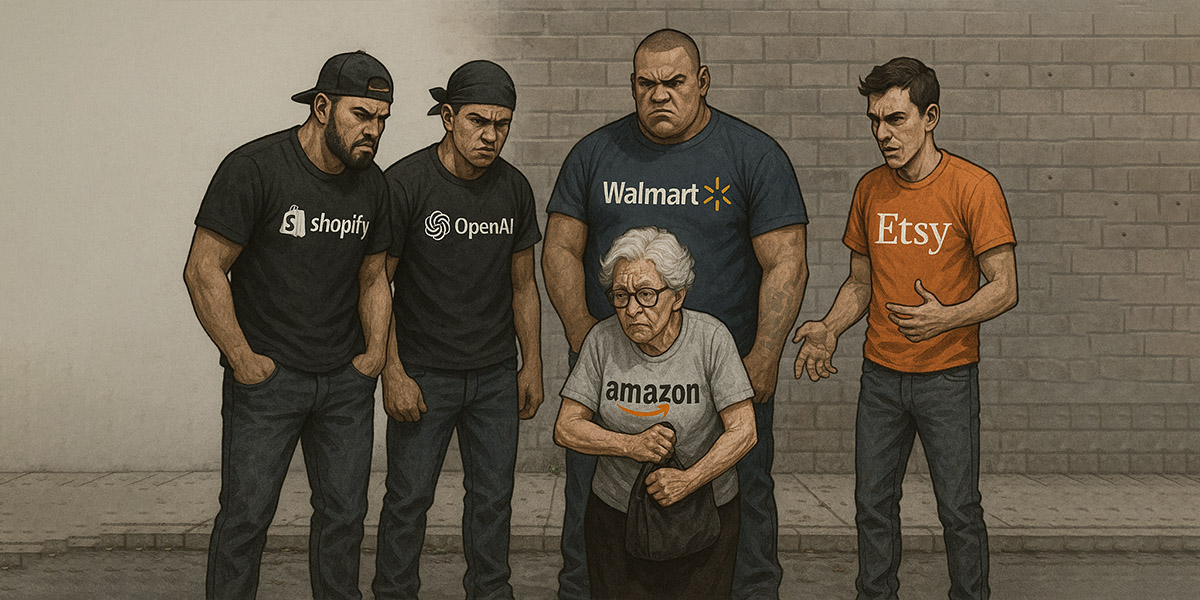
Are we gearing up for an OpenAI + Everyone vs Amazon scenario? I’ve never seen major platforms and retailers embrace a new untested acquisition channel faster than they’re jumping on the Instant Checkout bandwagon. This is the first time in decades that a single platform has amassed a product catalog large enough to rival Amazon’s, coupled with a recommendation system, integrated checkout, and a user base of 700M shoppers.
Yes, Google has ingested an enormous product database through its Shopping portal, and they’ve experimented with native checkout systems in the past — but the whole “product results grid” shopping experience didn’t really change the game for users, especially given how littered with sponsored results it is. That was just Google being Google.
Whereas OpenAI feels like it’s unifying the industry against the two biggest platforms where shoppers begin their searches, while simultaneously changing how they search and discover products.
It’s estimated that around half of shoppers begin their product searches on Amazon and a third begin on Google. It’ll be interesting to see where ChatGPT fits into that market share in a year from now.
Anyway, I’ve got a big edition for this week, so let’s dive in!
In this week’s edition I cover:
- Walmart embraces OpenAI’s Instant Checkout
- Twitch adds Amazon live shopping
- Maybe there won’t be 100% tariffs on China?
- Ulta Beauty launches its marketplace
- One Medical’s new virtual visits for kids
- Instacart’s upgraded business features
- AppLovin shuts down Array
- The questionable future of TikTok’s algorithm
- Shopify increases variant limits
- Apple is working on smart glasses
- Salesforce and OpenAI team up
- AI chatbots must identify themselves
- Square’s first Bitcoin payment
All this and more in this week’s 248th Edition of Shopifreaks. Thanks for subscribing and sharing!
PS: Love this newsletter? Write a Google Review! Your reviews go a long way in helping me reach new readers. Please and thank you.
Stat of the Week
56% of shoppers who made purchases during Amazon’s Big Deal Days event earlier this month compared prices and products at other retailers before buying on Amazon, according to a Numerator survey. The most common comparisons were to Walmart (68%), Target (43%), and club stores like Costco or Sam’s Club (25%). It seems the word is out on Amazon’s “deals,” and shoppers are no longer taking for granted that they’re getting the best prices without comparison shopping.

1. Walmart is the latest retailer to embrace OpenAI’s Instant Checkout
Walmart is the latest retailer to partner with OpenAI to enable shoppers to make purchases using ChatGPT’s new Instant Checkout feature. The integration allows shoppers having conversations with ChatGPT to ask for things like “best mattresses under $1,000 to get my freak on,” browse Walmart and Sam’s Club offerings, and complete purchases from within the app without ever having to visit Walmart’s website.
I reported earlier this month on the launch of Instant Checkout, which at the time was only supported by Etsy and Shopify to start. However it appears that OpenAI is onboarding new major partners at a faster pace than I would’ve guessed. They bagged a big fish with Walmart!
Walmart CEO Doug McMillon said in a statement:
“For many years now, eCommerce shopping experiences have consisted of a search bar and a long list of item responses. That is about to change. There is a native AI experience coming that is multi-media, personalized and contextual. We are running towards that more enjoyable and convenient future with Sparky and through partnerships including this important step with OpenAI.”
Liz Morton of Value Added Resource points out that the announcement doesn’t say whether the products featured in ChatGPT with Instant Checkout will include offerings from 3rd party merchants on Walmart Marketplace or if it is currently exclusively for items sold and shipped directly by Walmart, but we’ll find out soon.
Neither OpenAI, Walmart, Shopify, or Etsy have publicly disclosed what the “small fee” is that OpenAI will be taking for completing the transactions.
Is Amazon next to partner with OpenAI?
Likely not, but maybe they’ll surprise us. So far, Amazon hasn’t made any public statements about adopting Instant Checkout or integrating with third-party AI chatbots beyond its own Rufus assistant. Part of that has to do with Amazon protecting its $60B advertising business, which depends on shoppers starting their searches directly on Amazon so it can serve sponsored listings.
However there are certainly ways for Amazon to replace that ad revenue while embracing 3rd party chatbots by effectively turning Instant Checkout (and other future AI shopping experiences) into a sponsored channel. For example, only surfacing Amazon products within ChatGPT from merchants that agree to pay up to an additional 25% customer acquisition fee on top of their normal Amazon seller fee.
If Amazon were to partner with any 3rd party AI company, wouldn’t it likely be Anthropic, of which they own a significant stake? Although Anthropic doesn’t offer any AI-powered shopping experiences as of yet.
In the meantime, as we wait to see if / how Amazon embraces AI discovery channels, OpenAI has a great opportunity to become the next true “everything store” — without ever storing or shipping a single product. Instant Checkout could be the feature that finally moonshots its revenue.
2. Twitch adds live-shopping powered by Amazon products
Twitch is launching a live-shopping feature in partnership with e.l.f. Cosmetics, powered by Amazon Ads. Users will be able to purchase e.l.f. Cosmetics products as they discover them in a stream, without being taken to Amazon’s website or mobile app, marking the first time that a native live-shopping element has been offered on the platform.
e.l.f. Cosmetics launched its e.l.f.YOU! channel on Twitch in 2020, making it one of the first beauty brands to lean into the platform. Since then, it’s grown the channel to over 24,000 followers and hosted creator collabs, custom tournaments, and live events that have pulled in more than 43 million minutes watched and 800,000 chat messages.
Patrick O’Keefe, Chief Integrated Marketing Communications Officer at e.l.f. Beauty, said:
“When we launched e.l.f.YOU! on Twitch, our vision was simple yet bold — to meet our community where they play, create and connect. Live Streaming on Twitch has always been about self-expression, and we saw an opportunity to ‘game-up’ the space by bringing beauty into the conversation and creating a safe space for every eye, lip and face… We didn’t just want to show up on Twitch — we wanted to level it up, amplify voices that were often overlooked and prove that beauty belongs everywhere.”
This isn’t the first time Amazon has brought its products to the Twitch platform since acquiring the company in 2014, however it’s been a few years since they’ve experimented with adding new shopping features. In 2019, Twitch tested interactive shopping extensions that let viewers purchase Amazon products during streams, however they were redirected to Amazon.com to make the purchase. Twitch also experimented with an affiliate-style product panels under streams (which also redirected users back to Amazon to complete checkout), but none of these shopping integration efforts gained much traction.
This new partnership with e.l.f. Cosmetics marks Twitch’s first major return to live shopping, now with integrated checkout for a frictionless shopping experience.
Honestly, I forget that Amazon owns Twitch sometimes, as you rarely hear about the two worlds overlapping. However when it comes to competing with TikTok Live with social commerce and live shopping, Twitch is the biggest card Amazon has up its sleeve.
3. An update on the U.S. – China trade war
Last week I reported that President Trump said he will impose an additional 100% tariff on imports from China, as well as impose export controls on “any and all critical software” starting Nov 1st, in retaliation of China’s new export restrictions. Trump also indicated that he would not be meeting with Chinese President Xi later this month as originally planned because “there seems to be no reason” for the meeting to take place under current positions.
Here’s what’s happened since last Monday:
- Trump told FOX Business’ Maria Bartiromo that the new tariffs are “not sustainable” but that China “forced me to do that.”
- He went on to say, “I’ve always had a great relationship with them, as you know, but they’re always looking for an edge,” adding that China has “ripped off our country for years.”
- Trump also confirmed that his meeting with President Xi in South Korea is back on in a few weeks.
- In the meantime, U.S. Treasury Secretary Scott Bessent said on Friday he plans to meet this week with Chinese Vice Premier He Lifeng in Malaysia to try to de-escalate the trade war.
- The head of the World Trade Organization called on the U.S. and China to ease their trade tensions, warning that a full economic decoupling between the two nations could shrink global output by as much as 7% over time.
- More Chinese manufacturers have thrown in the towel on the U.S. market over its instability. Cherry Yuan, a sales manager at a manufacturer of mosquito trapping equipment, said, “The situation’s too unstable. Trump’s like a child – crying one minute, laughing the next. You can’t play along with that.”
- Cai Jing, who runs a travel mug company, said, “Sales to the U.S. have dropped by a lot, by around half. It’s not that we’re giving up on the U.S. market. It’s that U.S. buyers gave up on us.”
- A report released today shows that China’s economy expanded at the slowest annual pace in a year during Q3 2025, growing 4.8%, compared to 5.2% in the previous quarter.
So it seems that we likely won’t be seeing 100% additional tariffs on Chinese goods, and that the threat may have simply been a bargaining chip by Trump before meeting with Xi for further negotiations.
In the meantime, U.S. businesses are once again left in limbo, uncertain about what to expect with tariffs in the coming weeks.
4. Ulta Beauty launches its new marketplace
Ulta Beauty launched its new marketplace, initially featuring over 100 brands that were not previously carried in-store or online. I first reported on Ulta’s marketplace in March 2025 after the company’s new CEO Kecia Steelman shared its plans to build one on an earnings call, but there was no mention at the time exactly when it would launch. Turns out just in time for the holiday season!
Josh Friedman, Senior VP of E-commerce & Digital, said:
“Getting a new seller, much less a new product, up and running on Ulta.com is now a matter of days instead of weeks, or even months, as it might have been before. It also offers brands the prestige and scale of selling with the Ulta Beauty association, but removes the need to meet a certain minimum order requirement or invest in in-store visual merchandising to be part of the assortment.”
Here’s what we know about UB Marketplace:
- Ulta Beauty says the marketplace will enable the company to respond quickly to trending brands before they reach major retailers. That way as soon as a brand starts going viral on TikTok, they can add it to their marketplace and capitalize on its popularity.
- The marketplace is powered by Mirakl, which also powers marketplaces for Macy’s, Saks Fifth Avenue, and Lowe’s.
- UB Marketplace is invitation-only to help keep the selection curated and to avoid resellers.
- Brands are required to handle their own fulfillment and ship from a U.S. address to ensure speed.
- Purchases made through the marketplace can be returned through Ulta’s brick-and-mortar locations.
- Customers will earn loyalty points on marketplace purchases, same as on Ulta Beauty’s carried products.
- Ulta Beauty says that product listings from its marketplace will not receive lower listing priority than its own stock.
- However brands will have the option to buy sponsored search listings via Ulta Beauty’s UB Media platform. (Ads… isn’t that what this whole thing marketplace thing is always about?)
- Ulta Beauty plans to double or triple the number of brands in its marketplace during the next few years (so that it can charge more for ads, LOL).
- Marketplace items won’t be sold in Ulta Beauty stores for now, but it is considering an in-store pickup option.
I think it’s a smart move by Ulta Beauty to launch a marketplace, especially a curated one. The one big thing that seems to be missing from the equation right now is consistent shipping speeds, as brands are responsible for fulfilling their own orders. However maybe Ulta will launch a fulfillment service in the future.
5. Amazon One Medical introduces pay-per-visit treatments for kids
Amazon One Medical is launching a pay-per-visit virtual healthcare service for children ages 2 to 11, with message-based visits starting at $29 and video visits costing $49.
The service doesn’t require insurance, a One Medical membership, or a Prime membership, and is designed to treat issues like pink eye, lice, eczema, bug bites, dermatitis, fungal rashes, and other skin-related issues, as well as EpiPen and asthma medication renewals.
The big perk of the service is convenience. Most virtual visits can happen within 30 minutes of requesting a consultation, with treatment plans provided within five minutes after the video call, or within an hour of messaging visits.
Natasha Bhuyan, MD, family physician and national medical director for Amazon One Medical, said:
“We are here 24/7 to help parents who need quick medical guidance to determine the appropriate level of care when their child is developing concerning symptoms. This service isn’t meant to replace a family’s relationship with their child’s pediatrician, but rather to serve as a convenient option for those ‘in-between’ moments for parents with time-sensitive concerns who don’t already have on-demand access through a One Medical membership.”
It might not be designed to “replace” a family’s relationship with a local pediatrician, but it certainly could disrupt it. I’d imagine that a healthy portion of a family doctor’s billable hours come from these easier every day issues with kids, which now Amazon is offering to handle from the comfort of your home. I also fear that these virtual visits with random online doctors and nurse practitioners could lead to a lot of “I wish you had come to me sooner” scenarios with local pediatricians, as issues potentially go undiagnosed for longer periods of time.
Amazon is pushing hard into health services. Last week I reported that the company debuted prescription vending machines at select One Medical clinics, stocked with commonly prescribed medications like antibiotics, inhalers, and blood pressure treatments, with plans to expand the machines to other medical offices soon.
6. Instacart launches new business features for its Storefront offering
Instacart launched a full suite of business features across its white-label e-commerce solutions Storefront and Storefront Pro. These features have been available on Instacart App for Business customers, but now they are bringing them to their white label solution.
If you’re unfamiliar with the difference between Instacart’s app and white label solutions:
- Instacart App and Instacart.com are its consumer-facing marketplace model — where shoppers browse from multiple retailers in one place, and Instacart handles the shopping experience, payment, and delivery, while retailers pay a commission on each sale.
- Instacart Storefront & Storefront Pro are a white label solution where the e-commerce sites look and feel like the retailer’s own store, but Instacart is actually providing the backend infrastructure like catalog management, fulfillment, delivery logistics, and checkout, while branding, domain, and customer relationship belong to the retailer. For example, customers shop directly on kroger.com or wegmans.com, which are powered by Instacart Storefront.
New features brought to Storefront include:
- Bulk Ordering – businesses can order by the case instead of just by individual units
- Multi-user Management – now with customizable permissions for roles like admins, buyers, and approvers
- Account Oversight – a customer-facing dashboard that helps businesses manage order activity and spend
- Shopping Guides – to make it easier for team members to find frequently ordered or recommended items
- Controls and Reconciliation – business managers can set spend limits, approve order workflows, and export bulk receipts for recordkeeping
- Instacart+ Sharing benefits – businesses can share their Instacart+ subscription across team members and earn 2% cash back on orders over $250 placed with Instacart+ benefits applied
It’s always been interesting to me how Instacart has balanced playing both the roles of Shopify (underlying tech) and Amazon (marketplace) for grocery stores. However they seem to be doing a pretty good job. It makes you wonder if Amazon gave up on its D2C efforts too quickly back in the day. Remember when they acquired and shuttered Selz within a year and a half?
7. AppLovin shuts down its controversial Array product
AppLovin shut down Array, its software that let handset makers and carriers promote or preload apps on devices, over allegations that apps were being downloaded to mobile phones without consent.
Here’s what went down:
- AppLovin launched Array in 2022 to help mobile phone manufacturers like Samsung and service providers like T-Mobile monetize devices by recommending and installing apps via pre-loads or home screen placements.
- Short seller reports published in February 2025 by Culper Research and Fuzzy Panda Research publicized allegations that Array was was enabling automatic app installations without proper user consent.
- Ad-fraud researcher Ben Edelman later backed those claims by deconstructing AppLovin’s code and showcasing over 200 complaints from users who allege they received apps they never agreed to download.
- Some of those complaints said that apps were sometimes installed automatically in the background of mobile ads without any on-screen notification. Others claimed a screen popped up inviting a direct download, but when they tried to press “X” to dismiss the screen, it simply downloaded the app anyway. In other cases, a five-second countdown popped up before an app was automatically downloaded.
- AppLovin shut down Array last quarter, saying that it was a “test product” and that the company shuttered it because “it was not economically viable for us.”
- However Adweek’s Kendra Barnett points out that AppLovin CFO Matthew Stumpf last year cited Array as key to the company’s revenue growth, and product lead Jia-Hong Xu previously claimed that Array’s direct download ad function was “the company’s top revenue driver.” Ooooh snap!
Everyone involved denies all wrong doing:
- AppLovin said: “Users never get downloads with any of our products without explicitly requesting it.”
- They later added: “The reporting around this product is misleading, and clearly biased by a short seller trying to benefit financially.”
- T-Mobile said it doesn’t install apps on customers’ devices without their consent: “We previously piloted an ad experience with a partner that allowed customers to choose to install apps directly from ads; that pilot has ended.”
- Samsung said it does not allow for the installation of any application on its Galaxy devices without user consent, and that it no longer has a partnership with AppLovin.
Despite these allegations and short seller reports, AppLovin’s stock has continued to surge this year, up nearly 75% since the start of 2025. Maybe now’s the time to short it then…
8. Will TikTok’s ‘For You’ feed lose its magic after the sale?
TikTok insiders and creators are worried that the app won’t be as good anymore after ByteDance is forced to divest its U.S. business to Oracle and a group of international investors. One TikTok staffer told Business Insider, “The algo is what makes TikTok great. Will a retrain be as good?”
The TikTok U.S. spinoff requires that:
- ByteDance hand over the business, including its U.S. user data and algorithms, to the new owners to comply with the law.
- Oracle will audit its algorithm, which will be “retrained and operated in the United States outside of ByteDance’s control.”
The challenge with that plan for ByteDance is finding a way to hand over its complex system without giving away all of its trade secrets.
The challenge for Oracle will be to retrain a new “For You” feed without destroying the magic behind the current recommendation system.
Nicole Ellison, a professor at the University of Michigan School of Information who has coauthored two papers on TikTok’s algorithmic personalization, says the algorithm is more complicated than just code that can be easily duplicated. Her colleague, Paul Resnick, adds that uncoupling the algorithms from ByteDance’s workforce of machine-learning scientists and engineers will also be a challenge because Oracle’s engineers have no experience with the recommendation system.
Rather than directly hand over the algorithm code, ByteDance could:
- offer access to its algorithms via API — however that would give ByteDance access to user data, which would not comply with the U.S. law.
- offer a data clean room that allows entities to compare data without sharing personal information. ByteDance built its own version a few years ago.
- retain some control over the algorithm after the sale — which could receive pushback from U.S. officials.
A former TikTok product staffer that spoke to Business Insider is skeptical that the new owners will be able to replicate TikTok’s magic on their own. He said, “It will literally take years to retrain the thousands of models that power the TikTok algorithm.”
The ironic part of all this is that the new owners will likely have a bigger agenda to manipulate the algorithm than what they’ve accused ByteDance of all these years!
9. Other e-commerce news of interest
Shopify introduced the ability to create products that have up to 2,048 variants, increased from 100, which has been a long requested feature from merchants. To make it possible, the company says it had to re-architect how products are handled on its platform, starting with an upgrade from the REST Admin API to the GraphQL Admin API in April 2024, allowing thousands of app partners to update their integrations ahead of the rollout. However, despite the higher variant limit, Shopify products still support only three option levels and lack conditional logic, but maybe those features are coming down the road.
Etsy quietly launched a free onsite ads promotion, automatically boosting select listings and covering the cost of clicks for sellers. The unannounced campaign appeared in seller dashboards this week, with Etsy saying it aims to “help campaign performance.” The promotion applies only to Etsy’s pay-per-click onsite ads but comes as the company expands its partnership with OpenAI, enabling Instant Checkout for Etsy listings within ChatGPT. Some sellers are speculating the free ads could be a test to offset the 12-15% commission per sale, which the ChatGPT integration requires, as part of Etsy’s Offsite Ads program.
Walmart Connect introduced a new reporting metric called “Total Product Detail Page Views,” showing how many ad clicks lead to actual product page visits, as spotted by Joe Murphy of ShelfSight, a Walmart-focused growth agency. Early data suggests only about 30% of clicks result in a page view, revealing a gap caused by factors like slow load times, accidental taps, or tracking discrepancies. Advertisers are still billed for all clicks, but the new metric gives clearer insight into which keywords drive real shopper engagement.
Apple is abandoning its plans for a cheaper and lighter version of its Vision Pro headset to instead work on its own smart glasses with a built-in display. The smart glasses will run on its visionOS and feature two modes — one for pairing with iPhones and another for MacBooks — making the device capable of competing with Meta’s Ray Bans for use on the go, while also building on Vision Pro’s eye and hand-tracking interface to serve as a productivity tool when working at your desk.
Salesforce and OpenAI announced a partnership to integrate Salesforce’s Agentforce 360 platform into ChatGPT, enabling users to query Salesforce data, generate Tableau visualizations, and streamline workflows with Slack integrations. The collaboration also connects Agentforce Commerce with ChatGPT’s Instant Checkout via the Agentic Commerce Protocol, allowing in-app product browsing and transactions. Salesforce is developing its own family of large language models under its Einstein and Agentforce initiatives, but it’s also taking a hybrid approach that integrates external models from OpenAI, Anthropic, and Cohere when useful.
Emersoft released a new Shopify app that connects independent bookstores directly to Ingram’s catalog of over 12M books, removing financial barriers like the $2,000 upfront fee and $100k minimum annual sales and lengthy approval processes that previously prevented independent booksellers from being able to access the same fulfillment infrastructure available to larger retailers. The integration automates order fulfillment, shipping, and inventory management through Ingram’s CDF Lite service and imports complete book metadata and categories, enabling bookstores to build and manage online inventories with minimal manual work. Of course, this doesn’t change the fact that Amazon has a preferred distribution and pricing relationship with Ingram, so small retailers still won’t be able to touch Amazon’s pricing or delivery speed.
Governor Gavin Newsom signed SB 243, making California the first state to require AI companion chatbots to identify themselves as artificial intelligence and implement safety measures for minors. The law mandates clear disclosures, reminders every few hours for underage users, self-harm detection protocols, and annual safety reporting, with the right for victims to sue for violations. The bill, which takes effect Jan 1, 2026, was prompted by multiple teen suicides linked to chatbot interactions and holds companies like OpenAI, Meta, and Character AI accountable for failing to meet new safety standards.
Square processed its first Bitcoin payment with Compass Coffee in Washington, D.C. last week through its point-of-sale terminal. The company’s new Bitcoin payment system allows merchants to accept crypto and convert up to 50% of daily sales into Bitcoin starting Nov 10th, with zero processing fees for the first year. The only problem of paying with Bitcoin currently is that it triggers a taxable event for the customer since the IRS treats crypto as property, and most consumers aren’t trying to pay sales tax and capital gains tax on a coffee purchase.
Instagram is testing skippable ads in Reels, allowing users to bypass ads after a brief countdown, a similar format to YouTube’s in-stream ads. However a Meta spokesperson said that the company does not plan to share ad revenue with creators, unlike YouTube’s model. Instagram already sells sponsored posts and ads between Reels, including a non-skippable ad break that was introduced last year.
Waymo is dipping its toes back into delivery through a strategic multi-year partnership with DoorDash, marking its first entry into the delivery market since shuttering pilot programs with UPS and Uber Eats back in 2023 to focus on robotaxis. The partnership will match DoorDash customers ordering food and groceries within a 315-square-mile area of Phoenix with a self-driving Waymo, which will at first exclusively deliver orders from DashMart — DoorDash’s own convenience, grocery, and retail stores — with plans to add more local Phoenix merchants over time. Food or groceries will be placed in the trunk of a Waymo vehicle that will navigate on its own to the customer, who will then retrieve the items from the trunk via the DoorDash app. Does the customer get a discount for not getting drop off to their front door?
OpenAI is being accused of using legal tactics to silence nonprofit organizations that claim the company has strayed from its founding mission of benefiting humanity. At least seven nonprofits that have been critical of OpenAI have received subpoenas in recent months, which they say are are overly broad and appear to be a form of legal intimidation. OpenAI believes that the nonprofits are connected to Elon Musk, who sued the company earlier this year for allegedly abandoning its nonprofit roots and becoming a for-profit AI powerhouse — like he’s trying to take a page from Peter Thiel’s playbook — but six of the nonprofits were not involved in the lawsuit between OpenAI and Musk prior to OpenAI bringing them into it. Whether they’re connected to Musk or not, it’s illegal to be critical of OpenAI?
Watch out LinkedIn! Facebook is bringing back its job listings feature to help local businesses find entry-level trade and service industry job openings through Marketplace, Groups, and Pages. The updated feature lets employers post jobs directly and connect with candidates via Messenger for interviews or questions. Facebook will also offer personalized job recommendations and filtering tools to help users discover nearby opportunities more easily. Facebook originally launched its job listings feature in 2017, but sunset it in February 2023 when trying to turn their platform into TikTok.
Meta is now limiting content that teenage users can see on Instagram to what they would typically encounter in a PG-13 rated movie, hiding certain Instagram accounts that share sexualized content or media related to drugs and alcohol. Additionally, teenagers on the platform will not be recommended posts that contain swear words such as f… (actually never mind, just use your imagination)… though they can still search for it. Instagram says it will still allow certain semi-swear words to surface such as turd burglar, poo sniffer, butt pirate, bloody vaginal belch, and donkey raping shit eater. Additionally Meta is working on new supervision controls that will allow parents to limit their teens’ access to AI chatbots on its platform by blocking specific AI characters or all chatbots in general, except for the general Meta AI chatbot.
Meta’s Threads now comes equipped with third-party verification from Integral Ad Science, DoubleVErify, and Scope3, with verification tools from Zefr coming soon. The integrations provide impression-level data and content risk scoring to give brands more options in verifying their ad outcomes and helping them to avoid placements next to objectionable content. The move brings Threads’ ad standards in line with Facebook and Instagram as the platform grows to about 400M monthly active users.
Amazon is preparing to lay off as much as 15% of its human resources staff, known internally as the People eXperience Technology team, with additional layoffs likely in other divisions, according to Fortune sources. Additionally Amazon terminated Ahmed Shahrour, a 29-year-old Palestinian engineer who protested the company’s ties to the Israeli government. Shahrour, who worked for the Whole Food Market unit, was suspended last month after he posted a series of messages to corporate Slack chat rooms criticizing Amazon’s connections to Israel, and then subsequently handed out fliers at Amazon’s Seattle headquarters. Both Amazon and Google provide cloud-computing services to Israel government and military entities under a contract called Project Nimbus (unrelated to the king of the ocean).
In corporate shakeups this week… Meta poached Ke Yang, the Apple executive leading the company’s efforts to build AI-driven web search. Ron Conway, the founder of venture firm SV Angel, known for its early investments into Google, Airbnb, and Meta, resigned from the Salesforce Foundation, following Salesforce CEO Marc Benioff saying that he “fully supported” President Trump and proposing that National Guard troops should patrol San Francisco streets to combat crime and homelessness. Opendoor brought Shopify VP of Operations Giang LeGrice to lead operations at the company, marking the second former Shopify colleague Kaz Nejatian has brought to the company since he became CEO. Last but not least, Salad Group appointed former Klarna UK CEO Alex Marsh as CEO.
Carted, an Australian e-commerce platform that provided APIs enabling developers to embed shopping, checkout, and product discovery experiences directly into apps and websites, will shut down on Oct 22, four years after raising $13M. Co-founded by Holly Cardew and former Shopify engineer Mike Angell, the company later pivoted to a wishlist app that notified users of restocks and sales. Carted cited market conditions and competition from TikTok and Instagram’s in-house commerce tools as reasons for winding down operations.
Texas is being sued by a Big Tech lobby group over the state’s new law that will require app stores like Google Play and Apple App Store to verify users’ ages and impose restrictions on users under 18. The group claims that the Texas App Store Accountability Act imposes a “broad censorship regime on the entire universe of mobile apps,” and that it is a “misguided attempt to protect minors” that violates the First Amendment by imposing a “sweeping age-verification, parental consent, and compelled speech regime on both app stores and app developers.” The Texas law is scheduled to take effect on Jan 1, 2026, while similar laws enacted by Utah and Louisiana are set to be enforced in May and July respectively.
Squarespace released a three part campaign designed to position the platform as the ultimate tool for bold self-starters hoping to turn their passion into a profession, building on its Change Your World series that came out last year. One spot features a woman launching a skydiving school mid-freefall, another follows an office goth transforming her coworkers into leather-clad disciples, and a third shows a calm guru gliding through city chaos to a peaceful mountain field. Each spot is paired with a matching custom website template to demonstrate that every business can have its own unique style with Squarespace.
Zalando launched a dedicated online store in Portugal and began selling beauty products like skincare and perfumes in Spain, marking its first international expansion since 2022. The new Zalando.pt site offers 200,000 fashion and sports items and introduces AI-driven tools like Trend Spotter to personalize shopping. With the addition of Portugal, Zalando now operates in 26 countries, with Greece and Bulgaria launches planned by year-end.
Just under half of online shoppers in Germany, France, Italy, Spain, and the U.K. have shopped at Temu or Shein this year, which is roughly the same amount to reported shopping on the platforms last year too, meaning their growth in Europe has slowed down, according to the latest Amazon Shopper Report 2025 by Remazing. Both Temu and Shein invested heavily in awareness campaigns this past year, which resulted in brand awareness of 96% and 93% respectively, however, only around 45% and 49% of users actually bought something from the platforms. That’s surprising, given how much effort both platforms have put into gaining market share in Europe this past year as the U.S. market became more difficult for them due to tariffs and the de minimis exemption coming to an end.
Singapore is planning to create a new Online Safety Commission that has the authority to block what it considers to be harmful content on TikTok, Facebook, YouTube, and other platforms. The government says that the move is in response to a rising tide of AI-driven threats, including deepfakes, cyber scams, and online bullying, and gives victims a direct route to demand action from platforms. Platforms and individuals that fail to comply could face fines up to SG$500,000 and jail time, with the agency set to launch by mid-2026. Singapore laws are no joke! You can go to jail for chewing gum, accessing another person’s WiFi network without permission, feeding pigeons, or being racist.
Alibaba VP Kaifu Zhang said that the company’s investment in AI has reached break-even levels within its e-commerce business, meaning that its AI systems powering product recommendations, merchant tools, and logistics in Taobao and Tmall are now generating enough returns to offset development costs. The company has pledged to invest $53B over three years in AI and cloud infrastructure, deploying tools that personalize search results and improve virtual try-ons across its e-commerce platforms, which are its largest source of revenue.
The FDA seized the funds of Colorado couple Alan Carver and his wife for continuing to sell their unapproved anti-choking device, the Dechoker, after being ordered to stop in 2022, earning $8.2M in revenue through Amazon and their own site. The device was marketed as FDA-approved even though it was never cleared for sale and allegedly caused injuries in lab tests and consumer complaints. Amazon has since removed the Dechoker and similar devices from its marketplace, citing its rules that all medical devices sold on its platform must have proper FDA authorization. Carver published a response on his website stating that the FDA case was a civil matter that has been fully settled and closed, disputing Forbes’ claim that he made $8.2M from sales and insisting that Dechoker has never turned a true profit. He said the company is now working closely with the FDA on a new application, continues to manufacture in Mexico and sell globally, and remains confident that U.S. approval will be granted soon.
🏆 This week’s most ridiculous story… PayPal’s blockchain partner, Paxos, mistakenly minted $300 trillion worth of the company’s stablecoin on Wednesday in what the company called a “technical error.” Yeah, no shit! Paxos says it accidentally minted the stablecoins as part of an internal transfer, but immediately identified the error and burned the excess PYUSD about 20 minutes after it happened. “Oops, I added a couple extra zeros!” For a frame of reference, backing $300 trillion worth of PYUSD would require more than double the world’s estimated total GDP.
10. Seed rounds, IPOs, & acquisitions
Lantern, a Shopify loyalty and retention app that helps merchants build customizable rewards, referral, and VIP programs to increase customer lifetime value, raised $3.1M in a seed funding round led by Salesforce Ventures. The app was started by Headphones.com founder Andrew Lissimore after struggling to increase repeat purchases on his own store and competes with incumbents like LoyaltyLion and Yotpo. The company plans to use the funds to leverage AI and provide customers with insights and recommendations around retention.
PayPay, a Japanese mobile payments and digital wallet platform owned by SoftBank that allows users to make cashless purchases, send money, and earn rewards through QR code transactions, is preparing to go public in the U.S. with an IPO that could value the company at more than $20B. PayPay announced last month that users would soon be able to make payments abroad, beginning with South Korea, which is a popular tourist destination for Japanese travelers. PayPay also plans to grow its banking, credit card, and crypto services as SoftBank’s financial segment more than doubled profits in the latest quarter.
PayPay’s decision to go public sparked Rakuten, a Japanese e-commerce and fintech conglomerate, to also consider an American IPO for its credit card business, according to Reuters sources. Credit cards are a key piece of Rakuten’s business, which includes online shopping, banking, travel, and other services. An IPO could give Rakuten new capital to expand its credit and payments ecosystem globally and further develop its new agentic AI tools to improve personalization and automate customer interactions.
Dreamdata, a Danish B2B marketing analytics platform that helps companies measure and optimize their revenue attribution and customer journeys across channels, raised $55M in a Series B round led by PeakSpan Capital, bringing its total amount raised to $67M. The platform joins ads, website visits, e-mails, and CRM into one clean timeline per account so that businesses are able to sync high-intent audiences to ad platforms like Google and Meta, run marketing workflows, and trigger notifications to a sales team. It plans to use the funds to scale across Europe and North America and enhance its AI activation and analytics capabilities.
Chari, a Moroccan B2B e-commerce platform that enables small retailers to order and manage inventory directly from fast moving consumer goods suppliers, raised $12M in a Series A round co-led by SPE Capital and Orange Ventures. Initially when launched in 2020, the company helped small shop owners manage online orders and deliveries, but has since expanded to offer credit and digital tools that streamline merchants’ daily operations. The company plans to expand its platform into a “super app,” offering merchants an all-in-one tool for product purchases, payments, credit access, and business operations management. Chari is also expanding from serving small stores to fintech with the creation of a Banking-as-a-Service platform that enables other companies to offer financial services without having to build the underlying technology.
Meesho, an Indian social commerce and online marketplace, plans to go public in December with an $800M IPO to fund expansion and operations. The company, which is backed by investors like Elevation Capital, SoftBank and Peak XV Partners, who plan on partially exiting through the IPO, has become one of the country’s largest online marketplaces by daily orders, reporting $1.1B in revenue last year.
Oura Health Oy, maker of the Oura health and fitness ring, raised more than $900M in a round co-led by Fidelity Management and Research Co at an $11B valuation, almost doubling the company’s valuation after its $200M round in December. The company, which has sold over 5.5M rings and is on track to generate more than $1B in revenue in 2025, plans to use the funds to double down on AI algorithm development for preventive health, invest in new product innovation, and expand its global distribution network.
Dexory, a London-based robotics and data intelligence company that builds autonomous robots to track and analyze warehouse inventory in real time, raised $165M in a Series C round led by Eurazeo. The company will use the funds to advance its AI-powered data intelligence platform, DexoryView, expand into new international markets ,and strengthen its commercial operations. DexoryView is currently used by GXO, Maersk, DHL, and other global logistics providers, combining autonomous robots, AI, and digital twin technology to give customers end-to-end visibility and actionable insights.
Strella, an AI-driven interviewing platform that helps companies screen and evaluate job candidates through automated video interviews and analytics, raised $14M in a Series A round led by Bessemer Venture Partners. The startup helps companies like Amazon, Duolingo, and Chobani replace weeks of manual research with AI-moderated voice interviews that generate insights in hours. Since last year, Strella has grown revenue tenfold, quadrupled its customer base to more than 40 paying enterprise clients, and tripled its average contract values by moving upmarket to serve Fortune 500 companies.
Starship Technologies, a San Francisco-based robotics company that designs and operates autonomous delivery robots for food, groceries, and packages, raised $50M in a Series C round led by Plural, bringing its total amount raised to over $280M. Since launching in 2014, Starship has completed more than nine million deliveries across seven countries, five times more than all U.S. competitors combined. The company operates over 2,700 robots worldwide and plans to scale its fleet to more than 12,00 by 2027 while expanding into major U.S. cities.
Zepto, an Indian instant grocery delivery startup that delivers groceries and household items in minute through its network of dark stores, raised $450M in a round led by California Public Employees’ Retirement System at a $7B valuation. The platform has scaled from 500k daily orders a little over a year ago to 1.7M daily orders and predicts that the growth will continue. This is Zepto’s last funding round before it plans to go public next year.
Basis Theory, a data security platform that helps businesses securely collect, store, and use sensitive information like payment data through tokenization and APIs, raised $33M in a Series B round led by Costanoa. The platform enables merchants to tokenize, store, and control sensitive payment data independently from processors and orchestration layers, allowing them to move their payment data freely between providers and optimize costs, without being locked into a single platform. The company will use the funds to expand its engineering, product, and go-to-market teams.
Upgrade, a fintech that offers personal loans, credit card, and banking services to help consumers build credit and manage debt responsibly, raised $165M in a Series G round led by Neuberger, bringing its total amount raised to $750M. Since its inception in 2017, the company has delivered more than $42B in credit to more than 7.5M customers. It plans to use the new funding to develop additional products, grow distribution, and continue scaling its multi-channel, profitable growth strategy.
Ripple, a blockchain payments company that enables fast, low-cost cross-border money transfers, acquired GTreasury, a treasury and risk management software company that provides cloud-based solutions for cash management, payments, and financial risk analytics, for $1B. The deal provides Ripple with access to the corporate treasury market and many large corporate customers, while strengthening its ability to help customers move, manage, and optimize liquidity in real time. The deal follows Ripple’s recent acquisitions of Hidden Road and Rail as it pushes into global finance and digital asset adoption.
Fooda, a Chicago-based workplace food service platform that connects offices with local restaurants to provide pop-up lunches, catering, and meal programs, acquired Peach, a Seattle-based meal delivery company that partners with local restaurants to delivery office lunches and group meals, for an undisclosed amount. Peach’s service will continue under a new name, while its founders transition to Fooda as the company expands its footprint in office meal programs nationwide.
Blue Owl Capital, a New York based private equity firm, agreed to finance Meta’s new $30B Hyperion AI datacenter project in Louisiana, marking one of the largest AI infrastructure deals. 2.2 gigawatt Hyperion datacenter project in Richland Parish, Louisiana. The agreement includes $27B in debt and $1.5B in equity, structured to keep the debt off Meta’s balance sheet while the company retains a 20% stake. Scheduled to open in 2029, the 2.2-gigawatt facility will expand to more than five gigawatts of compute capacity as Meta grows its AI operations.
CVS Pharmacy completed its acquisition of Rite Aid assets nationwide, including former Rite Aid and Bartell Drugs stores and the prescriptions of 626 other locations. The deal adds more than nine million new patients to CVS’s network and brings 3,500 former Rite Aid and Bartell employees onto its team, while deepening its presence in the Pacific Northwest, where it previously had limited coverage. Over the next several months, CVS will integrate store systems, signage, and loyalty programs to bring the new locations fully under its brand.
Fashionphile, a California-based luxury resale platform that buys and sells pre-owned designer handbags, jewelry, watches, and accessories, acquired the intellectual property, customer database, and social media accounts of Luxe Collective, a UK-based luxury resale marketplace that shut down operations in 2024 after racing financial difficulties caused by high-value theft that the company couldn’t recover from. The deal marks Fashionphile’s official entry into the UK market and follows the company’s recent acquisitions in Canada. Luxe Collective’s founders will join Fashionphile to lead operations under the new brand “Fashionphile UK,” with plans to open a London authentication center and store.
Thanks for being a Shopifreak!
If you found this newsletter valuable, please leave a review on Google and share the newsletter with your friends and colleagues to help us grow.
See you next Monday,
PAUL
Paul E. Drecksler
🌐 Shopifreaks.com
🧑💼 Add me on LinkedIn
📧 [email protected]
📱 +1-828-273-3031
⭐ Leave A Review
PS: Why are dogs weighed in kilograms? Because they hate the pound.