
Hi Shopifreaks
Ready to see what you missed last week at Google I/O? I’ve got you covered in this week’s jam-packed edition — one of my favorite editions so far this year. Plus, learn what OpenAI has on its roadmap for ChatGPT ads and why Delta’s CEO went with Amazon Leo instead of Starlink (and why I think it was the right move).
Thanks for being a loyal reader of Shopifreaks. I hope that this newsletter continues to bring value to your business or job each week. If it does, I’d certainly appreciate a Google Review!
In this week’s edition I cover:
- E-commerce growing faster than retail
- Google’s new Universal Cart
- Plus everything else you missed at Google I/O 2026
- Why Delta chose Amazon Leo
- Upcoming ChatGPT ad formats
- Shopify’s official release of UCP
- Amazon cuts affiliate commissions (again)
- AI usage means shorter SaaS contracts
- Afterpay took over an Australian arena
- USPS got more expensive
- TikTok and Universal Music Group are best friends now
- Meta launched a new standalone app for Groups
All this and more in this week’s 279th Edition of Shopifreaks. Thanks for subscribing and sharing the newsletter with your colleagues!
Stat of the Week
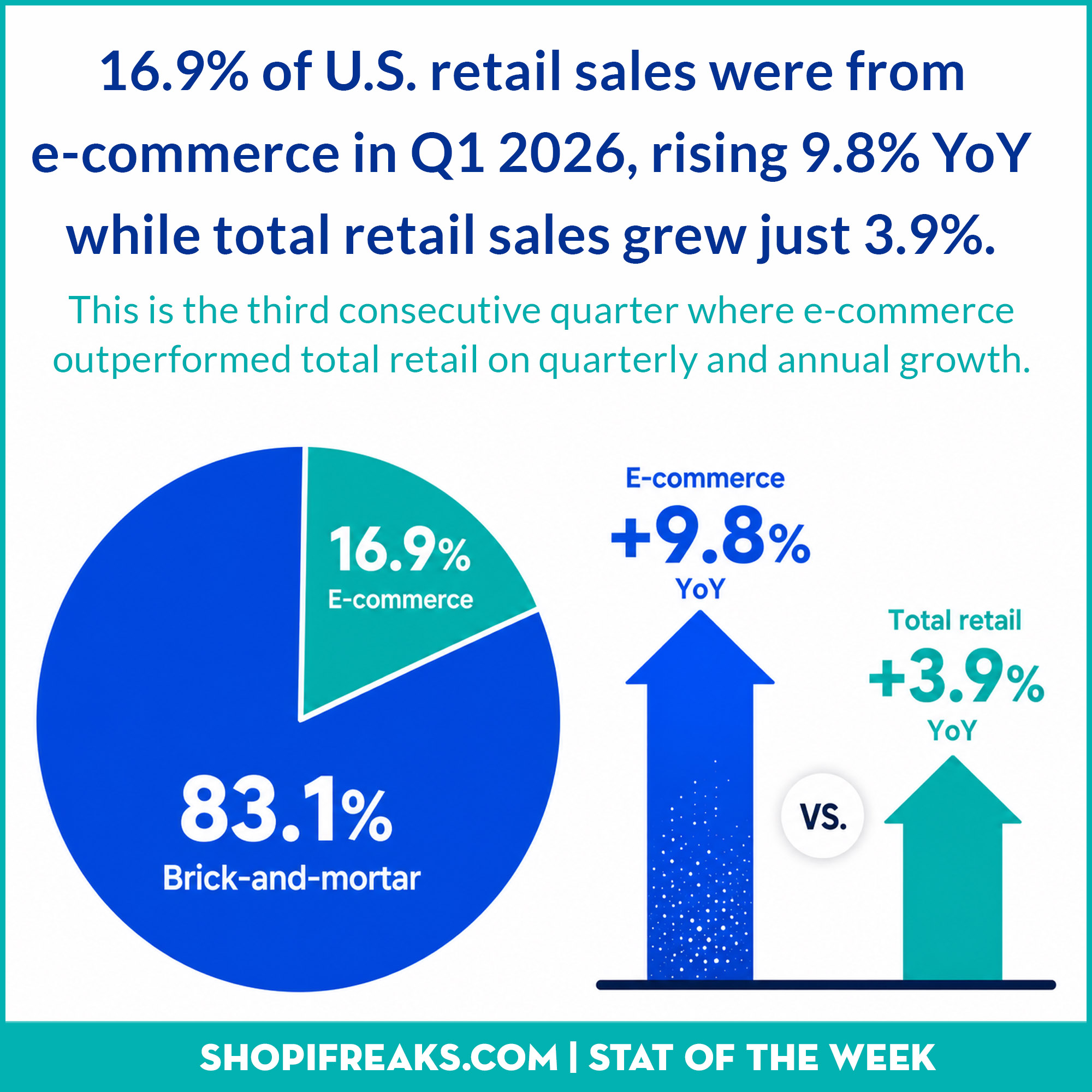
16.9% of U.S. retail sales were from e-commerce in Q1 2026, rising 9.8% YoY while total retail sales grew just 3.9%, according to the Census Bureau’s first-quarter retail eCommerce report. The Q1 figures mark the third consecutive quarter where e-commerce outperformed total retail on both quarterly and annual growth.
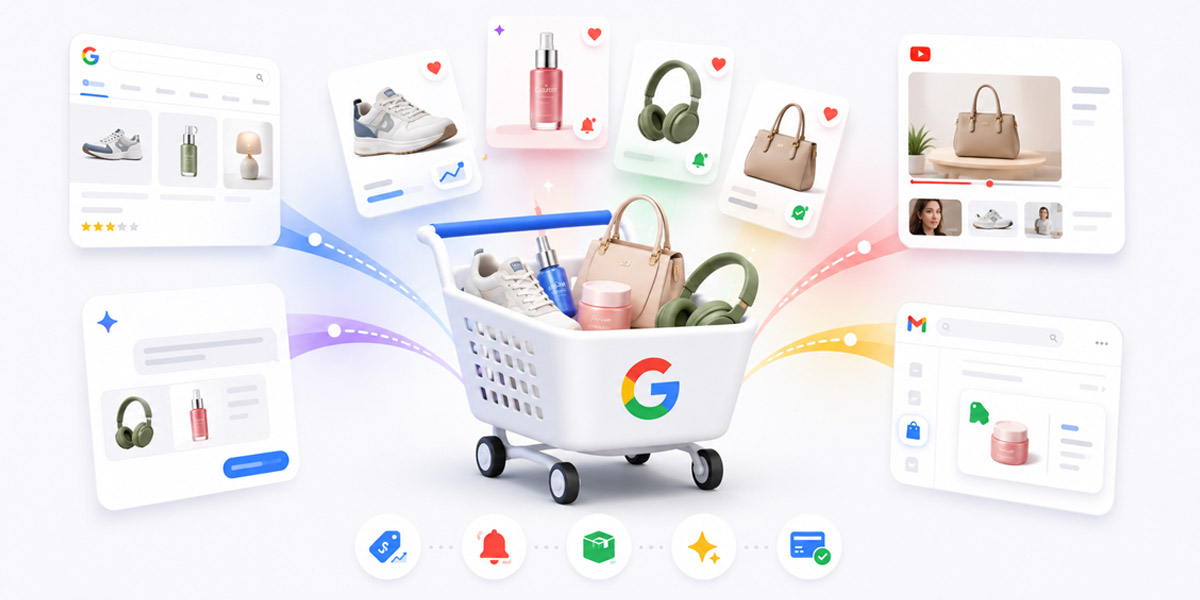
1. Google launches Universal Cart that follows you across Search, Gemini, YouTube, and Gmail
Google introduced Universal Cart at I/O 2026, an AI-powered multi-merchant shopping cart that lets shoppers add items to a single cart while searching, chatting with Gemini, watching YouTube, or reading Gmail.
Here’s how it works:
- The moment a product lands in the cart, it goes to work in the background, hunting for deals and price drops, surfacing price history, and flagging when an out-of-stock item returns.
- Google says the cart, which is powered by Gemini, leans on reasoning to prevent problems before they happen. For example, it will proactively flag when products are incompatible and suggest alternatives, as well as recommend payment methods through Google Wallet that maximize loyalty status, cashback rewards, and merchant offers.
- When it’s time to buy, the Universal Commerce Protocol handles the transaction. For participating brands, shoppers can either check out directly on Google with Google Pay, or transfer the cart to the retailer’s own site to complete the purchase there.
- No matter how a shopper chooses to buy, the retailer always remains the merchant of record, meaning the store, not Google, owns the transaction and the customer relationship.
Universal Cart rolls out across Search and the Gemini app in the U.S. this summer, with YouTube and Gmail to follow. Early participating retailers include Nike, Sephora, Target, Ulta Beauty, Walmart, Wayfair, Fenty, and Steve Madden.
Remember OpenAI’s vision for Instant Checkout — which it launched in October 2025 and shut down earlier this year? Universal Cart is a significantly better implementation of what Instant Checkout hoped to be. It integrates existing product catalogs, which merchants have already been managing for years through Google Merchant Center, and surfaces customers’ stored digital payment info from Google Wallet. Plus, it keeps the merchant in ownership of the transaction (which was one of OpenAI’s grave mistakes) and positions Google perfectly for monetizing the search and discovery end of the journey, which happens across Google tools that customers are already actively using, rather than within a dedicated AI chatbot. Brilliant execution all around by Google.
I’ve said it before and I’ll say it again: Maybe it’s time for OpenAI to adopt UCP.
2. Everything else from Google I/O 2026 that relates to e-commerce
Beyond Universal Cart, Google made roughly 100 announcements at this year’s I/O conference. Below, I’m going to highlight the ones that are most relevant to e-commerce merchants, customers, and app developers.
- Gemini 3.5 Flash is here, and it powers nearly everything else on this list. Google launched the first model in its 3.5 series built for long-horizon agentic tasks. The company claims it can deliver flagship-level intelligence at Flash-tier speed, often at less than half the cost of competing frontier models. Gemini 3.5 Flash is available immediately through the Gemini API, Android Studio, and Antigravity, and a 3.5 Pro version is expected next month.
- Gemini Omni can generate video (and eventually anything) from any input. Google’s new Omni model combines Gemini’s reasoning with its generative media tools, taking image, text, video, or audio as input and producing video you can edit conversationally rather than regenerate from scratch. All Omni output carries Google’s invisible SynthID watermark.
- Google gave its search box its biggest overhaul in over 25 years. The reimagined Search box now accepts text, images, files, videos, and Chrome tabs, and reasons across all of them at once. Google also merged AI Overviews and AI Mode into a single experience, letting users move from a question to an overview to a follow-up without interruption.
- AI Mode crossed 1 billion monthly users. Google’s most advanced AI Search now runs Gemini 3.5 Flash as its default model globally, with the company reporting that AI Mode queries have more than doubled every quarter since launch and that total Search queries hit an all-time high last quarter.
- Search is getting 24/7 “information agents” that monitor topics for you. Rolling out this summer to AI Pro and Ultra subscribers, these agents run in the background and track changes across the web on any topic you choose, from real-time finance and shopping to news and sports. Then they send you a synthesized update with the option to act on it. You can run several at once.
- Search can now build you custom mini-apps on the fly. Using Antigravity and Gemini 3.5 Flash, Search can generate custom layouts, interactive visuals, and full dashboards or trackers tailored to an ongoing project, like a home move or a wedding. Google calls these “mini apps,” and they’re coming to Search in the months ahead.
- Gemini Spark is a 24/7 personal agent that will eventually spend money for you. Spark works in the background on your phone or laptop, even when they’re off, taking action under your direction and checking in before major moves. Google’s roadmap includes letting Spark authorize payments within budgets and merchant limits you set. It’s rolling out first to trusted testers, with a beta for U.S. Ultra subscribers next.
- Daily Brief digests your day before you wake up. A new Gemini app agent that works overnight, analyzing your inbox, calendar, and tasks to surface what matters and suggest next steps. It’s rolling out now to Google AI subscribers in the U.S. who have connected their Google apps.
- You can now build native Android apps in Google AI Studio and publish them to the Play Store. Just pick “Build an Android app” and start prompting. AI Studio now supports the Google Play Console, letting developers preview apps in a browser-based emulator and push to Google Play’s Internal Test Track with a single click. This could let e-commerce brands launch their own custom shopping apps connected to their stores, or build a dedicated space for exclusive content and customer perks.
- Antigravity 2.0 launched, and the Gemini CLI shutdown sparked a developer backlash. Google’s agent-first development platform got a standalone desktop app for orchestrating multiple agents in parallel, plus a new Antigravity CLI for terminal users. The catch: the old Gemini CLI was open source, and the Antigravity CLI replacing it is not. Free and individual-tier users have until June 18 to migrate, while paying enterprise customers keep their access. Developers have accused Google of harvesting a year of open-source community contributions to build a tool it then closed off and moved into its paid stack.
- Google brought UCP tools to merchants and added AI performance tracking to Merchant Center. Alongside Universal Cart, Google rolled out Universal Commerce Protocol features on the retailer side, including new Merchant Center tools that let merchants track how their brand is showing up in AI-driven search results. It’s the same protocol Shopify just opened to all developers (see Story #5).
- Google rolled out new AI-generated ad formats across Search and AI Mode. Building on its Google Marketing Live announcements, Google is testing brand and product ads generated by Gemini that appear below AI Mode responses, plus expanded “direct offers” ads in standard search results. All are labeled “sponsored.”
- There’s a new $100 AI Ultra developer plan, and AI Pro now includes YouTube Premium Lite. The Ultra plan targets developers and technical leads with 5x higher usage limits and 20TB of storage. Separately, Google AI Pro subscriptions now bundle in YouTube Premium Lite, an $8.99-per-month value, for ad-free, offline, background YouTube viewing.
- Google’s SynthID watermarking is expanding to Search and Chrome. Three years after launch, SynthID has been used 50 million times to tag AI-generated content. Google is bringing AI-content verification to Search and Chrome and adding support for C2PA Content Credentials, so you can check whether an image is an unaltered camera original. OpenAI, ElevenLabs, and Kakao are adopting the tech too.
- Personal Intelligence is expanding to nearly 200 countries. AI Mode can now securely connect to apps like Gmail and Google Photos (with Calendar coming soon) to personalize results, rolling out across 98 languages with no subscription required. Google says users choose if and when to connect each app.
- Samsung’s “Intelligent Eyewear” smart glasses are coming this fall. Google’s next big Android XR push is smart glasses in two flavors: audio glasses that talk in your ear, and display glasses that show information in your field of view. The first audio glasses, built with Gentle Monster, Warby Parker, and Samsung, arrive this fall and work with both Android and iOS.
That’s the e-commerce-relevant slice of I/O 2026, but it’s a fraction of what Google announced. The other 80+ announcements focus on creative tools (Google Pics, Flow Music, Stitch), science research tools, and Workspace updates. The full list is worth a read.
3. Delta CEO says Amazon brings a lot more than satellite technology
Delta CEO Ed Bastian defended the airline’s decision to partner with Amazon Leo over Elon Musk’s Starlink for in-flight WiFi in a Bloomberg interview. He said:
“Amazon brings a lot more than just satellite technology. They bring great retailing capability and Amazon Prime and video gaming technologies, which Starlink does not have. I think the opportunities, in terms of the improved bandwidth with a much lower price point than what we’ve ever seen from Starlink, will make a big difference.”
Bastian’s comments came just a few days after Musk disparaged the airline for its decision to partner with Amazon Leo, saying:
“SpaceX requires that there be no annoying ‘portal’ to use Starlink. Starlink WiFi must just work effortlessly every time, as though you were at home. Delta wanted to make it painful, difficult and expensive for their customers. Hard to see how that is a winning strategy. They will lose customers over this.”
Musk was referring to the fact that Starlink has pushed for a more seamless in-flight WiFi experience with direct connections between passengers and the web, while airlines prefer to route access through their own branded systems. Dozens of airlines have struck deals with Starlink to give passengers free WiFi including Air France, Alaska Airlines, British Airways, Emirates, Qatar, and United Airlines, though the service is still being rolled out.
Starlink has launched over 10,000 satellites into orbit, while Amazon Leo has just 300 — but how many satellites does a company really need to provide WiFi on an airplane? As a point of reference, OneWeb, a direct competitor of Starlink and Leo, claims full global coverage with just 618 satellites. As long as Amazon can provide coverage on Delta’s flight routes, that’s all they require.
I also see the value in working with an Internet provider that offers seamless access to its entire ecosystem of products, as I’d imagine that the overwhelming majority of Delta flyers are existing Amazon Prime members.
Plus, am I crazy for thinking this, but do you find it far more dependable to work with Amazon than an Elon Musk company? As much grief as I’ve given Amazon over the years, they certainly offer a dependable suite of products. Whereas, you never quite know what Elon Musk is going to do.
4. OpenAI is testing larger ad formats and dedicated e-commerce ad units in ChatGPT
OpenAI is testing a new ad format for ChatGPT that features a larger image and an optional personalized call-to-action button with dynamic CTAs including “shop now,” “book now,” “sign up,” and “learn more,” according to mockups viewed by Digiday and confirmed by OpenAI.
The platform is also introducing a mobile and desktop-friendly dedicated e-commerce format that pulls in shopping data including price and customer reviews, with the portrait version designed to stack for carousel-style placement.
Until now, advertisers have only been offered a single ad format that consisted of a headline, short description, image, and link. These new formats provide more control over how their ads appear and a CTA button for the first time.
Digiday notes that more ChatGPT ad features are on the way including:
- Audience targeting to allow advertisers to retarget existing customers or exclude them entirely.
- Lookalike audiences to find new people who share similar traits and behaviors with an advertiser’s existing customers.
- Outcome-based optimization, which will let advertisers target against CPAs instead of just impressions and clicks.
- Plus, additional new ad formats that have yet to be announced.
My vote: OpenAI should partner with CJ, Awin, Rakuten, and Impact (which powers Walmart’s affiliate program), and even Amazon Associates if they’ll let them, and incorporate affiliate links into their organic product answers. This would accomplish two things:
- OpenAI can continue to boast that its organic answers are not impacted by sponsorship revenue — which would be true. The platform would simply be algorithmically integrating affiliate links where available. Myself and other publishers have done it for years on WordPress blogs. OpenAI could certainly handle the integration with ChatGPT.
- The company would instantly monetize its 900M+ ChatGPT users without having to independently onboard a single advertiser. They’d make billions of dollars in affiliate revenue overnight and never have to do a fundraise again. And that’d just be the beginning. Next they could unlock affiliate revenue for travel & accommodation, business & financial services, and other subscriptions. The sky is the limit when it comes to scaling an affiliate revenue model.
Need help, OpenAI? I’ll even lead the initiative for you. You’ll just have to acquire Shopifreaks for the same amount you paid for TBPN to free up my time. 😂 Jokes aside, I think it’s a win-win-win for OpenAI, merchants, and customers. Also, if OpenAI doesn’t do it… someone else will.
What are your thoughts? Hit reply and let me know, or join the conversation on LinkedIn.
5. Shopify opens Universal Commerce Protocol to all developers with full Catalog access
Shopify announced that the Universal Commerce Protocol with Shopify Catalog is now open to every developer, allowing any mobile app, content platform, or AI agent to access its catalog of millions of merchants and billions of products through a single protocol.
Shopify first introduced the Universal Commerce Protocol back in January, releasing documentation alongside its Agentic plan, which lets merchants on any platform plug into Shopify’s agentic commerce connections. At the time, though, the protocol was a controlled rollout limited to major partners like ChatGPT, Gemini, and Perplexity, with everyone else on a waitlist. Now it’s open to all developers, and the SDKs and APIs have been publicly released.
Shopify President Harley Finkelstein wrote:
“One protocol. Millions of merchants. Billions of products. That means a solo developer has the same commerce layer as the largest tech companies on the planet. And every new experience a developer builds? That’s a win for merchants too. More places for people to discover and buy their products. Nothing to set up. If they’re on Shopify, they’re already in.”
For years, there were rumors that Shopify would build its own marketplace to compete against Amazon, and Shop App was predicted to be its starting point. But that didn’t happen. Shopify never built a marketplace. It’s instead turning the entire Internet into its marketplace.
The combination of Universal Commerce Protocol with Shopify Catalog empowers any developer to build the next great product discovery portal, while enabling merchants to be a part of it. I’m genuinely excited about this. What are you going to build?
6. Amazon slashed affiliate commission rates by up to 50% and gutted reporting tools
Amazon quietly restructured its Associates affiliate program over the past several months, cutting commission rates by as much as 50%, eliminating milestone-based bonuses, and worsening reporting that affiliates relied on to optimize campaigns, according to seven publishers and partners who spoke to Adweek.
The changes were never publicly announced, with publishers learning about them through individual conversations with their account managers after seeing rates in some categories drop from as high as 10% down to 4% or 5%. Adweek notes that the cuts have not been uniform, with several publishers with longstanding relationships with Amazon retaining more favorable terms than publishers running paid-media-driven affiliate businesses, which have been hit the hardest, with one publisher marking its 2026 Amazon revenue forecast down by 50%.
Recurrent Ventures chief executive Andrew Perlman told Adweek:
“Amazon halved the affiliate rates across the publisher ecosystem. Between Google’s AI overviews collapsing organic traffic at the top of the funnel and Amazon paying less at the bottom, the business of converting organic search into affiliate revenue has become super challenging.”
Isn’t this like the 50th fucking time Amazon has screwed over its Associates since the program began in 1996?
I used to be a heavy driver of traffic to Amazon through its Associates program via my travel website, but after watching my affiliate revenue get slashed in half multiple times when Amazon arbitrarily changed its commission rates, I pulled back from it. There were more profitable programs to focus on.
It seems, from this Adweek report, that Amazon is continuing to degrade its affiliate program and sour relationships with publishers, which is a great opportunity for TikTok Shop and Walmart if you ask me. “Not making enough money from Amazon Associates anymore? Our doors are wide open.”
Amazon’s attitude towards publishers over the past two decades has essentially been: “Where else are you going to send your traffic that converts as good as we do? You need us more than we need you.” — and unfortunately, Amazon has historically been right. They have been the best option over sending traffic to individual D2C websites or other marketplaces, and they’ve known it. Though maybe that’s changing?
7. Businesses are demanding shorter contracts and favorable terms from SaaS providers
Businesses are demanding shorter contracts and other favorable terms from traditional SaaS providers as rising AI spending on Anthropic, OpenAI, and other AI providers eats into their software budgets, according to CTOs and CIOs interviewed by The Information’s Laura Bratton. For example:
- Ralliant ($6.6B sensor components seller) reduced five-year contracts to one-to-three-year terms, so it can switch off the legacy apps as AI agents take on more of the work.
- Ibex (IT services firm with $600M revenue) shifted from three-to-four-year contracts to one-year terms, so it can try out vendors’ AI features without being tied to them in the long run.
- Cummins ($90B market cap diesel engine maker) is now requesting 90-day reassessment provisions for which AI apps it uses.
Cummins CIO Earl Newsome said:
“In the mainframe era, we made 20-year decisions. In the client server era, we made 10-year decisions. In the cloud-based era, we made 3- to 5-year decisions. Now we’re in an era where we need to make 90-day decisions and have the flexibility to do so.”
Customers are also negotiating “swappability” clauses that prevent vendors from charging more when launching new AI features, opt-out provisions tied to AI performance metrics, and “repricing triggers” that allow renegotiation if AI usage costs hit certain thresholds.
Very interesting article, and anecdotally I can confirm the trend. I dealt with a mid-sized retailer recently that didn’t even want to sign a one-year contract for an enterprise tool because of how fast that particular vertical is changing.
None of this is to say that companies are about to begin abandoning their enterprise SaaS solutions in droves anytime soon. The trend just seems to be that the space is moving faster now, companies want flexibility to adapt alongside it, and as a result, they’ve got the leverage now to negotiate terms with software providers.
What’s been your experience as a buyer or provider of SaaS tools during the past few years? Does it match with the experience of the companies exemplified in the article above? Hit reply and let me know.
8. Welcome to the Afterpay Arena with end-to-end BNPL payments
Afterpay signed a five-year naming rights deal to rebrand Sydney’s Qudos Bank Arena into Afterpay Arena, as part of a new deal that will see the venue offer BNPL payment options across the entire fan experience. The venue, which is the largest indoor arena in Australia, is ranked among Billboard’s Top 5 Live Music Venues in the World in 2025 and has held the Qudos Bank name for the past 10 years.
Need tickets? Pay in 4! Thirsty? Drink now, pay later! Want some merch after the concert, but have no cash or credit? Afterpay’s got your back! Afterpay’s Pay in Four installment product will be available at every POS terminal throughout the venue, from ticket purchases to food, beverage, and merchandise.
Nick Molnar, co-founder and CEO of Afterpay, said:
“Live experiences are one of the more meaningful ways people choose to spend their time. We wanted to be the brand that makes sure nothing gets in the way of that. What we’ve built here is genuinely end-to-end — the flexibility starts when you buy your ticket and carries through to fans’ meal and a piece of merch on the night.”
You know Max Levchin is fuming right now:
“Why didn’t we think of this?! Get me a stadium! What, none are available? Fine, buy me a Chuck E. Cheese, plaster the name Affirm on the sign, and offer Pay in 4 on the arcade games. We need venues, dammit!”
Jokes aside, it seems like a great partnership between Afterpay and the arena, which sees more than 1.1M people pass through its doors each year who will now be directly exposed to the payment service. Afterpay has roughly 4M active users in Australia and New Zealand and around 24M users worldwide, so this arena play could give the brand strong visibility in its home market and potentially make a meaningful impact on its overall user base if executed properly.
The official name changeover takes place later in the year, and all updates to signage, branding, ticketing, and communications will be made at that time.
9. Other e-commerce news of interest
USPS announced two changes to how it calculates dimensional weight pricing for large, lightweight packages including now rounding up all package dimensions to the nearest whole inch and changing its dimensional weight divisor from 166 to 139. If you’re unfamiliar with the term “dimensional weight divisor” — it’s the number a carrier uses to turn a package’s size into a billable weight by multiplying length x width x height in inches, and then dividing by the divisor to get the “dimensional weight” in pounds. The package is then charged based on whichever is greater, its actual weight or its dimensional weight, which means lowering the divisor from 166 to 139 produces a larger dimensional weight for the same box and costs the shipper more. The new divisor brings USPS in line with FedEx’s typical 139 divisor and UPS’s daily rate divisor of 139.
TikTok and Universal Music Group signed a multi-year global licensing agreement that will keep artists including Taylor Swift, Kendrick Lamar, Sabrina Carpenter, and Noah Kahan on the platform for “years to come,” though the companies did not disclose financial terms or the exact length of the deal. In 2024, the two companies had a public falling-out when UMG pulled its entire music catalog from TikTok for roughly three months over a royalties and AI dispute, before the two sides reached a deal to restore the music. This new agreement builds on that partnership from 2024, while adding marketing and advertising campaigns, as well as access to e-commerce and other artist tools for selling merchandise and promoting tours. The deal also includes AI protections to promote human artistry, with TikTok and UMG working to remove unauthorized AI-generated music from the platform.
Meta advertisers attempting to connect third-party AI tools like Claude and ChatGPT to their accounts are reporting a rocky start, a month after Meta launched an open beta program for Ads AI Connectors, which provides advertisers a formal pathway to use outside AI agents for the first time. Currently only 10% of advertisers are eligible to use the connectors, based on what a Meta representative told one account strategist, and those that do get access are fearful that Meta’s automated flagging system will ban their accounts. Ad Age reports that months before Meta rolled out its MCP, advertisers had been connecting their outside agents to its ad platform and getting banned for doing so, which Meta says was not over the use of third-party AI tools, but because the connections were being set up incorrectly in violation of the company’s connection requirements. You know what’s fucked up? When regular advertisers get their Meta ad accounts banned for accidentally breaking rules, while scammers and fraudsters get to spend billions on the platform each year. Make it make sense, please.
Jeff Bezos defended Amazon’s $40M acquisition of the Melania Trump documentary as “a good business decision” during a CNBC interview last week while denying any personal involvement in the deal, calling reports that he engineered the purchase “a falsehood that will not die.” Amazon paid $40M for the film, with Melania reportedly making $28M, and spent about $35M on marketing, but the documentary made just $16.7M worldwide, failing to recoup its budget. Bezos claims it has “done very well on streaming,” but Amazon hasn’t released any official numbers. Senator Elizabeth Warren previously criticized the deal as “an apparent pay-to-play arrangement with the Trump administration,” but Amazon would never do that, right? Right?!? Next up, a $200M reality TV show starring all five Trump children. “Three marriages. Five children. One house! Can they survive?”
Shopify is facing a shareholder proposal from the Shareholder Association for Research and Education (SHARE), a Canadian non-profit focused on shareholder engagement, asking the board to adopt a responsible AI policy aligned with internationally recognized standards and human rights protections, citing concerns about misinformation, fraud, and privacy risks. Shopify has urged shareholders to vote against the proposal at its June 16 annual general meeting, calling it “a solution in search of a problem” and arguing that SHARE’s generic approach doesn’t take into account what specific companies do or how they operate. SHARE noted Shopify “lags behind several peers” including eBay, which has a responsible AI policy that includes reducing hallucinations and designing non-discriminatory systems. eBay was their example? Really? The same company that changed product images using AI without telling sellers, had its AI auto-populate fake Country of Origin data, and launched an AI listing tool that couldn’t actually identify items correctly? Now that’s just laughable.
Meta quietly launched a new standalone iPhone app called Forum that brings together posts from all of a user’s Facebook groups into a single feed without algorithmic recommendations or posts from friends. The app includes an AI feature called Ask that lets users search across all their groups at once instead of scrolling through each one individually, with the app pulling in a user’s existing groups, profile, and activity when they connect their Facebook account. Meta did not announce Forum on its newsroom page or X account, with a spokesperson telling CNET only that the company “tests lots of new products publicly.” Great idea for an app. Facebook Groups is one of the most valuable tools that Facebook offers today, but the information has historically felt very disparate across groups. As for e-commerce, Forums will make searching for items in local groups a heck of a lot easier.
Speaking of quiet social app launches… AppLovin launched a new app called Gist earlier this month, which Business Insider describes as a hybrid of TikTok, Lemon8, and RedNote. So, like pretty much every other social media app too? Gist, which pretentiously describes itself as a “handbook for the curious, the grounded, and the real,” features photo carousels, videos, and mini-games within its feed, and users are able to select content categories they’re interested in such as travel, relationships, or career advice. The move is part of AppLovin’s broader goal to create new digital real estate to house e-commerce ads and follows the company’s failed April 2025 bid to buy TikTok U.S. and a prior investment in a failed TikTok competitor called Flip.
Gen Z now holds the lowest average credit score of any generation at 676, according to FICO, with 14.1% of Gen Z borrowers seeing their scores fall 50 points or more after student loan delinquency reporting resumed in February 2025. Part of the reason for the low scores has to do with Gen Z’s propensity to use BNPL instead of credit cards, which means they haven’t built their credit scores through traditional credit card usage. Gen Z apparently hasn’t mastered credit usage yet either, with 39% reporting late BNPL payments, the highest of any generation, and 25% unsure of their next BNPL payment date.
Amazon’s Alexa+ can now generate podcasts on “virtually any topic,” with users able to provide a topic, receive an overview of what the AI hosts plan to discuss, and steer the conversation or adjust the length before generation begins. “Teach me the meaning of life in 9 seconds.” The AI-generated episodes draw from 200 news publications that Amazon has partnered with including Reuters, Associated Press, Washington Post, Vox, and Politico, with example use cases including the history of the Roman Empire, new music releases, World Cup expectations, and audio lessons about the Apollo missions. The feature is similar to AI-generated podcasts available through Google’s NotebookLM, Microsoft Edge’s Copilot, and most recently Spotify’s new Studio desktop app, which just launched.
Polymarket is launching a new predictions category tied to private company milestones like IPO timing, valuations, earnings, and secondary market activity, with resolution data sourced exclusively from Nasdaq Private Market via a new partnership. Early bets include contracts tied to companies like OpenAI, Anthropic, Stripe, Databricks, and Kraken reaching specific valuation thresholds by certain dates, with the platform pitching the new offerings as a real-time signal for institutional investors tracking private market sentiment and pricing trends. Honestly, I kind of like it. Too poor to participate in IPOs alongside institutional investors? At least you can make some money from the sidelines betting on the outcome. The move comes as the House Oversight Committee opened an insider trading probe into both Polymarket and Kalshi over suspiciously timed bets tied to military and government actions.
You know those invasive software tools that workplaces use to spy on monitor employees? Well, it turns out that many of those tools were sharing data with third-party platforms including Facebook, Google, and Microsoft, according to a new study. Stephanie Nguyen, senior fellow at Columbia Law School’s Center for Law and the Economy and former Federal Trade Commission chief technologist under Lina Khan, told The Verge in an interview, “The striking piece of this study is that every single platform, nine out of nine bossware companies, shared worker data with outside companies. Every single one. That blew me away.” The tools shared data about workers’ names, e-mails, and companies, as well as information about their online activities including their IP addresses, browsing histories, and precise locations. That does not sound very safe for the companies either, and ironically, they’re the ones paying for this software.
Google’s AI Overviews now result in a 58% lower average clickthrough rate for top-ranking pages, up from 34.5% just eight months ago, according to new research from Ahrefs, which analyzed 300,000 keywords using Google Search Console data and compared click-through rates from December 2023 (before AI Overviews) to December 2025. The impact extends beyond the top position, with pages in position two losing about half of their clicks and pages ranking tenth seeing drops of nearly 20%, suggesting the entire first page of search results is affected. Ryan Law, Director of Content Marketing at Ahrefs, said, “Search is becoming zero-click, which means people’s questions are answered directly on Google’s search results page, without a need to click any link.”
The average Google Ads cost-per-click rose to $5.42 from $5.26 the prior year, while average cost per lead actually fell to $66.69 from $70.11 in 2025, the first year-over-year decrease in cost per lead in five years, according to a WordStream by LocaliQ benchmark report that analyzed more than 13,000 campaigns. Attorneys & Legal Services topped the CPC rankings at $9.87, followed by Home & Home Improvement and Dentists & Dental Services in the $8 range, while Arts & Entertainment and Travel sat at the low end in the $1-$2 range. Notably, average conversion rates climbed to 8.18%, increasing in 87% of industries, which WordStream linked to advertisers adapting to a more automated search environment, but could also be a result of Google’s advertising algorithms getting better at matching ads with search intent.
In lawsuits this week…
- Google, Meta, and TikTok are facing coordinated EU Digital Services Act complaints filed by the European Consumer Organization and 29 member organizations across 27 countries, accusing the platforms of letting fraudulent financial promotions stay active despite repeated reports. The group said that of nearly 900 ads reported as suspected EU law breaches between December and March, only 27% were removed, while the companies claim they block the overwhelming majority of scam ads before users ever see them.
- Google is appealing the 2024 landmark court ruling that found it to be a monopolist in online search, asking a federal appeals court to throw out the decision and calling it “as basic an error of antitrust law as a court can make.” The original Department of Justice case stopped short of breaking up Google but ordered it to share some of its search data with competitors like Bing and ChatGPT. A separate 2023 case over Google’s ad-tech monopoly is still awaiting its own penalty decision later this year.
- Amazon won an appeal in a whistleblower case that accused it of helping foreign fur manufacturers dodge U.S. import tariffs on products sold through its platform, with the court finding no proof Amazon knew the manufacturers were lowballing their shipment values to pay less. The court ruled that there could have been an “innocent explanation” for the lower prices, such as economies of scale or lower labor costs, which is reasonable.
- Meta defeated a class-action privacy lawsuit after a judge dismissed claims that the company wrongly collected Facebook users’ location data through tracking software built into mobile apps. The suit, brought in February 2025 by two California residents, argued Meta pulls precise location data from apps that use its Facebook Audience Network ad software without users’ consent, but the judge ruled the case couldn’t proceed and dismissed it permanently so it can’t be refiled.
- Kenjiro Tsuda, a famous Japanese voice actor whose deep, recognizable voice has been featured in hit anime series and video games, filed suit against ByteDance for allegedly enabling an anonymous account to clone his voice with AI and post at least 188 narrated videos. Tsuda’s legal team argues the mimicry violates his right to control his own likeness, while ByteDance claims the narration is just a “generic male voice” possibly trained from a friend’s recording.
- PayPal reached a roughly $30M settlement with the Department of Justice, which had alleged the company’s Economic Opportunity Fund unlawfully favored Black and minority-owned businesses based on race and national origin. The settlement requires PayPal to launch a new Small Business Initiative that drops race and other protected characteristics as eligibility criteria, instead waiving processing fees on $1B in transactions for small businesses in farming, manufacturing, or technology.
- Ryan Billington, a 20-year-old poster designer who runs the online shop radialposters.com, is suing Shopify, alleging that two “ghost stores” built on its platform copied “substantially all” of his designs across 3,929 instances and that Shopify took no action to stop them. Billington says he filed 45 infringement notices with Shopify and had his lawyer request the sites be taken down, but Shopify never responded. Both sites came down nine days after he filed suit.
In layoffs this week…
- Meta laid off roughly 8,000 employees, about 10% of its workforce, two days after reassigning 7,000 workers to four new AI-focused organizations that use “AI native design structures” and have fewer managers per employee than the rest of the company. The company told U.S. employees to work remotely on Wednesday and sent layoff emails at 4 a.m. local time. Dude, that’s a wild reorganization strategy. “Don’t come in tomorrow because you might be fired. See you on Thursday, maybe.”
- One of the Meta employees terminated last week may have built the very AI tool her job was replaced with, according to a viral X post from a user named Julian, who claimed his wife was laid off after a company-wide “AI week” that required every employee to build an early-stage internal AI prototype. In the post, Julian wrote that “we knew the writing was on the wall.”
- LinkedIn is laying off 606 employees in July, roughly 5% of its 17,500-person global headcount, with cuts concentrated in its California offices. The layoffs follow an internal memo from CEO Daniel Shapero saying the company needs to “reinvent how we work” by shifting investments toward areas like infrastructure, and come even as LinkedIn’s revenue rose 12% YoY in Q1.
- ClickUp, a project management software company, laid off 22% of its workforce, with founder and CEO Zeb Evans framing the cuts as a deliberate AI restructuring instead of a cost savings move. Evans insisted that “the business is the strongest it’s ever been” and promised pay of up to $1M a year for remaining employees who show outsized impact through AI. Is that $1M salary before or after they replace themselves with AI?
Corporate Shakeups…
- Target named former Walmart executive Jeff England as its new chief global supply-chain and logistics officer, tasking him with fixing the unreliably stocked shelves that have contributed to 13 straight quarters of weak or falling sales.
- OpenAI posted job listings for a head of ads enterprise marketing and a head of SMB ads marketing to build out its advertising business, as well as a Preparedness safety team role that’ll be tasked with solving problems that “might exist in the future, but might not exist now.”
- Anthropic is hiring a copy lead and a head of copy and content, with both roles tasked with translating complex product capabilities into clear language for mass audiences. (I wonder if they’ll use Claude to do their writing?)
- In other Anthropic hiring news… The company brought on OpenAI co-founder and former Tesla AI director Andrej Karpathy, who started last week on Anthropic’s pretraining team, the group that handles the large-scale training runs behind Claude’s core knowledge and capabilities. Karpathy, who coined the term “vibe coding,” will build a team focused on using Claude to accelerate pretraining research itself, writing on X that “the next few years at the frontier of LLMs will be especially formative.”
🏆 This week’s most ridiculous story… An artist in London plastered fake OpenAI ads inside subway cars that read, “Yes, we built a machine that tells teenagers to kill themselves. But — it might also help them with their homework.” The artist, Darren Cullen, said the posters are meant to raise alarm bells about ChatGPT being integrated into schools, referencing stories of ChatGPT telling teenagers to hide their suicide plans from their parents and actively encouraging them to take the next step. Since its inception, ChatGPT has been linked to more than 20 deaths including suicides, murders, mass shootings, and overdoses.
10. Seed rounds, IPOs, & acquisitions
OpenAI is preparing to confidentially file for an IPO in the coming weeks, targeting a public debut this September, according to Wall Street Journal sources. The company has been working with Goldman Sachs and Morgan Stanley on the filing, which could value OpenAI at over $1T, following its $122B funding round at an $852B valuation completed in April. OpenAI cleared a major roadblock to its IPO last week when a jury rejected Elon Musk’s lawsuit alleging the company betrayed its nonprofit founding mission, though Musk has vowed to appeal. The IPO plans come as OpenAI faces heightened competition from Google, Anthropic, and xAI, missed internal revenue and user growth targets, and a slate of lawsuits tied to ChatGPT, with Anthropic and SpaceX also preparing public listings of their own.
Manus founders are seeking to raise roughly $1B from outside investors to buy back the AI agent startup from Meta after China’s National Development and Reform Commission ordered Meta to unwind the $2B+ acquisition last month. The target valuation for the round would be set at or above the more than $2B Meta paid, with any gap potentially filled by personal funds from the founders. The buyback could eventually lead to a Hong Kong IPO with Manus reorganized as a Chinese joint venture. Funds from the sale have already been transferred, Manus employees have joined Meta, and the firm’s technology has been woven into Meta’s infrastructure, which makes the buyback especially challenging.
Dust, an AI platform that enables teams to deploy and collaborate with AI agents in shared workspaces, raised $40M in a Series B round led by Abstract. The company is used by more than 3,000 organizations globally, with users having deployed more than 300,000 agents that share context, tools, and goals through features including a semantic search context layer, MCP connections for tool actions, agent self-improvement loops, and admin observability. Dust calls its approach ‘multiplayer AI,’ positioning it against single-agent tools by having humans and agents work in parallel from shared context, which means work like a product launch or customer onboarding can move forward across many people and agents at once, rather than one person delegating to one agent at a time.
Oura, the health tech company known for its smart rings, confidentially filed for an IPO, but did not specify a timeline beyond saying it “is expected to take place after the SEC completes its review process.” The company, which launched in Finland in 2013 and has since sold more than 5.5M rings, reached an $11B valuation following a $900M Series E funding round in October. CEO Tom Hale told CNBC the company could approach $2B in revenue in 2026, roughly double its 2025 sales, with its newest model, the Oura Ring 4, able to track over 50 metrics including blood oxygen, continuous heart rate, and metabolic health.
Uber increased its shareholding in Delivery Hero, a German food delivery company, to 19.5% from roughly 7%, plus an additional 5.6% held in options, making it the largest shareholder in the business. Uber, which offers delivery service in Germany in competition with Delivery Hero, said in a regulatory filing that it does not currently intend to increase its stake to 30%, which would trigger a mandatory offer to the remaining shareholders. However, a few days later, it offered to acquire the remainder of the company for €33 per share, just three cents higher than Delivery Hero’s closing share price on Thursday. Shortly after the offer was made, the Financial Times reported that Uber’s bid was rejected, with some investors seeking more than €40 per share.
The EVOQ Group, a collective of independently owned marketing agencies, acquired Red View Ventures, an Amazon specialty agency, for an undisclosed amount. Red View will be merged with EVOQ’s existing Amazon agency SaleSurf Growth to form a new combined agency called Brightshift Commerce, which will offer a range of Amazon services including listing optimization, advertising, brand protection, creative, and marketplace growth under one unified team. David Holmes, previous owner of Red View Ventures, will become chief growth officer of Brightshift Commerce, while Nenad Filipovic, current COO at SaleSurf Growth, will serve as COO of the combined operation.
Zoovu, an AI product discovery platform that unifies search, recommendations, personalization, guided selling, and conversational AI on a single engine for enterprise retailers, acquired XGEN AI, an AI search, merchandising, and recommendations platform for consumer brands, for an undisclosed amount. The combined company aims to consolidate the typical five-to-seven-vendor product discovery stack into a single AI-native engine on one data model, serving a collective client base that includes Microsoft, Canon, Honeywell, Marc Jacobs, and other enterprise retailers. Zoovu CEO Jonathan Taylor framed the deal around a shift from product discovery as ‘a stack’ to ‘an engine, with AI at its core rather than bolted on’.
Team Velocity, an integrated customer experience platform for the automotive industry, acquired Foundation Direct, a digital agency founded by former Google automotive executives that has used Team Velocity’s Apollo technology for years, for an undisclosed amount. The combined company will unify campaign strategy, audience activation, website experience, and attribution within a single ecosystem for car dealerships, with Foundation Direct keeping its existing client base. Team Velocity has positioned Apollo as a way for franchise dealerships to compete with direct-to-consumer car-buying players like Amazon Autos and Carvana, and the acquisition adds a media and advertising strategy layer to that pitch.
UniUni, a Vancouver-based last-mile delivery platform that processes over 1M parcels daily across the U.S. and Canada through a network of more than 100,000 drivers, announced it will go public through a reverse take-over of MAK Acquisition Corp (TSX: MAK.U), valuing the company at approximately $1B. The company expects to generate more than $1B in revenue in 2026, up from $113M in 2023, with approximately 80% of revenue coming from the U.S. and 20% from Canada, serving customers ranging from e-commerce platforms and marketplaces to global retail brands and SMBs. To fund the deal, UniUni will raise up to $100M from private investors and tap the cash MAK Acquisition already holds in reserve, with the money going toward new automated sorting facilities that would lift its capacity to as many as 3M packages per day.
RADAR, an AI-powered retail intelligence platform that uses overhead RFID sensors to deliver 99% item-level inventory accuracy in real-time, raised $170M in a Series B round co-led by Gideon Strategic Partners and Nimble Partners at a $1B valuation. The company’s platform, which combines ceiling-mounted sensors, software, and analytics into a single system that tracks every tagged item across the sales floor, stockroom, and fitting rooms, is currently deployed across more than 1,400 stores with major U.S. retailers including American Eagle Outfitters and Old Navy. RADAR plans to use the funds to accelerate deployments, advance its sensor hardware, expand AI analytics, and push into autonomous checkout, as well as grow internationally across Canada, EMEA, and Latin America. The company also appointed Abi Viswanathan, formerly CFO of autonomous vehicle company Nuro, as its new CFO.
Viktor, an AI startup that builds a virtual coworker agent embedded inside a company’s Slack or Microsoft Teams workspace, raised $75M in a Series A round led by Accel. The platform connects to systems like Google Drive, Meta Ads, Airtable, Notion, and Shopify to handle tasks like pulling reports, building internal apps, and proposing new workflows, differentiating itself from competitors like Microsoft Copilot and Salesforce’s Agentforce with a team-focused approach versus the individual-assistant model. Just three months after its public launch in February, the company has reached a $15M annualized revenue run rate with more than 2,000 organizations using the product.
The Bezos Earth Fund, led by Jeff Bezos and Lauren Sánchez Bezos, committed $34M to institutions studying and developing next-generation textiles like lab-grown fibers, biodegradable materials, and plastic-free synthetic silk, which could one day replace polyester and cotton. Common materials used in textiles today like polyester and viscose are derived from oil and coal, are not biodegradable, shed microplastics, and can release chemicals into water systems. Thanks fast fashion! The funding will back researchers experimenting with materials from bacteria, agricultural waste, and other unconventional sources, with the goal of reducing fashion’s environmental footprint. The investment marks a notable shift for the fund, which has largely focused on conservation since Bezos pledged $10B to climate initiatives in 2020.
Vêtir, an AI-powered luxury wardrobe operating system that helps rich people shop, get dressed, and manage their wardrobes, raised $5.5M in a Series A round led by a consortium of investors including Laidlaw & Company at a $150M valuation. While most AI commerce focuses on discovery and transactions, Vêtir’s system brings together what clients already own, what they want, and how they live in one place, learning from a client’s wardrobe, preferences, calendar, travel, and purchase behavior to create personalized style recommendations. It also offers features like photorealistic try-on, image and video search, and a CRM-like layer for private stylists and luxury clienteling teams. Over the past year, the company has reported 9x revenue growth and an average order value above $2,500.
Fractional AI, a two-year-old San Francisco company that helps businesses adopt generative AI, was acquired by a new AI enterprise services firm backed by Blackstone, Anthropic, and Hellman & Friedman for an undisclosed amount, making it the firm’s first acquisition. As a result of the deal, Fractional AI will end its 11-month partnership with OpenAI and serve as the operational centerpiece of the unnamed venture, which was created to encourage midsize companies to use Anthropic’s Claude and other generative AI. The deal follows a push by both Anthropic and OpenAI to form joint ventures with large alternative asset managers as a way to promote their AI tools across thousands of portfolio companies.
Tribal, an enterprise AI platform that helps companies build trustworthy AI agents inside their core software systems, like Salesforce and SAP, raised $10M in a seed round led by Team8. The company, which was founded by veterans from Salesforce, Wix, and Spot.io, builds metadata-native AI agents that ingest and map the full metadata layer of an enterprise’s system of record (objects, automations, permissions, dependencies, and business rules) to ship production-ready solutions in days rather than months. Tribal’s goal is to ensure AI agents like Salesforce’s Agentforce can operate safely within complex, customized enterprise environments, and it plans to use the funds to expand its product across major platforms including ServiceNow, NetSuite, and Workday.
LemFi, a cross-border payments fintech that connects immigrant communities in the UK, U.S., Canada, and Europe with recipients in Africa and Asia, received an undisclosed strategic investment from Tether, the digital asset company behind the USDT stablecoin. As a result of the deal, LemFi plans to integrate USDT as a settlement layer, replacing traditional multi-day SWIFT settlement chains with near-instant, lower-cost transactions, and will expand stablecoin infrastructure progressively across its suite of financial products. The partnership is aimed at improving the speed, affordability, and accessibility of remittances across emerging markets in Africa and Asia.
Thanks for being a Shopifreak!
If you found this newsletter valuable, please leave a review on Google and share the newsletter with your friends and colleagues to help us grow.
See you next Monday,
PAUL
Paul E. Drecksler
🌐 Shopifreaks.com
🧑💼 Add me on LinkedIn
📧 [email protected]
📱 +1-828-273-3031
⭐ Leave A Review
PS: I went to the store to buy eight bottles of Sprite, but when I got home I realized I had only picked seven up.