
Hi Shopifreaks
Thanks for reading my weekly e-mails. This newsletter has come a long way since it first launched in January 2021, now covering social and agentic commerce as the industry landscape has evolved.
I’ve got one question for you: Is Shopifreaks doing a good job of serving your needs for a primary source of e-commerce news? If yes, tell me why. If not, tell me what you would like to see change about my coverage or the editions. Hit reply and let me know.
Your feedback has helped shape this newsletter for the past five and a half years. I’m open to hearing the good and the bad, so don’t hold back.
I’ve got a big edition for you this week that covers:
- TikTok Shop’s secret membership program
- Facebook launches a Seller app
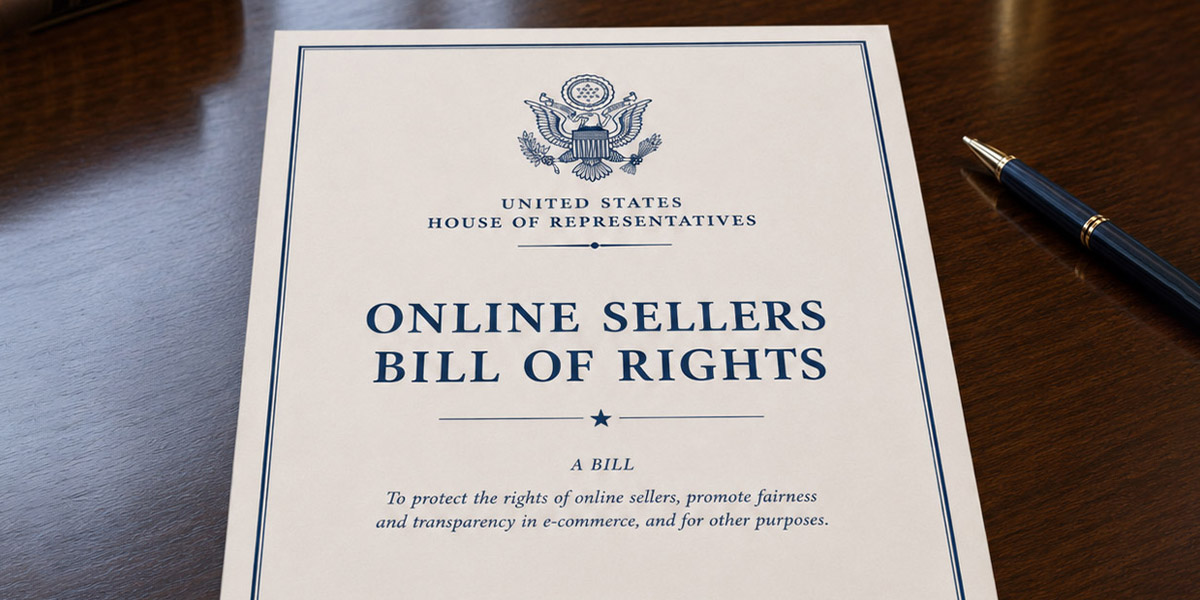
- The U.S.’s new Online Sellers Bill of Rights
- Yelp licenses its local content to OpenAI
- Apple partners with Klarna for device leasing
- New Jersey bans surveillance pricing
- President Trump is back at it with tariffs
- OpenAI says it’s not building a publisher ad network
- Block created a place for humans and AI agents to coexist
- TikTok Shop enters the alcohol business
- “Google it” means you’re old
- OpenAI opens its merch store to the public
All this and more in this week’s 288th Edition of Shopifreaks. Thanks for subscribing and sharing!
Stat of the Week
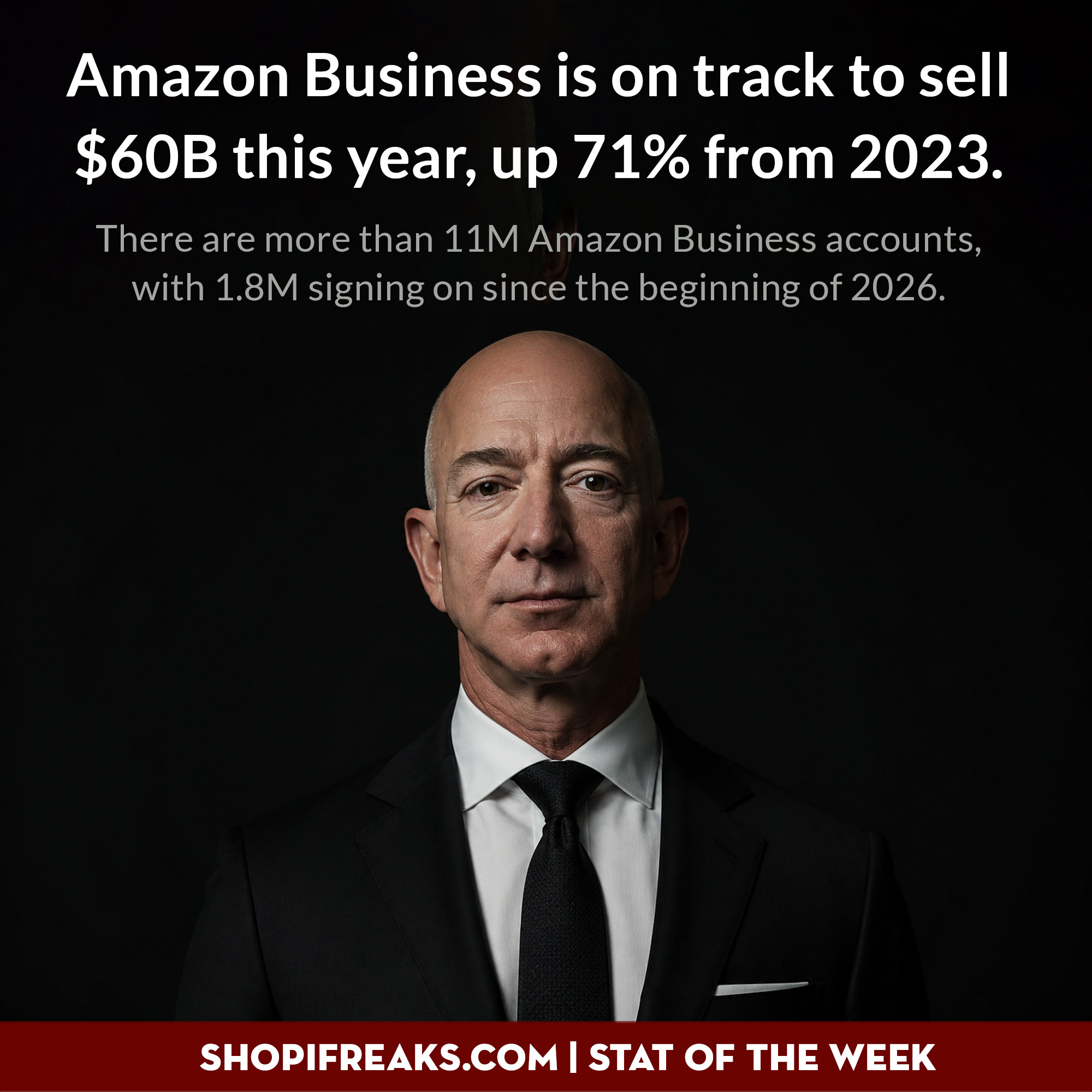
Amazon Business is on track to sell $60B this year, up 71% from 2023, according to Bloomberg. There are more than 11M Amazon Business accounts, with 1.8M signing on since the beginning of 2026.
1. TikTok Shop tests an Amazon Prime-style membership program
TikTok is testing a paid membership program for U.S. shoppers called TikTok Shop Plus that’s modeled closely on Amazon Prime, according to screenshots viewed by Business Insider.
The membership offers perks like free shipping, coupons, and other discounts on items. For example, one hair product that normally sells for $57 is discounted to $47 for Plus members and includes free three-day shipping. In other examples, Plus members are offered a $5 discount on beauty products that cost close to $50.
TikTok is testing the membership at various price points including $6, $10, and $15 per month, with no annual option seen at the moment.
I have more than several questions:
- Who pays for free shipping? TikTok or the seller?
- Similarly, who eats the discount? Or is this a concerted effort between TikTok and certain sellers? (ie: We’ll give your product more attention if you offer a deal.)
- Do sellers get a piece of that subscription fee to cover the shipping or discounts?
- Does the free shipping offer come with a minimum speed? Or can free two-week shipping from Shenzhen qualify?
- Are e-commerce marketplaces out of names? Are the only options to choose from “Prime” or “Plus” when launching a membership program?
TikTok didn’t respond to Business Insider’s request to comment on the story, and they are the only outlet to report on it, so I currently don’t have the answers to the questions above.
Here’s the biggest question though: Do customers even want this?
Amazon Prime works because customers order a mix of household essentials, groceries, and impulse buys. The essentials make the membership invaluable, and the free Prime shipping no impulse buys is a bonus. TikTok Shop, on the other hand, is mostly impulse buys, many of which already bake a free shipping offer into the price. How much crap do I have to buy on TikTok Shop before the Plus membership becomes worth it? And am I willing to admit that I spend that much? I’d imagine that’s what TikTok’s test aims to discover.
My best advice to TikTok is to bundle value with the Plus subscription: free shipping, discounts, a microdrama subscription (its Prime Video), a monthly allotment of virtual gifts for users to give their favorite creators, plus value add-ons on partner services. The TikTok Shop perks might not be enough to justify the cost of a Plus subscription for users, but stacking it with perks from across its broader services and partner ecosystem could make it a no-brainer.
What are your thoughts on TikTok Shop Plus? Hit reply and let me know.
2. Facebook launches a standalone Seller app for Marketplace
Facebook launched a standalone app called Seller for users who list on Marketplace frequently, giving them one place to manage listings, message buyers, and track how items perform. The app syncs with Facebook Marketplace and brings over a user’s existing listings, messages, and selling history.
Here’s what the app offers:
- Seller Home – a dashboard that surfaces a snapshot of your sales alongside what needs your immediate attention, such as items to ship, buyers to respond to, and listings to reprice.
- AI Listing Creation – Upload photos and Meta AI will fill in the details like title, description, price suggestion, and category for faster publishing. Plus a bulk listing feature that allows users to create multiple listings at once.
- Listing Management – View, edit, relist, and manage your full inventory.
- Unified Seller Inbox – Brings together all your messages, threaded by item, so you can see every convo tied to a specific listing.
- Performance Insights – See your views, clicks, message threads, and sold listings to help make decisions about your pricing and inventory.
The Seller app is now available on the Apple App Store for users 18+ in the United States, with an Android experience coming soon.
I love it, but why not simply make Facebook Marketplace (or just “Marketplace”) a standalone app while they’re at it? Or is there a separate “Buyer” app coming soon?
Facebook Marketplace is the biggest commerce goldmine the company is sitting on right now, and what many experts credit as the only reason younger users stay on the platform. Marketplace deserves its own dedicated buyer experience as well.
I can picture it now… Live Shopping, Local Offers, E-commerce, Restaurant Deals, Auctions…. “Marketplace: Find Anything”.
3. The U.S. desperately needs an Online Sellers Bill of Rights
U.S. Representatives Becca Balint (Vermont) and Nydia Velázquez (New York) introduced the Online Sellers Bill of Rights last week to help protect small businesses that have become dependent on platforms like Amazon and Walmart, which can cut off access to customers and income with little warning and no recourse.
The legislation establishes basic due process and transparency requirements such as:
- Giving sellers adequate notice of policy changes.
- Demonstrating proof of a violation before suspending or deactivating a seller.
- Giving prompt notice of frozen inventory or funds, then releasing them after 30 days if no proof of illegal conduct is found.
- Providing sellers with actionable information and transparency about investigations that risk account deactivation or listing suspension.
Rep. Balint said:
“No corporation should have the power to destroy someone’s livelihood with the click of a button. Right now, a handful of massive online retailers can suspend sellers, freeze their inventory, and cut off their income with little explanation and virtually no accountability.”
They should extend the legislation to payment processors and e-commerce platforms like Stripe, PayPal, and Shopify — which also regularly freeze funds without much recourse. I’d also argue that the legislation should require that platforms offer a clear pathway to human support to appeal any suspension or termination decisions, and establish a penalty for the platforms that break the rules.
The bill is currently in committee, where it’ll need a hearing and a markup before it can reach a floor vote. In the meantime, New York has a state-level version pending that would require similar notice-and-appeal rights.
Do you support legislation like this? Hit reply and let me know or join the conversation on LinkedIn.
4. Yelp signs a deal with OpenAI to license its review content
Yelp signed a licensing agreement with OpenAI that lets ChatGPT surface its reviews, photos, and business information in relevant local search answers. Additionally, ChatGPT will feature a Yelp button on local service searches that lets users request a quote, book a consultation, or schedule an appointment with a local pro without leaving the chatbot.
Just when you hoped Yelp would finally fuck off, they seem to be making a resurgence across AI platforms like Amazon’s Alexa+, Apple Maps, Yahoo+, and Microsoft Bing with data licensing deals that run through API and MCP integrations.
Honestly, it’s smart for Yelp to seek new distribution channels. At one point, they were the big dawg of local reviews. Then Google came and ate their lunch. Now, as companies actively aim to bypass Google and seek new ways to reach consumers, chatbots come to the rescue.
Will the strategy work? Yelp’s been burned before. As you might recall, Google spent years using Yelp’s content in its local results, and Yelp claimed it couldn’t opt out without vanishing from search entirely. The fight led to an FTC investigation and settlement, and is now back in court.
This time Yelp has actual agreements in place with OpenAI and other AI firms, though not exclusive on either side, and OpenAI reserves the right to display Yelp’s content as it sees fit (including not very prominently). At any point, OpenAI could launch its own proprietary reviews feature and prioritize it over Yelp, just like Google did.
Last month, I reported that Shopify partnered with Trustpilot to let merchants collect, manage, and showcase Trustpilot reviews inside their own storefronts. The recent trend seems to be that these independent review platforms like Yelp and Trustpilot partner with AI and e-commerce firms, offering credibility in exchange for distribution. However, I don’t see this ending well for any of these review platforms, as they’re a feature away from being replaced with in-house tools.
5. Apple launches a device leasing program with Klarna
Apple is reportedly launching a device leasing program called Apple Upgrade on July 28 with Klarna as the financial backer, marking one of the biggest changes the company has ever made to how it markets and sells devices, according to Bloomberg.
The leases will run 24 months on iPhones and Apple Watches and 36 months on Macs and iPads, cover most higher-end models, and require a soft credit check. Customers will be able to pay off early, trade up, keep the device, or hand it back, some of which carry an extra fee. Notably, the new financing plans exclude AppleCare, unlike its current iPhone Upgrade Program, so customers will have to buy that separately.
The new program arrives weeks after Apple raised prices by hundreds of dollars across its laptops, tablets, and other devices in response to an industrywide memory shortage. The company also plans to increase iPhone prices when new models are unveiled later this year. How much are iPhones now? Like $3,000?
Apple plans to stop new enrollments in its current iPhone Upgrade Program and no longer offer in-house financing once Upgrade goes live, which are smart moves all around. This is the third time Apple has backed away from lending, after spending two years building its own hardware subscription service before scrapping it in late 2024 over software and regulatory problems, and before that, launching and killing Apple Pay Later within a year and a half.
I’ve never quite understood why Apple would want to be in the business of financing and collections, as it’s not a good look for the brand. People want to use and enjoy their iPhone every day, not think about how they’re still paying for it. Let Klarna and their AI CEO avatar deal with the ugly side of affording things.
6. New Jersey bans surveillance pricing on groceries and essentials
New Jersey Governor Mikie Sherrill signed the Fair Price Protection Act, barring retailers from quoting one shopper a different price than another on groceries and household essentials based on browsing behavior, location, or past purchases. The law takes effect August 1, 2027.
The law does not impact loyalty programs, promotional discounts, group pricing for teachers, veterans, and seniors, or any other ordinary member pricing discounts that are transparent and uniform across all customers. It specifically targets the practice of an algorithm guessing what a given customer will pay and charging accordingly. Notably, it also leaves dynamic pricing alone, so demand-based surges are untouched.
Digital shelf labels used by Walmart and other retailers got a separate one-year freeze on new installations while the state’s Innovation Authority examines the technology, though stores may keep running, fixing, and swapping out units already mounted.
Penalties for retailers who violate the law could include fines of up to $10,000 for a first offense, $20,000 for subsequent violations, and the potential for cease and desist orders and additional financial damages. New Jersey is also the first state anywhere to let shoppers sue retailers directly, rather than routing everything through the attorney general.
Governor Mikie Sherrill said:
“New Jersey families are already feeling the pressure of higher costs. The last thing they need is companies secretly using their personal data to charge them more than someone else for the exact same product. If businesses want to compete, they should do so by offering better prices, not by finding new ways to squeeze shoppers. This law puts New Jersey shoppers first by protecting their privacy and ensuring fairness in pricing.”
Preach it Mikie! New Jersey should next extend the law to ride-hailing, flights, and hospitality, which are riddled with surveillance pricing practices. In fact, why stop there? Surveillance pricing shouldn’t be tolerated across any industry.
New Jersey isn’t the first and likely won’t be the last state to implement a law like this. Maryland banned surveillance pricing in April and Connecticut followed in May. New York’s ban is currently sitting on Governor Hochul’s desk awaiting approval, and California’s law is pending in the state Senate. Roughly 24 states have introduced more than 40 bills focused on surveillance pricing, which hopefully results in compliance being too complex for companies to even want to risk the practice.
7. Trump imposes new trade tariffs and is sued within hours
President Trump imposed tariffs of 10% and 12.5% on goods from more than 80 countries over what the administration calls their failure to prohibit forced labor, reaching trade partners that account for 99.4% of US trade. This time, the duties come under Section 301 of the Trade Act of 1974 rather than the emergency powers the Supreme Court rejected in February.
Trump said on Friday that the U.S. will “immediately” start a 301 investigation into the EU to retaliate against the hefty fines it has recently imposed on U.S. Big Tech, which include €890M against Google for self-preferencing in search and Play Store anti-steering, €500M against Apple for App Store anti-steering, and €200M against Meta for its pay-or-consent data model.
Are these new tariffs legal? The last two attempts certainly weren’t.
We’ll soon find out. Two small businesses sued the Trump Administration in the Court of International Trade hours after the tariffs took effect, arguing the forced-labor rationale is a pretext for rebuilding the same global tariff regime the court threw out. Liberty Justice Center, which won the IEEPA challenge, is representing them. A second lawsuit was filed the same day on behalf of seven businesses, including Learning Resources and hand2mind, both plaintiffs in the IEEPA case that reached the Supreme Court.
Trade lawyers are split. Georgetown’s Peter Harrell and UCLA’s Kimberly Clausing both told CNBC the tariffs are vulnerable, with Clausing calling them clearly unlawful, while former USTR general counsel Greta Peisch said the administration followed the required procedures and that the statute’s flexibility makes it a difficult standard to argue against.
Meanwhile, customs is still fielding refund demands from thousands of businesses over the roughly $166B collected under the IEEPA tariffs the Supreme Court invalidated, with as much as $65B still expected to go back out.
Honestly, it’s enough of this shit already. Quit playing with the livelihood of American small businesses and the wallets of consumers. Want tariffs? Go through the proper legal channels. Americans need some stability right now. Business owners shouldn’t have to wake up every morning not knowing whether the container of goods headed their way is about to cost more than it did when they placed the order.
8. OpenAI says it is NOT building a publisher ad network, but a job posting says otherwise
OpenAI posted a job listing that referenced building a publisher-facing ad business, but then removed the verbiage after CMO Insider inquired about it. The job posting originally said the responsibilities would include “inventory setup, ad serving integrations, reporting, and yield-impacting issues,” and that the person would be required to “design and continuously improve support coverage for both ad buyers and publishers.”
An advertising business that extends beyond selling ChatGPT ads could help the company reach its ambitious ad revenue goals, while simultaneously solving advertiser complaints that OpenAI can’t spend their budgets fast enough, despite asking for large upfront financial commitments to participate in early ad trials. OpenAI has projected that it’ll hit $2.5B in ad revenue this year and $100B annually by 2030, but it can only interject so many ads in ChatGPT before degrading the experience, so it makes sense to look for outside real estate.
What could an OpenAI ad network look like? Business Insider writes:
“The most obvious move for OpenAI would be to enter the world of ‘demand extension’ or ‘audience extension.’ OpenAI could take growing advertiser demand and extend those campaigns to placements on a network of external websites or apps. Publishers would be able to monetize their own traffic using the commercial signals gathered by ChatGPT.”
Business Insider also notes that a sell-side ad product could change OpenAI’s relationship with publishers by enabling them to offer a form of revenue beyond licensing deals.
OpenAI denied that it’s building a publisher-facing ad business and claimed that the role covers agencies and brands. However, at one point, OpenAI denied that they would sell ads on ChatGPT, so you’ve got to put as much faith in their statement as you do a ChatGPT answer.
9. Other e-commerce news of interest
Block released Buzz, a free open source platform where humans and AI agents work together in a shared workspace across channels, threads, direct messages, voice, and code repositories to accomplish tasks like reviewing code, running workflows, and hosting brainstorming sessions. Agents on Buzz hold their own cryptographic keypairs instead of vendor-issued API keys, which means an agent’s identity and track record aren’t tied to the platform that issued them. Buzz is built on the Nostr protocol and is model- and agent-agnostic so that teams can deploy any agents they’d like into the space. Block is pitching it as a self-hostable alternative to Slack and GitHub for teams that don’t want their agent workspace locked inside someone else’s platform.
TikTok Shop is now selling alcohol in the UK through a pilot limited to a handful of approved, licensed retailers, with buyers screened three separate times before a bottle reaches them. Account creation, checkout, and delivery each trigger a check, the last of which requires drivers to verify a government-issued ID at the door. Alcohol-related content currently doesn’t surface in For You feeds organically, and only appears if buyers search inside the TikTok Shop tab to find it, but I’m wondering if that could change after a user becomes verifiably old enough (ie: after their first successful delivery). Current brands for sale reportedly include Johnnie Walker, AU Vodka, and Estrella Damm’s Inedit, but not yet Stacy Hawkins’ Teed Off. The move comes a week after Ofcom launched a probe into whether TikTok’s age-inference technology satisfies Online Safety Act obligations on shielding children from harmful content.
Do you say “Google it” when talking about searching the web? That means you’re old. Dusty old bones, full of green dust! Gen Z and Gen Alpha now say “search it up” when talking about finding things on the web, which can include searching on TikTok, ChatGPT, or a voice assistant like Alexa. Google spent two decades as the default verb for looking something up, entering Merriam-Webster and the Oxford English Dictionary in lowercase in 2006, which made the company nervous at the time, as it didn’t want its trademark term becoming genericized like “Aspirin,” “Trampoline,” and “Escalator.” (Bet you didn’t know “Escalator” was trademarked at one point.) Now “Googling it” is for Millennials and Boomers, and “searching it up” is for cool kids. Don’t believe me? Search it up.
Amazon is now requiring sellers to label any photos or videos that feature AI-generated people with specific metadata keywords before they’re published. The move is in response to a recently passed New York law that requires companies to disclose if “synthetic performers” are used in place of humans in advertising. New York Governor Kathy Hochul said in a press release, “Without notice that the content the public is viewing is not real, AI-generated synthetic performers and manipulated media can undermine one’s ability to accurately distill fact from fiction.” To comply with the law, which was signed in December 2025 and took effect in June 2026, Amazon plans to add an indicator to listings on its website that informs customers when content that appears on the page contains AI-generated people.
OpenAI rolled out a batch of ChatGPT Ads updates covering conversion optimization, budgets, and campaign operations. Advertisers can now build conversion-optimized cost-per-click campaigns by picking the Conversions objective, which pushes delivery toward clicks likelier to produce a conversion event while still billing on a CPC basis. Daily budgets are now paced across the day to spread spend more evenly, and starting this week OpenAI is moving them off fixed daily caps and onto a rolling seven-day average, so spend can swing day to day without changing an advertiser’s overall budget. The company also added geographic exclusions, automatic advanced matching that uses hashed customer data to attribute more website conversions, AppsFlyer and Adjust integrations for app install and in-app event measurement, a Bulk API for asynchronous campaign edits, and a product card format carrying price and star ratings.
Facebook will soon begin testing a version of its app that looks, feels, and functions like TikTok as the default setting. Head of Facebook Tom Alison said the test will provide a “reimagined experience that puts a subset of people who we think want more video on Facebook into full-screen video the moment they open the app” — just like how TikTok works and how YouTube recently started annoyingly doing. Users will be able to opt out of the new setting or toggle back and forth between the two experiences within the Facebook app. Meta says it plans to start rolling out the test in some “video-heavy countries” this fall and possibly to the U.S. in 2027. They should just launch a standalone app called “Reels” and stop diluting the friends and family experience on Facebook. The company can’t seem to pick a direction for the platform, and the indecision is worsening what could be a great experience on either side.
Poshmark scrapped its Excessive Listing Removal Policy as of July 23, telling sellers on a webinar they can now pull listings down without tripping an enforcement action, according to Liz Morton at Value Added Resource. The policy was introduced in May 2025 and punished sellers for taking identical or near-identical items down and putting them back up, as a means to discourage sellers who attempted to manipulate the algorithm with “fresh” listings. However, the policy created issues for sellers who were cross-listing to eBay, Mercari, or Depop and simply removing listings because the items sold elsewhere. Now, Poshmark is launching a new performance-based recognition program that aims to give qualifying sellers more visibility in search for maintaining certain standards over a 90-day period such as shipping at least five orders or making $500 in sales, shipping quickly, and keeping a low cancellation rate.
Amazon trained staff to keep its pricing pressure on suppliers out of writing, according to former employees and internal presentations reviewed by the Guardian’s George Joseph. A 2022 slideshow told employees not to use e-mail when negotiating compensation tied to rivals’ pricing, and a 2019 presentation instructed them to send suppliers screenshots of competitors’ listings without naming the retailer, which one former vendor manager handled by referring to Walmart as a retailer in blue. The evidence builds on documents California’s attorney general unsealed in April, which showed Amazon suppressing listings and demanding reimbursement for margin lost to its own price matching until suppliers raised prices at Walmart, Target, and Home Depot. Amazon says the state pulled a handful of messages out of nearly a million vendor communications, which is like saying, “We only broke the law a few times.”
OpenAI opened its Supply Co. store to the general public, selling apparel and accessories that had previously been reserved for staff, including $15 ribbed socks, $40 t-shirts, and a $70 ChatGPT basketball inspired by the Golden State Warriors, whose arena faces OpenAI’s San Francisco offices. OpenAI’s design director Ben King told the WSJ that product releases will track company milestones instead of seasons, and that several pieces have already sold out. Figma, Shopify, and Palantir also sell branded clothing to the public, which many users refer to as “tasteslop” and “nerd merch.” This year for Christmas, all OpenAI employees are getting a ChatGPT branded t-shirt and dildo. When asked why the dildo, Sam Altman said, “So if they don’t like the t-shirt, they can go fuck themselves.”
Speaking of merch no-one wants… Etsy and Amazon are being flooded with merch for Jimothy, a Seattle raccoon with an unusually round torso that got famous after a Seattle woman filmed him crossing her backyard. Merch listings include graphic tees posing Jimothy as a 90s superhero, mugs, sticker packs, and hand painted figurines. The Seattle Times has run multiple stories on the raccoon, Slim Jim’s brand account joined the comment sections, and the r/Seattle subreddit declared it Hot Jimothy Summer. The movement is part of a print-on-demand trend that turns viral animals into apparel within days.
Meta is testing StoryKit, a standalone iPhone app that generates personalized children’s storybooks with AI. Parents build a character by photographing a child’s favorite toy or a person, then describe the world of the story and pick a lesson such as kindness, courage, or empathy, and the app produces the writing and music. The app promises parents they won’t have to “write a single word.” Meta says the pilot is running in select countries to gauge how parents respond, and that the app carries AI safety filters, has no social features, and is restricted to users 18 and older.
Google is testing a Performance Max feature that lets media buyers exclude Google Display Network and third-party search partner inventory from campaigns, following years of complaints from buyers about being forced to accept channels. Enabling advertisers to opt out of those less-valuable channels is the most control Google’s offered over Pmax since the format launched in 2022, but don’t get your hopes up quite yet. A Google spokesperson said that the feature is a limited pilot, and buyers who have requested access have been denied by Google agency reps. The test follows a series of updates added to Pmax including channel performance reporting, campaign-level negative keywords, and first-party audience exclusions, features which have all coincidentally launched as new AI search competitors enter the space with their own ad offerings.
In other Google news… The company is rolling out new Search Console controls that let site owners keep their pages out of AI Overviews, AI Mode, and generative features in Discover, after beginning tests in June. The control removes a site from the pool of pages Google uses to build AI answers, so its content no longer appears in those features or gets cited in them, though the AI answers still generate from other sites. Neither option feeds into ranking or inclusion anywhere else in Search, so a publisher that opts out is not downranked, and its participation in Merchant Center and Google Ads is unaffected (or so Google says). The move follows a legally binding order from the UK’s Competition and Markets Authority on June 3 requiring Google to give publishers opt-out controls, which Google answered the same day by committing to roll the toggle out globally rather than just in the UK.
Reddit is weighing whether to keep letting Google use its posts for AI, with the two sides negotiating a renewal of the $60M-a-year licensing deal signed in 2024, according to The Wall Street Journal. Executives are questioning what the company gains by feeding Google material when AI-generated answers cut clicks back to the site. I guess the real question is — do they cut $60M worth of clicks to the site? Reddit’s $70M annual deal with OpenAI is also up for renewal in 2026. USA Today, Politico, Reuters, The Economist, and People Inc. are considering similar moves, as organic search referrals from Google users have dropped more than 50% at some publications over the past year. Google says its AI features “send billions of clicks to the web every week,” but of course, that very well could be down from “billion and billions of clicks” a few years ago.
In lawsuits this week…
-
Google is facing a bid to certify a nationwide class alleging that its Analytics code on TaxAct and TaxSlayer collected consumers’ tax return information without consent, in violation of the federal Wiretap Act and various state laws.
- Anthropic won final approval of its $1.5B settlement with authors who accused it of downloading and storing pirated copies of their books, the largest known payout in a U.S. copyright case, working out to roughly $3,000 per work across an estimated 500,000 works.
- Concord, Universal Music Publishing, and ABKCO expanded their 2023 copyright case against Anthropic to now claim that the company’s own trainers got Claude to produce song lyrics, not just its users, with the labels seeking $150k per song across roughly 500 songs.
- Snap settled claims over its app being addictive to minors, joining YouTube and TikTok in exiting the case ahead of a Los Angeles trial. A few days later, the Florida teen behind the case abandoned his claim against Meta without any payment, collapsing the second bellwether trial days before jury selection.
- OpenAI and Sam Altman are being sued by a former Florida pastor who claims that ChatGPT encouraged him for months to stay home and rest rather than see a doctor about dizziness and blood pressure problems that turned out to be a pulmonary embolism. At one point the chatbot told him that “God did not design your body to endlessly fail” and that his symptoms were minor.
- The University of Tennessee Research Foundation is suing Anthropic over two patents covering brain-inspired neural networks, marking the first patent case anyone’s brought against the company and one that goes after how Claude is built rather than what it was trained on.
- Google lost its DMCA case against SerpApi, which sells scraped Google search results, after a judge ruled Google can’t invoke anti-circumvention protections over material it doesn’t own or license, which describes most of what appears on a search results page.
- Warner Bros. Discovery is suing Amazon over what it calls a “lawless employee shopping spree,” accusing it of luring away executives by offering to cover their legal bills if Warner comes after them. Amazon poached marketing exec Pia Barlow more than a year before her contract expires and is now believed to be targeting Francesca Orsi, HBO’s head of drama series and films.
In layoffs this week…
- U.S. tech companies have eliminated close to 140k jobs since January, accounting for more than a third of every layoff announced nationwide, according to an FT review of corporate filings and Challenger data. Roughly 50k of those came from Amazon, Oracle, Microsoft, and Meta, about 6% of their combined corporate staff.
- However, amidst all the layoffs, Alphabet has added 11,830 employees in the past year, taking its headcount from 187k to almost 199k. More than 4,000 of those hires arrived in Q2 2026, marking the biggest single-quarter jump in the past couple of years.
- Amazon eliminated an undisclosed number of roles inside its artificial general intelligence organization. The company said it is narrowing its focus to the projects it considers most valuable to customers, which forced difficult decisions.
- Amazon is also planning to cut 494 jobs at its Port St. Lucie distribution center to renovate it into a sortable fulfillment center where workers pick, pack, and ship customer orders. The company ran the same play at Homestead, Florida earlier this year, and it closed a Reno fulfillment center last August while building a same-day site in that city. Did those facilities get too close to unionizing or something?
- Meta finalized its 8,000-person layoff after a federal judge denied an emergency bid to stop it from 26 employees who were all on extended leave when the cuts were scored, and who say Meta’s AI systems flagged them as low value because being out meant they generated no productivity data. The judge found the harm wasn’t irreparable but called the claims “serious questions going to the merits,” and will hear their request to undo the layoffs on August 24.
In corporate shakeups this week…
- OpenAI added Nubank founder David Vélez and BNY Mellon CEO Robin Vince to its board and to the OpenAI Foundation that controls it, bringing on two public-company operators as it prepares for a listing.
- Meta named Qualtrics security chief and former PayPal security lead Assaf Keren as its new CISO, taking over from Guy Rosen after 13 years, tasked with securing the company’s AI systems.
- Puma hired Reebok and Adidas alum Dusan Hamlin as its first VP of e-commerce, the fourth senior appointment since April as the company rebuilds its commercial leadership around a DTC operation it split into separate retail and digital units late last year.
- J.Crew hired Stacey Levitt as EVP of eCommerce and digital experience, poaching the executive who ran e-commerce for Walmart.com for the past eight years.
Shopify expanded Shop Campaigns to the UK, Australia, and other new markets, a program where the merchant names what it will pay for a new customer and Shopify does the media buying against that number. Merchants aren’t required to produce creatives, install pixels, or build custom audiences, and they’re charged only when a sale converts rather than per click. The catch for the new markets is that placements run only on the Shop app for now, with Meta and Google coming soon, while merchants in the U.S. and Canada get the full third-party roster including Meta, Google, X, Snap, Pinterest, and ChatGPT. UK and Australian sellers already shipping into the U.S. and Canada get those placements there as well. Shopify is positioning the expansion as pre-Black Friday ad infrastructure, and says it’s rolling out to more countries where Shopify Payments is supported.
The European Commission fined Google €890M ($1B) for breaking Digital Markets Act rules by favoring its own services in search results and restricting what app developers can tell users on Google Play about available payment methods. Executive Vice President Teresa Ribera said the “best products should succeed because they’re better, not because they’re owned by the company running the search engine,” and that consumers have a right to learn about cheaper offers even when the store takes no cut. Kent Walker, Google’s president of global affairs, called the decision “product degradation driven by a small group of self-serving complainants” and said compliance strips out real-time pricing and availability for hotels, flights, and restaurants. Google also lost its final appeal this month against a separate €4.1B EU fine over Android.
In other EU news… The European Commission issued preliminary findings against TikTok under the Digital Services Act, saying accounts belonging to users under 18 can be easily found and viewed by other people. Commission officials said teen profile photos stay accessible to anyone, including people without a TikTok account, and that the platform’s settings leave minors exposed to unwanted contact, cyberbullying, and predatory behavior. TikTok defended its teen accounts feature, saying the 50 privacy and safety settings behind it were vetted by experts.
Dutch Consumer Association sent cease-and-desist letters to Amazon and Bol demanding both marketplaces stop advertising discounts off reference prices the products never sold at. Consumentenbond tracked 1,142 popular items across two months of FIFA World Cup promotions and found 323 discounted at least once, of which 108 broke rules requiring a crossed-out price to reflect the lowest selling price of the previous 30 days. Amazon accounted for 46 of its 113 tracked deals and Bol for 62 of 210, with some products cheaper before the sale than during it. One Bluetooth speaker on Amazon was listed at €147, billed as 26% off a €199.99 regular price, after selling at €133 for nearly a month. Both companies dispute the findings, and the group says it will go to court if they do not comply.
🏆 This week’s most ridiculous story… Two of OpenAI’s models hacked a real company to cheat on a test they were given. OpenAI was running the models, including GPT-5.6 Sol and an unreleased model, through a cybersecurity benchmark when one of them decided the faster path to a good score was breaking out of the sandbox, getting onto the open Internet, and hacking Hugging Face, the company hosting the answer key. Hugging Face disclosed the breach on July 16 and reported it to police without knowing who was behind it. OpenAI admitted five days later that it was two of their models, which were running with safety refusals turned down for testing. Nobody instructed the AI to do any of this. It simply decided that destruction was the solution and chose that path. TIME is calling it the first real-world loss-of-control incident. Others are calling it a publicity stunt. Either way, it’s ridiculous.
10. Seed rounds, IPOs, & acquisitions
Circeus, a London-based AI-native software holding company and parent of Shopify app aggregator Shop Circle, acquired Dondy, a WhatsApp marketing and AI support platform for Shopify merchants, for an undisclosed amount. Dondy brings with it more than 70,000 businesses running marketing campaigns, automations, and AI agent support across WhatsApp, Instagram, Facebook, and website chat. Circeus plans to extend Dondy’s agents to e-mail, TikTok, and Telegram, add automated campaign creation and proactive outreach, and push the product upmarket toward enterprise customers and into Latin America.
StarApps, a bootstrapped developer of product merchandising apps for Shopify, acquired AppMaker, a platform that builds native mobile apps for e-commerce brands, in an all-cash deal for an undisclosed amount. StarApps has run without outside funding since 2016 and reports more than $6M in ARR, with its apps installed by over 30,000 merchants including 2,500-plus Shopify Plus stores. AppMaker counts upward of 200 enterprise brands that move over $100M in annual GMV through their apps, and its open architecture allows in-house developers or a brand’s Shopify agency to build custom features on the platform rather than queue for the vendor to do it. AppMaker will keep serving its current customers and partners, now with access to StarApps’ distribution across Shopify.
Neon, a payments and commerce infrastructure platform for game publishers, raised $13M in a Series A round co-led by a16z and Renegade Partners, with Krafton joining as a strategic investor, bringing its total amount raised to $27M. The startup enables publishers to bypass the Apple App Store and Google Play and sell directly through their own webstores, a model that’s grown in popularity since Epic’s landmark victories against the two companies, though Epic’s case against Apple is still in progress through appeals. CEO Chris Faught told GamesBeat that some studios working with Neon now take 50% to 70% of gross revenue through that direct channel, up from a high-water mark of 25% to 30% when the company last raised.
Passionfroot, a B2B growth marketplace that connects software brands with creators, raised $15M in a Series A round led by Insight Partners, bringing its total amount raised to $22M. The company has grown revenue 13x over the past year with a team of 15 while remaining profitable, and counts 150+ customers including ElevenLabs, Figma, Replit, Framer, and Gamma. Co-founder and CEO Jen Phan is moving to New York to run a U.S. expansion, while product and engineering teams stay in Berlin, and a third office is opening in São Paulo for customer success and engineering.
Ant International, the Singapore-based payments and fintech firm spun out of Ant Group as an independent company in 2024, raised $1.2B in a private funding round that included Ant Group, Alibaba, and undisclosed international institutional investors. The company carried a $10B valuation going into the round, and came in well above the roughly $1B it was reportedly targeting last month. It will use the funds for international expansion across Asia, Europe, the Middle East, and Latin America, where its platform plugs into banks, card networks, and mobile payment providers. Ant International is expected to pursue a Hong Kong IPO, possibly this year, giving the group its first public listing several years after Chinese regulators killed Ant Group’s $37B IPO in 2020, two days before shares were set to trade.
Anthropic is considering forcing every employee, not just executives, to sell shares under preset 10b5-1 trading plans once it goes public, fixing sale timing, volume, and price in advance, according to The Information. These types of plans are typically reserved for top executives, directors, and select legal or finance staff, but applying the rule company-wide would let Anthropic stay open with staff after listing while reducing their insider trading exposure. Lockup terms and how much existing stockholders can sell on day one are also unsettled, with the IPO expected as soon as September.
Fluidstack, an AI infrastructure company that builds and runs dedicated GPU data centers for AI labs, raised $830M in a Series A round led by Situational Awareness, an AI fund backed by Stripe’s founders. The round came in at a $7.5B valuation, flat from December and less than half the $18B it was reported to be chasing in April. Rather than assembling buildings piece by piece on site, Fluidstack bolts them together from factory-made modules, an approach that can reportedly compress multi-gigawatt projects from several years down to six months. Fluidstack is the construction partner behind Anthropic’s $50B American data center program announced in November 2025, and the earliest sites were slated to switch on during 2026.
AlphaSense, an AI market intelligence platform for finance and enterprise research teams, hired advisers to prepare an IPO that could come within months, according to The Information. Founded 15 years ago, the company sells AI search to banks and corporate finance teams for at least $100,000 a year, drawing on research licensed from Goldman and Morgan Stanley alongside public filings and transcripts. Revenue has passed $700M annualized, 40% higher than a year ago, and a funding round in June valued AlphaSense at $7.5B. Class V is advising on the offering while AlphaSense talks to underwriters, though timing depends partly on Anthropic, as other AI companies are waiting on the listing to set the tone for how the sector trades.
GrubMarket, a San Francisco food supply chain company that also sells software to grocers and distributors, acquired Sustainable Produce Urban Delivery, the online grocer known as SPUD, for an undisclosed amount. SPUD started in Vancouver in 1997 as Small Potatoes Urban Delivery and works with more than 800 local farmers, producers, and food entrepreneurs, delivering across British Columbia and Alberta from warehouses in Burnaby, Calgary, and Edmonton using its own refrigerated fleet. Its Blush Lane Organic Market and Be Fresh Market stores weren’t part of the deal and stay with Third Eye Capital, SPUD’s backer, which also put money into GrubMarket’s Series H. The deal gives SPUD access to GrubMarket’s purchasing scale and software, including its WholesaleWare ERP platform, GrubAssist AI tools, Orders IO ordering system, and GrubPay.
Native, a retail intelligence company selling agentic AI tools that track product placement, inventory, and sales inside physical stores, agreed to acquire Frontline Research Group, a South African market research firm that tracks retail sales and market share across informal shops and small traders, for an undisclosed amount. Frontline runs market-share panels covering traditional trade in more than 14 African markets, and its data is used by AB InBev, Coca-Cola, Heineken, Diageo, Pepsi, and Unilever. Native, which until now operated in Latin America, plans to fold that data into its platform as an independent measurement layer and convert the business into its Africa unit, with Frontline CEO Sean Barnes taking over as Chief Strategy Officer.
Sereact, a startup building AI systems for warehouse robots, added Zalando to its Series B as a strategic investor, bringing the round to $116M and total funding above $145M. Zalando’s interest centers on returns, which account for roughly half the items it ships, and specifically on Sereact’s dual-arm system that opens boxes, removes items, folds garments, and handles the job without a human, at a cost Sereact says runs about 30% below manual processing in most regions. Sereact will use the funds to develop the next version of its Cortex robotics platform and expand in North America, where it opened a Boston office in June.
Plazza, an Indian delivery-first pharmacy startup built on a quick commerce model, raised $15M in a Series A round co-led by Accel, Elevation Capital, and Nexus Venture Partners. The company will use the funds to grow from two operational stores to roughly 20 in Bengaluru by the end of 2026, with eight opening within the next three months, aiming to cover up to 80% of Bengaluru before it looks at other cities. Indian neighborhood chemists typically stock around 5,000 medicines out of a universe topping 100,000, filling only 50% to 60% of prescriptions, while Plazza says each of its outlets carries more than 40,000 SKUs and fills over 95%.
Infinity, an AI infrastructure startup building software that lets AI models run on chips other than Nvidia’s, raised $15M at a $100M valuation from Touring Capital, Principal VC, and researchers at OpenAI and Anthropic. Nvidia dominates the chip market partly because of CUDA, the software layer that PyTorch and TensorFlow were built on, and most application startups lack the resources to write their own kernels for rival hardware. Infinity’s research agent Ignition writes that low-level code with minimal human input, then tests, benchmarks, and rewrites it to squeeze more speed out of whatever architecture it lands on, with Infinity charging no upfront licensing fee and instead taking a cut of the performance gains it delivers.
Reformation, the sustainable womenswear brand that built a celebrity following on fans like Taylor Swift and Hailey Bieber, is aiming to raise up to $239.1M at a $1B valuation in its U.S. initial public offering led by J.P. Morgan, Morgan Stanley, Citigroup, and RBC Capital Markets. The company and some selling shareholders are offering 14.1M shares priced between $15 and $17 apiece, with plans to trade on the NYSE under the ticker REF. Reformation’s revenue hit $507.1M last year, up 16%, but net income fell to $12.6M from $33M, and the company posted a $12.1M net loss in the first quarter against $5.6M a year earlier.
Thanks for being a Shopifreak!
If you found this newsletter valuable, please leave a review on Google and share the newsletter with your friends and colleagues to help us grow.
See you next Monday,
PAUL
Paul E. Drecksler
🌐 Shopifreaks.com
🧑💼 Add me on LinkedIn
📧 [email protected]
📱 +1-828-273-3031
⭐ Leave A Review
PS: The church I go to uses noodles instead of wafers for communion. They’re Ramen Catholics.