

Hi Shopifreaks
Before we begin, I’d like to welcome DataFeedWatch to the Shopifreaks family as our newest official News Partner! 🎉🥳
DataFeedWatch is a product feed management platform that helps PPC teams at e-commerce merchants and agencies optimize and distribute their product data across performance channels like Google, Meta, Pinterest, TikTok, GPT Shopping, and 2000+ channels, ad networks, and affiliate networks — without touching your storefront.
Your Shopify product catalog (or other e-commerce platform) stays the source of truth, while DataFeedWatch creates a fully optimized version of that data for every channel you advertise on.
⚙️ Here’s what DataFeedWatch brings to the table:
- AI Feed Optimization – Their native AI scans your product data and automatically improves titles and descriptions, fills in missing attributes like color, gender, and size, and recommends the most precise categories for each channel. Every sales channel and ad network has their own criteria for submitting your product catalog, and DataFeedWatch takes care of the heavy lifting so that you can list your products across more channels in a fraction of the time and with less headache.
- Drag-and-Drop Mapping Rules – Use 100+ drag-and-drop mapping rules to combine fields, rewrite titles, create custom labels, split products by profitability, and tailor feeds to your campaign structure. Data feed optimization that typically requires a developer or database specialist can now be performed by store owners or your in-house marketing team with DataFeedWatch’s user-friendly interface.
- One Centralized Feed – Replace dozens of apps and sales channel integrations that require individual customization and ongoing maintenance with a single platform that manages all your external sales channels. Rather than having to set up individual rules or manually edit your product catalog for each channel, DataFeedWatch enables merchants to create master rules and templates once that can be applied across all your channels, with the ability to customize each one as needed.
- Shopify Markets Feed Support – Create separate product feeds by language, currency, and catalog for each market so your international campaigns use localized, channel-ready data. Instead of sending the same feed from your primary market everywhere, you can tailor your product data to each market’s language, pricing, and assortment to improve relevance and performance in global campaigns.
✨ A few things that stand out about DataFeedWatch:
- They know the rules for each channel. DataFeedWatch makes it easy to expand into new sales channels without having to get a PhD in each one’s specific requirements. You’ll get better listings, faster than trying to do it on your own or through the native apps of each channel, which often lack intelligence.
- You’re not limited to Shopify’s product data fields. For example, you can create calculated fields like profit margin using external data, which you can then feed into your advertising channels to calculate ROI and ROAS.
- You can create automations that’ll save you on ad spend. For example, you can automatically pause ads for low-inventory products or when your margins drop due to items going on sale.
- You can create reusable feed templates. This enables agencies to create optimized data feed rules that can be used across multiple channels and stores, without having to recreate them for each client.
- Their support offers more than just technical assistance. The team at DataFeedWatch is praised for their high-touch support that advises on what actually works in your vertical such as the best way to optimize your feeds, create templates, and ultimately get the most from their services.
Want to try it?
Start a 15-day free trial and build your first optimized feed in minutes or request a free personalized demo to learn how DataFeedWatch can help you manage and optimize all your product feeds from one place. Plus through the link above, DataFeedWatch is offering Shopifreaks readers 25% off all monthly plans for the first 3 months after your trial ends. The offer applies to new users only, now through the end of the year.
And now onto your regularly scheduled programming…
In this week’s edition I cover:
- Stripe acquiring PayPal (or not)
- Shopify Campaigns in ChatGPT Ads
- 1,000+ lawsuits seeking tariff refunds
- New York’s proposed BNPL rules
- Is Shopify immune to agentic commerce?
- The eBay stalking saga ends
- SBA loans are now exclusively for US Citizens
- Meta explores stablecoin payments
- DoorDash quits operations in a few countries
- GoImagine is shutting down
- Google to deprioritize its own services in EU
- Circle to Search got an upgrade
- Klaviyo & Google partner up
All this and more in this week’s 267th Edition of Shopifreaks. Thanks for subscribing and sharing!
Stat of the Week
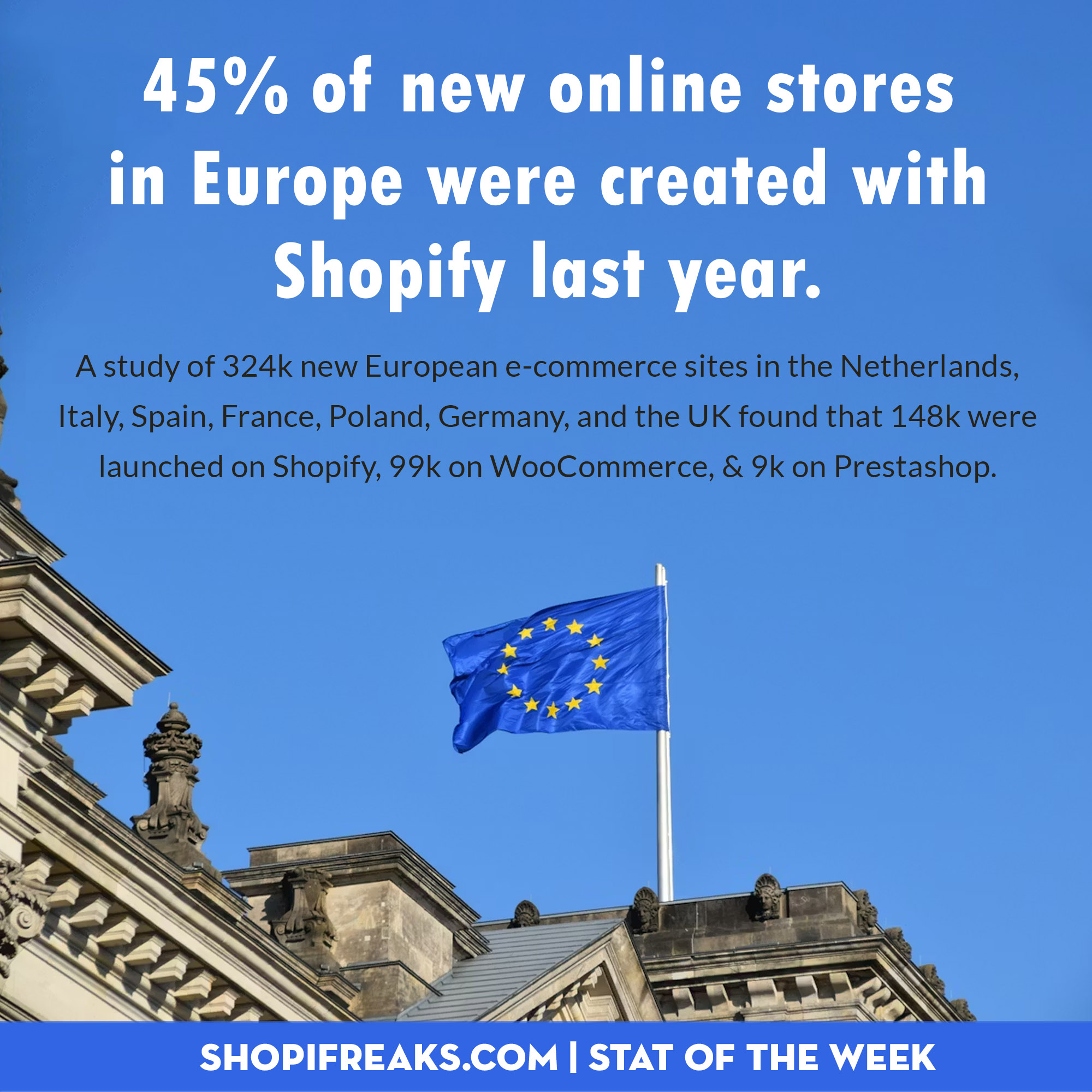
45% of new online stores in seven major European markets were created with Shopify last year, according to a report by ShopRank. The study analyzed 324,000 new European e-commerce sites in the Netherlands, Italy, Spain, France, Poland, Germany, and the UK and found that 148,044 were launched on Shopify, 99,140 were launched on WooCommerce, and 9,747 on Prestashop.
1. Stripe is considering acquiring PayPal, according to Bloomberg
Stripe is exploring a whole or partial acquisition of PayPal, according to Bloomberg sources, who said that the talks are preliminary and might not lead anywhere. Regardless of how close a deal actually is, it’s interesting that talks of a PayPal acquisition are even being held.
Could Stripe afford to acquire PayPal without taking on debt?
Stripe recently secured a valuation of $159B via a share tender offer to provide liquidity to employees, with the majority of the funds for the offer being provided by investors including Thrive Capital, Coatue, and a16z.
PayPal, although having experienced an 85% slump in market share over the past few years, still holds a market cap of around $42B.
While Stripe is a private company and doesn’t have to report how much cash they have on hand, it’s highly unlikely that they’re sitting on a $42B cash reserve (or potentially $50B+ if they had to pay a premium over the currently traded stock price) to acquire PayPal. They’d undoubtedly have to tap into their investor network and give away parts of the pie to make the deal happen, take on debt, and/or do a partial stock-for-stock trade with existing institutional PayPal holders.
Why would Stripe even want to acquire PayPal?
Likely for a few reasons:
- PYPL is incredibly undervalued right now on the market. Even if they paid a 20% premium, Stripe would be getting a steal in my opinion.
- PayPal / Venmo have a combined 540M wallet users, while Stripe’s Link only has around 200M users, most of which I’m convinced don’t have the same relationship with Stripe that they do with PayPal. Meaning consumers choose to pay with PayPal, whereas Stripe Link is just kind of there on some websites with their payment info saved.
- Stripe doesn’t currently have a peer-to-peer or in-house BNPL offering, both of which PayPal/Venmo bring to the table.
- PayPal’s Braintree is Stripe’s direct competitor for enterprise processing, and a merger would effectively consolidate that market.
- PayPal has been positioning itself as the digital wallet of choice for agentic commerce, which Stripe would inherit.
- PayPal is at the beginning stages of growing an ad network, a high margin vertical that Stripe would also inherit, alongside the decades of consumer purchase behavior data that PayPal brings to the table to power that ad network.
- A merger with PayPal could instantly take Stripe public without having to go through the traditional IPO process. Now, would one of the most coveted private companies in the world, that has never expressed urgency or even desire to go public, even want to go public in that manner? I’d think not, as they likely have a lot more to gain through a traditional IPO that would undoubtedly skyrocket their share price, but maybe there are things I’m not aware of that would make a reverse merger attractive.
The list of reasons to acquire PayPal goes on and on, but hopefully that sheds some light on why Stripe could be entertaining the idea.
However I hope that Stripe doesn’t acquire PayPal — both for personal financial reasons and because I don’t see it benefiting the market. It would benefit Stripe, but not the market.
First, I’m way too invested in PYPL because I have high aspirations for the company. See my recent post about how I believe Alex Chriss was positioning PayPal for the next several decades and why firing him was a mistake. I don’t want cash for my PYPL stock, which I would most likely receive as a retail investor. I want Stripe equity, which there’s no way I would get. I don’t want a 20% premium on my PYPL either. I want to see the 10+ year upside to PayPal’s valuation, which is why I heavily invested in the stock in the first place .
Second, I don’t want a payment processing monopoly. I want competition in the market, which Stripe and PayPal currently bring to each other. It’s already hard enough for a startup payment processor to compete in the market with either Stripe or PayPal, let alone the combination of the two. It’d also be a loss for merchants, who in many cases, would have nowhere to go if their relationship with Stripe went sour (which it’s known to do).
What are your thoughts on a Stripe-PayPal merger? Hit reply and let me know or join the conversation on LinkedIn.
2. Shopify Campaigns now integrate with ChatGPT Ads
Shopify started arranging for advertisements to promote its merchants within ChatGPT as part of an expansion of its Shop Campaigns network. The way it works: Shopify purchases ad space on the chatbot to display products from merchants, who in turn only pay when a sale occurs.
What are Shop Campaigns?
If you’re unfamiliar, Shop Campaigns is a pay-per-sale advertising channel offered by Shopify that lets merchants set a target customer acquisition cost and daily budget, and then automatically serves ads to Shop App users, within the Shopify Product Network, and optionally on Meta, Google, and Snap. Merchants only pay when a customer actually converts, never exceeding their preset CAC, but if they bid too low, their ads might never display. Basically it’s a hands-off way to give Shopify a budget and let it advertise for you within its network and across partner networks.
Back to the story…
Shopify has added ChatGPT as one of its partner networks, so merchants who opt-in to Shop Campaigns can now have their products or brand surface in advertisements within ChatGPT answers. At the moment, given that ChatGPT Ads are still in beta, it’s the only direct path to advertising on ChatGPT that I’m aware of for Shopify merchants, or for any small brand on any platform.
The Information notes that Shopify’s ad network only accounts for a small portion of the company’s $11.6B annual revenue, but that Shopify is trying to expand it. The integration with ChatGPT ads provides some additional incentive for brands to experiment with Shop Campaigns.
🔥 Partner News
Cloudways is hosting a free, two-day virtual bootcamp on March 10–11 focused on speeding up WordPress and WooCommerce sites and tying performance work to measurable revenue gains. Sessions include live site teardowns, Core Web Vitals optimization, AI-assisted troubleshooting workflows, and agency panels on packaging performance as a retainer service. The event is aimed at merchants losing conversions to slow stores and agencies looking to turn speed into a sellable growth lever. Registration is open now.
3. More than 1,000 companies are suing the Trump Administration for tariff refunds, and Trump issues new tariffs
FedEx filed a lawsuit in the U.S. Court of International Trade seeking a refund for President Trump’s tariffs, many of which were deemed illegal in February by the U.S. Supreme Court. Subsequently, FedEx’s customers filed a class action lawsuit against FedEx over import duties on products they said should have entered the United States duty-free.
Yup, it’s a legitimate clusterfuck. But wait, there’s more!
More than 1,000 U.S. companies have filed lawsuits to recoup what they paid on imports including Dyson, Dollar General, Bausch & Lomb, Brooks Brothers, Sol de Janeiro, L’Oreal, Skechers, and EssilorLuxottica. Of course, let’s not forget Costco, Revlon, and Kawasaki either, which kicked off their lawsuits at the end of last year.
Reuters reports that more than $175B in U.S. tariff collections are subject to potential refunds, which is a lot of money up for grabs — at least for the companies. It’s doubtful that refunds will trickle down to consumers, who ultimately got hit with the bill through higher product prices. Not to mention the fact that litigation will likely take years, and at this point the cost of tariffs is permanently baked into goods, whether companies continue to pay future tariffs or not.
Senate Democrats are calling for the government to issue refunds directly to consumers over the course of 180 days and pay interest on the refunded amount, but that’s a long shot.
Meanwhile, despite his IEEPA tariffs being deemed illegal by the Supreme Court, President Trump issued new 10% tariffs, this time under Section 122 of the Trade Act of 1974 which allows the President to impose tariffs of up to 15% for up to 150 days to address trade deficits. Later he said he would raise them to 15%. Trade agreements be damned.
4. New York proposes statewide BNPL lending rules
New York unveiled the nation’s first comprehensive regulatory framework for BNPL lenders, stepping in on a state level to fill the regulatory gap that the Consumer Financial Protection Bureau left after their recent retreat from regulating the space.
New York Governor Kathy Hochul said:
“Too many New Yorkers have learned the hard way that some ‘Buy Now, Pay Later’ products are designed to trip them up with junk fees and overly burdensome fine print instead of helping them build a stable financial future. These new nation-leading regulations ensure that lenders know we have clear disclosures, limits on fees and real oversight so families don’t get pushed into a debt spiral while big financial companies cash in.”
The new regulation would:
- Require mandatory licensing for all BNPL lenders, with separate permissions for interest-free and interest-bearing loans.
- Set strict fee caps on interest rates, origination charges, and late fees.
- Ban convenience fees, which BNPL lenders impose to make payments by certain methods like check.
- Require multilingual disclosures, so borrowers who don’t read English can understand what they’re getting themselves into.
- Require that periodic statements be sent for each billing cycle outlining balance due and interest charged.
- Require income-based ability-to-repay assessments, of which the requirements are disclosed to borrowers.
- Impose stronger consumer protections for disputes and data privacy.
- Ban “Social Underwriting,” which is where lenders use the creditworthiness of a borrower’s social network to determine their own loan eligibility.
What’s the status of these new rules?
An initial comment period for the draft rules ends March 5. From there, the rules would need to be published in the State Register for a 60-day formal comment period, which may lead to amendments. If everything goes through, the BNPL Act would become effective 180 days after the regulation is adopted.
If passed, companies already operating as BNPL lenders in New York when the regulations take effect must apply for a license within 45 days and may continue operating under a provisional license until their application is approved or denied.
5. Shopify thinks it’s immune to agentic commerce
Shopify President Harley Finkelstein told investors on the latest earnings call that “to be clear, LLMs do not bypass Shopify’s checkout,” and that “the complex back end of commerce will always flow through Shopify.”
However I’ve got to push back on one part of that statement: Is checkout really that complex anymore? It seems that everyone from Visa and Mastercard to PayPal and Stripe (both which partially power Shopify’s checkout), are creating agentic checkout experiences.
Actually let me push back on two parts of that statement: LLMs do not bypass Shopify’s checkout… for now. What’s to stop OpenAI, Google, or any AI-powered commerce platform from inviting Shopify merchants to sync their product catalogs and inventory and managing the checkout experience in-house, just like many other omni-channel platforms?
I sync my Shopify product catalog with Amazon on several stores, which handles the checkout (and is developing agentic commerce capabilities). Why couldn’t I sync my Shopify products with ChatGPT, especially if it offered me an incentive to do so?
Finkelstein went on to say:
“If you think about shipping or payments or inventory or analytics, that is really the stuff below the surface that every merchant requires, and that’s where Shopify shows up. Just in terms of the monetization of agentic, the focus like any other channel is driving both merchant and then consumer adoption and then ensuring it’s done really, really well.”
Again, I’m going to challenge that — and not to hate on Shopify or Harley Finkelstein, but for the sake of presenting the thesis that Shopify’s moat around its merchant relationships may not be deep enough to entirely hold back the advancing threat of AI-driven commerce to its business model, especially over the long term.
Shipping, inventory, and analytics… would any merchant say Shopify really shines in those areas? Or does Shopify simply provide a connection to third-party platforms that actually do those things really, really well?
Shopify has first-mover advantage, I’ll give them that. But what happens to that advantage when OpenAI begins building those connections directly with the same third-party platforms that currently serve Shopify merchants? Because they will.
None of this is to say that Shopify won’t continue to develop its platform’s competitive advantages in the area of agentic commerce. It’s also yet to be determined how big of a role agentic commerce will even play in consumers’ shopping habits, while Shopify continues to add value in other areas that currently carry more weight.
However, I think it’s important to realize that once there’s a real agentic commerce market, there will be pathways to connect to that market that bypass Shopify. Saying otherwise is short term thinking.
6. The eBay stalking saga ends 5 years later in settlement
eBay and former executives reached a settlement with journalists Ina and David Steiner just days before a civil trial regarding a 2019 harassment campaign was set to begin. The settlement ends a five-year legal battle where eBay personnel sent live insects and bloody masks to the couple, who run the EcommerceBytes blog, for criticizing the company in their publication. The court dismissed the case without prejudice as the parties are finalizing the undisclosed terms within 60 days.
This is honestly one of the most astonishing, yet under-reported lawsuits to hit our industry.
Huge shoutout to Liz Morton of Value Added Resource for her unmatched coverage of the lawsuit over the past several years. Read through her eBay Cyberstalking archives for more details on the case, which I’ll provide a very brief summary of below.
- Back in 2019, a team of high-level eBay security personnel, led by Director of Global Resiliency Jim Baugh, launched a stalking and harassment campaign against Ina and David Steiner for their critical coverage of eBay. The harassment included sending live insects, bloody pig masks, and funeral wreaths to their home, as well as threatening messages, doxxing, in-person surveillance, and an attempted break-in. Who does that?! A bunch of eBay mall cops who take their job too seriously…
- Seven eBay employees pleaded guilty to the harassment and were sentenced for their roles, including Baugh and six others. eBay signed a deferred prosecution agreement with the DOJ, admitting to six felony offenses and paying a $3M fine, which went to the US Treasury, not the Steiners.
- In 2021, the Steiners filed a civil lawsuit naming the seven criminal defendants plus eBay, ex-CEO Devin Wenig, ex-Communications Chief Steve Wymer, ex-SVP Global Operations Wendy Jones, and security firm Progressive F.O.R.C.E Concepts, alleging the harassment campaign was directed from the top of eBay’s executive suite.
- The Steiners settled with five of the lower-level security defendants in exchange for their testimony against the executive defendants. The trial was originally set for January 5, 2026 but was pushed to March 2 after Wenig’s attorney claimed last-minute scheduling conflicts.
- Just days before jury selection was set to begin, the parties reached an undisclosed settlement. The case was dismissed without costs and without prejudice, with a 60-day window to reopen if the settlement isn’t completed.
Crazy, right?! I hope that the Steiners made bank in their lawsuit, as they deserve it for what they went through.
7. SBA loans are now exclusively for U.S. Citizens & Nationals
As of March 1, 2026, the Small Business Administration is requiring 100% U.S. Citizen or U.S. National ownership for any business seeking an SBA loan, precluding Green Card holders or partially foreign-owned businesses from the lending program. The news actually broke in early February, but the new requirements just took effect yesterday.
What were the rules before?
- Prior to the current administration rewriting the lending rules in early 2025, the SBA followed a “Majority Rule” that had been in place for decades. Businesses that were at least 51% majority owned by U.S. Citizens or Green Card holders were eligible for SBA loans.
- Then in mid-2025, the Trump Administration changed the rules to require 100% ownership by either U.S. Citizens or Green Card holders.
- In January 2026, a 5% “passive” foreign ownership exception was granted, with Green Card holders still eligible for the other 95%.
- However as of yesterday, only U.S. Citizens and Nationals are permitted to receive SBA loans, with Green Card holders excluded entirely.
If you’re unfamiliar with the term “U.S. National,” it refers in this context to a person born in an outlying territory of the U.S., such as American Samoa or Swains Island. All U.S. Citizens are technically Nationals, but not all Nationals are Citizens. It’s just some weird nuance to immigration law.
Why does this matter to the e-commerce industry?
- In Fiscal Year 2025, the SBA guaranteed a record 85,000 loans totaling $45B.
- Roughly 12,000 of those loans were issued to businesses in the “Retail Trade” sector.
- 7k were issued to the Transportation / Wholesale sector, which includes 3PL providers.
- And around 9,000 loans were approved for Information / Professional startups, which include SaaS, digital marketing, and ad agencies, of which e-commerce businesses represent around 20% of new business applications.
Prior to June 2025, approximately 10-15% of SBA loans historically involved at least some level of Green Card or non-Citizen ownership.
For tens of thousands of entrepreneurs, an SBA loan is their best vehicle to receive growth capital for their business. Now, if they were to receive equity investment in their business from a foreign entity or Green Card holder, it would disqualify them from SBA loans in the future.
Good idea? Bad idea? I’m not qualified to judge this one. I just wanted to report the facts so that you’re aware of the changes and how it may impact your ability to obtain an SBA loan in the future.
8. Meta explores stablecoin payments, but this time not its own coin
Meta is exploring ways to integrate stablecoin payments within its apps and platforms, using third-party dollar-pegged tokens rather than launching its own coin. Sources report that Meta has sent out a Request for Product to third-party issuers and mentioned Stripe as a likely candidate for processing its stablecoin payments.
As you might recall, Meta spent years developing its own stablecoin, initially called Libra and later rebranded to Diem, before abandoning the effort in 2022 following pushback from regulators.
This time, the company doesn’t plan to launch its own proprietary stablecoin, but instead offer ways for users and businesses to transact on its platforms using their preferred digital currencies. This is an approach they should’ve taken to e-commerce and influencer marketing more than a decade ago, which ultimately gave way to the rise of TikTok Shop, but that’s a conversation for a different day.
Stablecoins are having their moment. The circulating supply of stablecoins surpassed $300B last year, largely due to support from the Trump Administration, which implemented the first federal framework for stablecoin issuers in July 2025 via the GENIUS Act.
By not becoming a stablecoin issuer, and instead integrating with Stripe and/or other stablecoin payment enablers, Meta gets the benefit of users transacting through stablecoin on their platforms, without having to deal with the regulatory scrutiny that ultimately stalled its previous stablecoin project.
9. Other e-commerce news of interest
DoorDash announced that it will cease operations for its Deliveroo and Wolt brands in Qatar, Singapore, Japan, and Uzbekistan to refocus its international strategy on prioritizing markets with a clear path to sustainable scale. The company noted that the withdrawals are not expected to materially impact its financial outlook as it competes with Uber and Prosus in Europe. The move comes after DoorDash spent heavily to build its international presence, acquiring UK-founded Deliveroo for $3.9B last year and eastern Europe-focused Wolt for $8.1B in 2022.
GoImagine, the handmade marketplace founded in 2020 that donated 100% of its profits to children’s charities, announced that it is shutting down, citing financial, marketing, and network-effect hurdles facing independent marketplaces as reasons for the closure. The company posted a notice on their site advising users that they will shut down on March 23, 2026 and that access to dashboards and listing exports will end on April 6, 2026. The announcement read, “We took a chance on a new philanthropic marketplace model for makers and artists. While it resonated with a passionate group, we ultimately were unable to reach the scale required for long-term sustainability. We came close, but sadly fell short.”
Google is preparing to test new search result formats across Europe to give rival hotel, airline, and restaurant search engines more prominence. The move is part of the company’s efforts to avoid an EU fine for allegedly favoring its own services in searches, in violation of the Digital Markets Act. Wait, hasn’t Google contended for years that it doesn’t prioritize its own services? So wouldn’t prioritizing rival services mean deprioritizing its own services, which means it actually has been prioritizing them? Google’s move to avoid the fine sort of reinforces the reason why it was given the fine in the first place.
Google’s Circle to Search feature, which allows users to draw a circle around any image or screenshot on their phone and search for results, can now scan and identify multiple objects at the same time. For example, a user can see an outfit they like on Instagram, circle the entire person in the photo, and the tool will attempt to find a match for each item they’re wearing, including shoes and accessories. At the same time, Google made it easier to see how those clothes might look on you by bringing its virtual try-on feature directly inside Circle to Search. Outside of shopping, Circle to Search can reason through the relationship between different objects in an image, such as identifying different fish species in a photo and explaining how they coexist with one another. The updates are coming to Galaxy S26 and Pixel 10 phones first before rolling out to more Android devices.
OpenAI COO Brad Lightcap said at the India AI Summit that the company’s process of integrating ads into ChatGPT is going to be an “iterative process” that “we are committed to getting right,” which includes “maintaining user trust at a very high level” and “getting privacy right.” After last week’s report on ChatGPT ads being spotted in the wild, I’d like to add to that — and not writing lazy ads that feel like they were written by an intern using ChatGPT! Lightcap added, “It means really creating a delightful product experience. We think ads done right can be addictive to a product experience. And so it’ll take iteration, it’ll take time, but we’re just starting out. So maybe give us a few months and see how it goes.” An easy request for free users, but quite a big ask for advertisers, who are being asked for $200k minimum commitments by the company.
Klaviyo partnered with Google to connect its customer data to Google’s advertising, AI, and messaging, enabling brands to move beyond static campaigns and predefined journeys towards AI-powered shopping and messaging experiences. The partnership is powered by Klaviyo’s data platform, which processes 3.4B daily customer interactions across more than 8B profiles, and includes live integrations with Google Ads, BigQuery, and Nano Banana for AI image generation. Additionally, Klaviyo integrated with Google’s RCS for Business, which lets consumers start conversations with an AI-powered customer agent directly from Google Search. That feature is currently available in a limited pilot to select customers.
Amazon is removing the ability for wishlist holders to restrict purchases from third-party sellers, meaning that starting March 25, sellers and potentially gift buyers will be able to see recipients’ full shipping addresses, a significant change from the previous policy of only sharing city and state. 404 Media notes that the change has raised alarm among sex workers, influencers, and public figures, which are sometimes one and the same, who use public wishlists to receive gifts from fans, as it exposes them to privacy and safety risks if they don’t switch to a P.O. box or non-residential address before the deadline. Amazon’s recommendation is to update your list settings to private or shared, or remove your shipping address entirely by selecting “none” from the dropdown in your list settings.
Wix launched a new integration between Wix Bookings and Google Search, Maps, and AI Mode, now enabling businesses that use Google Business Profile to display their services, prices, and real-time availability directly inside Google’s products. The integration automatically syncs availability approximately every 30 minutes and allows customers to select a time slot and be taken directly to the Wix booking form to complete the transaction, without ever leaving Google’s results page. The feature is currently live for beauty services, with more verticals coming soon.
Google’s AI Shopping tab is pushing users to browse more products with a dedicated “Show me more products” button and other links within its AI answer that lead to more product results. Sachin Patel spotted the change and posted a screenshot on X. The change marks the first time that Google’s AI Shopping has offered the ability to view more than 9 initial product listings without revising your search or initiating a new one.
TikTok products are bleeding into the real world. NOBS, a dentist-formulated oral care brand that has processed over 1M orders through TikTok Shop and maintains its position as the platform’s #1 selling toothpaste brand, will now be sold nationwide in Target stores, alongside 600 options of Colgate toothpaste in different packaging. Meanwhile PepsiCo launched its first TikTok-inspired line of snacks called “Flavor Swap,” which includes Doritos Cool Ranch-flavored Ruffles, Lay’s Sweet Southern Heat Barbecue-flavored Cheetos, and Ruffles Cheddar & Sour Cream-flavored Doritos. For the first time ever, the mashup flavors go live on TikTok Shop before hitting retail shelves.
Roblox has overtaken TikTok as the fastest-growing commerce channel for Gen Z, with purchase volumes on the platform rising 54% YoY compared to TikTok’s 10% growth, according to a Retail Technology Show 2026 study of 1,000 shoppers. Gen Z shoppers averaged 20 Roblox purchases in the past 12 months, 2.4x more than any other age group, likely because what adults are playing Roblox? The company says it has 150M daily active users collectively logging over 100B play hours per year. TikTok, however, still leads in total order volume, with Gen Z averaging 23 purchases on the platform in the past year.
OpenAI and Amazon are partnering to co-create a Stateful Runtime Environment powered by OpenAI models where AI agents can remember past work, switch between tools, and tap into computing power on demand, available through Amazon’s cloud platform. The unprecedented partnership follows Amazon’s commitment to invest $50B in OpenAI, which I cover in Section #10. As part of the agreement, Amazon will also be the exclusive outside distributor of OpenAI Frontier, the company’s enterprise platform that lets businesses deploy and manage teams of AI agents without having to worry about the underlying infrastructure. The deal expands OpenAI’s existing AWS computing agreement by $100B over 8 years, with OpenAI committing to use Amazon’s custom AI chips to power its growing workloads.
Google informed workers in non-technical roles that they were expected to use AI in their daily workflows for tasks like creating strategy documents, analyzing sales calls, and building customer insight reports, explicitly stating that AI usage will factor into performance reviews later this year. Googlers are generally permitted to use only their company’s internal AI tools, including a special version of Google’s Gemini chatbot named Duckie, which is familiar with internal documentation and Goose, which is trained on the company’s technical history. If it’s not painfully obvious, mandates like this aren’t about today’s output, but rather about future output. Big Tech firms are requiring the use of AI to ingest more of your daily work process into their AI systems so that they can eventually replace you with it.
Google rolled out Nano Banana 2, also known as Gemini 3.1 Flash Image, to free users across its AI platforms, making previously premium features like accurate text rendering and real-time data integration available without a subscription. The model also delivers visual upgrades over the previous version such as more vibrant lighting, richer textures, sharper details, and the ability to handle complex image requests more consistently, including maintaining up to five characters and 14 objects across a single workflow. Nano Banana 2 will replace Nano Banana Pro as the default across Gemini’s generation modes, though paid subscribers can still access Nano Banana Pro for specialized tasks.
Burger King is launching an AI agent named “Patty”” that will live in the headsets used by employees to evaluate their interactions with customers for friendliness. Fatty Patty will recognize words and phrases like “welcome to Burger King,” “please,” and “thank you,” as well as capture the tone of conversations. The OpenAI-powered voice assistant will also answer employee questions like how many strips of bacon to put on a Maple Bourbon BBQ Whopper or whether you’re supposed to put your feet in the lettuce.
In corporate and government shakeups this week…
- OpenAI appointed Arvind KC, a former executive at Roblox, Google, Palantir, and Meta, as its new Chief People Officer, tasking him with leading the company’s global hiring strategy. OpenAI also hired Riley Walz, a software engineer known for viral web stunts, to join its secretive OAI Labs division, and Ruoming Pang, a former Apple and Meta researcher, to join its team. Pang left Apple to join Meta last year for a pay package rumored to be worth more than $200M over several years.
- Meta recruited two founding team members of Thinking Machines Lab, an AI startup founded by former OpenAI CTO Mira Murati that helps developers custom-build AI models, bringing the total amount of founding members who now work at Meta to four.
- Amazon’s head of AGI, David Luan, is leaving the company less than two years after joining via an acqui-hire deal of his AI startup Adept to “cook up something new,” according to a LinkedIn post.
- Microsoft’s head of gaming, Phil Spencer, is retiring after 38 years at the company, to be replaced by Asha Sharma, who’s currently leading the company’s CoreAI Product unit. Sarah Bond, the president of Xbox, is also departing the division.
- The UK government appointed former Amazon executive Doug Gurr as the permanent chair of its Competition and Markets Authority to oversee the regulator as it implements new digital markets powers aimed at increasing scrutiny of Big Tech companies. Gurr took the role on an interim basis last year after the government said it wanted the CMA to focus more on economic growth.
In layoffs this week…
- Block announced plans to cut an astonishing 40% of its staff, more than 4,000 employees, as it shifts its focus towards AI. CEO Jack Dorsey posted on X, “i had two options: cut gradually over months or years as this shift plays out, or be honest about where we are and act on it now. i chose the latter. repeated rounds of cuts are destructive to morale, to focus, and to the trust that customers and shareholders place in our ability to lead. i’d rather take a hard, clear action now and build from a position we believe in than manage a slow reduction of people toward the same outcome.” Is his Shift key broken?
- eBay is cutting 6% of its workforce, or around 800 jobs, as it shifts US positions to hubs in India and Ireland. The law firm of Strauss Borrelli is investigating whether eBay may have violated the WARN Act’s requirement to give employees 60 days notice before mass layoffs.
- WiseTech Global, an Australian logistics software company that develops tools for freight forwarders, customs brokers, and logistics providers to manage global supply chain operations, announced plans to cut approximately 33% of its workforce, or around 2,000 jobs, which it plans to replace with AI. It also announced that it plans to integrate AI into its customer software and internal operations, affecting around 29% of its global workforce, or 7,000 people across 40 countries.
- OpenAI fired an employee for using insider information to make bets on Polymarket related to product releases and Sam Altman’s employment status. Funny enough, an employee of MrBeast just got fined by Kalshi for doing the same thing!
In lawsuits this week…
- Meta filed lawsuits against advertisers in Brazil, Vietnam, and China for impersonating celebrities and brands to defraud users, as well as against eight marketing consultants who advertised the ability to evade its enforcement systems.
- Walmart agreed to pay $100M to settle an FTC lawsuit that accused the company of misleading drivers about their potential base pay and tip amounts and deceiving customers by saying 100% of tips went to the drivers, when they did not. The company also agreed to implement an earnings verification program to ensure drivers are paid the promised amount.
- Perplexity accused Dow Jones and the New York Post of manipulating its chatbot to manufacture copyright infringement evidence by repeatedly prompting the system to reproduce paywalled articles verbatim to support their lawsuit. That still shouldn’t work, right? Dow Jones countered with a motion demanding documents on how the platform is ingesting web content.
- A judge dismissed xAI’s lawsuit against OpenAI regarding allegations of talent poaching and trade secret theft, ruling that xAI failed to demonstrate that OpenAI directed former employees to steal source code of proprietary data. OpenAI is calling the litigation a baseless harassment campaign as Elon Musk’s company is reviewing its option to file an amended complaint.
The U.S. Office of the Comptroller of the Currency proposed rules that would ban crypto platforms from passing along interest to stablecoin holders. The Genius Act currently prohibits stablecoin issuers like Circle, Paxos, and Stripe’s Bridge from directly paying yield to users, but crypto exchanges like Coinbase have acted as a middle man, receiving the interest from issuers and delivering it to users. The new rules would put an end to that practice. Banks have been pushing for stricter rules to prevent customers from pulling deposits in favor of yield-bearing stablecoins. Well here’s a thought banks, you could offer more attractive yields yourself!
Shein’s billionaire founder Xu Yangtian made a rare public appearance at a government forum in Guangdong, where the company was started, to pledge 10 billion yuan ($1.5B) in investment in the Chinese province over the next three years. The Information notes that the move marks a departure from Shein’s attempts to deemphasize its China ties in the last few years as it sought to expand to the US and other countries, including when the company moved its legal headquarters to Singapore in 2021 as it geared up to go public in New York, which never happened.
South Korea reversed a two-decade policy to allow Google to export high-precision map data to overseas servers, albeit under strict security conditions that require the company to blur sensitive military facilities and restrict specific coordinate data. The decision is expected to negatively impact Naver and Kakao, which currently dominate the country’s market for digital map services, but is being made to appease the Trump Administration, which has urged Seoul to tackle what it says is discrimination against US tech companies.
Poland’s largest political party outlined legislation to ban social media access for children under 15, following in the footsteps of Australia, which recently banned social media for kids under 16. The rules would require social media companies to verify users’ ages or risk a fine of up to 6% of their global turnover if their services remain accessible to children under 15. The UK is also considering similar legislation.
Spain’s competition regulator opened a non-compliance investigation against Apple and Amazon after the companies allegedly failed to remove anti-competitive clauses from their distribution agreement until May 2025, nearly two years after being ordered to do so. The original 2023 ruling fined the pair a combined €194M for clauses that restricted third-party Apple resellers on Amazon’s Spanish site and blocked competitors from buying advertising space on the platform. Both companies are appealing the original fine, with enforcement suspended pending judgment.
The Japan Fair Trade Commission raided the offices of Microsoft Japan to investigate potential antitrust violations regarding its cloud services. Authorities are probing whether the company imposed unfair licensing conditions that made it difficult or expensive for customers to use Windows software on rival platforms like AWS and is seeking further clarification from Microsoft regarding strategies that allegedly steered users toward its own Azure infrastructure.
TikTok Shop surpassed Shopee in total sales volume for the first time this year during Vietnam’s Lunar New Year shopping season. Metric reported that TikTok Shop captured 52% of market share as consumers spent a combined $2.6B during the popular shopping holiday, growing nearly twice the rate of Shopee throughout the six-week period.
🏆 This week’s most ridiculous story… Google’s automated news alerts accidentally pushed out an article with the headline, “How the Tourette’s Fallout Unfolded at the BAFTA Film Award,” followed by a call to action that read, “See more on n****rs.” (And no, that doesn’t spell “neighbors.”) Google clarified that no AI was involved in the error, which I’m not sure makes things better or worse. Instead, Google told Deadline that its systems “recognized a euphemism for an offensive term on several web pages, and accidentally applied the offensive term to the notification text.” You’d think there were systems in place long before AI existed to block the automated publication of offensive words, or maybe just one word if Google had to choose, but apparently not.
10. Seed rounds, IPOs, & acquisitions
Paramount won the battle to acquire Warner Bros. Discovery after Netflix backed out of the bidding war on Thursday following a $31-per-share bid from Paramount-Skydance that would value the conglomerate at around $81B. Netflix said, “The deal is no longer financially attractive, so we are declining to match.” Paramount also agreed to pay the $2.8B breakup fee that WBD would owe Netflix if that deal didn’t go through, as well as acquire WBD’s outstanding $29B debt. The acquisition now moves toward regulatory review, which is expected to take several months.
OpenAI completed its raise of $110B from Amazon ($50B), Nvidia ($30B), and SoftBank ($30B) at a $730B valuation. The funding round is more than double the size of its last raise a year ago, and boosts its valuation from $500B in a secondary financing round last October. Amazon is initially investing $15B in OpenAI, with the other $35B hinging on OpenAI reaching AGI or going public, according to The Information sources, while SoftBank and Nvidia will make their investments in three installments throughout the year. In addition to its participation in the round, Amazon announced a multiyear strategic partnership with OpenAI to develop customized models that will help power its customer-facing applications.
Ready for this though? Thrive Capital invested roughly $1B in OpenAI at a $285B valuation just three months ago, separate from the round above, the Wall Street Journal confirmed on Wednesday. The deal was negotiated as part of an investment in early 2025 that allowed Thrive to put capital into OpenAI at a preferential price over a period of time and also gives Thrive the option to invest up to another $1B at the same valuation if OpenAI met performance targets tied to its funding round above. OpenAI also took an ownership stake in Thrive Holdings as part of the arrangement. What a surprise!
Uber agreed to acquire SpotHero, a parking reservation app that connects drivers with discounted parking spots in garages, for an undisclosed amount. The acquisition would allow Uber to offer within its own app to help users find parking for events, venues and airports. Following the acquisition, Uber plans to offer a parking reservation experience within its own app to help users find parking for events, venues, and airports. SpotHero launched in 2011, has raised $118.5M from investors including Insight Partners and Macquarie Group, and was most recently valued at $290M.
Cerebras, a startup chipmaker that recently raised $1B at a $23B valuation, filed confidentially for a U.S. public offering that could take place as soon as April, according to The Information sources. The company previously withdrew its IPO paperwork in December and instead raised fresh private capital in February, while announcing a $10B agreement to supply OpenAI with 750 megawatts of compute through 2028, easing investor concerns that one company, UAE-based G42, accounted for a majority of its revenue.
Anthropic acquired Vercept, an AI model evaluation startup focused on testing and assessing the safety and behavior of large language models, for an undisclosed amount. The deal enhances Claude’s ability to navigate and interact with live applications and follows the recent launch of Sonnet 4.6, which demonstrated significant improvements in autonomous task execution. Vercept’s founders are joining the company to work on solving complex interaction problems as their external product winds down in the coming weeks.
General Atlantic is selling an equity stake in ByteDance in a deal that values the company at $550B, according to Reuters sources. The transaction marks a 66% increase in value since a share buyback last year that priced the company at around $330B and a 15% jump from a secondary market deal in November that valued ByteDance at $480B. General Atlantic first invested in ByteDance in 2017 when the company was valued at $20B, so it made a pretty good return on its investment, though the size of the stake being divested is unknown. It’s likely a partial liquidity event, not a full exit, given that General Atlantic’s CEO still sits on ByteDance’s board.
Wishlink, an India-based creator-commerce platform that enables influencers to monetize product recommendations through storefronts and affiliate tools, raised $17.5M in a Series B round led by Vertex Ventures Southeast Asia & India, bringing its total amount raised to $30M. The company plans to use the funds to develop new editing and monetization tools for creators, develop deeper performance intelligence for brands, and streamline the purchasing journey for consumers, as well as expand its sales and tech teams. Wishlink reports over 40,000 monthly active creators on its platform, producing more than 300,000 pieces of content and driving more than 6M orders each month.
Croissant, a Chrome extension that guarantees the resale value of fashion items at checkout so customers can feel more confident about their purchases, raised $28M in a round consisting of $14M in equity from Portage, Third Prime, and George Roberts, and $14M in debt, bringing its total amount raised to $52M. If customers see a pair of jeans for $300, for example, the platform will guarantee to buy them back for up to 40% MSRP in the form of credits to use in its network, which includes retail partners like Bloomingdale’s, Mytheresa, and Veronica Beard. The company plans to use the funds to share some of the affiliate commission it gets from brands with shoppers, offering 10% back on purchases as credits to purchase additional goods. This feels like a fashion Ponzi scheme, doesn’t it?
Infillion, an advertising technology platform spanning CTV, mobile, and in-app media buying, acquired Catalina, a shopper intelligence and retail media network operator focused on personalized in-store and digital promotions, for an undisclosed amount. The deal grants the ad-tech firm exclusive access to shopping history from 130 million households, allowing it to verify sales outcomes and target audiences based on actual purchase behavior rather than inferred intent.
Aalyria, a Google spinout developing laser-based communications and networking software for space, air, sea, and ground connectivity, raised $100M in a round led by Battery Ventures at a $1.3B valuation. The startup aims to bridge the gap between satellites, aircraft, ships, and ground networks by replacing slow, fragmented data handoffs that can take days with laser-based communications and intelligent routing that move data in minutes. The new funds will support hiring and product expansion as Aalyria scales deployments across both government and commercial sectors.
CoreWeave, a specialized GPU cloud infrastructure provider for AI training that recently received $2B from Nvidia, is seeking an $8.5B loan from banks including Morgan Stanley and Mitsubishi UFJ Financial Group to help finance a buildout of cloud computing capacity for Meta, according to Bloomberg sources. The proposed delayed-draw term loan would be backed by a $14.2B contract Meta signed last year to pay the company for its services and supported by a separate agreement the two companies reached earlier this year valued at more than $5B that hasn’t been previously reported.
Stay22, a travel affiliate platform that helps creators and publishers monetize their content by embedding accommodation and travel booking links directly into articles, videos, and event pages, raised $122M from Summit Partners. The company says it processed more than $1B in annual transactions in 2025, generating $80M in GMV for its 5,500 creators. It plans to use the funds to expand into additional retail verticals like food, fashion, DIY, and consumer technology, positioning itself as a broader monetization platform for creators.
Intrinsic, an Alphabet-owned robotics software and AI platform company focused on simplifying industrial automation, is joining Google so that it can work closer with DeepMind and tap into Gemini AI models and cloud services. The company spun out of Alphabet’s X division in 2021 and has since expanded through acquisitions and product launches, including its Flowstate robotics workflow platform and a factory automation joint venture with Foxconn. The shift brings Intrinsic’s robotics stack deeper inside Google as the company invests more heavily in physical AI for manufacturing and industrial systems.
Google is negotiating a $100M investment in Fluidstack, a London-based cloud infrastructure provider focused on AI model training and high-performance compute workloads, at a $7.5B valuation, according to Wall Street Journal sources. The deal is part of Google’s broader strategy to compete with Nvidia by expanding adoption of its TPU chips by backing a network of data-center partners. Google has also backstopped financing for former crypto-mining companies Hut 8, Cipher Mining, and TeraWulf as they transition to AI data centers.
Solutions for Business Travel, a corporate travel management company that helps organizations streamline, book, and manage employee travel logistics and expenses, acquired Travel Centric Technology, the UK-based parent company of HotelHub, a platform that enables travel management companies to search, compare, and book hotel inventory from multiple providers through a single interface, for an undisclosed amount. With the acquisition, the group now comprises eight brand and manages over $5B in annual hotel bookings, handling more than 60k bookings each day for its network of 2M global properties.
Bounce, a luggage storage network that connects travelers with local businesses that offer short-term bag storage, acquired Nannybag, a competing luggage storage network, for an undisclosed amount. The move expands Bounce’s European footprint in France and Italy, particularly in major cities like Paris and Rome. Nannybag will continue to operate as an independent brand, but users will now gain access to Bounce’s 20,000 luggage storage points.
Profitmind, an AI-powered analytics platform that helps businesses optimize pricing, margins, and financial performance, raised $9M in a Series A round led by Accenture Ventures. The funds will be used to expand globally and enhance the platform, which is also now available through Microsoft Marketplace and Azure following a recent partnership with Microsoft. Profitmind says it supports retailers ranging from $20M to $100B in revenue, and claims to have delivered outcomes including 250+ basis points of profit improvement for one client while saving hundreds of hours per month in manual data work.
Augmented Intelligence, the company behind the Apollo-1 neuro-symbolic AI model, which combines symbolic reasoning with neural networks to deliver more explainable and reliable AI decision-making, acquired Quack AI, an AI-powered customer service platform, for an undisclosed amount. Quack AI serves dozens of global customers including Yotpo, WalkMe, and Artlist, which will continue to receive uninterrupted service.
Humand, an employee experience platform that helps companies improve internal communication, engagement, and culture through a mobile app, raised $66M in a Series A round co-led by Goodwater Capital and Kaszek Ventures. The app combines internal communications, scheduling, benefits information, and training in a single platform aimed at the roughly 2.7B “deskless” workers globally who lack access to company e-mail or traditional enterprise tools. The funds will be used to expand its US presence and develop AI agents that automate HR tasks like internal communications, scheduling, and training, as the company aims to reach 10,000 corporate clients within five years.
Thanks for being a Shopifreak!
If you found this newsletter valuable, please leave a review on Google and share the newsletter with your friends and colleagues to help us grow.
See you next Monday,
PAUL
Paul E. Drecksler
🌐 Shopifreaks.com
🧑💼 Add me on LinkedIn
📧 [email protected]
📱 +1-828-273-3031
⭐ Leave A Review
PS: I gave my handyman a list of things to do around the house, but he only did #1, #3, and #5 on my list. Turns out he only does odd jobs.