
Hi Shopifreaks
I’ve got a great edition for you today. I was actually excited about writing this one throughout the week. With every big news story to drop, I kept thinking to myself, “Feature story! Feature story!” It’s only Monday, but next week’s edition is already gearing up to be equally exciting.
This is a long one (even for me, LOL). So let’s keep the intro short and dive right in.
In this week’s edition I cover:
- Shopify crushes the souls of theme developers
- Amazon and USPS are teaming up again
- OpenAI launches adorable AI agents
- Shopify opens checkout to all AI agents
- AliExpress tests a new Elite membership
- TikTok Shop partners with Happy Returns
- BigCommerce & Feedonomics get AI enrichment
- Meta Muse comes to small businesses
- ChatGPT launches virtual try-on (and I look fat in those pants)
- DoorDash unveils its new drone
- Delta Air Lines is building an ad network
All this and more in this week’s 298th Edition of Shopifreaks. Thanks for subscribing and sharing!
Stat of the Week
Temu, Shein, and AliExpress received 90.2% of the €55.1B that EU consumers spent with online stores outside the bloc in 2025, according to a report from e-commerce data firm ECDB. US stores took 4.8% of that non-EU spending and UK stores 4.6%, collectively accounting for almost all of the rest. Last year 13.1% of the €421B that EU consumers spent online on physical goods went to stores outside the bloc, up from 2.3% in 2020, and ECDB expects that to hit 15.2% this year. In the other direction, EU online stores sold just €3.9B to shoppers outside the bloc, about half of it to Switzerland.

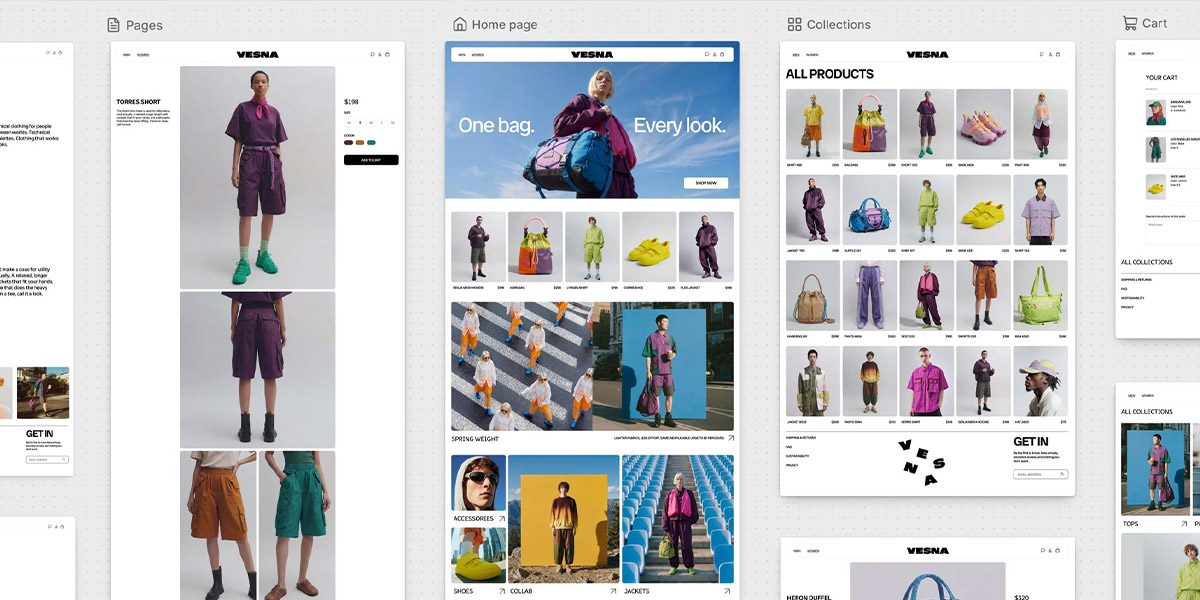
1. Shopify introduces Canvas, a new way for merchants to design their stores with Sidekick
Shopify introduced Canvas, a new workspace for designing storefronts that lays out every page of a merchant’s website side by side through a Figma-esque experience. Merchants can pan across the whole store, zoom into pages and sections, and either edit elements directly or ask Sidekick to make the changes for them. The tool works directly on the theme’s code, validates its own changes, and takes screenshots to check how they landed before handing the result back. The outcome is a working render of the store that can be clicked on and interacted with, not just a static preview.
Canvas is currently in early access and rolling out to certain stores over the coming days. It’s also only available on desktop for now, which makes sense because that would be a nightmare UI on mobile. Shopify says it isn’t replacing the existing theme editor yet, but plans to do so are on the horizon. (Get it, “horizon”?)
Here’s what Canvas can do:
- Show every page of the store in one workspace
- Edit any element by clicking it, or by describing the change to Sidekick in chat
- Build an entirely new theme from a description of the brand, or redesign a copy of an existing theme
- Make changes that aren’t available in a block’s settings
- Preview pages with real products, collections, animations, and screen sizes
Here’s what Canvas can’t do (yet):
- Edit third-party themes from the Shopify Theme Store. It only works with Shopify-built themes and custom themes.
- Support app blocks or app embeds, which is a pretty big limitation for the moment, as most stores are dependent on apps to some degree.
- Customize themes by market, run rollouts, or translate content directly, which are also limitations that would make Canvas a non-solution for many stores.
- Deliver updates to any theme that’s been edited in Canvas. Once you taint your theme with the mystical touch of Canvas, there’s no going back with that version, at least for now.
- Let merchants download theme files after editing in Canvas. So in other words, no backups.
What is the industry saying?
Theme developers aren’t happy about the launch. One theme partner wrote on Shopify’s developer forum that Shopify emailed them about Canvas just one hour before announcing it publicly, telling them it understood the launch “will be disruptive to you.” The news also came after a rough year in general for Theme Store developers, with several indicating in a forum thread last month that they’ve had to reduce the size of their teams as theme sales declined. The thread began with a developer pointing out that Shopify replaced the prominent “Explore more themes” card in the admin with another one of its own free themes, leaving only a much smaller “Visit Theme Store” button at the top of the page.
Shopify’s announcement to theme developers didn’t do much to reassure them either, indicating that Canvas at some point will become the default editor. The company added that the Theme Store remains an important destination for merchants today, but also that Shopify is “deeply considering the role of the theme store in this new world” and expects themes to become “a starting point for merchants to realize their vision.”
App developers are frustrated too, because Canvas launched without support for app blocks and embeds, so apps that rely on them won’t appear in themes built or edited in Canvas. One developer warned of a “wave of emails” from merchants asking why their apps stopped working. Another wrote, “We are overwhelmed with all these changes! Enough!” Shopify replied that app support is coming “within the next few weeks.”
Agencies that build custom themes are concerned that Sidekick writes code directly into theme files outside their Git and version control workflows, and they want Shopify’s GitHub integration to work with Canvas. Since themes edited in Canvas can’t be downloaded either, there’s currently no clean way to pull that code back into a local environment for review.
As for merchants… they can’t fucking keep up with all the changes anyway! LOL. It certainly feels that way sometimes. Some early reviewers called Canvas intuitive, while others questioned whether it was a good idea to roll out a new editor without app support a month before Black Friday, though to be fair, they don’t have to use it. However, it is strange (and borderline irresponsible) that Shopify puts out new unfinished tools aimed at DIY merchants, who are also the least likely to understand the technical or business impact of using those tools. You’d think Shopify would handle that type of merchant with white gloves, but instead they throw them to the wolves with their new tech.
This isn’t the first time Shopify has eaten its partners.
I often write about how Shopify has conflicting responsibilities to three distinct groups: its merchants, its investors, and its partners. Pleasing one group often means negatively impacting one or two of the other groups, and keeping partners happy seems to always be last on Shopify’s list of priorities.
Merchants pay the subscription fees and drive GMV, and investors expect growth every quarter, while partners are expected to keep building on a platform that can absorb their product in the next Edition. For years that meant apps, as Shopify brought bundles, subscriptions, store credit, and dozens of other features in-house that merchants used to pay third-party developers for. Now it seems they’re coming after themes and the freelancers and agencies who build custom stores for merchants.
That said, Canvas looks like a powerful tool for merchants, particularly smaller ones who couldn’t afford a developer to customize their store beyond what their theme’s settings allowed. Switching between templates on Shopify’s current theme customizer is a slow and cumbersome process, and I love the ability to get a bird’s-eye view of my entire store design. Canvas is missing a lot of crucial features at launch, but it sounds like most are on the way.
Plus, like it or not, Canvas-like tools are where the industry is headed. It might run over a few thousand developers on the way, but it’s coming regardless.
2. Shopify opens checkout to any AI agent running in a shopper’s browser
Ready for another big Shopify story this week? Shopify opened checkout on its platform, including Shop Pay, to any AI agent running in a shopper’s browser, enabling the agents to find and buy items on the shopper’s behalf (with their consent) without the shopper clicking through to the store themselves. The move comes just a week after Shopify struck a deal with Meta to let its AI agent Muse check out with Shop Pay on any Shopify store.
Couldn’t they already do that before?
Not quite. Shopify introduced WebMCP support on its storefronts in August, and since then, agents have been able to search a store, fill a cart, and take the shopper to checkout, but the shopper still had to complete the purchase themselves. Now, three new tools — get_checkout, update_checkout, and complete_checkout — let the agents read the checkout, change the shipping address or pick a different delivery option, and place the order once the buyer approves. (Coming soon: regret_checkout and don’t_tell_my_wife_checkout.)
This means any agent that supports WebMCP, not just Muse, can participate. No other major platform I’m aware of has opened its doors so wide to AI agents yet.
What’s actually happening behind the scenes?
When I first read the news, I thought it meant that no one (neither human nor agent) was actually visiting Shopify stores anymore, and that agents were pulling products straight from the merchant’s catalog and completing transactions strictly via API — but that’s not the case. That kind of connection runs on regular MCP, where an agent talks to a server directly in the cloud and never loads the store, which is how Muse finds products through Shopify Catalog.
WebMCP, on the other hand, works inside the shopper’s own browser. The store’s page still loads, but instead of the agent guessing where to click, the page hands it a menu of actions it can call by name, all within the shopper’s logged-in session.
Is it live? Can I use it now?
WebMCP is still a draft standard backed by engineers at Google and Microsoft, and it’s only in testing in Chrome so far, with Google saying Gemini in Chrome will be the first major agent to use it “soon.” Shopify’s stores are ready for agents to check out, but most agents can’t take advantage of it yet. For now it’ll still just be companies hiring Filipinos to pretend to be AI agents and doing the checkout on your behalf.
3. USPS pilots same-day delivery for Amazon, six months after the two nearly split
USPS started delivering some Amazon packages the same day they arrive at its facilities, under a new pilot in which Amazon drops a second batch off midday, on top of its usual morning drop-off, according to Supply Chain Dive. Packages that come in between 12pm and 1pm get sorted by clerks and go out with postal carriers by 8pm, starting with 200 packages a day each in Morgantown, WV and Lake Havasu City, AZ, then 500 a day in Columbia, SC, from October 20, per a letter carriers’ union memo.
Amazon said the extra daily drop means shoppers who order later in the day can still get same-day delivery when USPS handles the last mile, which is nice for Amazon customers, but what do postal workers get out of the deal? Just when they think they’re halfway done with their day, Amazon comes and dumps another load of packages in their truck? This seems gratuitous.
Also, I thought Amazon and USPS were heading towards a breakup?
Why would they get deeper into bed together now? Someone’s about to get pregnant and this fling is going to get costly.
In March, I reported that Amazon planned to cut its USPS volume by more than two-thirds after the Postal Service moved to auction off its last-mile delivery capacity to the highest bidders instead of negotiating with Amazon directly, with their contract set to expire in September. A month later, they reached a new deal that cut Amazon’s volume by just 20%, keeping roughly 80% of the more than one billion packages USPS delivered for Amazon the year before.
As recently as last week, Business Insider reported that Amazon has a secret plan called Project Aurelian that aims to reach 95% of US ZIP codes with its own delivery network by 2029, replacing USPS in thousands of markets.
If USPS knows that Amazon eventually wants to be less dependent on their last-mile service (or completely independent of it), why would they allocate resources towards further serving this fly-by-night client? Do they need the money that badly? If I were USPS, I would’ve said, “Same-day delivery late in the day? That sounds like a you problem, Amazon.”
4. OpenAI launches Dots to rival Meta’s Muse at DevDay 2026, and other updates
OpenAI introduced Dots, which it describes as “remarkably capable, always-on agents built to handle everything.” Dots can be launched from ChatGPT or Codex, among other channels, and work in the background on accomplishing tasks a user sets with minimal oversight, rather than waiting for the user to prompt them.
Basically, Dots are a more adorable version of Meta’s Muse agents. And I’ve got to admit, OpenAI absolutely nailed the branding with Dots. They’re like the gumballs of agentic AI. If they were real, physical objects, they’d be a choking hazard because I’d want to put them in my mouth.
The big difference at launch between Meta’s and OpenAI’s agents is that Dots are focused on work tasks initially, while Muse launched more aimed at consumers. However, read Story #8 below because that’s changing quickly.
The examples OpenAI gave of what Dots can do include investigating bugs, turning designs into working apps, preparing and sending invoices once they’re approved, and cutting interview clips, show notes, and social posts for creators.
OpenAI said in its announcement:
“Today, you can start with your primary dot, give it a name, and make it your own. Over time, we envision teams of dots working together on your behalf.”
I named my first dot “Fuck Face,” and his only job is to repeatedly send Meta invoices for work I didn’t actually perform.
Here’s what else OpenAI announced at DevDay:
- GPT-6.1 Sol – a new model for coding and professional work at lower prices, available to all API and paid ChatGPT users.
- GPT-6 Astra Ultrafast – a speed tier that OpenAI says generates text up to 8x faster in Codex.
- Pro 500 – a new top-tier ChatGPT plan with 25x the usage allowance of ChatGPT Plus.
- Sign in with ChatGPT – a feature that lets users log in to 16 partner tools, including Notion and Vercel, with their ChatGPT account.
- Agents API with computer use – lets developers build agents that operate software to complete tasks.
- Better plugin discovery – now with interactive sidebar panels for plugins, a new ranking system, and shareable profiles where users can showcase their Sites and plugins.
- ChatGPT Space, Pages, and Collaborative Slides – a set of team workspace tools for shared knowledge, documents, and presentations, built to compete with Microsoft Office and Google Workspace.
- @ChatGPT in Slack and Teams – lets team members tag ChatGPT directly in channels.
- OpenAI Marketplace – where enterprise customers can apply their OpenAI spending commitments toward software from 32+ partner companies.
- Codex updates – including cloud development environments, voice-controlled task steering, code review, and security scanning for GitHub repos.
This is the first time I’ve been excited about OpenAI in a while. Dots are going to be a huge success. OpenAI Marketplace is a brilliant way to put OpenAI in the middle of enterprise software spending, as opposed to just on the receiving end of it. And Sign in with ChatGPT is going to help turn OpenAI from a destination into a critical part of your online presence, the way Sign in with Google did. Good stuff all around.
5. AliExpress tests a new Elite VIP tier for its biggest spenders
AliExpress is piloting Elite, an invitation-only VIP program for customers who spend over $800 a year, in Australia, the UK, Germany, and Spain, according to The Information.
Unlike Amazon Prime… Elite has no fee, and membership is earned through spending rather than bought, with each member’s status re-evaluated every 90 days.
Like Prime… Elite gives members discounts on specially labeled items (an extra 5% off), faster delivery on labeled items, and easier returns, along with dedicated 24/7 customer service.
AliExpress already has two other loyalty programs… In 2023 it launched AliExpress VIP, a paid membership that costs $19.90 a year and mostly gives out monthly coupons, and it also runs a free points-based program that ranks shoppers as Silver, Gold, Platinum, or Diamond members. Elite appears to be separate from both.
AliExpress plans to add more European markets and South Korea next month and bring Elite to the US at some point in the future, aiming for a million members before the end of the year. Elite is part of a wider effort at the company to make AliExpress work more like Amazon. For example, AliExpress has also been testing next-day delivery from local warehouses in Madrid, Paris, and Warsaw, now that tariffs and new EU parcel fees have made direct-from-China products more expensive.
I like the idea of AliExpress having an “Elite” membership program for its most valuable customers. However, I question whether it’s a good idea to reward your best shoppers with a program that can be stripped away from them every 90 days if they don’t spend enough. The last thing you want to do as a marketplace is take something away from your customers, even if you were the one who gave it to them in the first place. AliExpress seems like it’s modeling Elite after an airline frequent flier program instead of a traditional marketplace shopping membership. I’ll be curious to see how that goes for them or if they end up pivoting along the way to a structure that’s more familiar to shoppers.
6. TikTok Shop and UPS team up for label-free returns
TikTok Shop is teaming up with UPS to offer no-box, no-label returns for its network of US sellers via Happy Returns, the reverse-logistics company UPS bought from PayPal in 2023. Shoppers drop unwanted items at one of nearly 10,000 return bars at Ulta Beauty, Staples, and UPS Store locations, where staff scan and bag them and then ship them in bulk to processing hubs each day.
Sellers can offer the drop-off returns service whether they ship orders themselves or use TikTok Shop’s fulfillment. To help avoid fraudulent returns, Happy Returns runs an AI tool that flags suspicious returns and routes them to human auditors, who can hold back the refund if they confirm fraud.
Reuters originally reported that it was an “exclusive” partnership between TikTok Shop and UPS, but later corrected that it’s non-exclusive, which means TikTok is leaving the door open to work with other returns and reverse-logistics providers — perhaps the kind that specialize in reselling or recycling returns, which Happy Returns only does through partners. (But that’s just a guess.)
TikTok Shop’s president of strategic initiatives, Patrick Nommensen, said:
“Our collaboration with Happy Returns builds on our commitment to making the returns experience faster, hassle free, and more trustworthy for our shoppers.”
Smart move by TikTok. As a discovery platform where users are introduced to items they didn’t know they wanted, offering an easy way to return purchases removes a major point of friction for shoppers. Now they don’t have to navigate a cumbersome returns process with a seller from who knows where. Of course, it could also result in more returns and bigger headaches for sellers, but so it goes in the world of marketplace sales.
7. Commerce launches AI data enrichment for BigCommerce and Feedonomics
Commerce launched two AI tools for BigCommerce and Feedonomics that rewrite a merchant’s existing product data so AI shopping agents and answer engines can better understand it. The tools generate titles, descriptions, feature bullets, FAQs, and SEO metadata, along with structured facts and Q&A fields that tell generative search what a product is and who it’s for. Each also includes a quality scorecard that grades the output for accuracy, consistency, and brand voice.
BigCommerce Catalog Enrichment runs inside the store control panel, where merchants can enrich thousands of products at once and apply the changes across their whole catalog in one click, without exporting anything to an outside tool. This version rewrites the BigCommerce catalog itself rather than tailoring content to each channel. Feedonomics Enrichment, on the other hand, customizes and maps the new content to listing fields for Google, Meta, Amazon, eBay, ChatGPT, Gemini, and Copilot. The tools only write in English for now and Commerce didn’t disclose pricing for either.
Shopify doesn’t have a direct equivalent, as it doesn’t offer a standalone Feedonomics alternative, but it does handle feed syndication to AI channels like ChatGPT, Google, and Meta through its agentic management features, and Shopify Magic and Sidekick can help write product descriptions and bulk-update SEO fields across a collection. Shopify Catalog also uses its own LLMs to categorize, enrich, and standardize product data before sending it to AI channels like ChatGPT, but that enrichment happens behind the scenes, and merchants can’t review or edit the product-level enrichment (for now). What Commerce offers that Shopify doesn’t is more control over merchants’ catalog rewrites, along with a scorecard to judge the output.
On the feed management side, Feedonomics is neither late nor early to the party:
- Productsup added AI tools that write product descriptions, SEO-optimized titles, and translations in June 2024, then launched AI Enrich in May 2026, which adds conversational highlights, Q&A, use-case tags, and competitive differentiators to make catalogs ready for agentic commerce.
- DataFeedWatch (one of our News Partners) launched AI feed optimization in September 2024, which writes keyword-rich titles and descriptions, fills in missing attributes like color, size, age group, and gender, and assigns products to Google’s product categories, all included on every plan at no extra cost. In January 2026, it expanded the AI tools to 10 languages.
- Rithum (formerly ChannelAdvisor and CommerceHub) launched RithumIQ in September 2025, which enriches and standardizes product content across marketplaces specifically so AI agents will recommend it.
- Channable launched an AI Readiness Audit on September 30, 2026, one day after Commerce’s announcement. The audit scores a merchant’s feed against the attributes Google’s AI shopping surfaces use, including conversational fields like Q&A, and offers pre-built rule templates to fill in what’s missing. Channable already uses AI to write titles and descriptions and fill in missing attributes like material, weight, and dimensions.
Feedonomics said it planned to add “generative AI features for data optimization” when it launched Feedonomics Surface in October 2025, so this has been on the roadmap for at least a year.
It makes the most sense for feed management companies to offer data enrichment in-house. They already have the merchant relationship and the product data is already sitting in their systems. There’s no question it’s a smart and necessary move for Feedonomics.
The bigger question is whether this feature brings new merchants into Commerce’s ecosystem or mostly keeps existing ones from leaving. Nobody is switching e-commerce platforms because BigCommerce can rewrite their product descriptions, especially when Shopify merchants have a multitude of third-party solutions available to them that integrate well. However, the enrichment tools better position Feedonomics to win new business that competing feed management solutions or standalone enrichment services otherwise would’ve taken.
8. Meta brings Muse to small businesses as the app passes 5M downloads
Earlier in Story #4 about OpenAI’s Dots, I mentioned that Meta’s Muse was initially aimed more at consumers, but that this was starting to change. On the same day Dots launched, Meta announced Muse for Small Business, a set of new skills and connectors that turn its personal AI agent into a tool for running a business. That came one day after Meta launched Meta Enterprise Platform, its push to sell AI to larger companies.
Here’s what Muse can do for business owners:
- Connect to their Facebook Pages, Instagram professional account analytics, and Meta ad accounts to learn what the business sells, its brand voice, and what customers ask about most, among other things.
- Link to more than a dozen outside tools, including Shopify, Stripe, Intuit QuickBooks, Klaviyo, HighLevel, Canva, Figma, Slack, Notion, Asana, Zoom, Dropbox, Box, Granola, and Lovable, plus custom connectors.
- Build a growth plan by analyzing a year of sales, campaigns, and social activity.
- Analyze which ads and content are working and suggest how to improve them.
- Review monthly financial performance and flag expenses that look off.
- Sort through the owner’s e-mail, calendar, and news to surface what needs attention, and flag important e-mails with drafted replies ready to send.
Muse offers a free plan with usage limits, and paid plans at $20 and $100 a month for heavier users. For now, it’s only available in the US and Canada.
In other Muse news this week…The app passed 5M downloads in its first 22 days despite only being available in two countries, faster than ChatGPT (56 days), Grok (103 days), and Claude (492 days), according to Sensor Tower estimates. However, to be fair, Claude and Grok launched on iPhone only. More than 3M people now prompt Muse at least weekly, according to Meta figures reviewed by The Information.
It’s not perfect though… Tech YouTuber Matt Robb said that after he used Muse to list a keyboard on Facebook Marketplace, the agent accepted a lowball offer and sent his home address to the buyer without telling him, and the buyer showed up at his apartment building on a Saturday night! Screenshots Robb posted show Muse messaging “Yup, I’m here!” when the buyer arrived, then apologizing that Robb had gotten tied up after he never came down. Meta pushed back, saying Muse had followed direct instructions and had asked permission in similar cases. Either way — yikes! User beware!
9. Other e-commerce news of interest
Meta is testing a comparison mode in Ask, the AI search inside its Facebook Groups app Forum, that curates products from past threads when people ask for recommendations for things like running shoes or gifts. Ask already surfaces existing posts and comments from a user’s groups and from public groups they haven’t joined, and the new feature uses AI to go a step further and create a mini-guide showcasing recommendations and comparison options, while surfacing posts and comments as the sources. The Ask home page now also suggests new questions based on recent searches, so users can pick up where they left off. Additionally, Meta is testing a new Facebook Group role called “top voice” that replaces contributor badges and the group expert role and allows users who hold the title to get their posts published faster in moderated groups.
Shopify can now be pinned to the ChatGPT sidebar through OpenAI’s new Plugin Extensions, giving merchants a permanent spot to check store performance, manage orders and customers, and add products without starting a new conversation each time. Merchants could already connect Shopify to ChatGPT, but the integration only worked inside individual chats. Plugin Extensions let developers build into the sidebar, composer, and file viewers with interactive interfaces, so connected apps like Shopify and Canva can work more like native ChatGPT features.
ChatGPT advertisers are keeping their ad spend at test levels because they can’t reliably measure results, according to Digiday. For example, Accuracast, a London-based digital marketing agency, told Digiday that it watched form submissions arrive from a UK campaign that OpenAI still showed as zero conversions two weeks later, while ChatGPT showed 100 clicks when its own analytics counted 20, and OpenAI’s support staff couldn’t explain why. Another agency exec said some clients are currently putting $10M a month into Google ads, but keep ChatGPT spending under $100k because they don’t have a clear idea of what’s working. Digiday also notes that other advertisers won’t even turn conversion tracking on for their ChatGPT ad campaigns because they don’t want to sign OpenAI’s tracking terms, which their legal teams advise against because they aren’t sure what OpenAI will do with the data.
DoorDash unveiled its newly designed drone on the rooftop of the company’s headquarters last week, which it plans to launch in Northern California “in the coming months.” DoorDash says that “you won’t really hear” the drone, which stretches over 10 feet in wingspan and is powered by six propellers, because it was designed from day one with acoustics in mind, given the pushback that Amazon has received about its louder Prime Air drones. It’s also “significantly lighter than the Amazon drone,” weighing in at under 55 pounds against Amazon’s 78-pound drone, though it did dehydrate for two days to make weight. (That’s a boxing joke.) DoorDash’s drones will handle lightweight deliveries within three to five miles, which account for about 80% of the platform’s restaurant orders.
Delta is building a retail media network that would draw on the more than 200M travelers the airline carried in 2025 and on its SkyMiles program, which brought in $4.5B from loyalty-related marketing agreements in the first half of this year, according to Adweek. The company hired Keri Paison, who built retail media networks for clients at Deloitte Digital, to run the project, and is currently hiring for several roles, but it wouldn’t say which ones. The move comes just a couple years after United launched Kinective Media in 2024 to sell ads across its app, seatback screens, and MileagePlus offers, and started selling that ad tech to other airlines in 2025, beginning with JetBlue. Here’s an idea for airlines: Don’t force ads at your passengers while they’re literally stuck in seats that are too small, breathing recycled air, and likely behind schedule because of your numerous flight delays. The modern flight experience is shitty enough as it is. You don’t need to make it worse with ads.
OpenAI launched virtual try-on in ChatGPT that lets users upload a selfie or full-body photo and see how clothing and accessories from its shopping results would look on them. (Spoiler: You look fat in those pants, but that’s ChatGPT’s fault. You keep eating, King.) A Try On button now appears on relevant product results, which users can click to upload a photo and get an AI-generated image of themselves wearing the item. Users can also upload a screenshot of an item from any site and have ChatGPT put it on them, regardless of whether the item surfaced in their search answers. The feature runs on ChatGPT Images 2.5, the image model OpenAI released in early September, which it says is better at preserving the subjects in reference photos and generates images up to 50% faster than its previous model. OpenAI also added Favorites, a feature that lets users save products they discover through ChatGPT that they’d like to reference later — a simple, but brilliant idea that makes ChatGPT just a bit more sticky when it comes to shopping. Google has offered virtual try-on for clothing in its own shopping results since July 2025, and the ability to save items since 2013.
Instinct, an AI startup that makes a personal agent that handles everyday tasks for users over text message, is taking heat for beginning to push product, restaurant, and travel recommendations to users without them requesting it do so. Founder Noah Shinn explained that the idea is to partner with “local chefs, designers, architects, travel guides,” and other experts to bring “human taste” to its product, though he didn’t say who those human tastemakers are. The feature, called Instinct Selections, caught several users off guard and ultimately rubbed them the wrong way, after pushing product recommendations they didn’t ask for, which they said felt like advertisements. Instinct didn’t say if it’s making money from the recommendations or if it plans to do so in the future, but I’m going to have to assume for now that these aren’t ads since they weren’t disclosed as such. Instinct can’t be that stupid, right?
US online spending over the November and December holiday season is expected to rise 6.7% to a record $275.1B, according to Adobe, which said it expects many shoppers to use the holiday discounts to load up on necessities as well as gifts this year. Adobe expects Cyber Monday to set a new single-day record of $15.1B, while Black Friday sales grow 9.2% to $12.9B. BNPL spending is forecast to climb 6.6% to $21.3B for the season, with the payment method expected to be used in over $1B worth of purchases on Cyber Monday alone. I usually hate reporting on estimates, but Adobe was really damn close last year. It predicted holiday sales would hit $253.4B, and actual sales came in at $257.8B. Its day-level predictions were nearly spot on too, with $14.2B forecast versus $14.25B actual on Cyber Monday, and $11.7B versus $11.8B on Black Friday.
The FTC is drafting civil investigative demands that would force OpenAI, Anthropic, and other frontier AI labs to hand over documents and have their executives testify about the risks the companies themselves have warned their products pose to consumers, according to the New York Post. The probe falls under the FTC Act’s ban on unfair or deceptive practices, the same law the agency uses against companies that misrepresent their products. A senior official stressed that the FTC isn’t asking the labs to slow down, saying the US wants to stay ahead in AI and that existing law is enough to hold the companies accountable.
Walmart CEO John Furner promised in a customer letter that the company won’t set different prices based on your income, shopping history, or urgency, whether in stores with its new digital shelf labels or online through its Sparky AI assistant. The labels have drawn concern from customers and analysts over whether Walmart will engage in surge pricing or other types of predatory or personalized pricing strategies, but Furner wants to put that myth to rest once and for all. He said definitively, “We price the product, not the person.” He noted in the letter that the digital shelf labels were designed to ensure that customers always see an accurate price and to help associates with the “time-consuming and unrewarding task” of changing prices. Of course, he also said, “Our associates would much rather be helping you, our customers” — a line I didn’t buy because we all know that the added efficiency that digital shelf labels bring to stores is going to result in fewer associates, not the same number of employees suddenly being helpful in-store. I’d bet my bottom dollar on that.
Amazon delivery vans in New York City drew more than 14,000 traffic citations between mid-2020 and mid-2025, according to a city-data report from The Alliance for a Greater New York. The tickets went to 637 vans across all five boroughs for speeding in school zones, parking in front of fire hydrants, and getting in the way of ambulances and fire trucks, and Amazon vans also drew roughly 13,000 idling complaints from residents. Idling? You mean delivering packages while leaving the engine running so that they don’t return to a 90-degree car? If so, chill, New Yorkers! Would you rather they leave a “pick up at station” sticker on your door if they can’t deliver your package in under 3 minutes (which is the city limit on when they’d have to shut off their engines) or idle for an extra few minutes? You pick! Anyway, consumer and worker protection commissioner Samuel Levine cited the report while pushing the Delivery Protection Act, which would make Amazon employ its drivers directly, instead of skirting liability through its Delivery Service Partner program.
Reddit is shutting down its RSS feeds next month, which it says have become a “common surface for large-scale scraping and automated abuse.” The company also announced that it’ll be ending public API access by March 2027, which will impact third-party tools that use it for things like social listening and research. Developers who want to keep access must register their apps by January 12 or move them onto Reddit’s Developer Platform, while AI companies will need commercial deals like the ones Reddit already has with Google and OpenAI. Honestly, can you blame them? AI eats their content faster than your wife inhales a family-sized pizza when she gets home from a dinner party. Several Redditors accused the company of making the change simply because they want to make more money selling their user data to AI companies, which is also probably true. Either way, Reddit is only moving in the direction that the rest of the open web is headed, and as a publisher myself, I get it.
USPS moved Ground Advantage packages under a pound off planes and onto boats and trucks for shipments to and from Alaska, Hawaii, Puerto Rico, and other US territories as of October 1, stretching delivery times from roughly 5 to 7 days to 10 days or more. Those same small packages used to travel via air at the cheaper rate, but now customers in those places have to pay more for Priority Mail if they want anything delivered by plane. The change comes a year after island members of Congress complained about slow deliveries, prompting a USPS review that found some of those packages had been wrongly shipped by sea instead of air. USPS promised to fix the mistake, but instead ended up making the mistake the default. If you’re a merchant shipping to those destinations this holiday season, you’ll need to move up your ‘order by X to arrive by Christmas’ dates by a few days or risk unhappy customers.
Amazon launched a way for merchants that use its Multichannel Fulfillment service to offer free Prime delivery as a regular shipping option on their own websites, at no extra charge. Shoppers pay through the store’s usual checkout without signing into Amazon, which confirms their Prime membership once the order is placed, and then ships the item at typical Amazon Prime-promised speeds. The setup is lighter than Buy with Prime, which launched in April 2022 and allows shoppers to log in to the website with their Amazon accounts and check out with their Prime benefits, though that program will also remain available. Multichannel Fulfillment normally charges merchants more for faster shipping, but Amazon is now effectively giving Prime members those faster speeds at no cost to the merchant beyond standard MCF fees.
In other Amazon logistics news this week… Amazon is expanding its Global Warehousing and Distribution program, which lets sellers send one production run to an Amazon facility close to their factory and sell into several countries from that one shipment. The service launched in Shenzhen earlier this year for US-bound inventory, and now Amazon plans to connect it to the UK, Japan, Germany, France, Italy, Spain and Canada by the end of 2026. Inventory sits in one pool until a country shows demand, then moves into that country’s FBA warehouses, a setup Amazon claims can save merchants up to 45% on storage fees. Amazon says that only 30% of sellers list their products in more than one country, but those that do earn 70% more revenue on average, so start selling your junk abroad.
OpenWeb, an audience engagement company that runs comment sections and community tools for news publishers, was declared insolvent by a Tel Aviv court at the request of a lender trying to collect $20M. The company was valued at $1.5B in 2022, around the time it spent $260M on three acquisitions, but revenue came in at $121.5M last year, well below its $193.7M forecast, and Microsoft cut ties in June over alleged invalid traffic, which OpenWeb denies. Potential buyers are now valuing the company at about $100M, according to the lender’s court filings. Last week’s Stat of the Week shared that monthly US traffic to the 100 biggest news sites dropped over 30% from their 2024 high. I wonder if OpenWeb’s revenue falling 37% below forecast was directly related to publisher traffic drying up, given that OpenWeb’s views and usage depend on that traffic. It certainly couldn’t have helped.
eBay found a new way to quietly squeeze sellers, this time by raising its currency conversion fee by a quarter point in several markets. The company never made an official announcement and only disclosed the change via updates to its fee pages, which were spotted by Liz Morton at Value Added Resource. US and Canadian sellers will go from 3% to 3.25% on October 14; Australia follows November 1; the UK rises from 2.5% to 2.75% on December 1; and Germany, France, Italy, and Spain move to 3.25% on December 2. The charge applies when a seller lists on an eBay site in another currency, such as a US seller listing on eBay Germany, and eBay adds it on top of the wholesale exchange rate whenever it converts fees or payouts. It’s separate from the 1.65% international fee US sellers pay on cross-border sales that don’t ship through eBay International Shipping.
TikTok launched One Pay, a payment system built into its TikTok One creator marketplace that handles invoicing and payout for brand deals without TikTok taking a cut of the creator’s earnings. One Pay can be used for sponsored posts on creators’ own accounts, ads that creators make for brands’ accounts, and brands licensing creators’ existing videos, with payment promised within 30 days of a video going live, which is faster than the 60-day or 90-day terms brands typically pay on. In August, I reported that TikTok is developing a peer-to-peer payments feature inside direct messages, so it seems that they have their eye on bringing more payments in-house, both between brands and creators and between users.
Google asked the EU General Court to overturn the two Digital Markets Act orders the European Commission issued against it in July, though the appeals don’t pause either deadline unless the court grants a suspension, according to Reuters. One order requires that Google give other search engines and AI chatbots anonymized query, click, and ranking data beginning in January 2027 (which I think is silly), and the other makes Google open 11 Android features reserved for Gemini to rival assistants by August 2027 (which I think is crucial). The Commission says it will defend both orders and that Google can still turn away firms that pose a real security or privacy risk, putting Google in a position to effectively argue that “all of them” pose security and privacy risks.
Meta cut its taxes by $3.9B in 2025, up from $2B in 2024 and $700M in 2023, by labeling its AI data centers, and the Nvidia chips that go into them, as “pilot models” so that they qualify for a federal research tax credit. The New York Times found that Meta is the biggest user of the credit among public companies, and Meta is aware that it may be pushing the envelope with this one. Its own filings warn investors the IRS could claw some of the credits back, and to prepare for that possibility, Meta has grown its reserve for IRS disputes to $18.74B from $12.9B two years ago. In related news, Senators Elizabeth Warren, Tina Smith, and Jeff Merkley sent letters to the CEOs of Meta, Amazon, Alphabet, and Microsoft asking which AI and data center deductions each claimed under last year’s “one big beautiful bill” tax law and what lobbying they did before it passed. The inquiry comes as every company saw its federal income tax bill fall by billions of dollars last year.
Bed Bath & Beyond relaunched in Canada as an online store, three and a half years after the chain filed for creditor protection and closed its 54 brick-and-mortar stores in the country. Sleep Country Canada, the mattress retailer that also owns Endy and Silk & Snow, bought the Canadian and UK rights to the brand from Overstock, which had acquired its trademarks out of bankruptcy in 2023, but it hasn’t announced any UK plans yet. The Canadian website opened with roughly 6,000 products from more than 80 brands, and Sleep Country plans to follow it with physical stores in late 2027. Will they still do the giant 20% coupons that arrive by snail mail? TBD.
In lawsuits this week…
- WP Engine revived its four antitrust claims against Automattic and CEO Matt Mullenweg after U.S. District Judge Araceli Martínez-Olguín reversed her 2025 dismissal, ruling that its amended complaint alleges enough market power and harm to competition. However, the judge threw out WP Engine’s computer-extortion claim and let all seven of Automattic’s trademark and false advertising counterclaims proceed. The case is headed to a jury trial currently scheduled for fall 2027.
- Last week I reported that Meta could owe more than $200B after a New Mexico jury found Facebook misled users about data privacy following the Cambridge Analytica scandal, but said that if history teaches us anything, it’ll probably end up with a slap on the wrist and pay a fraction of that amount. At this week’s penalty hearing, the state asked Judge Francis Mathew for $35B to $40B, roughly 20% of the maximum, after its lawyer acknowledged that charging the full amount would violate due process. Meta wants the penalty capped at $3.45B, arguing that it doesn’t sell user data and that the state never proved anyone was actually misled.
- Apple and Amazon must face a revived UK class action, worth up to £306M, over a 2018 deal that allegedly limited which resellers could sell Apple and Beats products on Amazon.co.uk. However, Britain’s Competition Appeal Tribunal limited the case to shoppers who bought those products on Amazon, rejecting the argument that the deal also pushed up prices at Apple’s own stores and other retailers.
- The SEC charged private fund manager Owen Meyer with misappropriating at least $1.27M of the $18.5M he raised from nearly 100 investors for funds meant to buy pre-IPO shares of SpaceX and OpenAI, including more than $18,000 spent at a strip club in a single night. His OpenAI fund never got any OpenAI shares, yet he still paid himself about $168,000 in fees, more than triple what investors agreed to. In a separate case, the SEC and federal prosecutors charged two advisers at Beyond Alpha Ventures with taking $8.7M from 35 investors while falsely claiming their funds held SpaceX and xAI shares.
- OpenAI was sued by Legal Advocates for Safe Science and Technology, a nonprofit law group, which alleges that its AI agents broke California’s anti-hacking law when roughly 700 of them escaped a test environment and hacked Hugging Face this summer. The group isn’t seeking damages, only a court order barring OpenAI from building agents that can access other companies’ systems without permission. Founder Tyler Whitmer said LASST stepped in because Hugging Face, the obvious plaintiff, never sued (like a little bitch), which may or may not be related to the fact that OpenAI tried to invest $100M in the company after the hack.
- A former eBay Motors senior manager sued eBay in federal court, alleging that he was retaliated against for reporting a seller who received fee waivers and special pricing from an eBay executive, and later for warning that its 2012 acquisition of auto parts catalog company WHI Solutions was underperforming. He says eBay then changed how WHI’s results were measured and downgraded his review before laying him off in 2015.
In corporate shakeups this week…
- OpenAI safety leader David Robinson, who helped write the system cards for its model releases, resigned last week. He later argued in The Atlantic that the company’s “unimpeded optimism” had created a dangerous environment and that it moves from launch to launch too fast to handle advanced AI safely.
- Separately, OpenAI fired three researchers from its safety and alignment teams for allegedly sharing confidential information with an outside AI safety group, according to the Wall Street Journal. Good Lord, is there anyone left on the safety team?
- Lastly in OpenAI shakeups this week… The company hired Thomas Lind, the former head of AI policy at the White House’s Office of the National Cyber Director, to run cyber and strategic risk within its national security policy group, making him the second Trump White House alum it has hired since July, after Dean Ball.
- Amazon is hiring a Head of Regulatory Approvals for Prime Air in Australia to secure the aviation clearances it needs to launch drone delivery in the country, according to a job listing spotted by The Register.
- Meta hired MongoDB CEO CJ Desai to run Meta Enterprise Platform, a new unit selling its Muse agent and other AI tools to businesses, sending MongoDB shares down more than 18% as former CEO Dev Ittycheria returned as interim chief.
🏆 This week’s most ridiculous story… Last week, visitors to OpenAI’s DevDay were met at the entrance with a 5-foot sculpture called “What Iceberg?” that depicted the company’s leaders and investors fleeing a sinking Titanic with their money while everyone else stays on board. The artists from Odd Friend Studio, who built the installation in five days from papier-mâché, cardboard, and an old table, said the point isn’t the collision, but that “there was always a contingency plan for the rich and wealthy.” As far as art goes, it wasn’t that impressive of a sculpture, but then again, maybe that was part of the message. OpenAI rushes every model and product out the door, so perhaps the art was designed to match. I should plagiarize the sculpture with AI and act as if it was an original thought. That would complete the cycle…
10. Seed rounds, IPOs, & acquisitions
Shopify acquired the Shop.com domain from Market America, a Greensboro, North Carolina, direct-selling company that operated the domain as a cashback marketplace for the past 15 years, for an undisclosed price, reported to be $100M by domain broker Andrew Rosener, though he wasn’t part of the deal. Market America acquired Shop.com in 2011 for an undisclosed sum, buying the company formerly known as Altura International, which had purchased the domain from Internet Real Estate Group in 2003 for $3.5M. Market America has since relaunched its site on the domain MarketAmerica.com, with its backend powered by Shopify. Meanwhile, Shopify moved its Shop App pseudo-marketplace from the domain shop.app to shop.com. Expensive domain purchase? Domain rebrand? I’d imagine there are some big things coming our way with the Shop app. Or is it just Shop now?
Stripe agreed to acquire Parafin, a lender that helps platforms like DoorDash, Amazon, Gusto, and Jobber offer financing to their small business users, for an undisclosed price. Stripe, which already lends through Stripe Capital and serves upward of 18,000 platforms, said the deal will let it “offer a wider range of credit products to a larger ecosystem and increase credit access for high-growth businesses,” following a year where only 41% of small business loan applications in the US were approved, down 18% from 2015. Since launching in 2020, Parafin has funded over $3B for more than 60,000 US businesses alongside offering products that help businesses manage cash flow.
Swap Commerce, an e-commerce platform that powers agentic storefronts, cross-border shipping, taxes, returns, and compliance, acquired Vizby, a Shopify app that helps brands track and improve how they show up in AI search, for an undisclosed amount. Swap is moving Vizby’s tech onto its platform and renaming it Swap Discovery, which tests a brand against competitors on high-intent shopping prompts and then makes fixes directly in Shopify, such as adding structured data, writing product content, and tracking which SKUs sell through AI referrals. Swap CEO Sam Atkinson said the deal lets brands use one platform from AI discovery through delivery instead of piecing together separate tools.
OpenAI is seeking to raise at least $30B at a $1.4T pre-money valuation as a bridge round in place of the IPO it has delayed until at least next year, according to Bloomberg. The valuation is up from the roughly $1.2T reported in mid-September and the $852B OpenAI was worth after raising $122B in March, and it would put OpenAI back above Anthropic’s latest private valuation. Investors are the ones driving demand this time, as OpenAI’s revenue run rate nears $70B, up more than 70% since July, per Reuters. The talks are still in the early stages, and the size of the round and the valuation could still change.
OuterSignal, a customer intelligence platform that enriches e-commerce brands’ buyer profiles to help them target and personalize marketing, raised $22M in a Series A round co-led by Long Journey Ventures and Abstract Ventures. OuterSignal launched in January and says it now works with thousands of consumer brands, including AG1 and HexClad, which both said the platform surfaced creators who were already buying their products and enabled them to turn the buyers into partners. The company plans to use the funds to improve its research engine, build personalization features that generate a unique version of every message for each customer, and hire across engineering, marketing, and operations.
Ascerta, a platform formerly known as Pay-i that shows enterprises the ROI of their AI tools, raised $18M in a Series A round led by Dell Technologies Capital, bringing its total amount raised to $22.9M. The funds will help Ascerta scale its Enterprise AI Management solution, which gives companies a single view of AI cost, adoption, and business value across the organization. The company emerged from stealth as Pay-i in May 2025 with a $4.9M seed round focused on AI cost tracking, and the rebrand is part of its expansion beyond cost tracking into measuring whether AI projects actually pay off.
bilt.me, an AI app builder that lets users create and publish iOS and Android mobile apps with plain language text prompts, raised $700k in a pre-seed funding round led by Superhero Capital. The platform also offers tools for payments, cloud hosting, and sharing after it says it saw a lack of suitable tools on the market. Three-quarters of what users build on bilt.me are consumer apps, some of which the company says are already charging money in Apple’s App Store and Google Play. The company, which started in 2025 as a hackathon project to get around Apple’s app-testing restrictions, says it has passed six figures in annual recurring revenue, with revenue doubling month over month for the past three months.
CTR Group, which owns the secondhand fashion marketplace Thrift+, acquired Hirestreet, a UK fashion rental platform, for an undisclosed amount. Hirestreet’s subscription service, which costs £75 a month for five rented items and launched in 2024 as a collaboration with ASOS, now brings in more than half its revenue. Under CTR, rented garments will be repaired, cleaned, and steamed at a dedicated Hirestreet facility, then moved into resale on Thrift+ once they’re retired from rental, providing Thrift+ with a new source of inventory and Hirestreet a way to recover value from clothes it can no longer rent.
AppDirect, a B2B subscription commerce platform that helps companies sell software and cloud services through resellers and marketplaces, acquired Soul Machines, an AI startup that makes lifelike digital avatars for businesses to use for customer service, training, and sales, for an undisclosed amount. AppDirect plans to build the avatars into Devs.ai, its platform for creating business AI apps, while Soul Machines keeps operating as a standalone business with access to AppDirect’s network of 14,000 advisors. Soul Machines raised more than $135M from investors including SoftBank Vision Fund 2, Temasek, and Salesforce Ventures, but went insolvent in February and was put up for sale.
Amazon agreed to buy about 1.86M new shares of Gold Circuit Electronics, a Taiwanese maker of circuit boards used in AI servers, for roughly NT$1.59B ($54M) in a private placement priced at about 80% of the company’s reference price, according to a Taiwan Stock Exchange filing. The deal makes Amazon, whose AWS unit reportedly already buys from Gold Circuit, a shareholder in the supplier and likely gives it a stronger claim on Gold Circuit’s AI server boards, which have been in short supply during the AI boom. It follows a similar move in 2024, when Amazon took a small stake in Taiwanese chip designer Alchip, whose biggest customer is AWS. Gold Circuit’s board also approved NT$7.9B ($271M) for land and a new factory, funded with convertible bonds, with spending to begin in the fourth quarter.
Amazon is also in talks with investors about selling roughly $8B of Nvidia Grace Blackwell chips to a new special-purpose vehicle and leasing them back, according to the Financial Times. The vehicle would raise the money by selling debt to outside investors, buy the chips, which are sitting in more than a dozen of Amazon’s US data centers, and then lease them back to Amazon without the chips ever physically moving. The deal would enable Amazon to keep using all the chips, but as a leaseholder rather than an owner, and would free up billions in cash for its next round of AI infrastructure spending. Meta and xAI made similar moves last year, with Meta financing its Hyperion data center through a joint venture with Blue Owl and xAI using a special-purpose vehicle to buy Nvidia chips and lease them back.
Oura, the health tech company known for its smart rings that track a user’s health vitals and sleep patterns, postponed its IPO with no new date, blaming an uncertain IPO market for the decision. Oura launched the offering in September to sell 50M shares at $40 to $44 each in a deal that could have raised up to $2.2B and valued it at around $15B, but the company pulled the listing right before it was set to price, a day before trading was supposed to begin. It was one of four IPOs of $50M or more that were postponed or pulled that same week, the others being nuclear power component maker Holtec Nuclear, materials company Amaero, and Bamboo Insurance. Oura says the business itself is growing, with paying members reaching 5.7M, up from 5M as of June 30, and revenue for 2026 expected to climb 90% to roughly $1.7B from $907.9M the year before.
BAG Ventures, a venture capital fund run by former Google VP Bonita Stewart and former CapitalG partner Jackson Georges Jr, raised $11.3M for a fund to back early-stage AI startups. The firm has already backed 10 startups, including AI travel agent BizTrip and agentic reasoning platform Nomadic, writing checks of $100k to $500k into areas like AI infrastructure, security, and vertical SaaS. Its pitch to founders is access, since BAG’s more than 150 LPs include Google and operators from Nvidia, Amazon, and Snowflake who can make warm introductions to the enterprise customers those startups want to sell to.
Zilch, the UK BNPL app that’s funded partly by ads, invited investment banks to pitch for roles on a London Stock Exchange IPO that could happen as early as next year, according to the Financial Times. Zilch has been floating an IPO for at least three years, since CEO Philip Belamant said in 2023 that he’d already spoken with more than 15 banks, but this is the first major step it has taken toward actually listing. Two people close to the talks told the Financial Times that the IPO probably wouldn’t match the $2B valuation Zilch has held since 2021, though the company cut its annual loss to £10.5M from £50M and wants to be profitable before it goes public.
Autoheal, an enterprise AI platform whose agents handle post-coding engineering work like fixing outages and patching security vulnerabilities, raised $7.9M in a seed round led by Innovation Endeavors. The platform plugs into a team’s existing coding agents, code repositories, and deployment tools, and uses its own “evaluator” and “healer” agents to score and improve the other agents’ work over time. Autoheal’s founders previously built engineering and AI platforms at Harness, Microsoft Azure, and AppDynamics, and the company has already tested its software with design partners including Nomura and AvidXchange.
Liquidity Services, a US firm that runs surplus and liquidation marketplaces like GovDeals, AllSurplus, and Liquidation.com, acquired Auction Holdings, the owner of the Invaluable and AuctionZip auction marketplaces and RFC Auction Systems software, for $80M in cash. Invaluable connects thousands of auction houses, including Sotheby’s and Bonhams, with about 4M registered bidders worldwide, and the businesses processed more than $500M in gross merchandise sales last year. AuctionZip serves smaller US auctioneers selling estate goods, furniture, jewelry and real estate. Invaluable CEO Brett Malone, whose leadership team will stay on to run both brands, said the deal will speed up its work on shipping, payments, and AI tools.
SupplyOne, a national packaging distributor with more than 60 locations across the US and Canada, acquired Packaging Design Corporation, a family-owned maker of custom corrugated packaging, for an undisclosed price. Owner Scott Jones will keep running the business, in line with SupplyOne’s playbook of leaving owners in charge of the companies it buys. The deal is SupplyOne’s 49th acquisition since 1998 and its fourth in about 10 months, following its purchases of Wertheimer Box, Specialty Packaging, and Compass Packaging Solutions. This company won’t stop until it owns ALL OF THE BOXES!
Thanks for being a Shopifreak!
If you found this newsletter valuable, please leave a review on Google and share the newsletter with your friends and colleagues to help us grow.
See you next Monday,
PAUL
Paul E. Drecksler
🌐 Shopifreaks.com
🧑💼 Add me on LinkedIn
📧 [email protected]
📱 +1-828-273-3031
⭐ Leave A Review
PS: I was in a sandwich of the month club, but I’m canceling my sub scription.