
Hi Shopifreaks
The biggest news this week — my daughter turned 3 years old on Sunday! Happy Birthday to Mia! How quickly time flies. It simultaneously feels like Mia just arrived, but also that she’s been in our lives forever. She’s growing into an amazing little girl… sweet, compassionate, and absolutely hilarious.
She’s also taking after her father and becoming an incredible negotiator. My wife questioned how many cookies she had already eaten after picking up another one, and Mia said, “It’s my birthday.” We couldn’t argue with that!
Every year for Mia’s birthday, my wife and I travel with her to somewhere new. This year we went to a wellness retreat in Yunguilla, Ecuador where we spent as many waking hours as we could in the pool because Mia loves to swim.
Now that we’ve covered the big story this week, let’s see what else is happening in the world…
In this week’s edition I cover:
- Shopify brings B2B features to all plans
- Amazon adds fuel surcharges for FBA sellers
- The World Trade Organization couldn’t agree
- TikTok partners with Cameo
- Spotify introduces carousel ads and playlist takeovers
- Perplexity says it’s done no harm to Amazon
- OpenAI secretly founded a child safety coalition
- Malls are cool again, according to Bloomberg
- Amazon Ring launched an app store
- Al Sharpton says BNPL is a debt trap
- OpenAI acquired a tech talk show
- Plus this year’s best April Fool’s jokes
All this and more in this week’s 272nd Edition of Shopifreaks. Thanks for subscribing and sharing!
PS: I made a suggestion to Shopify to add a second template picker to the page edit screen that lets merchants assign templates from an unpublished theme, allowing for a more seamless transition. I created a mockup of what that could look like and how it could work. Take a look at my LinkedIn post and let me know if you think this is something Shopify should implement in the future.
Stat of the Week
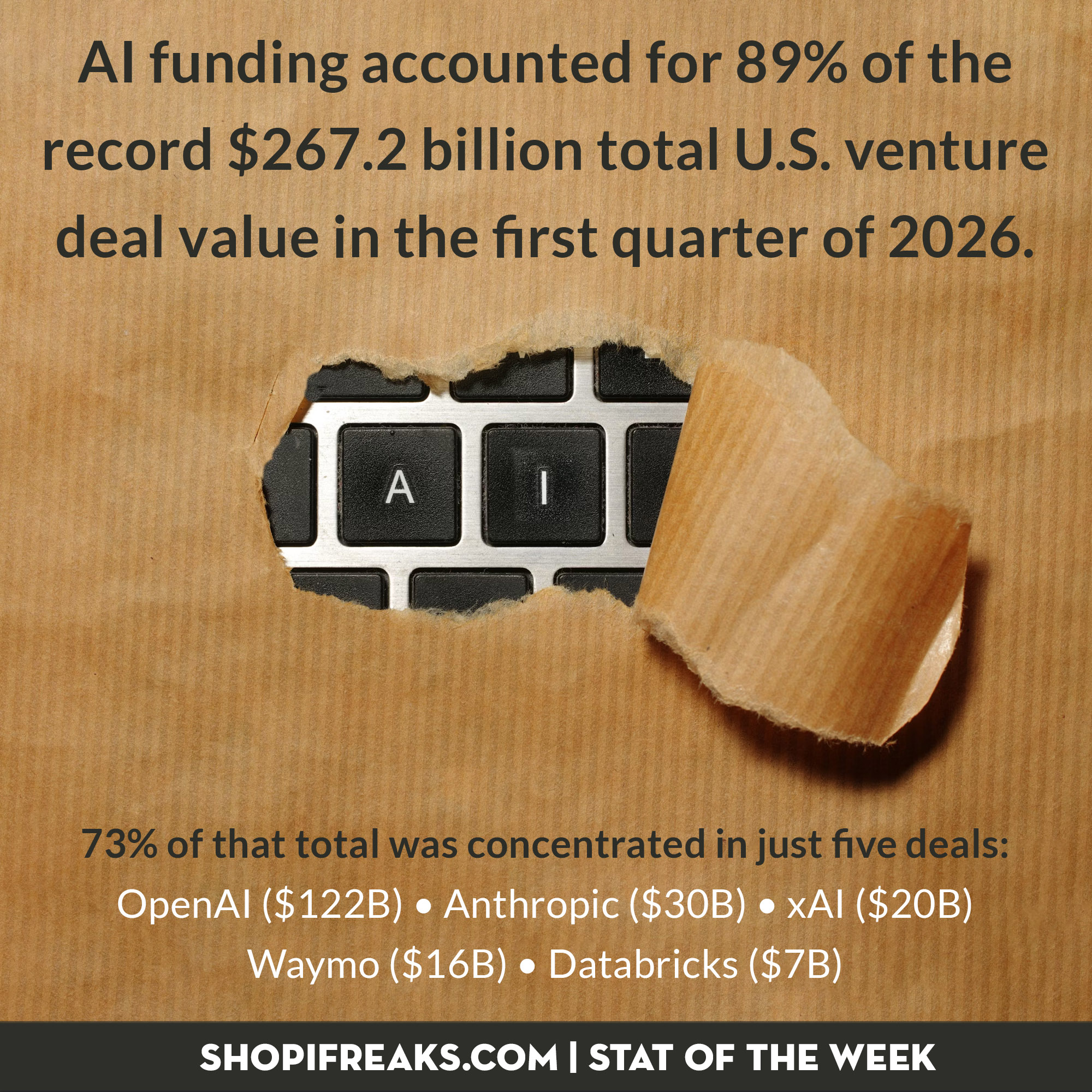
AI funding accounted for 89% of the record $267.2 billion total U.S. venture deal value in the first quarter of 2026, according to PitchBook. Of that total, 73% was concentrated in just five deals including OpenAI ($122B), Anthropic ($30B), xAI ($20B), Waymo ($16B), and Databricks ($7B). Excluding those transactions, investment activity remained relatively stable across other sectors, with $72.2B spread across an estimated 4,595 deals, in line with other recent quarters.
1. Shopify extends native B2B features to all merchants at no extra cost
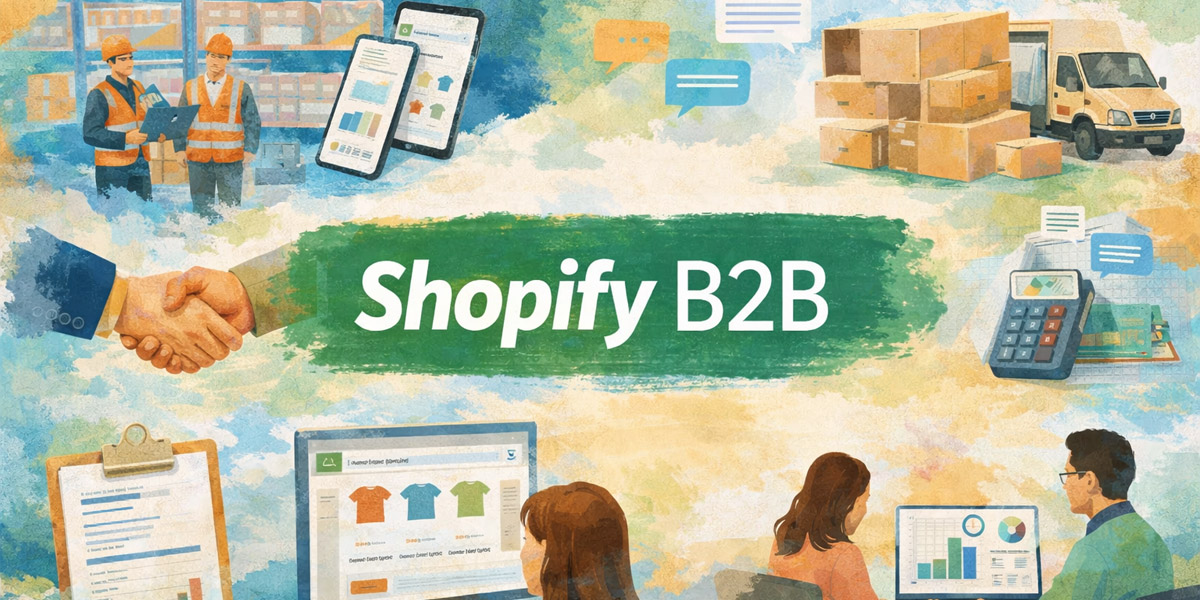
Shopify is rolling out its B2B features to all non-Plus plans for the first time at no additional cost, enabling merchants to manage their wholesale and D2C businesses through the same store without the use of third-party plugins.
Merchants on Basic, Grow, and Advanced plans now have access to:
- Company profiles for wholesale buyers
- Up to three custom catalogs with wholesale pricing, though limited to individual markets, not individual customers
- Volume discounts and quantity rules
- Vaulted credit cards, which securely store the buyer’s payment info for repeat orders
- ACH payments (U.S. only on non-Plus plans)
- Net payment terms
Previously these native B2B tools were exclusive to Shopify Plus, which costs $2,500 on a 1-year term and is out of reach for most small merchants, requiring them to rely on third-party solutions to run their wholesale business on Shopify.
It’s a big unlock for D2C stores that need to run a simple wholesale program that offers the same pricing to all vendors, but B2B commerce consultant Jason Greenwood notes that the B2B feature tiers are designed in a way to push bigger stores to Shopify Plus. He wrote:
“While the ENGINE for B2B is now open to everyone, the flexibility of that engine is STILL heavily throttled on the non-Plus plans. The 3-catalog limit is the biggest barrier, designed to keep high-volume or complex wholesalers on the Shopify Plus plan. Because you must assign these catalogs via Shopify Markets, you cannot easily give ‘Company A’ one price and ‘Company B’ another price if you have more than three unique pricing tiers. Plus users have unlimited catalogs and can assign them directly to a Company Location. This means a Plus merchant can have 500 different customers, each with their own unique negotiated price list – as is common in B2B!”
Although one workaround is that a merchant could use one general price list and create unique discount codes for their various customers. For example, Wholesale Customer A has a 10% off discount code, while Wholesale Customer B gets a 12% off discount code. Or alternatively a merchant could create one general 10% off coupon and assign as many customers to that coupon as they’d like. It’s not as sexy or streamlined as individual customer price lists, but effectively gets the job done in some cases where the merchant simply wants to offer the same discount on all products to a customer.
Jason also pointed out a couple of other limitations including:
- No partial payments or deposits, meaning no ability to ask for a 50% payment upfront. The only options are to require full payment upfront or offer net terms.
- ACH payments are geo-locked for standard plans, only allowing U.S. vendors to pay in this method. (However, I learned that Shopify currently does not restrict merchants from accepting B2B payments outside of its platform such as through check or wire transfer — a notable difference from its D2C payment policy.)
Obviously the available B2B features are always going to be smaller on non-Plus plans, just as it is on non-Plus plans for D2C, but I know a lot of merchants who will benefit just from the key B2B features that Shopify unlocked for all plans, so kudos to them for the move.
However, my condolences to the hundreds of B2B-enablement apps in the Shopify App Store that just became redundant. This was not a very satisfying announcement for them.
2. Amazon adds fuel and logistics surcharges for FBA sellers
Amazon will soon begin adding a 3.5% fuel and logistics surcharge to FBA fees for sellers in the U.S. and Canada, and a 1.5% surcharge for sellers in the UK, France, Germany, Italy, Spain, Poland, Sweden, Netherlands, Ireland, and Belgium, both taking effect April 17th. The fees come in response to the war in Iran driving up global oil prices by more than 60%.
Amazon wrote in an e-mail to sellers:
“Elevated costs in fulfillment and logistics have increased the cost of operating across the industry. We have absorbed these increased costs so far. However, similar to other major carriers, when costs remain elevated, we implement temporary surcharges on our fulfillment fees to recover a portion of the actual cost increases we are experiencing.”
On average, the surcharge equates to $0.17 per unit for U.S. FBA or CAD $0.26 per unit for Canada FBA, but varies depending on the item’s size.
An Amazon spokesperson noted that the surcharge is “meaningfully lower” than those applied by other major carriers — which is true. USPS recently proposed an 8% fuel surcharge starting April 26th, while UPS and FedEx are already charging fuel surcharges of 21-25% on top of base shipping rates.
The average price for a gallon of fuel in the U.S. now stands at $4.11, up from $2.99/gallon a month ago, so I can hardly blame Amazon for imposing a surcharge. They did not indicate how long the surcharge would last, but I imagine it’ll last as long as gas prices remain elevated. However, many sellers fear that “temporary surcharges” can easily become “permanent fee increases” — and it’s certainly fair to be skeptical when it comes to Amazon.
3. WTO couldn’t agree on tariffs so 23 countries made their own agreement
The World Trade Organization’s 28 year global moratorium on e-commerce tariffs expired without renewal at the organization’s 14th ministerial conference in Yaoundé, Cameroon, after Brazil and Turkey blocked an extension.
Quick History: Back in 1998, when e-commerce was relatively new, WTO members agreed to a moratorium preventing any member nation from imposing customs duties on digital purchases like software downloads, music and movie streaming, e-books, and video games. The idea was to “temporarily” not tax the new digital economy while it was finding its footing, however, the moratorium ended up getting renewed every two years for almost three decades… until now.
What changed? As digital commerce exploded, developing nations like India, Brazil, Indonesia, and South Africa began pushing back, arguing that the moratorium was costing them billions in foregone tariff revenue each year, while primarily benefiting U.S. and European tech giants, which is a fair argument to make. The 2024 renewal in Abu Dhabi two years ago was positioned to be the final extension on the “temporary” moratorium, with the expectation that the next meeting would produce a longer-term or permanent solution.
Flash forward to last week: The U.S. was pushing for a permanent moratorium, obviously, as that would greatly benefit U.S. Big Tech, and most other countries were willing to accept a five-year extension. However, Brazil wanted a two-year maximum, and Turkey ended up siding with Brazil. The WTO requires full consensus between its 166-member body for any global deal, so ultimately the deal collapsed.
WTO is expected to revisit the issue at a meeting in Geneva next month, but rather than permit a lapse in moratorium, 23 countries including the U.S., U.K., Japan, and Mexico quickly formed their own agreement to keep digital trade tariff-free among themselves. However that still leaves 143 other countries that could legally impose tariffs on digital commerce, though so far none have.
With respect to my country, I can’t believe that 164 members of WTO were so quick to want to extend the moratorium after President Trump’s tariff frenzy this past year! If I were in their shoes, I’d want that bargaining chip. Clearly the U.S. has the most to gain from a moratorium on digital commerce, and from a global perspective, I don’t quite see the benefit to the rest of the world of giving to us. Thanks though.
4. TikTok partners with Cameo to help creators monetize their connection to fans
TikTok partnered with Cameo to create a new way for creators to monetize their relationship with fans through personalized video messages, as if shilling TikTok Shop goods and peddling NFTs wasn’t enough.
The integration allows TikTok creators to sign up for Cameo without leaving the app and then add a customized button to their TikTok content, through which fans can request a personal video.
Cameo CEO Steven Galanis said:
“Creators are at the heart of everything we do at Cameo, and TikTok creators have become an essential part of our community. Cameo videos regularly go viral on TikTok, showing the power of authentic fan connections and the appetite for personalized content.”
It’s interesting that TikTok partnered with Cameo instead of completely ripping them off. How hard would it have been for TikTok to add a “Request a Video” button on content and facilitate payments between fans and creators? The feature could be up and running by the end of the day. Ask yourself, would Meta have gone the partnership route or simply stolen the idea and added it to Instagram? (They still might. LOL)
So, what’s the benefit of the partnership for TikTok? Effectively Cameo has to deal with all the operational headaches around payments, refunds, and dispute resolution, such as when a creator ghosts a fan’s request or delivers a terrible video, while TikTok gets to take a cut of sales. Cameo also has a roster of thousands of celebrities who may not all be TikTok creators, and the partnership could pull them into TikTok’s creator ecosystem without having to recruit them directly.
In general, TikTok seems to be taking the partnership route to expand its feature set rather than building everything in-house, which is a smart move in my opinion. The strategy makes it a staple part of multiple industries, as opposed to a succubus coming for your business model.
5. Spotify introduces interactive carousel ads and branded playlist takeovers
Spotify is rolling out interactive carousel ads that allow brands to feature up to six different products, each slide with its own image, link, description, and pricing or promotional information. The ads will pop up in the app’s Now Playing view while users actively consume content, as opposed I guess to appearing when the user is passively listening to music without interacting with their screen.
Spotify’s global head of advertising revenue and partnerships told ADWEEK:
“The user experience is becoming a much more interactive, audio and visual experience. It’s just time for us to make sure that our ad strategy reflects the trends we’re seeing and the user engagement we’re seeing from our consumers.”
Spotify is also introducing a branded takeover of select playlists in which advertisers can pay to be the only featured brand, where their names appear prominently on the playlist’s main page and their ads run exclusively during play.
Last week I reported that TikTok introduced a suite of new ad products including Logo Takeovers, which appear next to the TikTok logo on the launch page when users open the app, Sequential Storytelling Ads, which allow brands to deliver up to three ads to the same user within a designated 15-minute window, and TopReach Format, which allows advertisers to purchase the first ad users see when they open the app and the first in-feed ad within their For You Feed.
Do you see the trend?
Platforms have finally realized that random one-off ads that appear in users’ feeds with no rhyme or reason to frequency and order are not as effective as ads with strategic placement and ad sequencing. Now they’re creating new ad formats that cater to advertisers’ desires to tell a story and build a narrative through their advertising.
Brands don’t want to be AN advertiser, they want to be THE advertiser. They want to take over a user’s entire session, not appear alongside other forgettable one-off ads as the user scrolls. It’s the only way to filter through the advertising noise that the platforms themselves created.
There’s more ad noise than ever out there now, and it takes more than a single standalone ad placement to cut through it. Platforms are finally recognizing that.
What are your thoughts? Hit reply and let me know or join the conversation on LinkedIn.
6. Perplexity says Amazon can’t prove its AI agent actually caused any harm
In November 2025, I reported that Amazon filed a lawsuit against Perplexity to stop the company’s AI browser, Comet, from shopping on its website. Amazon had previously sent cease and desist notices to Perplexity, which it ignored, and tried to block Perplexity’s AI agents with technology, which it bypassed.
In early March 2026, Amazon won a temporary federal injunction against Perplexity to block Comet browser from accessing password-protected areas of Amazon to make purchases after Judge Chesney ruled that the retailer provided strong evidence of unauthorized access. Amazon argued that third-party AI agents bring risk to the customer experience and security of their shoppers and that it has the right to mitigate that risk as it so chooses. The company also argued that Perplexity is breaking multiple laws by not abiding by its requests to stop accessing its website and attempting to circumvent its firewalls.
Shortly after that happened in March, a U.S. appeals court subsequently suspended the ruling and paused the court order, allowing Comet to continue shopping on Amazon in the meantime.
Now Perplexity is asking a federal appellate court to vacate the injunction entirely, making the following arguments:
- Perplexity says it doesn’t actually “access” Amazon, and that consumers themselves use Comet to access its website.
- They wrote, “Amazon account holders authorized the [shopping agent] to access their own private information … to facilitate shopping on Amazon.com.”
- Perplexity believes that Amazon failed to prove it would suffer “irreparable harm” without an injunction, noting that its shopping agent was available for eight months before the previous judge issued an order banning it.
- They wrote, “Even after eight months of the Assistant’s operation, Amazon did not submit any evidence of harm to its reputation or goodwill: no declaration from a dissatisfied customer, no survey showing reputational damage, no data showing decreased traffic or lost sales.”
What does Jeff Bezos have to say about all this?
Everyone knows that Bezos is the founder of Amazon, but did you also know that Bezos Expeditions Fund participated in Perplexity’s $73.6M Series B round in January 2024, and that Perplexity runs on AWS? There’s a very strange interconnected relationship between Amazon and Perplexity, which makes Perplexity’s public disparaging of Amazon feel particularly out of place.
This is a case that I am following with great interest, as the outcome will set a precedent for how courts treat AI agents in the future as to whether or not they can access websites without permission. I’ve previously argued that websites can already choose whether or not to function on certain browsers, regions, or devices, so they should also be able to choose which AI can interact with their systems, and I anticipate finding out whether the courts agree with me.
7. OpenAI secretly founded a child safety coalition to push its own agenda
This was originally going to be “This Week’s Most Ridiculous Story” — but it’s so concerning that I wanted to cover it in greater detail. Listen to this…
OpenAI secretly founded and funded a coalition that recruited child safety groups across the country to endorse a list of policy priorities for AI regulation that included age verification, parental controls, and banning targeted advertising towards kids, as reported by The San Francisco Standard.
The organization, which called itself Parents & Kids Safe AI Coalition, wrote in e-mails:
“We believe it is important to demonstrate broad, visible support from parents, educators, community groups, and child-advocacy organizations to make clear that families expect action on AI this year.”
However, the e-mails never mentioned that OpenAI was behind the push or that the principles it was asking nonprofits to endorse mirrored policy proposals in a child safety bill the company itself co-sponsored and is currently working to get the California Legislature to adopt.
Why the secrecy? Why can’t OpenAI openly associate itself with its own coalition? Isn’t child safety a good thing?
Well, if people knew OpenAI wrote the rules, it’d look like the company was trying to regulate itself — which is pretty much exactly what’s going on.
The coalition was promoting a version of child safety legislation that OpenAI prefers — vague principles like age verification and parental controls that fall on users, rather than stronger measures like restricting kids’ access to AI chatbots or holding AI companies liable for harm. Real legislation would cost OpenAI users and force accountability for its own product, which is exactly what it’s trying to avoid.
OpenAI was effectively attempting to leverage the support and credibility of legitimate child safety groups to launder their own policy agenda without those groups knowing they were being used as pawns in Sam Altman’s game of regulatory chess.
Tom Lyon, a professor at the University of Michigan, reviewed the coalition website and said it meets the “classic definition of astroturfing” — which is when corporations form groups to support their objectives with little disclosure of their involvement.
Several of the child safety groups that originally joined the coalition have since removed themselves from the group. OpenAI will likely face no repercussions, as it technically followed the legal definition of minimum disclosure in all of its communications, but there’s a far cry between “legal disclosure” and “transparency” in most people’s books.
8. This year’s best April Fool’s jokes
This was the week that I had to be extra careful about distinguishing between real and fake news, as April Fool’s jokes spread throughout the web. I accidentally shared a post on my subreddit about Google moving to AI-centric search in 3 weeks that turned out to be a joke. Oops!
As you know, I’m a big fan of jokes. I’ve ended each of the past 272 Shopifreaks editions with one! So let’s celebrate a few of the best April Fool’s jokes this year….
😂 Google Sunsetting The Search Bar – This post in r/SEO is the one that got me. I actually shared that real quick on r/Shopifreaks to remember to look into it later without realizing that it was just an April Fool’s joke by the moderators. Great one!
😂 Snapchat Reals – I love when CEOs troll each other. Snap CEO Even Spiegel published a video announcing that Spotlight, its short-form video feed, was being renamed “Reals” to poke fun at Instagram Reels. Such a simple joke, but so funny!
😂 Yahoo Scrōll Stoppr – Yahoo put out a video promoting a finger accessory that physically blocks your thumb from scrolling social media, showcasing all the things you could get done if you stopped scrolling. The twist of the joke was that it was actually a real product available on TikTok Shop for $4.99!
😂 Metro by T-Mobile’s CALLoGNE – The mobile carrier jokingly released a unisex fragrance that smells like a brand new phone fresh out of the box. “The unmistakable scent of a new phone. It’s a fragrance worth answering.” LOL
😂 WordPress USB-C Hardware Dongles – 365i published a joke blog post about how WordPress will soon start requiring a physical USB-C hardware key plugged into your computer to access wp-admin. Kind of a nerdy joke, but funny.
😂 Apple Neo Laptop Recall – iFixit announced that Apple had issued an emergency recall for its new MacBook Neo after discovering a critical design flaw: it was accidentally too repairable. This one actually made me laugh out loud!
What were your favorite April Fool’s jokes this year? Hit reply and let me know.
9. Other e-commerce news of interest
Malls are cool again! Teens are flocking to malls in a trend called “mallmaxxing” that’s breathing new life into physical retail, according to Bloomberg, however, they’re bypassing legacy anchor stores like Macy’s and Belk in favor of Internet-born brands like Edikted and Princess Polly that have opened physical locations with photo booths, expanded fitting rooms, and couches built for content creation. Simon Property Group, the largest U.S. mall owner, reported sales per square foot at their highest levels in decades, surpassing pre-pandemic levels. The real question is though — are mall cookies back? Trick question… they never left.
Square has automatically turned on Bitcoin payments for all eligible U.S. sellers, offering instant conversion of Bitcoin payments into USD so that merchants are left with no crypto on their balance sheet, eliminating price volatility risk. The platform is waiving processing fees through the end of 2026 to encourage adoption, and merchants can optionally elect to retain a portion of daily sales in Bitcoin rather than converting it to fiat. The rollout began March 30th and should reach all eligible Square users by November 10th, with New York merchants currently excluded due to state regulations. Does anyone actually want this? Or is this just Jack Dorsey pushing his Bitcoin obsession on merchants? Doesn’t he know that stablecoins are the new grift?
Civil rights leader Al Sharpton wrote to the attorneys general of seven states in March, calling BNPL loans a “debt trap” for Black and Hispanic consumers, citing data showing Black consumers are 63% more likely and Hispanic consumers 50% more likely than white consumers to use BNPL products. The states, led by Connecticut and North Carolina, recently launched an inquiry into Affirm, Klarna, Afterpay, PayPal, Sezzle, and Zip, seeking details on customer service practices, credit reporting procedures, and internal analyses of delinquencies and defaults, and Sharpton wants them to expand their inquiry into Shop Pay, Splitit, and Qlarifi. Industry trade groups pushed back, with the Financial Technology Association noting that consumers repay BNPL loans 98% of the time and arguing the products offer a more transparent, lower-cost credit alternative, particularly for consumers historically underserved by traditional financial institutions.
Nvidia is pitching advertising agencies on real-time AI video generation, showcasing at Runway’s AI Summit how its computing platform can power instant video scene updates as prompts change, cutting what previously took minutes per output down to near real-time. The advertising agency, Monks, has been working with Nvidia and Runway for two years, building an internal AI workflow platform called Monks Flow, and last year used a combination of Runway, Google Veo, and other AI agents to produce a full 60-second Puma commercial from concept to final edit with minimal human involvement. Eight of Monks’ top 10 clients now use AI regularly, and roughly 40% of its 7,000 employees are active users of Monks Flow. I’m sure everyone who works at Monks feels very secure about their jobs.
Amazon’s sponsored prompts, a new ad format the company introduced in March that triggers chatbot conversations within its Rufus shopping assistant, are seeing very limited traction so far, according to sellers who spoke with The Information. One Amazon seller who does $20-30M in annual revenue recorded just 88 clicks from the format since January compared to 500,000 clicks from all other Amazon ads combined. However, on the flip side of the coin, the sponsored prompts currently only cost around 31 cents per click compared to 50-70 cents for traditional Amazon ads, and the data Amazon provides, including which products appeared in response to specific prompts and sample AI responses, is giving marketers useful insight into how Amazon’s AI selects products and what questions shoppers are asking.
Amazon is ditching American Express after an eight-year credit card partnership and partnering with U.S. Bank and Mastercard for two new credit cards targeting small businesses. U.S. Bank will issue one new business card that gives Prime members 5% back on Amazon purchases and another business card that offers 3% back to non-Prime members, neither of which will carry an annual fee. Amazon plans to transition the small business cards from Amex to U.S. Bank on Aug 14th and promises that existing cardholders won’t see changes to their credit limits or interest rates during the transition.
Amazon Ring launched an app store that allows third-party developers to tap into its network of more than 100M cameras for use cases beyond home security, with launch partners offering apps for elder care monitoring, queue management, Airbnb host surveillance, bird identification, lawn health, and business traffic analytics. For example, an app by Density called Routines can help families keep an eye on their elder loved ones and be alerted to concerns like falls or changes in routines, while an app from QueueFlow is designed to help businesses better understand wait times and congestion. Ring takes a 10% commission on partner sales but is structured to avoid Apple and Google app store fees, since users access the new functionalities through the partner’s own app rather than through in-app purchases within Ring itself. The store launched with 15 apps, but Ring is targeting hundreds by year-end, with facial recognition and license plate reader apps explicitly banned following consumer backlash over the company’s past surveillance partnerships with law enforcement.
Amazon’s Alexa+ can now handle food delivery orders from Grubhub and Uber Eats through a fully conversational experience that lets users browse menus, customize items, ask questions, and change their order mid-conversation. The integration syncs past orders automatically and works with natural language requests like “add a double cheeseburger with extra ketchup, no onion” or “cancel that and do a meat lovers pizza instead,” offering real-time cart updates visible on screen and a full order summary before checkout. Amazon describes the feature as the first step toward an adaptive interaction model where Alexa+ adjusts its conversational style based on the task at hand, with plans to introduce similar abilities for grocery shopping and travel planning in the future. Now this is a good use of AI! Make the process easier for users instead of attempting to take it over entirely.
Etsy updated its Purchase Protection policy to limit buyer cases for late delivery to shipments arriving seven or more days after the estimated delivery date, whereas previously buyers could open a case for items that arrived even one day late. Liz Morton of Value Added Resource notes that sellers had long complained the policy was unfair given Etsy’s often optimistic delivery estimates, however, many are skeptical of Etsy’s claim that the change was driven by seller feedback. Instead, they suspect that the real motivation was reducing Purchase Protection payouts that come out of Etsy’s own pocket. Could be both I guess? Alongside the policy change, Etsy released a seller tools update focused on reducing operational friction including stable listing URLs for better external SEO, smarter order management, and AI-powered integrations that make eligible Etsy items discoverable through ChatGPT, Google, and Microsoft Copilot, while also launching a brand and site refresh in partnership with agency SYLVAIN aimed at repositioning the marketplace as “a catalyst for creativity, discovery, and connection.”
The Linux Foundation launched the x402 Foundation, a nonprofit governance body that will serve as the new home of Coinbase’s x402 protocol, with backing from Google, Microsoft, Amazon Web Services, Cloudflare, American Express, Mastercard, Visa, Stripe, and Shopify. The protocol is designed as an open standard that allows AI agents to autonomously execute payments for APIs, data access, and digital services without human intervention and has the potential to become the de facto standard for how AI agents pay for things on the web given its support from major industry players. Coinbase created the protocol and is now handing governance to the Linux Foundation to ensure it remains vendor-neutral and open source, following the same model that turned HTTP and email into universal internet standards. This is what I’ve recommended that Google do with Universal Commerce Protocol as well.
Cash App launched a pay-over-time feature that lets users spread peer-to-peer transfers of $25 or more over six weeks for a flat 7.5% fee, effectively bringing a BNPL dynamic to paying your friends back for dinner. The company says eligibility is determined per transaction based on its own responsible lending criteria rather than traditional credit limits, and is targeting gig workers and entrepreneurs with variable income streams. The launch adds BNPL to one of the few remaining payment channels where it hadn’t yet been introduced. It’s worth noting that a flat 7.5% fee equates to around a 65% APR, which is a bit more aggressive than it sounds when Cash App pitches it as a “clear upfront fee with no hidden costs.”
Etsy updated its Animal Products Policy to prohibit the sale of products made from or containing natural fur from animals killed primarily for their pelts, including mink, fox, and rabbit, with the ban taking effect August 11, 2026. The policy notably excludes taxidermy and byproduct materials like leather, sheepskin, and wool, but since it applies regardless of age or origin, vintage fur items will not be exempt. The timing of the policy change is likely related to the Coalition to Abolish the Fur Trade’s disruption of Etsy’s presentation at the Morgan Stanley Technology, Media & Telecom Conference last month, where activists confronted Etsy CEO Kruti Patel Goyal and CFO Lanny Baker for “profiting off of the bloody fur trade.” Good news for all the real fur marketplaces out there (which actually exist, I just looked).
Beehiiv, a newsletter and website hosting platform competing with Substack, added podcast hosting and distribution, allowing creators to launch new podcasts or migrate existing archives and automatically distribute episodes to Apple Podcasts, Spotify, Overcast, and Castro. The tool includes automatic audio normalization, full episode transcripts, SEO-optimized webpages per episode, and IAB-standard analytics with breakdowns by country, listening app, and device. Podcast hosting is now included on every beehiiv plan at no additional revenue share, with the company also planning to extend its advertising network beyond newsletters to cover podcasts.
Paradigm, a San Francisco-based venture capital firm founded in 2018 by Coinbase co-founder Fred Ehrsam and former Sequoia Capital partner Matt Huang, is developing a prediction markets trading terminal catering to professional traders and market makers, according to Fortune sources. The firm, which is Kalshi’s most prominent backer after leading a December round that valued the company at $11B, is also exploring an internal market-making desk and prediction market indexes that would bundle multiple contracts into one tradable package. Paradigm is currently in the process of raising as much as $1.5B for a new fund that will not only focus on crypto, but also on AI and robotics, according to a recent Wall Street Journal report.
Shopify introduced Rollouts, a new feature that lets merchants schedule theme changes to go live at a specific date and time, set automatic revert dates for limited-time promotions, and run A/B tests comparing storefront changes against the current theme using real traffic. Merchants on Advanced and Plus plans can also target Rollouts to specific markets, enabling localized homepages or regional campaigns without manual intervention. The long requested feature is available to all merchants on Basic plans and above via Markets in the Shopify admin.
Mercado Pago, the fintech arm of MercadoLibre, is shutting down Mercado Coin, which it launched in 2022 as a cashback reward for shoppers in Brazil purchasing on the MercadoLibre platform. The company said its crypto focus has shifted to Meli Dolar, a U.S. dollar-pegged stablecoin available in Brazil, Mexico, and Chile since 2024. Customers holding remaining Mercado Coin balances must sell or spend them on MercadoLibre by April 17, after which any unused balance will be automatically converted to Brazilian reais.
Target updated its terms and conditions on March 22 to clarify that purchases made by a third-party AI agent on a shopper’s behalf are “considered transactions authorized by you,” meaning if the bot orders the wrong item, the customer is still on the hook. The update is tied to an upcoming Google Gemini integration that will allow the AI to suggest products and complete purchases with shopper approval and follows a November ChatGPT product recommendation tool that Target launched last year. Amazon and Walmart have made similar terms updates, adapting their terms of service to cover themselves legally before agentic commerce goes mainstream (if it does). This is what Perplexity wants, right? “AI should be indistinguishable from the user” — which means the user takes all the liability of employing the AI agent.
In lawsuits this week…
- The Justice Department filed a notice that it will appeal a federal judge’s ruling blocking its attempt to ban government contractors from using Anthropic’s AI. The appeal means the DOJ will now have to actually prove its claim that Anthropic poses a supply chain risk, which is something it hasn’t had to do yet.
- Klarna is being sued for approving users for “purchasing power” without actually investigating their ability to pay back the loans. The lawsuit claims that Klarna users are “disproportionately financially vulnerable” and that the company’s practices can lead to overdraft fees and other financial hardships.
- The lawsuit filed by WhatsApp’s former head of security, Abdullah Baig, who accused Meta of ignoring cybersecurity flaws that enabled thousands of employees to access sensitive user data, was dismissed by Judge Laurel Beeler for lacking sufficient facts to show Baig had reported violations of SEC rules or regulations, which is required for the case to move forward. Baig plans to refile and address those deficiencies.
- Perplexity AI has been hit with a class-action lawsuit alleging that trackers are automatically downloaded onto users’ devices upon login, giving Meta and Google full access to their AI conversations in violation of California privacy laws. The suit claims the data sharing occurs even in Perplexity’s “Incognito” mode, allowing Meta and Google to use the sensitive information for ad targeting.
- Meta agreed to substantially reduce its references to “PG-13” when describing its Instagram Teen Accounts content filters and add a disclaimer clarifying that the Motion Picture Association is not involved, resolving a cease-and-desist the MPA filed after Meta invoked the rating in October.
- The National Labor Relations Board ruled that Amazon must bargain with the Amazon Labor Union, which represents roughly 5,000 workers at its Staten Island warehouse and has been seeking to negotiate pay and working conditions since forming in 2022, finding that Amazon engaged in unfair labor practices by refusing to recognize the union. Amazon of course plans to appeal.
In layoffs this week….
- Oracle began informing employees that it’s cutting thousands of jobs, as the company faces a plummeting stock price tied to recent investments in AI infrastructure.
In corporate shakeups this week…
- Walmart International’s CTO, Vinod Bidarkoppa, announced his departure from the company after six and a half years in which he held leadership roles across Sam’s Club, Walmart US, and Walmart’s international business.
- Microsoft’s VP of energy procurement for data centers, Bobby Hollis, left the company after three years, during which he oversaw Microsoft’s push to secure power for its AI infrastructure.
- Doug Leone, who has been at Sequoia Capital since 1988 and led the firm for more than two decades, has been named chairman and will resume making new investments after stepping back in 2022.
- Meta’s longtime content policy chief Monika Bickert, who oversaw the writing and enforcement of Facebook’s content rules and regularly served as the company’s public face during controversies, is leaving the company in August to teach at Harvard Law School.
- Eric Eyken-Sluyters, a Salesforce executive who oversaw Agentforce, the company’s flagship AI agent product, has left after 23 years to become president of field operations at Sierra.
- Broadcom named Amie Thuener, who currently serves as Alphabet’s VP, corporate controller, and chief accounting officer, as its next finance chief, following the retirement of Kirsten Spears.
- OpenAI’s CEO of AGI deployment, Fidji Simo, is taking a temporary medical leave to seek treatment for postural tachycardia syndrome, a disorder that can cause heart palpitations, lightheadedness, and fainting, with plans to return in several weeks.
- OpenAI’s COO Brad Lightcap is transitioning into a new role that will place him in charge of special projects like selling enterprise AI products.
- Amazon’s robotaxi product lead, Michael White, is leaving the company to join the Florida Panthers as its business operations president.
Microsoft launched three in-house AI models, MAI-Transcribe-1, MAI-Voice-1, and MAI-Image-2, available immediately through Microsoft Foundry, with the transcription model claiming the lowest word error rate across 25 languages on the FLEURS benchmark, beating OpenAI’s Whisper and Google’s Gemini Flash on most languages tested. The models were each built by teams of fewer than 10 engineers and run on half the GPU footprint of comparable competitors, with Microsoft pricing them below every major cloud rival to reduce its own infrastructure costs across Teams, Copilot, Bing, and PowerPoint. Microsoft AI CEO Mustafa Suleyman told VentureBeat, “Our mission is to make sure that if Microsoft ever needs it, we will be able to provide state of the art at the best efficiency, the cheapest price, and be completely independent.”
Figure CEO Brett Adcock ended the humanoid robotics company’s AI partnership with OpenAI after concluding the team provided little value beyond brand recognition and that the two companies were headed toward direct competition. Adcock said on a recent podcast that he struggled to get OpenAI’s team engaged in the hands-on work that robotics requires, and ended the partnership after OpenAI signaled it planned to pursue humanoid robots internally. OpenAI has since built an internal robotics lab with around 100 data collectors focused on teaching robotic arms household tasks, and has also backed Norwegian-American robot maker 1X, putting it in direct competition with Figure. I hope they didn’t share too many trade secrets with OpenAI throughout the partnership…
Google is rolling out a long-awaited feature that lets Gmail users in the U.S. change their username once every 12 months without losing access to their existing emails, contacts, or account data, with the old address remaining active as an alternate sign-in option. Now [email protected], who made his e-mail address during his sophomore year in college based on his fraternity pledge name, can change his e-mail to [email protected] so he can finally get responses to his job applications. Dude’s been unemployed since the mid-2000s. Users can access the change through Google Account settings under Personal info, though the rollout is gradual and not all users will have immediate access. The feature was previously spotted rolling out in Hindi-speaking territories in 2025.
Amazon’s cloud computing operation in Bahrain was damaged following an Iranian strike, with Bahrain’s Interior Ministry confirming civil defence teams responded to a fire at a company facility, according to the Financial Times. The attack came one day after Iran’s Revolutionary Guards threatened to target U.S. tech companies operating in the Middle East, including Microsoft, Google, and Apple, in retaliation for strikes on Iran. AWS had already reported a disruption to its Bahrain region last week, making this the second time in a month that Amazon’s Middle East cloud infrastructure has been affected by the conflict.
🏆 This week’s most ridiculous story… Anthropic accidentally included the source code for its Claude Code command line application in a recent release, and while desperately trying to remove copies from GitHub, issued a DMCA takedown notice that swept up roughly 8,100 repositories, including legitimate forks of its own public Claude Code repo. Wait, there’s more… Developers began reverse-engineering the code and discovered that Anthropic is actively tracking how often users are using vulgar language when interacting with Claude. (Crap! I’m not too polite with my AI chatbots sometimes…) Claude Code creator Boris Cherny said the company just uses it as a signal to figure out if people are having a good experience, but who knows what really goes on behind the scenes. I think I might start being nicer to Claude.
10. Seed rounds, IPOs, & acquisitions
Allbirds, a sustainable footwear brand known for its Merino wool shoes, is selling all of its assets to American Exchange Group, a brand management company, for $39M, with the deal expected to close in mid-2026. At one point after its IPO in 2021, Allbirds was worth over $4B, and the company became a global D2C success story. However after a series of missteps, including opening 60 stores internationally that never turned a profit, purchasing expensive TV ads, and branching out beyond its core product, the sustainable footwear company couldn’t sustain itself and eventually shuttered its stores and abandoned its new product lines. Having never turned a profit, the company will winddown after the asset sale.
OpenAI closed its $122B funding round at a $730B pre-money valuation, roughly $22B above its initial target. SoftBank and Nvidia each committed $30B, while Amazon committed up to $50B, with the first $15B now and the remaining $35B contingent on an IPO or the achievement of AGI. Other participants include Altimeter, Blackstone, Coatue, Dragoneer, Sequoia Capital, Sands Capital, and Thrive Capital, plus over $3B raised from individual investors through banks. The raise comes as OpenAI generates approximately $2B in monthly revenue, with ChatGPT surpassing 900M weekly active users and 50M paying subscribers, and its advertising pilot crossing $100M in annualized revenue within six weeks of launch.
OpenAI acquired TBPN, a Silicon Valley live-streaming tech talk show founded in late 2024 that features interviews with industry CEOs and executives, for an undisclosed amount. Co-founders and hosts John Coogan and Jordi Hays, alongside the show’s 11-person team, will be joining OpenAI, reporting to chief global affairs officer Chris Lehane, though OpenAI says it will preserve TBPN’s editorial independence. LOL, I’m sure. The show averages around 70,000 viewers per episode, generated roughly $5M in advertising revenue in 2025, and was on track for more than $30M in 2026 before the deal, which will wind down its advertising business.
Amazon is in talks to acquire Globalstar, a low-earth-orbit satellite communications company with a market cap of roughly $8.8B, as it looks to accelerate the buildout of its Leo satellite network to compete with SpaceX’s Starlink, according to the Financial Times. Negotiations have been complicated by Apple’s 20% stake in Globalstar, requiring Amazon to negotiate with Apple as part of any potential deal. Amazon’s Leo network currently has 180 satellites in orbit compared to Starlink’s 9,500-plus, which serves more than nine million users globally and accounts for an estimated 50-80% of SpaceX’s revenue.
Sarvam AI, an Indian startup that aims to build a homegrown alternative to OpenAI and Anthropic, is close to raising $300 to $350M at a $1.5B valuation in a round expected to be led by Bessemer Venture Partners with participation from Nvidia, Amazon, and Prosperity7 Ventures, according to Bloomberg sources. The company’s models are built for voice interaction across 22 Indian languages, targeting the vast majority of India’s 1.45B population who cannot read, write, or type in English, giving it a structural advantage over Western AI models that struggle with Indian languages. Sarvam also offers agentic AI models for tasks like coding and meeting planning, positioning itself as an enterprise automation platform in the country.
Australia Post, the country’s national postal service, acquired Rendr, a last-mile delivery orchestration platform that uses algorithms to connect merchants with the most suitable delivery partners in real time based on location, speed, and service requirements, for an undisclosed amount. The deal will expand Australia Post’s same-day delivery coverage to nearly 90% of the population and add evening and weekend delivery windows. Rendr will initially continue operating as a standalone platform before eventually being integrated into Australia Post’s broader sending platforms.
Swipe Savvy, a merchant rewards and loyalty platform for restaurants, retail, and grocery, acquired GiftAMeal, a cause-marketing platform for restaurants that donates a meal to a local food bank each time a customer photographs their order at a partner restaurant, for an undisclosed amount. The deal integrates GiftAMeal’s photo-based donation experience into Swipe Savvy’s existing Points for Purpose program, giving restaurant partners a way to reward customers for both spending and for the community impact they help create. Since launching in 2015, GiftAMeal has partnered with more than 1,200 restaurant locations across 46 states and has helped provide 3M meals to families in need.
Latitude, a cross-border payments company founded by former leaders from Stripe, Coinbase, Uber, and Facebook that uses stablecoins to help businesses send international payouts that settle in local currency within minutes, raised $8M in a round led by NEA at an undisclosed valuation. The company’s core product, Global Payouts, allows American businesses to send U.S. dollars internationally by converting them into stablecoins as an intermediary and then into the local currency of the destination, which could be used for things like paying creators or prediction market payouts. Latitude competes against traditional banks operating on legacy Swift rails, which the company says leave small businesses “paying too much and getting too little.”
Numos, an AI platform that automates enterprise finance workflows like reconciliations, variance analysis, and financial close while keeping every step transparent and auditable, raised $4.25M in a seed round led by General Catalyst. The platform sits on top of a company’s existing finance stack rather than replacing it, connecting fragmented data across accounting systems, billing tools, data warehouses, and spreadsheets, with early customers seeing 80% faster financial planning and analysis reporting cycles. Unlike most AI finance tools that operate as black boxes, Numos takes a transparency-first approach, showing its full reasoning and audit trail at each step to help finance teams remain accountable for their numbers.
SpaceX filed confidentially with the SEC for an IPO, targeting a June public listing that could raise more than $75B at a $1.75 trillion valuation, surpassing all money raised by U.S. IPOs last year combined and making it the largest IPO in history. The company is considering a dual-class share structure that would potentially give insiders extra voting power to control decision making, while simultaneously allocating up to 30% to retail investors. SpaceX has lined up Bank of America, Citigroup, Goldman Sachs, JPMorgan, and Morgan Stanley for senior roles on the offering, with international banks coordinating orders across the UK, Europe, Canada, Asia, and Australia.
OpenRouter, a startup that gives AI app developers access to more than 300 closed- and open-source models from a single API, is in talks to raise $120M in a round led by CapitalG, Alphabet’s venture arm for mature startups, at a $1.3B valuation, according to The Information sources. Since launching in 2023, the company has grown to generate more than $50M in annualized revenue, up from $10M in October, making money by charging a small fee when developers buy credits to run AI models. The round would more than double OpenRouter’s valuation from the $500M it commanded in its last round led by Andreessen Horowitz and Menlo Ventures.
Bed Bath & Beyond entered into a definitive agreement to acquire The Container Store, along with its Sweden-based Elfa and Chicago-based Closet Works businesses, for $150M in stock and convertible notes. The Container Store’s more than 100 locations will be jointly branded with Bed Bath & Beyond, while expanding their offering to include flooring, lighting, kitchen, laundry room, and bathroom cabinetry. The acquisition is part of Beyond’s broader “Everything Home” platform strategy, which combines retail brands including Overstock, Kirkland’s, and BuyBuy Baby with home services like installation and customization.
Also, a micromobility startup spun out of Rivian last year, raised $200M in a Series C round led by Greenoaks Capital at a $1B valuation, bringing its total amount raised to $305M. DoorDash participated in the round and is getting a board seat as part of a deal to jointly develop autonomous versions of Also’s small electric cargo vehicles, which can carry more than 400 pounds of packages while fitting in a bike lane. It remains unclear whether the autonomy tech will come from Rivian, which has been developing its own custom silicon and autonomy computer, or from DoorDash, which already operates its own autonomous delivery vehicle called Dot in the Phoenix area.
Nvidia invested $2B in Marvell, a semiconductor company that designs chips used in data centers, networking equipment, and storage systems. Nvidia also participated in a $28M Series A round for ThinkLabs, an AI-powered grid intelligence company, as well as in a $25M strategic round for Emerald AI, a startup that builds software to turn AI data centers into flexible grid assets that can dynamically reduce power consumption during peak grid demand without disrupting compute performance.
Sona, an AI platform that handles scheduling, HR, payroll, and business intelligence for businesses in sectors like retail, logistics, and hospitality, raised $45M in a Series B led by N47, bringing its total amount raised to over $100M. The company will use the funds for U.S. expansion and to fast-track a decade’s worth of planned platform capabilities, including its newly launched Forge tool that lets businesses build custom AI applications on top of their operational data.
OpenFX, a foreign-exchange and remittances startup that uses stablecoins to offer near-instant FX settlement, raised $94M in a round led by several venture capital firms including Accel, Atomico, Lightspeed Faction, M13, Northzone, and Pantera. The company claims to settle more than 98% of transactions in under 60 minutes, compared to 2-5 business days on legacy forex rails, and now processes over $45B in annualized payment volume, up from $4B a year ago. It plans to use the funds for expansion into Southeast Asia and Latin America.
Manna Air Delivery, a Dublin-based autonomous drone delivery company that delivers food, groceries, medical supplies, and retail items, raised $50M in a Series B led by ARK Invest and Schooner Capital, bringing total amount raised to $110M. Since launching in 2019, the company has completed more than 250,000 commercial flights from its six locations in Ireland, Finland, and Texas, and recently expanded its global partnership with Uber. It plans to use the funds to scale to 40 new U.S. bases and build out infrastructure for what it calls the “next generation of logistics.”
Intel is planning to invest an additional $15M in SambaNova, a chip startup chaired by Intel CEO Lip-Bu Tan, which would bring Intel’s ownership stake to 9% following a separate $35M investment made in February, according to Reuters. Intel now invests in at least three other Tan-affiliated companies including EPIC Microsystems, 3D Glass Solutions, and OPAQUE Systems, but Intel says it “maintains rigorous, well-established governance and conflict-of-interest policies, with active Board oversight to ensure all decisions are made in the best interests of the company and its shareholders,” adding that Intel was already a shareholder in three of the four companies prior to Tan being appointed as CEO.
Intel is also spending $14.2B to buy back the 49% stake in its Leixlip, Ireland manufacturing facility that it sold to Apollo Global Management in 2024 for $11.2B, funded through cash on hand and roughly $6.5B in new debt. Intel sold the facility in 2024 because it needed cash, at the time in the middle of a multi-year manufacturing expansion plan called “IDM 2.0” under former CEO Pat Gelsinger while simultaneously losing market share to AMD, missing the AI boom, and burning through cash reserves. Quite the turnaround in two years! It’s been one of my best performing stocks, having bought in mid-2024 for an average of $20.00 per share, which helps offset my CMRC losses. LOL.
Uber agreed to acquire Blacklane, a Berlin-based premium chauffeur service that operates in over 500 cities across 60+ countries and serves executives and corporate travelers worldwide, for an undisclosed amount. The deal accelerates Uber’s recently announced Uber Elite chauffeur offering and builds on the strong growth of its pre-booked Uber Reserve trips, which have become one of the fastest-growing parts of its mobility business. The acquisition is expected to close by end of 2026 pending regulatory approval.
Anthropic acquired Coefficient Bio, an AI health platform for drug discovery, clinical regulatory strategy, and R&D planning, for approximately $400M, according to The Information sources. The startup’s team, comprising of fewer than ten employees, will be joining Anthropic’s healthcare life sciences group, which develops tools for the biotech industry ranging from drug discovery to clinical commercialization. The deal is one of the most expensive per-employee acquisitions in history.
Supabase, a San Francisco-based database management startup that competes with Google’s Firebase platform, is aiming to raise $500M in a round led by Singapore’s GIC at a $10B valuation, double the valuation it raised at last fall and five times its $2B valuation from a year ago, according to The Information sources. Last year the company reached annualized revenue of $70M, up from $20M the year prior, operating on a freemium business model with a free service for basic options and a monthly fee for large database storage needs.
Tether, the world’s largest stablecoin issuer with $184B of its USDT in circulation, has been struggling to close a fundraise at a $500B valuation since last year, with investors wary of a valuation that would make it worth more than every U.S. bank except JPMorgan Chase, and has given investors a two week deadline to shit or get off the pot. The company has no plans to go public, leaving investors with no clear exit path, and faces growing stablecoin competition following new U.S. legislation that has brought more issuers into the market. Tether was seeking to raise between $15B and $20B, but isn’t desperate for the capital, having earned $10B in net profits in 2025.
SIBS, a Portuguese payments infrastructure company that operates a network of ATMs and offers e-commerce solutions and card issuance services, acquired ITCARD, a Polish payments processing company that operates its own ATM and POS terminal network across the country, for an undisclosed amount. The deal adds ITCARD’s Planet Cash ATM network, Planet Pay POS terminal network, and Visa and Mastercard card issuance business to SIBS’s existing Polish operations, which date back to 2008 and already include payments company Paytel and POS provider Kar-tel. The combined group will process more than 17B transactions annually across its global network.
Mistral, a French AI startup that builds open-source and proprietary LLMs and positions itself as a European alternative to U.S. cloud giants, raised $830M in debt financing from a seven-bank consortium to purchase 13,800 Nvidia chips for a new data center in France that’s expected to go operational by mid-2026. The raise marks Mistral’s first debt financing and follows the company’s announcement last month of a second planned facility in Sweden, as it works toward securing 200 megawatts of capacity across Europe by end of 2027.
Physical Intelligence, a startup developing AI software that teaches robots to perform physical tasks like folding clothes, preparing coffee, and assembling boxes, is in talks to raise $1B in a new funding round that would more than double its valuation to over $11B in just four months, according to Bloomberg. Peter Thiel’s Founders Fund, Lightspeed Venture Partners, Thrive Capital, and Lux Capital are rumored to be participating in the round, though sources say the talks are still early and the details could change. The company’s ultimate goal is to build models that enable robots to perform any function requested by the user through “vision-language models,” similar to how large-language models complete digital tasks on command.
Thanks for being a Shopifreak!
If you found this newsletter valuable, please leave a review on Google and share the newsletter with your friends and colleagues to help us grow.
See you next Monday,
PAUL
Paul E. Drecksler
🌐 Shopifreaks.com
🧑💼 Add me on LinkedIn
📧 [email protected]
📱 +1-828-273-3031
⭐ Leave A Review
PS: My bank just called about suspicious activity on my account. They didn’t believe I bought a gym membership.