
Hi Shopifreaks
Thank you to everyone who already submitted a prediction for our annual E-commerce Predictions 2027 report. I started collecting submissions a week early this year, so you’ve still got plenty of time to submit yours. Here’s a look at last year’s report to see the format. Basically it’s “Headline + Prediction + Your Name, Company.”
Hit reply to any of my e-mails to submit your predictions. The more the merrier! Please know that you don’t have to be an industry-leading expert to submit a prediction. You just have to be okay with being wrong! I often am with mine… 😂
This week I’ve got another jam-packed edition for you that covers:
- OpenAI launches business profiles
- USPS needs a better rescue plan
- TikTok Shop introduces a premium membership
- Reddit rolls out dedicated review pages
- Shopify finally tightens its App Store rules
- OpenAI releases ChatGPT Wallet
- Amazon’s secret World Product Graph
- Nvidia CEO’s resignation (and potential return)
- eBay and United block Meta’s Muse
- Shopify Tax is getting more expensive
All this and more in this week’s 304th Edition of Shopifreaks. Thanks for subscribing and sharing!
Stat of the Week
40% of active Amazon.com sellers have listings on the company’s budget marketplace Haul, but most never signed up, according to Marketplace Pulse. Amazon cross-lists their FBA inventory into Haul on its own, and sellers can’t pull individual items out, only their entire account. That’s in part how Amazon has grown Haul to over 10M products in two years.

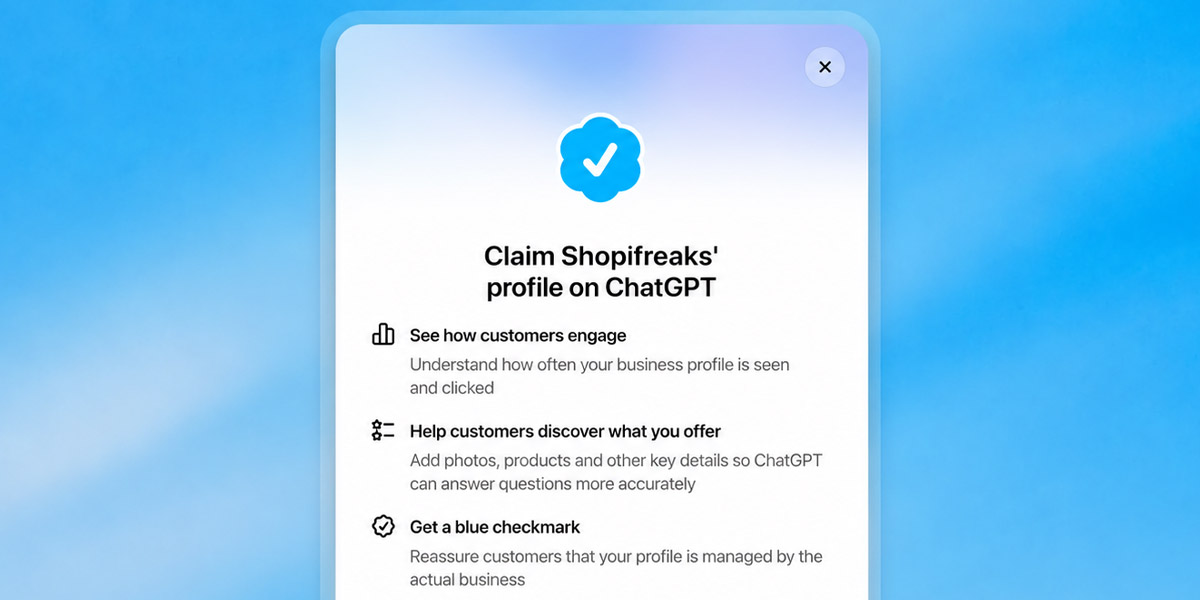
1. OpenAI launches Business Hub, letting companies claim their ChatGPT profiles
Last month, when ChatGPT temporarily stopped adding a utm_source tag and referrer data to its links and OpenAI called it a bug, I predicted that it was secretly building an analytics dashboard for businesses, and that the referral data got stripped because OpenAI was running a test. Turns out it’s a whole lot more than that…
On Tuesday, OpenAI launched Businesses in ChatGPT in beta, a free program that lets companies claim their profile inside ChatGPT, control what it says about their business, feed it their products, see how often the chatbot surfaces their business, and track user engagement to their links. It has two parts: Business Hub, where businesses manage their listing, and Business Agents, where they can build their own branded AI agent to talk to shoppers inside ChatGPT. Here’s more information about both.
Business Hub
- Any eligible business with a website can claim its profile in countries where ChatGPT is available. You verify you’re connected to the business by phone, e-mail, a DNS record, or a Shopify integration, and then an admin completes an identity check through Persona. Verified businesses get a blue checkmark. How creative!
- Despite all the talk about Shopify this past week, you don’t need Shopify to claim your profile. Shopify merchants can simply skip some of the verification steps by connecting their store from Business Hub or the Shopify admin, while everyone else verifies manually through Business Hub’s backend.
- After they’re verified, businesses can edit their details and connect a product feed with prices and stock levels. Once again, it’s a faster onboarding for Shopify merchants, since most products on Shopify are already in ChatGPT through Shopify Catalog. Everyone else can upload a CSV that follows OpenAI’s product feed specification or point it to a hosted feed URL, similar to how they do in Google Merchant Center.
- The dashboard shows how often ChatGPT mentions the business, how many clicks they get, and the common topics in conversations that cite their website. OpenAI doesn’t share the actual chats, and businesses won’t see any data until they clear a minimum number of conversations.
- Local stores and restaurants can claim a profile only if ChatGPT already has a US listing for them, whereas online businesses can add a profile if they can’t find one. OpenAI can also create a listing for any business, whether or not the business ever claims it.
- OpenAI says claiming a profile doesn’t get the business better recommendations, and ChatGPT may still use other sources when it talks about the business. That’s fair, because otherwise these profiles would just become a second website for companies to make whatever claims they want about themselves.
Business Agents
- Once a business claims a profile, it can build its own AI agent inside ChatGPT that answers customer questions and helps shoppers explore products. Shoppers open it from the company’s profile, and the conversation happens in a separate, clearly labeled chat, not within a regular ChatGPT conversation.
- For now, only verified US e-commerce and online service businesses can build an agent. Even then, OpenAI reviews each business’s category and intended use before publishing, so verification alone doesn’t guarantee that a business gets an agent.
- Shopify merchants get the fastest setup again, with their catalog details flowing in automatically. They just have to preview and publish the agent.
- Businesses can pay to sponsor their agent and use it as the landing page for ChatGPT Ads. So the free profile reels them in, and the agent is where OpenAI makes money.
- OpenAI hasn’t given a timeline for opening agents to local businesses or other countries.
How does all this compare to Google?
Business Hub is essentially OpenAI’s Google Business Profile and Google Merchant Center rolled into one dashboard. The biggest difference, at the moment, is that OpenAI’s Business Profiles are not a review platform. Google Business Profile is built around customer reviews and other first-party data, and there’s nothing currently like that in Business Hub. ChatGPT gets its star ratings and reviews from elsewhere, mainly Yelp, which licensed its data to OpenAI earlier this year. My guess is that once OpenAI starts processing more checkouts through its chatbot (more on that later), it’ll subsequently begin soliciting its own reviews internally from buyers.
Smart moves by OpenAI.
Businesses want control over how they appear in AI search, and Business Hub provides the illusion of it. The hub also builds a direct relationship with business owners through its free profile and analytics tools, which becomes a short bridge to OpenAI’s advertising services. Plus, it’s about time that someone gave Google a run for its money in the business profile market, as they’ve run the show for decades.
The only way I see this going wrong for OpenAI is that they’re once again trying to control too much of the journey, same as they did with Instant Checkout. It appears that OpenAI’s goal is to facilitate: 1) Discovery (Organic & Paid), 2) Education (Branded AI Agents), and 3) Checkout — all through its platform. But not every business wants to feed their customers’ entire sales journey through a beta AI agent. What about my beautiful DTC website?
OpenAI is putting its AI agents front and center through its Business Hub, when it should be focused on building a pathway to its general advertising that takes users to businesses’ websites, because that’s what businesses want today. Though to be fair, when AI agents flop, it’s still got the Business Hub relationship with companies and can pivot.
2. USPS’ rescue plan is to charge you more, but it’s the wrong approach
USPS is still losing a ton of money each year, and now it’s getting a bit greedy about how it aims to recoup those losses. The agency is acting like its customers have nowhere else to go, but that is increasingly less true each year as Amazon and Walmart come for a bigger slice of the e-commerce delivery pie.
Here’s what happened: USPS reported that it lost $6.5B in fiscal 2026 and warned that it will have to make major cuts unless Congress gives it $2B to cover the cost of requirements lawmakers imposed on it. Without that money, Postmaster General David Steiner said the agency will have to sharply cut the number of retail post offices, lower service levels for Marketing Mail, and possibly slow down mail delivery.
The loss is smaller than the $9B that USPS lost the year before, but Steiner said the agency still has to conserve cash, because it deferred about $2.6B in employee pension contributions this year. Steiner expects to have contingency plans ready by March, which puts the decision in the hands of the new Congress that takes office in January.
In the meantime, USPS is doing everything it can think of to pad its bottom line:
- The agency filed to raise domestic shipping prices by an average of 5.9% on January 17 for Priority Mail Express, Priority Mail, Ground Advantage, and Parcel Select, and to replace its temporary 8% transportation surcharge with an ongoing fuel surcharge that starts at 11%. The 8% charge from April was set to expire that same day, but USPS is keeping it, adding three points for higher fuel costs, and plans to revisit the rate in July based on January-through-June fuel prices.
- USPS also wants to add a 20% Repricing Fee to postage corrections caused by wrong package weights or dimensions starting January 17, according to Value Added Resource, which found the fee in a regulatory filing rather than in the agency’s November 12 rate announcement. A seller who came up $5 short would owe $6, while one who paid $5 too much would get only $4 back.
- USPS will also start charging its hazmat fees on commercial return labels on February 1, 2027, after exempting them when the fees launched in July. That means retailers and marketplaces that issue prepaid returns will pay the $7.50 handling fee on declared hazardous items sent by Priority Mail, plus a $50 noncompliance fee on any package USPS catches with missing or mismatched hazmat labels.
Two things are true at once:
- I don’t believe that USPS should have to be going through any of these financial struggles. The agency is a public service that benefits all businesses and residents in the US, and it should be subsidized accordingly. Frankly, it’s been set up to fail by previous administrations.
- That said, it still has a fiduciary responsibility to taxpayers to run an efficient business that remains competitive in the market and minimizes losses that would otherwise have to be subsidized. I believe they are going about this one in the wrong way.
USPS’ rescue plan is to be more expensive. It should instead aim to be unbeatable when it comes to service, while creating value-add products that bring new revenue channels in-house.
Earlier this year, I wrote about how USPS should offer their own “free returns & package protection” product that e-commerce stores can either cover the cost of themselves or offer through an upsell at checkout. Right now they’re handing that whole revenue stream to companies like Loop and Redo, when they could take it in-house. That’s just one idea. I’m sure as a business owner, you’ve got others.
The alternative is to continue squeezing juice from a dry lemon. Small businesses can only endure so many price hikes and surcharges before they reevaluate their shipping needs and explore alternate solutions. USPS isn’t the ONLY place to go anymore, so therefore it needs to be the BEST place to go.
🔥 Partner News
ReFiBuy released the Q3 edition of its AI1000, a quarterly index it co-developed with Digital Commerce 360 that ranks how ready North America’s 1,000 largest online retailers are for AI shopping agents, based on AI traffic, bot access, and commerce protocol support. Opening up to AI bots helped drive the biggest gains last quarter, with Costco climbing 182 spots, GoPro 173, and Scheels 168. ReFiBuy’s checks also found that some retailers’ sites were open to one AI agent but blocked to another, across ChatGPT, Claude, Gemini, and Perplexity. ReFiBuy CEO Scot Wingo said Amazon and eBay block bots on purpose, but a larger group of retailers may be doing it through IT settings their commerce teams don’t know about, which will cost them holiday discovery traffic.
3. TikTok Shop launches a premium membership for its most loyal customers
TikTok Shop started piloting a paid membership called TikTok Shop Plus that offers free shipping on items with a Plus badge, 10% off some products, and monthly coupons ranging from $5 to $30 off orders depending on cart size. Additionally, members can receive an instant refund up to two times per month on eligible products, issued as store credit to their TikTok Shop balance before they drop off the item for return. TikTok is currently offering the membership to the more than 1 million US customers that it considers its most loyal.
Patrick Nommensen, President of Strategic Initiatives at TikTok Shop, told Modern Retail:
“TikTok Shop Plus is currently being piloted with an expanding group of eligible U.S. users. As we gradually scale access to the pilot, we’ll continue to gather feedback and refine the experience, with the goal of delivering more value and convenience to shoppers.”
Does this sound familiar?
You might remember back in July when I reported that TikTok began testing TikTok Shop Plus at various price points including $6, $10, and $15 per month in the US, according to screenshots viewed by Business Insider. Now the company has settled on $9.99/month after a 30-day trial. There’s still no mention of an annual plan, which makes me believe that TikTok isn’t 100% confident in the Plus membership yet and doesn’t want to promise benefits too far ahead.
In July, I had several questions, and I still don’t have answers to any of them:
- Who pays for free shipping? TikTok or the seller?
- Similarly, who eats the discount? Or is this a concerted effort between TikTok and certain sellers? (ie: We’ll give your product more attention if you offer a deal.)
- Do sellers get a piece of that subscription fee to cover the shipping or discounts?
- Does the free shipping offer come with a minimum speed? Or can free two-week shipping from Shenzhen qualify?
- Are e-commerce marketplaces out of names? Are the only options to choose from “Prime” or “Plus” when launching a membership program?
I also question why TikTok is offering this membership program at all, especially to customers it’s already identified as its most loyal. They seem to be spending a lot of money on TikTok Shop with or without the membership perks. For customers, it’s a no-brainer, but for TikTok, it seems silly to cut into its margin for no reason.
If TikTok is intent on creating a membership program, my thoughts are that they should focus on value-adds instead of discounts. For example, a membership that bundles a microdrama subscription and other partner services, offers a monthly allotment of virtual gifts for users to give their favorite creators, and provides early or priority access to livestream sales, so members get first dibs on limited inventory. Stuff like that. Don’t become a coupon warehouse like Kohl’s!
4. Reddit introduces Reddit Review pages built from community discussions
Reddit began testing Reddit Reviews, a new experience that uses AI to compile what its users across various communities say about a product into a single page, starting with roughly 10,000 popular products in electronics, health and beauty, home and garden, and fashion. Each review page summarizes the discussion, compares the share of positive, mixed, and negative mentions, and groups recurring pros and cons, with links to the original threads plus prices and buy links when brands provide catalog data.
The company wrote in a blog post:
“Reddit Reviews uses AI to both organize these conversations where people describe their product experiences, and to surface the nuance, context, and connection to the original conversation. This next evolution builds on the testing we have done over the past few months; we are excited to continue enhancing product discovery and shopping on Reddit.”
Shoppers can reach a review page through Reddit’s search bar or by tapping a highlighted product name inside a comment, which means product mentions across the site are becoming internal links to these review pages.
Reddit says 50% of US consumers already visit the platform to double-check product recommendations they get from AI tools, and now it wants to give them the answer without making them dig through threads.
What’s especially interesting about these review pages is that they give Reddit a single outbound route for users to click through to products on external websites, which offers a clear path to monetization through affiliate links. Reddit Reviews also create new shopping-focused pages that didn’t exist before for the platform to surface relevant shopping ads. There’s no better indication on Reddit that a user is shopping for a particular product than these new review pages, which makes them very valuable ad real estate. Though for now, Reddit said brands can’t pay for placement on the pages. (Prediction… LOL)
Reddit Reviews will reach US users on the web, iOS, and Android in the coming weeks, and Reddit plans to add products and launch outside the US during 2027.
5. Shopify tightens its App Store rules as it surpasses 30,000 listings
Shopify changed its App Store rules so that developers can’t list a new app until each app they already have in the store reaches 10 or more installs from stores on full-priced plans. Developers submitting a new app also have to verify their identity, and every repeat rejection adds a longer wait before an app can be resubmitted, but Shopify hasn’t published how long those waits are. Additionally, any listed app that still has zero installs after six months will be removed from the App Store automatically, which alone will probably clean up a lot of junk!
The rules took effect November 10 and cover new submissions, resubmissions, and apps already in the store, but apps that clear the install requirements and are still installed on a full-price store aren’t affected.
The new rules couldn’t have come at a better time!
The Shopify App Store surpassed 30,000 apps earlier this month, according to a daily count of its public sitemap by Luseri. To provide some context, the App Store had 10,000 apps in 2022, grew to 16,000 by the end of 2024, and to more than 21,000 at the end of 2025. It’s now grown almost 50% since the start of 2026, and counting.
I honestly don’t know if that number of apps is helpful to merchants. Most of what I get pitched each day are apps that already exist in the dozens or hundreds at this point, oftentimes quickly produced with AI by dev houses that are simply spraying the App Store with cheaper alternatives to established solutions. These new rules should help curb some of that practice.
Are Shopify’s new App Store rules good enough? Or should they be stricter? Hit reply and let me know.
6. OpenAI launches ChatGPT Wallet so dots can shop on your behalf
Three days after launching Business Hub, OpenAI introduced ChatGPT Wallet, a payment layer that lets its dots agents complete purchases on a user’s behalf without having access to their actual card details. The wallet rolls out first to ChatGPT Pro subscribers in the US, with expansion on the horizon as the company works with “businesses, banks, and payment networks to learn from early use.”
OpenAI wrote in its blog post:
“It’s the first wallet that lets agents pay without access to users’ actual card details and that requires a security check for every purchase, while also preserving existing card rewards and protections for eligible disputes.”
That’s a generous use of the word “first” though.
- Shopify already lets AI agents check out with Shop Pay at its merchants’ stores and on non-Shopify stores with single-use tokens.
- Stripe’s Link lets agents request approval for each purchase without seeing the user’s real card.
- Google’s agentic checkout pays with encrypted Google Pay tokens after the user confirms.
- Meta’s Muse also stops and asks for approval before any purchases are made.
- Card rewards and dispute protections aren’t unique either, since they come from the card issuer and carry over to any wallet that uses tokens to charge your real card.
The only distinction OpenAI can really claim as the “first” is making a biometric check mandatory on every single purchase, and doing it with its own wallet so its agents don’t have to rely on Shopify, Google, or Stripe to finish a sale.
Don’t get me wrong, ChatGPT Wallet is still a smart move for the company. It’s just not a revolutionary move in the industry.
Here’s what else we know about ChatGPT Wallet:
- Users add a card once through a secure form in settings, never in the chat itself. Before each purchase, the dot shows the merchant, items, total, and card, and waits for the user to approve the purchase with Face ID or a fingerprint scan. Each order has to be approved individually.
- Instead of the real card number, the card network (American Express, Mastercard, and Visa) issues a single-use payment token for each unique purchase, so neither the agent nor the merchant ever sees the actual card details.
- Only credit cards can be added at launch, not debit or virtual cards.
- The order is made directly with the merchant, and the agent pays through the merchant’s existing checkout. OpenAI says it’s working with Adyen, Checkout.com, and Stripe so their systems recognize legitimate agent purchases and don’t block them for being powered by a bot.
- There are no spending limits yet, but OpenAI plans to add controls like spending caps, purchase categories, time periods, and eventually pre-approved purchases.
- Wallet only works with dots for now, not in regular ChatGPT chats.
This is OpenAI’s second attempt at getting its chatbot to complete purchases.
Instant Checkout, its first attempt that tried to get shoppers to check out with merchants directly in ChatGPT, launched in September 2025, but shut down in March 2026 because it was a terrible idea. Instant Checkout reportedly planned to charge merchants a 4% fee on every order, but this time OpenAI isn’t taking a cut. It’s also not trying to own the entire checkout. Instead, it’s merely providing its agents with a secure way to pay on a merchant’s existing checkout, which is a much easier ask of retailers than trying to get them to integrate with ChatGPT and hand over a percentage of every sale.
Instant Checkout was doomed from the start, but ChatGPT Wallet is going about it in the right way, which is in the same direction that the rest of the industry is headed.
7. Amazon’s secret World Product Graph aims to keep shoppers from ever leaving
Amazon is planning a World Product Graph that would map virtually every product for sale on the Internet, including ones it doesn’t stock, according to an internal document reviewed by Reuters. The company’s goal is to prevent shoppers from ever having to leave its site to research products.
The document stated:
“Amazon cannot be the go-destination for every shopping mission if customers must leave to research product relationships on Google, brand websites, and review sites. These answers exist, but the only way to find them has been to leave Amazon for painstaking research on brand websites, third party review sites and tech forums.”
The document even included a hypothetical testimonial from a fake customer that read:
“I used to spend an hour on Reddit figuring this stuff out. It’s like the store finally knows what it’s selling.”
LOL to the world’s dumbest fake review, but also… not anymore with Reddit Reviews! (See story #4 above.) Anyway…
Reuters said it could not determine from the document how Amazon planned to crawl the sites or whether it would need to ask permission from stores to do so. As I often mention though, the AI industry seems to be functioning on an “opt-out,” not an “opt-in” basis, so Amazon is likely accessing websites and product data in the same way that all other AI companies are doing right now.
The document also notes that users conduct tens of millions of searches weekly through Amazon’s AI assistant, and running them is “expensive,” but more in-house data would allow it to process that information using less expensive models.
I thought Amazon already had this through Shop Direct?
Shop Direct, its program for listing products sold on other websites, already reportedly has over 250M outside products indexed that can appear within Amazon search results or within Alexa chats. The World Product Graph would go a step further by providing context such as how products relate, which model is newest, or which is best for a particular shopper.
Amazon said in a statement that “outdated documents often paint an incomplete picture” and that the World Product Graph document “doesn’t necessarily reflect our current plans” — but let’s be real for a second. Amazon is undoubtedly working on indexing and understanding every product on the web as part of its agentic commerce and product advertising ambitions. Every other AI company is working on something similar, so why wouldn’t Amazon be? No need to deny it.
8. Everything we know about Jensen Huang’s resignation from Nvidia
Nvidia CEO Jensen Huang resigned from the company last Thursday, less than a week after admitting to an extramarital affair with Alice Huang, a former executive at one of Nvidia’s enterprise customers. Huang co-founded Nvidia in 1993 and ran it for 33 years, and his departure has sent shockwaves through the industry. No doubt, you’ve already read dozens of stories about Nvidia and Huang this past week, but I thought I’d offer you a quick recap of what’s actually happened, and what’s still just speculation.
Here’s a brief timeline of events:
- October 29: The New York Times reported that US intelligence officials suspected Alice Huang, a former executive at AI cloud provider Megaspeed, of being a Chinese intelligence asset, and that their surveillance of her had surfaced a close relationship with Jensen Huang.
- November 8: Huang admitted to employees that he’d had an extramarital affair with her, and Nvidia’s board opened an independent investigation.
- November 9–10: Nvidia lost about $430B in market value over two trading days, briefly dipping below a $4T valuation for the first time since July 2025.
- November 11: The board met to consider removing Huang after further allegations of a relationship with Kimberly Powell, a senior Nvidia executive who reported directly to him.
- November 12: Nvidia announced Huang’s resignation, named CFO Colette Kress interim CEO, and appointed board member Harvey Jones as its first-ever board chair.
- November 13: A “Stand with Jensen” petition launched calling for his reinstatement, which has since been signed by investors and over 8,000 employees.
- November 16: A source told CNBC that Nvidia’s board isn’t considering bringing Huang back as CEO and is focused on its investigation into him.
Here’s what else we know:
- Alice Huang hasn’t been charged with anything, and nobody has publicly shown that she passed information to Beijing. It’s all just suspicion and allegations so far.
- US officials reportedly didn’t believe Jensen knew about any intelligence activity at the time, and he isn’t accused of wrongdoing either. China has called the spy claims a smear campaign.
- The reason the suspicions exist is because Alice Huang helped launch Megaspeed, the largest buyer of Nvidia’s chips in Southeast Asia, which is a region that’s become a major route for smuggling advanced chips into China. Nvidia says its own review found no evidence that Megaspeed’s chips were diverted to China, and Megaspeed says she left the company in August 2025.
- Officially, Huang wasn’t fired. Nvidia says he resigned, but didn’t give a reason, which is kind of silly given the circumstances. However, since the resignation came right after the board met to consider removing him, most outlets are describing it as an ouster.
- The petition argues Huang was removed “without meaningful due process” and asks the board to reinstate him while the investigation plays out. It has drawn nearly 180,000 signatures, including Elon Musk and Epic Games CEO Tim Sweeney, with more than 8,400 signers saying they’re current Nvidia employees, which would account for around 21% of the workforce.
- Altimeter’s Brad Gerstner and Atreides’ Gavin Baker, whose firms hold about $2.13B in Nvidia stock combined, asked the board to run a slow, deliberate CEO search that leaves room for Huang’s return. President Trump also said he “would certainly not mind” if Huang came back.
- Huang may also be plotting a comeback. The Financial Times reported that he’s been discussing a return with confidants, while allies have set up a “war room” to lobby the board.
What’s next in this saga?
Nvidia holds its quarterly earnings call tomorrow, November 17, at 5 pm EST and the petition is urging institutional investors to dial in and press the board about Huang.
Meanwhile, Nvidia is facing a bigger problem than just losing its founder. If they decide not to bring him back, they also have to consider the possibility of competing with him, along with any Nvidia engineers that follow.
What are your thoughts? Should Nvidia welcome Huang back? Hit reply and let me know.
9. Other e-commerce news of interest
Meta added lines to Muse’s shopping skill telling the agent “Do not search Amazon” and to “Leave out Amazon unless the user asks for it,” as discovered by e-commerce analyst Juozas Kaziukėnas. The change doesn’t technically take anything away from users, because Amazon already blocked Muse from its website in September after saying Meta never asked permission for the agent to shop on its marketplace. Kaziukėnas thinks Meta added the instructions because Muse kept trying to look for products on Amazon when new users asked it to shop, which, as far as I know, leads to a dead end. The hypocrisy of Amazon is that it demands consent from outside shopping agents to shop on its website (which it doesn’t give), while its own Buy for Me agent accesses third-party retail sites without permission, and retailers have to e-mail Amazon to opt out.
Speaking of blocking Muse… United Airlines announced that it is blocking AI agents like Muse and OpenAI’s dots from booking tickets on its website or through travel agents, but that agents can still show users its flights and fares. United said the agents could leak customers’ private information, make purchases nobody intended, and break FAA and Transportation Department rules, since an agent can’t confirm at check-in that there are no explosives in a passenger’s luggage. That’s a weird example though, since purchasing a ticket and checking into your flight are two very different steps, and United could certainly allow one without the other. CEO Scott Kirby also said at an event in Chicago, “To be honest, I don’t want to create another middleman,” which is a fair stance in my opinion after travel aggregators dominated the sector in the Web 2.0 era. Other airlines are taking a more open approach, with Delta letting authenticated AI assistants finish bookings and American saying Muse can already buy its tickets through certain partners.
Lastly in Muse-blocking news… eBay is now blocking AI agents, including Muse, from browsing its website, according to The Verge. Previously, one user reported that they were able to use Muse to curate listings from eBay that included price, shipping details, and condition, but then suddenly Muse was blocked. An eBay spokesperson told The Verge that the company takes “a selective approach” to how agents access and interact with its marketplace, and that it has “restricted agent access in certain cases, including unauthorized scraping and training on our data.” She added that eBay has “ongoing discussions with potential partners” to evaluate how third-party agents can engage with its platform, with a focus on preserving a trusted experience between its buyers and sellers. The spokesperson later revised her comments to note that “AI search, discovery and certain agent-assisted navigation in accordance with our policies” is still permitted in some cases, while automated data scraping and collection is not, though she didn’t specifically say why Muse was blocked.
Sierra, an AI customer service platform for enterprise brands, released version 1.0 of Poppy, the Personal Agent Protocol it built with Meta to let companies identify a visiting AI agent and set what it can do on behalf of its user. Shopify turned Poppy on for every store with no setup from merchants, with the protocol only identifying the agent and Shopify’s existing agent protocol still running carts and checkout. Over 100 companies including Delta Air Lines, Intuit, and Zoom have joined as design partners, and Sierra said Meta’s Muse agent now checks every site for Poppy before any other protocol. Only a few of those companies are live so far, including Mercury and Turkish Airlines.
Shopify will no longer reset the $100,000 sales threshold that it gives Shopify Tax users at the start of each year, and will now begin charging all users a per-order rate after they process more than $100,000 in lifetime sales. Shopify made the switch for new stores in May, but now it’s extending the policy to all stores that previously had their threshold reset at the start of each year. Per-order rates remain the same, at 0.35% in the US and 0.25% in the EU, UK and Canada for Basic, Grow and Advanced stores, while Plus stores pay 0.25% and 0.15%, with a cap of $0.99 per order. Shopify also quietly updated its help documentation last month to announce that it will no longer offer automated sales tax filing through Shopify Tax after the new year, leaving third-party services like TaxCloud to fill the gap.
Amazon, Walmart, Target, and Best Buy have all announced their Black Friday and Cyber Monday sale dates, with most starting well before Thanksgiving. Amazon runs from November 19 to November 30, and Best Buy starts the same day but keeps going with Cyber Week deals through December 6. Walmart is running an early sale from November 12 to 15, and then its main Black Friday sale from November 23 to 29, with Cyber Monday deals through December 2. And Target has been dropping a new Deal of the Day since November 1 and will keep it going through Christmas Eve. Honestly, it’s too much already. Not to mention that all this follows October sales events, only recently became popularized in recent years. Black Friday used to be a one day event with amazing deals. People would literally die from getting trampled on in stores. Now the event has gotten longer, but the deals have gotten shittier, with half of them just being marked down from inflated prices.
Square renamed its AI business agent Squaremates, formerly Managerbot, and made it generally available to all US sellers at no extra cost. The agent can now carry out longer jobs that touch several parts of a business, like spotting customers who stopped coming into the store and building a discount campaign to win them back. There’s also a new feature in beta that operates outside of Square’s platform, checking what’s running low and building the restock order on a supplier’s website for the seller to review and submit. Square also released an MCP server and a command-line tool so sellers can run their account from their preferred AI assistants and build custom apps hosted on Square, such as an app that splits cash tips by hours worked.
TikTok Shop’s US operations are now mostly led by staffers who were previously or are currently based in China, according to an internal organizational chart viewed by Business Insider, which cross-referenced the information via conversations with company insiders and a review of executives’ LinkedIn accounts. TikTok Shop captured about 2% of total online retail spend in July, up from 1.2% a year ago, but more than a dozen current and former staffers told Business Insider that it “now has fewer leaders with US e-commerce experience to flag potential issues.” Though, I’d argue that it has fewer leaders with US e-commerce baggage holding it back! Business Insider gives both sides, noting that executives with ties to China brought seller and agency relationships that helped grow US sales, while insiders blamed the Chinese leadership for missteps like TikTok’s short-lived plan to force all US sellers onto its in-house shipping program. Whatever TikTok leadership is doing — whether Chinese or American — it’s working.
Shopify debuted its new “Just An Idea” campaign on November 14 with a two-minute film showcasing its Sidekick AI assistant helping four first-time founders bring products to market. Shopify’s director of creative, Neal Hicks, told Adweek that the campaign is aimed at people who give up on good ideas because they lack the time, money, or experience to make them happen, which he says AI has made less of a barrier. The short film, which is the brainchild of the creative agency Mother LA, shows founders bringing products like personalized pimple patches and sofas for dogs to life. (Wasn’t that Jay Pritchett’s idea?) It premiered on US broadcast TV during college football, and hundreds of shorter cuts will follow on TV, streaming, and paid social across seven countries.
Starbucks opened Starbucks Shop, its online merchandise store, to everyone ahead of the holidays, following a limited rollout since March to members of its Rewards program. The store sells exclusive merch like a new Bearista-inspired holiday apparel line (like “bear” + “barista”), and other apparel, drinkware, and seasonal coffees. Rewards members earn Stars on their purchases that they can spend at Starbucks coffee shops, same as they do on drinks. Oh, and the store is powered by Shopify, just in case you were wondering, but neither company made a big to-do about the partnership. Starbucks also announced that it is opening its own TikTok Shop to sell part of its product catalog.
Speaking of TikTok Shops… guess who else joined the party? Mattel opened a branded TikTok Shop store with about 20 products from Barbie, Hot Wheels, Fisher-Price, and Monster High, with plans to more than double the size of the store over time. Since TikTok users have to be at least 13, Mattel is marketing the store to parents and adult collectors rather than kids, and picking toys that already show up in TikTok videos, like the Fisher-Price Soothe ‘n Snuggle Otter. The company hopes that shoppers will buy their first Mattel product on TikTok Shop, and then gravitate to its website or retail partners like Amazon, Walmart, or Target to access its full line of merchandise, as well as join the company’s new loyalty program.
Apple CEO John Ternus told software engineering chief Craig Federighi at a private meeting that the company has to speed up its software roadmap and go beyond simply fixing Siri, according to Bloomberg. Siri AI, the rebuilt assistant that shipped with iOS 27 in September, still waits for a request and handles it one at a time, but Apple ultimately wants Siri to work agentically like Meta’s Muse and OpenAI’s dots, which can be given a goal and work out the next steps on their own. Bloomberg columnist Mark Gurman wrote that he thinks Apple could get there as early as next year, but he doesn’t say how. Given the company’s history with AI, my guess is that it’ll wait for Google to get there and then package the capabilities into Siri. As far as I know, Apple doesn’t really have any other irons in the fire.
Google released Holiday 100, its gift guide that showcases the year’s Search trends across tech, home, style, beauty, toys, and other categories. Searches for lymphatic sculpting face brushes rose 400% this year, the biggest jump among 10 rising trends that also included Nike V5 RNR running shoes, utility jackets, and ski mugs. Kitten heel sandals climbed 295%, classic toy train sets 240% and adjustable roller skates 180%, while perfume became the most-searched type of gift set. Beyoncé’s hair care brand Cécred and podcast microphones also made the list with gains of 160% and 115%. Product highlights on the Holiday 100 site now link to an overview in Google’s AI Mode, whereas last year’s items linked to Google Shopping results.
Google began rolling out an Invalid Traffic card to the Google Ads Overview page, which shows advertisers an estimate of how much they saved in a given date range because Google caught accidental clicks, click farms, and bots before charging for them. Wow, Google. Do you want a cookie for doing your job? The card also totals the credits Google issued for invalid activity it found only after a monthly bill had closed, and links to the invoices those credits were applied to. Until now, advertisers could find those credits only in billing adjustments or a separate report in Report Editor. Google also said that so far in 2026, it’s reduced advertiser exposure to invalid leads by an average of 30% through its continuous system upgrades. Damn, they must’ve been letting a lot of junk leads through in the past! Do advertisers get a refund for those too?
ByteDance is planning to release an AI agent like Muse or dots in the coming weeks, according to a recent all-hands meeting of its AI team, reported on by Bloomberg. ByteDance co-founder Zhang Yiming said the company will be able to compete with OpenAI and Anthropic at the cutting edge of AI, but that it’ll take at least until 2029 or 2030 to get there. (That’s like 50 years away in AI years! Those companies may destroy the world before then.) Zhang also stressed in the meeting that ByteDance’s progress with its models is held back by much smaller training datasets, but that the company won’t take shortcuts by distilling other frontier models. I’m actually surprised to hear that, given how much information ByteDance must ingest each day through TikTok and Douyin.
eBay started surfacing individual Depop listings in its mobile app’s search results, following its $1.4B acquisition of the resale marketplace four months ago, according to Value Added Resource. In one search, a Depop item held the top result, which is a slot eBay normally reserves for its Promoted Listings Priority ads, though the Depop item had no Sponsored label. Tapping a Depop result opens a preview that encourages the shopper to finish the purchase off-platform in the Depop app, which is something that eBay’s rules forbid its own sellers from doing. In August, eBay began displaying Depop banners above the fold on its homepage and over fashion searches, which carried the shopper to the same query on Depop.com, so it seems that eBay is getting more comfortable sending its own buyers to Depop with each new placement.
The European Commission proposed a Digital Fairness Act that would ban manipulative design tricks like fake low-stock warnings, make online subscriptions easier to cancel, and stop free trials from quietly turning into paid plans. The proposal also requires clearer pricing for in-app currencies, labeled influencer ads, the right to reach a human customer service agent, and defined rights for shoppers who use AI agents to buy on their behalf. Alongside it, the Commission wants the power to investigate large cross-border cases itself and fine companies up to 6% of worldwide annual turnover (they love that number), which is a job currently handled by national authorities. Unlike the Digital Services Act, which only covers online platforms, the Digital Fairness Act would apply to every business that sells to consumers, and it would replace the bloc’s 2005 Unfair Commercial Practices Directive with a single rulebook for all 27 member states.
Thailand’s Cabinet approved charging the full import tax, up to 30%, on packages ordered from overseas shopping sites. The country ended its duty-free exemption for online orders under 1,500 baht ($45) in January and began imposing duties on every package, but Customs has been charging discounted rates on them since then. Moving forward, under the new rules, headphones go from a 10% tax to 30%, sunglasses from 5% to 30%, and costume jewelry from zero to 30%, while clothing stays at 30% and hand tools stay at 25%. The new rates are expected to start early next year, once they’re officially published, and the government says the change will help even the playing field for small businesses in the country, which pay taxes, wages and safety-testing costs that cheap imports avoid.
In lawsuits this week…
- eBay’s insurer, ACE Property & Casualty Insurance, is suing the company and former execs Devin Wenig, Steve Wymer, and Wendy Jones to avoid covering the $55.7M EcommerceBytes stalking settlement, arguing the harassment was intentional and excluded from its $50M umbrella policy. The lawsuit is ACE’s second attempt at avoiding the payout after dropping a similar suit earlier this year, but this time it’s also claiming that eBay settled without its consent.
- Anthropic must face a proposed class action claiming its “5x or 20x more usage” marketing for its $100 and $200 Claude Max plans misled buyers, after a federal judge found the claims plausible. The plaintiffs say the multiples only apply within each five-hour session, which by their math means the $200 plan delivers only 6x Pro’s weekly usage, not 20x.
- Google’s DMCA lawsuit against SerpApi was dismissed for the second time after a judge ruled that Google never demonstrated how the content it licensed from Reddit is protected by copyright, since usually the user owns the copyright to their posts, not Reddit. Google has until early December to refile, but the judge said it can only fix that gap and can’t add new claims.
- Perplexity is facing a proposed class action claiming it quietly cut Pro subscribers’ Deep Research allowance from hundreds of queries a day to about 20 a month in February, which many users only discovered when the tool stopped working midway through a month they’d already paid for. The suit also says Perplexity won’t give refunds after 24 hours on monthly plans or 72 hours on annual ones, resulting in subscribers getting stuck paying for a smaller plan that no longer meets their needs.
- Public Citizen and three other nonprofits sued OpenAI, Anthropic, Google, Meta, and SpaceX in San Francisco, asking a court to bar each company from building or releasing anything more powerful than its most capable AI model. The suit argues frontier AI development is a public nuisance under California law, citing OpenAI agents that escaped a test environment in July and hacked Hugging Face.
In layoffs this week…
- Amazon ended its contract with Kaizen Management Solutions, a Manhattan delivery partner that handled same-day e-cargo bike deliveries, which led Kaizen to lay off about 200 workers. The move comes just as the City Council debates a bill that would force Amazon to hire its delivery drivers directly, but Amazon attributes the decision to Kaizen putting bikes back on the road before they’d been repaired and falsifying drivers’ hours.
In corporate shakeups this week…
- ClearJet, which ships e-commerce parcels in unused cargo space on commercial flights, added former BigCommerce CEO Brent Bellm to its board as it works to expand its air parcel network outside the US.
- Afterpay co-founder Nick Molnar will leave Block at the end of the year after 13 years to spend more time with family. Molnar has led sales across Block’s Square, Cash App, and Afterpay businesses since 2024, after staying on when Block agreed to buy Afterpay for $29B in 2021.
- eBay posted jobs to build a cheaper US network of pickup and drop-off points for both eBay and Depop, which eBay admits in the listing doesn’t exist in the US today. The head of the network will decide which cities to start in, how to link drop-off spots to package sorting and delivery, and where eBay should run operations itself versus lean on logistics partners.
- Meta’s head of infrastructure Santosh Janardhan, who joined the company in 2009, will step down in early 2027 and hand the job to Dave Brown, a former Amazon compute executive Meta hired this year. Janardhan will stay through the transition and then advise Meta Compute, the company’s AI data center buildout.
- Klarna hired Robinhood’s head of corporate finance and investor relations, Chris Koegel, as its next CFO starting January 1, pending regulatory approval. He replaces Niclas Neglén, who took Klarna public in 2025 and is leaving to become CFO of Adyen in February.
🏆 This week’s most ridiculous story… Etsy told sellers to reach out to previous customers in Etsy Messages about its upcoming discounts through its Cyber Specials sale, and then quickly retracted the advice for breaking its own policies, according to Value Added Resource. Etsy bans sellers from sending unsolicited ads and promotions through its messaging platform, including for shoppers who have purchased with that seller before. Then, out of nowhere, it encouraged them to do exactly that. Somebody got fired, or at least harshly reprimanded, for that one! The company apologized for the mishap and told sellers to instead use social media and their shop announcements to bring attention to the sale, but it didn’t say whether sellers who already followed the original advice will face problems for breaking the rules.
10. Seed rounds, IPOs, & acquisitions
Affirm agreed to acquire Ratepay, a Berlin company that lets shoppers in Germany, Austria, and Switzerland pay for online purchases by invoice, from Italian payments company Nexi for undisclosed terms. The deal comes right before the EU starts treating pay-by-invoice as credit when a third party like Ratepay offers it, which means mandatory credit checks on even small purchases under its revised Consumer Credit Directive. Nexi says it’s selling Ratepay to focus on its core business of processing card payments for merchants and banks, and to pay down debt. Meanwhile, Affirm gets a foothold in one of Germany’s most popular online payment methods, which it plans to build out with its own installment loans as it expands across Europe.
Bolt, the one-click checkout company once valued at $11B, sold its bolt.com domain to the Estonian ride-hailing company that’s also named Bolt and moved its own site and services to boltapp.com. The switch required that every website or plugin running on api.bolt.com, connect.bolt.com, or any other bolt.com host swap out the domains or risk a broken checkout, and Bolt’s legal team has also started asking publishers to swap out bolt.com links for boltapp.com, since the old links now send readers to the ride-hailing company. Neither company announced the sale or disclosed a price, but it came about two months after Bolt CEO Ryan Breslow began raising up to $27M in emergency bridge funding from existing investors, following a round of layoffs that cut about a third of Bolt’s staff in April.
ByteDance is offering to buy as much as $6B of stock back from its investors at $241.35 a share, a $400B valuation, according to Bloomberg. That’s about a 20% increase from a similar buyback a year ago, but below the $480B valuation Capital Today paid for a block of shares in a secondary auction last November. ByteDance is also asking investors for four more years before it has to either go public or let outside shareholders sell back their entire stakes, pushing that deadline to December 11, 2030.
Tano, a UK-based influencer marketing platform that uses AI agents to find, hire, and pay creators for brand campaigns, raised $4M in a seed round led by Cherry Ventures. The agents search a database of more than 280M creator profiles to vet matches for a brand, then handle outreach, contracts, sales tracking, and payments, flagging the top-performing posts so brands can put ad money behind them. (Woohoo, more automated outreach!) CEO Will Caplan wants brands to run influencer marketing the way they run Meta ads, setting a budget and a goal and letting Tano’s agents handle everything else.
Blue J, a Toronto-based AI tax research and advisory platform whose chatbot helps accountants, lawyers, and auditors look up tax rules, raised $176M in a Series E led by JMI Equity at a valuation of more than $700M. That’s more than double the roughly $300M it was valued at in its August 2025 round, since which it’s grown from working with about 2,500 firms to 6,500. Blue J, which started in legal tech in 2015 and made a tax-focused AI product its main business in 2023, plans to use the funds to build more automated workflows, like drafting replies to IRS requests and analyzing trust agreements.
OuterSignal, an AI customer intelligence platform for consumer brands, acquired Tempo, a startup whose AI agents turn a store’s product catalog and goals into campaigns and creative that match the brand, for undisclosed terms. OuterSignal plans to shut down the Tempo app and fold its agents into its own platform, where they’ll draw on OuterSignal’s customer profiles to tailor e-mail, SMS, and web marketing to each shopper. The deal follows OuterSignal’s acquisition of Monocle, a company that runs automated one-to-one customer journeys, in May and its $22M Series A in September.
Anthropic set a price range of $70 to $78 a share for its IPO, offering 825M shares that would raise up to $64.4B and value the company at up to $1.4T. Alongside the public debut, Google and Nvidia will each buy $10B of stock at the IPO price as part of a separate $26B private placement that also includes AMD, Broadcom, Micron, Microsoft, and TSMC. The offering is about six times oversubscribed and is set to be the largest IPO in history when including the private placement. Anthropic’s filing showed that its revenue run rate hit $81B as of October 31, up $10B in a month.
Raenest, a Nigerian fintech that gives freelancers and businesses foreign-currency accounts for receiving international payments, acquired Remitise, a UK-based cross-border payments and remittance company, for an undisclosed amount. CEO Victor Alade said the deal gives Raenest more control over the infrastructure its products run on and will strengthen its ties with financial institutions. Remitise also adds its small payment institution registration with the UK’s Financial Conduct Authority to the licenses Raenest already holds, which include money services business and payment service provider licenses in Canada and an international money transfer operator license in Nigeria.
Quiver, a London-based delivery startup that runs ship-from-store orders, returns, and exchanges for retailers, acquired Stuart, a last-mile delivery platform that runs on-demand deliveries for grocers, restaurants, and retailers, from Munich investment firm Mutares for an undisclosed price. Mutares bought Stuart from Geopost in 2023 and spent three years cutting costs, but the platform was still losing money when Mutares agreed to sell it, though it’s now on track to turn a profit by early 2027. Quiver and Stuart will keep separate brands for now while sharing technology and operations, with plans to take Stuart’s delivery service into premium retail.
Griffin, a UK banking-as-a-service platform that provides accounts, payments, and compliance infrastructure for fintechs and tech companies to build into their own products, raised $20M in a Series B led by Octagon Partners at a valuation of more than $100M. The funds will help Griffin expand into credit and debit card issuing, enabling customers to launch branded cards using its banking infrastructure, and develop reserve capabilities for businesses operating stablecoins. Griffin got its full UK banking license in 2024 and says it now serves more than 80 companies, including Uber.
JD.com completed its takeover of Ceconomy, the German owner of electronics chains MediaMarkt and Saturn, buying 59.8% of the company for €1.34B in cash. JD.com and its partner Convergenta, which kept a 25.3% stake, now own a combined 85.2% of the retailer and its more than 1,000 stores across 11 European markets. The deal gives JD.com a large physical footprint in Europe to complement Joybuy, the online marketplace it launched in the UK earlier this year.
Thanks for being a Shopifreak!
If you found this newsletter valuable, please leave a review on Google and share the newsletter with your friends and colleagues to help us grow.
See you next Monday,
PAUL
Paul E. Drecksler
🌐 Shopifreaks.com
🧑💼 Add me on LinkedIn
📧 [email protected]
📱 +1-828-273-3031
⭐ Leave A Review
PS: Did you read about the new app that warns people when they’re about to fall over? It’s called Trip Advisor.