
Hi Shopifreaks
If you’ve ever thought to yourself — “I want to see more ads in my everyday life” — then today’s edition is for you! No, don’t worry, I’m not about to personally shove more advertisements down your throat, but McDonald’s and Citi are about to…
In today’s jam-packed edition, I cover the launch of new ad networks, Best Buy joining TikTok Shop, Amazon’s plans to become the hub of your entire online retail presence, and more. Let’s dive in…
This week’s edition covers:
- Third-party ads coming to McDonald’s
- Citi using your purchase history for ads
- Shopify and PayPal partnering with Meta’s Muse
- Amazon’s new tools for sellers
- Best Buy joining TikTok Shop
- YouTube becoming an AI shopping tool
- Temu ceasing its “fake” creator ads
- Meta’s potential $200B penalty in New Mexico
- ChatGPT’s sneaky ad cookie
- Shopify’s new Apple TV app
All this and more in this week’s 297th Edition of Shopifreaks. Thanks for subscribing and sharing!
Stat of the Week
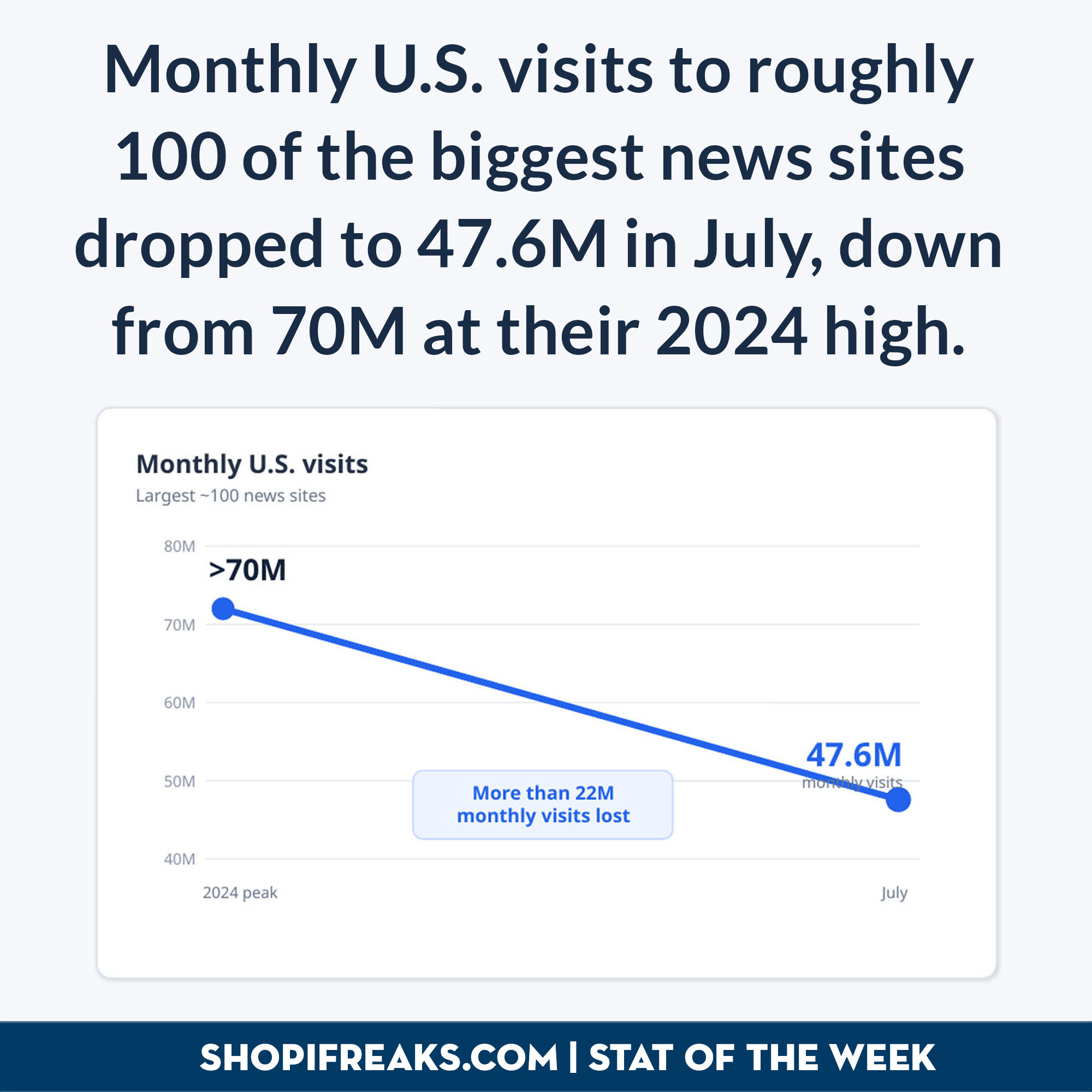
Monthly U.S. visits to roughly 100 of the biggest news sites dropped to 47.6M in July, down from more than 70M at their 2024 high, according to Similarweb data. Traffic topped out that year before Google’s AI Overviews and Meta’s wider rollout of its AI assistant started keeping readers off publisher pages, and direct visits to the sites have since dropped 25%. AI chatbots now send those same sites more than 150k referrals a month, up from almost none, but that doesn’t come close to covering the more than 22M monthly visits the sites have lost since 2024.
1. McDonald’s aims to be the Amazon of fast food with its new ad business
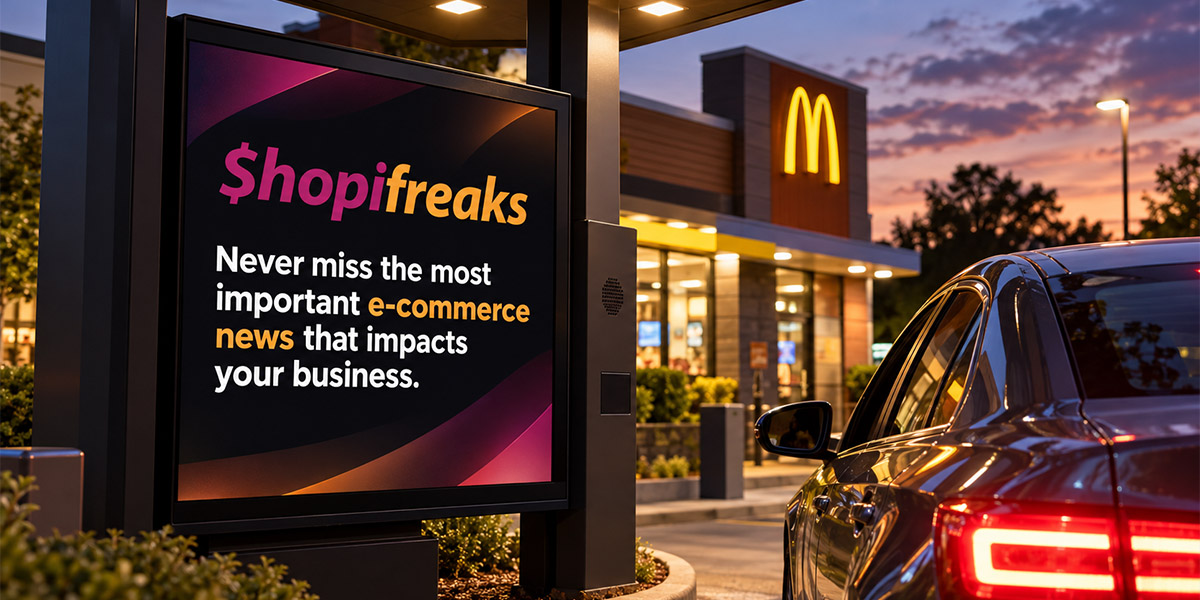
McDonald’s unveiled the McDonald’s Media Network at its investor day last week, a new division of the company that will sell ads from other brands across its app, self-order kiosks, menu boards, and drive-thru screens. It had been testing the concept since August at 450 company-owned restaurants in the US, which is just about 3% of its roughly 14,000 US locations, most of which are franchise-owned. McDonald’s plans to eventually roll out the ads to more stores, though it hasn’t indicated if or how it would split the revenue with franchise owners or if franchises will even be included.
So far, the ads just show up after you’ve ordered, while waiting for your food. (Uh oh, did McDonald’s just find an incentive to make the wait time longer? Future C-Suite Conversation: “If we slow the drive-thru by an average of 10 seconds, it’s almost undetectable to the customer, but adds thirty million additional ad slots each day!”)
Global CMO Morgan Flatley pitched it as “an opportunity to generate revenue for the system, with little in the way of additional costs, no operational complexity, and no disruption to our customer experience.”
It’s actually a great idea, and the move makes sense for McDonald’s, which has always positioned itself more as a real estate holdings company than a restaurant business. McDonald’s model is to own or control the land under its restaurants and collect rent from franchisees, a structure that offers operating margins in the mid-to-high 40s, which is unheard of for most restaurants.
Real estate and advertising go hand-in-hand. And just like real estate, ad businesses operate with incredibly high margins, especially in scenarios where they already own the slots where the ads sit. It wouldn’t surprise me if McDonald’s turned all of their outdoor signage into digital billboards under the golden arches at some point in the future, given their prime locations in most cities and towns.
The timing is good for the company too, as US traffic fell 4.5% last quarter, sales growth stalled out, and the stock just hit a 52-week low after CEO Chris Kempczinski told CNBC, “We’re not expecting things to change.” (Is that the same guy who couldn’t stand the taste of his own “product” in a viral video?)
CFO Ian Borden told CNBC:
“We have one of the most valuable brands of any company of our size and scale in any industry. We serve about 85% of the U.S. population at least once a year, so we have reach that’s quite unique, and we have 14,000 locations across the U.S., which means we’re in every community, and we’re connecting with every consumer.”
McDonald’s has an opportunity to make one of the most epic moves in history and use its advertising revenue to offset the rising cost of its food business, which has seen menu prices increase by 40% since 2019. They could take that ad revenue and use it to subsidize food prices, bringing the menu down to a level that no other fast food chain on the planet could compete with and win back their customers who would gladly watch some drive-thru and in-store ads in exchange for affordable combo meals.
They absolutely won’t do any of that though. Those ad dollars are going straight to the company’s bottom line, which is why it might be a good time to buy some MCD stock right now, as we’ve all seen what advertising does to a company’s profits. McDonald’s says it aims to build a $1B ad business “over time,” which would only account for about 4% of revenue, but would carry equally high or higher margins.
2. Citi is also launching an ad business based on your spending habits
Not to be outdone by the Hamburglar, guess who’s also entering the ad business?
Citi is creating a new unit called Citi Commerce Media that will let brands advertise to its 70M+ customers based on their spending histories, according to Business Insider. The ads will target users inside Citi’s mobile app and on its website, as well as on outside platforms like Facebook.
Citi says it can link its ads to measurable business impacts based on intel from 6.5B annual transactions across more than 700 spending categories.
Abhinav Anand, head of value cards, lending, and commerce at Citi, told Business Insider:
“We are focusing primarily based on your spending pattern, and that’s what the advertisers care the most about.”
Citi already ran a pilot with health and beauty brands that it says produced an average 15% lift in spending compared to people who weren’t shown ads. But at what cost?! The Business Insider article didn’t mention anything about ROAS, just revenue increase, which can be a bit deceiving.
Citi is not the first, nor will it be the last, bank or fintech to launch an ad network. Klarna has sold ads to merchants since 2020. JPMorgan Chase and PayPal both launched ads businesses in 2024, and Mastercard and American Express followed in 2025. Outside of financial institutions, tech companies like Uber, Lyft, DoorDash, Instacart, and Expedia have launched ad businesses in recent years, to name a few. Of course, there’s also OpenAI, the $1 trillion elephant in the room that launched an ads business earlier this year.
The space is getting crowded, but that’s a good thing.
I’m pro having more ad networks. There’s been a stronghold on the digital advertising market for more than two decades, dominated by a select few tech companies. Launching new advertising networks that leverage consumer transaction data can bring much needed competition to the space, offer affordable alternatives to legacy advertising networks, and ultimately bring down the cost of digital ads for brands.
3. Shopify and PayPal partner with Muse for almost-agentic commerce
Last Monday, I reported that Amazon blocked Meta’s new Muse agent from making purchases on Amazon.com. Later that same day, Shopify stepped in to fill the void. The next day, PayPal joined the party.
Shopify CEO Tobias Lütke posted on X:
“We are excited to announce we are partnering deeply with Muse to enable agentic checkout with Shop Pay on all Shopify stores, offering people an easy and delightful way to shop and check out with Muse.”
Muse locates products through Shopify Catalog and runs the order over the Universal Commerce Protocol, with payments running through Shop Pay, which already holds a buyer’s shipping and billing details. The transactions aren’t fully agentic, or even one-tap, yet. Muse simply finds the products, loads them into a cart, and then shoppers get handed to an in-app browser to finish the transaction. Similar to how Muse works with Link by Stripe, its first payments partner that Muse launched with, each purchase draws a credential good for just that transaction, so the card number never reaches Muse.
As for PayPal… pretty much the same setup as Shopify.
The big perk of PayPal though is that it reaches a much wider network of businesses. Shop Pay almost exclusively touches retail e-commerce, while PayPal works across travel, hospitality, SaaS, and other categories that Muse can assist users in.
So, all good, right? Maybe…
Heather Hershey, a Senior Research Director at IDC, outlined several big problems that Muse and other AI agents bring to commerce, including the big one — chargeback and return liability stays with the merchant. If Muse purchases a product that a user didn’t actually want, the cost of returns or disputes lands on the merchant. And as merchants, we all know how fast consumers are to jump to a chargeback before you’ve even had time to respond to their e-mail.
This is likely one reason why Muse is only “pseudo-agentic” to start. Meaning, human intervention is still required for the final purchase. Without that final approval, I can’t imagine what Muse would be buying!
4. Amazon wants to be the hub of your entire e-commerce business
Amazon began rolling out free multichannel selling tools to US sellers that let them connect accounts on eBay, Shopify, TikTok, and Walmart and run those channels from the same Seller Central workspace as their Amazon store.
A seller can edit a product description once and have it reformatted for every channel carrying the item, as well as send a Shopify or Walmart order to Amazon’s Multichannel Fulfillment with tracking passed back to the original platform. A profit dashboard combines each linked account’s sales, ad spend, and traffic, replacing the need for manual spreadsheets or third-party data consolidation tools.
Does that mean Amazon is getting all of my sales data from other channels?
Yes and no. Amazon admits that linking a channel provides it with that channel’s sales data, but said that it won’t share the information with other sellers or use it to inform its retail business. Though I do find it interesting that Amazon specifically wrote “retail business” in its announcement without mentioning its “ads business.” Accidental oversight or strategic omission?
As much crap as I give Amazon, they truly are a brilliant company. Rather than being on the receiving end of product data management and synchronization, Amazon has positioned itself to be the master copy. For retailers that primarily focus on Amazon and only dabble in other channels, it’s a no brainer to manage orders across all channels and update all their product listings at once through a dashboard that they already live and breathe on the daily.
I like the way Ben Donovan at Marketplace Pulse put it:
“Amazon is betting that owning the hub matters more than how a seller’s revenue splits across the spokes, and its sellers’ behavior supports the bet. Amazon says more than 95% of its sellers sell on multiple channels, but selling on several channels rarely means being diversified. According to Marketplace Pulse’s 2026 Seller Index, 71% of Amazon-primary sellers active on at least one other marketplace still earn three-quarters or more of their marketplace revenue from Amazon.”
I’ll also add that becoming the hub for all of a merchant’s channels creates a big opportunity for one-click onboarding of merchants into Amazon’s ad network. “This SKU is moving slower than usual. Try boosting it with Amazon Ads.”
In other Amazon Seller news this week… Amazon launched a Selling Partner plugin that brings Seller Assistant, its AI agent for sellers, into Amazon Quick and into Anthropic’s Claude as a beta, so US sellers can review and act on their listings, inventory, and sales data from those tools. Seller Assistant itself now remembers each seller’s pricing habits, stock cycles, and goals across all three tools, and it gained workflows that watch for things like inventory falling low or a competitor dropping its price. Amazon says 90% of its sellers already use outside AI tools and that it wants to make it easy for them to use their tools of choice.
5. Best Buy to launch a storefront on TikTok Shop in October
Best Buy is launching a TikTok Shop storefront in late October with close to 10,000 products, including headphones, cameras, laptops, and small appliances from major brands. The storefront will allow shoppers to buy products from Best Buy without leaving TikTok, just in time for the holiday season.
Best Buy will fulfill the orders themselves, same as they do with non-marketplace items sold on their own website, and shoppers will be able to return eligible purchases directly at a Best Buy store or by mail — a great perk that separates the retailer from most other brands that sell on TikTok Shop.
Jonathan Greer, VP of e-commerce at Best Buy, said:
“Social media isn’t just influencing what people buy anymore. It’s shaping how they discover products, with creators playing an increasingly important role in what people notice, consider and want to try. Launching on TikTok Shop lets us meet customers at that exact moment of discovery and make it easy to shop.”
The partnership also unlocks new ways for brands to work with TikTok creators. Brands that advertise through Best Buy Ads will be able to run creator videos as paid campaigns with shoppable links, then measure which creators and products drove sales using Best Buy’s own shopper data.
A marketplace joining a marketplace? Am I in bizarro land?
As you know, Best Buy launched its own third-party marketplace last year, yet now they’ll be selling through another marketplace. And they’re not alone in doing so. Ulta, which launched its UB Marketplace last October, started selling on TikTok Shop in March, and I’d imagine that there are more to come.
TikTok has created an environment that welcomes other retailers that operate marketplaces because it offers a social channel they otherwise wouldn’t reach. Meaning, it might not make sense for Best Buy to create a storefront on Amazon (although they have partnered on launches in the past) because both platforms are competing to be where shoppers begin their product searches. However, TikTok Shop is more discovery-focused, so it brings Best Buy new customers rather than competing for ones who were already shopping.
I’m going to guess that Best Buy’s next stop is going to be Whatnot, as their product catalog would be a perfect fit for live selling. Perhaps they’ll dabble with live selling on TikTok first before moving on to other platforms. We’ll find out soon.
6. YouTube becomes a product research tool with new AI features
Have you ever been watching a YouTube video and thought to yourself, “I really want to ask YouTube a shopping question”? Google is betting that you have and is ready to oblige.
YouTube is expanding Ask YouTube, its experimental AI search tool, into a product research tool that pulls information from videos and outside sources to build product comparison tables, with viewers able to continue asking questions from a video’s watch page. For example, if you search for information about the new iPhone Duo, Ask YouTube can show you how it stacks up against better foldable phones from rivals like Samsung and Google.
YouTube wrote in its announcement:
“When searching for reviews of a specific product, you may receive organized video recommendations, such as a comparison table that includes product attributes and categories based on your preferences. Once you click on a video that interests you most, you can continue asking more questions about the product directly on the video’s watch page.”
Is this the beginning of AI eating your video views, like it has your website traffic?
A YouTube spokesperson told CNET, “Our goal is to connect viewers with the right video faster. With Ask YouTube, we expect watch time to remain steady or improve.”
The spokesperson compared the tool to other AI features, such as chapters and AI summaries, which they said “showed no negative impact on watch time; instead, they helped retain viewers.” They added that videos included in the AI search’s answers will “prominently display the video title and channel name.”
YouTube says more than 140M people used Ask YouTube in June alone, which either indicates that the tool is really good, or that people’s attention spans are shrinking to the point that they don’t even want to watch full videos anymore.
7. Temu stops pushing products through its fake creator network after the Fortune report
Earlier this month, I reported that Temu appeared to be pushing products on Facebook and Instagram through fake creator accounts. Fortune shared the story of Ya Lili, a creator account with 183k Instagram followers and 129k Facebook followers whose content ran in over 100k Temu ad campaigns throughout the 16 months ending in April 2026, which is about 225 campaigns per day. Temu spent as much as $962M on ads like these across all of its “creators” during the same time period in the UK and Europe, according to Online Risk Labs research.
Well, now Fortune reports that Temu has mostly stopped the practice. It originally broke the story on August 31 and said that Temu was running 4,900 separate partnership campaigns a day at the time. However, by September 4, Ya Lili only had five ads appearing on Meta platforms, likely as remnants from previously scheduled ad buys, and the account, which previously posted multiple times per day, had stopped posting entirely on September 7.
ORL manager Vendula Prokůpková told Fortune:
“When you look at their Instagram accounts, you can see that they have not published any new posts/reels since two weeks or so. These are predominantly the accounts based in Russia, with some also based in the United States or China. We also noticed that most of the Instagram accounts of these ‘creators’ no longer display information about the country the account is based in.”
Fortune also reports that Temu maintained its ad budget for “legitimate creators,” but that ads in Ireland, Cyprus, Austria, Denmark, Latvia, and Slovenia ceased almost entirely, according to ORL, which might have to do with laws in those countries against misleading advertising.
Earlier this month I wrote:
“What exactly does ‘fake’ mean anymore? Is Wirecutter ‘fake’ because it’s a team of professionals putting out their product videos instead of just one solo creator? Is MrBeast involved in fraudulent activity for naming his channel after himself and not his entire production crew? Perhaps it’s fair that Temu could be more transparent about their creator accounts, if they’re the ones behind them, but that alone doesn’t necessarily mean they’re doing anything illegal or breaking any platform rules.”
I still have those same questions. What exactly is the problem with a retailer building non-branded channels to promote its own goods? I can name countless other retailers and companies that do the same. I recently discovered an AI company operating 20+ LinkedIn pages about e-commerce, AI, automation, Shopify, etc, and liking / reposting their own posts across each page. Is it illegal? Doubtful, but laws do vary from place to place.
It’s possible that Temu simply stopped the practice because it was exposed, and not because it was doing anything illegal, but the company has yet to comment on the story.
8. Meta faces over $200B in penalties in New Mexico
Meta could owe more than $200B in penalties after a New Mexico jury found Facebook committed more than 43M violations of the state’s consumer protection law by misleading users about how it protected their data after the Cambridge Analytica breach. Though if history teaches us anything, it’ll probably end up with a slap on the wrist and pay a fraction of that amount.
Quick Backstory: New Mexico sued Facebook back in 2021, after a personality quiz app harvested data from about 87M Facebook profiles and passed it to Cambridge Analytica. The state accused Facebook of misleading users about how much control they had over their data, and about how seriously it investigated the third-party app developers who were scraping it. The suit also claimed Facebook made false statements about fighting hate speech and misinformation on its platform.
Flash forward to last week: The jury sided with the state on 26 of the 29 statements it challenged, agreeing that Facebook misled people about how much control they had over their data and about its investigations into data-harvesting app developers. However, it rejected the state’s claims about how Facebook removed harmful content. New Mexico is seeking the $5,000 maximum for each violation, and the judge will set penalties at an October 1 hearing.
This is New Mexico’s second big win against Meta this year. The state stayed out of the August settlement between Meta and 47 states over allegations that it built Instagram and Facebook to hook kids, because it had already taken Meta to trial over child safety on its own and won.
New Mexico Attorney General Raúl Torrez said he hopes the message is “unmistakable for Mr. Zuckerberg, Meta and well beyond that: Anyone in big tech who thinks that they can mislead and misrepresent the way in which they do business in the State of New Mexico will not be tolerated.” He added that any penalty would go into a special fund for New Mexico schools and students.
Meta, of course, disagrees with the verdict and said it will continue to defend itself “against efforts to distort our record,” which likely means it plans to appeal.
9. Other e-commerce news of interest
ChatGPT can set a cookie called __obi that stays in a browser for up to a year and can send conversion and page data back to OpenAI when the user visits sites running its ad pixel, according to independent researcher Buchodi. The researcher didn’t directly observe OpenAI linking that off-site activity to specific ChatGPT accounts, as that would happen on OpenAI’s servers, but the setup would allow for it since it works the way a standard third-party ad cookie does. OpenAI classifies __obi as an analytics cookie, which means it could still be set for users who allowed analytics cookies but turned down marketing ones, despite collecting and sending ad conversion data. OpenAI told Buchodi it would pass the findings along internally but hasn’t explained publicly why the cookie is labeled analytics.
Meta unveiled new consumer hardware at its Connect event, including a VR device and a handheld gadget. Its VR Glasses are the company’s first new VR device since the Quest 3S in 2024 and are priced at $1,299 with shipping set for spring 2027. Notably, the glasses are super lightweight, weighing about a fifth as much as the Quest 3, because the Qualcomm chip, battery, and storage sit in a separate puck that clips to a pocket and connects to the glasses via a cable. Meta’s palm-sized handheld device, called the Muse Charm, is built around its Muse AI agent and puts an animated Muse character on a 2″ touch screen with front and rear cameras so the agent can see what’s around it. Charms can also detect and interact with one another, though Meta hasn’t said what they can actually do. My guess is some creepy, privacy-invasive shit. Meta hasn’t announced a price, but says the devices will go on sale in time for the holidays this December. Despite looking like an old school Tamagotchi device, Meta says that Charm is not a toy and isn’t marketed to kids.
The Pentagon can label Anthropic a supply chain risk, which prevents the US military and defense contractors from using its models, according to a 2-1 decision by a federal appeals court. The Pentagon applied the label in March after Anthropic refused to drop contract terms barring the military from using Claude for lethal autonomous warfare or domestic surveillance, and because the Pentagon relied on two separate legal designations, Anthropic had to fight them in two courts. A federal judge in San Francisco struck down one of them in August, but the DC Circuit has now upheld the other. The two judges in the majority said there was ample support for the Pentagon’s conclusion that Claude’s built-in restrictions, which had repeatedly blocked government users from completing requested tasks, posed a national security risk, while the dissenting judge argued the law targets suppliers that sabotage or secretly manipulate their products, not a company that openly enforces its own usage restrictions. Anthropic says it’s considering all options, including further review.
Amazon is still pursuing its goal of achieving net-zero carbon emissions by 2040, but doesn’t exactly know how it’s going to do so, according to its Chief Sustainability Officer Kara Hurst. Hurst said at an Axios event that “we are still striving towards that target,” but later added that she is “not going to sit here and say, ‘We know all the ways that we’re going to do this.'” Honestly, how could they, given how fast the world is changing? AI wasn’t even part of the conversation in 2019 when Amazon made the pledge, but now it’s undoubtedly causing emission growth at the company. Last year, carbon intensity rose YoY for the first time since Amazon began tracking the metric, erasing some of the progress it had made since 2022. Hurst said “we hold ourselves accountable” to the 2040 climate pledge and that the “commitment hasn’t changed,” but no one knows what that accountability actually looks like, as no consequence has ever been disclosed. Accountability could simply mean issuing a corporate apology in 2040 and moving the goalpost another decade.
Speaking of Amazon’s carbon emission goals… The company co-founded the Climate Pledge Fashion Coalition with Stella McCartney, a British luxury fashion house, and Canopy, a nonprofit dedicated to protecting the world’s forests, bringing in more than 60 brands, retailers, manufacturers and material makers. Members will pool their purchases of lower-carbon materials so fiber and fabric suppliers can count on steady, committed orders, which, in turn, will allow them to lower their prices. Members also get access to a library of more than 100 ways to cut emissions from fashion materials, with guidance for each type of fiber and a directory of companies making the alternatives. The goal of the coalition is to get those more sustainable materials priced at or below conventional fabrics, as fashion brands don’t want to pay a premium for lower-carbon materials, while the startups making them can’t cut prices without scale. I’ve been saying for years that someone should do this with plastic bottle alternatives, and I’d love it if Amazon spearheaded that next.
Gemini gave at least one answer that could cost a buyer money or land them the wrong product on 56% of 220 shopping questions on its free tier and 54% on its paid tier, the worst of four AI chatbots tested, according to a study by Product.ai. Claude’s paid tier did far better than its free tier, at 21% versus 44%, while Perplexity scored best out of all four chatbots on both tiers at 15% free and 14% paid. ChatGPT landed somewhere in the middle, at 19% free and 17% paid. Product.ai asked every chatbot each question five times, and Gemini contradicted its own earlier answer with no new information to justify the change on 29% of questions, more often than any rival. Most prices were accurate, with 85% of verifiable answers matching the seller’s listed price exactly, but the wrong ones were rarely close, missing by a median of $300. Moral of the story: AI still kind of sucks at comparative shopping.
Shopify began rolling out a redesigned Admin to all merchants, with new colors, type, and icons on every page, and a more prominently positioned Sidekick. The store picker, search, and notifications have moved out of the top bar and into a side navigation that merchants can collapse when they want more room. Sidekick now opens as a small chat window floating at the foot of each page and expands into a side panel for longer tasks, because Shopify says merchants increasingly use the assistant as their main way of working, with daily Sidekick sessions up 4.8x from 2025 to 2026. Admin UI extensions pick up the new styles automatically, but custom App Home interfaces built without Polaris web components stay on the old look until their developers migrate. Small request while you’re at it, Shopify… Can you make my selected date range stick when I switch between reports? I’m tired of resetting it every single time.
eBay is expanding Ship with eBay, its managed shipping program, to more US sellers with personal accounts in categories like Collectibles, Fashion, Electronics, and Home & Garden. Instead of sellers picking a carrier and setting their own shipping charge, eBay gives the buyer an option between standard and expedited shipping at checkout, and then delivers a prepaid USPS or FedEx label to the seller. Eligible listings must have a Buy It Now price of $200 or less, weigh less than 70 pounds, measure in at less than 130 inches combined length and girth, and both the buyer and seller must be located in the US. The weird part, as noted by Liz Morton of Value Added Resource, is that eBay collects the shipping fees and pays the carrier directly, yet it still charges sellers a Final Value Fee on the amount, which can range from 13% to 15% in most categories, even though that money never reached them. It sounds like eBay is being a greedy little pig when it comes to shipping.
Shopify released Shopcast, an Apple TV app that turns a television into a store dashboard for an office or warehouse. (No thanks, we prefer to stream episodes of The Office on our shop floor.) Merchants can use the remote to move through five views reporting sales, orders, units sold, and average order value, with retail and geography views that show the busiest store locations, compares online sales with Shopify POS, and plots incoming orders on a globe. Merchants running several stores can switch between them, with each shop’s data kept separate. The app itself is read-only, with totals refreshing through the day rather than streaming, and currently doesn’t offer any administrative capabilities, such as the ability to fulfill orders or edit products and pages. It’s a shame that the app doesn’t announce new orders in real-time as they come in with a loud cowbell ring or other customizable sound. It’s a missed opportunity to make the app something that merchants are glued to all day, celebrating as new sales come in.
Google introduced Live Avatar, a feature that creates an AI persona that can dynamically listen, see, and speak, complete with facial expressions. The tool is being positioned as something brands can use to create conversational experiences with customers that provide information to make better purchase decisions. For example, a skincare brand could put an avatar on its website that looks at a shopper through their webcam, asks about their skin type and concerns, and recommends products face to face, like a virtual beauty advisor. The avatar can also pull up product details, inventory, and company information in the background while it talks without skipping a beat, so the customer never has to wait for an answer, unlike those annoying AI customer service chatbots that make you wait while they pretend to type. Live Avatar is currently only available to Gemini Enterprise customers.
Meta and YouTube agreed to accept advertising for director Alex Gibney’s upcoming documentary about Elon Musk after reportedly rejecting it as political content, with Meta calling it an error and YouTube saying its system had temporarily restricted the ad. X, on the other hand, unapologetically rejected the ads and couldn’t give two fucks about making excuses, with Musk himself posting that “Dogshit is worth more respect than Gibney.” TikTok also rejected the ads and hasn’t budged. The four-hour documentary touches on Musk’s tech career, his political alliance with President Trump, and his personal life, including interviews with two of his baby mamas. “Musk” premiered at the Venice International Film Festival earlier this month and is set for theatrical release in the US on October 9.
Google is testing a Buy button on some Flipkart product listings in Gemini and AI Mode in India that takes shoppers directly to a Flipkart checkout flow without leaving the AI interface, according to TechCrunch. The checkout is Flipkart-branded rather than Google-hosted, and TechCrunch says it isn’t clear what technology powers the experience, though I’m assuming it runs on Google’s Universal Commerce Protocol. Only a small group of users can see it, and only on a limited set of phones, electronics, and accessories, but Google said it plans a wider rollout later in October, before India’s festive sales season. Google acquired a minority stake in Flipkart for $350M in 2024, and earlier this month, Google said Flipkart, which is majority-owned by Walmart, was among the merchants partnering with it to bring agentic shopping experiences to consumers in India.
Amazon is investing another $1.9B into its Delivery Service Partner program next year, aiming to lift average driver pay nationwide by $1 to nearly $24/hour. Wait, I thought DSP drivers worked for independent contractors and that Amazon had nothing to do with setting wages? So technically, the DSP owners can just keep the increased rates they receive, and Amazon can’t do anything about it, right? Amazon also announced at its annual Ignite Live conference that it’s adding surround-view cameras to its Rivian vans that warn drivers about cars, cyclists and pedestrians, with plans to have them in half of its fleet by year-end. The company also expects more than 20,000 pairs of its Smart Delivery Glasses, which show drivers real-time navigation and delivery details in their line of sight, in use by the end of 2027. The announcements about driver pay arrive weeks after New Jersey’s attorney general sued Amazon, arguing it is a monopsonist that sets pay and conditions for drivers it classifies as independent, while preventing them from unionizing and barring contractors from hiring one another’s drivers.
Square launched an integration with Apple Business that lets sellers manage how their physical locations appear on Apple Maps, Siri AI, Apple Wallet, and other Apple apps from the Square Dashboard. Hours, addresses, and phone numbers that sellers update in Square now carry over automatically to each connected location’s Apple Maps place card, and they can add buttons like Order, Delivery, or Book that link to their Square commerce pages. The integration is available in eight countries, including the US, UK, Japan, and Australia, and sellers in the US and Canada who aren’t on Apple Business yet can enroll from Square. The move follows Square’s recent integrations with ChatGPT and Claude, which also position Square as the hub of a seller’s online presence.
In lawsuits this week…
- OpenAI is facing a proposed class action from two California ChatGPT users who allege that OpenAI presented the chatbot as a private exchange and never clearly disclosed that outside contractors would read and score real user conversations. The suit says that OpenAI’s automated filter misses personal details in chats about health, money, and legal problems, which the contractors are able to see in violation of multiple California consumer protection and privacy laws.
- Depop has been sued again over its buyer-paid Marketplace Fee, this time by a shopper who says a $20.70 fee on a $400 purchase didn’t appear until the last screen before he paid. The complaint calls it “drip pricing” and claims that it stops buyers from comparing prices with rivals, while noting that eBay, which bought Depop in July, already shows fee-inclusive prices upfront for a similar fee in the UK and Australia.
- X.com sued two men in London’s High Court, alleging they ran a network of Bitcoin accounts that posted duplicate crypto news and boosted each other with fake engagement to collect at least £207k (about $278k) in Creator Revenue Sharing payouts. X called the coordinated efforts “coordinated revenue sharing fraud” and wants the money back, plus at least £75k to cover the cost of its investigation. Personally, I think if X’s now-defunct creator revenue program was that easily exploitable, that’s on them, but that’s up to the courts to decide.
- YouTube CEO Neal Mohan said the company won’t join Meta’s multistate child safety settlement, which requires a two-hour daily limit and an overnight block for users under 18, arguing that it has spent years on teen safety and is a “very different platform” from Meta. California Attorney General Rob Bonta said he’s willing to take YouTube and TikTok to court if needed to get them on board with the deal.
- TikTok settled Alabama’s teen safety lawsuit for at least $100M without admitting wrongdoing, agreeing to cap teen use at two hours a day and block minors from the app between midnight and 6 a.m. The payout rises to as much as $300M if 40 more states sign similar deals. The Alabama deal is separate from Meta’s multistate settlement that YouTube refused to join, but it puts TikTok under nearly the same restrictions.
- TikTok agreed to pay a £12.7M fine from the UK’s Information Commissioner’s Office, dropping its three-year appeal of the regulator’s finding that it let as many as 1.75M British children under 13 use the app without parental consent. TikTok said it still disagrees with the ruling but paid because the fine covers 2018 to 2020, before it added many of its current youth safety policies.
- Apple asked the judge in its trade secrets suit against OpenAI and io to let its own forensic experts examine former employees’ devices and to force OpenAI to hand over hardware development records, which OpenAI called an attempt to “snoop on a competitor.” OpenAI wants a neutral expert to handle the device images instead, but Apple says that would leave it a step behind defense experts who have already been through the material.
In corporate shakeups this week…
- Automattic CEO Matt Mullenweg named a new board, including science-fiction author Hugh Howey and two co-founders of IRL, the defunct social app whose users turned out to be mostly bots, weeks after the previous board tried to put him on leave. Well, isn’t that just a ragtag group of people who will likely say “yes” to anything Matt wants? Yay!
- Shopify’s APAC and Japan managing director Shaun Broughton is leaving after eight years, less than a week after EMEA managing director Deann Evans announced her own departure.
- OpenAI hired Patreon co-founder Sam Yam, along with Patreon’s former heads of product and engineering, to lead a new Creator Product team, with a first look expected at OpenAI’s DevDay on Sept. 29.
- Amazon is recruiting former employees, including some it laid off, for AWS and AI roles after cutting more than 30,000 jobs over the past year, with one recruiter asking a former employee whether the five-day office mandate had pushed them out.
- OpenAI contractors hired to grade ChatGPT’s answers are getting fired for using AI to do the work, and reviewers are told to flag telltale signs like repeated words, heavy em dash use, and work finished suspiciously fast. Meanwhile, one contractor told 404 Media that even though they don’t use AI, they deliberately pick the worst responses to sabotage the models. Now that’s funny!
Amazon added Affirm as a payment option on Amazon.co.uk, letting approved UK shoppers pay for orders of £50 or more in three monthly installments at 0% interest or finance them over as long as 48 months at a fixed 22% representative APR. Neither plan charges late fees or penalties for paying early, and purchases above £100 also get Section 75 protection under the Consumer Credit Act. Affirm is rolling out to eligible Amazon shoppers over the coming weeks and covers most categories, though gift cards, groceries, and digital content such as Kindle books are excluded. Affirm has powered Amazon’s installment plans in the US since 2021, and the UK launch follows its Costco deal in the country earlier this month.
Google was fined €403M (about $462M) by Ireland’s Data Protection Commission, which ruled that the way it processed location data between May 2018 and February 2020 was not lawful, fair or transparent enough under GDPR. The regulator said people using Web & App Activity, Location History and Location Accuracy may not have realized their whereabouts could feed targeted advertising and guesses about their interests, and that Google held on to the data longer than it needed to. Google has six months to fix the practices, though it says the ruling covers policies it has already changed, pointing to controls it added from 2019. The move marks the DPC’s fourth-largest fine, behind the €1.2B it hit Meta with in 2023. Google may appeal parts of the ruling.
🏆 This week’s most ridiculous story… Meta has been secretly using human contractors in call centers to make phone calls for Muse users when the AI agent couldn’t handle the task, according to internal posts seen by Reuters. The company quietly turned on these “human agent calls” a couple of weeks ago for half its staff, after businesses kept hanging up on Muse once they realized an AI was calling. A Superintelligence Labs vice president said internal tests showed humans could complete 95% to 98% of calls, but she also conceded it had been “a miss” to begin testing without the right disclosures, adding that Meta had rolled the test back. Employees warned that sensitive details could leak to contractors, and one even found that a contractor made a racist reference on his call. Another employee wrote in an internal post, “It’s baffling to me why we think this feature is worth the risk. We are one bug away from unnecessary information being leaked to human callers.” It’s baffling to me too, my friend! However, I’ve stopped being shocked at every unscrupulous thing Meta does, because otherwise I’d be walking around with a permanent surprised Pikachu face my whole life. Meta said it will launch the feature only once it’s ready and properly disclosed.
10. Seed rounds, IPOs, & acquisitions
Numeral, a tax compliance platform for e-commerce and SaaS businesses, raised $100M in a Series C round led by Insight Partners, bringing its total amount raised to $157M. The round comes just one year after its $35M Series B, which it likely blew through on LinkedIn Ads. LOL, I get a lot of them. Numeral says the volume of transactions running through its tax engine grew 327% from the year earlier and that more than 3,500 businesses now use its platform, up from over 2,000 at the time of its Series B. It plans to use the money to build out its product for software makers, manufacturers, distributors, and wholesalers, whose transactions carry more complicated tax rules, as well as to expand abroad.
eMarketer, a market research firm that publishes data, forecasts, and analysis on digital advertising, media, and commerce, acquired the research business of RetailX, a UK retail events and intelligence company, for an undisclosed amount. eMarketer will now publish RetailX’s annual UK500 report, which ranks Britain’s 500 biggest e-commerce retailers, and its pan-European CustomerX Index, which launches in late September. It will also add its own research to both rankings, including data from its recently launched AI Visibility Index, which tracks how brands show up in LLM search, as well as launch US editions. RetailX’s events business will remain independent and will run a media partnership with eMarketer.
Snapdeal, an Indian e-commerce marketplace that sells low-priced, value-focused goods mainly to shoppers outside the country’s big cities, is going public as a marketplace for value fashion and lifestyle goods, rather than the all-category platform it once was. CEO Achint Setia said shoppers buying clothes don’t want them sitting alongside grocery and tools and that they’d rather have a curated experience. Parent company AceVector set the IPO price band at ₹30 to ₹32 a share (about $0.31 to $0.33), valuing the company at about ₹1,741 crore ($182M), and is raising ₹420 crore ($44M), which is far less than the ₹1,250 crore ($131M) it sought when it first filed to go public in 2021.
Paymob, a payments platform serving merchants in Egypt, the UAE, Saudi Arabia and Oman, raised $35M in a pre-Series C round co-led by Mubadala and the EBRD. The platform enables merchants to sign one contract and work off one API and dashboard covering more than 60 local payment methods, instead of the seven or eight card, BNPL and installment contracts merchants typically sign. Paymob says revenue across its four core markets tripled in 18 months while Gulf revenue grew sevenfold to nearly half the total, helped by roughly 20,000 merchants it added across its three Gulf markets after the UAE central bank granted it a payments license in January 2025.
Backcountry, an online marketplace specializing in outdoor recreation gear, clothing, and footwear, acquired the assets of Velofix, whose 96 certified technicians run mobile bike repair shops across the US and Canada, for an undisclosed amount. Backcountry plans to use Velofix to assemble and hand over bikes that customers order online, so buyers get a bike that’s built and tuned at their door instead of one that arrives in a box, though it hasn’t said when that will start. The deal is Backcountry’s second cycling acquisition in a year, following its purchase of Velotech, the parent of BikeTiresDirect, Western Bikeworks, and TriSports, in September 2025.
Baselayer, an identity verification and fraud prevention company that serves banks and fintechs, raised $35M in a Series A round led by M13, bringing its total amount raised to $40M. Alongside the funding round, Baselayer publicly launched its Agentic Identity Suite, which is built to tell financial institutions, payments companies, and card networks which agent they’re dealing with, who that agent represents, and whether the institution’s own agent can safely proceed with the transaction. No US law currently requires companies to verify an AI agent’s identity before it transacts, so for now Baselayer is selling to institutions that want to get ahead of the problem.
Confido, an AI platform that automates finance and trade spend management for consumer packaged goods brands, raised $55M in a Series B round led by Insight Partners, bringing its total amount raised to $77M. The company says it has grown 5x year over year since its Series A and now serves more than 250 brands, including Dude Wipes, Kettle & Fire, Unilever, and Mars, with more than $30B in planned retail sales running through the platform. Confido plans to use the funds to move into food service and hire across engineering, product, marketing, and sales.
Searchable, a startup that tracks how brands turn up in AI-generated answers, acquired Meridian, a direct competitor that launched around the same time, for an undisclosed seven-figure sum. Meridian launched in October 2025, and Searchable opened for business a couple of months later, then raised a $14M seed round at an $85M valuation in May, money it has been spending on growth in the US market. Searchable is folding the technology into its own platform rather than running Meridian as a separate product, making it one of the first consolidation deals in an AI visibility market that barely existed a year ago.
ReturnPro, a Miami company that processes returns and resells the merchandise for retailers, acquired iF Returns, a Madrid returns platform working with more than 200 European brands, for undisclosed terms. iF’s software handles the front end of a return, steering shoppers toward an exchange or a new purchase instead of a refund through a funnel it says converts 30% to 40% of would-be refunds. ReturnPro plans to offer the software to its US customers, including sellers on Walmart Marketplace, and pair it with the processing and resale work it already handles once an item ships back.
Amazon is planning to invest more than $100M into building a robotics manufacturing plant in Greenwood, Indiana, bringing its total robot-making sites to four. Amazon says it has rolled out more than one million robots in the past decade that now play a part in 75% of its orders, and that the robots have created skilled jobs and cut the rate of recordable injuries by more than 40%. The plant should open by 2028 with 300 manufacturing and engineering jobs paying close to $100k on average.
Anthropic wants shareholders to sign off on a special share class that would hand CEO Dario Amodei and the other six co-founders 50.1% of the vote as a group on most corporate matters once it goes public, according to The Information. Keep in mind that the Anthropic Seven will only collectively own less than 14% of the company after the IPO, yet they want a controlling vote on most matters, as well as an extra seat on the board. Dual-class setups like this are common in big tech, where Mark Zuckerberg controls a majority of Meta’s votes, Google’s founders still control Alphabet through supervoting shares, and Snap sold public investors shares with no votes at all. The shareholder vote is expected within days, and personally, I hope they vote against the idea. If Anthropic’s founders want full control, they can stay private.
Amazon plans to invest $3B in its Amazon Now quick-commerce business in India by 2030, with the first $1B coming by the end of 2027, according to Reuters. Most of the money will go to neighborhood warehouses, growing Amazon Now’s network from about 750 sites today to roughly 1,300 by next April, and the rest will cover better inventory software, AI tools that predict demand, and a wider product range. Amazon Now will keep stocking mainly everyday essentials that customers reorder, as opposed to iPhones and other high-value purchases that some rivals carry. Amazon Now surpassed $1B in annualized gross sales over the past three months, but holds just 6.2% of India’s quick-commerce market, far behind Blinkit, Swiggy, and Zepto at a combined 77%.
Andreessen Horowitz is investing $35M into the Horowitz Andreessen Academy, an unaccredited two-year college alternative program in San Francisco for students 16 to 22, which has raised $42M in total. The school will run as its own business under Udemy co-founder Gagan Biyani, with 10 founding partners, including Anthropic, Google, Meta, Nvidia, and OpenAI, supplying software, compute, office space, and internships. Applications open this week for a founding class of about 50 students that starts a tuition-free one-year program in fall 2027, and the two-year version follows in 2028 if regulators sign off. Biyani says tuition will match elite private universities after that, as much as 80% of the program is project work rather than lectures, and instructors won’t need teaching credentials.
SoftBank sold $11.1B of junk bonds, made up of $10B in dollar notes across three maturities and €1B across two, to help fund a follow-on OpenAI investment closing next month, marking the largest high-yield corporate bond sale on record. The dollar notes yield 8.625% to 9.75%, compared with the 2.125% to 5.25% SoftBank paid in its June 2021 bond sale, which doesn’t speak well to its current economic outlook. Few single borrowers have ever sold anywhere near that much high-yield debt at once, but SoftBank has committed close to $65B to OpenAI and added nearly $21B of borrowing capacity this month alone, so it’s kind of running out of options. They really need this OpenAI IPO!
Squarespace is investing another €70M in Ireland, where it has run a Dublin office since 2013, as it looks to the country as a “strategic location” for growth. The commitment builds on a plan the company laid out in February 2025 to hire more than 120 people in Dublin by 2027, mostly engineers and product staff, which would take its Irish workforce past 400. Squarespace plans to use the funds for research and development on AI-powered design tools and new commerce features, as well as its global expansion.
Thanks for being a Shopifreak!
If you found this newsletter valuable, please leave a review on Google and share the newsletter with your friends and colleagues to help us grow.
See you next Monday,
PAUL
Paul E. Drecksler
🌐 Shopifreaks.com
🧑💼 Add me on LinkedIn
📧 [email protected]
📱 +1-828-273-3031
⭐ Leave A Review
PS: How do you think the unthinkable? With an itheberg.