

Hi Shopifreaks
Before we begin, I’m excited to present to you my new video series: 90 Second Pitches! 🎉🥳
90 Second Pitches are a new way to discover innovative e-commerce technology before everyone else. Watch as founders present their startups in a 90 second video pitch, followed by a live interview where we do a product demo and dive deeper into the solution.
It’s kind of like a Shark Tank for software, except instead of asking for a financial investment from a shark, the founders are asking for consideration from YOU — the people who actually use these tools — to try their solutions.
The first pitch to kick off the series is from Carson and Bridger Hart, founders of Hoppn, the startup behind Infinite Color Search – which is a revolutionary way for shoppers to discover products by color. And I don’t use the word “revolutionary” lightly!
Infinite Color Search is one of the most brilliant search technologies I’ve ever seen. Once more people discover this technology, it’ll likely become the de facto way we search for products by color. (No more tiny color swatch squares that look nothing like the actual color you want to search for.)
Watch Carson and Bridger’s 90 Second Pitch below and then let them know in the comments if you’re going to add Infinite Color Search to your tech stack.
 Watch the 90 Second Pitch on LinkedIn | Watch The Full Interview on YouTube
If you’re interested in giving Infinite Color Search a test drive, Carson & Bridger are offering Shopifreaks readers a free white glove onboarding session, plus 50% reimbursement on your first two months. Start by installing the app for free and then book a getting started session with Bridger. Or simply e-mail [email protected] with the subject “SHOPIFREAKS” to claim your discount after installing the app.
Want to pitch your startup? Hit reply and show me what you’re working on! I’ve got a lot of great pitches coming your way soon, and I’d love to feature your e-commerce app or SaaS solution too. Hope you enjoy the new series!
And now onto your regularly scheduled programming.
In this week’s edition I cover:
- Lovable’s new Shopify integration
- OpenAI’s Atlas browser
- Amazon’s ‘Help Me Decide’ tool
- Exciting new Shopify features
- Amazon delivery partners giving up
- Smart glasses from Alibaba, Samsung, & Amazon
- BNPL news from Affirm and Splitit
- Amazon rejects robot claims
- Does ChatGPT traffic convert?
- BigCommerce & PayPal launch BigCommerce Payments
- A new Google Merchant Center for Agencies
All this and more in this week’s 249th Edition of Shopifreaks. Thanks for subscribing and sharing!
Stat of the Week
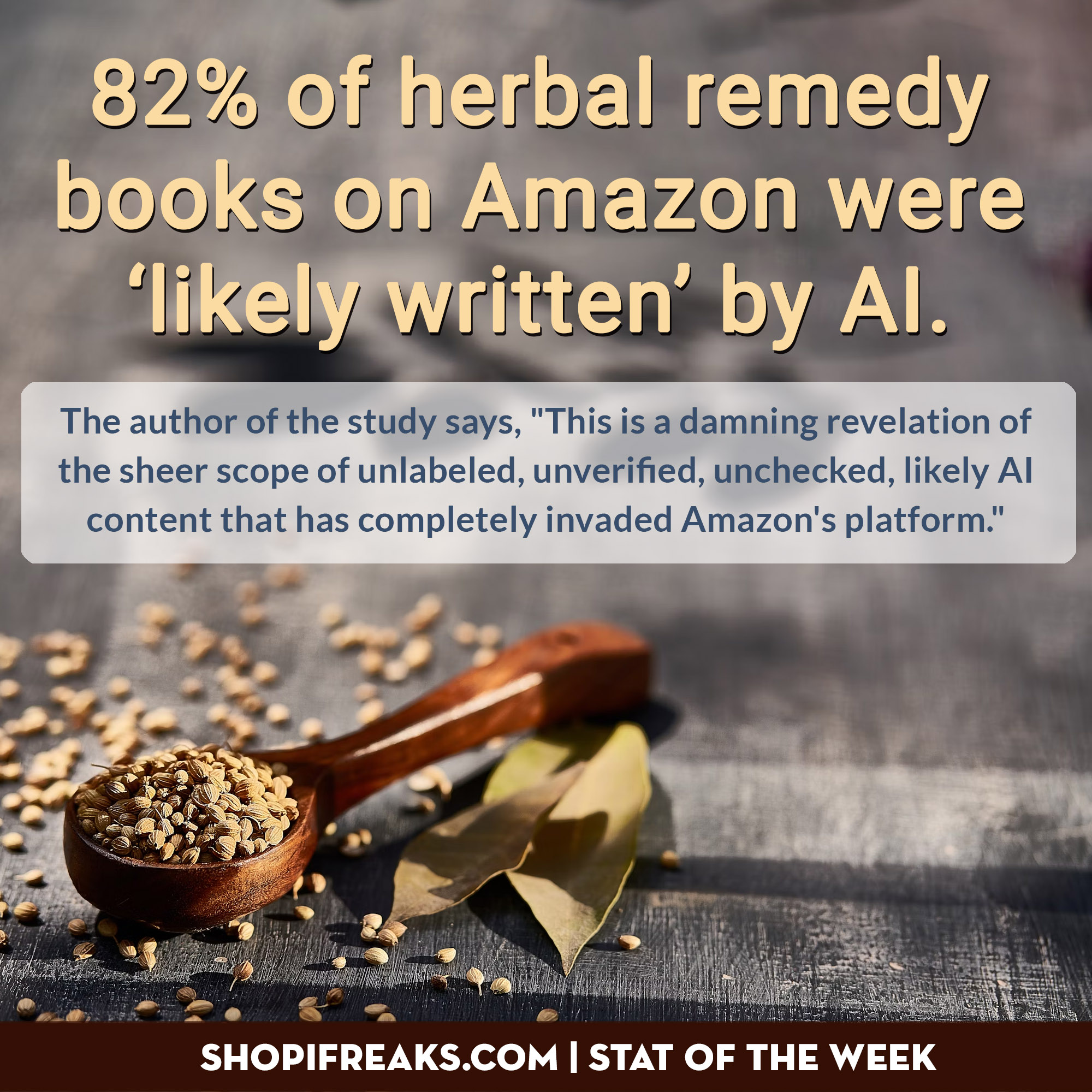
82% of herbal remedy books on Amazon were “likely written” by AI, according to a study by Originality.ai, which offers tools to universities and businesses to detect AI-generated content. The author of the study says, “This is a damning revelation of the sheer scope of unlabeled, unverified, unchecked, likely AI content that has completely invaded Amazon’s platform.” The books are part of a larger trend of unverified AI content being sold on Amazon.
1. Lovable launches a Shopify integration
Lovable launched a direct integration with Shopify that enables merchants to create and launch an e-commerce store on the platform without code. Since its public launch in November 2024, Lovable’s core offering has been an AI-powered app and website builder. It hasn’t positioned its product as a platform specifically for building or managing online stores, until now…
Here’s how the Shopify integration works:
- Tell Lovable what you want to build. You can give instructions like, “Create a Shopify store that sells novelty t-shirts aimed at e-commerce professionals.”
- Lovable instantly designs and builds your store, complete with product pages, checkout, and navigation.
- Once finished, Lovable will let you claim the store on Shopify, publish it, and start selling.
Lovable creates an entirely new theme that’s only editable from its platform (and not from the traditional Theme Customizer within your Shopify backend). It connects with Shopify via an app, which syncs product info and theme data between the two platforms for live updates.
Christopher Dodd, a freelance Shopify consultant, offers a great less than 2 minute video overview of the integration in action if you’d like to see an example of the creation of a new store.
Michael Klim, co-founder & CTO of commerce-ui, said:
“What is impressive, though, is how it shows Shopify’s MCP in action. After launching the store, I added products, built collections, and created discounts – all without opening the Shopify admin for a second. It’s still quite limited in terms of operations you can make (you’re not able to add a metafield to a product, for example), but nevertheless, it shows how platforms like Lovable can integrate deeply into Shopify.”
What Lovable does do is let you build a theme and create sample content using AI prompts. It’ll also let you manage your actual Shopify products (if you’ve got some) from its platform.
What Lovable doesn’t do (yet) is offer native support for advanced Shopify features like Metafields or liquid customizations required by third-party apps.
While the integration is cool — is it necessary? Who’s actually using it? And do I want to be locked into Lovable’s platform to edit my theme, as opposed to having the ability to leverage Shopify’s AI block builder and other apps that power theme sections and blocks? Not everyone is impressed.
Giovanni Pollarolo, a solution architect at Power2Cloud, said:
“After a few prompts, the AI started missing context. It misunderstood some requests and even deleted parts of the layout I liked most. Customization felt too limited.”
Honestly designing an e-commerce store doesn’t require too much heavy lifting now-a-days (and didn’t before Lovable). There are more than plenty of options for themes, section stores, third-party page builders, and AI design tools to create a nice looking store quickly.
The real challenge with running an e-commerce store is what comes next — after the store is built.
I’m personally not ready to lock myself into Lovable’s ecosystem to power my Shopify store design, especially given that similar features are likely right around the corner via Shopify’s own native AI tools.
What are your thoughts about Lovable’s integration with Shopify? Game changer or nothingburger? Hit reply and let me know.
2. OpenAI releases its AI browser Atlas
OpenAI released its long anticipated AI-powered browser called Atlas, positioning itself to compete directly against Google Chrome, Perplexity Comet, Microsoft Edge, and other AI-infused browsers. Atlas allows ChatGPT to see and analyze what’s on your screen, while an “agent mode” can navigate the web and perform certain tasks for you.
Atlas is built using Chromium, an open-source browser project managed by Google that provides the codebase for Chrome, Opera, and other browsers, and is currently only available for MacOS — a slap in the face to Microsoft, one of OpenAI’s biggest investors and supporters, if you ask me!
OpenAI CEO Sam Altman called the launch a “rare, once-a-decade opportunity to rethink what a browser can be about and how to use one.”
Here’s what Atlas offers:
- ChatGPT sidebar on any page – Summarize long articles, compare products, or extract key points from any webpage without leaving the tab. For example, you can highlight a review roundup and ask Atlas to produce a pros and cons list.
- Ask or Search from the Same Bar – Enter a question or URL in the main input area to get both AI-generated and traditional search results including text, images, videos, news. Atlas doesn’t have a traditional address bar; everything is powered by the ChatGPT-looking input field.
- Agent Mode for task completion – For premium users, Atlas can interact with websites on your behalf — opening tabs, clicking buttons, filling forms, and completing workflows. It can also carry out multi-step tasks like itinerary planning or shopping comparisons. For example, you can ask Atlas to “find my recipe ingredients, add them to Instacart, and place the order.”
- Agent User Control and Safety Prompts – Atlas pauses and requests confirmation before acting on sensitive sites (like financial or medical pages).
- Browser Memories – Atlas can remember context from sites you visit and recall them later. For example, you can ask Atlas to “summarize the apartments I looked at last week.” OpenAI says you have “full memory control” and can view, archive, or delete the browser memories or clear your history anytime.
- Site-by-Site Visibility Toggle – You can choose whether ChatGPT can “see” the current page. When visibility is off, it can’t read or create memories from that site. Kind of like an Incognito mode for when you’re viewing your digital dirty magazines.
- Smart Suggestions – Based on your past browsing, Atlas surfaces next steps such as returning to pages, continuing a search, or finishing tasks.
- Interactive Cursor Tools – Highlight text in emails, docs, or web pages to rewrite, summarize, or clarify with ChatGPT in one click.
- Privacy & Control – OpenAI says that the web content you browse is not used to train OpenAI models unless you explicitly opt-in.
- Parent Controls – Parents can disable Agent Mode or browser memories for child accounts. What parents are letting their kids use Atlas yet?
- Also Basic Browser Features – Supports tabs, bookmarks, autocomplete, saved passwords, history import, and dark mode. Or is Chromium doing all the heavy lifting for that stuff?
What are people saying about Atlas?
- Wired called the Ask ChatGPT sidebar “moderately helpful at best,” and at times “confusingly wrong.”
- The Washington Post warned that users should be mindful of how ChatGPT can store “memories” of online activity.
- TechRadar brought attention to expert warnings about indirect prompt injection risks, advising users to be careful about confirming sensitive actions.
- Tom’s Guide praised Atlas for novel features like its unobtrusive sidebar, full-side scrollable tabs, and prominent display of URL, but noted missing Chrome features such as the ability to seamlessly switch between Google accounts.
- BBC commented that although the browser is free, it will “only work to its full capacity if you pay a subscription fee.” So more like freemium.
- Tech writer Anil Dash criticized Atlas for not actually taking visitors to the real web at times, but instead displaying results that look “closer to a last-minute book report written by a kid who had mostly plagiarized Wikipedia.” He also says that while OpenAI describes the browser as being your agent, in reality “you are the agent for ChatGPT.” He says that by giving Atlas permission to look over your shoulder, “OpenAI can suddenly access all kinds of things on the internet that they could never get to on their own.”
Most importantly, what do you think about Atlas? What’s it great at? What does it underperform at? Hit reply and share your thoughts, which I’m curious to hear, because as a Windows user, I’ve not gotten access yet to Atlas!
3. Amazon releases new AI tool to help you decide what to buy
Amazon launched a new AI-powered tool designed to help you choose which product to buy. Now, when looking at multiple similar items on Amazon’s website or app, it may display a “Help Me Decide” button that picks one for you based on your browsing activity, searches, shopping history, and preferences.
So it’s sort of like an Amazon “I’m Feeling Lucky” button? Amazon says:
“For example, if you’re looking for a new camping tent, Help Me Decide will analyze the tents you’ve already viewed along with other details from your shopping history. If you’ve recently browsed for adult and kids’ sleeping bags that stay warm at cold temperatures, looked at large stoves for car camping, and purchased hiking boots for your children, Help Me Decide may recommend an all-season, four-person tent that’s warm and spacious enough for your whole family’s upcoming adventure.”
Here’s how it works:
- A “Help Me Decide” button appears on product detail pages after viewing several items. You can also find Help Me Decide by tapping “Keep shopping for” at the top of the homepage.
- Tapping the button displays a single product recommendation based on your shopping history and preferences, alongside a clear explanation of why it’s a great choice for you including highlighted features, insights from customer reviews, and how it aligns with your previous purchases and preferences.
- If you want to see more options, you can choose to explore an upgraded recommendation or a budget option.
Help Me Decide feels like a much more organic way to integrate AI recommendations into Amazon’s shopping experience than pushing everyone towards a chatbot, as it seamlessly integrates with your existing shopping flow.
Now get ready for Amazon agencies across the globe to launch their “Help Me Decide Optimization Services – ensuring that you win that reco every time!”
Also, how long before Amazon monetizes this feature with sponsored recommendations?
4. Shopify releases new features for D2C, B2B, and developers
This past week felt like a Mini Shopify Editions with the company releasing several long requested features! Here’s what’s new:
1) Unlisted Products – Shopify enabled a new product status called “Unlisted” alongside its existing “Active, Draft, and Archived” statuses. Unlisted hides the product from on-site collections and search, 3rd party search engines like Google, and all other channels except for the Online Store, which means the product can still be accessed by directly visiting its URL. This allows merchants to drive traffic to “hidden” products via e-mail marketing and social media, without having the product listing visible to their general audience. It could also be used for selling warranties or other product add-ons that don’t need to show up elsewhere.
2) ACH bank payments for B2B – Shopify Payments now allows U.S. businesses to accept ACH bank payments for B2B orders, making it possible for wholesale buyers to pay straight from their bank accounts at checkout. Customers can optionally save their payment details for future orders, allowing you to charge their accounts directly from the admin as payments become due, eliminating manual payment matching. Kai Morton, a senior account executive at Shopify, said that the transaction fee is 1% capped at $7.50 for payments.
3) Increased Entry Limits – Shopify increased the entry limits for metafields and metaobjects from 64k for non-Plus stores and 128k for Plus stores to 1M entries for everyone, allowing merchants and developers more room to build complex, custom data structures. Each app also now gets its own allocation, with up to 128 metaobject definitions per app. The update supports larger catalogs, richer metadata, and more advanced multi-app workflows.
4) New Cross Border Sales Reporting – Shopify introduced two new analytics reports, Average Profit Margin by Market and Profit Margin by Order, to help merchants measure the profitability of cross-border sales. The first shows overall profit margins by market, including customer costs and fulfillment expenses, and the second provides a detailed breakdown at the order level. Merchants can access both reports in the Shopify admin under Analytics → Reporting by searching “Average profit margin by market.”
5) New Local Payment Methods – Lastly, Shopify added Pay by Link to Shopify POS, allowing in-store customers to pay using local methods like iDeal, Klarna, Swish, Twint, MobilePay, and USDC. Shoppers can now complete purchases securely on their own devices via QR code or link, reducing manual entry and expanding checkout flexibility. The feature requires Shopify POS version 10.13 and activation of the supported payment provider.
5. Amazon delivery contractors are quitting the business
Amazon delivery partners are quitting the business due to dwindling profits caused by rising costs for insurance and vehicle maintenance, coupled with Amazon’s increased performance demands, according to an investigation by Bloomberg’s Spencer Soper.
Bloomberg interviewed 23 delivery partners who operated in 11 states around the U.S. and discovered that five quit the program because they were making less money each year and several others were contemplating quitting, while only four owners said they were happy with the program and their income was growing.
Amazon launched its Delivery Service Partner program in 2018, claiming that a $10,000 investment up front could earn entrepreneurs as much as $300,000 a year in profit. However that didn’t prove to be the case for a lot of partners. Amazon recently announced a 20% hike to 12 cents for each package that partners deliver — the first increase since DSP’s launch — but many partners said the gesture was too little too late, while others “saw it as a carrot to keep them working through the holidays when Amazon needs them most” since the increase doesn’t take effect until January.
Bloomberg shared the story of an owner named Jake Clay who earned more than $200,000 his first year of running the business in 2022, but then saw his profits dwindle to nothing after one of his drivers was badly bitten by a dog and went on workers comp for a year, causing his insurances rates to quintuple to almost $500k annually. He contemplated laying off all his managers and running the business himself, but after determining that he would only clear about $75,00 in that scenario, he decided it wasn’t worth it and quit.
Clay was able to speak to Bloomberg openly about his scenario after rejecting an offer from Amazon to sign an exit contract that would have paid him $75,000, but ban him from speaking publicly about the program. (My price to stop speaking publicly about Amazon is $1M.)
In September, I reported that Amazon paused a controversial plan to redistribute its fleet of delivery vans after encountering widespread resistance from its delivery service partners, who lease the vans from a fleet manager selected by Amazon and are contractually obligated to pay for repairs before returning them to the company for redeployment (of which they have no option to say no).
Some delivery service providers said they were hit with surprise repair bills totaling tens of thousands of dollars that have been impacting their profitability, but that they have no ability to challenge them without risking that Amazon cancel their contracts. Several company owners have chosen to close down or declare bankruptcy because they couldn’t afford the repair costs.
Many Amazon delivery partners are finding themselves trapped in a business that has no exit.
Unlike other small business owners, they have no hard assets to sell given that they lease the vans and have no warehouse facilities, since the packages are stored in Amazon facilities. Selling the business isn’t really an option either because it’s tied to a one-year contract with Amazon, which can veto any prospective buyer.
Not a very sexy value proposition if you ask me.
6. Watch out Meta! Competition has arrived…
At some point in the near future you’ll have a big decision to make… Which smart glasses do you wear? Meta currently dominates the smart glasses space with around 73% market share, but competitors are coming for them in a big way.
Alibaba unveiled its first smart glasses, the Quark AI Glasses, in July, which are now officially on pre-sale. The AI-infused glasses are powered by the company’s Qwen large language model, which already has over 400M downloads. The glasses integrate with Alibaba’s ecosystem of services including navigation through Amap, payments through Alipay, price comparisons through Taobao, and travel bookings through Fliggy. It also supports calls, music streaming, and language translation.
While not exactly services that American or European users might be interested in integrating with, it’s very likely that Quark AI Glasses will integrate with Western services in the future too.
Samsung teased its upcoming smart glasses at its recent Galaxy XR event. The company is partnering with Warby Parker and Gentle Monster to design the glasses, powered by the Android XR operating system. Gentle Monster will offer a more fashion-forward option for users, while Warby Parker will cast a wider, mainstream net. (Meh, they’ll likely all look fairly similar.)
Amazon revealed its smart glasses for drivers, designed to help them “identify hazards, seamlessly navigate to customers’ doorsteps, and improve customer deliveries.” Instead of relying on an accompanying smartphone like Meta, Amazon’s glasses come with a vest that contains a battery and a camera trigger button. The glasses are designed specifically for delivery associates, helping them scan packages, follow turn-by-turn walking directions, and capture proof of delivery, all without using their phone.
Wouldn’t it be cool if Amazon’s future consumer version of these smart glasses came with vests that had batteries and a remote control attached too? Now that’s a “tech bro vest” that I would wear!
7. Read now, know later
Several big BNPL related stories this week, so I’m giving BNPL it’s own section. Here’s what’s new with in the buy now, pay later industry.
- Splitit teamed up with DXC Technology to enable banks to offer BNPL installment payments directly from customers’ existing bank accounts or debit cards, without new apps or loan approvals needed. The system runs on DXC’s Hogan core banking platform, which already supports over 300M bank accounts, allowing banks to quickly add installment options both online and in stores. The partnership helps banks compete with BNPL providers like Klarna, Afterpay, and Affirm.
- Mastercard expanded its Installments Payment Services to include Citi’s U.S. credit card portfolio, allowing millions of Citi cardholders to split purchases into fixed monthly payments directly at checkout through Citi Flex Pay. Citi is the first U.S. issuer to join Mastercard’s installment platform, which lets customers choose pay-over-time options online, in apps, or via digital wallets, without additional credit checks or applications. 74% of U.S. credit cardholders say they’d prefer cards offering installment options, as opposed to having to use a dedicated BNPL service.
- Affirm extended its existing relationship with Wayfair, integrating its BNPL option directly into the retailer’s checkout experience. The two companies have partnered since 2017, however previously, Affirm was one of several third-party financing options that shoppers could use through Affirm’s own checkout flow, often after being redirected or during certain high-ticket purchases. The new “expanded partnership” means Affirm is now natively integrated directly into Wayfair’s checkout across all its brands including Wayfair, Joss & Main, AllModern, Birch Lane, and Perigold, rather than being an optional, secondary financing path.
- Affirm also expanded its partnership with payment services provider Worldpay, which will integrate Affirm into its embedded payments offering for software platforms. Worldpay for Platforms provides embedded payments for more than 1,000 SaaS companies, and over the last 12 months has processed more than $400B in payment volume and 4.6 billion in transactions. Wow, big partnerships for Affirm! No wonder my stock is doing well.
- Lastly with Affirm news… the company says it wants the U.S. to find ways to cap late fees on pay-later loans. Affirm co-founder & CEO Max Levchin said in an interview with Financial Times that limits on fees for BNPL payments would let leaders focus on their underwriting models rather than banking on missed payments. He added that “Everyone in the industry who uses late fees is basically just covering up or the fact that they’re not very good at underwriting.” Shots fired!
8. Amazon denies that it plans to replace 600,000 workers with robots
Amazon rejected a New York Times report claiming that it plans to replace 600,000 warehouse jobs with robots, calling the story “wrong” and “incomplete.”
On Tuesday the NYT wrote:
“Amazon’s U.S. work force has more than tripled since 2018 to almost 1.2 million. But Amazon’s automation team expects the company can avoid hiring more than 160,000 people in the United States it would otherwise need by 2027. That would save about 30 cents on each item that Amazon picks, packs and delivers to customers. Executives told Amazon’s board last year that they hoped robotic automation would allow the company to continue to avoid adding to its U.S. work force in the coming years, even though they expect to sell twice as many products by 2033. That would translate to more than 600,000 people whom Amazon didn’t need to hire.”
The NYT report cited internal documents and Morgan Stanley estimates suggesting automation could save Amazon up to $4B annually by 2027.
Amazon opened its most advanced warehouse facility in Shreveport, LA last year to serve as a template for future robotic fulfillment centers, with plans to copy the design in about 40 facilities by the end of 2027. The facility currently has around 4,000 employees, but once the robotic systems are installed it is projected to process 10% more items daily with 1,200 fewer employees.
Amazon says its automation strategy complements, not replaces, human jobs.
The company said in a statement that the documents viewed by NYT were incomplete and did not represent the its overall hiring strategy, but rather, reflected the viewpoint of one group inside the company. They went on to note that Amazon plans to hire 250,000 people for the coming holiday season, but declined to say how many of those roles would be permanent.
Udit Madan, who leads worldwide operations for Amazon, said in an interview that Amazon has a long history of using the operational savings from automation to create new jobs, such as its recent push to open more delivery depots in rural areas. Okay, but what happens when there’s no more room to grow?
I personally believe that Amazon’s long-term strategy is to burn through human capital over the next decade until no one wants to work for them anymore, at which point it won’t matter, because robots will have taken over those jobs. “Employee satisfaction” and “retention” are temporary metrics at Amazon that won’t exist in ten years.
9. Other e-commerce news of interest
ChatGPT referral traffic converts “far worse” than traditional marketing channels like Google Search, email and affiliate links, according to a new study by researchers at the University of Hamburg and the Frankfurt School of Finance & Management, which analyzed 12 months of data from 973 e-commerce sites — although it didn’t specify an exact number. The study found that ChatGPT accounts for more than 90% of all e-commerce traffic originating from LLMs including Gemini and Perplexity, but that ChatGPT traffic is still 200 time smaller than Google’s organic search, representing less than 0.2% of total traffic across all stores studied. Affiliate links were 86% more likely to convert than ChatGPT referrals, while organic search outperformed ChatGPT by 13%.
BigCommerce announced BigCommerce Payments, an embedded payment solution powered by PayPal and built directly into the BigCommerce dashboard. The co-branded service, which is launching to U.S. merchants in 2026, will offer real-time balance insights, payouts, currency management, and PayPal’s Buy Now, Pay Later features within a unified “Money” dashboard. Merchants will retain a direct payment relationship with PayPal, while managing transactions and financial data from within BigCommerce’s control panel. The move expands on a decade-long partnership between the two companies and aims to reduce the need for merchants to switch between multiple systems to track financials. Should PayPal buy BigCommerce? Asking for a friend.
In other PayPal news… PayPal teamed up with Rokt to deliver AI-powered post-purchase advertisements across PayPal, Venmo, and Honey merchant confirmation pages. The integration uses Rokt’s machine learning technology to show personalized offers immediately after transactions, helping PayPal drive new revenue and engagement and enabling brands like Grubhub and Walmart to reach users when they’re most likely to buy. The program is currently live in the U.S., with plans for international expansion this summer.
Google launched Merchant Center for Agencies, a dedicated platform for agencies managing multiple Merchant Center accounts. The new system offers centralized management through four sections including All Client Accounts, Agency Overview, Diagnostics, and Optimizations, aimed at helping agencies save time, detect issues early, and improve collaboration. The new platform provides leadership oversight, proactive issue resolution, and clearer visibility into account performance, building on the former Multi-Client Account structure, but with clearer workflows tailored for agencies. Access can be requested through Google’s Contact Us form on the Merchant Center site.
Amazon introduced a new “Seller Challenge” feature for Account Health Assurance members, giving sellers three opportunities every 180 days to contest enforcement actions such as listing removals. Successful challenges reverse decisions instantly, while failed ones reset after six months. Industry consultants say the feature could improve fairness for sellers, but warn it will only be meaningful if Amazon provides clear explanations for denied appeals, which is something previous systems have failed to deliver.
TikTok Shop is urging sellers to adopt its new automated ad-buying tool, GMV Max, which promotes creator-made videos that link exclusively to TikTok Shop, and requiring merchants who want to join upcoming fall promotions to now use the tool. While TikTok has never allowed ads that drive traffic to external websites, merchants could previously run their own ads on TikTok, but now, if they want to participate in these promotions, they must advertise exclusively through GMV Max. The new policy has angered sellers who prefer directing traffic to their own sites, since TikTok Shop withholds customer data like email addresses. Brands also report that GMV Max reduces control, automatically increases budgets, and slows performance by prioritizing a limited pool of creator videos that take weeks to optimize.
Amazon is extending its Community Delivery program, an initiative that quietly launched during the pandemic and uses the company’s logistics network and Flex drivers to deliver food from local food banks directly to people in need. Since launch, the initiative has provided groceries for 60M meals across more than 40 food banks and will now continue through 2028. The program helps address transportation barriers for families, seniors, and people with disabilities, leveraging Amazon’s delivery infrastructure to support food security amid rising costs and cuts to federal nutrition programs. It isn’t a separate philanthropic arm of the company, but part of Amazon’s ongoing strategy to find ways to benefit communities by using its existing infrastructure and technology. I never knew this existed! Props to Amazon!
Amazon relaunched its Luna cloud gaming service less than a month after retiring Prime Gaming, introducing a new GameNight category centered on social, mobile-controlled multiplayer titles. Prime members can now play over 25 party-style games, including the exclusive “Courtroom Chaos: Starring Snoop Dogg,” while Luna Premium, which costs $9.99/month, offers a broader catalog with titles like Star Wars Jedi: Survivor and EA Sports FC 25. The revamp aims to position Luna as a casual, family-friendly alternative to traditional game streaming platforms, which is a smart move given that appealing to the masses is Amazon’s forte.
eBay is rolling out its Listing Quality Report to all sellers after an almost 5 year wait to help sellers optimize listings and fix errors that may prevent their items from showing up on Google. Originally launched in 2020, the tool suffered from inaccurate data and limited availability, leading eBay to repeatedly pull and rework it over the years. The updated version now integrates directly into Seller Hub and the eBay app, providing sellers with accessible insights and recommendations to improve visibility and performance across their listings.
In other eBay news… eBay is changing how Promoted Stores cost-per-click ads manage budgets, moving from daily limits to a monthly averaging system starting October 28, 2025. The update allows ad spend to fluctuate up to double the daily target on high-traffic days, while staying within the monthly total, which is similar to how other platforms operate. However, Liz Morton of Value Added Resource reports that sellers are frustrated by the lack of public notice and fear the change could quickly exhaust their budgets and push them to spend more to keep ads active. The shift follows similar updates to eBay’s Priority CPC ads earlier this year.
Walmart Marketplace unveiled a new Seller Performance Standard called the Negative Feedback Rate (NFR), which tracks the percentage of 1- or 2-star reviews from the past 60 days, as spotted by GeekSeller. If an order receives both a negative item review and a negative seller review, Walmart considers the lower rating of the two. Sellers are expected to maintain an NFR of 2% or lower to avoid account issues. The metric will appear in Seller Center soon and become an official standard in early 2026, with API access to follow.
Walmart partnered with Stadium Goods, a New York City-based collectible-sneaker retailer, to offer authentic, high-end kicks from brands like Nike, Jordan, On, and UGG on Walmart.com ahead of the holiday season. The partnership expands Walmart’s Marketplace assortment and follows similar collaborations with StockX and other collectibles platforms, while further positioning the company to compete for a share of the $53B global sneaker resale market projected by 2032. All I know is that the first place I think of for purchasing high-end collectible sneakers is Walmart! Right?
Amazon is teaming up with Rivian’s spinoff, Also, to develop a custom pedal-assisted, four-wheel cargo bike based on its newly unveiled TM-Q quad. The company plans to purchase and deploy thousands of these vehicles across the U.S. and Europe to improve urban deliveries and reduce emissions. One commentor hilarious wrote, “This makes sense, historically Amazon doesn’t see a problem with having their drivers deliver packages without air conditioning.” Also spun out of Rivian earlier this year with $105M in funding from Eclipse and operates independently but maintains close ties to Rivian, which holds a minority stake in the company.
Amazon Web Services experienced a widespread outage Monday that disrupted hundreds of services including Reddit, Snapchat, Venmo, Coinbase, and Perplexity. The issue, traced to a DNS problem in AWS’s US-EAST-1 region, caused “significant API errors and connectivity issues” across more than 100 Amazon services before being fully resolved by 6pm ET. The downtime hit airlines, financial apps, and workplace tools, forcing companies like United and Robinhood to deploy backups while Amazon worked to restore operations. A small reminder why it may not be a great idea sometimes for one company to power most of the web!
Meta is rolling out new safety features across WhatsApp and Messenger aimed at protecting older adults from online scams. WhatsApp users will now see warnings before screen-sharing with unknown contacts, while Messenger is testing an AI-powered scam detection tool that flags suspicious chats and explains potential red flags. Meta is also planning on introducing message limits on WhatsApp to deter messages being sent en mass to unknown contacts without eliciting a response — unless of course you pay Meta for the ability to spam. LOL. In 2024, Facebook users over 60 years old lost $4.8B to scams that targeted seniors. Meta says it has disrupted nearly 8M scam accounts this year and is expanding its use of facial recognition and AI to combat impersonation and celebrity fraud.
Etsy introduced a new Community Hub that combines forums, Teams, educational resources, and live seller events into one centralized platform. First announced in September as part of Etsy’s holiday seller support updates, the hub features AI-powered search, simpler navigation, and integrated event tools, hosted on Bevy instead of Khoros. Etsy says the update enhances collaboration and learning, but some sellers are raising concerns about AI moderation delays, transparency in post approvals, and data privacy under Bevy’s sign-in permissions.
Reddit is suing Perplexity for allegedly (but definitely) conspiring with several companies to illegally scrape its content from Google search results, dodging anti-scraping methods that require substantial investments from both Google and Reddit. Reddit says that Perplexity claims to be “the world’s first answer engine,” but can only operate by “wrongfully accessing and scraping Reddit content appearing in Google’s own search results from Google’s own search engine.” Reddit compares Perplexity to “bank robbers” and says it caught the company “red-handed” stealing content for its answer engine that it should not have had access to. Perplexity denied any wrongdoing and suggested that Reddit was attacking the open Internet by trying to extort licensing fees for its content.
OpenAI has hired more than 600 former Meta employees, which is about 20% of its total workforce, according to The Information, leading to internal debate over whether the company is adopting Meta-style tactics to grow users and revenue. Under new applications chief Fidji Simo, formerly head of Facebook, OpenAI has explored ad models tied to ChatGPT’s memory, launched the social video app Sora, and emphasized daily engagement metrics, which feel like pages straight out of Meta’s playbook. Some staff welcome the business discipline, but others fear OpenAI is drifting from its research-driven roots toward a social-media-like focus on growth and monetization. Crap, maybe Elon was right after all?
In layoffs this week… Meta is laying off roughly 600 employees from its AI unit, not affecting employees within TBD Labs, which includes many of the top-tier AI hires brought into the company this summer. Meta said its AI unit was “bloated,” with teams from various groups vying for computing resources. Well, I guess they can all go work for OpenAI.
Target is cutting 1,800 corporate jobs, or roughly 8% of its corporate workforce, in the largest round of layoffs at the company in a decade. Target’s incoming CEO Michael Fiddelke cited cost-saving and restructuring efforts but avoided addressing the ongoing DEI backlash that has impacted the company since the 2023 Pride merchandise controversy.
TikTok terminated about 15 employees in its U.S. and Latin American music divisions this week, affecting roles across artist partnerships and programming teams, as part of a broader restructuring expected to extend to U.K.-based staff in the coming weeks.
In corporate shakeups this week… commercetools CEO Andrew Burton is leaving the company less than 16 months after taking the position, to be replaced by Doug McNary. Butter Payments named Sofya Pogreb as CEO and Charles Rosenblatt as Chief Commercial Officer to lead its next phase of expansion. TikTok’s global content and distribution partnership teams, both currently led by Western executives, will be moved under Fiona Zhi, a Bytedance veteran who has been TikTok’s product chief since 2023. Poshmark co-founder and SVP of Seller Experience, Tracy Sun, is stepping down after 15 years at the company, following two other co-founder departures earlier this year. Suitsupply appointed Fabio Baum as VP of E-commerce and Growth, who is coming from Zalando where he served as General Manager Nordics & Benelux. Cassie AI appointed Rhys Maddocks as its new CEO. And last but not least, Visualsoft appointed Lucy Dixon as its new CFO.
Meta was hit with a class action lawsuit accusing it of unlawfully using financial professionals’ names, images, and voices in paid ads across Facebook, Instagram, and WhatsApp. Plaintiffs John Suddeth and Sara Perkins claim Meta ignored warnings from state attorneys general and allowed impersonation ads promoting fraudulent, China-based securities to proliferate. The suit seeks damages and injunctive relief under the Lanham Act and multiple state publicity and consumer protection laws.
Former Whole Foods CEO and cofounder, John Mackey, revealed in a recent interview that he didn’t want to sell his grocery chain to Amazon, but activist investors threatened to take over his board, fire him, and sell the company anyway. Mackey described a 2017 confrontation with representatives from Jana Partners, an activist hedge fund that had acquired an 8.8% stake in the struggling grocery chain to become its second-largest shareholder, in which they threatened to fire him and any executive that opposed their plan, and then put Whole Foods up for sale to the highest bidder, while claiming “there’s not an effing thing you can do about it.” WTF Jana Partners?! Mackey said he explored other buyers, including Warren Buffet and Albertsons, but ultimately felt like Amazon was the best match, despite not really wanting to sell at all. Jana Partners subsequently sold its entire stake in the company after the sale, netting close to $300M in profit in just over two months.
Google is investigating a security breach in which a contractor working through Accenture took nearly 2,000 screenshots and internal documents related to Google Play’s fraud detection and app review systems. The contractor, based in the Philippines, reportedly sent the files via WhatsApp and Telegram to an unidentified recipient before being fired. The stolen information could help a developer understand why the Android Play store suspends apps, which could ultimately help them upload malicious apps below the radar. Google confirmed the breach, but noted that it wasn’t a “master key” that was stolen and that its security models are updated daily.
Bold Commerce launched a new agency matchmaking service for Shopify merchants called Bold Match that offers free access to vetted expert agencies without commission fees or markups. The service operates on what founders Eric Boisjoli and Jay Myers describe as a “nonprofit org” model that does away with expected referral fees, which can typically be as high as 15%. Myers notes that all agencies included in the free directory and matchmaking service are their “favorite” agencies and none of them paid to be included. It’s a great idea, but not completely altruistic, as the matchmaking service helps bring Shopify merchants into Bold Commerce’s ecosystem, pairing them with agencies who are likely to utilize Bold’s apps for their referred merchants. (Not hating, just saying.)
X launched a “handle marketplace” to sell abandoned and inactive usernames, with prices for rare handles ranging from $2,500 to several million dollars. Dibs on @shopifreaks! The platform will prioritize Premium+ and Business subscribers, charging up to $10,000 per year for access to bidding and ownership. Some usernames will be given away for “free,” included as part of your membership and awarded through merit-based “public drops” that allow multiple people to apply. Other handles that are deemed rare will be sold directly at a fixed cost determined by X. The handle marketplace is part of X’s latest effort to boost revenue amid declining ad sales since Musk’s 2022 takeover. Mark Zuckerberg is probably counting how many inactive handles he’s got on Instagram and Facebook right now and pooping his pants with excitement over how fast he’s going to copy the idea for a handle marketplace.
EU regulators found Meta and TikTok in breach of the Digital Services Act for restricting researcher access to public data and making it too difficult for users to report illegal content, calling their data-request process “burdensome” and saying researchers are often left with partial or unreliable information that limits their ability to analyze “whether users, including minors, are exposed to illegal or harmful content.” The European Commission said Facebook and Instagram use “dark patterns” that discourage reporting, and that the appeals processes of both platforms lack transparency. TikTok and Meta disputed the findings, claiming they have invested in compliance, but could face fines of up to 6% of global annual revenue if violations are confirmed — unless of course President Trump steps in at the final hour and threatens higher tariffs on the EU for imposing those fines.
Apple could face claims of up to £1.5B after losing a case in the UK brought on behalf of 36M iPhone and iPad users, arguing that its 30% commission and closed system for apps resulted in overcharging businesses and inflated prices passed on to consumers. Apple said it will appeal the decision, maintaining that its App Store benefits both developers and users by providing a secure and competitive marketplace. Well, “competitive” unless you’re Spotify, Netflix, Epic Games, or any other app that competes directly with one of Apple’s own services, which don’t have to pay the 30% tax.
UK Chancellor Rachel Reeves is expected to close the “low-value imports” de minimis loophole in her November budget, following in the footsteps of the U.S. and ending duty exemptions on overseas parcels worth under £135. The change targets Chinese e-commerce platforms like Shein and Temu, which have leveraged the rule to sell into the UK tax-free at a disadvantage to domestic retailers. The policy shift could recover up to £600M annually for the UK retail sector. The EU has recently begun tightening import controls, but has not yet fully ended its de minimis exemption, and as of now, goods valued under €150 can still enter the EU without customs duty — though it has plans to abolish the exemption entirely by 2028.
The Bank of Canada revealed the first 300 registered payment service providers under the country’s new Retail Payments Activities Act, including Wealthsimple, Koho, Brim, Venn, Helcim, Trolley, ZayZoon, Zum Rails, and Shopify Payments. The designation allows these fintechs to access payment rails directly and compete with banks, as opposed to relying on traditional banks for infrastructure access and paying fees to process transactions through their systems. Over 1,500 more applications are pending as the country prepares for its Real-Time Rail system launch in 2026.
Meta and Reliance Industries formed a new joint venture called Reliance Enterprise Intelligence Limited, with an initial investment or Rs 855 crore (roughly $97M) to develop enterprise AI products in India. Reliance will hold a 70% stake in the venture, while Meta’s Facebook Overseas will own 30%. The partnership aims to build open-source, enterprise-ready AI solutions that leverage Reliance’s industry expertise and Meta’s technology, while catering to India’s push for homegrown digital innovation. Does partnering with Meta count as “homegrown”?
🏆 This week’s most ridiculous story… Marie Efstratiou, owner of Australian brand Chimaera, took heat for her comments on TikTok, saying, “Brands don’t need to stock sizes XXXXL. You need to choose health and drop to a safe size.” She later double-downed on her opinions to an Australian news outlet, saying, “My post is addressing brands not having to stock such extreme sizes. I don’t believe that to be fatphobic. Not all brands need to be ‘inclusive’ and if people have an issue with that, then the issue lies within themselves.”
Honestly, she’s just a rage baiter, who knew what she was doing when she expressed her dickish opinion while staring into the camera with her soulless eyes. It’s not like it’d be difficult for her to carry larger sizes of her seemingly print-on-demand sweatpants and sweatshirts. The only truth to her statement is that not all brands need to carry sizes beyond XL because doing so can be extremely capital intensive, with many of those larger sizes ending up in the clearance collection because of low demand. It’s not about lack of inclusiveness — it’s strictly economics of running a fashion brand. However Efstratiou took the low road and chose to punch down on bigger sized people, and now she’s basking in the attention she’s received, which has likely resulted in the sale of 0 sweatshirts.
10. Seed rounds, IPOs, & acquisitions
Bizcap, an Australian business lending platform that provides fast unsecured loans to SMBs, and its U.S. affiliate NewCo Capital Group, acquired 8fig, a revenue based funding platform that provides growth capital and financial planning tools for e-commerce merchants (who is also one of our News Partners at Shopifreaks), for an undisclosed amount. 8fig will continue to operate independently under its existing brand and leadership while gaining access to Bizcap’s capital resources and international reach, while Bizcap will integrate 8fig’s AI systems to strengthen its use of automated underwriting.
Arena Group, a New York-based digital media company that operates publications like Sports Illustrated and TheStreet, acquired the intellectual property of ShopHQ, an interactive television network and e-commerce retailer that filed for Chapter 11 in June 2023 and was acquired by IV Media later that year. Arena Group intends to use ShopHQ’s data and brand recognition to create “pools of first-party data sets,” re-emerging as a digital-first marketplace accessible through social channels, YouTube, and is website. The company plans to rely on a dropship model to avoid the cost of holding merchandise and prioritize creator-led selling, using hosts and influencers to drive engagement.
Netflix, Comcast, Amazon, and Apple are interested in purchasing Warner Bros, following the company’s breakup with Discovery, according to Bloomberg sources. Warner Bros. Discovery Inc, the parent company of HBO, CNN, and Warner Bros, has already received three offers from Paramount Skydance Corp, ranging from $19 to almost $24 per share, which were all rejected as too low. The company will begin asking bidders to sign NDAs this week, prior to sharing sensitive financial information with the parties.
Veeam, a data protection and backup software company that provides cloud, virtual, and physical workload recovery solutions, signed a definitive agreement to acquire Securiti AI, a data security and governance platform that helps enterprises manage privacy, compliance, and protection across cloud and AI environments, for $1.725B in cash and stock. Following the acquisition, which is set to close in December, Veeam will offer Securiti’s data command center product alongside its existing offerings, and Securiti founder Rehan Jalil will join Veeam as president of security and AI.
Google agreed to invest in THG Ingenuity, the e-commerce and logistics division of The Hut Group that offers end-to-end technology, fulfillment, and marketing solutions for brands, via a convertible instrument that could give it an equity stake at a valuation of at least $1B. Sky News reported that dozens of shareholders in THG Ingenuity were notified that Google had agreed to invest in it through a structured equity deal as part of a broader partnership between the two companies aimed at combining Google’s generative AI and data analytics products with THG Ingenuity’s logistic capabilities.
Adobe explored acquiring Synthesia, a London-based AI video generation platform that enables users to create videos using digital avatars and text-to-speech technology, for $3B, but the two companies couldn’t agree on a price. The talks followed Adobe’s $10M investment in Synthesia in April and came as Adobe looks to expand its video and AI capabilities beyond its Firefly model. Synthesia recently surpassed $150M in ARR, up 50% since April, and is now planning a new funding round expected to value it above $3B. Synthesia also held separate sale discussions with Meta earlier this year, which did not advance.
Lemlist, a French sales engagement platform that helps businesses automate and personalize cold e-mail outreach and multichannel campaigns, acquired Claap, an AI platform that transforms sales conversations into actionable insights and context-aware AI agents, for an undisclosed amount. The deal will power a new “smartbound” sales approach that uses buying signals and AI-generated follow-ups to help reps engage prospects at the right time. Claap’s conversational intelligence will integrate directly into CRMs like HubSpot and Salesforce, giving lemlist users real-time cues and automated next steps to close deals faster.
PayPal is taking over a stake in Shopware, a German open-source e-commerce platform, from Carlyle Group, according to Bloomberg sources. PayPal’s stake in Shopware will increase to about 41% from roughly 11% with the deal. Carlyle and PayPal invested $100M in Shopware in February 2022 to build a larger footprint in Germany. PayPal said the move reflects its commitment to strengthening digital commerce partnerships across Europe.
Zebra, an Illinois-based provider of barcode scanners, mobile computers, RFID, and POS solutions, acquired Elo, a California manufacturer of touchscreen displays, monitors, and POS systems, for an undisclosed amount. The deal expands Zebra’s total addressable market to $8B and strengthens its position in retail, hospitality, healthcare, and manufacturing sectors. Elo brings a portfolio of self-service and checkout solutions, along with over 100 patents and 35M touchscreens deployed worldwide.
Locally, a retail technology platform that connects online shoppers with nearby stores that have products in stock for same-day pickup or delivery, acquired BrandSlice, a marketing platform that helps brands and local retailers sync product inventory and drive local placements on Google Ads, for an undisclosed amount. The acquisition creates a comprehensive solution that connects product discovery, local availability, marketing, and in-store sales, giving retailers a single login for managing campaigns, analytics, performance, and inventory.
Cohere CEO Aidan Gomez said the Toronto-based AI company could go public “soon” and expects to reach profitability before 2029. Speaking at Bloomberg Tech London, Gomez cited strong margins and a SaaS-like business model as advantages over competitors. The $7B company, which recently opened a secondary share sale for employees, now generates $150M in annual recurring revenue and projects $200M for 2025.
Mention Me, a customer advocacy and referral marketing platform that helps brands turn customers into brand advocates through personalized sharing and rewards programs, acquired Insitu, a creative analytics platform that unifies ad assets, copy, and performance data to show marketers which creatives work and why, for an undisclosed amount. The move is part of Mention Men’s goal to grow beyond referrals to provide one holistic platform that marketers rely on for referrals, influencer activation, and analytics. As part of the deal, all Insitu employees are joining Mention Me, while former CTO Andy Done takes on a new role as VP of Engineering.
Mondra, a London-based AI supply chain analytics platform that helps food companies measure, manage, and reduce environmental impacts across their value chains, raised £10M in a Series A round led by AlbionVC and Planet A Ventures. The funds will be used to accelerate the company’s expansion into the Netherlands, Germany, and France, as well as for the development of new product capabilities, including extending beyond emissions management into supply chain disruption and climate risk management.
Anrok, a global sales tax platform for software companies, raised $55M in a Series C round led by Spark Capital, bringing its total amount raised to over $100M. Anrok serves more than 3,000 companies across 100 countries including Anthropic, Cursor, and Notion, providing comprehensive coverage across jurisdictions worldwide to ensure that companies remain complaint with taxes globally. The new funding will accelerate AI-driven product innovation and expansion as Anrok scales its hybrid automation and expert oversight model to simplify compliance.
Coco, a Tokyo-based AI customer service platform, raised ¥300M (around $2M USD) in a Series A round led by Firstlight Capital, bringing its total amount raised to over ¥600M. The company’s AI sales assistant helps more than 3,000 stores manage customer inquiries across LINE, SMS, and email, with 80% of responses generated by AI. The new funds will be used to strengthen sales, expand its remote support network, and enhance AI features to automate promotions and customer analysis for local businesses.
Meta, Amazon, Comcast, Google, Coinbase, Microsoft and Apple are among the companies that have made donations in the amount of $350M to build President Trump’s 90k square-foot ballroom at the White House, replacing the existing East Wing. Many support the project, including alumni of the Biden and Obama administrations who acknowledge the long-overdue need for an event space to replace the tents and porta-potties that have had to be erected for state dinners. Others see the destruction of the existing East Wing as emblematic of Trump’s disregard for process and history. Trump says he has no plans to name the ballroom after himself.
Thanks for being a Shopifreak!
If you found this newsletter valuable, please leave a review on Google and share the newsletter with your friends and colleagues to help us grow.
See you next Monday,
PAUL
Paul E. Drecksler
🌐 Shopifreaks.com
🧑💼 Add me on LinkedIn
📧 [email protected]
📱 +1-828-273-3031
⭐ Leave A Review
PS: Why didn’t the skeleton cross the road? Because it didn’t have the guts! 🎃 Happy Halloween!