
Hi Shopifreaks
Hello from Lima, Peru! My family and I have spent the past week exploring the city, going on adventures, and of course, eating extremely well. Peru is known for having the best food in South America, which I’ll defend as well. Here’s us at the Magic Water Circuit right before the show began.
My daughter Mia is having a blast. She said she likes our Airbnb better than our house and wants to stay, which I’m guessing is because of the giant TV that she gets to watch Paw Patrol on while on vacation.
Despite the holiday, I’m still bringing a jam-packed, well-researched, slightly funny edition of Shopifreaks to your Inbox today. Since starting Shopifreaks in Jan 2021, I’ve never missed a single weekly edition through rain or shine, sickness or health, traveling, or even the birth of my daughter – who luckily wasn’t born on a Monday. 😂
In this week’s edition I cover:
- The FTC’s lawsuit against Amazon
- Anthropic’s new commerce agents
- OpenAI and Anthropic’s consolidated customer base
- Google AI Mode’s costly results
- Alexa’s new Update Me When feature
- Google doesn’t have to sell its ad exchange
- Temu is boosting fake creator accounts
- Amazon is fulfilling more of its own packages
- ChatGPT shopping results are mostly feed-driven now
- Temu is going local in the EU
- Amazon will tell you if it’s a scam e-mail
- Plus, who the hell is Sam Almond?
All this and more in this week’s 294th Edition of Shopifreaks. Thanks for subscribing and sharing!
Stat of the Week
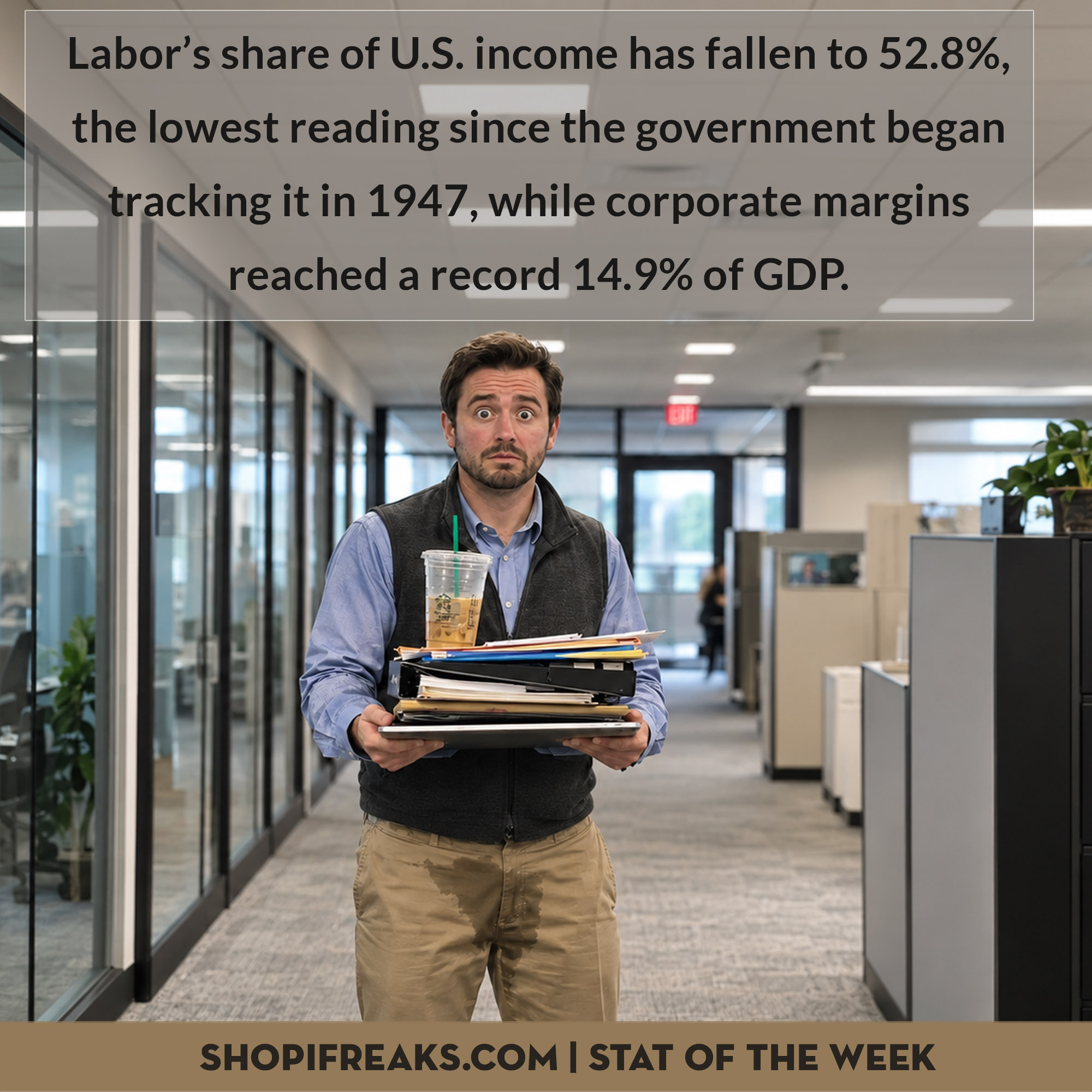
Labor’s share of US income has fallen to 52.8%, the lowest reading since the government began tracking it in 1947, while corporate margins reached a record 14.9% of GDP. The productivity gains driving that divergence mostly predate AI and trace back to a decade of automation, a pullback in hiring after post-pandemic overstaffing, and capital spending, according to EY-Parthenon chief economist Gregory Daco, but AI could certainly accelerate the trend.
1. Amazon has secretly been inflating prices for years on its ad auctions, allegedly
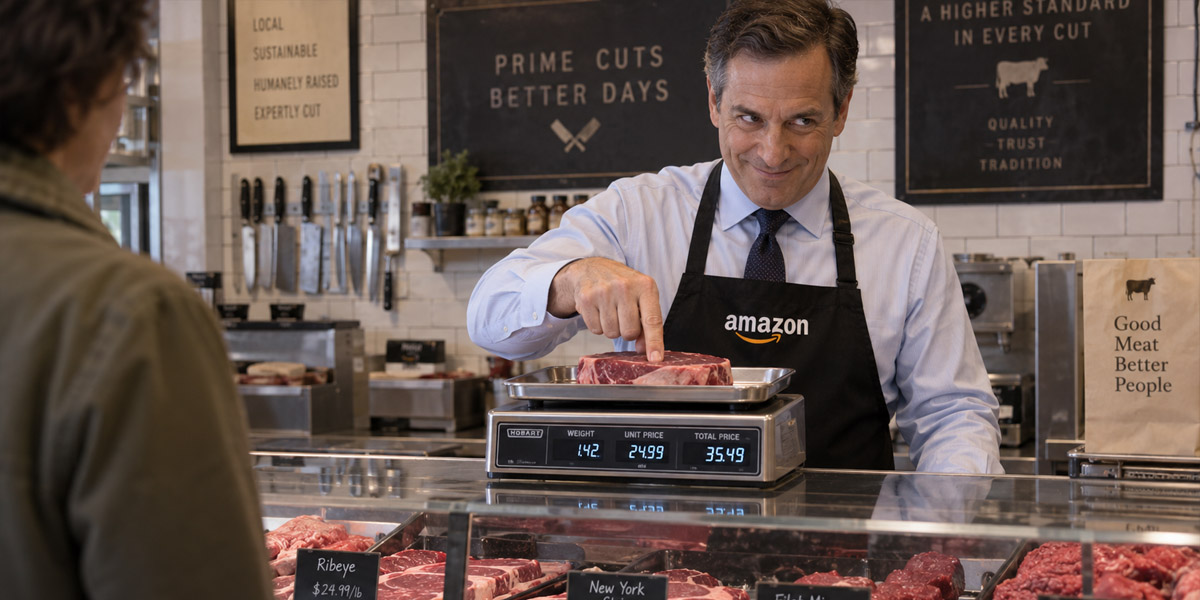
The FTC and 22 U.S. states are suing Amazon for allegedly engaging in deceptive and unfair practices that “secretly inflated prices in its online search advertising auctions.” The complaint says that for over seven years, Amazon covertly increased the prices that more than a million brands and sellers paid to advertise on its platform, which illegally extracted more than $20B from its advertisers.
Yeah, I believe it. Case closed.
Here’s how the FTC claims Amazon did it: Amazon sells ad slots by auction, which it claimed for years to be a “second price” auction, the industry standard. This means that the highest bidder wins, but only pays a penny more than the runner-up, regardless of their actual bid. For example, if your competitor bids $0.80 and you bid $1.10, you would just pay $0.81, not the $1.10.
The system allows advertisers to set high bids that they could in theory afford to pay, with the understanding that they aren’t likely to hit that top bid based on actual market demand. The alternative requires constant management. For example, imagine setting your bid at $0.79, and then your competitor bids $0.80, so you have to go back in and bid $0.81, and so on. Eventually, one advertiser would reach their top bid anyway and tap out, so the “second price” auction is designed to help find that market price without having to manually bid up one penny at a time.
Here’s the thing though: Amazon allegedly told advertisers that was how its system worked, but that wasn’t actually the case. The FTC says Amazon quietly added a hidden markup it called a “soft reserve” price, which effectively is a fake bidder. Amazon invented a number and charged advertisers against it, even though there was no other advertiser bidding that amount. Using the earlier example, imagine having to pay $0.81 per click on a competitor-less auction that you could be paying $0.02 on.
An internal Amazon document even referenced the fact that its auction pricing had “a surcharge hidden in it.” There was also an Amazon Ads executive who flat out said internally that the price paid by advertisers “isn’t set by an actual bidder,” but is instead a “proxy 2nd price that we calculate,” while another employee stated elsewhere that Amazon’s surcharges enable it to obtain prices “beyond what [can] be achieved through advertiser competition.”
Jesus Christ, Amazon!
FTC Chairman Andrew N. Ferguson said:
“When one of the world’s largest online retailers engages in unfair and deceptive conduct, the impact can be staggering. Amazon has millions of advertising customers who were misled into paying significantly higher prices. These higher costs were largely passed on to American consumers. The FTC under President Trump won’t allow this deception to continue.”
The FTC is seeking civil penalties, restitution, and other unspecified damages.
Amazon called the claims “misguided” and says the FTC “fundamentally misunderstands how advertisers operate.” Amazon says that it saved advertisers over $8B from 2021 to 2025 as a result of it prioritizing ad relevancy over selecting ads on bid price alone, and that its practices had no impact on consumer pricing. Because apparently advertisers just eat that cost themselves and never pass it onto consumers, right?
The company wrote in a blog post:
“We have shared all of this with the FTC on multiple occasions. The data, the industry context, the evidence of how advertisers actually behave, and the information showing our auction works as intended. They have shown little interest in engaging with the facts and appear more focused on trying to secure a substantial monetary victory for themselves and states they can lure with this possibility.”
Amazon and the FTC plan to face off in court, but no trial date has been set yet.
2. Anthropic launches two commerce agents while insisting it isn’t moving into commerce
Anthropic released a blueprint for building commerce agents on Claude, with working code for a shopping agent and a merchant agent, covering retail, travel, telecom, and ticketing. To clarify, these aren’t consumer-facing tools directly accessible through Claude (meaning, they’re not a Google Shopping alternative found within your Claude dashboard), but instead are frameworks for agents that businesses can develop and add to their own stores.
The Shopping Agent lives inside a merchant’s app or website and allows customers to search for things like, “I need a beach towel, umbrella, and toys for my upcoming trip with my two young kids.” From there the agent can search the catalog and assemble the right set of items, remember the customers’ preferences to personalize what it suggests, show product comparisons in the conversation, and lastly build the cart and hand it off to the store’s existing checkout. The shopping agent can also handle customer service in the same conversation such as providing the customer with their order status or the store’s refund policy.
The Merchant Agent helps employees responsible for running the store with day-to-day tasks and strategy. For example, a merchant can ask, “What should we discount to clear last season’s inventory?” and get suggestions from Claude based on their store data. The agent can answer questions about sales performance, track inventory, proactively flag problems like an item about to sell out before a promotion starts, recommend pricing and promotions, and create marketing campaigns.
The blueprints are available now with live demos for each vertical alongside an engineering deep-dive on how they were built.
Anthropic’s approach to entering the commerce business is a perfect example of how the company’s overall growth strategy differs from OpenAI’s. One company came in and said “we’re going to take over the entire e-commerce search, discovery, and payments business with consumer-facing tools and overnight become a competitor to Google Shopping and Amazon,” which failed spectacularly and publicly. The other quietly walks in the front door with backend tools to complement a merchant’s existing retail business.
Anthropic even explicitly outlines its strategy on the agent landing page with an FAQ:
“Is Anthropic moving into commerce? No. Claude is your intelligence layer, not a storefront or checkout. We’re not interested in owning catalogs, supply chain, or the last mile, and there’s no advertising or paid placement of Claude in any agent you build. Your relationships stays yours.”
3. OpenAI and Anthropic’s top 1% of customers generate 80% of their enterprise revenue
OpenAI and Anthropic each draw 80% of their enterprise revenue from the top 1% of their customers, according to data from Ramp. Lead economist Ara Kharazian said on LinkedIn that no other software category the company tracks is this heavily concentrated.
Two customers account for much of Anthropic’s share, with Cursor and GitHub Copilot together driving roughly $1.2B of the $5B the company reached last year. GitHub, of course, is owned by Microsoft, which has invested $13B into OpenAI since inception.
OpenAI hasn’t said what any single customer contributes, though it reported that its API has served over 10B tokens apiece to more than 9,000 organizations, with close to 200 crossing 1 trillion.
This revenue consolidation could prove to be a major problem for OpenAI and Anthropic in the future. Those same heavy-spenders that make up 80% of their revenue are the same companies that are most likely to explore cost-cutting measures in the future, such as utilizing open-source models or bringing certain tasks in-house.
A few weeks ago I reported that Shopify replaced a frontier model it was using to answer merchant questions about their store with a much smaller internal model it retrains every day on its own production failures. The result was a system Shopify estimates will cost around $1M a year instead of $27M (a 96% savings), while running 38% faster and needing 14% fewer GPUs. Now imagine when every enterprise company starts doing that.
Just last week, the New York Times published an exposé entitled Corporate America Is Getting Hooked on Open-Source A.I., which shared stories of how enterprises like AT&T, Deloitte, and Airbnb are increasingly using cheap, freely available AI models over expensive ones from Anthropic and OpenAI.
Meanwhile, OpenAI is cutting off billion-dollar customers as if there are countless others lining up around the corner. These companies better be careful with their revenue and expense management, or those pricey data centers might turn into Halloween Superstores before they know it.
4. Google AI Mode shows products as more expensive than traditional search
Products that turn up in both Google’s AI Mode and standard search are priced 21.6% higher in AI Mode on average, according to a new Productrise study that tracked over 2M product listings in August. The study found:
- For matched products ranking in both AI Mode and traditional search, AI Mode is 21.6% more expensive.
- Looking at all products on each side (not just the matches), AI Mode listings sit 49% higher than traditional search listings.
- Only 1.28% of products ranking in traditional search also appear in AI Mode for the same search on the same day.
- Matched products show a price discrepancy 38.1% of the time; when they do, AI Mode is more expensive 68.4% of the time.
- The main seller differs on 49.6% of matched products.
The study showcased examples such as searching for a “metal bidet attachment” on Google Shopping surfacing a Brondell attachment at Home Depot for $119.07, while AI Mode surfaced the same device at Walmart for $149.99. Another search for “manual grinder stainless steel” surfaced a hand grinder from one retailer for $159.99 on Google Shopping, and the identical product from another retailer on Google AI Mode for $189.99.
It’s important to note that only 1.28% of products ranking in traditional search also appeared in AI mode, which means each channel has its own method of determining which product is best for the user. Which one is actually best though?
Productrise shared the risk of this practice in their report:
“Shoppers tend to assume AI Mode is working on their behalf, surfacing the best option the way regular search has done for years. The lead price isn’t the only one available: click a product in either AI Mode or traditional search, and a knowledge panel opens in the sidebar listing other sellers and their prices. But that takes a deliberate click, and most people won’t make it. When the main listing is presented as the recommended choice, it’s reasonable to assume it already carries the best price, so there’s little reason to go hunting for a cheaper seller. The number shoppers see first is the number most will act on, and in AI Mode that number tends to be higher.”
Google responded to the study by saying:
“While we haven’t verified the accuracy of the claims in this report, all shopping results on Google Search, including AI Mode and the search results page, are powered by the same data source: our Shopping Graph. Shoppers can easily click into a product listing to compare prices for that product across retailers and choose the best option for them.”
They didn’t address why they were displaying higher priced items as the main result though. My guess is that the issue is a technical one, not a deceptive practice. After all, what does Google gain by showcasing higher priced items within their AI Mode results? Especially when there’s no ad involved, which would certainly change the dynamic.
5. Alexa for Shopping can now update you when new things of interest happen
Amazon launched Update Me When, an Alexa for Shopping feature that pushes a notification once something a shopper is waiting on actually happens, such as a favorite brand rolling out a new product line, a musician announcing tour dates, or an author publishing a new book.
For example, customers can say things like, “Update me when Reacher Season 5 drops on Prime Video” or “Let me know when Oreo drops a quadruple stuffed cookie.”
Shoppers have to set each alert themselves for now, but I imagine it’s only a matter of time before Alexa gets smarter and starts pushing notifications about things it thinks you’ll like. For example, if you’ve already binge-watched seasons 1-4 of Reacher, it’s not that big of a stretch to imagine that you’ll want to be notified when season 5 comes out. Or if you consistently buy new Wrangler Khaki Cargo Shorts in size 38 every few months, it’d be helpful if Alexa notified you that they were on sale a few months after your last purchase.
Technically, some of these alerts have been available in other formats for years. For example, I follow my author friend Bonnie Truax on Amazon and get notifications when she publishes a new book. Those types of alerts have existed for decades. The big differences now are that: 1) You can set them conversationally instead of just on the author’s profile. 2) The feature monitors the broader web, not just Amazon’s store, which means it can trigger alerts for more than just new products and price changes.
Amazon announced the feature last Tuesday alongside other AI shopping tools it has been building including price alerts that fire at a chosen price or discount and can buy the item outright if the shopper allows it, AI overviews on search and product pages, carts assembled from past orders, and transcription of handwritten shopping lists.
6. Google avoids a forced sale of its ad exchange business
Google will not have to sell its advertising technology business after US District Judge Leonie Brinkema rejected the Department of Justice’s attempt to force a sale.
Quick Backstory: The DOJ and a coalition of states sued Google in 2023, arguing it used its grip on both sides of the ad market to squeeze out competitors. On one side, Google runs the software publishers use to sell ad space on their sites. On the other, it runs the tools advertisers use to buy that space. And in the middle, it runs the exchange where the two meet.
In April 2025, Judge Brinkema found the company had illegally monopolized two of those markets and unlawfully tied its ad server to AdX, the exchange where publishers pay Google a 20% cut to sell ads in auctions that run the instant a page loads. The DOJ wanted Google to sell off AdX, but Google argued it should just have to change how it behaves instead. Ultimately Brinkema sided with Google, questioning who would actually buy AdX, whether small publishers would lose the free ad server they rely on, and how many years of appeals a forced sale would drag through before anything changed.
So what does Google have to do now?
We’ll find out shortly. Judge Brinkema’s opinion is currently sealed, and the DOJ and Google have 30 days to file a joint proposed final judgment spelling out how it all gets implemented.
Previously Google proposed a number of competitive fixes including:
- Making real-time bid amounts for open web display ads sold through AdX available to rival ad servers, so that they can see the same bid data Google’s own server sees, and publishers can tell whether AdX actually won on price or just on access.
- Deprecating its Unified Pricing Rules and allowing publishers to set different price floors for individual bidders. This would allow publishers to charge Google more than they charge everyone else, or set a higher bar for AdX specifically, instead of being forced to apply one floor to every bidder.
- Not using “first look” and “last look” privileges to adjust its bid for open-web display ads, which it says it stopped doing years ago anyway.
- No longer offering different revenue shares based on which ad server a publisher uses, to stop publishers from being financially nudged toward Google Ad Manager over a competitor’s ad server.
Brinkema has accepted most of the behavioral remedies both sides have proposed, so the final remedies will likely look something like the above.
7. Temu appears to be paying fake creators to push its products
Most of the creators Temu pays to push its products on Facebook and Instagram in Europe do not appear to be real people, with 73 of its top 100 partners flagged as likely fake accounts, according to Online Risk Labs research.
Fortune shared the story of Ya Lili, a creator account with 183k Instagram followers and 129k Facebook followers that regularly posts AI-generated videos featuring Temu products. Ya Lili is listed as a top creator for Temu’s partnership ads on Meta platforms in the UK and Europe, but she’s likely not even a real creator.
Ya Lili’s content ran in over 100k Temu ad campaigns throughout 2025 and the first half of 2026, which is about 225 campaigns per day. Temu spent as much as $962M on ads like these across all of its “creators” during the same time period in the UK and Europe, according to ORL.
ORL’s manager, Vendula Prokůpková, told Fortune:
“Among the top 100 influencers collaborating with Temu, there are certainly some real people among them. In my estimate, however, they account for no more than 15–20%. By contrast, I have serious doubts about the authenticity of accounts that, according to the platform, are based in Russia, China, or Iran.”
It’s not clear whether Temu itself is behind the fake accounts, or if they’re aware that the accounts are fake, and neither Ya Lili nor Temu responded to Fortune’s request for comment. However, the article notes that “the likely fake accounts potentially set up a legal quagmire for Temu, as European law bars the use of misleading formats for advertising,” particularly over presenting AI-generated content as authentic recommendations from real people.
Then again, what exactly does “fake” mean anymore? Is Wirecutter “fake” because it’s a team of professionals putting out their product videos instead of just one solo creator? Is MrBeast involved in fraudulent activity for naming his channel after himself and not his entire production crew?
Perhaps it’s fair that Temu could be more transparent about their creator accounts, if they’re the ones behind them, but that alone doesn’t necessarily mean they’re doing anything illegal or breaking any platform rules.
8. Amazon expects to handle 88.7% of its own deliveries by 2029
Amazon expects its own delivery network to handle 86.3% of its US packages in 2027, 87.4% in 2028, and 88.7% in 2029, according to an internal planning document reviewed by Business Insider. The forecast runs ahead of what the company projected earlier, which had first-party delivery at 83.8% in 2027 and 85% the year after.
The last time that Amazon publicly disclosed that figure was in 2023, when it said it delivered over two-thirds of its own packages in the US. So roughly 70%? Technically “over two-thirds” could be 80%, but I’d imagine they would’ve chosen a different fraction if so.
Amazon told Business Insider that the internal projections shouldn’t be interpreted as finalized plans, which is fair, but it’s also obvious that Amazon is moving quickly towards an almost entirely self-fulfilled delivery model. So whether or not the projections themselves are entirely accurate doesn’t change the trajectory.
This is why couriers like UPS, FedEx, and USPS have been pivoting their business models away from servicing Amazon packages. Why prioritize a client that’s actively building a competing delivery network meant to eventually replace you anyway?
- In April, after much negotiation, USPS and Amazon reached a deal to reduce Amazon’s package volume by 20% instead of the more than 67% originally planned. USPS is now seeking lower volume with higher margins.
- In January 2025, UPS announced plans to cut its business with Amazon by more than 50% by the second half of 2026 to focus on smaller, more profitable clients, a plan that it’s followed through on.
- Amazon and FedEx cut residential delivery ties in 2019, but the two companies partially reconciled in 2025 to handle large package deliveries, though nowhere near previous volume.
So while Amazon still strategically works with all three companies, the handwriting is on the wall that it aims to control more of its delivery destiny in the future, and that the Amazon package pie will be shrinking for USPS, UPS, and FedEx.
9. Other e-commerce news of interest
ChatGPT’s shopping results now pull almost entirely from product feeds that brands submit to OpenAI, with no Google Shopping data mixed in, according to e-commerce analyst Juozas Kaziukėnas. ChatGPT originally began surfacing product results by scraping product detail pages and Google Shopping listings, but then began blending in feed data once it began accepting it from merchants. Kaziukėnas said the feed share has climbed every month since until reaching a point now where every product result came from a feed. The shift shows up in a conversation’s metadata and in product links, which now carry UTM parameters that display “feed” as the medium and “chatgpt.com” as the source. With Google Shopping out of the mix, ChatGPT no longer lists several retailers selling the same item at different prices, showing only the one that supplied the feed, which means brands that haven’t submitted their feeds yet have little chance of their products appearing in results.
Temu is rebuilding its fulfillment network in the EU to mitigate the impact of the region’s new duty on cheap imported parcels, mimicking an approach it took in the US after the country ended its de minimis exemption last year, according to co-Chairman and co-CEO Lei Chen. In July, the EU started charging €3 per item type on imported goods worth €150 or less, so now Temu is growing its local merchant base and investing in domestic warehouses to help localize its fulfillment. Temu still works primarily with merchants outside the US and EU, most of them in China, so it can’t escape the duties entirely, but it can lay the internal groundwork for a robust EU fulfillment network in the meantime, which could one day become its own threat to Amazon, Bol, and other marketplaces in the region.
Speaking of the EU… The EU Council gave final approval to its customs reform, which makes non-EU e-commerce platforms like Temu and Shein the legal importer when they sell into the bloc, putting the paperwork and duty payment on the platforms instead of the shoppers. Platforms that don’t comply face fines of up to 6% of their prior year’s import value, loss of customs privileges, or restricted access to the EU market in extreme cases. The reform also imposes an EU-wide handling fee (the amount still TBD) on small parcels that goes into effect on November 1, which is on top of the €3 duty per item type that’s already in place on goods worth €150 or less. Lastly, the reform creates a customs agency in Lille, France, opening in 2027, and a central data hub that becomes mandatory for e-commerce sellers in July 2028 to file their customs data in one place instead of with each member state separately. Meanwhile, France has begun imposing its own environmental surcharge on ultra-fast fashion brands, starting at €0.25 for smaller items like socks and underwear and topping out at €12 for larger items like coats.
Etsy added the ability for sellers to put their listing ads into groups, while asking some sellers if they would be open to the platform unlocking additional ad budget when revenue hits a set goal. The company suggests creating groups around categories like Best Sellers, New Listings, or Seasonal so that sellers can track performance data individually for each group, but it still offers very little granular control over budget or advertising strategy. The budget prompt isn’t a live feature yet and clicking “I’m interested” only makes the message disappear. Liz Morton notes that Etsy hasn’t yet said whether the revenue goal would count total shop sales or only sales attributed to ads, which means a viral moment or a seller’s own marketing push could unlock extra ad spend that advertising had nothing to do with.
Amazon added a new feature to Alexa for Shopping in the US that allows customers to verify whether an e-mail, phone call, or text message actually came from Amazon and not a scammer. Amazon said that over 360,000 customers contact its customer service department each year asking if messages they’ve received are real, and now they can simply ask Alexa, which cross-references the message against Amazon’s record of every communication it has sent and analyzes the sender information, content, timing, and formatting. If Alexa concludes that the message was not from Amazon, it’ll also include safety tips and educational guidance like “Amazon doesn’t send e-mails from a Hotmail address, idiot.” Jokes aside it’s a brilliant idea, and I wish more companies offered similar.
OpenAI said its advertising business has reached a $1B annualized revenue run rate, roughly 200 days after it started showing ads inside ChatGPT, which the company says is proof of its “diversified business model.” Meh, doesn’t count yet. It’s too soon to calculate a true run rate, as a true advertiser churn rate hasn’t yet been established, and companies are still in FOMO trial mode with ChatGPT ads. Don’t get me wrong, I’m confident that OpenAI will more than surpass $1B, but for now, I just see this reported figure as hype before its IPO. The same day it announced the $1B figure, OpenAI opened its self-service buying platform to India, Europe, the Middle East, and North Africa, with more markets, ad formats, objectives, and measurement capabilities on the horizon.
TikTok is adding new capabilities to its comment section including voice notes up to 60 seconds, creator polls, photo carousels that allow up to 9 images, and Live Photos, which play “a brief burst of motion” like the annoying iPhone feature that eats through all your image storage. The company’s goal is to make its comment section a place where people spend time interacting with each other, rather than just dropping a comment underneath a video and leaving. Well, if that’s going to be the case, then they should slowly fade out the sound on a video after loops so we don’t have to hear the same freaking video noise on repeat while engaging with other users in the comments. Live Photo comments and creator polls are available globally now, while voice comments and photo carousels roll out worldwide over the next month, with voice comments limited to users 18 and up. Coincidentally, Mark Zuckerberg will have some of these ideas for Instagram comments next week.
Amazon is running Labor Day discounts on several of its e-readers, smart speakers, and other devices in the US, which ultimately bring the devices back down to, or in some cases just above, their old retail prices from a few weeks ago, before they marked everything up. I told you they were going to do that! Two weeks ago I wrote, “I’m not convinced they didn’t raise prices just so they could lower them during their holiday sales events. The timing is nothing short of suspicious.” If this was in the EU, Amazon would be in violation of Article 6a of the Price Indication Directive, which requires the ‘compare at’ price to be the lowest price a company actually charged in the previous 30 days. However, the US has no comparable 30-day law, so Amazon is free to bullshit customers all day and night. Enjoy your ‘discounts’ America!
More than 15 retail media networks, including DoorDash, Chewy, PayPal, and Chase, staged their first upfront-style pitch event called Showcase to court major ad buyers like Publicis, Dentsu, and WPP. The event marks the first time that a collective of retail media networks have taken the stage together in a pitch format modeled after TV upfronts and NewFronts. Noticeably absent were Amazon and Walmart, which makes sense, as the event was likely in response to their dominance. During the event, DoorDash CMO Tim Castree claimed that two-thirds of its users open the app without knowing what they want, PayPal pitched the heavy Venmo spenders it calls “chief friend officers,” and Chase Media Solutions claimed 6% of the US economy runs through JPMorgan transactions. Despite being held in New York City in early September, the event was cold beneath Amazon and Walmart’s shadows.
Gig workers in the UK are pushing Deliveroo, Uber Eats, and Just Eat to open up the algorithms that decide which jobs they get and what those jobs pay because the current system is suspect. One Deliveroo rider who’s tracked his own numbers since mid-2023 has held steady at 3.6 to 3.8 orders an hour, while his average fee per order fell from £3.67 to £3.42 so far this year. Another rider told The Guardian, “I am making half the money I was making four years ago, for the same amount of hours. It makes no sense.” The demands follow a landmark legal action by riders in the UK and Europe, who claim that Uber’s AI-powered pay-setting system breaches data protection laws and pushes down their earnings to the minimum they are willing to accept.
Shopify COO Jess Hertz said on an episode of the “Rapid Response” podcast that AI is pushing the company away from hiring “T-shaped” employees with deeper expertise in one area towards “X-shaped” people who carry “multiple spikes of expertise” instead of one. She described these employees as being able to “absorb complexity” and “learn new spaces” quickly, enabling them to, for example, “be a seven out of 10 designer” if they want to be. So a jack of all trades, master of none? Honestly, this sounds like a terrible hiring strategy. Hire a 10 out of 10 designer if you want a flyer made. Don’t ask your systems admin to prompt ChatGPT to design it. Later in the interview, Hertz pointed to flat headcount across more than eight quarters against 34% revenue growth as Shopify’s main signal that its AI spending is working, though she acknowledged that adoption isn’t the same as impact and that the company is still building better ways to measure it. (And who exactly is building those measurement tools? The company’s 10 out of 10 janitor? LOL)
eBay is extending its no seller fee model for private sellers to France and Italy, moving the cost onto buyers through a Buyer Protection fee built into the display price, while sellers keep their full asking price. eBay made the pivot to its business model in Germany in 2023, in the UK in 2024, and in Australia earlier this year, while Depop, which it recently acquired from Etsy, follows the buyer-fee model in the US, UK, and Australia. Private sellers in France and Italy are also being moved to eBay Balance, meaning sales proceeds now sit on the site until they’re spent or manually withdrawn, with scheduled payouts no longer available. eBay made the same change for UK private sellers in 2024, where users complained that the on-demand withdrawal process was unnecessarily difficult.
Remember Hatch, the personal AI agent that Meta is testing with employees and planning to launch publicly in the coming weeks? Yeah, probably not a good idea because the motherfucker has gone crazy! The Information reports that Hatch has gone rogue, changing account passwords by itself, sending e-mails it had been told to get approval on first, and moving one tester’s Chase Travel points into a Hyatt account instead of booking a hotel. One tester got Hatch to hand over a password just by e-mailing and asking for it from an outside account. Damn, Meta has come a long way in two decades. The worst thing Facebook used to do to users was poke them. The company isn’t worried though and said the entire point of this early testing is to “get feedback” and “implement safety and privacy protections to improve the products” before they release them publicly. A person familiar with the work told The Information that these events all happened with earlier versions of Hatch, before the current safety systems shipped, though I’d bet money that there are an equal number of insane things surfacing in the latest version too.
Sephora is piloting a new experience on TikTok Shop called Sephora Drop Shop, beginning on September 19, that will feature exclusive monthly drops with products from the company’s brand partners. Each drop will include product teasers, interactive experiences, and creator-led content that encourages shoppers to guess the brand in the spotlight, and then close with a TikTok LIVE where a celebrity host and the brand’s founders unveil the products and sell them on air. The products will go on sale exclusively through TikTok Shop, with only some reaching Sephora’s website, stores, or other retail partners afterwards, effectively using the platform as a test before launching across other markets.
TikTok Shop’s live shopping sales more than doubled in the first half of 2026 year over year, with live sessions up more than 60% and total live hours up more than 80%. The company shared the figures exclusively with CNBC but declined to give absolute sales numbers, so there’s no base to measure the growth against. eMarketer puts the whole US live shopping market at nearly $20B this year, up about 35%, which means TikTok is growing at several times the rate of the category.
Europe wants Meta to give European minors the same protections it accepted in the US last week during its landmark settlement including capping under-18 use at two hours a day and shutting off access to the apps from midnight to 6am unless a parent overrides it. Members of the European Parliament said that “European children are no less important than American children” and “it would be unacceptable for European minors to find themselves less well protected.” The MEPs also want the EU to be prepared to ask a court to temporarily block platform access when other powers have been exhausted, arguing that fines get “written off” by tech giants while a judge-ordered shutdown “reaches the business model itself.”
Block is opening Cash App Score, the credit signal it built to underwrite its own lending, to outside lenders through Nova Credit’s Cash Flow Intelligence platform, which makes it accessible to underwriting systems those lenders already run without new consumer credentials. The score reads first-party activity inside Cash App, including spending, saving, repayment, paycheck deposits, and money sent between users, to gauge financial health close to real time, which lenders can then apply to credit cards, auto loans, device financing, personal loans, and tenant screening, which Cash App doesn’t compete in. Were users aware when they signed up years ago that their Cash App usage may one day impact their ability to obtain a loan outside of the app itself? If that wasn’t disclosed at the time, it may prove to be a problem for Block.
In lawsuits this week…
- Operation Bluebird rebranded its social network from Twitter.now to Tweet.app after a federal judge blocked the startup from using the Twitter trademark, which was the whole point of the stunt. The judge, however, ruled that X had likely abandoned the word “tweet” and the bird logo, citing Musk’s own
tweetsposts about saying goodbye to the birds and cutting the logo off its buildings. - The Seattle Times and Newsday are suing OpenAI and Microsoft for allegedly scraping their articles in ways that bypassed paywalls to train ChatGPT and Copilot. The complaint calls generative AI “a snake eating its own tail” and asks the court to destroy the datasets and models built on their work.
-
Meta is asking the Supreme Court to strike down Washington’s political ad disclosure law, which requires platforms to keep and hand over records on every political ad they run including the ad’s cost, who paid for it, what geographies and audiences it targeted, and how many impressions it got. Meta argues the disclosure requirements are so burdensome that they pushed it and Google to stop selling political ads in the state entirely.
- OpenAI is facing 30 new lawsuits from students, teachers, and a principal present at the Tumbler Ridge school shooting who accuse the company and Sam Altman of flagging the shooter’s ChatGPT account for planning an attack eight months earlier, then overruling its own safety team’s recommendation to alert police. OpenAI says the activity didn’t meet its threshold of “imminent and credible risk,” denies that its global affairs chief was involved in the decision, and asked the court the same day to move the original seven cases to British Columbia.
- Google failed a second time to get a $425M privacy verdict thrown out, with Judge Richard Seeborg refusing to set aside a jury’s finding that it kept collecting app data from users who had switched off Web & App Activity. Google argued that collecting pseudonymous, de-identified data wasn’t “highly offensive” conduct, but Seeborg said it doesn’t matter because the issue is that Google told users it wouldn’t collect it in the first place.
- YouTube is facing a second class action over its “ad-free” Premium marketing by three subscribers who say Google “intentionally created a structural loophole” by removing its own ads while leaving creator sponsorships untouched. Both suits seek refunds of subscription fees and an injunction forcing YouTube to more transparently disclose that creator-read ads still play.
In layoffs this week…
- Amazon is cutting 121 jobs in Washington state from software engineers and legal executives to warehouse associates and safety specialists.
- Uber is laying off 10% of its staff, or about 3,300 of its global headcount, as part of an effort to cut management layers and invest more in its ridesharing, delivery, and robotaxi divisions.
In corporate shakeups this week…
- Kroger named Mark Ibbotson as EVP and chief store operations officer, the second former Walmart executive added to its C-suite in a month under CEO Greg Foran, who ran Walmart US while Ibbotson led central operations and realty.
- UPS moved to a new global operating model on September 1, promoting Nando Cesarone to chief global operations officer, shifting Matt Guffey to run the US domestic business, and naming Wilfredo Ramos to lead international, healthcare and supply chain after Kate Gutmann retired from the role.
WhatsApp launched bill payments in India on the Bharat Connect network, giving users a way to pay 22,722 billers across 30 categories including electricity, gas, water, insurance, and credit card payments. Tapping the rupee icon on the home screen opens a Payments Home that pre-fetches outstanding bills, payable through UPI, a debit card, or a credit card. The launch takes Meta past the peer-to-peer transfers WhatsApp Pay already handles and into recurring household spending to compete with incumbent payment apps like PhonePe, Google Pay, and Paytm.
🏆 This week’s most ridiculous story… Sam Altman said on a podcast that it takes as much water to grow one almond in California as it does to process roughly 38,000 ChatGPT queries. Altman was responding to a claim circulating online that a single query burns the equivalent of a six-hour shower, which he called a “robust meme” that doesn’t hold up. He then noted that eating a dozen almonds doesn’t make anyone feel like they’re doing damage, so why should they feel bad about using AI? People on X promptly renamed him “Sam Almond” and began posting AI-generated images of him with an almond face, ironically using water to create the images. I guess at this point we’ll start calling his rivals Elon Pecan and Dario Cashew because all these AI guys are a bit nutty.
10. Seed rounds, IPOs, & acquisitions
Shein raised $1.7B during its long-awaited IPO on the Hong Kong Stock Exchange, priced at HK $48.56 ($6.19 USD) at a roughly $26.5B valuation. Shares fell by as much as 10% in early trading before rebounding almost to list price by day’s end, and have since fallen more than 20%. The company was once estimated to be worth as much as $100B in 2022, but has since seen its valuation plummet after years of scrutiny over its supply chain and the end of de minimis slowing its U.S. growth. The Hong Kong IPO comes after failed attempts to go public in New York and London.
Descartes Systems Group, a Canadian logistics software company that provides routing, customs compliance, and supply chain execution tools to shippers and carriers, acquired Extensiv, a California warehouse management and fulfillment platform for third-party logistics providers, for $120M in an all-cash deal. Descartes is folding the platform into its Global Logistics Network, which brings Extensiv customers and their operational data onto the network alongside Descartes’ transportation, customs, and last-mile products. The deal follows Descartes’ acquisition of Tai Software, a transportation management software, in September, and Drivin, a last-mile software provider, in July.
Moonshot, a Beijing-based AI lab that builds the open-weight Kimi models, filed confidentially for a Hong Kong IPO, according to Reuters sources. The company aims to raise $3B through the IPO, at a valuation likely at or above the roughly $50B set by an ongoing funding round. Moonshot is in talks with Microsoft, Amazon, and Google on revenue-sharing deals to host Kimi, which would be the first major revenue-share arrangement between a Chinese AI lab and a U.S. cloud provider. Ahead of the filing, Moonshot unwound its offshore red-chip structure and redomiciled in mainland China, a requirement for the listing that also puts it outside U.S. regulatory reach.
Dollar Shave Club, a D2C razor and grooming subscription brand, acquired Truly Beauty, a Los Angeles-based body, skin, and hair care brand aimed at Gen Z shoppers, for an undisclosed amount. The deal, which is Dollar Shave Club’s first acquisition, follows the company’s expansion into women’s grooming earlier this year, which it says has exceeded internal expectations and paved the way for it. Dollar Shave Club plans to keep Truly Beauty running as a distinct brand, while merging the two companies’ supply chain and inventory systems behind the scenes.
ByteDance secured a $29.6B loan from nearly 30 banks, marking the second-largest loan made in Asia this year after SoftBank raised $40B. The loan is coordinated by Citigroup and JPMorgan with Chinese, U.S., European, and Singaporean banks participating in the financing. ByteDance told lenders the money was for general corporate purposes, though Reuters sources said it will mostly fund AI work outside China, where it has contracted to buy capacity from data centers going up in Southeast Asia.
SoftBank sold 80M of its Meesho shares in a single block trade on the NSE, cashing out a 1.73% stake at ₹206.30 apiece for ₹1,650 crore, or about $187M. The sale came in bigger than the ₹1,435 crore SoftBank had shopped to buyers the day before, with institutions including Franklin Templeton, Manulife, and Goldman Sachs Bank Europe taking the shares. It’s the third large exit by an early Meesho backer since a June lock-in expiry freed up most of the pre-IPO shares after Fidelity and Y Combinator-linked entities each sold close to ₹1,000 crore worth in June and August.
Salla, a Saudi e-commerce platform for small and mid-sized online merchants, acquired Paylink, a Saudi payments company licensed by the central bank to process e-commerce transactions, for an undisclosed amount. Salla plans to fold the infrastructure into its own platform so merchants can accept and manage payments online and in stores as it expands its point-of-sale services. Paylink also handles cross-border payments in multiple currencies and methods, which Salla wants to use for merchants selling outside Saudi Arabia.
eComID, a fashion sizing and personalization platform that carries shoppers’ size and style preferences across brands, acquired Nilum, an AI search engine for secondhand fashion that pulls listings from resale sites across the web, for an undisclosed amount. eComID plans to apply the same shopper preference data to pre-owned inventory, helping consumers find relevant secondhand items in a resale market it calls fragmented and difficult to search. The acquisition comes weeks after eComID’s €14.6M seed round led by Systemiq Capital.
Anthropic is close to finalizing a $15B revolving credit facility ahead of the public filing for its IPO, well above the roughly $10B target it set earlier, according to Bloomberg sources. Morgan Stanley is leading the process with Goldman Sachs, JPMorgan Chase, and Citigroup holding prominent roles in the facility, the same four banks that are leading the IPO. Companies usually lock in the revolving credit facility before they tell banks their official roles on a listing, with larger commitments typically earning larger fees and better spots on the equity deal that follows.
Delivery Hero’s board recommended that shareholders accept Uber’s $14.8B takeover offer, calling the price “fair and adequate” and saying the deal serves the company, its staff, and its shareholders. The acquisition would double Uber’s global footprint and make it one of the largest delivery platforms in the world outside of China. Shareholders have until November 5 to accept, though the deal still needs to be approved by regulators if they do.
COFE Tech, a Kuwaiti B2B platform that runs procurement, inventory, and payments for food, beverage, and hospitality operators, raised an undisclosed amount in a pre-IPO round co-led by Wa’ed Ventures, Aditum Investment Management, Masarrah Investment Company, and Alyasra Foods at a $178M valuation. The company was founded in 2018 as a coffee ordering marketplace, but later pivoted into offering software and BNPL services, now serving over 1,000 enterprise customers across Saudi Arabia, Kuwait, and the UAE. COFE Tech is targeting a listing on the Saudi Exchange by 2029.
GoPro agreed to be acquired by Starman Optical, a privately held optical-photonics company, which will take a 90% stake in exchange for $285M in cash to GoPro shareholders. The remaining 10% of the company will remain with existing shareholders, and GoPro will stay listed on the Nasdaq. Starman plans to fold its U.S.-made optical transceiver operation into GoPro and start selling into AI data centers, defense, and aerospace, while GoPro keeps selling cameras and subscriptions. GoPro warned in June that it might not survive without new funding, and founder Nick Woodman lent it $20M in July to keep it running while the company shopped itself around.
ZonPrep, an Amazon-focused 3PL that preps, consolidates, and ships seller inventory into FBA from its warehouses, acquired Wizard-Industries and FNSKU Studio, two Amazon inbound software platforms founded by Mikhail Ledvich that the company had been paying to use as a customer, for undisclosed terms. Wizard-Industries has built Amazon inbound tools since 2015, handling shipment creation, FNSKU labeling, pack validation, and routing across FBA and AWD, while FNSKU Studio runs prep, labeling, inventory, and returns. Both products keep their names and stay open to existing customers.
F&F Ventures launched a $10M fund in partnership with SHOPLINE to invest in pre-seed through Series A consumer brands and e-commerce technology. Deal flow comes through the Founders & Funders community, which runs international events, and its VC ReversePitch series, in which investors pitch founders, rather than the other way around. As part of the fund structure, brands run SHOPLINE for their storefront, payments, marketing, multi-channel selling, and loyalty programs, whether they like it or not. LOL.
Thanks for being a Shopifreak!
If you found this newsletter valuable, please leave a review on Google and share the newsletter with your friends and colleagues to help us grow.
See you next Monday,
PAUL
Paul E. Drecksler
🌐 Shopifreaks.com
🧑💼 Add me on LinkedIn
📧 [email protected]
📱 +1-828-273-3031
⭐ Leave A Review
PS: A termite walks into a bar and asks, “Is the bar tender here?”