

Hi Shopifreaks
Do you have any colleagues that would benefit from my weekly e-mails? If so, share the love! Forward today’s edition to their e-mails and encourage them to sign up at www.shopifreaks.com. Your referrals go a long way in helping me grow this newsletter.
I’ve got another great edition for you today, so let’s dive right in…
In this week’s edition I cover:
- India challenges the WTO
- USPS launches Local XChange
- Amazon’s secret Moonraker project
- Klarna wants to be a real bank
- Amazon pushes new Business seller requirements
- OpenAI adds custom audiences
- Meta launches a new image generation tool
- OpenAI expands its ad pilot to new countries
- Google adds new analytics tools for Creators
- Cloudflare and OpenAI launch a real-time signal pilot
All this and more in this week’s 286th Edition of Shopifreaks. Thanks for subscribing and sharing!
Stat of the Week
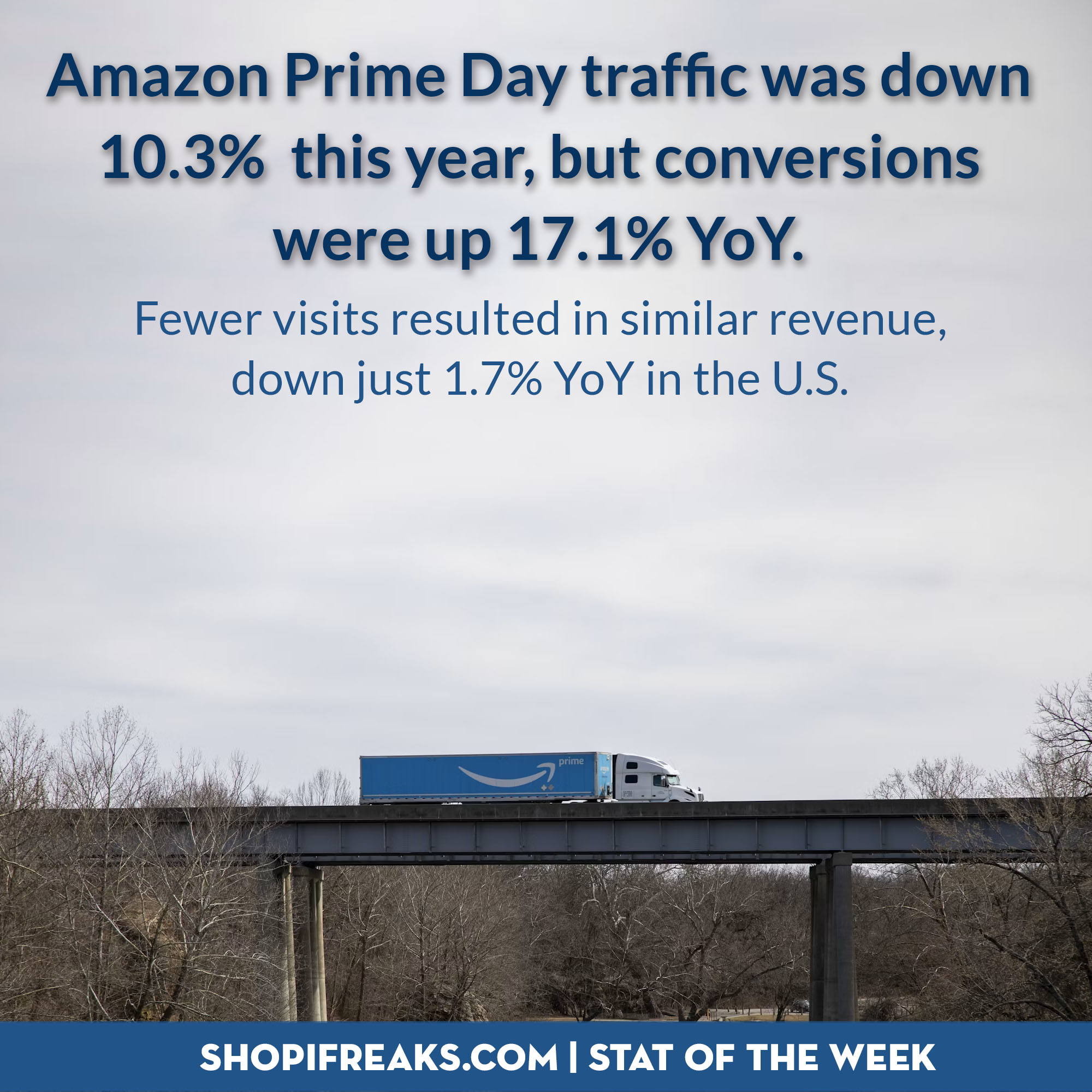
Amazon Prime Day traffic was down 10.3% this year, but conversions were up 17.1% YoY, according to ad-tech firm CommerceIQ. Fewer visits resulted in similar revenue, down just 1.7% YoY in the U.S., which CommerceIQ credits largely to Alexa for Shopping recommendations.
1. India says “WTF” to the WTO over member countries making their own side agreement
India formally questioned the World Trade Organization over the legality and legitimacy of an interim e-commerce arrangement that’s currently in place between 66 member countries. To paraphrase, India is like, “Hey, WTF is going on? I thought WTO needed unanimous agreement in order to move forward with pacts. Now these other countries can form their own agreements? That’s not how it works.”
Forgive the oversimplification above, but that’s essentially what’s going on.
Here’s a brief timeline of events:
- Back in 1998, when e-commerce was relatively new, WTO members agreed to a moratorium preventing any member nation from imposing customs duties on digital purchases like software downloads, music and movie streaming, e-books, and video games. The idea was to “temporarily” not tax the new digital economy while it was finding its footing, however, the moratorium ended up getting renewed roughly every two years for almost three decades.
- After nearly 28 years, developing nations like India, Brazil, Indonesia, and South Africa began pushing back, arguing that the moratorium was costing them billions in forgone tariff revenue each year, while primarily benefiting U.S. and European tech giants, which was a fair argument to make.
- The 2024 renewal in Abu Dhabi was positioned to be the final extension on the “temporary” moratorium, with the expectation that the next meeting would produce a longer-term or permanent solution.
- In March 2026, at the WTO’s MC14 meeting in Yaoundé, Cameroon, members couldn’t agree on a permanent solution, and the moratorium on e-commerce tariffs expired without renewal for the first time in nearly 28 years. The U.S. was pushing for a permanent moratorium, obviously, since that would greatly benefit U.S. Big Tech, but Brazil and a handful of others held firm against locking in a long-term deal.
- In April, 23 WTO members led by the U.S. issued a joint statement pledging to keep digital trade tariff-free among themselves, inviting other countries to join.
- In early May, the WTO General Council met in Geneva to try and break the deadlock, but Brazil held firm in its opposition. In response, the U.S. and a group of other countries, including Japan, South Korea, Australia, and New Zealand, pushed ahead with their own digital trade deal, the Agreement on Electronic Commerce (ECA), through “interim arrangements” that skip the unanimous sign-off the WTO normally requires. The pact keeps digital transmissions tariff-free among its members, sidestepping Brazil’s opposition, and has since grown to 66 countries.
Flash forward to today and India is asking:
- Is this even allowed? The 66 countries tried twice to get their deal into the official WTO rulebook and failed both times, because that requires everyone to agree, and India said no. Therefore, if it’s not in the rulebook, what gives the pact any official standing? How is it running at all?
- Why is the WTO’s top official helping run it? The WTO’s Director-General is acting as the deal’s official record-keeper — the person who collects and holds each country’s signature. India’s asking who authorized that. If the deal isn’t officially part of the WTO, why is the WTO’s Director-General doing its paperwork and lending it the organization’s credibility?
- Why was the rest of us kept in the dark? India wants to know how the Director-General agreed to take that role without looping in the other member countries, and it’s demanding written answers put in the official record and debated at the next big WTO meeting.
I’ve got to side with India on this one. How is this even allowed?
And to be clear, the problem isn’t that a group of countries wants to move ahead without everyone on board, as the WTO actually has a legal path for that called Annex 4. The catch is that getting into Annex 4 still requires every member to sign off on letting the deal in, even the ones who won’t be part of it. In this case, the U.S. and its partners couldn’t get that unanimous sign-off because India blocked it twice, so instead of playing by the rules, they’re routing around them while still using the WTO’s staff and Director-General to organize the deal. This is ultimately what India is challenging.
What’s the point of bylaws requiring consensus if members can just bypass them the moment they don’t get their way? Allowing that creates an environment where there’s no urgency to reach a real multilateral agreement and sets a bad precedent for negotiating good-faith deals in the future.
2. USPS quietly launches Local XChange to let buyers and sellers swap items through smart lockers
The U.S. Postal Service rolled out USPS Local XChange, a new service that lets people buying and selling on platforms like eBay and Facebook Marketplace exchange items through secure post office lockers rather than meeting face-to-face. The launch has not gotten much publicity, with only eCommerceBytes and a handful of postal-industry sites having covered it so far, and USPS’s own information on the launch is scattered across half a dozen pages that don’t fully agree with each other. So it appears that they are still finding their footing with it.
Here’s how Local XChange works:
- You agree to sell your used off-brand Crock-Pot to some idiot on Facebook Marketplace, who sends you $15 on Cash App.
- You collect the buyer’s name and e-mail address to input into the Local XChange system.
- Next, you create a free USPS.com account, pick a smart locker location within 50 miles of your return address, pay a fee, and drop the boxed item into the locker.
- The buyer then gets an e-mail with a Pickup QR Code and has five calendar days to retrieve the item. If the QR code won’t scan, there’s a six-digit backup code.
- If they aren’t able to make it to the post office in time, the package moves to the retail counter for another 10 days, requiring a photo ID for pickup.
- If the buyer still hasn’t picked up the item after the 10 days, it’s mailed back to you.
- For now, notifications are e-mail only. There is no text-message option.
The USPS’s Local XChange page and eCommerceBytes both list the cost of the service as $5.10 per transaction, but the USPS FAQ page says the charge is pegged to the prevailing price of a USPS Connect Local Flat Rate Box and lists $5.51 as of June 29. Either way, the seller pays, and the label becomes non-refundable the moment it’s scanned at the locker.
The program is currently running as a pilot, available only at postal facilities that already have smart lockers installed, for an unspecified time period. USPS said 700 post offices offered smart lockers as of last fall, part of the broader “Delivering for America” lobby-modernization push that also added enhanced self-service kiosks at 2,600 locations. Local XChange is a new use for existing lockers that were already handling deliveries, returns, and oversized PO Box packages.
USPS has a few rules about what can and cannot go inside the lockers:
- Anything that isn’t mailable is also prohibited (like fireworks or mercury).
- Live animals, alcohol, cremated remains, and hazardous materials are also prohibited, with an exception for the small lithium batteries inside electronics.
- Items have to fit the compartment, which maxes out at 22.5″ x 19.5″ x 14.5″, and some kiosks are smaller.
USPS is pitching Local XChange as a safe and convenient way to sell locally. No more meeting a stranger in a parking lot to complete a Facebook Marketplace sale, and no coordinating schedules for a handoff.
What about the buyer though? The primary reason to pay for and pick up an item in person is to verify that the item is what you expect. I would never send some random Facebook Marketplace seller payment in advance and hope for the best.
The service is also fairly costly. How expensive are the items USPS thinks people are buying on Facebook Marketplace? Let alone items that can fit into a small locker. Does USPS think I’m buying a Canon DSLR camera from a stranger online and paying for it in advance? Your average person selling an $8 holiday trinket isn’t going to pay $5+ to stick it in a locker. They’re going to show up at the back of the Ingles parking lot 25 minutes late with all their kids in the car and collect that $8 in cash.
I don’t see the Local XChange pilot being successful. It’s way too niche of a use case, and while it addresses safety and convenience, it ignores every other problem for buyers when shopping on local marketplaces. Swing and a miss.
3. Amazon is building a secret Alexa AI agent called Moonraker
Amazon is developing an Alexa project codenamed Moonraker that would let the assistant complete several actions from a single request, according to internal documents reviewed by Business Insider. Moonraker would push Alexa+ deeper into the AI agent race, handling multistep tasks like “book me a ride and text my friend” through partner apps like Uber, rather than one command at a time, similar to agentic products from OpenAI, Google, and Anthropic.
Amazon, which is one of Anthropic’s biggest investors, is testing Moonraker on hundreds of Nvidia GPUs paired with Anthropic’s Sonnet model — simultaneously racing Anthropic in the agent space while building on its tech.
The internal documents show how expensive the project is, calling it the “highest cost” new Alexa+ initiative, projected to cost more than $100M in GPU expenses in 2026. The document also mentioned delaying or scaling back the Moonraker project to lower cost.
However, in Amazon’s latest shareholder letter, CEO Andy Jassy said customers are talking to Alexa+ twice as much and placing online orders three times more often than before, which is reason enough to keep investing in Alexa. Plus, Amazon kind of owes it to the old girl. She’s part of the family now.
It’s also important to note that free Alexa+ access for Prime members ends in September 2026, after which it becomes a paid add-on, so Amazon has an existing pathway to recoup its investment.
I’m all for it personally. We have an Alexa Echo in our living room, but it’s the Dumb Alexa. Basically a glorified Bluetooth speaker at this point that we connect to our phones to play music. Occasionally we ask her “What time is it?” when we’re too lazy to turn our heads and look. She’s so very stupid though. Amazon needs to bend Alexa over and inject a syringe of AI in her butt before she’ll be useful. For that reason, I’m in favor of Amazon spending $100M to make her smarter. In fact, make it $200M. Just get the job done.
4. Klarna applies for a U.S. banking charter in Utah
Klarna applied to establish an FDIC-insured U.S. bank in Utah, which if granted, would allow the company to fund loans with customer deposits, expand into traditional banking products, and pull more of its payments, lending, and merchant operations in-house, instead of relying on third-party banking partners. Klarna Bank USA would be led by Gary Harding, former Chairman & CEO of Milestone Bank and former President & CEO of Prime Alliance Bank. Klarna already holds a full banking license in the EU, where it’s operated as a licensed bank since 2017.
CEO Sebastian Siemiatkowski said:
“We’ve seen firsthand the appetite for a fairer, more transparent approach in the U.S., and our own banking license is the natural next step, giving customers tools to borrow responsibly and build financial confidence, while bringing greater competition, innovation, and choice to consumers and merchants alike.”
If the move sounds familiar, it’s because every fintech wants to be a U.S. bank now. In December 2025, I reported that PayPal applied for a banking license, joined by Affirm in January 2026. Mercury, Revolut, Sezzle, Upstart, Mission Lane, Circle, and Ripple, among other fintechs and BNPL firms, have also applied for banking charters, or announced plans to do so, in recent months.
It hasn’t been easy to become a bank, until recently.
What changed is the regulatory environment surrounding nontraditional bank charters. The Office of the Comptroller of the Currency has begun approving national trust bank charters for crypto and payments firms, allowing them to operate under federal banking supervision without taking insured deposits or offering checking and savings accounts.
At the same time, the FDIC has revived support for industrial loan company charters, which let commercial and payments firms offer lending and certain banking services while avoiding Federal Reserve oversight under the Bank Holding Company Act, lowering the barrier for fintechs and large brands to pursue bank-like status.
I’m in favor of more banks. The industry needs more competition for the benefit of consumers. There are around 4,379 FDIC-insured banks and savings institutions in the U.S. today, down sharply from more than 14,000 in the mid-1980s after decades of consolidation. The industry has long been dominated by the same large incumbents, with only a handful of new banks chartered each year until a recent small uptick began in the early 2020s. It’s estimated that the top four U.S. banks, JPMorgan Chase, Bank of America, Wells Fargo, and Citi, hold roughly 45% of all U.S. bank deposits, and the top 10 banks hold a 65% share.
The space is ripe for competition and innovation, which can only come from dishing out more banking charters. The banking industry is overdue for a competitive correction.
5. eBay adds livestream shopping to its affiliate program
eBay is adding its Live livestream shopping to the eBay Partner Network, letting affiliates like creators, publishers, and deal sites earn commissions for driving traffic to live shopping events. Affiliates were told by email last week and provided new reporting fields to track live-event performance, as reported by Liz Morton of Value Added Resource.
eBay was early to enter live shopping, but moved slowly afterwards, to the distress of sellers. The company first launched eBay Live in June 2022 in beta with a focus on trading cards and Funko Pops, but kept it locked to eBay-produced streams with hand-picked seller partners rather than opening it to everyday sellers. It also launched without the livestream auction format that made rivals like Whatnot and Poshmark popular. For several years, eBay said that auction support was “on the roadmap,” but it lost a lot of sellers in the meantime.
The recent move to add livestream shopping to its affiliate program aligns eBay more closely with competitors like TikTok, Whatnot, and Amazon Live, which already reward affiliates for driving traffic to livestreams.
In April, I reported that eBay is launching a new “streaming as a service” pilot program that connects sellers with livestream hosts, allowing them to participate in Live commerce without having to host the sessions themselves. However, details about the service, including how much it will cost, still have not been provided yet. Nor has eBay specified whether it would exclusively be matching sellers with “human” hosts, leaving the door open for digital avatars to do livestreaming.
eBay appears to be getting more serious about livestream selling, but it’s certainly taking its sweet time to do so.
6. Amazon to penalize B2B sellers who don’t deliver orders within business hours
Amazon will require professional sellers to maintain a Business Hour Delivery Rate of 90% or higher on seller-fulfilled orders starting September 30 in the U.S., U.K., and Germany, meaning packages must reach Amazon Business customers during their operating hours. Sellers whose rate stays below 90% by October 30 risk having their offers deactivated for Amazon Business customers, though FBA and retail offers are unaffected.
The metric has existed for a couple of years, but until now, it was informational only, with Amazon telling sellers it carried no penalty. Now Amazon writes:
“For Amazon Business customers, receiving shipments during operating hours is essential to packages getting received securely and on time, with fewer re-delivery attempts. […] If your Business Hour Delivery Rate is below 90% on September 30, we’ll notify you and provide recommendations on how to improve. If your rate doesn’t improve by October 30, your seller-fulfilled offers may be deactivated for Amazon Business customers.”
The big problem for sellers is that they don’t control when UPS, FedEx, or USPS actually attempt a delivery. Even if they hand off the package on time, they’re at the mercy of the carrier to deliver on the expected date and within business hours.
Sellers on Amazon’s forums have expressed their frustration with the change:
- “This is EXTORTION!! If they don’t eliminate this OTD rate… it’ll be the death of all of us 3rd party sellers on Amazon. We can’t control this metric, it’s the shipper’s performance, and they hold us accountable.”
- “What in the holy #*@! I can NOT believe they went through with mandating this garbage metric. Looks like the end for most of us non FBA sellers.”
- “How in the heck do I make sure the carrier delivers during business hours for my $7-$15 items shipped via Ground Advantage? It is not like I can assign a shipping method to a certain customer.”
- “Amazon’s own carrier fails in this department miserably… they are constantly trying to deliver our orders after the business hours. Do they punish themselves for that? I don’t think so.”
- “This is the first step in Amazon making this broken metric a requirement. It will NOT apply to FBA… We are not in charge of shipping companies, and can’t be held responsible for their performance.”
Is this basically Amazon’s way of pushing everyone to FBA, as that’s the only exception to falling below that 90% threshold?
The running theory on seller forums is that the change is designed to make self-fulfillment impossible, forcing them to move to FBA, where Amazon collects the fees. Amazon representatives suggest tools like Automated Handling Time, Shipping Settings Automation, and Amazon Buy Shipping to ease the pressure of the new requirement, but those are the same tools sellers say they already use while sitting below 90%.
Setting unrealistic delivery guidelines that exempt your own fulfillment service from having to hit the same metrics feels a bit “anti-competitivey” if you ask me, but Amazon certainly didn’t ask me.
7. OpenAI adds custom-audience targeting to ChatGPT Ads
OpenAI added custom-audience targeting to ChatGPT Ads, letting advertisers upload their own e-mail and phone lists to reach specific customers, mirroring the same first-party data method used on Google and Meta.
The move was spotted early last week by Craig Graham, CEO of Grayvault Consulting, who wrote:
“The setup itself is straightforward. In the Ads Manager, under Audiences, you create an audience and upload a list. You give it a name, choose the identifier type, and upload a CSV or TXT file. The platform then matches your list against its users and, once processing is done, the audience shows as ready with an approximate count of matched users. From there, at the campaign level, you apply that audience as either an included or an excluded custom audience.”
He went on to say not to expect perfection or one-to-one matching:
“One practical note on match rates: expect to match a portion of your list, not all of it, the same as on any other platform. Only the people whose details match an account will be found. A modest match rate is normal and not a sign anything is wrong, but it does mean you should think of these audiences as directional rather than complete, which matters when you are relying on an exclusion to protect spend.”
OpenAI officially announced the new feature yesterday, a few days after it was spotted in the wild and reported on by various publications. Note that it’s geared towards larger businesses with at least 25,000 matched users, but OpenAI recommends audiences of at least 100,000 users.
8. Meta launched a new image generation model, and the Internet was not a-Mused
Meta introduced Muse Image last Tuesday, the first image-generation model from its Superintelligence Labs, and by Friday, was already pulling back on a feature that wasn’t received too well. Here’s what happened…
Muse Image was built to power image generation in Meta’s Advantage+ ad creative tool (coming soon). The model uses agentic visual reasoning to interpret full creative briefs rather than keywords, producing on-brand ad variations while swapping styles and adjusting elements with fewer iterations. The model also enabled features like Room Restyling, a new AI shopping tool that lets shoppers upload a photo of their space so Meta AI can place business’ catalog products into their actual room. Cool stuff so far.
However… Muse Image also included a feature that let people create AI-generated images from your public Instagram photos — and that didn’t go over too well with users. Hannah Einbinder, the actress on “Hacks,” criticized the feature, saying it had been turned on automatically, and encouraged users to shut it off.
Then SAG-AFTRA (the actors union) spoke up about it:
“Anything other than a clear and conspicuous opt-in for these types of uses of Instagram users’ images is unacceptable, and an utter miscalculation of public sentiment regarding the obvious dangers and harms inherent in such use… With the dangers of nonconsensual digital replicas well known to all, a feature that encouraged that behavior is unwise.”
Meta said:
“Our intent was to provide a useful creative tool and to give people control over whether their public content could be referenced in this way… We’ve heard the feedback that this feature missed the mark, so it’s no longer available.”
Meta shut the feature down on Friday.
Honestly, what was Meta thinking? Is leadership completely out of touch with user expectations around privacy and safety? And are staff too worried about being replaced by AI to speak up in opposition of these idiotic features before they go live? “Hey guys, let’s release an AI feature that lets people create images of other users in compromising positions without their consent!” The fuck, Meta. My phone number is in my e-mail signature if you guys want to run this stuff by me in the future.
9. Other e-commerce news of interest
OpenAI is preparing to expand its advertising pilot into France, Germany, Ireland, and Singapore, based on new job listings for regional ad teams spotted by Digiday. The move comes just a few weeks after the company launched the pilot in the UK, and will eventually bring the program to 13 markets globally including the U.S., UK, Canada, Australia, New Zealand, Japan, South Korea, Mexico, and Brazil, as announced so far by OpenAI. The upcoming rollout encompasses Europe’s three largest digital ad markets, which together accounted for 62% of the region’s ad revenue last year.
Google is adding a Search Console feature called platform properties that lets creators and publishers see which Google Search terms lead people to their Instagram, TikTok, X, and YouTube content. Creators can track clicks, impressions, and queries by post, view traffic trends and top performers, and see how audiences discover their accounts, even without having their own website. Google frames the feature as part of its push to make Search a hub for creators, following a June update that let big creators and publishers claim dedicated Search profiles linking to their other platforms. I love the feature, but am curious why Facebook was left off the list of social platforms, given that Instagram is included (meaning it’s not an issue with Meta platforms in general). Some outlets reported seeing Facebook as part of Google’s December 2025 experiment, but Google has never specifically referenced the platform.
USPS began charging a $7.50 hazmat handling fee on Priority Mail for some household goods, including essential oils, nail polish and remover, perfumes, hand sanitizer, inks, stains and varnishes, hairspray, and electronics with lithium batteries. The “hazmat” classification isn’t new, as these are all flammable or battery-related items that the Department of Transportation has long classified as hazardous for transport, but the fee is new. Historically, USPS has eaten the additional safety and handling costs associated with transporting these items, and will now begin passing them on to customers as part of its broader cost recovery efforts. Sellers who don’t properly declare and label hazmat face a separate $50 noncompliance fee, which applies to Ground Advantage too (where the handling fee itself is $0 for now). The change took effect July 12, bundled with a broader USPS rate hike, with another increase coming in October.
Marketplaces like Amazon and Walmart draw 44% of shoppers making a first purchase from a new brand, compared to 10% who start on retailer sites like Target or Macy’s and 3% who shop on social platforms like TikTok Shop, according to a Dynata survey commissioned by Radial. Some 38% of shoppers reported using marketplaces more often than in 2025, led by millennials at 45% and Gen Z at 44%, versus 19% shopping retailer sites more and 13% social commerce. About four in ten respondents said they trust a brand more when it sells across multiple destinations, rising to 56% among Gen Z, while just 5% trust it less. Lastly, merchants better keep their expedited shipping promises, because more than half of respondents said they’d stop buying from a brand after paying for expedited shipping that didn’t actually arrive faster.
Cloudflare launched a research pilot with OpenAI to test whether signals from its global network can help AI search engines index and crawl the open web more effectively. Real-time signals such as content freshness, traffic quality, and page changes will feed the effort, aimed at making AI answers more accurate and up to date. OpenAI brings its frontier models, search system, and real user queries to test, while Cloudflare brings its cloud distribution network that powers more than 20% of the web. This is a brilliant move, as OpenAI has historically fallen short on surfacing up-to-date information about events happening in real-time, and tapping Cloudflare’s network gives it a live read on what’s changing across a huge chunk of the web without having to build Google-scale crawling infrastructure itself. As for Cloudflare, it’s spent the past year positioning itself as the toll booth between AI crawlers and publishers, with features like pay-per-crawl and bot-blocking, and this pilot extends that effort.
Meta denied knowingly running paid ads that promoted child sexual abuse material on Instagram after a BBC investigation found the ads targeting users in India and directing them to Telegram channels. Even after Meta said it had removed the ads, the BBC found roughly 30 more, to which Meta replied that “no system is perfect” and that its review process “may not detect all policy violations.” I believe Meta when they say they didn’t know — and that’s the problem. They’ve created an environment where anything goes, as long as it brings in revenue for the company and no one’s paying attention. India’s government ordered Meta to remove the content and explain how the ads cleared an approval process meant to review every Instagram ad before it runs. Meta is shifting most of its content and ad review to automated AI moderation by 2027, but I’d imagine that this AI system won’t be “perfect” either.
Google appears to be testing google.com/goto passthrough URLs in some search results, rewriting result links to route each click through a Google redirect before it reaches the destination site. The encoded URL parameter can’t be read directly, so scrapers and AI bots that once pulled clean destination links straight from the results page now have to follow each redirect through Google, which slows them down and hands Google a signal every time they do. The change also disrupts legitimate SEO and analytics tracking, while hiding the destination link that searchers often check to confirm they’re landing on the right site and to spot phishing attempts before clicking. SEO analyst Brodie Clark flagged the pattern and Ahrefs has picked it up across a rising share of queries, though sightings remain limited and it’s unclear whether Google is running a small test or slowly rolling it out.
43% of consumers abandon a purchase when BNPL is unavailable, according to a PYMNTS Intelligence report with PayPal — which seems incredibly high to me, given that only a single-digit percentage of online transactions globally are made using BNPL payments. The report found that presenting BNPL as a payment option early in the shopping journey, such as on product pages, collections, and in the cart, increases overall sales by 4.4%, indicating that the availability of BNPL can alter shopping behavior before checkout even begins. 81% of respondents said they spend more when using BNPL, while 42% said they pick a cheaper option when it’s absent. So basically the report says that financial literacy isn’t a strong point among consumers who use BNPL.
Google added a “How this ad was made” section to its My Ad Center panel, letting users check whether an ad across Search, YouTube, and Discover was created or edited with AI. Advertisers using Google’s own generative-AI ad tools get the disclosure automatically, while those using other tools must flag AI involvement through a new control. The move follows New York’s AI Synthetic Performers Disclosure Law that went into effect June 9, which requires advertisers to conspicuously disclose when an ad features an AI-generated human likeness that doesn’t depict a real person, including e-commerce product and lifestyle imagery shown to New York shoppers. Meta and TikTok also made AI ad transparency moves last week, with Meta adding AI tags to its “About this ad” menu on Facebook and Instagram, and TikTok joining the C2PA content-provenance standard and rolling out new AI-detection and labeling tools.
In other Google ad updates… The company introduced Qualified Future Conversion, a new Gemini-powered Google Ads metric that estimates how much future revenue a brand-awareness or prospecting campaign will drive. The metric forecasts conversions expected within 180 days of an ad interaction by blending live signals with past data to project sales. In comparison, standard lookback windows typically undervalue brand and prospecting campaigns, capturing only about 70% of conversions for a typical campaign within a 30-day-click and 3-day-engaged-view window and leaving 30% unattributed. Google announced the metric at Google Marketing Live in May and only explained it last week, testing it with select advertisers before a wider rollout later this year to supplement metrics like attributed branded searches.
Meta paused (not canceled) its Model Capability Initiative, aka its employee spying program, which tracked employee keystrokes and mouse movements, after an internal data leak made sensitive employee data like private conversations, performance records, AI prompts, and even personal tax and medical information accessible to the entire company, according to CTO Andrew Bosworth during an interview with The Atlantic. Bosworth said a researcher moved the transformed employee data to an internal location it shouldn’t have reached, noting that there was no external breach or sign of foul play. Okay, so your nosy co-worker got dirt on you, not an outsider? Somehow that doesn’t seem any better. Meta launched the program in April without an opt-out, drawing heavy workforce backlash, and Bosworth has said morale ranked among the worst in the company’s two-decade history.
In lawsuits this week…
- California, Colorado, Kentucky, and New Jersey are seeking $1.4T in penalties from Meta over claims that the company built Facebook and Instagram to be addictive to young users, a figure close to Meta’s roughly $1.5T market value. Meta called the demand “outlandish” — a word that one might also use to describe Meta’s behavior during the past several decades.
- Apple is suing OpenAI and its chief hardware officer Tang Tan for allegedly stealing trade secrets to develop competing devices. Tan, a 24-year Apple veteran, allegedly directed job candidates to bring Apple parts to interviews, while co-defendant Chang Liu, a former Apple engineer, kept a company laptop and downloaded dozens of confidential hardware files. OpenAI said it has “no interest in other companies’ trade secrets” and that it remains “focused on building innovative technology that empowers people everywhere.”
- eBay asked a Utah federal court to move most of a former employee’s whistleblower and retaliation lawsuit into private arbitration and pause the case, without addressing the plaintiff’s underlying allegations. Paige Williams, terminated in January 2024, alleges retaliation after she flagged a systemic practice of manipulating metrics tied to eBay’s Promoted Listings ad program and reported it to the SEC. eBay concedes it can’t force her Sarbanes-Oxley whistleblower claim into arbitration but wants it paused anyway, which would keep the Promoted Listings allegations out of public view.
- Block agreed to a $45M settlement with 46 states over allegations that Cash App misled users about its safety and failed to protect them from fraud. State investigators said Block pitched Cash App as bank-safe to unbanked users while fraud rose, ran a frictionless sign-up with weak identity checks, and offered no phone support for years, leaving locked-out users to call scam numbers. Block must now add 24-hour live phone support, stop misleading safety claims, end fraud-linked marketing like its Cash App Fridays promotion, and properly investigate fraud and refund unauthorized transactions. The $45M is separate from at least $75M in consumer restitution Block owes under an earlier CFPB settlement, which the states will enforce if Block doesn’t pay.
- A federal judge approved the SEC’s $1.5M settlement with Elon Musk despite “significant misgivings,” saying it wasn’t the court’s place to second-guess the agency even though the deal raised red flags. The case stemmed from Musk failing to disclose that his Twitter stake had crossed 5% in early 2022, waiting until it hit 9% in April, which the SEC said cost shareholders $150M before he bought the company for $44B. Separately, a California jury found in March that Musk defrauded Twitter shareholders in a class action that could run to $2.5B, which he’s fighting to overturn.
- News outlets led by the New York Times asked a federal judge to sanction OpenAI, alleging it concealed and deleted records of how ChatGPT used copyrighted news. Plaintiffs claim OpenAI deliberately withheld its training datasets and ChatGPT logs, and that a recent employee deposition contradicts the company’s earlier statements about its ability to search those logs. More on this in this week’s Most Ridiculous Story below.
- Depop saw a proposed federal class action over its hidden Marketplace Fee voluntarily dismissed without prejudice, leaving a similar California state case pending. Plaintiff Linsey Dinh, who accused Depop of “drip pricing” by hiding a $1.55 Marketplace Fee on a $17 purchase until checkout, dropped the suit Friday with no ruling on whether the practice broke California’s Honest Pricing Law. A near-identical state case, Yuen v. Depop, was filed months earlier and has already reached mediation, all as eBay’s ~$1.2B acquisition of Depop awaits UK clearance.
- Amazon agreed to a class-action settlement that lets U.S. consumers pursue more than $200M from third-party social casino app developers sold through its Appstore, resolving a 2023 suit alleging Amazon violated Washington gambling and consumer-protection laws by brokering the transactions. Amazon will ultimately pay just $2.5M of its own money and sign over its right to sue the developers, letting the plaintiffs chase them for the rest.
- AmazonFresh is being sued by a former Amazon employee for allegedly misclassifying assistant store managers as overtime-exempt to avoid paying them for hours worked past 40 a week. The plaintiff argues the assistant managers’ primary duties are non-exempt work like customer service, stocking, cooking, pushing freight, and cleaning, and that they had no say in hiring or firing. LOL, everyone’s a manager now? Nice try, Amazon.
In layoffs this week…
- Microsoft laid off around 4,800 employees, or 2.1% of its global workforce, mostly from its sales and Xbox divisions. HR chief Amy Coleman told employees the eliminated roles are “not being directly replaced by AI.” So, just indirectly? The layoffs follow the elimination of roughly 15,000 roles at the company last year.
In corporate shakeups this week…
- Fiserv president Dhivya Suryadevara resigned for “good reason” on July 7, less than a month after her promotion to the role. The move follows last month’s departure of CEO Mike Lyons for Truist, which elevated Takis Georgakopoulos to CEO and Suryadevara to president in the same shuffle.
- Whoop hired former Nike CMO Dirk-Jan van Hameren as CMO to oversee brand partnerships, athlete relationships, and product storytelling to drive awareness and subscriptions. He’s the third Nike alum in Whoop’s C-suite, joining CFO Michener Chandlee and chief creative officer Johan Liden.
- OpenAI product and business chief Fidji Simo stepped down Thursday due to a chronic illness, handing product oversight to president and co-founder Greg Brockman while her broader duties split between CFO Sarah Friar and CSO Jason Kwon. Simo, a former Meta executive and Instacart CEO who led OpenAI’s product road map for about a year, will stay on as a part-time advisor after taking medical leave in April.
- OpenAI named Mili Kapoor its consumer marketing lead for India, hiring the former Apple iPad product marketing lead to expand ChatGPT’s consumer push in one of its fastest-growing markets. Kapoor brings nearly two decades across Meta, Nestlé, Philips, Pernod Ricard, and PepsiCo before her Apple stint.
- OpenAI chief futurist Joshua Achiam is leaving later this month after nearly nine years, the latest in a run of safety-focused departures as the company heads toward an IPO. Achiam, who joined as a 2017 intern and led the now-disbanded Mission Alignment team, follows Jan Leike, who left for Anthropic, plus Miles Brundage, Steven Adler, and Andrea Vallone.
- Lastly in OpenAI news… The company posted two job listings including one for an investment-banking expert to train its models on M&A, valuation, and deal execution, and one for a product manager building for families, caregivers, and older adults. The family-focused role follows a demographic shift, with ChatGPT’s 35-and-older share rising to 31% globally in Q2 from 26% a year earlier as the 18-to-24 share fell to 29% from 34%, per Sensor Tower.
- Ben Bernanke, the former Federal Reserve chair and Nobel-winning economist, joined Anthropic’s Long-Term Benefit Trust, an independent governance body that can appoint and remove a growing share of the company’s board to hold it to its public mission. Bernanke, the trust’s fourth member, will advise mainly on AI’s economic effects, including its impact on jobs and the workforce.
- Airbnb hired Michael Tabtabai as VP of creative, poaching OpenAI’s first global creative chief less than a year into that role as Airbnb builds out its in-house creative team. He will oversee design, marketing, and brand work as Airbnb expands into AI-powered travel features and tries to keep its product from blending in with rivals routed through ChatGPT.
OpenAI released its GPT-5.6 model family to the public on Thursday after the Trump administration approved a broad rollout, ending weeks of restricted access limited to roughly 20 government-vetted partners. One of 5.6’s models, Sol, drew federal scrutiny that delayed the launch over its coding, biology, and cybersecurity skills, which prompted the Commerce Department’s AI standards body to evaluate the models before clearing them. CEO Sam Altman said the company made “many changes” during a collaborative back-and-forth with the Trump administration, but didn’t mention specifics. Anthropic faced similar intervention in June over its Fable 5 and Mythos 5 models, with Mythos 5’s controls lifted only for a limited group of cyber-defense and infrastructure users. How is the government determining if and when these models are ready for release? TechCrunch says, “Nobody’s quite sure.”
Microsoft is replacing OpenAI and Anthropic models with its own in-house MAI models in Excel and Outlook, according to Bloomberg, with tens of thousands of AI prompts in those apps now handled weekly by MAI instead of the outside labs. The main driver for the change is cost, with AI model chief Mustafa Suleyman saying in June that Microsoft’s goal is to “reduce and ultimately eliminate” what it pays Anthropic. Microsoft currently receives a discount on OpenAI tokens as a perk of being an early investor in the company, but that arrangement won’t last forever, and Microsoft wants to be prepared for when it runs out. Microsoft rolled out seven new AI models at its June Build conference, including one it says matches the coding ability of Anthropic’s Opus 4.6 at a lower cost.
The European Commission issued preliminary findings that Meta is in breach of the Digital Services Act over its “addictive” design features on Instagram and Facebook such as infinite scroll, auto play, push notifications, and personalized recommendation systems. The Commission also accused Meta of ignoring how much time young people spend on the apps at night, and how its various content formats, including reels and stories, could lead to excessive use of its services. Meta is facing fines of up to 6% of its total annual turnover, an estimated $12B, if the Commission’s findings are confirmed, which is no big deal, as it’s only about three-quarters of what Reuters reported it made from scam ads last year. Meta said it disagrees with the preliminary findings, which “don’t accurately take into account the significant steps we’ve taken to protect teens.” Since the investigation began, Meta rolled out Teen Accounts that allow parents to block access to the accounts at night and cap daily screen time at 15 minutes.
The Bank of England was given authority to regulate Amazon Web Services, Google Cloud, Oracle, and Microsoft, which supply roughly 73% of UK financial firms’ cloud services, in response to fears that system failures could threaten financial stability and harm consumers. Starting today, the Bank, alongside the Financial Conduct Authority and the Prudential Regulation Authority, will be in charge of overseeing whether the four companies run adequate stress tests against emergency scenarios, and will require them to report major incidents like cyberattacks, outages, and natural disasters directly to regulators. The oversight applies only to the services these firms provide to the financial sector, not their broader commercial operations, and comes after an October AWS outage that disrupted more than 2,000 companies, including Lloyds Banking Group, one of the UK’s largest banks.
eBay violated multiple user-rights provisions of the EU’s Digital Services Act, according to Germany’s Digital Services Coordinator. Violations include a desktop reporting process that regulators say is hard to use, insufficient explanations when listings are removed or accounts are suspended, and seller information that isn’t easily accessible. Regulators ordered eBay to fix the problems or face escalation, which could include imposing fines on the company. eBay pushed back, saying it takes its DSA obligations seriously and believes it has carefully implemented the requirements, noting that it remains in “close and constructive dialogue” with the regulator.
Google introduced new video commerce tools for Southeast Asia at its Marketing Live event in Singapore, expanding shopping across YouTube, Search, and marketplaces. Commerce Media Suite lets shoppers jump from a YouTube ad straight to a marketplace checkout, Affiliate Partnerships Boost lets marketplaces and retailers promote high-performing affiliate videos as paid ads, and Creator Partnerships Boost, a rebrand of Google’s existing Partnership Ads, lets brands run creators’ videos as ads from the creator’s own channel. Google is piloting Commerce Media Suite and Affiliate Partnerships Boost with Shopee, with Southeast Asia one of the first regions globally to test the affiliate tool. Video commerce in Southeast Asia grew fivefold from 2022 to 2025 to reach 25% of the region’s e-commerce sales, according to Google.
The Hyundai, a major South Korean department store chain (and distant cousin to the Hyundai car brand), launched an experimental e-commerce app called The Hyundai Hi that replaces algorithmic rankings and best-seller lists with tastemaker curation, gamified “gems,” and editorial content. The platform’s actors, models, and writers, which it calls “Icons,” post shopping recommendations across more than 3,000 brands spanning fashion, beauty, home goods, and even livestreamed fresh produce, while a “Saved Item” star replaces the standard “Add to Cart” button. The app has generated about $35.3M in GMV since soft launching in April, up 43.5% from the retailer’s former online store, with user registration up 560%, according to The Hyundai.
🏆 This week’s most ridiculous story… OpenAI has been lying in court, according to The New York Times and other publishers, which are accusing the company of falsely denying its ability to search customer chat log data. The accusations are an escalation in a two-year lawsuit, which alleges that OpenAI violated copyright law by training its generative AI models on the publishers’ content and reproducing the journalism in user outputs. Throughout the case, OpenAI has claimed it lacks the ability to search the material it used to train its models and that doing so would violate the privacy of its users. However, in a court deposition earlier this year, OpenAI data privacy engineer Vinnie Monaco revealed that the company had already conducted internal searches and evaluations of its training data to locate copyrighted journalism works. He also shared that OpenAI has amassed a database of about 78M ChatGPT conversations that it was using internally to determine how much it was infringing on others’ works. Good lord! So, not only does OpenAI knowingly infringe on copyrights, they also have a tool that measures how much they do it?! “Hey guys, we only infringed on two-hundred million works this week. Good job bringing that down 3%!”
10. Seed rounds, IPOs, & acquisitions
Taxwire, an AI-powered sales tax and VAT compliance platform that automates product tax coding, rate calculation, filing, and remittance across 100+ countries, raised $25M across combined seed and Series A rounds led by Headline. The company pairs its AI tax engine with human tax experts to handle the full compliance cycle, from nexus tracking and registration to filing and remittance. Taxwire plans to use the capital to scale its managed tax infrastructure, expand its automated geocoding across global tax systems, and hire more data engineers.
Even Realities, a Shenzhen-based smart glasses startup founded by former Apple engineers, raised $150M in a pre-Series B round led by Meituan and Tencent at a $1B valuation. Founder and CEO Will Wang, who worked on the Apple Watch and iPhone before leaving Apple in 2018, differentiates the company’s flagship Even G2 glasses from Meta’s Ray-Ban line by leaving out a camera and focusing instead on an optical display embedded in the lenses that surfaces messages, directions, and real-time translation. The company plans to use the funding to expand internationally and strengthen its AI capabilities, as smart glasses shipments jumped 167% YoY to 2.25M units in the first quarter, with Meta holding roughly 70% of the market.
Floqer, an AI customer-data platform that unifies data sources into a single customer view for go-to-market teams, raised $2M CAD in a pre-seed funding round backed by Perplexity’s F7 Fund, its co-founder Denis Yarats, N49P, and Tidal Venture Partners. The platform, which pitches itself as an alternative to Clay and Common Room, pulls more than 100 third-party data sources together with a company’s CRM, Slack, and sales calls, letting sales teams surface buying signals and automate lead enrichment. The funds will go toward developing deeper first-party integrations and broader data coverage, and building an agentic GTM platform.
Banzai, an AI marketing and sales technology company whose tools help businesses run and measure webinar, video, and demand-gen campaigns, acquired ConnectAndSell, an AI sales-acceleration platform that helps B2B teams reach decision-makers in live phone conversations, for $13.2M in a mix of cash, seller’s notes, stock, and earn-outs. The deal adds phone-based sales acceleration to Banzai’s marketing and sales software portfolio, with most of ConnectAndSell’s 38 employees joining the company.
Descartes Systems Group, a Canadian cloud logistics and supply chain software company, acquired Drivin, a Santiago, Chile-based provider of last-mile delivery management software for Latin America, for roughly $30M in cash, plus up to a $5M performance-based earn-out. Drivin’s platform helps retailers, distributors, and logistics providers optimize routes, manage dispatch, and track real-time delivery execution using machine learning and agentic AI, with strong adoption in dense urban markets. The deal, which marks Descartes’ 33rd acquisition since 2017 and third of 2026, expands its AI logistics capabilities, deepens its Latin America reach, and adds operational delivery data to serve distribution-heavy businesses.
Whering, a London-based mobile app that lets users digitize and manage their wardrobes, raised $7M in a seed funding round led by eBay Ventures and Google’s AI Futures Fund, bringing its total amount raised to $14M. eBay’s interest ties to its resale business, which benefits from keeping clothing in circulation longer, given Whering’s data on what people own and actually wear. Google’s fund backs AI styling features Whering is rolling out, including image enhancement capabilities, a virtual try-on tool, and outfit suggestions based on mood, weather, or occasion.
Auger, a supply-chain technology startup founded by former Amazon operations chief Dave Clark, raised $50M in a Series B round led by Eclipse, bringing its total amount raised to $150M. The platform sits on top of a company’s existing ERP, warehouse, transportation, and demand-planning systems, using AI agents and optimization models to make and execute supply-chain decisions automatically rather than just flagging them, and now counts Meta, Fanatics, and Kimberly-Clark as customers. Clark, who spent 23 years at Amazon and briefly led Flexport before founding Auger in 2024, said about 85% of the decisions Auger manages at Fanatics now run autonomously.
Amazon raised $25B through an eight-part bond sale to help fund its AI infrastructure buildout, primarily the development of data centers and chips. Underwriters were told that this is Amazon’s final debt issuance of 2026 following roughly $54B in bond sales earlier this year. Demand for the bond sale came in softer than earlier sales, with orders settling around $41B, or just 1.6x the deal’s size, versus the roughly 4x in orders that similar top-rated corporate bond sales have averaged this year, forcing Amazon to sweeten terms with extra yield. The sale pushed Amazon’s bond issuance over the past 12 months to about $107B, the most of any Big Tech company, as it funds a projected $200B in capex.
OpenAI took out a $520M line of credit from Bank of America ahead of its planned public offering, marking its first loan from the bank, according to Reuters sources. Bank of America is now one of OpenAI’s largest lenders, a position it has built while helping raise nearly $500B for AI-related companies since 2025. Bank of America is also seeking advisory roles on the planned IPOs of both OpenAI and Anthropic, after recently helping run SpaceX’s record June listing. Doesn’t OpenAI have like $73B in the bank? Do we need to be pouring more gasoline on the fires of these AI giants or could other startups use a leg up too?
OpenAI’s Deployment Company agreed to acquire Northslope, an applied-AI firm founded by ex-Palantir engineers, for undisclosed terms, according to Axios. The deal marks its second acquisition aimed at helping enterprises put AI into core operations, following its acquisition of Tomoro earlier this year. OpenAI’s approach to hiring and deploying forward-deployed engineers mirrors Palantir’s model of embedding engineers directly with clients — a model now also being adopted by Anthropic, Amazon, Microsoft, Google, Salesforce, and other AI firms.
Wonder, the meal-prep and delivery company that owns Grubhub and Blue Apron, is raising hundreds of millions at a $9B valuation in what could be its last round before an IPO, with founder Marc Lore indicating he’ll add $200M of his own, according to The Information. Lore has told staff an IPO could come as soon as next year, though Wonder is deep in the red after spending roughly $250M in cash and taking on $500M of Grubhub debt to buy Grubhub and Blue Apron. Wonder’s $9B target sits below the $11B it sought earlier this year, with investor materials projecting nearly $2.7B in cash burn through 2029 before it turns cash-positive in 2030.
Shein won approval from China’s securities regulator for its long-awaited Hong Kong IPO, its third attempt to go public after failed bids in New York and London, according to Reuters. Approval lets Shein line up investor roadshows and a listing-committee hearing, with the company reportedly eyeing a $40B to $50B valuation and a possible September or October debut, a target that sits well below its $100B valuation in 2022 and $66B in 2023. Beijing treated the listing as politically sensitive, reportedly clearing it only at the highest levels after controversies over supplier labor practices, and Shein still faces EU scrutiny and over €200M in French fines.
Thanks for being a Shopifreak!
If you found this newsletter valuable, please leave a review on Google and share the newsletter with your friends and colleagues to help us grow.
See you next Monday,
PAUL
Paul E. Drecksler
🌐 Shopifreaks.com
🧑💼 Add me on LinkedIn
📧 [email protected]
📱 +1-828-273-3031
⭐ Leave A Review
PS: What do you call a mouse who curses a lot? A cursor.