Hi Shopifreaks
Major news this week — de minimis is officially coming to an end! Learn more in this week’s headline story below.
I’d love to hear your thoughts on how this will impact the economy, the retail industry, and/or your business in particular. Hit reply and share your insights after you’ve had a chance to read this week’s edition.
Here’s what else I cover this week:
- Amazon’s one millionth robot
- Google’s Offerwall for publishers
- OpenAI expands into consulting
- OpenAI vs Meta
- TikTok may be divesting soon
- Meta messenger & ad updates
- Amazon vs Nintendo
- OpenAI shopping assistants for Shopify
- Google price change rich results
- eBay photo carousels
- Tariff engineering
All this and more in this week’s 233rd Edition of Shopifreaks. Thanks for subscribing and sharing!
Stat of the Week
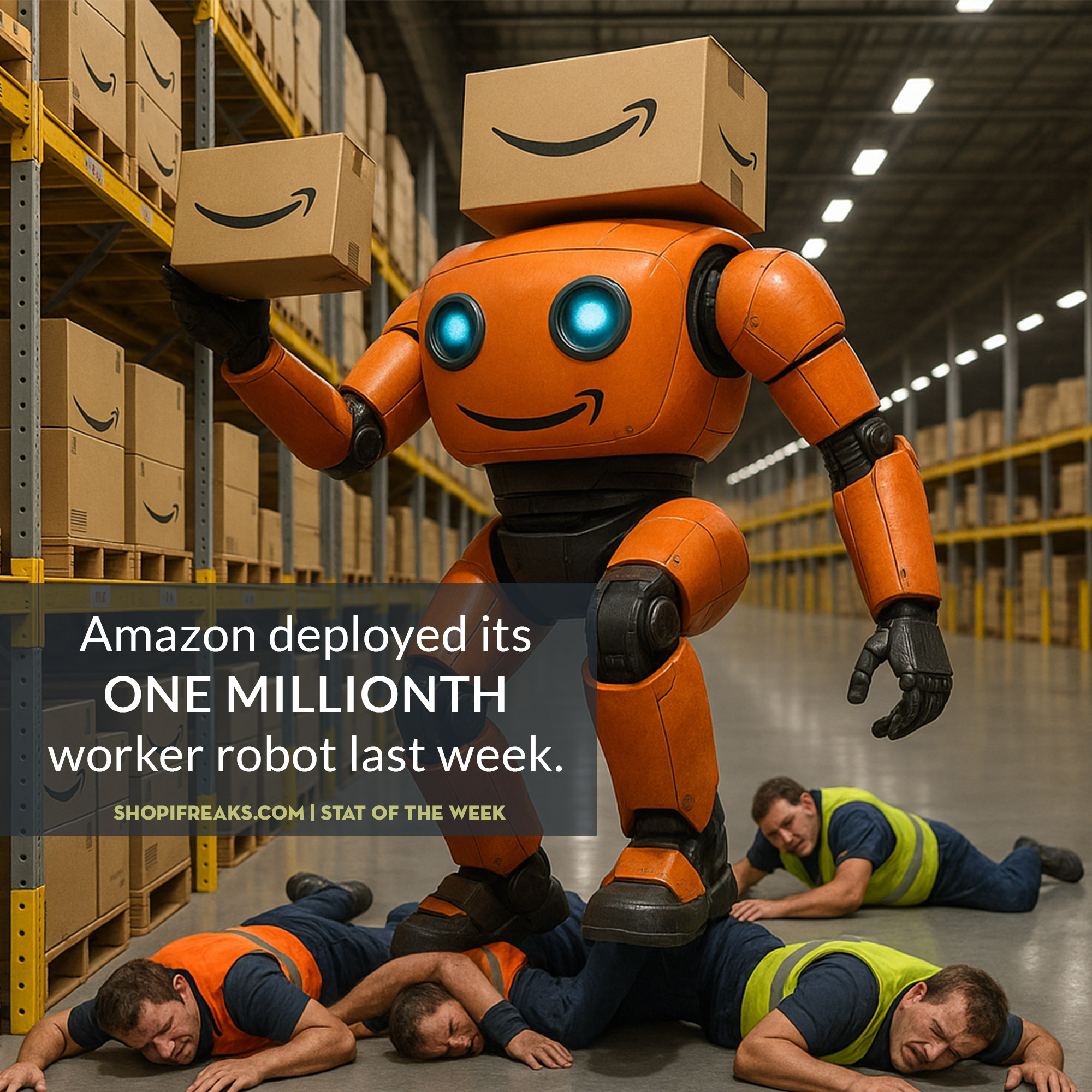
Amazon deployed its ONE MILLIONTH worker robot last week across its more than 300 facilities. The company also shared that its entire fleet will soon be powered by a newly launched generative AI model that will coordinate the movement of its robots within its fulfillment centers, reducing the travel time of the fleet by 10% and enabling faster and more cost-effective package deliveries. Plus they don’t take bathroom breaks — which is something Amazon has always disdained about its human liabilities workers.
1. The de minimis exemption is coming to an end in the U.S.
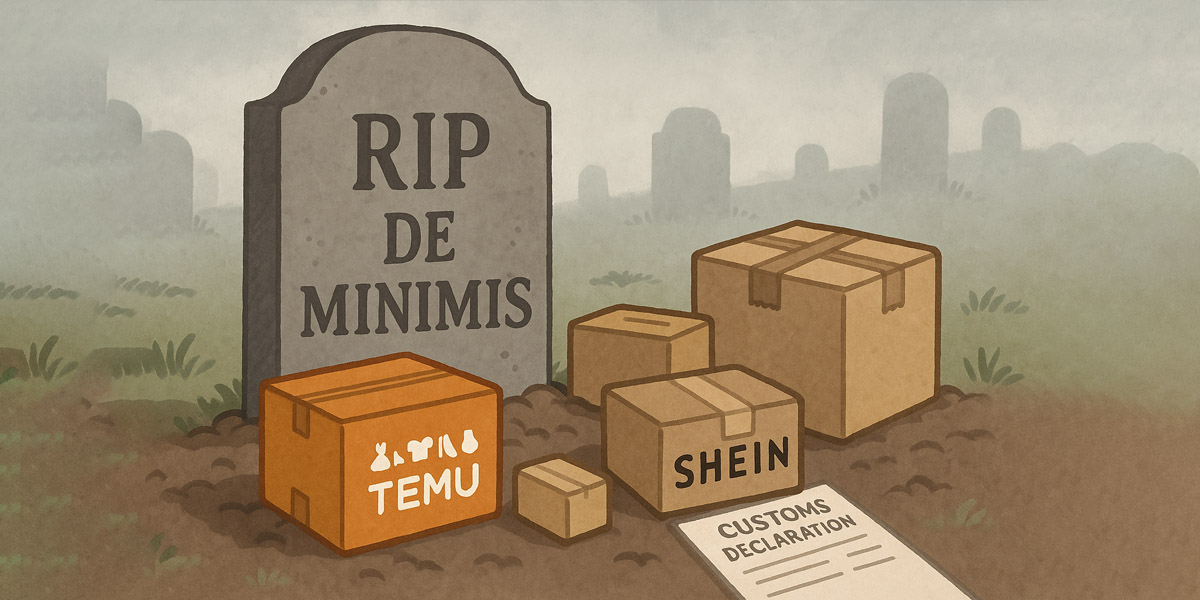
As part of the package introduced as the “One Big Beautiful Bill Act,” the U.S. will repeal the de minimis exemption allowing imports under $800 to enter the country duty and tax free on July 1, 2027. President Trump already ended the exemption for imports from China and Hong Kong in May, but now the bill extends the policy to all countries.
Moving forward, parcels will be subject to more stringent inspection and different entry processes, with the Trump administration expected to provide details about what to expect at a later time. The bill also establishes a penalty for any person attempting to use de minimis entry in a way that “violates any other provision” of U.S. customs laws in the amount of $5,000 for the first violation and up to $10,000 for subsequent violations.
The de minimis exemption was originally designed as part of the 1930 Tariff Act to reduce paperwork and administrative costs for customs, long before e-commerce and the Internet existed, and not necessarily to fuel global e-commerce and duty-free purchases into the U.S. The $800 de minimis threshold, which was boosted from $200 in 2016, is one of the highest in the world and fueled the rise of platforms like Temu, Shein, and AliExpress.
Ending the exemption nationwide is expected to generate up to $40B in federal revenue over the next decade, though critics warn that enforcement costs may offset much of that benefit. However even if it’s a financial washout for the government, ending de minimis will be a boom for domestic manufacturers and retailers.
Plus, with advancements in AI, improved logistics, and greater cooperation with major foreign retailers and marketplaces to collect duties at the point of purchase, ending de minimis lays the groundwork for a modernized import and customs infrastructure that can serve the U.S. for the next several decades.
The EU and the UK have also been taking steps to end or significantly reduce their de minimis exemptions, and the movement is fueling discussions in other countries around the world about how reforming or eliminating their low-value thresholds as well.
As the global tide turns against de minimis, the Big Beautiful Bill marks a pivotal shift in how the U.S. approaches trade, enforcement, and digital commerce, and will ultimately set a precedent for how other countries proceed.
2. Google introduces Offerwall to publishers
Google introduced Offerwall, a new tool that lets publishers offer readers alternative ways to access content and new ways for publishers to monetize their content, beyond traditional impression-based advertising or affiliate marketing. Google wrote:
“For years, our publishing partners have asked for more ways to monetize their content beyond traditional ads using Google Ad Manager. That’s why we’re launching Offerwall, a flexible tool that helps publishers earn revenue while giving their audience choices.”
Options for accessing content include:
- Watching a video ad
- Completing a survey
- Making a micro payment
- Signing up to a newsletter
Google tested the offering with more than 1,000 publishers and has now made it generally available in Ad Manager. The company claims that publishers who have implemented Offerwall have seen an average revenue uplift of 9%. Google also shared one case study with TechCrunch, showing that India’s Sakal Media Group implemented Offerwall on esakal.com, which led to a 20% revenue boost and up to 2M increased impressions within a three-month period.
Alongside the public launch, Google also introduced a new feature called Optimize, which uses AI (of course it does) to determine when to show the Offerwall for each visitor to increase engagement and revenue.
So first Google slashes traffic to publishers with its AI Overviews and decimates their ad revenue… then it launches a new way to monetize what’s left of their traffic? (Obviously Google is getting a cut of the ad revenue and micro-payments through Offerwall.)
Sarcasm aside though… I think it’s a valuable tool. I’ve been a proponent of introducing microtransactions into the news media ecosystem for quite some time. Publishers need to make money for their work, but at the same time, readers don’t necessarily want to buy a monthly or annual subscription to access a single article.
Other companies have tried and failed at introducing microtransactions into the publishing ecosystem, but Google has both the clout, publisher reach, and digital wallet access to consumers, who are already accustomed to making microtransactions through the Google Play Store via apps and other forms of media.
What are your thoughts on Google’s new Offerwall? Hit reply and let me know.
🔥 Partner News
Omnisend launched a suite of AI-powered tools that simplify how marketers create, personalize, and target their e-mails. The new features enable brands to automate tasks like building audience segments, generating subject lines and preheaders, and writing branded e-mail content in multiple languages using previous campaign insights and a brand’s tone of voice. Marketers can now also deliver more relevant shopping experiences using Omnisend’s new Personalized Product Recommender, which analyzes each customer’s browsing behavior to suggest products tailored to their interests.
3. OpenAI expands into high-ticket consulting
OpenAI is expanding into high-ticket consulting, offering AI customization services starting at $10M to large companies and government agencies. Through a team of “forward deployed engineers,” OpenAI is offering to help clients fine-tune GPT-4o using proprietary data and build tailored applications that can solve problems specific to their needs, effectively creating their own custom ChatGPT portals.
The consulting service already has buyers including large software firms and governments, according to The Information sources, with some clients agreeing to spend tens or hundreds of millions of dollars over multiple years.
OpenAI formed a dedicated consulting team earlier this year and has since hired around a dozen people for it, including several who previously worked at Palantir. A source told The Information that the goal of the division is to figure out whether OpenAI can develop technology that an enterprise customer would be willing to pay $1B or more for.
The move puts OpenAI in competition with software firms like Palantir and consulting firms like Accenture, as well as smaller AI startups focused on applying AI to specific fields.
OpenAI’s custom consulting model has been in the works for quite some time:
- Two years ago the company built a chatbot for Morgan Stanley financial advisers to answer their questions using the bank’s proprietary research and data.
- Last year it helped Grab fine-tune a specialized version of its GPT-4o Vision model to automate the work of creating maps of countries across SEA using hundreds of street-level images that Grab’s delivery drivers captured with 360-degree cameras.
- Most recently, OpenAI won a $200M contract to build a custom AI product for the U.S. Department of Defense, which will incorporate its data and use it to plan war-fighting strategies.
OpenAI Chief Commercial Officer Giancarlo Lionetti said that offering access to the company’s engineers is one of the reason’s enterprises want to work directly with OpenAI.
The hybrid model of offering a product + consulting has worked for many tech companies in the past including Palantir, Salesforce, SAP, Red Hat, IBM, and countless others. More close to home, Klaviyo recently launched a consulting-style offering called “Klaviyo Professional Services,” which directly offers consultation and support services to clients rather than relying solely on agency partners. The model allows a company to drive revenue from both their platform and through higher-margin services that are in demand.
The real question is — will Meta copy the model? On that note…
4. Sam Altman blasts Mark Zuckerberg in more ways than one
The battle between Meta CEO Mark Zuckerberg and OpenAI CEO Sam Altman is heating up. It seems that Sam Altman is getting the fight that Elon Musk desired — only it’s happening in the office where it belongs.
Quick recap of recent events: Last month Meta launched its new “Superintelligence team” focused on building AGI systems and began poaching high-profile OpenAI researchers with $100M compensation packages. So far Meta has reportedly enticed at least eight engineers from OpenAI to join its team.
Flash forward to last week and Sam Altman is going on the defense.
Altman wrote a memo to all OpenAI researchers, pitching why staying at the company is the only answer for those looking to build artificial general intelligence and hinting that OpenAI is evaluating compensation for the entire research organization. He dismissed Meta’s recruiting efforts, claiming that what the company is doing could lead to deep cultural problems in the future.
Altman wrote:
“We have gone from some nerds in the corner to the most interesting people in the tech industry (at least). AI Twitter is toxic; Meta is acting in a way that feels somewhat distasteful; I assume things will get even crazier in the future. After I got fired and came back I said that was not the craziest thing that would happen in OpenAl history; certainly neither is this.”
He noted that Meta has not gotten their “top people:”
“Meta has gotten a few great people for sure, but on the whole, it is hard to overstate how much they didn’t get their top people and had to go quite far down their list; they have been trying to recruit people for a super long time, and I’ve lost track of how many people from here they’ve tried to get to be their Chief Scientist. I am proud of how mission-oriented our industry is as a whole; of course there will always be some mercenaries.”
He went on to make an emotional plea about how OpenAI is a mission-driven organization, even though it’s simultaneously actively looking to convert into a for-profit organization:
“Missionaries will beat mercenaries. I believe there is much, much more upside to OpenAl stock than Meta stock. But I think it’s important that huge upside comes after huge success; what Meta is doing will, in my opinion, lead to very deep cultural problems. We will have more to share about this soon but it’s very important to me we do it fairly and not just for people who Meta happened to target.”
Lastly he slammed Mark Zuckerberg for jumping from one trend to another:
“And maybe more importantly than that, we actually care about building AGI in a good way. Other companies care more about this as an instrumental goal to some other mission. But this is our top thing, and always will be. Long after Meta has moved on to their next flavor of the week, or defending their social moat, we will be here, day after day, year after year, figuring out how to do what we do better than anyone else. A lot of other efforts will rise and fall too.”
Shots fired!
5. A TikTok deal is right around the corner…
President Trump said on Friday that the U.S. “pretty much has a deal” for an American company to acquire the U.S. branch of TikTok and that he’ll be restarting talks with China this week to approve it. Trump said via Air Force One:
“We’re going to start Monday or Tuesday talking to China. We think we probably have to get it approved by China. Not definitely, but probably. I think the deal is good for China, and it’s good for us. It’s money, it’s a lot of money.”
A deal had supposedly been in the works this spring to spin off TikTok’s U.S. operations into a new U.S. based company, majority-owned and operated by U.S. investors, but it was put on hold after China indicated it would not approve it following Trump’s announcements of steep tariffs on Chinese goods.
Despite three extensions on the ban… a deal might actually be nearing.
The Information reports that TikTok is building a new version of its app for users in the U.S., internally known as “M2,” with plans to launch to app stores on September 5th. (The existing TikTok app is internally known as “M”.) Users would eventually have to download the new app to be able to continue using the service, but the existing app will work until March of next year.
While it’s unusual for an app with a large following to ask users to download an entirely separate app to continue using its service, sources say the new M2 version could help address the data-security concerns surrounding TikTok that have led us to this point.
At this moment, it’s unclear if ByteDance will share TikTok’s algorithm with the U.S. buyers, license the algorithm, or deliver an amended version exclusive for the U.S. market.
The next deadline for the U.S. to enforce the ban law is Sept. 17, less than two weeks after the new TikTok app is set to launch. On that day, the existing TikTok app will be removed from U.S. app stores and users will be directed to download the new version.
6. Meta Updates to Messenger, WhatsApp, & Ads
Meta announced several updates to its messaging and advertising offerings at its global “Conversations” conference in Miami on Tuesday.
1) Centralized Ad Creation – Brands can now use the same creative, flows, and budgets to setup campaigns across WhatsApp, Facebook, Instagram, and Threads.
2) WhatsApp Buttons – Brands can now add a WhatsApp button to their Google Business Profile, enabling customers to get in contact directly from Google Search and Google Maps with a clickable link that opens the app.
3) In-App Browsing for WhatsApp – In turn, users will be able to open business-provided links within WhatsApp itself, eliminating app switching and enabling more seamless interactions.
4) WhatsApp Order Tracking – The company is testing native order tracking updates via WhatsApp from Shopify, VTEX, WooCommerce and other platforms, as well as the ability to send one-time passwords, and verification codes from within WhatsApp.
5) Messenger Updates – Including the ability to see who is calling and whether it is from an ad, as well as AI call summaries and transcriptions.
6) Expanded Access to Business AI – which can make personalized product recommendations, facilitate sales on a brand’s website, and follow up with customers to answer questions or provide updates within WhatsApp.
7) Direct Calling For Big Brands – Customers will be able to place voice calls to businesses and allow the businesses to call them back, which is something that’s been available to small businesses but not yet larger businesses.
8) WhatsApp Business Volume Pricing – Meta introduced tiered pricing to offer “greater flexibility and scalability” — which means the ability to charge certain businesses more money.
7. Can Amazon still sell Nintendo products?
Last week Bloomberg reported that Nintendo pulled its products from Amazon.com after a disagreement over unauthorized sales, which resulted in Amazon missing out on the recent debut of Nintendo’s Switch 2. The article said that Nintendo had noticed that third-party merchants were buying games in bulk in Southeast Asia and listing them for sale in the U.S. at prices that undercut Nintendo’s advertised rates, and that despite Amazon’s attempts to resolve the issue, Nintendo ultimately opted to pull its products from Amazon in the U.S.
However both companies deny the allegations.
Nintendo: “There is no such fact. We do not disclose details of negotiations or contracts with retailers.”
Amazon: “[The claims are] inaccurate. [We are] pleased to offer Nintendo products directly to our customers as part of our commitment to providing an exceptional shopping experience with the widest selection possible.”
So where are the Nintendo Switches!?!?
Nintendo’s website shows the Switch 2 available for sale on GameStop, Best Buy, Target, and Walmart — but noticeably absent from that lineup is Amazon. Certain Switch titles like Donkey Kong Bananza are now appearing for pre-order on Amazon’s U.S. website, but the Switch 2 device remains unavailable.
Regardless of not being available for sale on Amazon, the Nintendo Switch 2 smashed sales records, shipping 3.5M units in just four days.
Turns out having the console available on Amazon wasn’t that big of a deal. Will other console makers take note?
8. OpenAI & Shopify add one click shopping assistants for merchants
OpenAI introduced a new tool allowing retailers to create AI-powered shopping assistants in Shopify with just a few clicks. Using the Storefront Managed Compute Platform (MCP) and the OpenAI Responses API, developers can build agents that can:
- Search products
- Answer product questions
- Explain differences between items
- Add items to a cart
- Generate checkout links
Users can enter prompts like, “I am looking for a tri suit for a cold weather triathlon,” and the assistant will search for options from the store’s inventory to show the shopper. If the shopper picks one of the options, the assistant can automatically move to checkout.
@ShopifyDev account shared a demo on X featuring a fictional cycling store where a chatbot guided the shopper through helmet and jersey recommendations, pulled real product data via the Shopify API, and completed checkout using built-in tools. The assistant even remembered the user’s previous product preferences and adjusted suggestions accordingly.
I played around with it for a few minutes with one of my stores, and it seems pretty easy to implement. However it’ll require some additional testing before we decide to go live.
Have you tried it yet? If so, hit reply and let me know how your experience went.
9. Other e-commerce news of interest
Google is testing a price change rich result that indicates if the price is low, high, or typical, as spotted by Brodie Clark, an independent SEO Consultant. When clicking on the extension, a pop-up informs the user that insights are based on the last 90 days. The experiment appears to be an extension of the price drop rich result which has been detailed within Google’s documentation for several years.
eBay is testing a feature that would allow buyers to scroll through multiple listing images directly on the search results page without needing to click through the listing page first. Some sellers have praised the move for improving the buyer experience, while others raised concerns that the new capability, along with eBay’s vague Promoted Listing terms, could lead to more aggressive add attribution, possibly charging sellers for buyer interactions like swiping through the photo carousels. Others pointed out issues with the carousel skipping videos, overlapping key product details, and boosting visibility for competing listings through a “Find Similar” button. Can’t please everyone!
Amazon Business is partnering with Mathnasium, the math tutoring franchise with more than 1,000 U.S. centers, to help locations procure classroom and operational supplies like toner, paper, and student incentives. The move aims to streamline purchasing, reduce admin tasks, and give centers access to bulk pricing and digital spend management tools. Since launching in 2015, Amazon Business has added more than 8M customers globally and reported $35B in annualized gross sales in 2023.
Meta is testing proactive AI chatbots that send unprompted follow-up messages to users in an effort to boost retention and engagement on its AI Studio platform, a no-code platform where anyone can build custom chatbots and digital personas that Meta launched in 2024, according to leaked documents viewed by Business Insider. The initiative, internally dubbed “Project Omni,” is being developed with contractor support from Alignerr, and allow bots to follow up with users up to 14 days after a conversation, but only if the user previously sent at least five messages.
Alibaba and Wix partnered to help entrepreneurs and small businesses expand globally. Wix merchants can now become Global Gold Suppliers on Alibaba via a new app integration, streamlining product syncing and access to millions of global buyers, while Alibaba sellers can use Wix’s AI-powered tools to build branded D2C and B2B storefronts. The partnership also enables Wix users to source products directly through a dedicated Alibaba wholesale marketplace, with AI-driven onboarding and product discovery tools to further simplify cross-border trade on the horizon.
Perplexity is launching a $200/month subscription plan for its power users called Perplexity Max, which offers unlimited access to its spreadsheet and report generation tool, Labs, and early access to new features like its upcoming AI-powered browser, Comet. Max subscribers will also get priority access to any Perplexity services using the latest LLMs like OpenAI o3-pro and Claude Opus 4. In 2024, Perplexity generated roughly $34M in revenue, mostly with its $20/month Pro plan, but still burned about $65M in cash due to heavy spending on cloud servers and buying access to AI models from OpenAI and Anthropic.
A new AlixPartners survey reports the biggest slowdown in online shopping in more than 10 years, with double-digit YoY declines across key categories like office supplies (-13%), sporting goods (-12%), and cosmetics, furniture, and electronics (each -10%). Tariff uncertainty and rising delivery and return costs are pushing retailers to tighten shipping perks and consumers to delay or reshuffle purchases, with 66% saying they’d switch to U.S. goods if overseas prices rise 10%.
In corporate shakeups this week… DHL eCommerce appointed Scott Ashbaugh, who currently serves as the company’s Chief Commercial Officer, as its new Americas CEO, effective July 1st, following the retirement of Lee Spratt. BigCommerce appointed Anil Kamath, former Adobe Fellow and VP of Technology, to its board of directors. Pattern appointed Sue Taylor, former Chief Accounting Officer at Meta and LinkedIn, and Ann Mather, former Chief Financial Officer at Pixar, to its board of directors. And last but not least, eToro appointed Laura Unger, a former SEC commissioner, and Lior Shemesh, the CFO of Wix, to its board of directors.
Microsoft is laying off 9,000 workers, or about 4% of its workforce, mostly targeting salespeople and workers in the Xbox division, in its second major wave of layoffs this year, aiming to control costs while ramping up its AI spending. The terminations follow a round of layoffs in May that hit 6,000 people across product and engineering teams. Matt Turnbull, the executive produce at Xbox Game Studios, took heat for suggesting in a since-deleted LinkedIn post that affected employees should use ChatGPT and Copilot to “help reduce the emotional and cognitive load that comes with job loss.”
TikTok is laying off more workers in its U.S. e-commerce division including moderation workers, product team members, and staff who work with creators and sellers, marking its third round of layoffs for that team since April. In a message to staff, the company said it’s spent the past month assessing how to “best support our evolving global e-commerce business in alignment with our mission and evolving goals,” and that it’s “repositioning resources and reducing complexity in pursuit of strengthened collaboration and increased efficiency.”
Mirakl and Shopify expanded their partnership with the release of the Mirakl Platform Connector for Shopify, aimed at helping large enterprises rapidly deploy and manage marketplaces. The connector is designed to reduce integration effort by up to 80% through prebuilt synchronization of taxonomy, products, sellers, and orders, and supports mixed 1P/3P checkouts, theme and headless storefronts, and real-time updates. Honestly, starting a marketplace has never been easier. We’re about to enter the era of niche marketplaces.
eBay overhauled its tracking experience for both buyers and sellers, introducing a more visual and intuitive interface across Seller Hub and buyer shipment flows. The new system, which rolls out in late July, provides sellers with enhanced order tracking visualization and buyers with a unified delivery view, including separate tracking for outbound and return shipments. By offering clearer updates, especially on delays, eBay aims to reduce “item not received” claims, minimize customer service inquiries, and improve seller ratings and buyer trust.
Walmart released its 2025 Marketplace Seller Playbook, highlighting new tools and programs to help sellers scale across channels and international markets. Key initiatives include expanded Walmart Fulfillment Services, which the company says is now 15% cheaper than competitors, and a new Multichannel Solutions feature allowing sellers to fulfill orders from other platforms. The playbook also shares how new sellers can tap into up to $75,000 in savings, leverage Walmart Connect for 7x sales lift through ads, and access global markets like Canada, Mexico, and Chile, as well as details growth in categories like Premium Beauty, Collectibles, and Automotive, positioning Walmart as an increasingly competitive alternative to Amazon.
Two upcoming New York state laws are set to impact retailers: one requiring algorithmic pricing disclosure, which takes effect July 8, and another expanding return policy disclosure rules to online sellers, effective August 7, 2025. The National Retail Federation has sued to block the pricing law, arguing it unfairly stigmatizes dynamic pricing methods that often benefit consumers. Meanwhile, the updated return policy law mandates that online retailers clearly display or hyperlink their return terms near the product or before billing info is requested, aligning digital compliance with in-store standards.
Shopify launched App Bridge Reviews API, which lets app developers collect reviews directly from the merchant admin, as opposed to having to visit the app listing in the Shopify App Store. The move reduces friction for leaving reviews, which can ultimately improve review volume, helping both merchants and developers with additional feedback.
Alibaba’s Taobao announced that it will be issuing $7B in subsidies over the next 12 months for certain purchases to boost consumption in China amid economic sluggishness and deflationary concerns. Rolled out over the next 12 months, the incentives include “red envelopes” (a digital form of cash gifts), product discounts, and reduced delivery and commission fees, particularly through Taobao’s “flash purchase” feature. The move aligns with broader government efforts to spark spending through policy stimulus, as the country grapples with a weak property sector, labor concerns, and ongoing trade tensions with the U.S.
Zoho unveiled Zoho Commerce 2.0, a fully redesigned and AI-enhanced e-commerce platform with new features including AI-generated product descriptions, abandoned cart recovery, loyalty programs, and BOGO-style coupon engines. The platform also now supports localized selling, WhatsApp Commerce, mobile apps, B2B functionality like quote requests and credit limits, advanced analytics, and multi-location fulfillment with carrier integration, with a redesigned interface that the company says is faster, cleaner, and more intuitive.
Circle, the issuer of USDC stablecoin that recently went public, applied for a national trust charter, which is a type of banking license issued in the U.S. that allows an institution to operate as a national trust bank, but without taking traditional deposits like a commercial bank. The charter, if approved, would create First National Digital Currency Bank, N.A., which would manage USDC reserves and offer digital asset custody for institutions. The move would align Circle with upcoming U.S. stablecoin legislation included in the GENIUS Act and follows Circle’s June IPO, which tripled its share price and boosted its valuation above $18B.
Amazon is now formally integrating its 16 Leadership Principles into employee evaluations using a new three-tiered rating system, as part of CEO Andy Jassy’s push for a more disciplined and performance-focused workforce, according to documents obtained by Business Insider. Starting this review cycle, corporate employees will be scored on how well they embody principles like “customer focus” and “cost discipline,” alongside performance and potential, to determine raises and performance plans, with only 5% of employees able to achieve the top “role model” rating. Wow, between return to office mandates, layoffs, relocations, and now leadership principle evaluations — Amazon sounds like a great place to work.
As tariffs drive up the cost of manufacturing, more brands are turning to tariff engineering, a legal strategy that involves tweaking product materials, features, or classifications, to reduce duty rates. There are currently more than 5,000 product classification codes used by over 200 countries when assessing tariffs, and small changes can make big differences in costs. Walmart, for example, has been working with suppliers to swap out materials like aluminum, which is subject to 50% tariffs, for alternatives like fiberglass. While effective, the practice carries legal risks if deemed purely evasive, as seen in Ford’s $365M penalty for importing vans with added rears seats to avoid a 25% duty on cargo vehicles.
TikTok Shop officially launched in Japan, a market which has been dominated by Amazon Japan and Rakuten up until now. The app currently has over 33M monthly users in the country, with an average screen time of 96 minutes per day, according to the Japan External Trade Organization. Japan is TikTok Shop’s 17th market, following launches in the U.S., the UK, Malaysia, Thailand, Singapore, the Philippines and Vietnam, among others, and introduces another Chinese player to the country’s e-commerce market, which already includes Temu and Shein.
Reliance Industries, the largest conglomerate in India with businesses spanning energy, petrochemicals, telecommunications, retail, and digital services, is transferring all of its consumer goods brands to a new wholly-owned subsidiary as it readies for an IPO for its retail business. The brands, spanning apparel, fashion, food, personal care, and beverages, will be moved to the new New Reliance Consumer Products Ltd (RCPL), allowing the capital-intensive consumer brands to attract a different set of investors.
Australia’s consumer regulator put Shopify and Meta on notice, urging them to take action against online “ghost stores” that pretend to be local businesses to dupe shoppers. The agency issued a public warning about ghost stores on Thursday and announced it had written to the two companies after an investigation by Guardian Australia identified more than 140 of these websites. Meta said it would look into it, and Shopify has yet to comment.
Bol, the largest e-commerce marketplace in the Netherlands and Belgium, is now allowing sellers from outside the EU to join for the first time, with the first 100 non-EU sellers expected to onboard this year. The company emphasized strict quality control for offerings from countries such as China and made a rule that products must be stocked within Europe (ie: no direct-from-factory offerings like Temu). Bol first opened its doors to 3rd party EU sellers in 2011, and its network has since grown to over 50,000 sellers.
France imposed a €40M penalty on Shein for using “deceptive commercial practices towards consumers regarding price reductions,” following a year long investigation into the issue. That took a year? The French competition and anti-fraud office claims that Shein misled customers on price deals and on its environmental impact, particularly by raising prices on products before putting them “on sale” back to their original price. (Best Buy, are you paying attention?) In 57% of cases, Shein’s advertised promotions actually offered “no price reduction” and in 19% of cases, the price drop was “less significant than announced.”
FAST channels, which are free, ad-supported streaming channels like those showing “Gunsmoke” or “Murder She Wrote”, are seeing up to a 50% drop in ad revenue this year, even as viewership continues to rise. The decline stems from a saturated ad market and growing competition from premium services like Amazon Prime Video and Netflix, which have begun selling ads themselves. On that note, Amazon announced that it is shutting down Freevee this August, its free streaming TV service that it launched in 2019 underneath IMDb, to concentrate exclusively on its free viewing options within its Prime Video app.
As Amazon Prime Day approaches on July 8th, NordVPN researchers have identified over 120,000 fake Amazon-related websites launched in the past two months, aiming to scam shoppers through phishing, malware, and counterfeit product schemes. The spike in impersonation scams represents an 80% increase during last year’s event — which I’m sure AI and the ease of launching websites has played a role in the uptick. Amazon urges shoppers to only verify purchases directly on its official site or app and warns that it never asks for payments by email, phone, or gift card.
A Bitcoin miner bagged a reward of 3.173 BTC ($349,028) by mining Bitcoin block number 903,883 late Thursday night. Solo CK, the non-profit service that enables Bitcoin miners to attempt to mine solo blocks, said that a miner of this size has about a 1 in 2,800 chance of solving a block every day, or once every 8 years on average. Lucky miner!
🏆 This week’s most ridiculous story… An Indian software engineer named Soham Parekh was called out on X for working 3-4 jobs at a time (or possibly more), targeting YC companies. Other founders came out of the woodwork in the replies talking about how they had either hired or interviewed the guy at some point. The funniest reply said, “We had him on the team for about 3 months. He was confident and well spoken in meetings but hardly ever finished any of his work. Frequently other devs would step in to finish the task and get it shipped. The final straw was when he was caught masturbating on an all hands zoom call. He forgot his camera was on.” A few publications covered the news including TechCrunch, CNBC, and Business Insider.
10. Seed rounds, IPOs, & acquisitions
SRS Distribution, the specialty distribution subsidiary of Home Depo, is acquiring GMS Inc, distributor of wallboard, suspended ceilings, steel framing, and construction products, for $5.5B in a cash transaction. Through the acquisition, Home Depot is doubling down on its strategy to win more digital-first professional customers within the specialty trade industry, particularly in online jobsite delivery and fulfillment for specialty building materials.
Tailor, a San Francisco-based headless ERP platform that focuses on flexibility and developer-friendliness, raised $22M in a Series A round led by ANRI, JIC Venture Growth Investments, and others. The company’s system, which separates the frontend and backend to allow for independent development, is currently available in the U.S. and Japan and targets retail and e-commerce customers, automating workflows and managing operations like inventory, fulfillment, finance, purchase, and omnichannel management.
Kintsugi, a San Francisco-based sales tax compliance platform that automates tax calculations, filings, and nexus tracking for e-commerce and SaaS businesses, raised $18M in a round led by Vertex. The company, which previously expanded from the U.S. to Canada and Europe, aims to offer compliance across 171 countries and has plans to go live in South America, Africa, and Asia, leveraging AI to offer its services at half the cost of leading competitors.
Grammarly, an AI-powered writing assistant that helps users improve grammar, clarify, and tone, acquired Superhuman, an AI-powered e-mail client for business users that offers features like e-mail summaries, read status tracking, and follow-up reminders, for an undisclosed amount. This acquisition follows Grammarly’s acquisition of Coda at the end of last year and the appointment of its co-founder Shishir Mehrotra as CEO of the combined company. In June, I reported that Grammarly raised $1B in non-dilutive financing from General Catalyst to grow its AI offering, so I imagine that there may be more acquisitions and/or big moves for the company on the horizon.
Remark, a NYC-based platform that builds human-powered expert models by combining AI with curated expert knowledge, raised $16M in a Series A round led by Inspired Capital with participation from Stripe, Neo, and other investors, bringing its total amount raised to $27M. Following a $10M fundraise in 20254, the company has seen 4x revenue growth and increased its network of experts to 60,000. It is now working on the ability to generate blog posts that recommend products based on expert conversations, as well as the ability to send personalized follow-up e-mails to users about a conversation they had with an expert.
Jumbotail, an Indian B2B e-commerce platform that enables retailers to procure food and grocery products through a digital marketplace and supply chain network, raised $120M in a Series D round led by SC Ventures, bringing its total amount raised to $263M. Alongside the funding round, the company announced that it finalized its acquisition of Solv India, a B2B commerce and financial services platform incubated by SC Ventures, with plans to combine the two operations to serve over 500k retailers.
Figma, a San Francisco-based collaborative web design platform used for interface design, prototyping, and real-time team collaboration, officially filed for an IPO, revealing strong financials with $749M in 2024 revenue and 91% gross margin. After a brief unprofitability in 2023 due to a $732M stock compensation expense, Figma returned to profitability by late 2024 and reports virtually no debt. The IPO is expected to raise up to $1.5B, potentially matching CoreWeave as the largest tech offering of 2025 (so far).
Jeff Bezos sold 3.3M Amazon shares, netting $736.7M, as part of a 10b5-1 trading plan Bezos adopted in March for up to 25M shares. Last year Bezos sold 75M shares for a total of $13.6B through the arrangements, which allow company insiders to offload shares at predetermined times. Since 2002, Bezos has unloaded Amazon shares worth about $44B.
Liki24, a Ukrainian healthcare logistics platform that connects pharmacies, medical supply stores, and courier services to deliver medicines and health products to consumers, raised $9M in a Series A round led by undisclosed investors, bringing its total amount raised to $16M. The marketplace features over 200k products, allowing customers to choose between lower-cost international options or quicker local delivery. It plans to use the funds to expand into additional European markets beyond the nine that it currently operates in.
Hived Ltd, a London-based sustainable parcel delivery company that provides carbon-neutral EV logistics services for e-commerce businesses, raised $42M in a Series B round led by NordicNinja. The company will use the funds to expand across the UK and enhance its AI logistics platform, HIVEDmind, which dynamically updates routes based on delivery volumes, route patterns, and real-time world data.
Meta offered to buy a minority stake in NFDG, a venture firm founded by two of its key AI recruits, Nat Friedman and Daniel Gross, for an undisclosed amount. NFDG was in the process of raising around $1.5B for a second fund this year, according to WSJ sources, after investing in companies including Safe Superintelligence, the AI company co-founded by former OpenAI co-founder Ilya Sutskever.
Tapi, an Argentine payments services startup, acquired the bill payment and cash-handling operations of Mastercard’s Arcus in Mexico, for an undisclosed amount. The deal gives tapi access to a large network of cash-in and cash-out locations and expands its connectivity to billers across the country, where it aims to expand digitization efforts. Mastercard will retain the Arcus brand name and the payment processing and reconciliation tech through Mexico’s real-time interbank network SPEI.
Thoma Bravo, a Chicago-based private equity firm specializing in software and technology investments, acquired Olo, a platform that enables restaurants to manage digital ordering, delivery, and customer engagement across multiple channels, for $2B in an all-cash deal. Following the acquisition, Olo will become a privately held company with plans to boost its growth by strengthening its platform and offerings. I’ve been a shareholder of Olo for quite some time, and this acquisition means I’ll endure a realized loss of 68%! LOL, that investment turned out to be a dud.
TD Synnex, a global IT distribution and services company that connects tech vendors with a network of resellers, integrators, and service providers, is acquiring Apptium, a Virginia-based software and cloud commerce company, for an undisclosed amount. Apptium has been instrumental in building TD Synnex’s StreamOne platform, which enables partners to manage their entire cloud services lifecycle including provisioning, billing, subscription management, and analytics, and will continue to operate independently, while its CEO Rick Kapani will become a general manager and SVP at TD Synnex.
Gensmo, an AI-powered fashion agent that helps users discover, personalize, and shop for clothing by offering recommendations based on style preferences, body type, and occasion, raised $60M in seed funding from unnamed investors. Founded by ex-Google and Alibaba exec Ning Hu, Gensmo launched in December 2025 with offices in major U.S. fashion and tech hubs including New York, Los Angeles, San Francisco, and Seattle.
ASK BOSCO, a U.K.-based digital marketing analytics platform that helps e-commerce and retail businesses optimize their online ad spend, raised £4.1M from Gresham House Ventures. The funds will be used to expand their technical and sales teams, launch a Shopify app, and expand into the U.S.
Thanks for being a Shopifreak!
If you found this newsletter valuable, please leave a review on Google and share the newsletter with your friends and colleagues to help us grow.
See you next Monday,
PAUL
Paul E. Drecksler
🌐 Shopifreaks.com
🧑💼 Add me on LinkedIn
📧 [email protected]
📱 +1-828-273-3031
⭐ Leave A Review
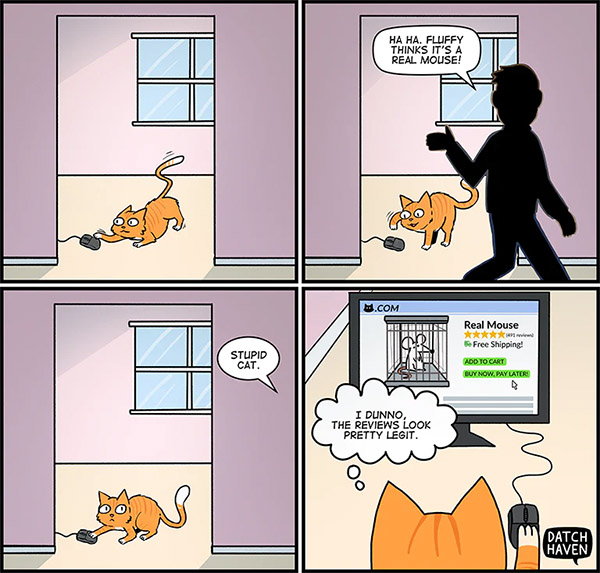
PS: Today’s comic relief is brought to you by Datch Haven at this ecommerce life.