
Hi Shopifreaks
I’m back in the U.S. for the first time in over a year — and man have things changed! Starbucks wants $4.55 for a Grande Americano. Order at the counter restaurants flip their iPads around to display tipping tiers that start at 20%. Walmart had a display by the register advertising $2.68 for a Pepsi. HVAC companies are quoting me $12,000 for mini-split systems!
Don’t get me wrong, I love the U.S. — particularly Western North Carolina where I’m from. However since returning last week, it feels like I’m walking around with a hole in my pocket because my wallet feels light. Yet amidst all this, the minimum wage hasn’t been raised past $7.25 since 2009? This doesn’t feel sustainable for our country. Consumers can only split purchases into 4 installments so many times before it catches up with them.
All that said, I better finish up this week’s edition so I can get back to work! 😂
I’ve got a very interesting edition for you this week covering:
- Amazon’s increased emissions
- OpenAI wants a cut
- Shopify & Amazon’s agentic AI war
- Wix’s new native AI analytics
- Gmail mini-shopping experiences
- Amazon’s Prime Video lawsuit
- UPS voluntary buyouts
- Delta’s dynamic AI pricing
- Amazon’s post-tariff prices
- The UK goes after BNPL
- Meta settles its $8B lawsuit
- Early, early back-to-school shopping
All this and more in this week’s 235th Edition of Shopifreaks. Thanks for subscribing and sharing!
Stat of the Week
Amazon’s emissions increased 6% in 2024 as the company builds more data centers to power its AI services. Its total carbon emissions in 2024 reached 68.25M metric tons, marking a 6% increase from the year prior and a 33% increase from 2019, when the company launched its Climate Pledge commitment to reach net-zero emissions across its operations by 2040.

1. ChatGPT puts the squeeze on e-commerce sales
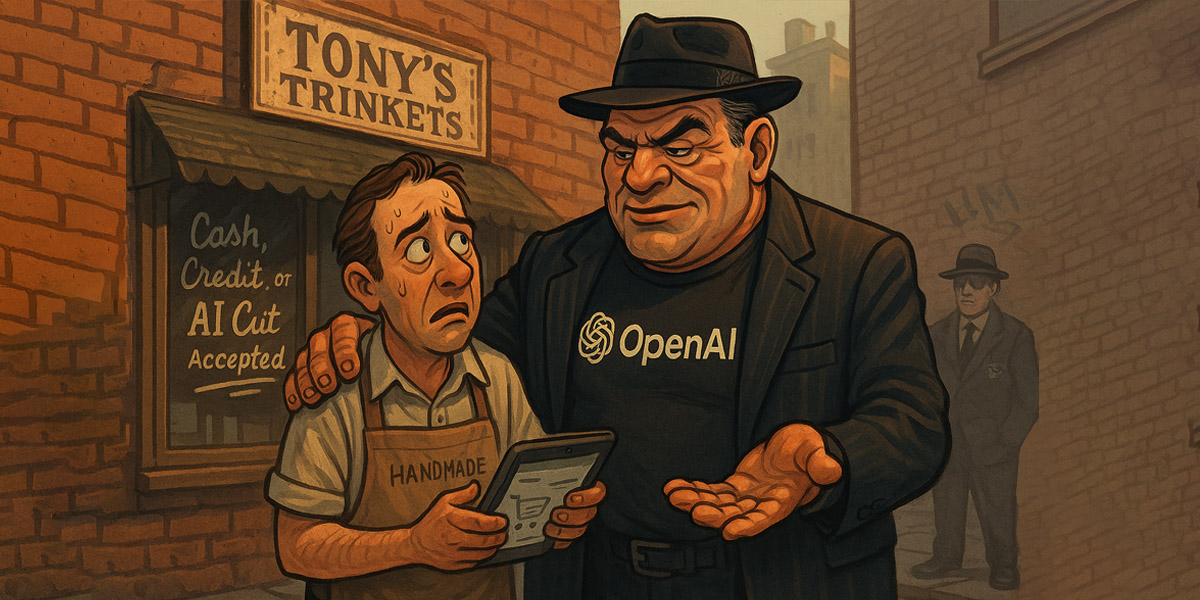
OpenAI is planning to take a cut from online product sales made directly through ChatGPT as the company looks to expand revenues beyond subscription fees, according to Financial Times sources.
Currently ChatGPT displays products within its chatbot interface with an option to click through links to online retailers. Now it aims to integrate a checkout system into ChatGPT so that users can complete transactions within the platform and so merchants can pay a commission on those sales.
Taking a cut of sales from ChatGPT would allow OpenAI to make money from free users in lieu of offering advertising, which is a group it hasn’t yet been able to monetize.
I like, and I hate it.
Pros: Obviously, OpenAI was going to monetize its e-commerce operations at some point. Taking a cut of sales feels like a more democratic way for merchants to participate in ChatGPT’s e-commerce ecosystem without having to shell out upfront money for advertising. When only paying a commission, the fees are incremental to sales, so it’s a relatively risk-free way for merchants to increase customer acquisition.
Cons: Requiring a cut of sales to appear in AI generated search results doesn’t feel so “open,” does it? Although to be fair, is it any more “open” than Amazon’s product results, which are like 80% sponsored at this point?
It’s also important to note that advertising within AI results isn’t completely offer the table either. As recently as December, OpenAI said it had “no active plans to pursue advertising”. However CFO Sarah Friar told the Financial Times it was considering options to introduce advertising but wanted to be “thoughtful about when and where we implement them”.
The commission feature is still in development, according to FT sources, so the details may change. However OpenAI and partners like Shopify have been presenting early versions to brands and discussing financial terms, so it’s likely on the way.
At the moment, there are many unanswered questions:
- How will commission rates be determined? Will there be a flat percentage or will different categories, sellers, or price points incur different fees?
- Will Shopify open this program up to all merchants or just Shopify Plus merchants?
- Although the checkout is happening within ChatGPT, is it running behind the scenes on Shopify’s payment rails? Or will ChatGPT be processing the actual payments?
- Will users be clearly informed when results are influenced by commissions? Will there be labels or disclosures similar to “Sponsored” on other platforms?
- If a product is available through multiple sellers, how will it decide which link to show?
- Will small or new brands be disadvantaged? Could this create yet another pay-to-play environment where emerging brands struggle to gain visibility?
- Will the company prioritize more popular products that it knows will sell well based on conversion data (so that it earns the commission easier), as opposed to surfacing the actual best items for shoppers?
- Will it exclusively display product results from merchants that are willing to offer a commission? If so, does that worsen the shopping experience for users who will miss out on any type of “organic” results?
- If taking a cut of sales, will OpenAI refund commission fees if items are returned?
More to come on this developing story.
2. Shopify & Amazon begin the agentic AI war
Shopify quietly added new default language to its robots.txt file telling agentic AI bots what they can and can’t do. The message reads:
“Robots & Agent Policy – Checkouts are for humans. Automated scraping, ‘buy-for-me’ agents, or any end-to-end flow that completes payment without a final review step is not permitted. Legitimate integrators must use the official Checkout Kit: https://shopify.dev/checkout-kit”
The updated language was first spotted by Johnny Herge, a Senior SEO Specialist at Amsive, who posted a screenshot on LinkedIn, and suggests that Shopify wants tighter control over how automated agents operate within its ecosystem.
Ilya Grigorik, Shopify’s technical advisor to the CEO, posted on X:
“Some of you might have noticed we updated the default robots.txt on Shopify storefronts. This change doesn’t add or remove any rules for bots or agents. All we added is a comment for curious humans with a pointer to http://shopify.com/checkout-kit for native integration that delivers a full-featured checkout experience. We offer pre-made SDKs for popular platforms, and a low-level protocol for advanced app & agentic checkout integrations.”
Juozas Kaziukėnas, founder of Marketplace Pulse, told Modern Retail:
“It’s really a note for developers who will be poking around,. Shopify is trying to be upfront, saying, ‘We think you’re going to be doing this, trying to build automated checkout on top of our merchants, but we don’t want you to do this.’”
Kaziukėnas also revealed on LinkedIn that Amazon blocked Google’s shopping agent last week.
Regarding the recent moves by Shopify and Amazon, he wrote:
“No one wants to be where the AI agents are shopping at – everyone wants to build AI agents that do the shopping. One side of the coin is the possible future of agentic shopping – systems that do shopping for us. The other side of the coin is that no one wants to be aggregated; everyone wants to be aggregator. Hence why Amazon has no interest in Google building any automation on top of it but it wants to build ‘Buy for Me’ on top of other websites. Nor Shopify wants to turn its millions of merchants into a storefront for AI tools to consume. (Unless they work out a partnership, of course. Perplexity and ChatGPT/OpenAI already did).”
Remember when Facebook and Instagram tried to control the entire e-commerce journey by forcing merchants to use their native Shops? It failed miserably and they eventually back pedaled on the requirement.
We’re hitting a similar inflection point with agentic AI shopping agents and the major platforms behind them. Every platform is attempting to control the entire experience so that they can squeeze as much revenue as possible from each transaction, but that kind of gatekeeping is going to create a fragmented experience for shoppers and a management nightmare for brands — once again giving larger retailers and brands an edge up over smaller merchants who don’t have the time, budget, or knowhow to navigate this new realm.
🔥 Partner News
Weglot launched its new AI Language Model feature, an update that enables businesses to create brand-specific language models for more accurate, on-brand website translations. The model learns from a brand’s specific tone of voice, translation glossary, brand description, target audience, and past manual translation edits, and enables them to create improved AI translations that truly reflect their unique voice and personality. The feature is now available to all paying Weglot customers.
3. Wix launches native AI visibility insights
Wix launched its new AI Visibility Overview, a solution that enables users to understand, monitor, and actively improve how their brand appears within AI chatbots like ChatGPT, Gemini, Perplexity, and Claude, marking the first CMS to offer this kind of AI visibility natively.
Capabilities of the AI Visibility Overview include:
-
Manage AI citations & visibility – Users can track how often their website is cited by AI platforms, as well as add or remove questions to better reflect their business.
-
Monitor brand sentiment across LLMs – To help users to stay informed on how their brand is perceived by analyzing sentiment, perception, and positioning in AI-generated content.
-
Benchmark visibility and competitive context – Users can compare their AI visibility performance to competitors to identify growth opportunities and discover which other sources are being cited in similar contexts.
-
Measure AI-driven traffic & query volume – Users can see how much traffic is driven to their site from AI platforms, as well as how frequently people ask about their brand or services in the chatbots.
The AI Visibility Overview is available to users with a Wix Business Manager set to English and is gradually rolling out to additional languages.
Do you know what my first thought was after reading this news? … “Man, WordPress is falling behind.”
A decade ago, I hated working on Wix websites. I preferred developing on WordPress so that I could have complete control over certain aspects of my site. However last week, a client asked me to help them edit a Wix site, and I was impressed! Not only was their backend easy to navigate, but their support was fantastic. I ran into an issue when pointing the client’s domain to Wix via IP address, and Wix’s live chat support got me working within a few minutes.
As an open-source platform currently fraught with leadership turmoil and ongoing conflict between its opposing for-profit and nonprofit missions, WordPress has proven in recent years that it’s simply unable to move as quickly as Wix to keep up with the times.
That’s not to say that WordPress is going away anytime soon. Wix clearly isn’t the solution for everyone. However new features like AI Visibility Overview are certainly solidifying Wix’s lead in the no-code platform space amongst DIY website builders.
4. Google tests mini shopping experiences within Gmail
Google is experimenting with a new ad format in Gmail that turns the Promotions tab into a mini shopping experience — because everything has to be a fucking store now.
An ad unit now appears in the Promotions tab showcasing a featured product that when clicked, expands to show multiple product tiles side-by-side with product images, name, price, star rating, and promo labels such as “Free Shipping.”
A screencapture shared by Thomas Eccel showed ads from iRobot and Wybot pool cleaners, with the Wybot product displayed in a side-by-side comparison format like a mini Shopping carousel embedded inside Gmail.
The update blends Google’s Demand Gen advertising with Shopping-style ads, placing e-commerce front and center in users’ inboxes and allowing brands to showcase multiple products in an easy to browse format.
If testing proves successful, this format could be rolled out more broadly across Gmail and potentially other Demand Gen surfaces like YouTube and Discover.
Can we please just have one e-mail or messaging platform that I can’t shop through?
5. Amazon got its Prime ad lawsuit dismissed
A federal judge dismissed a class-action lawsuit claiming Amazon’s addition of ads to Prime Video in 2024 amounted to a hidden price hike.
U.S. District Judge Barbara J. Rothstein ruled that introducing ads was a permissible change in service benefits under Amazon’s contract, not a violation of pricing terms, because only users who opted to pay an extra $2.99 per month to remove ads experienced any price change. She noted that all subscribers agree to a contract when they join Prime that gives Amazon the ability to alter the nature of the services provided under the contract.
Losing this lawsuit was completely the fault of the attorneys.
The attorneys unsuccessfully tried three times to argue that losing the ad-free benefit counted as hidden price change, causing the lawsuit to be dismissed with prejudice, meaning it cannot be refiled. They repeatedly went about this the wrong way.
For years, ad-free streaming was one of the key selling points of a Prime membership prior to adding ads in 2024. The class-action lawsuit should have gone after Amazon for false advertising.
The court ruled that Amazon’s contractual terms gave it the right to change benefits, however, statements made in advertising, emails, and on Amazon’s website could have formed the basis for a false advertising or deceptive marketing, especially if they had argued that consumers relied on those claims when subscribing or renewing — which they clearly did.
So unfortunate! I would I have loved to see Amazon pay for this one.
6. UPS offers voluntary buyouts to U.S. drivers
UPS is offering voluntary buyouts to its full-time U.S. drivers amounting to $1,800 per year of service, with a minimum payout of $10,000 and no cap, in the midst of a major network overhaul to boost profitability, marking a first in the company’s history. The financial incentive is in additional to earned retirement benefits like pension and healthcare.
The Teamsters union, which represents more than 300,000 UPS employees, is urging members to reject the offers, calling the move an “illegal buyout offer.”
Teamsters General President Sean O’Brien said:
“Our members cannot be bought off and we will not allow them to be sold out. The Teamsters are prepared to fight UPS on every front with every available resource to shut down this illegal buyout program.”
What exactly makes these buyouts illegal? Doesn’t even a unionized company like UPS have the right to downsize?
Yes, but only within the bounds of its collective bargaining agreement with the Teamsters. That’s the core of the current dispute.
The Teamsters argue the Driver Voluntary Separation Program violates the union contract because:
- It wasn’t negotiated — and any program that changes terms of employment, such as compensation and separation, must be bargained with the union.
- The buyout offers seniority order, which, while might be considered a nice addition for employees with longevity at the company, still requires union approval.
- It could be seen as UPS skirting its obligations for job security guarantees, as outlined in its 2023 contract with the Teamsters.
So while UPS has every right to downsize, the way that it went about doing so with these voluntary buyouts may conflict with their negotiated contract with the Teamsters — at least that’s what the union is claiming.
The Teamsters are urging UPS drivers not to accept the buyout terms, likely because they believe they can negotiate a better deal, and also to maintain control over how these types of scenarios are handled in the future.
7. Delta, Delta, Delta, can I help ya, help ya, help ya pay more?
Delta Air Lines launched a pilot program that uses AI to determine how much you personally will pay for a ticket, as opposed to offering static prices to all customers. The personalized pricing is currently in effect for 3% of fares, but the company aims to increase that to 20% by the end of the year.
The personalized pricing is accomplished through a partnership with Fetcherr, a six-year-old Israeli company that also counts Azul, WestJet, Virgin Atlantic, and VivaAerobus as clients. Fetcherr plans on establishing itself in the airline industry, and then moving on towards hospitality, car rentals, cruises, and other industries. If the company has it their way, the pricing on the digital menu at Chick-fil-A will dynamically change as you approach the counter!
Delta says that the pilot program has been “amazingly favorable,” but privacy advocates fear that it will lead to price gouging and lack of fairness and transparency.
Critics of the program, like Sen. Ruben Gallego, call the practice “predatory pricing,” however Delta argues that its per-passenger fares are based solely on trip-related factors and comply with federal law.
A Delta spokesperson told Fortune:
“[Delta] has zero tolerance for discrimination. Our fares are publicly filed and based solely on trip-related factors like advance purchase and cabin class, and we maintain strict safeguards to ensure compliance with federal law.”
So how does one get off the “idiot who will pay anything” registry? Imagine if you’re a hard working guy who travels regularly for work on your company’s dime. On those trips you’re more concerned about schedule than pricing. However then you go to book a vacation for your family that you pay for out-of-pocket, and now you’re given personalized pricing that’s reflective of all your previous high-priced company travel?
Airlines have already been guilty of artificially inflating prices due to false scarcity based on your browsing history, but up until now shoppers have been able to clear cookies and use a VPN to reset prices. However in the future, Delta and other airlines will likely require customers to be logged in to browse ticket prices, which will make avoiding their predatory pricing next to impossible.
8. Amazon hiked prices on thousands of essential items
Amazon quietly raised prices on thousands of low-cost staples including food, pet supplies, and cosmetics, despite previously promising that it wouldn’t raise prices over tariffs, according to a Wall Street Journal study that analyzed nearly 2,500 items. Some items, like Campbell’s New England Clam Chowder, saw increases as high as 30%, but across the board, prices jumped by an average of 5%.
Interestingly, many manufacturers say they haven’t increased their wholesale prices, yet their products still jumped in price significantly on Amazon. Even many U.S.-made products experienced price hikes, often shortly after key tariff policy announcements were made.
Amazon defended its pricing, saying that the tracked items were not indicative of overall store trends.
A spokesperson told WSJ:
“We have not seen the average prices of products offered in our store change up or down appreciably. Our commitment to offering low prices—not relative percentage changes—is what delivers the most value to our customers.”
That confusing statement practically amounts to nothing, so I’ll rephase:
“We jacked the prices of our products up significantly because consumers have become numb to price gouging and we’re committed to delivering the most value to our shareholders.”
Here’s what’s even more wild: The WSJ’s analysis of prices found that while Amazon’s price rose on 1,200 of its cheapest household goods, Walmart lowered prices on the same items by nearly 2%!
Did you ever think you’d live long enough for Walmart to become the good guy?
9. Other e-commerce news of interest
The UK’s Financial Conduct Authority proposed new protections for BNPL borrowers including requiring lenders to check that customers can afford to repay BNPL loans, offer borrower support if they get into financial difficulties, and allow borrowers to take complaints to the Financial Ombudsman Services. The agency argues that the proposed rules will extend to BNPL the same protections that are available for other types of lending. BNPL lenders have until Sep 26, 2025 to provide feedback on the new rules, which would take effect when BNPL comes under the regulator’s control on July 15, 2026.
Shopify expanded its Theme Store from 286 to 861 active themes by introducing dedicated theme cards and listing pages for each preset, allowing merchants to download themes tailored to specific industries and catalog sizes, whereas before, a theme had to showcase all of its presets within one listing. The store also now features an embedded demo store experience and improved filters for industry and catalog size, making it easier to preview and find the right theme without leaving the page. Lastly, when merchants install a theme now, they get the actual demo setup with images, sections, features installed, rather than just an empty canvas.
Judge.me, a popular product review app for e-commerce stores that offers simple flat rate pricing, is sunsetting its WooCommerce, Squarespace, Square, Duda, and BigCommerce apps to focus exclusively on Shopify. Peter-Jan Celis, the company’s founder, shared that the move will result in the loss of only 10k out of its roughly 558k total installs, but will allow the company to gain more focus.
Amazon Web Services launched AgentCore, a new suite of tools for building AI agents that can automate multi-step tasks and autonomously complete complex actions with minimal human intervention. AgentCore also integrates with the AWS Marketplace, enabling teams to deploy pre-built agents and tools. The move places AWS in direct competition with Salesforce, OpenAI, and Google in the agentic AI space.
Mark Zuckerberg and other current and former Meta executives reached an undisclosed settlement in a lawsuit seeking $8B in damages for allegedly allowing repeated privacy violations on Facebook. The lawsuit alleged that Meta leadership failed to oversee the company’s compliance with a 2012 FTC agreement to protect user data and claimed that they knowingly ran Facebook as an illegal data harvesting operation, which led to a $5B FTC fine in 2019. The trial was halted on its second day just before key testimonies from Mark Zuckerberg, Marc Andreessen, and Sheryl Sandberg were set to begin.
67% of back-to-school shoppers have already begun purchasing items for the upcoming school year as of early July out of concern that prices will rise due to tariffs, according to a survey by the National Retail Federation and Prosper Insights & Analytics. The early start is up from 55% last year and is the highest since NRF started tracking early shopping in 2018. Despite getting a head start on some supplies, 84% of parents indicated that they still have at least half of their purchases left to complete because they are waiting for the best deals (47%), do not yet know what items are needed (39%), or are planning to spread out their budgets (24%).
eBay is testing a new listing feature that displays the median sold price for trading cards over the past 90 days, causing fear amongst sellers that incorrect data will artificially drive down prices. The median sold price appears right above the Buy It Now button and could potentially influence buyers to submit lowball offers based on pricing data aggregated by cheaper, lower-condition sales of similar items. Sellers are criticizing the test for failing to account for key differentiators like card condition or grading, which can drastically affect value.
Brett Lemieux, founder of Mister ManCave, ignited what may be the largest sports memorabilia fraud scandal in history, claiming to have profited over $350M from counterfeit memorabilia sales and naming co-conspirators, before taking his own life. Sports Collectors Daily called the scheme a “wake-up call” to memorabilia collectors. The Shopify website for Mister Mancave is still active with items available for sale, but Lemieux’s Amazon and eBay stores were taken down after the news broke.
Chile partnered with 30 institutions across Latin America and the Caribbean to create Latam-GPT, an open-source large language model that is being trained by locals who take language and cultural nuances into account. The project led by Héctor Bravo says it is “building AI in Latin America, for Latin Americans” and aims to redefine success metrics — “not just accuracy or speed but cultural representation, social impact, and accessibility.” Latam-GPT includes Indigenous languages such as Nahuatl, Quechua, and Mapudungun, as well as dialect variants, including some from the Caribbean.
Coinbase unveiled an “everything app” called Base App that replaces Coinbase Wallet and combines trading, payments, messaging, social media, and mini apps, powered by its in-house blockchain, Base. It also introduced Base Pay, a one-click USDC checkout developed with Shopify, and Base Account for identity verification. The move aims to bring more non-trading people into the crypto economy and position Coinbase as a super app like WeChat or Alipay. Seems good in theory, but are people really going to be like, “Hey follow and DM me on Coinbase”? It feels a bit too “Dunder Mifflin Infinity-ish” to me.
Elon Musk’s AI startup xAI secured a $200M contract with the U.S. Department of Defense, announced just days after public controversy over antisemitic output produced by the company’s Grok chatbot. As part of its agreement with the government, xAI presented “Grok for Government,” a new initiative to develop tailored AI applications for public sector needs like healthcare, national security, and other essential services. The Department of Defense also announced that it had signed similar $200M agreements with Google, Anthropic, and OpenAI, giving the Pentagon simultaneous access to multiple AI models and workflows.
eBay is adding AI-generated content to the coveted top section of sellers’ listings, according to a screenshot shared by a user on its discussion boards and confirmed by EcommerceBytes. The seller that posted the screenshot sarcastically noted, “By the way, one ice maker I looked at had an AI notation: Great for making ice. It’s that sort of extra information that makes AI so invaluable.” Another commentor shared that a fabric she sells with fruit designs on it had an AI-generated description that said “delicious to eat.” But yeah, let’s use AI to power wars.
Meta hired Mark Lee and Tom Gunter, a pair of key AI researchers who worked at Apple, for its Superintelligence Labs team. Lee has already started at Meta after leaving Apple a few days ago, while Gunter will begin work in the near future. Meta also appointed Connor Hayes, who’s previously held several key roles at the company, as the new head of Threads
Scale AI, the Meta-backed AI data labeling company that recently faced embarrassment when it was revealed that they were using public Google Docs to track work for high-profile customers, is laying off 14% of its workforce, or about 200 employees, after the CEO says it “we ramped up our GenAI capacity too quickly over the past year.” In reality, the company lost several key clients including Google, OpenAI, Microsoft, and xAI after Meta’s recent investment.
In other layoffs / departures this week… Amazon laid off several hundred employees across its AWS division, Reddit CMO Roxy Young is departing the company after more than eight years, and Starbucks upped its return-to-office requirement for corporate employees to four days from three — which is effectively another round of silent layoffs. I paid $4.55 for an Americano yesterday (just arrived back to the U.S. after more than a year and didn’t realize prices had shot up so much) and Starbucks thinks work-from-home employees is the problem they’re facing? That’ll be my last Starbucks visit this trip guys.
Amazon’s smart home division is now requiring employees seeking promotions to prove that they use AI in their jobs and are accomplishing “more with less” using the technology, as part of a new policy announced by Ring founder and division head Jamie Siminoff. The change comes two months after Siminoff returned to Amazon, replacing former division leader Liz Hamren, and amid a broader push by CEO Andy Jassy to rid itself of useless humans embrace AI and re-embrace the company’s startup roots. Weren’t Ring doorbells recently hacked? Thanks AI!
Every major e-commerce platform posted negative YoY growth in Q2 2025, as shared by Malte Karstan. Shopware is down -44.2%, WooCommerce -18.5% and Shopify dropped -9.1%, while the total market shrank -17.2% across the top 1M sites, according to data from BuiltWith. Karstan attributes the drop not to demand crashing, but to how brands are restructuring their digital infrastructure such as replatforming toward headless, composable, or custom stacks or consolidating platforms, as well as the market stabilizing after explosive growth during 2020-2022.
Temu launched its previously invitation-only Local Seller Program to all sellers in Australia, allowing Australian-registered businesses with locally stocked inventory to list their products on the platform. Temu launched in the U.S. in September 2022 and entered the Australian market in March 2023. Currently sellers in over 20 countries including the U.S., Canada, UK, Germany, Japan, and South Korea have joined the Local Seller Program in their respective markets.
Microsoft abruptly ended new movie and TV purchases on its Xbox and Windows platforms, closing the Movies & TV store as of July 18, 2025. Users can still access and download previously purchased content via the Movies & TV app, but no refunds are being offered. The move ends a nearly 20-year media sales run that began with Zune Marketplace in 2006, followed with Xbox Video, and subsequently concluded with their Movies & TV app. Microsoft is now leaving video content on Windows and Xbox entirely to third-party platforms like Amazon, Apple TV, and Netflix.
Consentik, a Shopify plugin meant to safeguard privacy, quietly exposed hundreds of online stores to data theft, full account takeover, and hijacked ad spend for over 100 days. The flaw turned out to be an unsecured Kafka server that broadcast sensitive data in real-time without a password or firewall. The leaked Shopify tokens could give bad actors complete admin access to stores, allowing them to change prices, access customer data, inject malicious code, and more. Neither Shopify or Omegatheme, the maker of the app, have made an official statement about the breach.
The Competition Commission of Pakistan launched an investigation into Temu for allegedly engaging in misleading and anti-competitive practices that are distorting the local market by offering artificially low prices while avoiding taxes and import duties. Last week I reported that Temu, which only entered the Pakistani market a few months ago, raised prices for customers in Pakistan by up to 300% following the government’s decision to impose new taxes on online sellers. Temu is off to a rocky start in Pakistan!
Snapchat is delivering stronger returns on ad spend than larger platforms, particularly for fashion and e-commerce advertisers, according to a new study by Snap and Triple Whale. The report analyzed $3B in ad spend across 20,000 brands and found Snapchat’s ROAS increased 7.5% while others declined, and it recorded the lowest cost per acquisition of all measured platforms. Wow, what are the odds that a Snap-led study revealed that Snapchat offers the best ad platform? Even though the report is a bit biased, I’m including the news this week because it’s interesting to see the Snapchat advertising insights offered in the study.
Christine Hunsicker, the founder of clothing-rental company CaaStle, was arrested Friday on federal fraud charges accusing her of cheating investors out of $300M by making false revenue projections and falsely claiming to have hundreds of millions of dollars in cash on hand, when in truth, the company was nearing collapse. She’s also accused of attempting to raise new capital, even after CaaStle’s board removed her as chair and prohibited her from soliciting investments. Damn, that’s almost as embarrassing as getting caught cheating on your wife at a Coldplay concert!
🏆 This week’s most ridiculous story… Reddit announced that it will begin verifying the ages of users in the UK before they can view NSFW subreddits by — get this — having them upload a selfie! O-face not required. 😂 The rule change is in response to the UK Online Safety Act coming into effect this month, which requires all platforms that host certain adult content to establish an age verification system by July 24th. Reddit partnered with Persona, a third-party age verification provider, which will require UK users to upload either a selfie or their government ID, which Persona will use to verify that they are over 18. Meta is also taking similar moves. Wow, great idea! What could possibly go wrong?
10. Seed rounds, IPOs, & acquisitions
Lovable, a Swedish AI startup that lets users build web apps by describing them in natural language using a technique called “vibe coding,” raised $200M in a Series A round led by Accel at a $1.8B valuation. The company launched eight months ago and claims to have more than 2.3M active users, of which 180k are paying subscribers, helping it reach ARR of $75M. Most users are non-technical and use Lovable to create prototypes that they can collaborate on later with developers, but the company envisions itself becoming a tool that can be used to create production-grade applications and full-fledged businesses.
Leadpages, a no-code platform owned by Redbrick that helps small businesses create high-converting landing pages and websites, acquired Glorify, a design platform that helps e-commerce brands create high-quality, conversion-optimized product images and marketing assets, for an undisclosed amount. The acquisition creates a unified marketing platform that combines a landing page builder with built-in visual design tools and marks Redbrick’s third acquisition of 2025, following its acquisitions of digital media company Quartz and programmatic newsletter platform Paved.
Boulevard, a client experience platform purpose-built for appointment-based, self-care businesses like salons, spas, and medspas, raised $80M in a Series D round led by JMI Equity. The company will use the funds to accelerate delivery of enterprise capabilities across its platform and increase investment in AI research and development, with the aim of being able to use AI to deliver smarter, more customized recommendations for clients.
Udaan, an Indian B2B e-commerce platform that connects manufacturers, wholesalers, traders, and retailers, acquired ShopKirana, a B2B commerce platform that helps connect fast-moving consumer goods brands directly with small retailers to streamline supply chains and improve inventory management, for INR 88.5 million (roughly $1M USD). The acquisition gives Udaan a stronger presence in smaller city markets and within consumer goods and everyday essentials categories, and is a key milestone for Udaan as it prepares for an IPO.
Stord, a cloud supply chain company that provides end-to-end logistics services like warehousing, fulfillment, and freight through a unified platform, acquired Penny Black, a UK-based packaging startup that aims to make e-commerce packages more rewarding and personalized, for an undisclosed amount. The acquisition adds to Stord’s continued investment in fulfillment and CX tools, including its previous acquisitions of Ware2Go and ProPack, and aims to help its brand clients increase AOV, retention, and revenue through targeted messaging at unboxing.
Paypercut, a Bulgarian fintech that enables small businesses to offer multiple BNPL payment options through a single integration, raised €2M in a pre-seed funding round led by Concentric. Once Paypercut’s platform is integrated with a merchant’s store, shoppers can choose their preferred BNPL provider at checkout or let an internal algorithm route the transaction to the faster or lowest-cost provider, helping merchants close more sales and avoid a single BNPL decline from killing the basket.
The Integration Group (TIG), a Houston-based company that provides systems integration, engineering, and automation solutions for industrial clients, acquired Matrix Management, a Chicago-based provider of aftermarket assembly, kitting, and e-commerce fulfillment solutions, for an undisclosed amount. The deal brings together TIG’s expertise in assembly and kitting for highly distributed dealer networks with Matrix’s capabilities to act as an e-commerce fulfillment resource for multipart products.
Meta bought a 3% stake in EssilorLuxottica, the eyewear manufacturer that owns brands like Ray-Ban and Oakley, in a deal valued at roughly $3.5B. The investment deepens the relationship between the two companies, which have partnered to develop AI-powered smart glasses. Bloomberg sources say that Meta is considering further investment that could build its stake to around 5% over time. Meta has sold Ray-Ban smart glasses since 2021 and last month launched Oakley-branded glasses with EssilorLuxottica.
Rokt, a New York-based provider of e-commerce marketing technology that delivers personalized offers and messages at checkout, acquired Canal, a San Francisco-based platform that enables brands to create and manage embedded e-commerce partnerships, for an undisclosed amount. The deal expand Rokt’s ecommerce offering with a new product called Rokt Catalog, which lets partners surface curated third-party inventory from DTC brands without managing logistics or inventory, and integrates Canal’s distributed commerce infrastructure into Rokt’s AI-powered platform, enhancing its Pay+, Aftersell, and Thanks products.
Eurazeo, a European investment firm that provides financing to companies across private equity, private debt, real assets, and venture capital, raised $752M for the first close of its Growth Fund IV, aiming for a $1B total to back Series B to pre-IPO companies across Europe. The fund will focus on AI, cybersecurity, health tech, and robotics, with a strategy to secure allocations before deals hit the market. Previously backed companies include Cognigy, EcoVadis, commercetools, and Fever.
Linkage Global Inc, a Japanese provider of cross-border logistics and marketplace support for merchants selling internationally, secured $3.5M in senior unsecured convertible notes through a private placement, with $2.7M available at closing and the remainder contingent on registration requirements. The company also established a framework to raise an additional $30M under similar terms. to support the expansion of its cross-border sales operations and integrated e-commerce services.
ONAR Holding Corporation, an investment company focused on acquiring and managing marketing tech and agencies, signed a definitive agreement to acquire Retina.ai, an AI-powered marketing intelligence platform that helps businesses optimize marketing and retention strategies, for an undisclosed amount. ONAR plans to merge Retina.ai with its predictive analytics platform, Cortex, to enable its agencies to give brands real-time visibility into which customers will become their most profitable before the first campaign dollar is spent.
Twitter co-founder and Block CEO Jack Dorsey invested $10M into “andOtherStuff,” a collective focused on building open source, decentralized social media tools and experiments outside traditional corporate structures. The group, which includes early Twitter and Truth Social engineers, is working on apps like Shakespeare, heynow, and White Noise, built on protocols such as Nostr and Cashu. The team is also drafting a “Bill of Rights” for social media to promote privacy, interoperability, and user self-governance.
Thanks for being a Shopifreak!
If you found this newsletter valuable, please leave a review on Google and share the newsletter with your friends and colleagues to help us grow.
See you next Monday,
PAUL
Paul E. Drecksler
🌐 Shopifreaks.com
🧑💼 Add me on LinkedIn
📧 [email protected]
📱 +1-828-273-3031
⭐ Leave A Review
PS: I flew back into the USA for the first time in over a year last week, and this is what it feels like everywhere I go…
