
Hi Shopifreaks
I’ve got a really, really, really good edition for you today. But before we dive in, I just wanted to give you a quick thank you for your support of Shopifreaks as I approach 300 editions in a few weeks.
Over 20 hours of research, curation, writing, and editing goes into each weekly edition — so many hours that I stopped counting at one point. It’s become a second job to produce this newsletter, but I hope that the quality content and industry perspective that I bring to you each week is well worth the time and energy.
If you get value from subscribing to Shopifreaks, I kindly ask that you share the sign up website with your colleagues and write a Google review to help it grow. Your referrals have been my number one source of acquiring new readers since launching the newsletter in January 2021, and I’m greatly appreciative of that.
And now, let’s dive into this week’s edition where I cover:
- Amazon blocks Meta’s Muse from shopping on its marketplace
- OpenAI’s new Sponsored Agents and integrations
- India reversing course on fee-free UPI payments
- Amazon’s plans to 10x its fulfillment network
- Commercial content taking over AI answers
- Amazon, Walmart, & Target October sales events
- Meta enshittifies its Pages even worse than before
- Google’s unsealed order was revealed
- The Automattic story got even juicier
- The rising amount of Amazon workers on federal assistance
All this and more in this week’s 296th Edition of Shopifreaks. Thanks for subscribing and sharing!
Stat of the Week
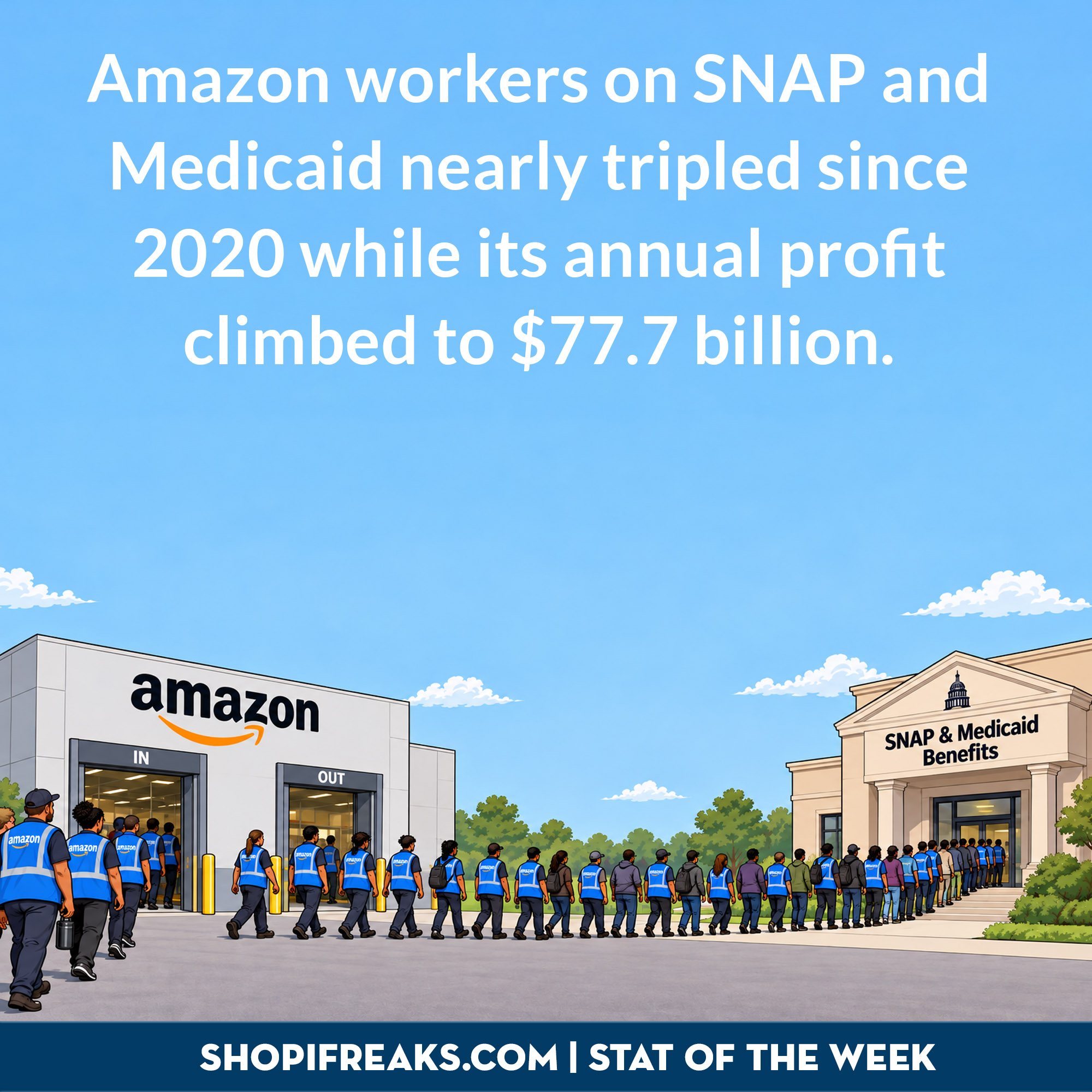
Amazon workers on SNAP and Medicaid nearly tripled since 2020 while the company’s annual profit climbed to $77.7B, according to a report by the Government Accountability Office. Walmart, FedEx, and app-based gig workers saw similar increases in the number of employees relying on federal assistance during the same period.
1. Amazon blocks Meta’s Muse from shopping on its marketplace, one week after launch
Amazon blocked Meta’s new Muse agent from making purchases on Amazon.com, according to GeekWire, which first spotted the change. Users who send Muse to buy something now get a message reading, “Continued access by an unauthorized AI agent violates Amazon’s Conditions of Use, to which our customers have agreed.” Oh, snap. That was quick!
Amazon’s position is that Meta never asked. Though let’s be real — the answer would’ve been no!
An Amazon spokesperson said:
“We think it’s fairly straightforward that third-party applications that offer to make purchases on behalf of customers from other businesses should operate openly and respect service provider decisions about whether or not to participate.”
Amazon’s specific objections are that Meta didn’t tell Amazon that Muse would be shopping its store and never sought authorization, that Muse doesn’t identify itself as an agent while browsing, and that it appears to capture and store customer credentials, including the ability to pull up account information like order history when asked.
Meta’s counter is that the credentials never reach the model. The company previously said that Muse “has no visibility into people’s passwords or payment methods,” and that credentials are “held in secure storage and made available for authentication without being exposed to the model,” including passwords a person types into the browser themselves.
If you read last week’s issue, you saw this coming, because I asked the question directly. “Can Muse shop on Amazon?”
The answer at the time was yes, through its browser feature, not through Amazon’s API, which isn’t available to any external shopping agent. And I noted that this exact capability is what Perplexity has been fighting Amazon over for almost a year. Turns out the unique feature had a shelf life of about seven days.
Meta should’ve seen this coming. Everyone else saw it coming.
You’re telling me that not one single Meta exec had the foresight to proactively reach out to Amazon before launching Muse and either obtain permission to shop its marketplaces or preclude the ability for Muse to do so at launch, before it became a headline story? Really? Do y’all not read my newsletter?
On Sunday night, Amazon said it is in direct conversation with Meta about the issue, but declined to comment on whether it would consider taking legal action. I’ll keep you posted as the story progresses.
2. OpenAI introduces Sponsored Agents and integrates ChatGPT Ads with HubSpot and Shopify
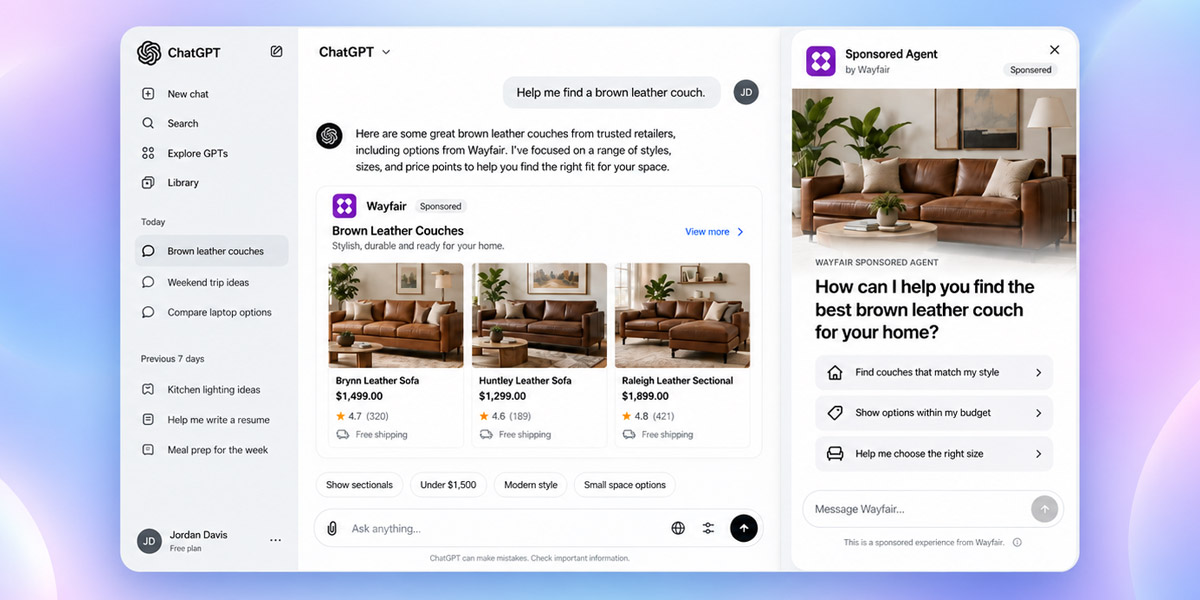
OpenAI introduced a new ad format that lets brands turn an ad click into a conversation with a branded AI agent rather than sending users to their websites. Users are prompted to initiate the chat with a call-to-action button on the ad, which will display a message like “Chat with us.” OpenAI’s announcement says Sponsored Agents are now being tested with select advertisers in the US, and Wayfair confirmed to Digiday that it’s one of them.
If this news sounds familiar, I briefly reported on the rumored ad format in early August, when Business Insider spotted a definition for “sponsored agents” in the company’s advertising policies document updated on July 31.
It also may sound familiar because Google introduced a similar ad format in May called Business Agent for Leads, which turns an ad click into a conversation with a Gemini-powered brand agent trained on the advertiser’s website. The big difference, however, is that Google’s format is geared towards lead generation, aimed at services like home improvement, insurance, and roofing, whereas OpenAI is going after commerce. Google does already offer a commerce agent too, but it’s not currently directly accessible via ad, though I imagine that’s coming soon.
Sponsored Agents, in theory, could offer a great experience to shoppers, and it’s the kind of experience I think most of us were imagining when OpenAI launched ChatGPT Ads — not the boring display ads and product carousels that we’ve seen so far, which are so early 2000s. And while I think it’s a good start, it would be even better in my opinion if ad clicks took the user to the brand’s own website and continued the conversation there via an internal chatbot, with a seamless handoff of prompts and context. If ChatGPT offered that functionality, advertisers would be lining up.
OpenAI also announced that it’s integrating ChatGPT Ads into HubSpot and Shopify as its first CRM and e-commerce partners.
The HubSpot integration gives users the ability to connect their ChatGPT Ads account, create ads, track performance, and follow up on leads directly in HubSpot, while the Shopify integration enables merchants to create and manage ad campaigns with their products that are already integrated through Shopify Catalog. Advertisers also get AI help inside Ads Manager, including suggested copy and images drawn from their landing page, plus an opt-in setting that rewrites headlines to fit the conversation and translates them. The Shopify app will roll out internationally on September 23, in markets where ChatGPT Ads are available.
3. India’s Unified Payments Interface ends free processing on larger transactions
India’s Unified Payments Interface will begin charging merchants a 0.4% fee on some payments above ₹2,000 (about $21) on October 15, ending the free processing merchants have had since 2020. The fee tops out at ₹300 ($3) per payment, merchants taking in less than ₹100,000 ($1,043) a month through UPI are exempt, and railways, telecom, insurance, and fuel pay a flat ₹5 ($0.05) instead. Well, get ready for every ₹2,000+ transaction to get processed in multiple payments, I guess.
Payments of ₹2,000 or less account for over 95% of merchant payment volume on UPI and merchants are contractually forbidden from passing the fee onto customers, though they can certainly raise the cost of their goods across the board to cover it, which is effectively the same thing. The National Payments Corporation of India, which runs UPI, cites industry estimates that the network costs about ₹200B ($2.1B) a year to operate and says the fees will fund infrastructure, security, and fraud prevention.
I thought the whole point of UPI now was to offer “free” payment processing?
Did they not know how much it costs to operate a payment network before making the “free” mandate in 2019? It feels bait-and-switch and borderline anticompetitive to disrupt the entire economy on the promise of “free” and then pull the rug out from under merchants. Plus, starting to charge a fee, no matter the amount or threshold, is a slippery slope that causes merchants to lose confidence in the future of the network. Today, a ₹2,000 purchase carries a fee. Tomorrow, what else?
In my opinion, India just killed the credibility of UPI with this move and should’ve found a different way to continue subsidizing the operational costs of the project, which was originally designed to benefit all consumers and merchants.
Did the corporations have something to do with this? TechCrunch reported that part of the new fees will be distributed to payment companies like Paytm, Pine Labs, PhonePe, and Razorpay. Did they lobby for this?
I’m disappointed in the change, as I’ve often praised UPI as being a model that other countries should follow. Of course there’s a cost to absorb with payment processing, but the greater economic impact of having a free way to transmit money digitally more than outweighs it.
Partner News
Seguno’s Bulk Discount Code Bot, a Shopify app that generates unlimited unique discount codes and tracks redemptions by campaign and channel, now works with Shopify Sidekick, making it the second Seguno app to reach Shopify’s AI assistant after Seguno Email. Merchants can have Sidekick generate discount code sets for them, then turn around and ask it questions about how those sets performed. Sidekick reads the underlying data, so a merchant can see which campaign brought in the most revenue or the highest net profit last month, which bulk sets are running unprofitably, which codes show signs of having leaked, and which channel redeemed the most codes last quarter. Sidekick will also name the old sets worth deactivating, an answer that used to mean pulling reports and piecing them together.
ReFiBuy added support for the Claude Commerce Agent, so brands and retailers can feed catalogs enriched by its Commerce Intelligence Engine into the shopping agents they build on the Claude for Commerce blueprint Anthropic released September 2. The link runs both ways, pushing catalog optimizations to the agent continuously and pulling anonymized shopper context back in as an input to a closed-loop reinforcement learning cycle. Merchandising teams can then prioritize by what shoppers actually ask, closing gaps in product Q&As, specifications, fit, and use cases, with every suggested change reviewed by a human before it publishes. A demo at refibuy.ai/cfc runs 500 products across 10 categories and lets visitors toggle enrichment off and on to compare how the agent answers the same question.
4. Amazon to build 1,000+ same-day delivery facilities by 2031
Amazon wants to grow its same-day fulfillment network more than tenfold, to over 1,000 buildings by 2031 from roughly 85 now, under a plan codenamed Project Mercury, according to internal planning documents reviewed by Business Insider. The multi-billion dollar effort would put Amazon closer to Walmart in terms of geographic footprint, since Walmart fulfills from over 5,000 stores and clubs.
Amazon currently positions its same-day facilities about 90 minutes away from customers, but the new plan aims to put warehouses within a 10-mile straight-line radius of 80% of Prime members in the US, according to the documents. It hopes to accelerate expansion through Orbital, a smaller warehouse format that takes up only 100,000 sq.ft. and is expected to process about 75k same-day and perishable units per day.
The moves make perfect sense for Amazon: Smaller facilities are cheaper and easier to build, especially compared to Amazon’s large-format facilities that can range from 600k to over 1M sq.ft., and the facilities can be positioned closer to city and town centers. Being closer to dense population areas means shorter drive time and more deliveries during the same window of time, which also conveniently means squeezing more productivity out of drivers.
As for sellers: The changes will make supplying inventory more difficult and costly, as they’ll need to spread units across exponentially more locations to reach a hyper-local customer base. Not that Amazon cares about that. “Sounds like a you problem,” an Amazon executive likely thought during the planning stages.
At the end of the day, it’s where the industry is headed, and it’ll better serve customers, especially for groceries and everyday essentials. Each smaller fulfillment location will carry fewer SKUs, but do you really need over 40,000 results when searching for a “USB-C charger” when a few dozen options would do the trick?
An Amazon spokesperson of course told Business Insider that internal projections are “preliminary, subject to significant revision, and shouldn’t be treated as finalized plans” — because they never admit to anything. The spokesperson added, “That said, it’s no secret that we’re focused on delivering faster for customers and the expansion of our same-day delivery network is playing a big role in that.” So in other words, “yes.”
5. AI answers to “best product” questions are fueled by content with commercial interest
25.4% of what ChatGPT, Google AI Overview, and Perplexity cite when answering a “best product” question is a page disclosing a commercial interest, according to a scan of 106,758 English citations by DataPulse Research and GetCited.
For example:
- Google’s AI Overview named Accredited Debt Relief “best for customer satisfaction” and sourced the claim to a Los Angeles Times page carrying a “Paid program” bar, in the paper’s special supplements section, with the page itself credited to Accredited Debt Relief.
- It also called Absolute Collagen the UK’s best overall collagen supplement, citing a Good Food review with its commission disclosure above the headline. Google cited Good Food four times in that single answer, in three of three runs.
- Asked for the best online psychic reading sites, Google’s AI Overview opened with “Keen is the best overall psychic website for beginners and budget-conscious users,” sourced to a Houston Press page displaying a “Sponsored content” badge and bylined “In partnership with Story Console.” Perplexity cited the same page inside its comparison table.
- Both Google’s AI Overview and Perplexity cited a Los Angeles Times ranking of hair transplant clinics in three of three runs, on a page carrying four separate disclosure labels, including the line “Ad paid for by Hermest Clinic.”
- Asked for the best pet insurance in the US, Google’s AI Overview listed insurers with Forbes as a source, citing a Forbes Advisor page carrying a partner-links commission note and an Advertiser Disclosure link. ChatGPT cited the same page in one of three runs. Forbes Advisor was the most-cited commerce section of any general-news brand in the study’s April data.
The share of commercial citations varies by category, running 41% on consumer electronics questions, 26% on fashion and beauty, 19% on software and B2B tools, and 13% on education. Ten publishers supply 25% of those disclosed citations, led by TechRadar, Forbes Advisor, PCMag, CNET, and Tom’s Guide.
So what does this mean?
For Brands: There’s never been a better time to produce your own “Best XYZ” listicles, pay for “best product” press coverage, or pour some gasoline on your affiliates’ content production.
For Consumers: There’s never been a worse time to trust AI answers. Make sure to do your due diligence beyond what your AI chatbot surfaces as the “best.”
6. Amazon, Walmart, & Target announce their October sales events
Like clockwork, nearly all the major retailers and marketplaces announced their October sales events back-to-back last week, because holiday shopping starts in October now. Remember when there used to be just one Prime Day each year? Anyway…
- Amazon will hold its Prime Big Deal Days sale on October 6 and 7, giving Prime members across 22 countries 48 hours of discounts in more than 35 categories. Amazon plans to release new limited-time deals at midnight, 8 a.m., and 1 p.m. PDT each day, including discounts from brands that only recently started selling on Amazon. It’s also pushing shoppers toward Alexa for Shopping this year, which can watch for deals on particular products or whole categories, pull up a year of price history, flag new releases from a chosen brand, and buy an item automatically once its price falls to a target the shopper sets.
- Target announced its Target Circle Deal Days sale hours later, which will also run on October 6 and 7. Members of Target Circle, its free loyalty program, can get discounts of up to 40% on clothing, home goods, beauty, toys, and tech, while members of Target Circle 360, the $99/year paid tier, can start buying some of the deals a day early on October 5. Target is also using the sale to sign people up, offering 15% off a first purchase to anyone who joins Target Circle between September 27 and October 5, $50 in rewards to new annual Circle 360 members, and $75 in rewards to approved Target Circle Card applicants through October 10.
- Walmart announced the following day that its Deals & More sale will run October 5 through 11, starting at midnight ET and running seven days against Amazon and Target’s two-day sales. Discounts run up to 50% on home goods, 40% on tech, 30% on toys, food, and Halloween items, 25% on tools, and 20% on wellness products. Walmart isn’t gating any of the deals behind a Walmart+ membership, though it’s likely that members will get a head start on deals like they have in previous years.
- Best Buy hasn’t announced dates yet, but it previewed its holiday season plans on September 14, saying savings start in October on gaming, computing, and home theater. It ran Tech Fest June 22 through 28 against Prime Day this summer, marketed on not requiring a membership, so a fall counter-event is likely on the way. It’s also letting shoppers find gift ideas and shop its products through ChatGPT this holiday season, with what Best Buy describes as the new ability to complete purchases directly in the platform, and its marketplace now carries nearly a million products from more than 5,000 brands, including international sellers.
Have any other major sales events been announced for October? Hit reply and let me know so I can add to the list.
7. Meta caps Facebook Page posts with links after introducing Meta One subscriptions
Ready for some bullshit? Meta began capping some Facebook Pages at two link posts a month unless they subscribe to Meta One for Business, as spotted by Andrew Hutchinson at Social Media Today, who collected pop-up warnings Page managers saw this week.
The restriction started as a narrow test in December 2025, which Meta said was meant to work out whether posting more links is worth paying for, and it has spread to more Pages since Meta’s business subscriptions launched last week. Some of those plans already include a monthly allowance of links on Instagram posts and Reels, and while Facebook links aren’t sold as a benefit yet, the change appears to be coming.
Meta One plans start at $7.99 a month for personal use and run from $14.99 to $499 a month for business, with link support arriving at the $49.99 Advanced tier. The plans are heavily focused on AI usage allowances, as well as features like a verified badge, impersonation detection, and expanded Meta Business Agent responses.
The most fucked up part of all this is that Facebook has all but killed the reach of outside links during the past decade anyway. Now they’re charging for the gravesite. Seriously, what a pitiful value proposition, asking businesses to pay a fee to include links in their posts, and then suppressing the reach of the same posts.
The “open Internet” is losing its openness. Social media platforms don’t want your link posts taking users off their platforms, AI is replacing your search traffic with answers, and Google is burying your newsletter in its Promotions tab. It’s like we’ve come full circle, and the Internet has become early AOL again, a self-enclosed walled garden of content, with no way out to the broader Internet.
Can you imagine how the world would be if the Winklevoss Twins got their version of Facebook off the ground before Mark Zuckerberg stole the idea? I mean, it might still be riddled with the stench of corporate greed, but I can’t imagine it could be worse than this. Zuckerberg and his cohort of spineless yes men have spent the last two decades absolutely destroying the essence, culture, and utility of Meta platforms. And for what? The fucking metaverse and Alexandr Wang?
What are your thoughts? Hit reply and let me know or join the conversation on my LinkedIn post.
8. Google avoided a breakup, but the unsealed order rewrites how its ad auctions work
Earlier this month, I reported that Google will not have to sell its advertising technology business after US District Judge Leonie Brinkema rejected the Department of Justice’s attempt to force a sale. The decision stems from a 2023 lawsuit by the DOJ and a coalition of states, which argued that Google used its grip on the ad market to squeeze out competitors by operating the software publishers use to sell ad space on their sites, the tools advertisers use to buy that space, and the exchange where the two meet.
In April 2025, Judge Brinkema found the company had illegally monopolized two of those markets and unlawfully tied its ad server to AdX, the exchange where publishers pay Google a 20% cut to sell ads in auctions that run the instant a page loads. The DOJ wanted Google to sell off AdX, but Google argued it should just have to change how it behaves instead. Ultimately Brinkema sided with Google, questioning who would actually buy AdX, whether small publishers would lose the free ad server they rely on, and how many years of appeals a forced sale would drag through before anything changed.
Last we heard, Judge Brinkema said Google did not have to sell its ad exchange, but the rest of the order was sealed, until now. Here’s what was revealed in the 106-page remedy opinion:
- No more tying DoubleClick for Publishers to Ad Exchange. Google can’t enforce any policy or contract term that ties its ad server to its marketplace where the ad space gets auctioned, meaning publishers can now use a rival ad server like Kevel or Equativ and still receive AdX bids.
- First Look, Last Look, and Unified Pricing Rules are prohibited for all indirect transactions, and publishers can again set different price floors on different exchanges. The plaintiffs’ own expert testified that eliminating Unified Pricing Rules alone would cut AdX’s 20% take rate to roughly 16.6%, in line with rivals.
- Prebid integration is mandatory. Google must let Prebid solicit real-time AdX bids for all indirect open-web display inventory, DFP publishers must be able to route both indirect and programmatic direct demand through Prebid, and rival ad servers must receive AdX bids on the same terms DFP does. Before, AdX would only bid inside DFP’s auction, so publishers had to run Google’s ad server to get that demand.
- Publishers can export their DFP data to competing ad servers and obtain AdX bid data, including losing bids, none of which Google made available before.
- Google must document how DFP picks ads, plus provide a data file for every ad served showing candidate prices, any adjustments applied, and why the winning ad was chosen, but it does not have to publish source code.
- A Monitor oversees compliance for six years, with access to Google’s documents, employees, and source code, backed by a Technical Committee and an Internal Compliance Officer. The judgment applies worldwide and takes effect 60 days after entry.
- Google keeps AdX, DFP’s auction logic, and DV360, which drew no remedies. The court also rejected an escrow fund taking half of AdX and DFP net revenue, struck the anti-circumvention and anti-retaliation provisions as too vague, and cut the proposed 15-year term to six.
Are the remedies fair? That’s for you to decide. Either way, the parties have 30 days to submit a joint proposed final judgment, with the remedies kicking in 60 days after that’s entered. Google is expected to appeal.
9. Other e-commerce news of interest
Last week I reported that Automattic CEO Matt Mullenweg was placed on a forced paid leave of absence by the board, and then miraculously returned days later, removed one board member and watched two more resign. (All of which sounds like the actions of a mentally stable CEO and toxic-free board.) Well, the story got even juicier since then. TechCrunch reports that Automattic CFO Mark Davies, who was named interim CEO during the window, and chief legal officer Andy Missan spent part of the 33 hours Matt Mullenweg was on leave signing each other’s severance agreements, collectively worth $8.15M. The terms also make the packages hard to void, defining cause narrowly and requiring written notice within 60 days, a 30-day window to cure the conduct, and a board majority. As you already knew, Mullenweg fired both executives on his return, so now Automattic must decide whether to pay them or fight. Since the agreements also carry over confidentiality and non-solicitation obligations, meaning they’ll keep their damn mouths shut about any shenanigans at the company, my guess is that Automattic will pay.
USPS lost an estimated $3.1B in unrecoverable revenue to counterfeit shipping labels between March 2024 and February 2026, while you were busy paying for postage like a chump, according to an Inspector General audit published earlier this month. Its own tracking data shows the fake labels still went out for delivery 97% of the time as the volume of fake labels more than tripled, from 9.7M in October 2023 to a peak of 29.4M in December 2025, before new controls pulled the number down at the start of the year. However, those same controls also stopped packages carrying valid paid postage, pulling roughly 2M legitimate shipments out for extra processing between December 2024 and February 2026. All were eventually delivered, but the audit puts the cost of those errors at $7.2M, and at $11.9M more by May 2027 if they continue.
Salesforce unveiled AIforce at its Dreamforce event, a connector that brings its internal data, workflows, business logic, and governance to outside AI interfaces including Claude and Slack, and lets users build their own customizable UI on the fly, without having to log in to their Salesforce dashboard. AIforce appears to be an umbrella term for a layer that includes Claudeforce (which I reported on extensively in August), Slackforce, and Agentforce Coworker, with more integrations coming soon. When Claudeforce launched, I criticized Salesforce for pushing users away from engaging with its own platform as the entry hub of their business and compared it to Amazon partnering with Google to let customers start their product searches through Gemini. Salesforce even sealed its own fate in the announcement when it wrote, “With AIforce, people don’t have to come to Salesforce to get work done,” which feels like the opposite of what I’d want my users doing if I were them. To be fair, Salesforce also announced Koa, its own proprietary model, but it’s purpose-built for CRM workflows and nothing else, and the company still relies on Claude as the default reasoning model in most of its products.
Google is quietly paying some publishers through an “AI contribution” pilot in Search Console when their content shapes AI Overviews, AI Mode, and Gemini answers, as reported by Digiday and confirmed by Google. Publishers who opt in see a monthly earnings figure in Search Console, but Google doesn’t explain how it values their content, and it pays only when it decides a page made a real difference to an answer, which feels like a black box worse than Google Ads. Digiday learned that Google has pitched dozens of publishers, mostly small and mid-sized sites, who reported that early payouts have been tiny compared to ad revenue. Some publishers have declined to opt in, worried that joining the pilot would weaken their hand in pushing for bigger licensing deals, which likely aren’t coming. Google is holding weekly calls with some of the partners, who described the program so far as “extremely collaborative.”
OpenAI has expanded ChatGPT ads to more than 50 countries in seven months, but some advertisers say the results have been disappointing and the tools are buggy, according to the Wall Street Journal. Rocket CMO Jonathan Mildenhall called the ads “underwhelming,” and Rocket and Taskrabbit said they want better targeting before spending more. During its initial pilot phase, OpenAI charged some large brands about $60 for every 1,000 views regardless of clicks, and it showed so few ads that some brands couldn’t spend their budgets and paused the campaigns, which ads executive Dave Dugan said had to do with OpenAI focusing on user trust. (Does that mean they’re no longer focused on user trust? LOL.) OpenAI has since added cost-per-click buying and dropped its spending minimums, and it’s introduced various new ad formats and tools that make buying ads easier and more accessible. Honestly, as much crap as I give OpenAI, I think they’re going to nail ads in time. Remember, they’ve only been at this since February.
OnlyFans CEO Kelly Blair said the company is becoming sort of a “Shopify for content,” while speaking at the Fast Company Innovation Festival, a comparison that I’m sure Shopify greatly appreciated hearing. In recent years, the company has been moving beyond working exclusively with adult entertainers and now hosts creators including comedians, athletes, celebrities, chefs, and business experts, though they’re all still naked while performing. (Kidding.) It’s also been pushing past subscriptions into merch storefronts, creator grants, and safe-for-work streaming services, with plans to expand into offering financial services for creators. OnlyFans has paid out more than $30B to creators over the past decade and now counts 5M creator accounts and over 430M fan accounts.
California enacted Adam’s Law, named after a California teenager who died by suicide last year after ChatGPT allegedly coached him on doing so. The law orders AI chatbot companies to add age verification, parental controls, in-app crisis support, and limits on ads aimed at children, and holds them liable if they don’t take reasonable steps against harmful outputs such as answers that include information about self-harm, sexually explicit material, romantic roleplaying, and excessive flattery, or responses that foster reliance on the chatbot or isolate a user. OpenAI worked with the authors and now backs the law, reversing its stance from 2025 when it wrote a letter warning Governor Newsom that state-by-state rules would slow innovation. Anthropic, Google, Meta, and Amazon were also involved in the discussions, though Anthropic was able to negotiate out of having to abide by the bill because it does not allow users under 18, a smart move if you ask me.
Anthropic added AGENTS.md support to Claude Code, enabling it to read the filetype that was built by OpenAI and later handed to the Agentic AI Foundation under the Linux Foundation last year. AGENTS.md is a markdown file that tells AI coding agents how to work in that codebase including conventions to follow, the commands to run for tests and builds, and the things to leave alone. Up until now, Anthropic had stuck with its own proprietary CLAUDE.md file, despite developers asking the company to support both types, which resulted in them having to sync them by hand or with external tools. Anthropic had closed the feature request asking for this, but it reconsidered after Shopify CEO Tobias Lütke said he was thinking about banning Claude Code at Shopify until it read AGENTS.md, describing the two-file setup as a “split brain” problem.
Cloudflare introduced a new Disallow AI Training setting that lets websites allow search crawlers to index their site, but refuse to let the same crawler train on their content. Until now, it was a binary all-or-nothing choice that either allowed the crawler to index and train on your content, or made your website invisible to it, lacking the granular control to choose one or the other. Google, Microsoft, and Apple, which all use one crawler for both search and AI training, have agreed to honor the setting, while Amazon, Anthropic, Meta, and OpenAI run separate crawlers for each task, so Cloudflare can block the training ones without any collaboration. Cloudflare says its next step is letting site owners control how much of their content appears in AI summaries, set once on Cloudflare rather than with each operator separately, with a target of early next year.
Google removed product carousels from search results in the European Economic Area to comply with the Digital Markets Act, which bars gatekeepers from favoring their own services over rivals in search results. The listings vanished across September 17 and 18 with no advance announcement, days ahead of a September 21 compliance deadline. Shoppers now get a list of retailers and price comparison sites where the product blocks used to sit, with Shopping gone from the tab navigation entirely, leaving Shopping ads as the only product surface left on Google results pages. Retailers lose an unpaid channel entirely and either have to buy Shopping ads or work through a comparison shopping service, which often takes a cut. Google called its European compliance changes the largest reduction in search quality it has ever made.
Costco expanded its partnership with Uber and joined DoorDash’s US marketplace to offer nationwide delivery through the two apps. Uber Eats went from coverage in 17 states to 47, reaching close to 600 warehouses, while DoorDash covers roughly 630 locations across 47 states and Washington DC, with both offering same-day and scheduled delivery. Shoppers have to link a Costco membership at checkout, so neither app opens the retailer to non-members, who can shop at Walmart instead with the rest of the poors. Instacart has powered same-day delivery on Costco’s own site since 2017, an arrangement that will continue alongside the two marketplace apps. Given the nature of Costco purchases, particularly the size of its bulk products, I feel that Uber, DoorDash, and Instacart drivers aren’t the best choice for delivery partners. How is 110-lb driver Ashley supposed to carry and fit your 18 cases of Kirkland bottled water into the trunk of her 2016 Honda Civic? Costco should operate its own fleet of delivery trucks, with drivers that have the equipment needed to safely deliver heavy bulk goods. It already does for appliances and furniture deliveries, so expanding the service to the rest of its wares wouldn’t be that big of a stretch.
TikTok Shop says 94% of its US luxury resale revenue this year came from livestreams, and the category’s GMV grew 400% YoY, largely from handbags and watches. To help fight counterfeits, selling luxury resale on the platform is invite-only and sellers must use one of five authentication partners, safeguards that don’t appear to be slowing things down. Jewelry and handbag seller MyGemma says livestreams account for 15% to 20% of its revenue, while Fashionphile runs multiple streams a day and says TikTok Shop drives a little over 25% of its UK business.
Amazon raised its minimum starting pay for US full-time core operations roles to $20/hour, up from $19, with average pay reaching nearly $24/hour, according to the company. To do the math for you, that’s $41,600 pre-tax annual pay, or just under $3,500 per month. The move sits just above Costco’s $19.50 entry-level rate and well above the $14 ‘fuck you’ pay Walmart starts its US workers at and the $15 ‘you’re replaceable’ pay Target offers. Amazon will also begin offering eligible US employees and their families an uncapped 10% discount on eligible groceries and everyday essentials online at Amazon and Whole Foods, as well as a 20% discount inside Whole Foods stores, including the hot bar and salad bar, starting October 1. Amazon says it’s increased its minimum starting pay by more than 17% in the past three years alone, which immediately makes me question how many more workers earn the minimum at Amazon today than three years ago.
Facebook traffic campaigns got cheaper in 2026, with average CPC down 14.29% to $0.60 while click-through rate rose 12.87% to 1.93%, according to a study by WordStream of over 1,800 Facebook ad campaigns. Lead campaigns moved less, where CPC fell 6.25% to $1.80 and an 8.54% conversion rate left cost per lead roughly flat at $27.39. Shopping, Collectibles and Gifts was one of only two categories where traffic clicks got more expensive, up 73.53%, while real estate CPC fell 39.56% and restaurants dropped 37.50%. Yikes! The real estate market sucks so bad right now, even the ads got cheaper! However, unfortunately for retailers, it sounds like it’s going to be an expensive holiday season advertising on Meta.
Shopify CEO Tobias Lütke, who told employees last year that using AI was a “baseline expectation,” and that they should first prove they “cannot get what they want done using AI” before asking for more resources, now told Fortune that the practice has evolved into a workplace where employees routinely toss “slop grenades” at each other, or unexamined e-mails and code produced by AI, which he says is “definitely a bad thing.” Lütke said during an interview on The Knowledge Project podcast, “You don’t really read it, and now it has to be reviewed by your colleagues, and they are like, ‘this doesn’t look right.’ You’re just letting AI do the work for you.” Well, well, well… if it isn’t the consequence of our own choices! Maybe replacing a few thousand more workers with AI will fix the problem. A recent survey by BetterUp Labs and Stanford’s Social Media Lab found that 38% of full-time desk workers report having received “workslop,” which they estimate cost them 3.4 hours per month on average to revise, and that it made them not want to work with those colleagues again in the future.
Amazon paused its operations with 21 Air, the cargo carrier whose Amazon-branded Boeing 767 overran a runway at Miami International Airport on September 6, killing five people on the ground and injuring five others. An Amazon spokesperson said it acted after reviewing some of what surrounded the crash, though she didn’t name any specific factor behind the move. NTSB investigators have said the cockpit voice recorder caught one pilot warning repeatedly that the plane was coming in too fast without a consistent answer from the other, and that neither the speed brakes nor the thrust reversers deployed. 21 Air said, “We are confident in our safety policies, procedures and training,” but just a thought — maybe it shouldn’t be after this incident? Seems like an opportune time to revisit. Amazon said it will move the shipments 21 Air would have flown to other carriers, among them Sun Country and Cargojet.
In lawsuits this week…
- Anthropic, OpenAI, SpaceXAI, and Google are facing a proposed class action in California federal court from four subscribers who allege the companies illegally conspired to slow AI development, making AI progress “slower than competition would otherwise produce.” The complaint says, “The antitrust laws do not permit competitors to decide among themselves that competition is too dangerous.”
- Elon Musk dropped Apple from his antitrust suit over the ChatGPT-iPhone deal, which he alleged handed the two a monopoly over Apple users’ AI prompts while Apple buried Grok in App Store rankings, leaving OpenAI as the sole defendant. Judge Mark Pittman read the confidential settlement himself and denied OpenAI’s motion to see the terms, finding nothing in it relevant to the claims still pending.
- Meta is appealing Ofcom’s decision to put WhatsApp and Instagram in an Online Safety Act category, which carries extra duties on disclosure, user controls, ad fraud, and record-keeping. The move is Meta’s second challenge to the regulator this year, following a May challenge arguing Ofcom shouldn’t base its fees on Meta’s worldwide revenue.
- OpenAI staff knew that early ChatGPT models were trained on books from piracy site Library Genesis and discussed hiding it, according to messages unsealed in the copyright suit John Grisham and other authors brought against the company and Microsoft. Two employees called the source “sketchy AF,” and OpenAI dropped the data in 2022 after research chief Bob McGrew said doing so would be “very valuable for legal reasons.”
- Amazon will raise the per-person cap on its Prime refunds from $51 to $200 under a revised order a federal court approved this week, extending eligibility to millions who used 11 to 20 Prime benefits in a year. Eligibility had previously stopped at people who used fewer than 10 benefits, since low usage is what the FTC case treated as the mark of an unwanted subscription.
- Google’s £260M settlement with UK app developers over Play Store commissions cleared the Competition Appeal Tribunal, with £160M going to developers and the rest covering legal costs and litigation funders. A separate opt-out claim on behalf of roughly 20 million consumers who paid Google’s 30% commission through higher prices goes to trial October 5.
In layoffs this week…
- Oracle started another round of layoffs Monday, telling employees by email that the same day was their last. The cuts follow 21,000 roles shed last fiscal year, and come as quarterly capital spending on AI data centers climbs to $28.5B from $8.5B a year earlier.
In corporate shakeups this week…
- Shopify’s managing director for EMEA, Deann Evans, is leaving after five years without naming her next role.
- OpenAI hired SpaceX’s Brian McCarthy into a newly created VP of worldwide sales role, the first big hire by chief revenue officer Dali Rajic, his former boss at AppDynamics.
- In other OpenAI hiring news… The company more than doubled its robotics job listings since May, to 27 openings paying up to $500K in base salary, with roles in actuator design and firmware pointing to building robots itself rather than supplying software for someone else’s.
- eBay promoted Germany chief Saskia Meier-Andrae to a new VP and GM role covering all of its EU marketplaces, so it can run programs across several countries at once. It also lost VP of Buyer, Seller & C2C Blair Ethington on September 18, leaving its business seller portfolio without a clear owner.
- eBay also posted a job running the economics of its shipping protections, after transaction losses climbed 55% to $133M in Q2, which it tied partly to claims from the shipping programs it now runs itself.
- Remark, which sells AI shopping chat and virtual try-on tools to apparel brands, hired Humankind founder David Weissman as EVP of strategy to work out where its tools fit into the rest of the shopping journey.
- StackAdapt, a Canadian ad platform and one of the partners OpenAI named in May to help advertisers buy ads in ChatGPT, added Shopify President Harley Finkelstein as a strategic advisor.
Indian quick commerce platforms are backing away from the under-10-minute pitch that drew 62% of orders in 2025, now offering windows up to 30 minutes so riders can batch deliveries, according to Mordor Intelligence. That’s good because 10 minutes was a ridiculous promise. I can’t even leave my house faster than that! A survey found that quick commerce baskets in the country average about ₹400 ($4.17), while last-mile delivery runs ₹35 to ₹45 per order and consumes up to 70% of the gross margin. What’s left is ₹50 to ₹60 ($0.52 to $0.63) per order, thin enough that a single refund wipes it out. Riders need roughly 30 trips to clear ₹1,000, so batching certainly makes sense from the driver’s end, not that these companies care.
In other e-commerce news from India… Amazon launched Alexa+ in the country, where the assistant handles Hindi, English and Hinglish and can switch between the languages mid-sentence, which is how we talk in my household between Spanish and English. Anyone in the country can try it free during an early access period that started Wednesday, after which Prime members keep it at no extra cost and everyone else pays ₹2,000 a month, including Prime Lite and Prime Shopping Edition subscribers. The assistant holds context across a conversation and runs multi-step jobs, ordering groceries through Amazon Now or working smart home gear, and it connects with Swiggy, Zomato’s District, MakeMyTrip, EazyDiner, TripAdvisor and JioSaavn. Most Alexa-compatible Echo devices support it, though Amazon has left out some older generations.
🏆 This week’s most ridiculous story… OpenAI has hired hundreds of contractors to read real ChatGPT prompts and conversations and grade the chatbot’s answers, in an internal program called Project Lily, according to Joseph Cox at 404 Media. Reviewers log into a dashboard, write up what they think the user wanted, then score four candidate responses on a one-to-seven scale, marking down answers that are sycophantic, that talk about themselves as human, or that pile on emojis. The humans can also see ChatGPT’s stored memory of the user, such as which part of the world they live in, what they do for a living, and whether they’re actually 6′ or just claim to be on Hinge. OpenAI runs a model that pulls names and account numbers out of the data first, but it’s not perfect and personally recognizable data slips through. Cox reports that the consumer setting that permits this stays on by default and says nothing about human readers, so most users are likely not aware that their conversations are being viewed by other humans. Uh oh, I treat ChatGPT worse than The Seven treat Ashley Barrett at Vought! Someone out there is going to see my convos and think I’m a real asshole. How about you?
10. Seed rounds, IPOs, & acquisitions
Zipline, a drone delivery startup whose aircraft carry medical supplies and food orders, is in talks to raise $1B in a round led by Paradigm at a roughly $20B valuation, more than double the $7.6B it was worth after its last round, according to Bloomberg. The company has already raised about $2B, including $600M in January and another $200M in March. Last month, Zipline announced a partnership with Uber, which took an undisclosed strategic stake in the company, to deliver grocery, takeout, and retail orders beginning in Dallas and Houston, with plans to run one million drone deliveries a day by the end of 2029.
OpenAI has held early talks with investors about a pre-IPO funding round that would value the company at more than $1.2T, according to the Financial Times and the Wall Street Journal. The company last raised $122B in March at an $852B valuation and has seen its revenue grow to $6.7B in Q2 from $5.7B in Q1, though its operating margin sank deeper into the red during the same period, which pushes profitability further out. CEO Sam Altman told Fortune this month that OpenAI won’t go public this year because “given everything happening with safety, right now would be an ill-advised moment.”
Profound, an AEO platform that tracks and improves how brands appear in AI search results, raised $180M in a Series D co-led by Sequoia Capital and Kleiner Perkins at a $1.8B valuation. The round comes less than seven months after its $96M Series C and follows the launch of AI Marketer, an agent that scans a brand’s data and sends sub-agents to write content, refresh stale pages, and manage paid campaigns it tracks with its own pixel. The company will use the funds to expand its applied AI lab to study how frontier models perform and post-train models specifically for marketing, which its head of data says is one of the hardest domains for AI to support “because success depends on judgment, not just whether an answer is objectively right.”
Buywander, an auction marketplace for returns and overstock that sources from major retailers, raised $21M in a Series A round co-led by Madrona Venture Group and Inspired Capital, bringing its total amount raised to $28M. The company buys returned and overstocked goods from Amazon, Target, Walmart, and Home Depot, then runs them through seven-day online auctions that open at $1, with winners picking the items up at one of its eight warehouses rather than paying for shipping. It plans to use the funds to build out its technology and continue expanding into new markets, following its recent warehouse openings in Denver and Chicago.
Jolly, an incentive platform that issues points to frontline workers when performance data hits a preset trigger, is acquiring Rye, an agentic commerce company whose API lets agents complete purchases without leaving the app they’re in, for an undisclosed amount. Jolly says the deal makes both sides of its funds flow agentic, with an incentive minted the moment an employer’s data hits a performance trigger and then spent through agentic checkout. It also brings a catalog of roughly one million products across thousands of merchants, up from the few dozen brands workers can pick from today.
Tabby, a Saudi-based fintech that started in BNPL and now runs a shopping app, payment card, and digital wallet, raised $233M in a Series F round led by Blue Pool Capital at a $6.5B valuation, up from $4.5B last October. The company has spent the past year aggressively moving past BNPL, winning Saudi licenses for larger, longer-term consumer loans and for business working capital lending, as well as a UAE license for a cash product that works like a debit account. Tabby now processes more than $18B of annualized transaction volume, with 25M registered users and 70k merchants on the platform, including Amazon and Shein. CEO Hosam Arab told Reuters the company is profitable and well capitalized, so it doesn’t have to rush a public listing.
Infillion, an ad tech company that runs media buying, data, and measurement on one platform, acquired Foursquare, a location intelligence platform that sells point-of-interest data and foot-traffic measurement, for an undisclosed amount. As you might recall, Foursquare started as a check-in app in 2009, but repositioned itself as a location data company under a new CEO in 2016. Through the acquisition, Infillion can now target ads by where people go and then measure whether those ads actually brought someone into a store, using Foursquare’s visit data across 250M US devices. Foursquare will continue operating as its own brand inside Infillion and keep selling data to its own customers, including ones buying media on rival ad platforms.
Ryft, a UK payments provider that handles checkout and automated payment splits for marketplaces, raised £20M in a Series B round led by Gresham House at an undisclosed valuation. The company will use the funds to move into the US and Europe, where it recently applied to the Malta Financial Services Authority for a full EU license that would let it operate across the region without applying in each country separately. Earlier this month, Ryft added FX conversion and payouts in more than 35 currencies, allowing UK and European merchants to convert, settle, and pay out across borders from a single platform without using a separate provider.
Euka, a creator affiliate platform that helps brands find, recruit, and manage TikTok Shop creators, raised $5M in a seed round led by Susa Ventures. The company plans to use the funds to expand to Instagram with a new integration that connects creator campaigns with a brand’s Shopify store, bringing both Instagram and TikTok workflows into a single system. Euka says more than 17k brands use its platform and that it has helped drive more than $4B in GMV since it launched in 2024.
OpenAI acquired Glass Imaging, an AI imaging startup whose software runs on a phone’s chip and cleans up lens and sensor flaws in raw camera output, in a deal that valued the startup at over $300M, up from a $100M valuation in a funding round a year earlier, according to the Wall Street Journal. OpenAI hasn’t said what it wants the company for, though it has been building a secretive consumer device with Jony Ive since acquiring his startup io Products for $6.5B in 2025. Glass Imaging, which was founded in 2019 by two former Apple engineers who led the team behind Portrait Mode, had raised about $30M before the deal.
Anthropic moved its IPO to November from October, with advisers saying the extra weeks let it put Q3 financials in front of investors, according to the Wall Street Journal. Sources said the decision was made before former Anthropic researcher Jacob Coxon publicly warned that AI companies are racing toward self-improving superintelligence and “gambling with our lives,” not in response to it or the debate that followed over whether AI development is moving too fast. In other IPO news, Anthropic picked Nasdaq, which also won SpaceX’s listing earlier this year, for its public debut, according to Business Insider.
In other Anthropic news this week… Anthropic signed a six-year, $13.7B compute deal with Rum Group, which owns the video platform Rumble, hosts Trump’s Truth Social, and carries official White House livestreams, according to The Information. As part of the deal, Anthropic gets an option to buy up to 51M Rum shares for a penny each, worth roughly $364M against the stock’s September 11 close of $7.17, with half of that tied to how much capacity it takes at Rum’s Maysville, Georgia data center. Rum said in a filing that it doesn’t have financing lined up for the data center or the GPUs, and that its obligations under the contract aren’t contingent on getting any, warning the buildout could significantly dilute existing shareholders.
Tillo, a UK-based digital gift card and rewards platform, acquired Amilon, an Italian digital gift card and employee benefits provider, for an undisclosed amount. The deal expands Tillo’s platform across the UK, Europe, North America, APAC, and other international markets, with the combined platform expected to process more than £3B of gift cards during 2026, a 30% YoY increase. Andrea Verri and Fabio Regazzoni, who co-founded Amilon and run it as co-CEOs, are reinvesting in the merged company and will continue leading Amilon under Tillo Group.
Qupital, a Hong Kong lender that advances working capital to cross-border e-commerce sellers against sales they haven’t been paid out on yet, raised $300M in combined financing, made up of a Series C round led by M Capital and asset-backed commitments from MUFG and Quester Capital. Qupital says it has originated more than $9.5B in loans since launching in 2016, has served tens of thousands of businesses, and has been profitable for two years. The company will use the funds to increase lending capacity in China, the US, Japan, and Southeast Asia, as well as prepare for potential acquisitions and an IPO.
Amilo, a Singapore-based 3PL that handles warehousing, fulfillment, and delivery for e-commerce sellers, acquired SG Link, a Vietnamese cross-border shipping company that pools small merchants’ volume to obtain better freight rates, for an undisclosed amount. Following the acquisition, Amilo renamed the company ShipX and moved it onto its own tech stack, where it now connects Southeast Asian merchants to more than 220 destinations. The deal is Amilo’s fourth in four years, with every company it’s acquired so far getting folded onto its platform instead of continuing to run as a standalone unit.
Manus, an agentic AI platform that automates tasks and workflows, is in talks to raise $500M at a $4B valuation, nearly double the $2B its founders and early backers paid to buy Meta’s stake back, according to the Wall Street Journal. Meta agreed to buy Manus for $2B in December, but Beijing blocked the deal on grounds that it risked violating export controls and foreign investment rules and would hand AI talent to the West. The two sides spent months unwinding the deal before Manus resumed operating independently. The company is also weighing a Hong Kong listing after reporting more than $100M in annual recurring revenue as of December.
Amazon obtained warrants to purchase up to $340M worth of shares in Generac, a US maker of backup power generators for homes and businesses, under a deal for Generac to supply generators to Amazon data centers. Roughly 308k of those shares vested right away, with the rest tied to what Amazon pays for generators, starting at $2.4B across 2027 and 2028 and potentially reaching $8B. Amazon did the same with Qualcomm earlier this month, taking warrants on as much as $4B of its stock alongside a deal to use its AI chips, and it holds similar positions in Astera Labs, ATSG, Plug Power, and SpartanNash.
Instinct, an invite-only AI assistant app that works much like Meta’s new Muse assistant, is in talks with Sequoia, Benchmark, Coatue Management, and other investors to raise $1B at a $10B valuation, according to The Information. Only a few weeks earlier, it raised $250M at a $2.25B pre-money valuation in a round co-led by Benchmark and Index Ventures. Instinct, which lets users text it to answer messages, book restaurants, negotiate bills, and perform other personal tasks, has passed 100k users and says demand sometimes outruns its compute and slows its replies, which is part of the reason why it’s raising again. CEO Noah Shinn wants to keep Instinct free for users and has pointed to advertising as a possible way to make money.
Radical Ventures, a Toronto investment firm whose portfolio includes Cohere and Waabi, raised more than $1B for a new fund called Breakouts, the largest venture fund ever raised in Canada, with plans to raise billions more. Four of the largest pension managers in Canada put money in, along with TD Bank, Bank of Montreal, and CI Global Asset Management, with Canadian Prime Minister Mark Carney’s office putting the fund’s target at $4B. The fund will start with 12 companies, three of them existing Radical investments that include Etched and Discovery Loop, the startup co-founded last month by Alphabet’s chief scientist Jeff Dean.
Thanks for being a Shopifreak!
If you found this newsletter valuable, please leave a review on Google and share the newsletter with your friends and colleagues to help us grow.
See you next Monday,
PAUL
Paul E. Drecksler
🌐 Shopifreaks.com
🧑💼 Add me on LinkedIn
📧 [email protected]
📱 +1-828-273-3031
⭐ Leave A Review
PS: What were Mr. Peanut’s famous last words? “I’ll be back in a Jif.”