
Hi Shopifreaks
As you’re reading this, I’m currently on a plane en route from Cuenca, Ecuador to Chicago, Illinois to attend Commerce Live, the annual BigCommerce event formerly known as BigSummit, to talk about the future of the industry with my fellow e-commerce nerds. I look forward to meeting many of you there for the first time! Please don’t hesitate to introduce yourself if you see me walking around. I look like this — although with a slightly longer beard now and without the Indigenous face paint. LOL

Thank you to everyone who submitted questions for my AMA with Travis Hess later this week. We’ll be covering a healthy range of topics during the limited time we have together, and I’ll be publishing the videos throughout the week on my LinkedIn page, so be sure to connect with me there.
Speaking of interviews, the next AMA I have lined up is with Scot Wingo – CEO of ReFiBuy, host of the Retailgentic podcast and The Jason & Scot Show, founder of Tweener Fund, and a million other notable achievements!
Scot is one of the most brilliant entrepreneurs and commerce experts I’ve ever had the pleasure of speaking to. I kept him on the phone for over an hour last week with ten different “one last questions” — picking his brain about agentic commerce and other e-commerce topics. He’s an unbelievable wealth of knowledge.
Is there anything you’d like me to ask Scot about agentic commerce or other topics of interest during the interview? Hit reply and submit your questions, and I’ll get them answered.
In this week’s edition I cover:
- More evidence of Amazon price fixing
- Walmart’s new fulfillment strategy
- BigCommerce payment processing fees
- Uber’s special price for Amex cardholders
- eBay’s new streaming as a service program
- Commerce’s poison pill and Rezolve’s response
- China restricts U.S. investment in its AI firms
- UCP gets five big new supporters
- Amazon launches scheduled actions for Rufus
- Emoji search is taking over e-commerce
- Amazon enters the weight loss industry
- Apple gets a new CEO
- Meta spies on what’s left of its workforce
All this and more in this week’s 275th Edition of Shopifreaks. Thanks for subscribing and sharing!
Stat of the Week
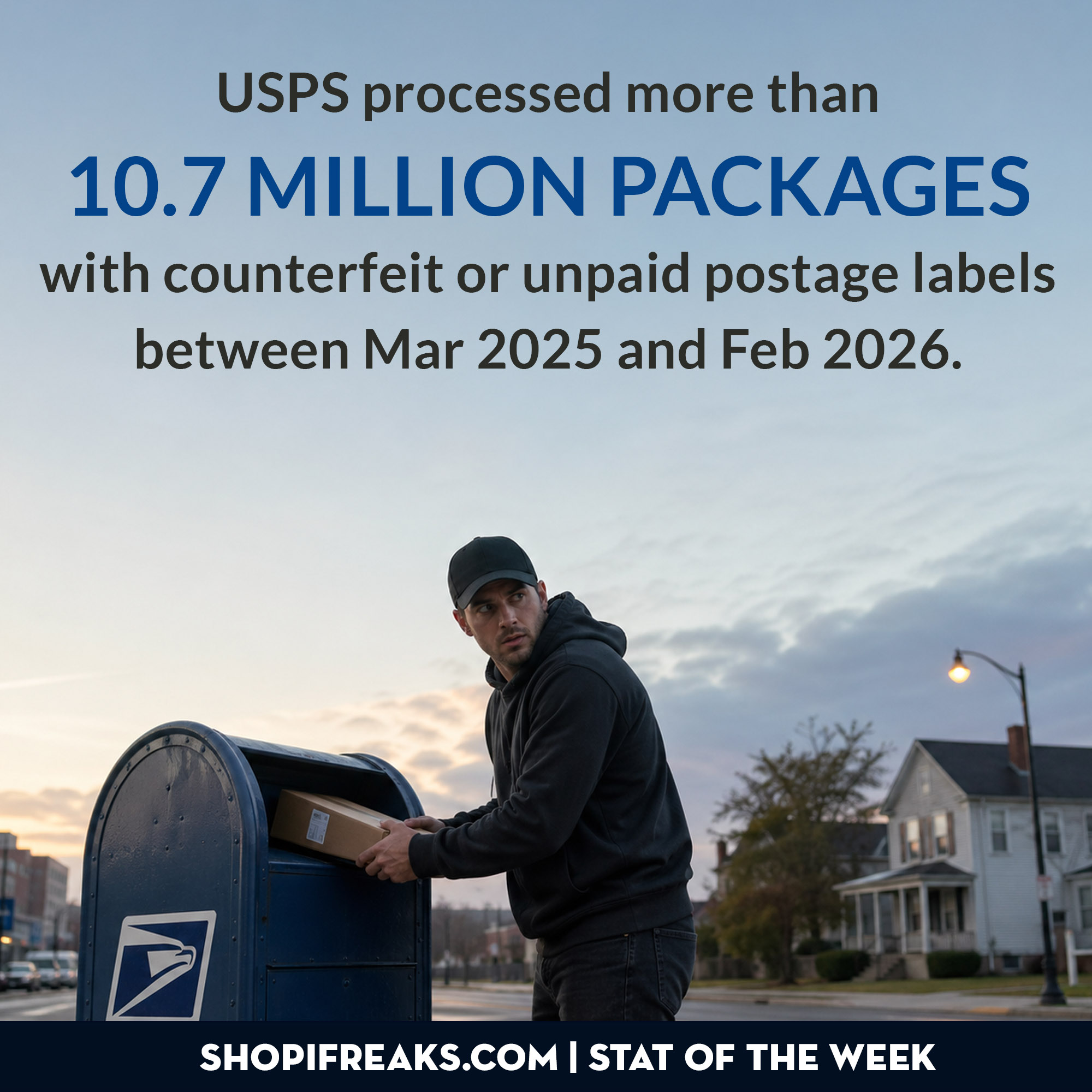
USPS processed more than 10.7M packages with counterfeit or unpaid postage labels in the 12 months ending February 2026, according to a Postal Service OIG management alert. Between November 2025 and February 2026 alone, that volume surged an additional 8M packages, marking a 609% increase in just four months and costing USPS an estimated $46.3M in lost revenue.
1. Newly released Amazon e-mails show evidence of price fixing with vendors
Last week I reported that unsealed court records revealed what most Amazon sellers already knew and have been saying for years — that Amazon punished sellers if their prices were lower on other websites. The documents include internal e-mails, deposition testimony, and confidential corporate presentations that California Attorney General Rob Bonta obtained as part of a civil case his office launched in 2022 accusing Amazon of large-scale price-fixing.
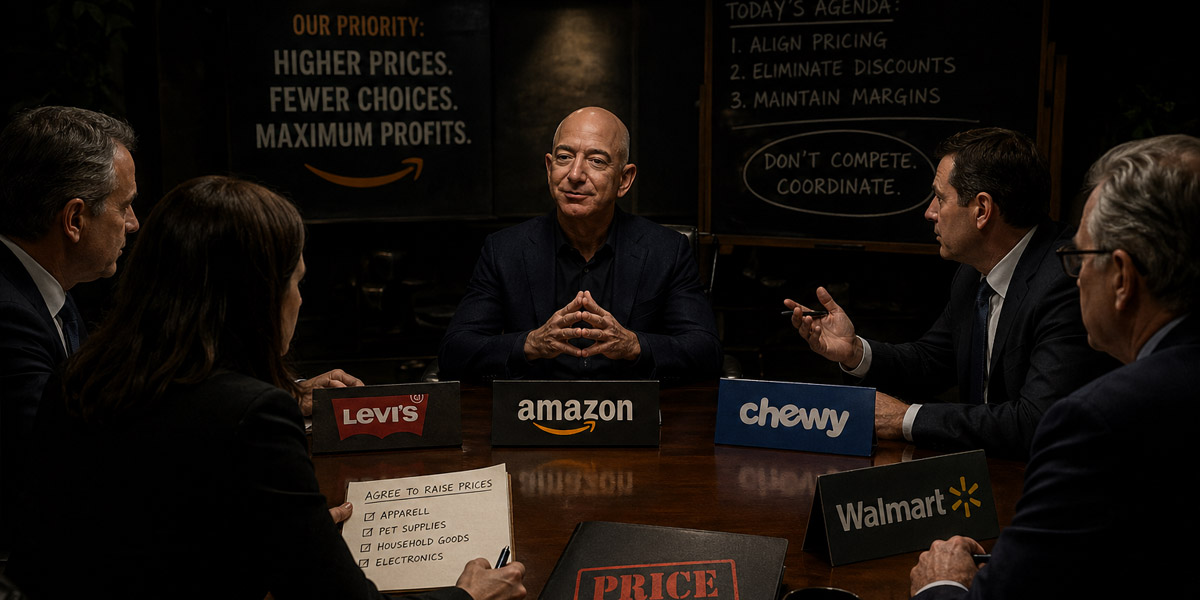
Well since then, more documents have been released that are even more damning, including e-mails that explicitly show Amazon colluding with other companies to raise the prices of pet treats, khaki pants, eyedrops, and other products sold online.
The Guardian reports that in one case, Amazon raised prices on a set of dog treats and worked with a pet treat manufacturer to convince Chewy to follow its increases as a means to protect its market share while simultaneously charging consumers higher prices. Amazon e-mailed the manufacturer a list of products with price increases, instructing them, “As you noted, Chewy should be aware of this update and follow suit accordingly.” Two days later, the manufacturer confirmed that the price had gone up on both sites, ending their message with a 😊 emoji like a slimy piece of shit.
In another case, Amazon sent links to Levi’s showing Dockers khaki pants being sold by Walmart for less money. The next day, Levi’s reported to Amazon that it talked to Walmart and that the company had “partnered with us” to raise the price of the khakis up to “$29.99 immediately.” Afterwards, Amazon notified Levi’s that it would also update its price to $29.99, a few dollars higher than it had previously been selling the pants for.
California attorney general Rob Bonta said:
“The evidence uncovered today is clear as day: Amazon is working to make your life more unaffordable. The company is price fixing, colluding with vendors and other retailers to raise costs for Americans beyond what the market requires – beyond what is fair.”
Amazon said that Bonta’s filing was “a transparent attempt to distract from the weakness of its case,” noting that it came “more than three years after filing its complaint and based on supposedly ‘new’ evidence it has had for years.”
The company also said in a statement that “Amazon is consistently identified as America’s lowest-priced online retailer” — which is easy to do when you force everyone else to raise their prices!
News of blatant unapologetic price fixing like this is absolutely flabbergasting. If the attorney general’s allegations prove to be true, I believe we are all due a substantial refund from Amazon.
2. Walmart is storing third-party marketplace items in store backrooms
Walmart is testing a program to store third-party marketplace merchandise in the backrooms of select supercenters, allowing the items to be delivered at the same speeds as locally stocked groceries and apparel. Typically, items sold by third-party sellers on its marketplace are stored and shipped from Walmart fulfillment centers, which have not offered the same delivery speed advantages as items coming from its 4,600 local retail stores. The pilot is currently underway in several stores in Dallas, TX.
The strategy also ties into two other projects that Walmart has been working on in recent years, including:
- Redesigning its stores with larger e-commerce fulfillment spaces, widened aisles, enhanced signage, and expanded self-checkout zones, among other things.
- Automating its supply chains, such as with AI-powered warehouses that sort items before they are shipped to a store, allowing pallets of products to go straight from the truck to the shelf for restocking.
Business Insider’s Dominick Reuter notes that Amazon and Walmart have been busy in recent years actively encroaching on each other’s territories, with Amazon embracing brick-and-mortar retail and Walmart finally taking e-commerce seriously. Now, Reuter says, “both are branching out after conquering their own games.”
While Amazon has been piloting supercenter-style warehouse-and-store combinations and pushing hard into rural communities with new local facilities, Walmart has been using its local retail footprint to complement its e-commerce ambitions, as well as building out its own logistics network to offer ultrafast delivery across the country.
Reuter says “the race is on to see if Walmart can become Amazon before Amazon becomes Walmart.”
Target was not mentioned in the article. LOL.
3. BigCommerce adds payment processing fees to third-party providers
BigCommerce will soon be adding an Open Payment Provider fee ranging from 0.6% to 2%, depending on which plan you’re on, to merchants using payment processors not on its embedded provider list, which includes Stripe, PayPal, Adyen, Klarna, Sezzle, Afterpay, and others, effective June 1, 2026.
The company has renamed its plans, while simultaneously lowering the GMV ceilings associated with each plan, which means some merchants who fit comfortably inside their plan limits may now be forced into a more expensive tier, even if their volume remains the same. For example, the Core plan, which was previously called Standard and allowed up to $50k in annual GMV, now only allows up to $30k.
MTN Haus, a BigCommerce and Shopify development house, wrote:
“A merchant doing $150K in annual GMV on the Plus plan ($79/month) is about to be auto-upgraded to Scale ($299/month). That’s a 278% increase in platform cost before the new transaction fee is even factored in. BigCommerce frames this as “your business has grown beyond your plan’s threshold,” but the threshold is the thing that moved, not the merchant’s revenue.”
I knew they had to pay for my flight to Chicago somehow, but geez guys!
For years, BigCommerce has touted the fact that it doesn’t charge transaction fees, unlike its biggest rival Shopify, but now it has quietly backpedaled on that promise.
If you missed the big announcement about this change, it’s because they didn’t make one! The updates were only posted to a documentation page that isn’t easily accessible from the main site navigation.
4. Uber may be charging higher fees to AMEX cardholders
Uber riders are accusing the company of charging higher fares when an American Express card is selected in the app. A viral video with over 2.5M views shows an UberX ride in Atlanta priced at $33.05 when the rider selected an Amex card, then dropping to $20.33 after she switched to a Visa card.
Seriously, Uber?! A 63% increase in fare price for using an Amex card? You know they’ll give those to anyone, right?
I remember arriving in the Philippines for the first time many years ago and the immigration officer asking if I had either a credit card or enough money for the duration of my stay. I showed him my Amex card and he waived me through. Apparently Uber and the Philippines still think it’s the 60s and only rich people can have an Amex.
The video that went viral was published over six months ago at this point, but similar claims have since circulated across Reddit, Instagram, YouTube, FlyerTalk, and on credit card forums, where users say fares rise when Amex cards, Uber Cash, Uber One memberships, gift card balances, or business profiles are attached to their accounts.
Uber adamantly denies the allegations. The company told Fortune:
“Prices on Uber are not personalized. We never set prices based on credit/debit card brand, whether you’re paying by card, gift card, or Uber Cash, your account balance, or your battery level.”
Uber also said it does not use battery information or other technical characteristics to set prices or promotions, and only personalizes promotions based on factors like whether the customer has not used the app in a while, in which case it may send a discount to encourage them to return.
If what Uber says is true, then how do they explain all the stories circulating around the web saying otherwise? For example, on this recent Reddit thread where users commented:
- “I have Amex in my uber account. Wife doesn’t. We always check both ours. And her prices are consistently 10-20% less”
- “took Ubers every day for over years. Same route every single time would be under 20$. Ever since I paid with an Amex, the rate is now close to $40. Ridiculous”
- “Can also confirm. I was going to get an uber for my friend to get to my apartment which is less than 2 miles away from her. It was $30 for me and when she checked on her uber it was $9”
- “They also do it for Uber for Business as well. I took Uber to the airport for a business trip this weekend and watched the price go up $35 as I moved from my personal account to my business account and switched from Visa to Amex.”
- “Can confirm. Was with a group of friends and we were checking our uber apps and my friend and I who use Amex had a higher rate for same route/distance than the friend who didn’t use Amex.”
Have you experienced fare increases when using certain payment methods on Uber? Hit reply and let me know.
5. eBay is launching a new service to connect sellers with livestream hosts
eBay is launching a new “streaming as a service” pilot program that connects sellers with livestream hosts, allowing them to participate in Live commerce without having to host the sessions themselves.
eBay Live fashion business development leader Emma Munguia said during a recent webinar:
“We do have a pilot program that we are launching more fully in the next six to eight weeks for host matching and ‘streaming as a service’ partners… so even if you feel like ‘I don’t have the personality for this’ or ‘we’re a small team,’ don’t let that stop you from investigating. We have solutions that can help make that more feasible.”
I actually had a similar idea a few years ago, around the time that I gave a speech at a conference about how live streaming commerce was coming to the U.S. in a big way. (I nailed that prediction.) My idea was to build a studio that offered white label 24/7 live streaming with in-house hosts. eBay’s execution is even better, serving as a middleman between merchants and established hosts, as opposed to offering the service through their own studio.
eBay Live has been available in the U.S. for almost four years and in the U.K. for two years, but the company has just recently begun expanding into new categories, geographies, and streaming offerings to better compete against platforms like Whatnot and TikTok.
Liz Morton of Value Added Resource wrote:
“The move signals eBay is not just investing in Live, it’s actively working to remove barriers that have slowed seller adoption. But it also raises a bigger question: is eBay solving a participation problem, or trying to push more sellers into a format many aren’t convinced fits their business?”
Morton notes that some sellers feel shut out by the selective application process, while others simply have no desire to participate in livestream selling and worry that their listings could lose visibility if eBay continues to prioritize Live on its homepage, search, and ads.
Details about the service, including how much it will cost, have not been provided yet. Nor did eBay specify whether it would exclusively be matching sellers with “human” hosts, leaving the door open for digital avatars to do livestreaming.
6. Commerce adopts a poison pill, which Rezolve calls a “desperate” move
Two weeks ago, I reported that Rezolve AI was attempting a public and hostile takeover of Commerce, the parent company of BigCommerce, Feedonomics, and Makeswift. After submitting two crappy offers to Commerce’s board and having both rejected, Rezolve began attempting to bypass the board by publishing a letter directly to shareholders.
Rezolve wrote in the letter that Commerce’s board is “asking its shareholders to believe in a fiction: that a thinly traded screen price is the same thing as a realizable value, and that 3% annual revenue growth constitutes a credible standalone recovery,” while positioning itself as a company on the up and up.
Since then, the saga has continued with a few big happenings:
On April 14th, Commerce’s board adopted a “poison pill” — formally called a stockholder rights plan — to block Rezolve from accumulating enough shares to force a deal. The plan is triggered if any entity acquires 10% or more of the company’s outstanding shares, at which point existing shareholders get the right to buy additional shares at half price, massively diluting the acquirer.
Rezolve fired back immediately, calling the poison pill a “white flag” and a “desperate” attempt by a failing board to entrench itself, pointing out again that Commerce’s stock has collapsed 96% from its post-IPO peak and that the board is now “forcing shareholders to remain under the stewardship of the directors responsible for the tremendous erosion in shareholder value.”
Rezolve CEO Daniel Wagner wrote, “A poison pill is not a strategy, and this board knows it.”
Rezolve then hosted an investor call that was open to both sets of shareholders, during which it made the case that deploying its Brain Suite platform across Commerce’s 60,000+ merchants would create “an instantly profitable global giant.”
Whether Commerce’s shareholders agree with that vision will come to light at the company’s annual meeting on May 14, 2026, when directors are up for election.
7. China restricts U.S. investment in domestic AI firms
Chinese regulators plan to restrict domestic tech and AI firms from accepting U.S. investments without government approval, as part of Beijing’s response to Meta’s acquisition of Manus in December 2025. Government agencies have told several private firms in recent weeks that they should reject capital of U.S. origin in funding rounds unless explicitly approved, according to Bloomberg sources.
Moonshot AI, StepFun, and ByteDance were among the companies that received these instructions, which sources said are to prevent U.S. investors from taking stakes in sensitive sectors where national security is a priority.
It makes sense, right? The restrictions are tit for tat with rules that the U.S. has towards investing in Chinese tech.
For example, Washington, under the Biden administration, restricted U.S. investment in Chinese semiconductor, quantum computing, and AI companies to prevent American capital from advancing China’s military capabilities or giving its tech sector a competitive edge over U.S. rivals. It goes hand-in-hand that China would be cautious about accepting that capital.
While China and the United States might have similar attitudes towards investing in each other’s technology, Chinese and American people have very different views on AI.
Only 38% of Americans say AI products make them excited, compared to 84% in China and roughly 80% across Southeast Asia, according to a Stanford University study. Notably, U.S. trust in government AI regulation scored just 31%, the lowest of any country surveyed. Singapore had the highest score of 81%, with Indonesia scoring 76% and Malaysia scoring 73%.
8. The Universal Commerce Protocol Tech Council gets five big new names
Amazon, Meta, Microsoft, Salesforce, and Stripe joined the Universal Commerce Protocol Tech Council, an industry body developing an open standard that governs how AI agents handle the full shopping journey across any platform and payment processor. The five companies join founding members Google, Shopify, Etsy, Target, and Wayfair in helping to shape the future of the protocol.
Amazon’s membership has stirred conversation this past week, with folks wondering if the company’s participation in the council indicates that opening its platform to third-party AI shopping agents could be on the horizon, which would be a shift from its current stance of actively blocking external bots and even suing AI companies that attempt to scrape its product listings.
Will OpenAI be joining the council anytime soon?
Honestly, if these new members don’t mark the nail in the coffin for OpenAI’s Agentic Commerce Protocol, I don’t know what will. I think it’d actually be a baller move if OpenAI abandoned ACP and supported UCP, as it’d demonstrate the lab’s commitment to open and interoperable standards, as opposed to a desire to write the entire playbook itself.
However, I also feel that Google should spin UCP off into its own independent foundation like the W3C or the Linux Foundation, rather than keeping UCP under its umbrella. This would show Google’s commitment to building open standards, and not make competitors feel like they’re bending the knee to Google’s dominance.
9. Other e-commerce news of interest
Amazon launched “scheduled actions” for its Rufus AI shopping assistant, allowing the bot to almost automatically restock personal care items, select monthly book purchases based on buying history, or buy a product when it drops below a set price. Rufus currently stops short of automatically completing the purchase and instead notifies users when it has added something to their carts, which feels like a good first step with agentic commerce. As a customer, I’d like to confirm that I actually need replenishment or that I like the book selection before I’m charged. CEO Andy Jassy told investors in February that 300M Amazon customers used Rufus in 2025 and that those who did were 60% more likely to complete a purchase afterwards.
Consumers are increasingly using emojis to search for products across apparel, footwear, and accessories, according to a study by Fast Simon. Emoji-based searches grew 42% in 2025, with top searches evolving from standard apparel icons like 👟 and 👗 to more expressive combinations like ☕ + 🏃 for active morning routines, 🐺 + 🤍🖤 for fan merchandise, and hybrid searches pairing visual icons with text like “$200” combined with 👠. Fast Simon CEO Zohar Gilad says the shift means retailers must now use AI to interpret the emotional and contextual intent behind emoji searches rather than just indexing keywords, as shoppers increasingly use emojis to signal how they feel and what subculture they belong to.
Amazon One Medical launched a GLP-1 management program that integrates obesity treatment into routine care and combines virtual and in-person visits, prescription management, and pharmacy fulfillment into a program designed to treat weight management as a long-term chronic condition rather than a one-off prescription, with insured pricing starting at $25 per month. Amazon’s prices for injectable treatments are roughly in line with current market rates, but the company believes that its same-day delivery and convenience through its existing logistics networks will give it an edge in the competitive industry. Shares of Hims & Hers Health, Viking Therapeutics, Amgen, and Septerna, which offer competing services, fell on Tuesday after the news dropped.
WooCommerce updated its Google for WooCommerce extension to let merchants tag products from their catalog directly in YouTube videos and Shorts, turning them into shoppable cards that appear while viewers watch and in the channel’s Shopping tab, with the product feed syncing automatically through Google Merchant Center to keep titles, descriptions, prices, and inventory current. The update also added AI-powered ad creative generation for Performance Max campaigns, pulling product images and descriptions from the same Merchant Center feed to generate ad variations across video thumbnails, display banners, and text headlines, as well as support for service businesses running campaigns without a product catalog. Shopify merchants have had similar YouTube Shopping functionality available for some time through the Google & YouTube app, which allows eligible Shopify Plus and Advanced merchants in the U.S. to sync their product catalogs and tag products in videos, Shorts, and live streams.
Etsy is raising its Regulatory Operating Fee across several markets effective June 22, 2026, with France seeing the steepest increase from 0.47% to 1.14%, Italy rising from 0.32% to 0.80%, Spain from 0.72% to 0.88%, and the UK from 0.32% to 0.48%, while Hungary will see a new fee of 1.97% introduced for the first time. Etsy says the changes are necessary to keep its pricing aligned with local regulatory requirements, but sellers have limited transparency into how the fees are calculated or where the money goes. Amazon and eBay employ similar regulatory fee pass-through practices in some markets, and Meta began doing the same for advertisers in six European countries earlier this year, passing on digital services taxes it had previously absorbed since 2019.
Google introduced three agentic safety features in Ads Advisor that automate policy compliance and account security tasks that previously required manual effort, including proactive scanning for policy violations with a clear path to resolution, real-time policy reviews as campaigns are created and edited, and daily security monitoring that flags issues like dormant users and suspicious domains. The certification process is also being automated, with Google saying Ads Advisor will soon be able to grant instant certifications or guide one-click applications based on a company’s industry, location, and need, turning what previously took weeks of paperwork into near-instant approvals. The features are part of Google’s broader push to reduce administrative burden on advertisers so they can focus on campaign performance rather than compliance management.
Google Ads introduced AI-Qualified Call Conversions that use AI to evaluate call recordings for signals of genuine purchase intent, such as a customer inquiring about specific services, scheduling a consultation, or showing readiness to buy. The feature replaces the previous system that classified conversions primarily based on call duration alone, addressing a longstanding limitation where long calls could still represent wrong numbers or robocalls rather than actual leads. The new tiered system prioritizes call recording analysis first, falls back to call duration if recording is unavailable, and uses ad interaction data only as a last resort when a Google forwarding number isn’t available.
Cash App launched managed accounts for children ages 6-12 that offer 3.25% interest on savings, providing parents a dedicated place on the platform to send allowances, set aside savings, and track spending for their children. Parents maintain full control over account activity, can schedule recurring payments to their kids, and can approve transfers from up to five trusted contacts such as siblings or grandparents. The accounts do not include access to Bitcoin, though sponsored teen accounts for users 13 and older can include crypto access with parental consent. Cash App currently serves more than 5M teens monthly, and this is the first time that it’s offered a product for kids below the age of 13. Personally, I love the idea of teaching kids about financial literacy, but there’s no way that Mia is getting her own phone at that age, so I don’t really see the point of putting money for her in an account that’s only accessible on my phone and only earns 3.25%. Each to their own though, so you do what you want with your iPad kids.
TikTok expanded its partnerships with Integral Ad Science, a digital advertising verification company that measures brand safety and ad fraud, and Zefr, a platform that helps brands ensure their ads appear alongside appropriate content, as part of the company’s efforts to establish itself as a trustworthy partner for advertisers in the U.S. Integral Ad Science will expand its Total Media Quality coverage and Zefr will extend its brand safety, invalid traffic, and other measurements to four additional TikTok ad products, including search, creation tools for brand and Smart+ traffic, TikTok Lite, and GMV Max. The expanded partnerships come as TikTok is expected to command 4.8% of global digital advertising revenue in 2026.
Meta is launching a beta version of its new AI Business Assistant to advertisers and agencies of all sizes across global major markets and languages, following the successful launch with small businesses in the U.S. last October. The assistant, which lives directly within Ads Manager, Meta Business Suite, and Business Support Home, allows businesses to resolve common account issues, optimize campaign performance, and offer real-time guidance based on an account’s business data. Early beta results showed businesses using the assistant resolved account issues at a 20% higher rate and saw a 12% decrease in ad cost per result after applying its opportunity score recommendations.
Meta is also launching an Instagram spinoff app called Instants that allows users to share disappearing photos, exactly like on Snapchat. The slogan for the app is “real life, real quick,” with the app encouraging raw, unedited content sharing of temporary photos. Instants is essentially a revamped version of Shots, a feature that Meta experimented with on Instagram last year. The new app marks Meta’s infinith attempt at creating a direct Snapchat clone app or feature, which includes Poke, a Snapchat clone app it launched in 2013 and shut down 17 months later, Slingshot, which it tried out in 2014 and shuttered 6 months later, and Quick Updates on Facebook, a feature Meta experimented with in 2016 that no-one remembers.
Visa and TikTok launched a co-branded Creator Card in the UK that gives TikTok Live creators faster access to their earnings, which typically arrive in irregular bursts from virtual gifts that are converted into diamonds and then exchanged for real income, creating cash flow gaps that can make it difficult to cover everyday costs or reinvest in their businesses. The card and accompanying business account are designed to help creators separate personal and business finances and spend earnings immediately rather than waiting for funds to settle. A Visa survey of creators across multiple social platforms found that 86% of creator-run businesses are self-funded and 49% experience late payments, which are cash flow challenges the card aims to address. Makes sense! You can’t pay your bills with virtual diamonds.
Sam’s Club launched an enhanced Express delivery tier that gets members from checkout to doorstep in one hour or less at a flat $10 for Plus members and $22 for Club members, with no purchase minimum and the same prices as in-club shopping. The delivery option is an upgrade from its existing three hour or less Express delivery, which costs $5 for Plus members and $17 for Club members, and is still available. Since rolling out across all 600+ clubs on April 2, nearly 65,000 Express deliveries have been fulfilled with an average delivery time of 55 minutes, and the 10 fastest deliveries all completed in under 12 minutes. Did these people live across the street from a Sam’s Club or something? The launch comes as Sam’s Club reported 23% YoY e-commerce sales growth in its most recent quarter.
WhatsApp is rolling out a paid tier called WhatsApp Plus that gives subscribers access to premium stickers with special effects, personalized app themes and icons, the ability to pin up to 20 chats, and custom ringtones for specific contacts, with no impact on free features like messaging, voice calls, or end-to-end encryption. People still keep their ringer on? My phones have been on permanent vibrate since like 2010. Anyway, pricing has not been officially announced but WABetaInfo found subscription costs currently ranging from less than $1 to around $3 depending on the market, sometimes with one-month trials being offered. As you might remember, WhatsApp was originally supposed to cost $0.99 per year, a fee that founders Jan Koum and Brian Acton planned to implement to avoid ever having to sell customer data or serve ads, but the fee was only implemented briefly in some markets starting in 2013 and was dropped a few years later following Meta’s acquisition of the company in 2014 for $19B.
Netflix is getting ready to launch a TikTok-style vertical video feed within its app this month that helps users discover shows, movies, and video podcasts, following successful tests of the feature since last year. Disney+ recently launched a similar vertical video feature called Verts in March. Netflix is also expanding its use of AI-powered recommendation systems that co-CEO Gregory Peters said can “iterate and improve more quickly” and add support for different content types more efficiently. Other CEO Ted Sarandos said the company’s recent acquisition of Ben Affleck’s AI filmmaking company InterPositive is accelerating its generative AI capabilities for creators, and that it expects to generate $3B in ad revenue this year by using AI to improve ad formats and customization. Co-CEOs Peters and Sarandos can often be found in interviews speaking in unison like Bridgette and Paula Powers.
Ready for some classic old man advice? Amazon CEO Andy Jassy told Gen Z that “if you aren’t willing to start at the bottom and pay your dues, it’s unlikely that you’re going to ever be successful,” saying on Capital Group’s Power of Advice podcast that expecting a great job straight out of college is the wrong mindset and that building a reputation for reliability and hard work from the ground up is what separates people who move up from those who stall out. Of course, you’ve got to afford to pay those dues, which is where having rich parents can certainly help! Jassy, who spent years bouncing between sportscasting, coaching, paralegal work, and investment banking before landing at Amazon after his Harvard MBA, said his own winding path taught him that trying many different things to discover what you love is a career advantage, not a liability. Though he did recognize on the podcast that his advice is easier said than done in today’s job market, so he’s not completely out of touch.
More than 40,000 U.S. retail stores will close over the next five years, as e-commerce, now accounting for more than 20% of total U.S. retail sales and projected to reach 27% by 2030, and AI-enabled shopping continues to siphon sales away from physical locations, according to UBS analysts. Department stores and specialty retailers are most at risk, while Walmart, Costco, and Target are expected to keep expanding. Tariffs and net-negative immigration policies could drive even further closures if they remain in place, with UBS estimating retail sales could drop about 0.5% annually as retailers absorb roughly $100B in increased costs and lower-income households cut spending. The U.S. already had 5,000 fewer stores in Q3 2025 compared to Q3 2024, with the country now at fewer than three stores per 1,000 people, down about 12% from 2003.
In lawsuits this week…
- Google agreed to a $50M class action settlement resolving claims that it discriminated against Black employees by failing to hire them, assigning them to lower job levels, paying them less, and failing to promote them in a racially hostile work environment. Google did not admit any wrongdoing under the settlement, but agreed to analyze employee pay for racial differences, maintain employee reporting channels, and provide information about salary ranges.
- Justin Sun, the crypto billionaire founder of the Tron blockchain, is suing World Liberty Financial, a crypto project co-founded by President Trump, accusing the company of extortion and an “illegal scheme” to seize his tokens. Sun also claimed in his complaint that “World Liberty is on the verge of collapse” and questioned whether it holds enough reserves to back its USD1 stablecoin.
- Consumer Federation of America, a nonprofit advocacy organization that represents consumer interests, filed a lawsuit against Meta for allegedly violating consumer protection laws by allowing scam ads to proliferate on its platform because it had a financial incentive to do so, citing internal documents suggesting Meta was generating roughly $16B per year, or roughly 10% of its annual revenue, from the scam ads. Meta denied the $16B revenue figure and said that the allegations “misrepresent the reality of our work.” Meta notes that 159M scam ads were pulled from its platforms in the past year, a defense it is expected to lean on heavily in the case.
- UMG, Capitol Records, and Concord filed a copyright infringement lawsuit against Quince, a direct-to-consumer fashion startup, alleging the company and its influencer partners used music by artists including Sabrina Carpenter, Billie Eilish, Olivia Rodrigo, Drake, Fleetwood Mac, and ABBA as soundtracks in promotional videos without obtaining licenses. The complaint lists 67 sound recordings and 71 musical compositions as an “illustrative, non-exhaustive” list of infringed works and alleges willful and deliberate infringement, noting that Quince was first notified of the violations in September 2024.
- Elon Musk dropped his fraud claims against OpenAI and co-founders Sam Altman and Greg Brockman, narrowing the scope of his lawsuit to just 2 of the 26 claims he made in his Nov 2024 complaint. Musk alleges that OpenAI abandoned its founding mission as a nonprofit to benefit humanity and is seeking as much as $134B in damages that he asked to be directed to OpenAI’s charitable arm, the restoration of the firm’s status as a nonprofit research organization, and the removal of Altman and Brockman from their roles at OpenAI – the last of which would likely benefit humanity on its own.
- Capital One customers are suing Meta, Google, and other parties over the “outrageous, illegal and widespread practice” of knowingly and secretly installing third-party tracking tools on its websites, allowing other businesses to collect customers’ personal and financial information. The plaintiffs claim that the third-party tracking tools collect vast amounts of sensitive consumer data, which resulted in them being bombarded with ads after applying for a credit card, and that Capital One does not adequately disclose these practices or obtain consent, as required by federal and state laws.
- A former MrBeast executive is suing the media company over alleged wrongful termination after returning from parental leave, pregnancy discrimination, and sexual harassment, including claims that she was demoted after filing a formal harassment complaint and had to be on a work call while in the delivery room. Beast Industries called the lawsuit “clout-chasing” built on “deliberate misrepresentations,” saying it has Slack messages, company documents, and witness testimony to refute the claims.
In layoffs this week…
- Meta confirmed plans to lay off approximately 8,000 employees on May 20th, representing 10% of its 79,000-person workforce, while also closing 6,000 open roles it had intended to fill. Reuters reported last month that Meta could cut at least 20% of its total headcount this year, but a Meta spokesperson called the report “speculative reporting about theoretical approaches.” I guess they aren’t so theoretical after all?
- Microsoft will offer voluntary buyouts to 7% of its 125,000 employees in the U.S., marking a first for the 51-year-old company, according to sources. The one-time retirement program will be available to workers at the senior director level and below whose years of employment and age add up to 70 or higher, with eligible employees receiving details on May 7th.
- Amazon is planning to lay off approximately 616 employees at its Homestead logistics facility beginning in early July through the end of September, while the warehouse is temporarily closed for a building conversion. More than 300 affected employees have already accepted transfers to other facilities. Amazon plans to reopen the facility in mid-to-late 2028 and expects to employ approximately 1,000 people there when it does.
- Sama, a Nairobi-based outsourcing firm that handled AI training and content moderation work for Meta, abruptly laid off more than 1,000 Kenyan workers with just six days notice after Meta ended the contract. The termination follows Meta’s decision last month to pause its work with Sama after allegations that workers were asked to view private footage captured by Meta’s Ray-Ban smart glasses, including users filming themselves in bathrooms and during business time.
- Nike is cutting 1,400 jobs in its operations division, mostly from its technology department, as part of its turnaround plan to operate with “more speed, simplicity and precision.” The move follows January layoffs during which Nike slashed some corporate staff and eliminated nearly 800 jobs at its distribution centers.
In corporate shakeups this week…
- Apple CEO Tim Cook announced that he will step down as the company’s CEO in September after holding the position for nearly 15 years, during which he grew the company’s market value more than tenfold to $4 trillion. The top spot will be filled by John Ternus, the 50-year-old head of Apple’s hardware engineering who joined the company in 2001, making Ternus the eighth CEO in Apple’s history.
- Best Buy appointed Jason Bonfig, the company’s current Chief Customer, Product, and Fulfillment Officer as its next CEO, succeeding Corie Barry, who held the position for seven years. Bonfig’s appointment marks the sixth CEO in the company’s 60-year history.
- Truth Social is temporarily replacing its CEO Devin Nunes, a former California congressman, with Kevin McGurn, a digital media executive who previously worked at NBC Universal, Hulu, and DoubleClick, as it searches for a permanent replacement. The company’s stock has plunged more than 67% since its recent peak in November 2024, wiping out more than $6B in market value. However, to be fair, I’d call it more a “correction” than anything else, as Truth Social was never worth $10B and is still overvalued.
- Lululemon named Heidi O’Neill, who most recently served as Nike’s president of consumer, product, and brand, as its new CEO, succeeding Calvin McDonald, who has held the position since 2018.
- Goldman Sachs named Akila Raman as global head of its private and alternatives capital markets business where she will lead capital raising, structuring and distribution within the asset class. Raman joined Goldman in 2004 and became partner in 2018.
- OpenAI hired Emmanuel Marill, a former Airbnb executive, as its first managing director to oversee operations in Europe, West Asia, and Africa. Marill will be tasked with the expansion of ChatGPT’s parent company in key markets, similar to his former role at Airbnb.
🏆 This week’s most ridiculous story… Meta is installing a keystroke and screenshot tracking software on employee computers to train its AI models, with no ability to opt-out. The program, called Model Capability Initiative, will be installed on computers of U.S.-based employees and contractors and will track keystrokes, mouse clicks and movements, and capture screenshots of work-related apps and websites including Gmail, GChat, and its internal AI assistant Metamate, as part of an effort to train AI agents how humans actually use computers. Meta said the data will not be used in performance reviews or visible to managers, but this is coming from the same company that denied that it would be performing mass layoffs only a month ago, right before laying off 10% of its workforce. Mass internal surveillance… mass layoffs… a company that is actively aiming to replace employees with AI — who the fuck would want to work at Meta anymore?
10. Seed rounds, IPOs, & acquisitions
Google announced plans to invest $10B in Anthropic at a $350B valuation, the same amount it was valued at in a funding round in February, not including the recent money raised, with another $30B potentially to follow if the company hits specific performance targets. The Google investment was announced alongside an Anthropic update on political neutrality in Claude, with the company saying it has trained Claude to treat different political viewpoints with equal depth and analytical rigor ahead of the U.S. midterms and other major elections worldwide. Also last week, Amazon committed to investing an additional $5B in Anthropic at the same valuation, with another $20B potentially to follow. Amazon was already one of Anthropic’s earliest and biggest backers, with prior investments totaling $8B.
Speaking of Anthropic… The company’s implied valuation on Forge Global, a private share marketplace, has climbed to roughly $1 trillion, surpassing OpenAI which trades at $880B on the same platform, despite Anthropic’s own most recent primary funding round valuing it at $350B just three months ago. Availability of shares is so scarce that one buyer reportedly offered to purchase shares at a $960B valuation, and one seller listed their shares at a $1.15 trillion valuation. And let’s not forget the tech banker in California who’s offering his $4.8M mountain estate in exchange for Anthropic shares! If that’s fair game, I’ve got a mountain home in Western North Carolina to trade if anyone’s interested…
Astor, an AI platform that connects to your investment portfolio and provides financial advice, raised $5M in a seed round led by Monashees. The platform can offer guidance for general portfolio construction or take an investor’s broader financial situation into account, such as whether they need to manage credit card debt or plan for an upcoming large expense like a wedding or home purchase. The financial advice industry is highly regulated, and the company says that its founder holds a Series 65 license and that its human advisors fact-check any advice Astor’s agents provide.
Swoop, a startup founded by a 19-year-old Thiel fellow that aims to build a super app for Africa, raised $7.3M in seed funding from Long Journey, Variant, Version One, Dune Ventures, and Soma Capital. The company plans to begin with food delivery and later expand into payments and other lifestyle services, taking inspiration from Asian platforms like Kaspi and WeChat. Swoop’s founder, Aubrey Niederhoffer, says that Africa’s lack of legacy banking infrastructure and low credit card adoption creates significant opportunity for a fintech approach, though he’s certainly not alone in recognizing the opportunity, as the continent has become crowded with fintech startups.
Omni, a four-year-old startup that builds a semantic layer that sits between a company’s raw data and whatever platform is querying it, raised $120M in a Series C round led by Iconiq at a $1.51B valuation. Fortune describes the layer as a “living rulebook that defines what revenue means, who can see which numbers, and how key metrics should be calculated.” The company competes with OpenAI Frontier, Snowflake, Databricks, and other AI labs and enterprise tools that have their own semantic layer offerings, but Omni’s founders say that their advantage is architectural, having built a product from the ground up, whereas legacy players would have to rearchitect their entire products to match.
Adyen entered into a definitive agreement to acquire Talon.One, a Germany-based loyalty and incentives platform that serves more than 300 global merchants, for €750M in cash. The deal aims to extend Adyen’s Unified Commerce strategy by combining its global payments infrastructure with Talon.One’s real-time loyalty and promotions decisioning capabilities, allowing merchants to recognize a customer and apply SKU-level promotions and pricing adjustments directly within the payment flow before a transaction is completed. Talon.One’s co-founders will reinvest a portion of their proceeds into newly issued Adyen shares, and the deal is expected to close in the second half of 2026 pending regulatory approval.
SpaceX announced a deal with Cursor, the San Francisco-based AI coding tool founded in 2022 that reached a $29B valuation in November, giving the company the option to acquire Cursor for $60B later this year or pay $10B for their collaboration without completing the acquisition. Cursor, which had been facing competitive pressure from Claude Code and OpenAI’s Codex, said the deal addresses a key bottleneck by giving it access to xAI’s supercomputer infrastructure to dramatically scale up its model training capabilities. The deal comes as SpaceX prepares for what could be one of the largest IPOs ever, potentially as soon as June, and follows SpaceX’s February acquisition of xAI in a deal that valued the combined company at $1.25 trillion.
Home Depot acquired SIMPL Automation, a warehouse automation company that uses AI and advanced engineering to speed item picking, reduce cycle times, and maximize storage density, for an undisclosed amount. The deal follows a successful pilot of the technology at Home Depot’s distribution center in Locust Grove, Georgia, where it drove faster pick speeds, faster cycle times, and fewer product touches. Home Depot says that SIMPL’s storage and retrieval solution will allow it to house a broader assortment of high-demand products closer to customers, enabling faster delivery and expanded product availability in support of its same-day and next-day fulfillment strategy.
Pine Labs, an Indian fintech that provides merchant commerce platforms and POS payment solutions, acquired Shopflo, a startup that builds checkout optimization and conversion tools for D2C e-commerce brands, for Rs 88 crore ($9.3M). The acquisition will enable Pine Labs to offer an end-to-end platform for merchants that spans in-store payments, online checkout, conversion optimization, growth tools, and consumer engagement and retention capabilities. Pine Labs CEO Amrish Rau believes that “commerce is no longer defined by channels” and that “merchants need a single, intelligent platform that can power both their offline and online journeys,” which the Shopflo acquisition will take the company closer to achieving.
Huboo, a UK-based tech-enabled fulfilment provider that manages warehousing, picking, packing, and shipping for e-commerce brands, acquired Sorted Group, a UK-based delivery management and tracking technology platform that helps retailers and carriers optimize carrier selection and manage returns across multiple shipping providers, for an undisclosed amount. The deal aims to create an integrated logistics solution spanning fulfillment, shipping, returns, and delivery analytics for European brands and retailers, with plans to use AI-driven optimization to improve carrier selection, streamline fulfillment-to-delivery handoff, and give retailers deeper visibility into performance from a single platform. The combined group processes more than 100M parcels annually, services more than 400 brands and retailers, and will operate from sites in Bristol, Manchester, Eindhoven, and Madrid.
Robinhood Ventures Fund I, a closed-end fund that began trading on the NYSE in March 2026 under the ticker RVI, announced a $75M investment in OpenAI at an $852B valuation, making it one of the fund’s largest investments to date and adding it to a portfolio that also includes Airwallex, Databricks, ElevenLabs, Oura, Ramp, Revolut, Stripe, and others. RVI is designed to give retail investors access to private market companies without accreditation requirements or investment minimums, addressing what Robinhood calls a growing gap between public and private markets as the number of publicly traded U.S. companies has fallen from roughly 7,000 in 2000 to about 4,000 in 2025. Following the OpenAI acquisition, RVI currently trades at a 23% premium.
AngelList, a fintech that provides infrastructure for venture capital funds, startup fundraising, and private market investing, launched USVC, a venture fund open to non-accredited U.S. investors that provides exposure to private AI companies including OpenAI, Anthropic, and xAI, with a $500 minimum investment and a 1% flat management fee and no carry fees. The fund pools investor capital across three vehicles including emerging fund managers, company growth rounds, and secondary equity sales, and as of late March had deployed roughly 44% of its capital across seven private firms, with xAI representing its largest holding. Unlike Robinhood’s RVI fund mentioned above, USVC is not listed on an exchange and can’t be easily traded, but AngelList co-founder Naval Ravikant said the fund aims to allow investors to redeem up to 5% of the fund quarterly.
ZigZag, a UK-based returns management platform that helps e-commerce retailers handle cross-border product returns across more than 170 countries, acquired Shipup, a post-purchase platform specializing in proactive delivery communication and customer engagement, for an undisclosed amount. The deal combines ZigZag’s global warehouse and carrier infrastructure with Shipup’s delivery tracking, customer support, upsell e-mails, and feedback survey tools into a single end-to-end post-purchase platform. The combined company now operates across 170+ countries with 250 employees across offices in the UK, Spain, France, Bulgaria, Germany, and Portugal, and will operate globally under the ZigZag Global brand.
OpenTable, a US-based restaurant reservation and management platform, acquired Libro, a Canadian AI-driven restaurant reservation and table management platform, for an undisclosed amount. Libro will continue operating under its own brand while gradually integrating its inventory, technology infrastructure, and security functions with OpenTable, and its restaurant partners will have the option to join OpenTable’s broader diner network for increased visibility and bookings. Libro’s CEO and full leadership team will join OpenTable as part of the deal, which aims to strengthen OpenTable’s presence in Canada, particularly in Quebec.
VisioLab, a German startup that makes iPad-based self-checkout systems using computer vision and edge AI to recognize packaged and unpackaged food items without barcode scanning, raised $11M in a Series A round co-led by eCAPITAL Entrepreneurial Partners and Simon Capital. Alongside the raise, VisioLab launched an integrated checkout-to-payment platform that combines item recognition, POS software, and payment processing in a single system, eliminating the need for separate payment terminals. The company plans to use the funds to expand internationally and support its rollout with Live Nation Entertainment.
Warner Bros. Discovery shareholders voted overwhelmingly in favor of selling the entire company to Skydance-owned Paramount for $31 per share, a deal that values Warner at roughly $81B or $111B including debt. The acquisition would unite HBO Max, CNN, and Harry Potter under the same roof as CBS, Paramount+, and Top Gun, but still faces regulatory hurdles, with California AG Rob Bonta actively investigating it and Democratic senators pushing antitrust concerns. Paramount CEO David Ellison has pledged a 45-day theatrical window and 30 films per year across both studios, but regulatory filings have already flagged planned layoffs and cost-cutting measures, and many observers expect CNN to face editorial changes similar to those already seen at CBS News under Bari Weiss.
SoftBank is seeking a $10B two-year margin loan secured by its OpenAI shares, with an option to extend by a year and an initial interest margin of roughly 425 basis points over SOFR, working out to approximately 7.88%. The move comes after SoftBank recently committed an additional $30B to OpenAI following an earlier investment of the same size, and just last month signed a $40B loan to fund the follow-on investment. S&P Global Ratings cut SoftBank’s credit outlook to negative in March, citing liquidity concerns tied to its OpenAI exposure, and the cost of insuring its debt against default jumped roughly 10 basis points on the news of the new loan request.
Thanks for being a Shopifreak!
If you found this newsletter valuable, please leave a review on Google and share the newsletter with your friends and colleagues to help us grow.
See you next Monday,
PAUL
Paul E. Drecksler
🌐 Shopifreaks.com
🧑💼 Add me on LinkedIn
📧 [email protected]
📱 +1-828-273-3031
⭐ Leave A Review
PS: Where is happiness made? At the satisfactory.