
Hi Shopifreaks
Before we begin, I’d like to welcome ReFiBuy to the Shopifreaks family as our newest official News Partner! 🎉
ReFiBuy optimizes your product catalog so that AI shopping agents like ChatGPT, Perplexity, Gemini, and Amazon’s Alexa can accurately understand, compare, and recommend your products. This practice is called Agentic Commerce Optimization (ACO), a category ReFiBuy coined and built the first platform for.
ReFiBuy runs as a continuous loop:
- Evaluating how each of your SKUs is currently interpreted by the agents
- Enriching the data to fill the gaps
- Distributing it to the AI shopping surfaces
- Monitoring how you perform so each round of optimization gets sharper
Why? Because agents don’t shop the way people do.
When a shopper asks an agent to recommend a product, the agent reads your product data and decides upstream whether it even qualifies, before anyone reaches your site. The basic attributes in a traditional data feed are often enough for a human, because we form an opinion from the total package, which often includes brand name recognition, lifestyle images, videos, and other emotional elements.
However, that’s not enough for agents. They need a literal interpretation of what your product does, who it’s for, and why it’s the best choice for the shopper’s specific use case.
For example, if a shopper is buying their first running shoes for a 5K, your product needs to signal that it’s built for a beginner running shorter distances, not just that it’s a size 10 running shoe. ReFiBuy pulls your reviews, Q&As, and external data to expand your product attributes and structure them in a way that agents can understand and recommend.
ReFiBuy started with optimizing for answer engines like ChatGPT and Gemini, and has since extended to Amazon’s Alexa for Shopping through a launch called ACO Everywhere, which connects each AI selling surface to a single, continuously improving catalog.
✨ A few things that stand out about ReFiBuy:
- ReFiBuy was built by one of the most experienced teams in the space. Scot Wingo founded ChannelAdvisor in 2001 and built it into one of the largest platforms for selling on Amazon and eBay before it went public in 2013, and the rest of the exec team comes from ChannelAdvisor and Walmart. I’ve followed Scot for years, back before ReFiBuy existed, through his Retailgentic newsletter and Jason & Scot Show podcast, and he’s my go-to resource on agentic commerce.
- ReFiBuy learns and improves over time. Many tools on the market will audit and enrich your catalog once and leave it there, whereas ReFiBuy keeps monitoring how the agents recommend and compare your products against competitors, then feeds what it learns back into the next round of optimization as the engines and your competition shift. The days of one-time optimization are over.
- The platform was built agentic from the ground up. ReFiBuy’s own AI agents do the tedious work of mapping SKUs correctly and generating the expanded context the shopping agents need, which is hard to do by hand across a catalog of any real size. This isn’t AI bolted onto a legacy catalog tool. The platform was specifically built for this kind of optimization from the start.
- You stay in control of what changes. ReFiBuy is human-in-the-loop by default, meaning it shows you each recommended change with the reasoning behind it for you to accept or reject. Once you trust it, you can set confidence thresholds that auto-apply high-confidence changes across thousands of SKUs and route the rest to a person. I’m personally a bit skeptical of giving any AI platform unfettered control over my product catalog, so this one’s especially important to me.
Want to learn more?
Start with a free Agentic Readiness Report, where ReFiBuy analyzes your PDPs and e-mails you a diagnostic on how AI agents currently interpret your catalog. I also highly recommend subscribing to Scot’s Retailgentic newsletter – one of the better resources out there for following where agentic commerce is headed.
And now onto your regularly scheduled programming…
In this week’s edition I cover:
- Google AI Mode is showing fewer products
- BigCommerce teams up with WP Engine (again)
- DoorDash launches its own drones
- Amazon got $600M in tariff refunds
- eBay finally settled with EcommerceBytes
- Amazon overhauls its AI strategy
- OpenAI’s ad business is maturing fast
- Claude convos were indexed by Google (again)
- AI doesn’t care about “Made in USA” labels
- PayPal wants to focus on BNPL
- OpenAI tests a new agentic ad format
- Robinhood’s prediction market bet is paying off
- X Money rolls out more widely
- Plus, should you get more votes if you earn more money?
All this and more in this week’s 289th Edition of Shopifreaks. Thanks for subscribing and sharing!
Stat of the Week
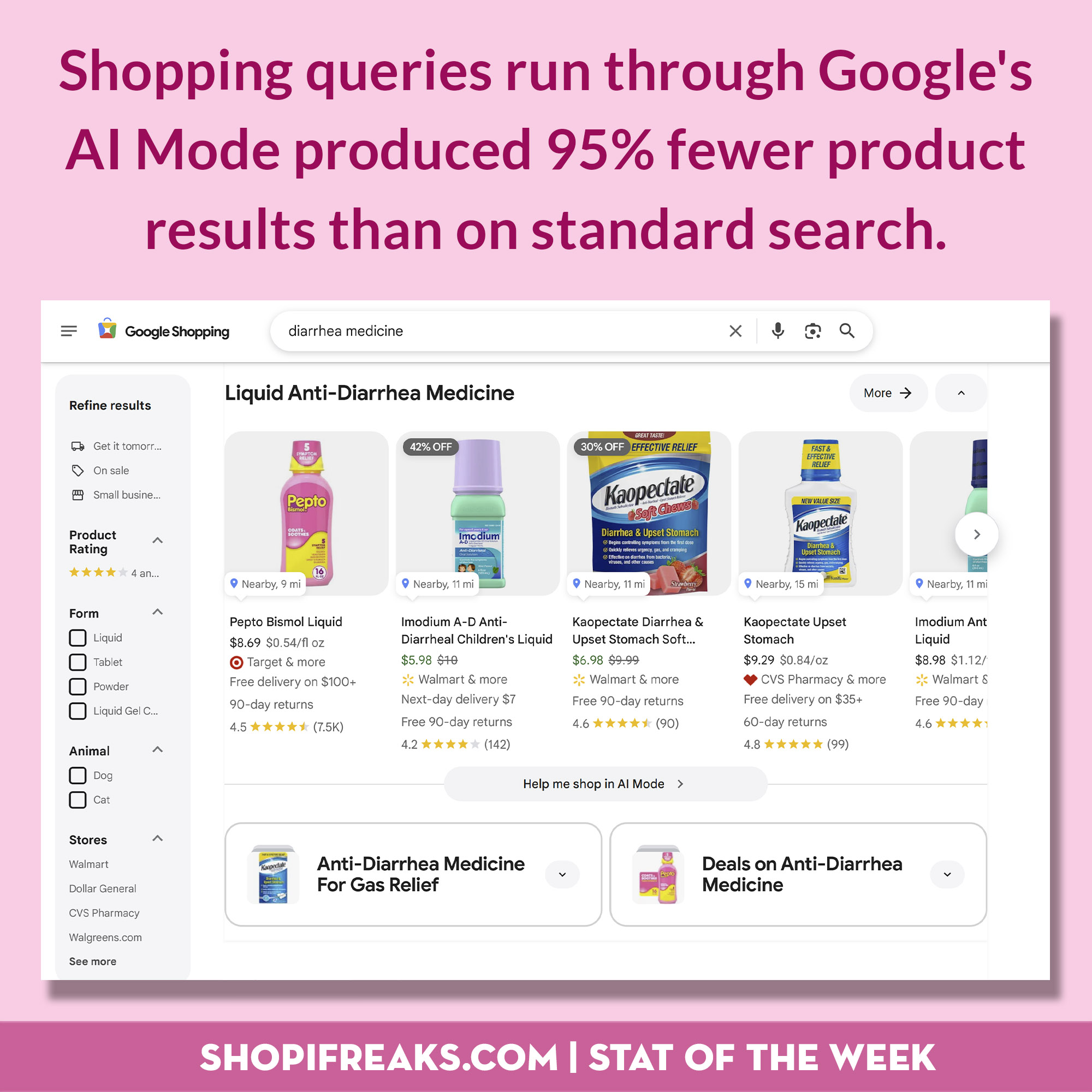
Shopping queries run through Google’s AI Mode produced 95% fewer product results than on standard search, according to a study by Productrise of more than 2M listings across over 100k search pages. Standard search returned products for 88% of queries versus 23% in AI Mode, and roughly 5x as many products per page when they did appear.
1. BigCommerce teams up with WP Engine for a WordPress merchant grab
WP Engine launched WP Engine Commerce Connect for BigCommerce, a solution that keeps a merchant’s WordPress front end in place while BigCommerce runs orders, payments, shipping, tax, and customer records. The offering pairs a WP Engine hosting plan with a separately priced BigCommerce plan and aims to keep mid-level merchants on WordPress when they outgrow the capabilities of their existing stores.
Existing themes, custom designs, URL structures, and site architecture all carry over, and WP Engine says the site stays operational throughout, so a merchant doesn’t surrender search rankings by having to take the storefront down to switch. Neither company gave pricing or an availability date.
WP Engine VP of Product Keith Fafel told Search Engine Journal:
“It’s not about replacing one platform with another. Each ecommerce solution takes a different approach to helping brands create a successful online store. We want to keep growing the WordPress ecosystem, and this solution provides optionality for scaling ecommerce sites.”
I also got fed a healthy dose of the “it’s not about replacing platforms” medicine (no offense, Dana), but I’m not buying it.
WP Engine and BigCommerce are directly going after WooCommerce’s lunch with this one. There’s really no sidestepping that. WooCommerce wants mid-market too. It is 100% about replacing one platform with another when we’re talking about an e-comm solution on WordPress, as merchants aren’t using two at the same time.
WP Engine and BigCommerce didn’t launch this solution to harmoniously coexist in the marketplace with WooCommerce. It was launched to take market share from them — both current and future — and that’s okay, right? No need to be apologetic or disingenuous about it in my opinion. WooCommerce made their bed, pissed in it, and now other companies are coming in to change the sheets. Shopify included. (Is that a good analogy? It was the best I could come up with this morning without much coffee.)
The incentive is obvious for BigCommerce. WordPress offers a fresh territory to win merchants over on. But what about WP Engine?
Well, let’s not forget that WP Engine and Automattic (the makers of WordPress and WooCommerce) have been in a nasty legal battle for the past couple of years. Pushing merchants towards e-commerce solutions from BigCommerce reduces WP Engine’s reliance on proprietary Automattic products housed within WooCommerce. WP Engine can always fork WordPress and run its own in-house version, but the transition becomes harder for merchants once they get entangled in WooCommerce payments, taxes, shipping, etc. There’s an incentive to keep WooCommerce at arm’s length.
Lastly, am I crazy, or does this feel like déjà vu? Wasn’t there already a BigCommerce + WP Engine / WordPress integration?
Yes, there was. The two companies announced a similar partnership in 2018, which targeted the same scalability problem, same architecture, and same mid-level merchant. Back then it was packaged as a BigCommerce for WordPress plugin, which currently sits at a 3.9-star rating on 300+ installs and hasn’t been updated in almost 2 years.
Will this time around be any different? I guess we’ll find out in a few years. Personally, if I were BigCommerce, I would’ve built out my blogging infrastructure and made it seamless to migrate WordPress content to BigCommerce without losing any SEO rank, not the other way around. But that’s just me.
What are your thoughts on a BigCommerce + WP Engine mashup? Hit reply and let me know.
2. DoorDash launches an in-house drone delivery program
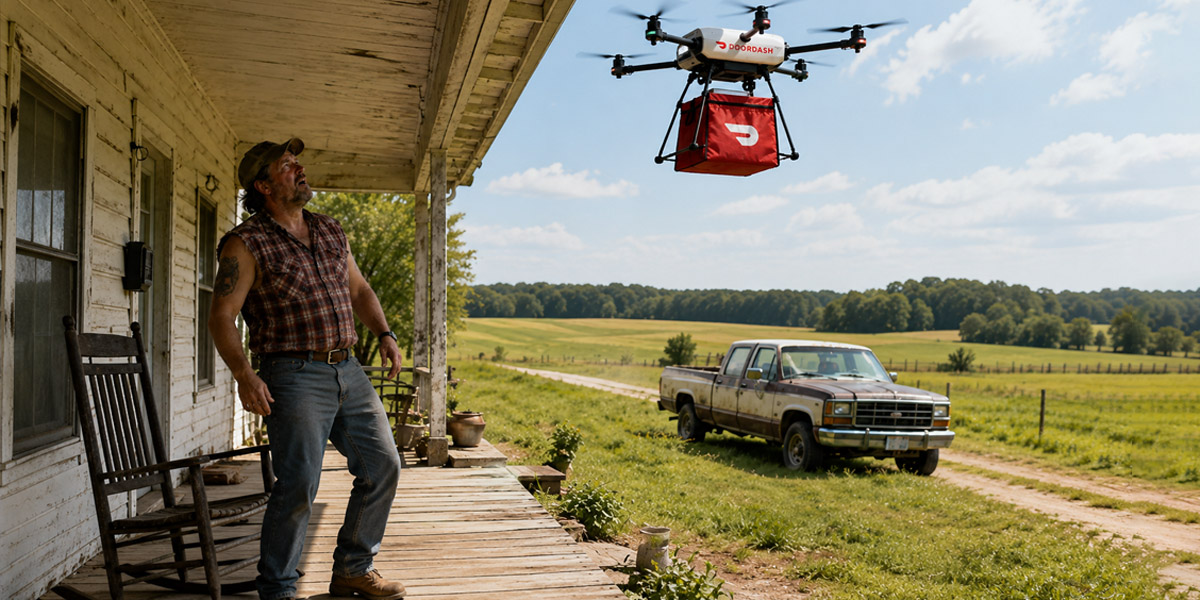
DoorDash is launching its own in-house drone delivery service, DoorDash Air, after the FAA certified the company as an air carrier on July 29. The company has previously flown drone orders through partners like Wing and Flytrex (which it’ll continue working with), but the Part 135 certificate lets it operate the aircraft itself, which only seven other U.S. companies have been approved to do. For the moment, its certificate only covers the areas named in its FAA operations specifications, so DoorDash Air has city-by-city paperwork ahead of it before drones show up in your neighborhood.
The company wrote:
“Similarly to our ground robot, Dot, we’re designing and building our drone program inside DoorDash Labs, our in-house robotics and autonomy team. We’re designing an aircraft purpose-built for the gaps we see in local commerce, and it complements the short- and long-range designs our partners are scaling. Our drone is also proudly American-designed and built, with the majority of components made right here in the U.S.”
DoorDash plans to target three-to-five-mile deliveries with its new drone fleet, which account for over 20% of last year’s trips and run about 25% slower than short ones because a Dasher is often harder to find, according to the company. (I bet they wouldn’t be if DoorDash paid more for those trips, including the drive back as part of the gig. Though paying Dashers doesn’t seem like it’ll be a problem for much longer.)
DoorDash still has a ways to go before you’ll begin seeing branded drones peeking into your windows. In addition to building the drones, it also has to develop the infrastructure needed for the drone to operate, such as a hand-off system for retrieving and delivering the packages and the routing, dispatch, and safety systems that run the airline itself. Other companies have done it though, so I imagine DoorDash won’t be far behind.
3. Amazon collected $600M in tariff refunds, but you likely won’t see shit
Amazon received roughly $600M in tariff refunds last quarter, according to CFO Brian Olsavsky on an earnings call last week. However, you likely won’t be getting much of that sweet tariff money back.
The disclosure came after months of Amazon refusing to say whether it would even apply for refunds. Consumers sued in Seattle federal court in May, alleging Amazon was sitting out the refund process to curry favor with Trump, who told CNBC in April that he’d “remember” companies that didn’t seek refunds.
Olsavsky said:
“We are participating in the tariff refund process, and as I mentioned earlier, we received approximately $600 million in Q2. The amount is limited for a couple reasons. First, our teams did a lot of work forward-buying and pre-positioning inventory to avoid tariff costs. Second, we are not the importer of record for the large majority of items sold in our store given suppliers typically handle imports and pay relevant tariffs. In cases where we did see an increase in costs due to tariffs, we largely absorbed those costs rather than pass them on to customers.”
I’d like to be shown that, not told. Particularly the part about Amazon absorbing the cost of tariffs. Because earlier this year, CEO Andy Jassy said the opposite:
“At a certain point, because retail is, as you know, a mid-single-digit operating margin business, if people’s costs go up by 10%, there aren’t a lot of places to absorb it. You don’t have endless options.”
Also, DataWeave found Amazon prices up 5.7% through the end of September 2025, against 1.7% at Target, across roughly 16,000 items per retailer, though to be fair, that includes across third-party sellers. Last but not least, the $600M figure is suspiciously small for a company Amazon’s size. In comparison, Apple reported $2.2B in tariff refunds for the same quarter with roughly another $1B expected, and Amazon is the larger importer.
Olsavsky said that some customers can expect refunds, but it’ll be limited:
“We have identified a limited set of circumstances where we can trace that we passed specific import charges on to customers, and when we receive those refunds, we will proactively contact affected customers and automatically issue refunds to them. Otherwise, like other large retailers, we’ll utilize refunds to continue to invest in low prices for customers.”
Nice story, but I’m going to guess that that $600M goes straight into AI data center buildout. Prove me wrong.
4. eBay finally settles the EcommerceBytes cyberstalking case for $55.7M
eBay and former executives finally reached a settlement with journalists Ina and David Steiner over the 2019 harassment campaign, putting an end to a six-year legal battle between the two parties.
The $55.7M settlement includes $48.7M in compensation for the Steiners, with eBay paying $46.15M, former CEO Devin Wenig contributing $2M, former SVP of Global Operations Wendy Jones paying $500k, and former communications chief Steve Wymer paying $50k. eBay will put another $6M toward nonprofits, and Wenig will give $1M to a First Amendment charity in Ina Steiner’s name.
This is honestly one of the most astonishing and horrific lawsuits to hit our industry. (More so than Matt Mullenweg whining about WP Engine not giving enough back to the WordPress community.)
Huge shoutout to Liz Morton of Value Added Resource for her unmatched coverage of the lawsuit over the past several years. Read through her eBay Cyberstalking archives for more details on the case, which I’ll provide a very brief summary of below.
- Back in 2019, a team of high-level eBay security personnel, led by Director of Global Resiliency Jim Baugh, launched a stalking and harassment campaign against Ina and David Steiner for their critical coverage of eBay. The harassment included sending live insects, bloody pig masks, and funeral wreaths to their home, as well as threatening messages, doxxing, in-person surveillance, and an attempted break-in. Who does that?! A bunch of eBay mall cops who take their job too seriously…
- Seven eBay employees pleaded guilty to criminal charges and were sentenced for their roles. eBay signed a deferred prosecution agreement with the DOJ, admitting to six felony offenses and paying a $3M fine, which went to the U.S. Treasury, not the Steiners.
- In 2021, the Steiners filed a civil lawsuit naming the seven criminal defendants plus eBay, ex-CEO Devin Wenig, ex-Communications Chief Steve Wymer, ex-SVP Global Operations Wendy Jones, and security firm Progressive F.O.R.C.E Concepts, alleging the harassment campaign was directed from the top of eBay’s executive suite.
- Judge Patti Saris dismissed the claims against PFC on summary judgment in August 2025, and the Steiners cut deals with five of the security defendants to release them in exchange for testimony against the executives. The trial was pushed from January 5, 2026 to March 2, 2026 after Wenig’s attorney claimed scheduling conflicts.
- Days before jury selection, the parties settled on undisclosed terms and the case was dismissed on February 25, 2026, with a 60-day window to reopen if the deal wasn’t finalized. That’s where I last left off with my coverage.
- Well, the deal wasn’t finalized. After multiple extensions, the last running to June 12, the Steiners told the court the parties couldn’t produce a written agreement matching their respective understandings of the terms. Saris reopened the case and set trial for January 4, 2027.
- A new deal came together in July. As noted earlier, eBay and three former executives agreed to pay roughly $55.7M, with the Steiners’ attorney Christopher Murphy saying the couple will receive $48.7M. eBay was required to issue a statement as part of the agreement, calling the 2019 conduct wrong and reprehensible.
Nothing in the new deal stops the Steiners from discussing the case or the evidence. So I look forward to the biopic with Michelle Pfeiffer playing Ina and Kyle Chandler playing David.
Congrats to the Steiners for taking home this well-deserved settlement. I hope that they are able to move on in peace from this wild chapter of their lives.
5. Amazon overhauls its AI strategy, sunsetting most of its flagship models
Amazon is overhauling its AI strategy, reorganizing its in-house teams and sunsetting several of its own flagship Nova models, including Premier, Omni, Reel, and Canvas, according to Business Insider sources. Several Amazon employees described the models as operating in “KTLO” or “keep the lights on” mode, which refers to software that remains supported for existing customers but is no longer in development.
The moves follow layoffs in Amazon’s Artificial General Intelligence group last month and the shutdown of AGI Lab, a research group it started in 2024 after acqui-hiring the team behind Adept. Business Insider says the restructuring suggests Amazon is refocusing its AI strategy and concentrating engineering talent on its highest priorities, instead of investing in various models across text, image, and video.
Sources said that Amazon is moving resources away from its existing Nova models toward a new frontier-model effort led by Pieter Abbeel, a researcher who joined Amazon through its acquisition of AI robotics startup Covariant. The new model, known internally as Frontier Model Research, will be a top priority this year.
An Amazon spokesperson said:
“AI models remain one of the most important things we’re working on, and that hasn’t changed. As with any AI portfolio, we continually evolve our model lineup based on what customers need, and we always provide customers clear guidance and migration paths as models advance.”
At this point, Amazon can’t lose at AI (outside of China absolutely demolishing all U.S. efforts entirely). The company has $50B invested in OpenAI and $13B in Anthropic, with up to $20B more to Anthropic tied to milestones, and hundreds of billions of dollars dedicated to AI infrastructure buildout this year that outside models will also run on. Whoever ultimately wins the AI race, Amazon will win it right alongside them.
6. OpenAI is running a mature advertising operation just 6 months after launch
OpenAI appears to be building a Meta-shaped ad sales organization around a platform that ran its first advertisement just six months ago. Digiday’s Krystal Scanlon wrote, “OpenAI is effectively building the plane while flying it,” which is an accurate way to describe what’s been happening this year.
Here’s a quick timeline of OpenAI’s ad business progression:
- Jan 2026 – OpenAI announced plans to test ads on the Free and Go tiers.
- Feb 2026 – Ads went live for U.S. Free and Go users. Managed service only, $200k minimum, $60 CPM.
- Mar 2026 – Its ad business passed $100M in annualized revenue in under 60 days.
- Apr 2026 – OpenAI launched a self-serve Ads Manager. The minimum dropped to $50k. OpenAI added CPC as a pricing option.
- May 2026 – The platform opened to every U.S. advertiser. The minimum was removed entirely.
- June 2026 – OpenAI updated its ad terms to allow advertisers to upload their own customer lists for targeting and to generate ad creative with AI.
- July 2026 – OpenAI tests an Agent campaign type that sends clicks into a chat with the advertiser’s own agent, and starts offering promotional credits to new advertisers.
OpenAI has also made some big name hires over the past year:
- Fidji Simo joined in August 2025 as CEO of Applications, running the business and operational teams behind ChatGPT, after a decade at Meta where she built out Facebook’s mobile ad business. She stepped back to a part-time advisory role last month for medical reasons, and OpenAI hasn’t named a successor.
- Denise Dresser joined in December 2025 as chief revenue officer from Slack, where she was CEO, and picked up part of COO Brad Lightcap’s commercial duties in April.
- Dave Dugan joined from Meta in March as VP and global head of ads solutions, running advertiser and agency relationships.
- Archana Joshi joined as the founding member of the ads go-to-market and revenue strategy team, after seven years at Meta, the last four running partner and client programs across its apps.
- Sam Mulinder joined from Snap, where he led marketing science for North America, to build OpenAI’s marketing science function from scratch.
- Benji Shomair joined in December 2025 as VP of monetization, building OpenAI’s business across ads, commerce, apps, and subscriptions, after running Meta’s commerce go-to-market as a VP.
Now Digiday reports that two new job postings show OpenAI building the commercial machinery underneath all of it — a head of scaled ads solutions to design a reseller model from scratch, and a global vendor manager reporting beneath them to actually run it.
Up until now, OpenAI has been renting its ad tech, signing Criteo, StackAdapt, and LiveRamp over the spring to handle targeting, buying, and measurement. Now it appears to be building a proprietary ad-serving layer that sits above them, with dedicated leadership to orchestrate these vendors, manage data pipelines, and control ad quality.
Is this enough for OpenAI to reach its ambitious goals of $2.5B in ad revenue in 2026 and $100B by 2030? No one can be sure, but it’s certainly a good start.
7. Claude convos made their way into Google search results, again
Anthropic once again let shared Claude conversations spill into Google search results, with some carrying cryptocurrency wallet keys, names, and addresses. Reddit users found that one search phrase returned long lists of shared chats and Artifacts (the mini apps built inside Claude) covering programming, work notes, and erotica, including a chat tagged “shared by Anthropic” in which Claude generated explicit content its own policy bars. Only chats that users clicked the share button on were exposed, which publishes a copy of the chat on a dedicated URL that then got indexed.
An Anthropic spokesperson told Fortune:
“We give people control over sharing their Claude conversations publicly, and in keeping with our privacy principles, we do not share chat directories or sitemaps with search engines like Google. These shareable links are not guessable or discoverable unless people choose to share them themselves. When someone shares a conversation, they are making that content publicly accessible, and like other public web content, it may be archived by third-party services.”
Correction: Not if you explicitly BLOCK those search engines from indexing the pages! Or block them from viewing the page content!
At this point it’s just negligence, and both Anthropic and Google are to blame. If this were the first time this mistake happened, I could offer more forgiveness — but it’s not. The same thing has already happened to OpenAI, xAI, Meta, Google, and even Anthropic last year!
The AI companies are to blame for making their shared convos indexable, and Google is culpable for continuing to index these convos, when it knows it shouldn’t be. It’s no longer an “Oops! Who knew this could happen?” scenario. It’s now complete negligence.
Fortune reported that Anthropic appears to have resolved the issue and that the links are no longer surfacing through the Reddit search technique, but previously exposed chat links remain live for anyone who already has them, which feels like a half solution if you ask me.
What are your thoughts? Hit reply to this e-mail or join the conversation on LinkedIn.
8. Alexa and Sparky can spot false made-in-USA labels, but don’t care
Amazon’s Alexa for Shopping and Walmart’s Sparky can catch mismatches between made-in-USA labels and contradictory details in the listing, but neither retailer uses that ability to police them, according to a study from Lina Khan’s Center for Law and the Economy at Columbia.
When asked why fakes persist, Alexa told researchers that doing nothing stays easier until the harm to U.S. brands carries a cost for Amazon in money, regulation, or reputation. Sparky pointed to the FTC enforcing origin rules against manufacturers rather than retailers, then called that “a business calculation, not a legal justification.” Well, at least they’re honest!
Alexa also told Wall Street Journal testers that it couldn’t access made-in-USA data, but then produced a list once the prompt was reworded. Khan says that’s the pattern, with the assistants hiding American-made products when shoppers search for them and mislabeling imported ones, which she calls a business choice to promote foreign suppliers.
Walmart didn’t immediately comment, but an Amazon spokesperson said:
“Country-of-origin information, when available, is currently displayed on product detail pages, and we’re continually working to improve Alexa for Shopping’s ability to accurately provide this information to make it even more accessible for customers.”
Why does all this matter?
FTC rules require products advertised as “Made in USA” to be “all or virtually all” made domestically, and last year the FTC pushed Amazon and Walmart to crack down on false “Made in USA” claims. Apparently, their AI is not doing a great job about it yet though.
Shoutout to former FTC Chair Lina Khan for continuing to be awesome and fighting to protect U.S. consumers, even after her tenure at the FTC came to an end.
9. Other e-commerce news of interest
PayPal is planning to lean on BNPL, credit, and Venmo monetization to drive growth, according to CEO Enrique Lores on a recent earnings call. BNPL volume grew 26% in Q2, and the company has been expanding installments internationally, particularly in Europe, while looking to “capture more value” out of Venmo and Braintree. In regards to being acquired by Stripe, Lores said that PayPal “remains open” to an acquisition, but the company’s focus is on “executing our own strategic plan.” There was not enough talk about PayPal Ads on the call though — from either Lores himself or analyst questions. PayPal Ads is what would take my shares from $57 to $200+, not a Venmo debit card.
OpenAI is testing a ChatGPT ad format that sends the click into a conversation with the advertiser’s own AI agent rather than out to a website, according to Juozas Kaziukėnas, who found the option sitting in ChatGPT Ads Manager. OpenAI crawls the advertiser’s site first and builds a business profile from it, covering the questions customers tend to ask, support details, and general context. The advertiser then configures an agent on top of that profile using custom instructions, product feeds, MCP tools for live data, and lead capture forms, and runs a campaign pointed at the agent instead of a URL. In June, I reported that Amazon began running similar conversational display ads that open an Alexa chat.
In other OpenAI ad news… The company is preparing to offer new advertisers promotional credits as an incentive to start buying ChatGPT ads, according to Digiday, which reviewed one promotion granting a $50 credit to advertisers who spend $50 in their first 14 days on the platform. Other versions of the promotion offered a $100 credit, as OpenAI apparently tests various values before making a larger push. Matching initial advertising credits is standard strategy across digital advertising, used by Google, Meta, and TikTok, which ran the same play last fall to lift TikTok Shop ad spending in the U.S.
Amazon told investors that groceries and everyday essentials are growing “meaningfully faster” than the rest of the Stores business, without attaching a number to it, partially fueled by the expansion of its 30-minute delivery service, Amazon Now, to 80 more cities. CEO Andy Jassy shared, “The number of monthly active perishables customers grew over 50% since the start of the year. Same-day orders with perishables averaged over 3x more units per order, and fresh groceries now make up six of the top 20 bestsellers on Amazon.com.” He also noted that Amazon Pharmacy customers grew more than 2x in the first six months of the year.
Robinhood earned more from prediction markets than from stocks or crypto for the first time last quarter, with the betting business bringing in $156M, more than 10x what it made a year earlier, according to The Information. However, much of the quarter’s volume came from the World Cup, which only happens every four years, making June an abnormally strong month. Prediction markets now make up 20% of Robinhood’s trading revenue and trail only options, less than two years after the company launched its first contract on the 2024 presidential race.
X Money opened to Premium and Premium+ subscribers across the U.S., widening a rollout that had initially been limited to a slice of Premium+ accounts. Premium+ subscribers at $40/month receive 6% APY on deposits, while Premium subscribers at $8/month get the same rate only if they link a direct deposit. Both tiers get free peer-to-peer transfers and a virtual and physical X Visa debit card that works in Apple Pay, with free ATM withdrawals globally, 3% cashback on eligible purchases, and early direct deposits. The service was originally expected to launch by the end of 2024 after X secured its first money transmitter licenses, but regulatory holdups, particularly in New York, delayed the rollout by several years. Honestly, at 6% APY, it’s hard not to want to park some cash in X Money, and Elon Musk knows it.
Stripe published its own subscription app to Shopify’s App Store, moving up from the payment rails beneath Shopify Payments into the app layer. Stripe Subscriptions is free to install and puts Stripe Billing in charge of the plans, discounts, and dunning rules, while the charge itself runs through whatever subscription-supporting gateway the store already uses, allowing Shopify to collect its cut while Stripe charges an additional 0.7% on subscriptions or $620/month and up on an annual Stripe Billing contract. Who is this for and why did Stripe launch it? I have no clue. There’s nothing standout about the app’s features compared to legacy subscription apps on the market, and I don’t quite understand why merchants would want a second system of record for subscriptions when they’re already running their shop through Shopify (but perhaps I’m missing something obvious). Stripe hasn’t offered much information about the app, beyond its app listing and help documentation.
USPS missed an estimated $22.6M in underpaid postage and never flagged $6.1M in overpayments from March through May, because a coding error left its Automated Package Verification system ignoring up to 50M scans a week, according to an alert from the USPS Office of Inspector General. The postal service had renamed its parcel sorting machines but never added the new name to APV’s trusted equipment list, and it did not fix the omission until June, three months after the OIG raised it. Sellers got hit both ways, because underpaid shipments escaped adjustment while those who overpaid never received automatic refunds. With the fix in place, the OIG expects APV to collect $96.9M in additional postage and issue $36.6M in refunds through February 2027, though none of that recovers what slipped through during the outage.
Amazon’s Zoox won federal clearance to charge for rides in robotaxis built without steering wheels or other human controls, the first US approval of its kind, according to Reuters. The National Highway Traffic Safety Administration exempted the vehicles from rules written for conventional cars and cleared Zoox to deploy up to 2,500 a year for two years, though none can be sold to the public. Zoox already carries test passengers in Las Vegas and San Francisco (I saw them driving around in Vegas recently), and will begin charging in Las Vegas first, adding markets as it receives additional state and local approvals. Make no mistake, these little Zoox cars (or a version of them) are going to one day be delivering Amazon packages to your door.
Shoppers are three times as likely to start a purchase in an AI chat as they were a year ago, according to Salesforce’s fourth State of Commerce report. Traffic arriving at e-commerce sites from AI chats grew between 150% and 428% depending on the quarter, while overall site traffic only grew in the low single and double digits, which means consumers were shifting to new channels to begin their shopping searches. Consumers said they’re finding fewer products on brands’ own sites, down 7%, and through regular search, down 15%, and discovering more products with AI assistants, social AI, and delivery apps, which collectively rose 38%. Most merchants indicated that they aren’t ready for the shift, with only 28% running agentic AI today, 44% planning to adopt within six months, and 32% having defined what success looks like in the space.
eBay is shutting down myFitment as a standalone service on September 30, ending support for Amazon, Rithum, and other third-party platforms that utilize the vehicle compatibility data service. eBay acquired myFitment in 2022 to help sellers improve listings, reduce returns, and give buyers more confidence that parts would fit their vehicles, but the double-edged sword was that the service continued to help sellers do the same on other competing platforms too. Now eBay is bringing the competitive advantage it acquired four years ago exclusively in-house, where it will live inside Fitment Plus Auto. And as a final fuck you to sellers on competing platforms, eBay isn’t supplying an export or migration tool, so multichannel sellers must find a replacement on their own.
In lawsuits this week…
- The FTC, joined by California and Utah, sued Hims & Hers in California federal court, alleging the telehealth firm ran tracking pixels from Meta, Snap, Microsoft, Pinterest, Reddit, and X that shared customers’ health data against its own privacy policy, and separately that its “Pay $0 today” intake forms started recurring subscriptions that were hard to cancel. Hims & Hers called the claims baseless and said its privacy policy tells users they can choose how their data gets used. (Yeah, because everyone reads your long ass TOS.)
- Google is facing a proposed class action lawsuit in California alleging its advertising technology sent sensitive personal data on U.S. consumers to Temu and Baidu, allowing those firms to receive IP addresses, persistent identifiers, and device-level data each time Google’s tracking code ran on a site. The complaint says that the actions broke the DOJ’s Bulk Sensitive Data Rule, which restricts bulk transfers of Americans’ data to entities tied to China and other countries of concern, and seeks statutory damages, disgorgement, and an injunction.
- Reddit’s DMCA suit against SerpApi and Perplexity survived a motion to dismiss on Friday, with U.S. District Judge Paul Engelmayer finding it plausible that SerpApi sold a tool for defeating Google’s access controls and Perplexity paid to use it. A different judge tossed Google’s nearly identical claim less than two weeks earlier, but Engelmayer said Reddit’s licensing deal with Google names specific prohibited uses, where Google had only asserted it holds licenses in general.
- Anthropic’s challenge to the Pentagon’s supply-chain risk designation went before U.S. District Judge Rita Lin on Thursday, who said the government’s argument had gotten worse rather than better. The Pentagon applied the “supply-chain risk” label earlier this year after Anthropic refused to let the military use Claude for mass surveillance or fully autonomous weapons, but Lin said she saw no evidence Anthropic could alter a model after delivery or “flip some kind of kill switch,” which is what the “supply-chain risk” label implies.
- Elon Musk’s X and the World Federation of Advertisers ended the litigation over GARM, the brand-safety coalition X blamed for its post-takeover ad slump, which X attributed to a systematic illegal boycott by Mars, CVS Health, Shell, Lego, and other advertisers. A federal court dismissed the case in March after finding X hadn’t shown harm, and X appealed in April, with WFA now settling by committing in writing that it won’t rebuild GARM or start anything comparable.
- Meta got two class actions over stock pump-and-dump schemes thrown out on a technicality rather than the merits, with U.S. District Judge William Orrick ruling that a 1998 federal law bars class actions brought under state law when the underlying claim is securities fraud. Investors said they clicked Meta ads for fake investment clubs using celebrity likenesses, landed in WhatsApp groups run by fake financial advisers, and bought two obscure Chinese stocks the scammers had already loaded up on cheap, then watched the price collapse once the scammers sold, with claimed losses of roughly $500M on one of the two.
- Tennessee told a Nashville jury that Meta left autoplay, notifications, and infinite scroll switched on to stretch teen sessions and raise ad views, even after its own researchers tied compulsive Instagram use to depression, disordered eating, and self-harm. State attorney Tom Cartmell showed jurors a 2017 memo where Meta product managers called those features “inherently at odds with well-being” and said the public should be warned, then told the jury the warning never came.
In corporate shakeups this week…
- Scale AI hired Google Cloud COO Francis deSouza as CEO, effective August 10, filling the seat founder Alexandr Wang vacated in 2025 when he left for Meta after its $14.3B investment.
- Babylist named Rent the Runway cofounder Jenn Hyman CEO, effective September 9, with founder Natalie Gordon moving to executive chair after 15 years and stepping aside deliberately before the company goes public.
Shein is under investigation by the FTC, according to documents revealed in connection to its upcoming Hong Kong IPO. The company didn’t say in the filing what exactly the FTC is investigating, but noted that the outcome could significantly impact its business. Shein wrote, “The outcome of the investigation, whether in settlement or otherwise, may require us to make significant monetary payments that could have a material adverse effect on our financial condition and results of operations.” CNBC pointed to the FTC’s focus on dark patterns like buried disclosures, pre-checked boxes, and cancellation flows built to confuse, noting Shein’s app runs flash sales, countdown timers, and gamified discounts. The largest FTC penalty over dark patterns to date is Amazon’s $2.5B Prime settlement in September 2025, and a fine anywhere near that would wipe out Shein’s entire 2025 net income of $2.06B, which already fell 39% from the year before. So yeah, “material adverse effect” sounds about right.
European shoppers are getting hit with duty charges they never saw coming, and BEUC, the umbrella group for consumer organizations from 31 EU countries, wants the European Commission to put an end to the practice. On July 1, the EU started charging a €3 fee per product category on cheap imported parcels that used to come into the region duty-free, and sellers are legally the ones who owe it. However, BEUC found the charge often shows up late in checkout or not at all, and then postal carriers like PostNL and La Poste hit shoppers with a bill before they’ll hand over the package, sometimes with their own admin fees piled on top. The European Commission says businesses are legally responsible for the duty and it shouldn’t be collected from consumers, but it seems like it implemented the new duties faster than it began enforcing them.
In other EU news… The European Commission charged Temu with failing to cooperate during a December raid on its Dublin headquarters, carried out under the Foreign Subsidies Regulation to determine whether Chinese state aid has given the company an unfair edge in Europe. Investigators said Temu withheld information on how it organizes and manages its EU business, the IT systems running it, and certain books and records, which could carry a fine of up to 1% of annual turnover. Temu rejected the charge and said it complied with every request during the inspection and that its own operating cash flow funds its European business. Only slightly related, but remember back in December 2025 when staff from Temu’s parent company PDD fought Chinese officials during an on-site investigation into fraudulent delivery allegations? You know that had to have been on the back of the Commission’s mind before they went into the Dublin headquarters. Temu staff are ready to throw down!
🏆 This week’s most ridiculous story… Apparently Shopify CEO Tobi Lütke thinks your right to vote should be tied to how much money you make. Lütke posted on X that retirees on pensions have become dependents like minors and should lose the right to vote, leaving decisions to those with something at stake. Would they also lose the right to hold office in this dream scenario of his? Former TD Bank executive Eric Thor responded two hours later with a tiered scheme awarding no votes to anyone paying no income tax, one vote up to $100k, and as many as five votes at $500k or above, which Lütke called a “good system.” I speak for everyone when I say, “The fuck?” Does he forget that everyone, regardless of income tax level, pays an assload of taxes across all walks of life, from property and excise taxes to sales taxes and tariffs? But regardless, who cares how much money we have or how much taxes we pay? Every human is equal and gets the same vote in a democracy. Lütke has neither retracted nor explained the posts, and Shopify has not commented.
10. Seed rounds, IPOs, & acquisitions
Cashea, a Venezuelan BNPL platform that offers installment financing for in-store and online purchases, raised $100M in a previously undisclosed $40M Series A round led by Spice Expeditions and a Series B round led by FinSight Ventures. The company says it has 10M consumer accounts (over half the country’s adult population), a merchant network of 40,000 stores, and 100M transactions since launch in 2022. The funding was announced weeks after the June earthquakes in Venezuela, after which Cashea waived late fees across the country, advanced cash to merchants, and loosened credit access.
UNIT AI, a warehouse robotics company that automates e-commerce order fulfillment and returns processing inside a retailer or 3PL’s existing facilities, raised $12M in a funding round co-led by Prologis Ventures, Dynamo Ventures, and Ground Up Ventures. The company’s pay-per-use system automates item-level inventory handling, order picking, and returns processing for retailers, brands, and 3PLs, working within their existing warehouses without requiring a facility redesign. UNIT AI says it can go live in as little as 1,000 square feet and pay for itself within a year.
Monetate, an e-commerce personalization platform that runs A/B testing, product recommendations, and targeted on-site content, acquired Simon AI, a customer data platform that runs AI agents to build and execute personalized marketing campaigns, for undisclosed terms. Both products will stay separate after the close, keeping their own teams and roadmaps, while Monetate CEO Steve Maher will serve as CEO of both companies and Simon AI co-founder Jason Davis will continue to run Simon AI. Monetate bought A/B testing vendor SiteSpect in June 2025, making this its second acquisition in thirteen months.
Dimension, an agency that runs TikTok Shop operations for brands, agencies, and creators, raised $1.65M in a seed round that included Science Inc. and UpscaleX. The company’s in-house agentic AI platform, Seller OS, handles ads, customer support, affiliate and creator relationships, and day-to-day storefront operations. Dimension built the platform off its own experience running TikTok Shop programs for more than 40 brands and agencies, and will use the funds to take Seller OS out of private beta and into general availability.
Amazon paid out the full $50B it committed to OpenAI in late February, delivering the last $35B in two pieces, $13.7B during Q2 and $21.3B since the end of June, according to a securities filing. Only $15B went in at signing, with the balance owed once OpenAI either went public or hit unnamed milestones. Since OpenAI has obviously not gone public yet, it’s assumed that one of the other milestones triggered the release of funds, but neither company has said what it was. The milestone could’ve been OpenAI hitting 1B monthly active app users, but definitely wasn’t OpenAI falling behind Anthropic in revenue growth and valuation, which would be a weird trigger to pay out on, though both are true.
Situational Awareness, an AI-focused hedge fund founded by former OpenAI researcher Leopold Aschenbrenner, sold most of its public stock portfolio to Citadel after heavy losses on AI holdings, according to Wall Street Journal sources. The firm had borrowed heavily on margin to build its positions, so when AI stocks fell, its lenders demanded cash it didn’t have, forcing it to either raise cash or sell some of its holdings. Citadel only took the positions bought with borrowed money, while Situational kept its private stakes, including its shares in Anthropic. Aschenbrenner, who launched the fund with no professional investing experience, had grown it as high as $45B, but now it sits around $10B after the selloff.
Stripe is in talks to acquire OpenRouter, a startup that gives AI app developers access to more than 400 closed- and open-source models from a single API, for a reported $10B, according to WSJ sources. The Information notes that Stripe would be paying roughly 70 times revenue if it paid anywhere near that amount, since the three-year-old startup was recently running at about $140M in annualized revenue. However, with revenue nearly tripling since April and gross profit margins around 70%, the multiple would likely be smaller by the time any deal closed.
Freehand, an enterprise software company whose AI agents manage supply chain spend and invoice processing, raised $75M in a seed round co-led by Battery Ventures and NewRoad Capital Partners. The company’s agents read contracts, negotiate rates with suppliers, process invoices and payments, and reconcile data inside enterprise systems, taking over work that large companies now hand to outsourced teams and legacy procurement software. Freehand emerged from stealth earlier this year with deployments already running at Meta, Unilever, Johnson & Johnson, Pfizer, Dunkin’, and Cardinal Health.
Polar, an AI browser that completes multi-step tasks by clicking and typing through sites logged in as the user, raised $5.7M in a seed round led by Madrona. CEO Kevin Jiang, who previously worked on Perplexity’s Comet browser, is aiming Polar at sales, recruiting, marketing, and research teams, though he expects most of them to keep a separate default browser, since he doesn’t think people run enough automations yet to switch. AI browser competition is lower than a year ago, with OpenAI’s Atlas shutting down, The Browser Company absorbed by Atlassian, and Comet redirected toward agents.
Wander, a luxury vacation rental company that operates a curated portfolio of homes with hotel-grade amenities and concierge service, acquired the team behind Maple, a family organization app that gives parents a shared calendar, meal planning, and task tools in one place, for undisclosed terms. The Maple team will work on WanderOS, its platform for independent rental operators, building out the booking websites, guest marketing, and distribution tools that let property managers take reservations directly instead of through Airbnb or Vrbo. Maple, which was founded by former Shopify executives Michael Perry and Mike Taylor, will sunset on December 31, 2026.
Fincart, an Egyptian platform that plugs merchants into 40-plus shipping carriers and reconciles their cash-on-delivery payments, raised $2.8M in an oversubscribed seed round co-led by Launch Africa and Antler MENAP. The company also provides short-term cash advances to merchants based on their sales and AI tools for customer retention and engagement. Fincart plans to use the funds to hire across its commercial and technology teams, establish new commercial partnerships, and expand into new markets in 2027.
DHL eCommerce entered into a definitive agreement to acquire Venipak Group, a Baltic parcel delivery company that runs courier services, parcel lockers, and e-commerce fulfillment across Lithuania, Latvia, and Estonia, for an undisclosed amount. Venipak runs roughly 800 lockers alongside a network of pick-up points and handles both B2B and B2C volume in a region where shoppers lean heavily on out-of-home collection. Venipak keeps its brand after closing, along with its management team and staff, while gaining the ability to plug into DHL eCommerce’s worldwide network and its 165,000-plus out-of-home points. The deal needs regulatory clearance before it closes.
AMZ Advisers, an Amazon marketing agency that handles listings, advertising, and marketplace expansion for brands and manufacturers, acquired Reach Social Commerce, a TikTok marketing agency that runs affiliate campaigns and GMV advertising for consumer brands, for an undisclosed amount. Rather than a clean buyout, AMZ Advisers bought out one of Reach’s owners and partnered with co-owner Jackie He, who will stay on to run the business. CEO Mike Begg said the deal stemmed from client demand, and that buying an agency that already knew the platform was quicker than building the capability.
Thanks for being a Shopifreak!
If you found this newsletter valuable, please leave a review on Google and share the newsletter with your friends and colleagues to help us grow.
See you next Monday,
PAUL
Paul E. Drecksler
🌐 Shopifreaks.com
🧑💼 Add me on LinkedIn
📧 [email protected]
📱 +1-828-273-3031
⭐ Leave A Review
PS: I started a dating app for dead people. There were lots of matches, but everyone kept ghosting each other.