
Hi Shopifreaks
BIG NEWS: I’m launching something really cool soon! A new way to share your e-commerce app or solution not only with my audience of 20,000+ e-commerce professionals who read this newsletter religiously each week, but tens of thousands more merchants who are looking for innovative technology to power their stores and grow sales.
If you’ve got an e-commerce app, SaaS product, or innovative solution for merchants that you’d like to share, hit reply and let me know and I’ll provide more details with you about the project. More info coming soon for everyone!
And now, like always, I’ve got a jam-packed edition for you this week…
In this week’s edition I cover:
- ChatGPT is sending a lot of traffic to Walmart
- Amazon’s settlement with the FTC
- Cloudflare’s new stablecoin
- OpenAI’s building a marketing platform
- Facebook launches AI dating features
- Affirm targets professional services
- Tai Lopez and Alex Mehr are accused of running a Ponzi scheme
- Apple and Google say DMA isn’t working
- TikTok’s only valued at $14B?
- Walmart’s upper hand against Amazon and Target
- China’s making you watch ads for toilet paper
All this and more in this week’s 245th Edition of Shopifreaks. Thanks for subscribing and sharing!
Stat of the Week
20% of Walmart’s referral clicks in August came from ChatGPT, up 15% from July. ChatGPT now drives more than 20% of referral traffic to Etsy, 15% to Target, 15% to Shopifreaks, and 10% to eBay. While notable, referral traffic from ChatGPT still remains a small sliver of overall traffic for these websites, accounting for less than 5% of total visits, outweighed by direct traffic, paid channels, and search engines. Still though, it sounds like ChatGPT needs to graduate from the “Referral” traffic category to its own dedicated channel soon within analytics dashboards! After all, it’s no more of a “referral” than Google organic search is.

1. Amazon quickly settles with the FTC for $2.5B
Last week I reported that the FTC won a partial summary judgement victory in its case against Amazon, which claims that Amazon tricked tens of millions of customers into signing up for Prime membership and made it hard to quit, in violation of the Restore Online Shoppers’ Confidence Act. I also noted that the FTC might hold several Amazon senior executives personally liable for being aware of the complaints but continuing the practices anyway.
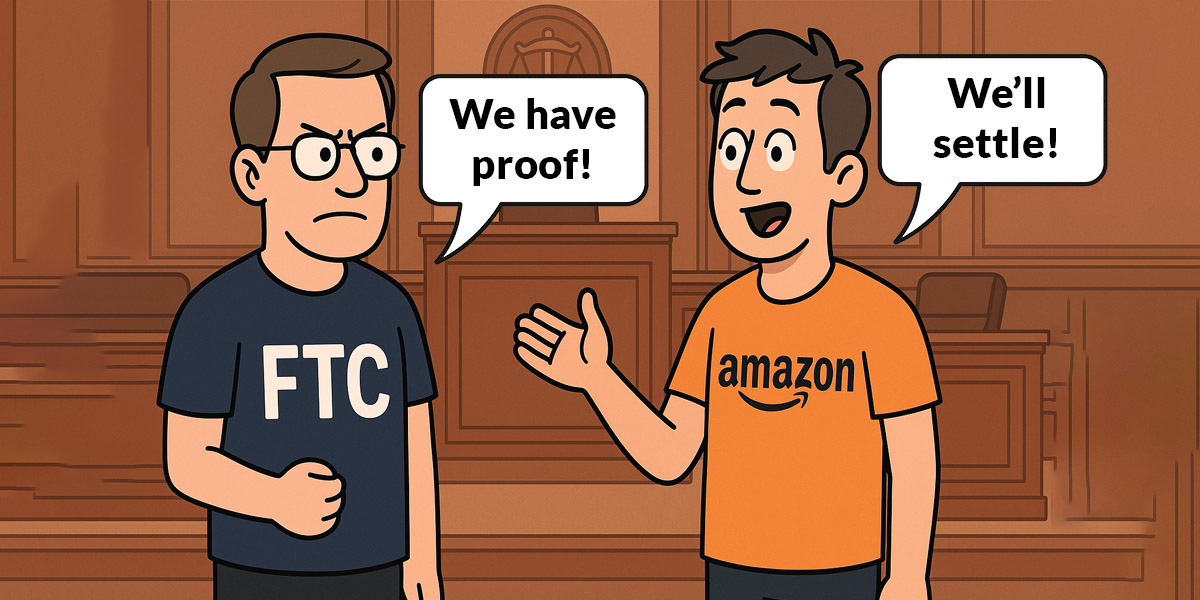
Flash forward a few days.. and Amazon has agreed to a $2.5B settlement with the FTC, representing one of the largest and fastest settlements in history, relative to its size. Under the settlement, Amazon will pay a $1B civil penalty to the government and provide $1.5B in refunds to approximately 35M affected customers, who could receive up to $51 each. Can I get mine as an Amazon gift card?
FTC Chairman Andrew Ferguson credited the Trump-Vance administration for some reason, even though the original lawsuit was filed in 2023 under Democratic then-chair Lina Khan, while Biden was still in office:
“Today, the Trump-Vance FTC made history and secured a record-breaking, monumental win for the millions of Americans who are tired of deceptive subscriptions that feel impossible to cancel. The evidence showed that Amazon used sophisticated subscription traps designed to manipulate consumers into enrolling in Prime, and then made it exceedingly hard for consumers to end their subscription.”
Amazon spokesperson Mark Blafkin denied wrongful doing, but said it was the fastest way to move on from the issue:
“Amazon and our executives have always followed the law and this settlement allows us to move forward and focus on innovating for customers. We work incredibly hard to make it clear and simple for customers to both sign up or cancel their Prime membership, and to offer substantial value for our many millions of loyal Prime members around the world. We will continue to do so, and look forward to what we’ll deliver for Prime members in the coming years.”
Right, I’m sure Amazon ponied up $2.5B strictly for the sake of getting back to innovating faster. That evidence must have been damning!
Amazon previously argued that its funnels and disclosures met or exceeded industry standards and that its sign up and cancellation processes were very clear to most customers, but as part of the settlement, the company has agreed to eliminate “confirmshaming” buttons like, “No, I don’t want Free Shipping” and instead provide clear options for customers to decline Prime. Amazon must also offer transparent disclosures about Prime’s terms during enrollment and create simpler cancellation processes.
The refund pool covers Prime memberships between June 23, 2019, and June 23, 2025 and refunds are capped at $51 or the actual membership fees you paid, whichever is lower. Automatic payments are due within 90 days of the settlement’s approval, and claim-based payouts will come after Amazon processes submissions.
The lawsuit and subsequent settlement send a strong signal that dark patterns, particularly those tied to subscription sign-ups and cancellations, won’t be tolerated under U.S. consumer law. Although I poked fun at the Trump administration for taking full credit for the settlement, kudos to them for finishing the job. It was a true bi-partisan multi-administration effort, and I’d like to see more of those.
Companies relying on dark patterns should take note and end the practices, not just to avoid litigation, but because it is the right thing to do.
2. Cloudflare to launch its own stablecoin
Cloudflare announced plans to introduce a new stablecoin called NET Dollar to power agentic commerce. The company says that its new USD-backed coin “will help power a new business model for the Internet that rewards originality, sustains creativity, and enables innovation in an AI-driven world.”
Cloudflare co-founder and CEO Matthew Princes said:
“For decades, the business model of the Internet ran on ad platforms and bank transfers. The Internet’s next business model will be powered by pay-per-use, fractional payments, and microtransactions—tools that shift incentives toward original, creative content that actually adds value. By using our global network, we are going to help modernize the financial rails needed to move money at the speed of the Internet, helping to create a more open and valuable Internet for everyone.”
In July I reported that Cloudflare was experimenting with a “pay-per-crawl” tool that allows content creators to charge a fee to AI crawlers to scrape their websites. The beta tool enables publishers to set their own prices that bots must pay before scraping content as well as choose which bots can access specific areas of their websites. Cloudflare shared at the time that it is acting as the Merchant of Record for the service in addition to the underlying technical infrastructure.
I assume that this NET Dollar stablecoin is being launched to complement Cloudflare’s pay-per-crawl efforts. Why exclusively work with other stablecoins as payments when you can also benefit from launching your own?
In June, after the U.S. Senate passed the bipartisan GENIUS Act to establish a federal regulatory framework for USD‑pegged stablecoins, I wrote that stablecoins were having a moment, and it isn’t going to end well.
My issue is that rather than banks, fintechs, AI companies, and the U.S. government collectively working towards updating our archaic ACH and SWIFT payment rails, we’re allowing major institutions to build a private layer on top of it. Privately issued stablecoins are not the solution to modernizing our financial digital infrastructure. Instant, low-cost settlements are completely possible directly using USD if payments weren’t running on a system BUILT IN 1972! However my opinion on stablecoins is neither here nor there.
If anyone has a shot at launching a globally utilized stablecoin to power agentic commerce — it’s Cloudflare.
The service already powers an estimated 20% of websites on the Internet including a third of the web’s biggest 10,000 sites globally. Talk about instant adoption! No other tech company on the planet comes close to Cloudflare’s reach in terms of network distribution, request volume handled, and ubiquity across every industry vertical online.
I support the mission of facilitating micro-transactions on a global level and wish them luck — even if we have to use stablecoins to get there.
3. OpenAI is building a marketing platform — for itself?
OpenAI posted a job listing for a “Growth Paid Marketing Platform Engineer” to “build and scale the systems that power OpenAI’s marketing channels and spend efficiency,” according to a since taken down post (which is still visible via the Wayback Machine).
The job listing said that the role will involve:
- Developing campaign management tools.
- Integrating with major ad platforms.
- Building real-time attribution and reporting pipelines.
- Enabling experimentation frameworks to optimize our objectives.
- Designing and implementing infrastructure to make the company’s marketing investments more effective, measurable, and automated.
The job listing indicates that OpenAI is building this tool to manage and optimize its own internal marketing campaigns — but of course, that could just be a clever cover story.
Rumors have already circulated across the web that OpenAI is looking to build this infrastructure to eventually power its own advertising offering (ie: for brands to advertise on ChatGPT), given how the move follows the company onboarding executives with advertising experience.
Separate from the job posting mentioned above, last week Sources reported that OpenAI’s new CEO of Applications, Fidji Simo, who started last month after leaving her former role as CEO of Instacart, has begun meeting with potential candidates to lead a new team that will be tasked with overseeing all monetization efforts across the company, including bringing ads to ChatGPT.
btw – the marketing platform engineer job listing said the role pays between $160K – $385K annually and offers equity, and Mark Zuckerberg already said he would double it! 😂
In other OpenAI marketing news… AdAge reports that OpenAI is launching its first extended brand campaign for ChatGPT since its Super Bowl commercial last February. The series of ads features “evocative, slice-of-life stories that double as product demos–showing how people are exploring an expressing themselves using the fast-growing AI assistant.” The featured commercial shows a young woman eating a meal she cooked for a date after searching, “I need a recipe that says, ‘I like you, but want to play it cool.'”
4. Facebook launches AI dating features
Remember Facebook Dating? The dating service connected to your Facebook profile that no-one asked for? It originally launched in Colombia in 2018 as a pilot before expanding to the U.S. in 2019 and 50+ other countries shortly after.
While it never exactly become a cultural dating phenomenon, it has become one more Meta product that Mark Zuckerberg can inject AI into!
Meta released two new AI features to Facebook Dating last week:
- Dating Assistant – an AI chatbot aimed at helping you find better matches and “avoid swipe fatigue” by enabling you to enter text prompts about what you’re looking for such as “just want to smash.” LOL. Actually Facebook gave the example, “Find me a Brooklyn girl in tech.”
- Meet Cute – a feature that automatically matches you with a surprise person based on Facebook’s matching algorithm. You can then choose to chat with the match or unmatch them. Meet Cute is initially offering weekly surprise matches, but may increase the frequency soon.
Fortune points out that other dating apps are also adding AI features:
- Tinder has an AI photo selector that automatically makes your featured image the one that gets the most right swipes.
- Hinge has an AI feature that gives users an option to improve their responses to profile prompts.
- Bumble offers an AI-powered ice-breaker feature to begin conversations.
- Hinge’s CEO told Fast Company he expects “mass swiping” to become “arcane” within three to five years as users turn to AI to find matches.
Amber Lee, a matchmaker and relationship expert, thinks otherwise:
“My first thought is, these new AI features may feel like too little, too late. Gen Z already associates Facebook as a platform for an older demographic, so this feels more like a PR stunt than something groundbreaking in the dating space… Gen Z is likely to be turned off by the inauthentic nature of AI-polished profiles. These singles are seeking genuine connection, not one [run] by AI.”
It’s inevitable that AI will soon play a bigger role in online dating (as it does with any online service), but are these the AI dating features that people actually want (or need)? How about instead…
- AI security features that detect inconsistencies across a user’s stated info to help flag catfishing accounts.
- Anti-crazy filters that attempt to stop a match from getting too aggressive too quickly. “It’s 3am. Are you sure you want to send a message with just a single question mark?”
- AI profile building that learns your values, likes, dislikes, and what you’re looking for in a partner through your conversations with matches, as opposed to just your profile inputs.
- Suggesting local spots for first dates or meetups based on your common interests.
- Not matching Bernie Babes with die hard Trump Dudes.
- AI ghosting notifications to help soften the blow when you’re unmatched.
Instead of new AI-powered safety features, Meta employed its Superintelligence Team to come up with “surprise matches.” Nice one!
5. Affirm targets professional services for future growth
Affirm is looking to further expand its BNPL financing into home services like plumbing, air conditioning maintenance, and other professional services, according to its CFO Rob O’Hare who spoke at a recent fireside chat with shareholders.
To demonstrate growth in these service areas, O’Hare noted the company’s new partnerships with:
- ServiceTitan– a platform for hiring in-home professionals like plumbers and HVAC specialists.
- Vagaro – a platform that powers beauty salons, fitness centers, and tattoo parlors.
- Tekmetric and Shopmonkey – two workflow management platforms for auto repair shops.
O’Hare said there was “a lot to like” about service businesses, pointing out the higher order values of home improvement projects and car maintenance over typical e-commerce purchases. He said:
“Those can be large-ticket items, and I think they’re also pretty considered purchases and something that we can help with in terms of driving affordability and smoothing the cost of those services over the course of several months for the consumer. That’s an area that we’re seeing nice traction, and we’re pretty bullish on today.”
PYMNTS reports that services accounted for 3% of Affirm’s GMV in the most recent quarter, but grew 39% YoY, surpassing travel, fashion, and electronics.
Affirm isn’t the only BNPL firm targeting lucrative professional service industries. The company faces competition from startups like:
- Wisetack – focuses on home services like HVAC, plumbing, electrical, roofing, and pest control, as well as auto repair, elective medical procedures, dental, and veterinary services.
- Citizens Pay – focused on home renovation contractors and service providers.
- Credee – focuses on service providers like dentists and home improvement contractors.
- QuickFee – targets professional service providers with its own in-house white label BNPL financing.
- Sunbit – for in-person services; big in auto service and dental.
- GreenSky – for amortizing jobs with contractors.
- and dozens of others!
6. The SEC accuses Tai Lopez and Alex Mehr of running a $112M Ponzi scheme
Remember when Internet marketing “gurus” Tai Lopez and Alex Mehr bought Dressbarn, Pier 1 Imports, RadioShack, and the name brands of other bankrupt retailers through their investment company Retail Ecommerce Ventures? Pepperidge Farm remembers, and so does the Securities and Exchange Commission.
The SEC is now accusing Lopez and Mehr of running a $112M Ponzi scheme, using their acquired brands to defraud investors. Here’s what happened…
REV claimed that its investment approach was “one of the best strategies you can invest in” and that unlike other businesses, its portfolio of brands was “on fire” and “cash flow strong.” They also promised investors that their funds would only be invested in the specified firm they were raising money to acquire.
However in actuality, REV’s portfolio of brands generated a little revenue, but never any profits, so Lopez and Mehr had to look elsewhere for investor returns.
The SEC alleges:
“Consequently, in order to pay interest, dividends and maturing note payments, Defendants resorted to using a combination of loans from outside lenders, merchant cash advances, money raised from new and existing investors, and transfers from other portfolio companies to cover obligations. At least $5.9 million of the returns distributed to investors were, in reality, Ponzi-like payments funded by other investors.”
The SEC also says that Lopez and Mehr used at least $16M in investment funds for their own personal use. LOL, like renting Lamborghinis and mansions to film videos in?
The SEC also named REV’s COO, Maya Burkenroad, in its lawsuit, who was pitched to investors as an experienced manager who had run multi-million dollar companies for a decade, but in reality, was Lopez’s cousin who previously worked as his assistant.
Tai Lopez’s defense is going to be, “Well I only skimmed and speed-read books on investment law to extract the key ideas quickly, so I didn’t actually know that what we were doing was defrauding investors.”
(Come on, that’s funny!)
7. Apple and Google argue that the Digital Markets Act isn’t working
If there’s one thing Apple and Google can agree on — it’s that the EU’s Digital Markets Act sucks! Or so they say. The two companies are collectively urging the European Union to revisit the three-year-old regulation, which they say is failing the industry and consumers.
Apple published a post on Wednesday which says:
- The DMA is impacting many parts of European users’ experiences — from how they download apps and make app payments to how their Apple products work together.
- The DMA’s requirement that Apple make certain features work on non-Apple products and apps before they can share them with Apple users is causing the company to delay new features in the EU such as live translation with AirPods, iPhone mirroring to Mac computers, and preferred routes on Apple Maps.
- Apple says its teams haven’t found a way to share these capabilities securely with other developers without putting their users’ data at risk, so they’ve not been able to bring the features to the EU.
- The company says that it has suggested changes to the features that would protect its users’ data, but so far the European Commission has rejected their proposals.
- The DMA’s requirement that Apple allow sideloading other apps, alternative app marketplaces, and alternative payment systems make it more likely that EU users will be exposed to scams spread through fake banking apps, malware disguised as games, and third-party payment systems that overcharge users and offer no buyer protections.
- The DMA lets other companies request access to user data and core technologies of Apple products, which creates risks for Apple users. For example, Apple has received requests for the complete content of a user’s notifications including their messages, e-mails, and medical alerts, as well as the full history of Wi-Fi networks a user has joined.
- Apple says that the DMA is not living up to its promise of promoting competition and giving European consumers more choices. When features are delayed or unavailable in the region, users get fewer choices. Forcing Apple to build features for non-Apple products means making options available to European consumers more similar, not more differentiated. And lastly, the DMA’s rules are unfair, and many only seem to apply to Apple, even though Samsung is the smartphone market leader in Europe.
- Apple ends the letter by saying, “Despite our concerns with the DMA, teams across Apple are spending thousands of hours to bring new features to the European Union while meeting the law’s requirements. But it’s become clear that we can’t solve every problem the DMA creates.”
Google followed up the next day with a post of its own where it said:
- The DMA is causing “significant and unintended harm to European users and many of the small businesses it was meant to protect.”
- For example, the DMA requires Google Search to stop showing travel results that link directly to airline and hotel sites and instead show links to intermediary websites that charge for inclusion, which raises prices for consumers and makes it harder for users to find reliable, direct booking information.
- The DMA is making it difficult to protect users from scams and malicious links on Android by forcing Google to remove its safeguards, even though Android has always allowed sideloading and alternative app stores on its operating system.
- Like Apple, the company argues that “regulatory burdens and uncertainty” are delaying its product launches, such as its newest AI features, by up to a year after they launch in the rest of the world.
- Google argues that it’s “time for a reset” and that despite changes its made to comply with the DMA, it still faces considerable uncertainty and unpredictability, partly due to overlapping rules form national regulators that are undermining the DMA’s goal of creating harmonized, consistent rules across the EU.
Apple says it is “urging regulators to take a closer look at how the law is affecting the EU citizens who use Apple products every day.”
Google says, they are calling on the European Commission “to ensure that future enforcement is user-driven, fact-based, consistent and clear.”
8. TikTok U.S. is valued at $14B, and other TikTok deal updates
I’m honestly tired of talking about the “TikTok deal” and the political theater surrounding it that the industry is calling “news” — however it’s outcome is important, so here goes another update.
Two weeks ago I reported that the U.S. and China had struck a framework agreement on transferring TikTok to U.S.-controlled ownership, but that the deal would have to be finalized with President Trump and President Xi.
Then last week I followed up coverage with reports that President Trump had extended the TikTok ban deadline for the fourth time until Dec 16th, and that the deal would include U.S. control of TikTok’s algorithm by a consortium of investors including Oracle, Silver Lake, and Andreessen Horowitz (which has now been potentially replaced by MGX, but more on that below).
Following a phone call with President Xi, Trump wrote on Truth Social last Friday that he and Xi “made progress on many very important issues” and specifically thanked Xi for “the TikTok approval.”
So what’s happened since?
- On Thursday, President Trump signed an executive order paving the way for a TikTok deal and thanked President Xi for approving the sale.
- Regarding political bias of the new platform, Trump said, “I always like MAGA-related. If I could make it 100% MAGA, I would, but it’s not going to work out that way, unfortunately. No, everyone’s going to be treated fairly. Every group, every philosophy, every policy will be treated very fairly.”
- It was revealed that Abu Dhabi’s MGX will be part of the investor consortium, which has up until now been touted as “American owned.”
- CNBC later reported that General Atlantic, Susquehanna, and Sequoia are also expected to contribute equity in the new TikTok U.S. entity.
- TikTok U.S. was valued at $14B in the deal, indicating a 1.27x valuation-to-revenue multiple based on TikTok U.S.’s expected revenue of $11B in 2025.
- In comparison, Meta sits at a $1.88 trillion market cap compared to its $164.5B in global revenue last year, or an 11.4x valuation-to-revenue multiple.
- Is it me? Or is TikTok U.S. being seriously undervalued in this deal? Part of the valuation discrepancy lies in that fact that ByteDance would get at least 50% of the American company’s profits if the deal goes through, despite the fact that it would only own 20% of the spun-off company, according to Bloomberg reports, and those payments would come via a combination of license fees and profit distributions.
- Experts raised concerns about what the U.S. TikTok deal could mean for News Corp’s dominance in Australian media. Should Australia use the Chinese version or the U.S. version? Tom Sulston, head of policy at Digital Rights Watch, said, “The problem is not the ownership. The problem is the constant and intrusive surveillance of the user base. Users of a US-owned TikTok won’t enjoy any more privacy than they did with a Chinese-owned TikTok, on account of the lack of meaningful regulation of social media companies.”
On Sunday, Vice President Vance told FOX News:
“I feel very confident that we have successfully separated this company from TikTok global and actually made it so that we can control people’s data security. We can ensure that the algorithm is not being used as a propaganda tool by a foreign government.”
LOL, why did he specify “foreign” government? Anyway…
As of Sunday, ByteDance has not acknowledged Trump’s executive order, nor has it confirmed that the transaction is actually taking place.
Unrelated but interesting… I never knew that TikTok’s CEO Shou Zi Chew used to work for Mark Zuckerberg as a Facebook intern. Did you?
9. Other e-commerce news of interest
Walmart is looking to gain an edge against Amazon and Target this year during the holiday season by pushing the message that its deals are open to all customers — “no membership required” — although Walmart+ members do get a five-hour head start on its October sale. Whereas Amazon and Target’s sales events are member-exclusive, requiring either a Prime or Circle membership to access promotions. All three retailers are emphasizing their fast delivery as they battle for early holiday shoppers.
Mercari released three new features that have been in beta testing for the past few months including: 1) Time-Limited Sales – for running 72 hour sales that are featured on a deals page and boosted in search results. 2) Auto-Offers to Likers – which sends messages with special offers that are good for 24 hours to customers that like your items. 3) Adjusted bundle shipping – now calculates bundle shipping based on the weight of each item for more accurate rates.
Etsy is rolling out AI-powered listing helpers, marketplace insights, and improved Shop Manager dashboards to help support sellers ahead of the holiday season. The company is also expanding its Purchase Protection coverage to $500 per order, piloting a new listing appeal process, and preparing to launch a redesigned Community Hub to better connect sellers. Oh, and it slightly changed the font-weight of its logo!
India is considering easing foreign direct investment rules to let platforms like Amazon directly purchase goods from local sellers for resale to overseas customers to help expand global trade opportunities. Currently, Indian law prohibits foreign e-commerce companies from selling goods directly, allowing them only to act as marketplace intermediaries between buyers and sellers, however, the Directorate General of Foreign Trade, which drafted the proposal, argues that the restrictions constrain small businesses from accessing global markets. Amazon, which has already facilitated $13B in Indian exports since 2015 and targets $80B by 2030, stands to benefit if approved, but small trader groups are pushing back, warning that changing the rules would enable global giants to outcompete traditional retailers.
Meta is in talks with Google Cloud to use its AI systems, Gemini and Gemma, to improve the company’s ad targeting and content understanding, according to anonymous The Information sources, which calls the move the latest sign of how Meta’s own AI setbacks have prompted the company to consider using other AI technology, at least as an interim while its newly formed Superintelligence Team improves its own models. Meta later denied the rumors and said that it “regularly evaluates third-party tools for the purpose of benchmarking, which is the case here.”
Google is expected to face its first penalty under the EU’s Digital Markets Act in the coming months after earlier being fined €2.95B for ad tech abuses. The new case accuses Google of favoring its own vertical search services like Shopping, Flights, and Hotels, with critics arguing rivals are disadvantaged. While Google has submitted proposals to avoid a fine of up to 10% of annual sales, regulators say its fixes have not resolved concerns. The European Commission is now drafting its decision, according to Reuters sources.
The U.S. Postal Service said it will not raise stamp prices in January, ending a streak of twice-yearly increases that had driven up first-class mail rates more than 50% in five years — the last hike being in July when it raised the price of Forever stamps to $0.78 from $0.73. Postmaster General David Steiner, who took office last summer, said the agency will hold off until mid-2026 to help preserve mail and to ensure that frequent hikes didn’t make mail campaigns unaffordable. Despite operating in the red by $9.5B last year and facing steep financial challenges, regulators are reviewing whether to permanently limit USPS price increases to once a year.
commercetools, Stripe, Lovable, and Klaviyo are co-hosting a new event called EcomHack.AI, a virtual hackathon running from Oct 13-17th, 2025 that will challenge participants to design and protype new solutions “at the intersection of artificial intelligence and commerce.” Using technologies from the host companies, teams will compete for prizes and recognition as they create e-commerce prototypes and business models. I asked the website’s chatbot what the prizes were, but it didn’t know. It told me to check the website I was on (which didn’t list the prizes). I asked it a couple other questions, but it didn’t know the answers to those either. I’m going to enter the competition and create a better website for next year’s hackathon.
President Trump vowed to impose “substantial” tariffs on any country not making its furniture in the U.S., following last week’s announcement of a 50% tariff on cabinets and vanities and a 30% tariff on upholstered furniture. Prices for furniture and bedding have already risen 4.7% YoY as tariffs on imports from China and Vietnam take effect, with Trump citing the decline of North Carolina’s furniture industry as a key motive to the heavy tariffs. The move comes ahead of a Supreme Court case in November that will weigh in on Trump’s authority to levy country-specific tariffs under claims of economic emergency. Ikea, which did $5.5B in U.S. sales last year, said it could not guarantee that it will be able to keep prices down following the new tariffs.
Depop introduced Outfits, a new in-app feature that lets users build and shop moodboard-style looks from marketplace listings, enhancing discovery and engagement. The Etsy-owned resale platform also confirmed executive changes, naming Sonia Biddle as Chief Product Officer and Keyur Govande as Chief Technology Officer, as Depop grows into the strongest performer in Etsy’s portfolio following divestitures of Reverb and Elo7.
Chinese sellers now represent 50.03% of Amazon’s global active seller base across all international marketplaces, crossing the 50% threshold for the first time. In 2015, Chinese sellers accounted for just 7.1% of new registrations on Amazon.com, compared to 70.6% from the U.S. However by 2024, Marketplace Pulse reported that Chinese sellers comprised 62.3% of new registrations and American sellers had dropped to 26.8%. However in terms of revenue, U.S. sellers account for approximately $157B of Amazon.com’s $305B third-party GMV, compared to $132B for Chinese sellers, with the average U.S. seller generating more than double that of the average Chinese seller.
Shopify merchants can now offer Google and Facebook sign-in options on customer account pages, making logins faster and more convenient for shoppers. The update is available through Shopify’s new customer accounts, which must be enabled before activating the feature in the platform’s settings. The new sign-in options reduce friction at checkout and during account creation, aiming to help merchants boost conversion rates and improve customer experience. Long time coming! I’m tired of confirming my phone number multiple times every time I login to my Shop account!
Meta AI launched a new feed for short-form AI-generated videos called Vibes, designed to encourage users to remix AI videos and post their own. Vibes replaces the Discover feed that gave users the ability to share their prompts and AI content with their followers and “show people what they can do with AI,” marking the next iteration of that plan, focused exclusively on video instead of prompts. Meta says that Vibes is “designed to make it easier to find creative inspiration and experiment with Meta AI’s media tools.” People are hating on the feed, but it’s pretty cool! It’s not going to replace TikTok, but it’s not supposed to. It’s just interesting to see the incredibly detailed prompts that creators are using to make AI videos.
Shopify is building a new feature called Remote Products that lets merchants display and sell items from other Shopify stores, complete with badges showing the external shop’s name, logo, and policies, as discovered by Filippos Dematis of dev commerce. Unlike Shopify Collective, customers will know the product comes from a different store, and merchants may need to adjust settings like discounts and shipping rules. The feature could open new revenue streams through affiliate sales, sponsorships, and cross-promotion, with early access already enabled for select merchants.
Michaels is filling the void left by Joann and Party City, both of which shut down in the past year, by rolling out The Knit & Sew Shop and The Party Shop in its stores, which will collectively take up about a quarter of floor space. The company acquired Joann’s IP and private-label brands, including Big Twist yarn, and will expand fabric cutting tables to 650+ locations by mid-October, while adding 700 new party products, balloon bars, and lower-priced in-store birthday parties. CEO David Boone said the moves leverage Michaels’ 50-year crafts heritage to capture demand for celebrations and sewing and position the retailer as both a creative and party destination.
Meta announced the return of Meta Lab as a flagship retail store in Los Angeles, alongside new pop-up locations in Las Vegas and New York, while its original Burlingame lab remains open. The experiential retail spaces will feature Meta’s full Reality Labs lineup including the $799 Meta Ray-Ban Display glasses launching September 30th, the Neural Band, Oakley smart glasses, and Quest headsets, with in-person demos and limited-edition product drops. Each location will also serve as a cultural hub, hosting community events, art collaborations, and themed experiences designed to spotlight Meta’s AI glasses and hardware.
Amazon is shutting down all 19 of its Amazon Fresh stores in the U.K., just four years after launching its first grocery shop in London, with plans to convert five into Whole Foods Market shops. Amazon launched its first Fresh store in 2021 in West London, which used the company’s Just Walk Out technology, however the concept struggled to take off. John Boumphrey, country manager for Amazon U.K., said its focus for grocery retail in the country will now be its online channels in collaboration with its delivery partnerships including Morrisons, Co-op, Iceland, and Gopuff. Amazon stressed that the store closures are NOT because food in the U.K. is so gross that even locals don’t want to eat it.
Meta is bringing its “pay or consent” ad model to the U.K., which will require that Instagram and Facebook users pick between being served ads or paying a monthly subscription for an ad-free experience, starting at £2.99/month (or £3.99/month if you subscribe via mobile). Meta was forced to walk back a similar model in Europe after regulators slammed the “binary choice” it offered users, however, the U.K.’s “more pro-growth and pro-innovation regulatory environment” will allow the option, which is priced significantly less than the EU subscription that started at €9.99/month.
Perplexity launched Search API, providing developers with access to the same infrastructure that powers its own public search engine on a pay-per-use model. The API works by breaking webpages into smaller sections and returning the most relevant snippets already ranked for the user’s query. Developers can use it to build things like research assistants, shopping comparison tools, or apps that pull in real-time, source-backed answers from across the web.
Accenture, one of the “Big 4” international consulting firms, said that the firm has been “exiting” employees that it can’t retrain with AI skills, while simultaneously planning to expand head count in the coming year. The firm employed more than 779k people at the end of August, down from about 791k three months earlier, and has been slowly building up its AI workforce, doubling its number of AI and data specialists to 77k since 2023 while training over 550k employees in the fundamentals of generative AI. Is being an “AI specialist” the new “Microsoft Word expert” at big corporations? Am I an “AI expert” in Accenture’s book because I know how to write prompts?
OpenAI, Oracle, and SoftBank announced plans for five new U.S. AI data centers under the $500B Stargate initiative, backed by President Trump to expand AI infrastructure. Sites include Shackelford County, TX; Doña Ana County, NM; Milam County, TX; Lordstown, OH; and one undisclosed Midwest location, bringing Stargate’s projected capacity to nearly 7 GW and $400B in investment over the next three years. OpenAI said the projects, expected to create 25,000 onsite jobs, will help achieve the initiative’s goal of 10 GW capacity, with Nvidia separately committing up to $100B to supply data center chips.
LinkedIn will begin using member profiles, posts, resumes, and public activity to train its AI models in the U.K., EU, and other regions beginning on November 3, 2025, extending a program it launched in the U.S. last year. The setting is enabled by default, but users can opt out via their account’s Data for Generative AI Improvement toggle in Settings & Privacy. However, LinkedIn notes that previously collected data may still be retained unless users submit a formal objection form. Aren’t half of LinkedIn posts written with AI now? So does that mean that AI is officially training AI at this point?
OnBuy, a U.K.-based online marketplace founded in 2016 that positions itself as a fairer alternative to Amazon by not competing with its own sellers, is opening up to sellers in Austria, Belgium, Finland, France, Germany, Greece, Ireland, Italy, Netherlands, Portugal, Slovakia, and Spain, with plans to operate in 20 countries by the end of 2025. The company says that they are seeing huge demand in Europe and is expecting an additional £100M in GMV and at least 5M new customers from its EU expansion in the next 12 months.
The European Commission wants to eliminate the region’s annoying “cookie law,” which since 2009 has required that all websites get consent from users before loading cookies onto their devices. The Commission is working on tweaking the rules to include more exceptions or to make sure users can set their preferences on cookies once in their browser settings instead of every time they visit a website. Some policy makers are suggesting that the cookie rules, which are part of the e-Privacy Directive, could be simplified by moving cookie regulation to the GDPR, which takes a more flexible, risk-based approach. Critics argue that the rules already make an exception for cookies that are necessary to deliver crucial services, such as remembering items in a shopping cart, and that loosening the rules opens the door for websites to smuggle in analytics or ad personalization cookies.
🏆 This week’s most ridiculous story… Some public toilets in China are now requiring users to watch an advertisement in order to gain access to toilet paper. For the sake of my underwear, I hope it’s a short one! A video shared by China Insider showed a person scanning a QR code on the toilet paper dispenser and watching a short video ad before a few squares of paper are dispensed — or the pooper can pay 0.5 RMB (about $0.07 USD) to skip the ad. The company claims that its system cuts down on waste, reducing the amount of people who take excessive amounts of free toilet paper. That’ll be a ‘no’ from me dawg! I would never encourage vandalism, but… Also, what company would want to advertise on the toilet paper channel? Feels like a shitty value proposition all around.
10. Seed rounds, IPOs, & acquisitions
Firesale, an online resale marketplace that uses AI to autogenerate listings from short videos and then handles pricing, logistics, and fulfillment, raised over $1M in a crowdfunding campaign from 583 investors at a $10M valuation cap. I was actually one of the investors! The Miami startup uses AI to let sellers list items in seconds, with automated descriptions, pricing, and delivery powered by logistics partners like Uber. Led by repeat founder Anthony Longo and backed by notable angels including former Citrix CEO Mark Templeton, Firesale aims to become the world’s largest online yard sale, beginning in the South Florida market and scaling regionally from there.
The ODP Corporation, which is the parent company of both Office Depot and Office Max, entered into an agreement to be taken private by private equity firm Atlas Holdings for $28 per share, or roughly a $1B valuation, representing a 34% premium over the company’s closing share prices last Friday. The deal is expected to close by the end of 2025, pending regulatory and shareholder approvals, and comes three years after a previous exploration into selling the business, including to rival Staples, went south.
Nvidia is planning to invest up to $100B in OpenAI as the AI company sets out to build hundreds of billions of dollars in data centers using the chipmaker’s processors. OpenAI is planning to build Nvidia systems that requires 10 gigawatts of power, which is equal to between 4M and 5M GPUs, which Nvidia will ship in total this year. Nvidia’s first investment of $10B will be deployed when the first gigawatt is completed, and investments will be made at then-current valuations, according to CNBC sources. So is Nvidia basically trading $100B of GPUs for OpenAI stock?
eBay acquired Tise, a Norwegian mobile-first marketplace for second-hand fashion and interior items that has over 2.5M registered users in the Nordic countries, in a deal estimated to be worth approximately $130M. The acquisition aims to strengthen eBay’s presence in the Nordic market, particularly with younger demographics like Gen Z and Millennials, who are driving demand for second-hand goods. eBay had already owned a minority stake in Tise through its ventures arm since 2022, and the deal now gives it full ownership of the platform.
Oracle sold $18B U.S. investment-grade bonds on Wednesday, with demand peaking at nearly $88B, marking the second-largest deal this year. The debt raise comes as the company begins to fulfill massive cloud infrastructure deals with OpenAI and Meta, which are boosting its expenses. Over the next several years, Oracle is projected to spend hundreds of billions of dollars to rent and power data centers. Oracle’s cash flow turned negative this year for the first time since 1992, and analysts expect the company’s cash flow to continue sinking for the coming years before returning to positive in 2029.
Distyl AI, a three-year-old startup founded by ex-Palantir employees that provides engineers and AI software to automate business processes, raised $175M in a round led by Lightspeed Venture Partners and Khosla Ventures at a $1.8B valuation, bringing its total amount raised to $202M. The company charges licensing fees worth up to tens of millions of dollars over several years for its software, positioning it as a competitor to Palantir, OpenAI, Anthropic, and major consultancies like McKinsey & Co, and has been profitable since Q3 2024.
Handpickd, an India-based zero-inventory fresh produce delivery app that collects orders, procures exact quantities directly from farmers, and delivers the same day, raised $15M in a Series A round led by Bertelsmann India Investments. The company is betting that its “made-to-order” approach to delivering fresh produce can change consumer habits who still buy fresh produce offline due to concerns about quality, even letting customers specify ripeness, sweetness, or crunchiness of the produce they want. It plans to use the funds to expand to more cities, hire talent, and improve its supply chain technology.
Banana Republic acquired Abandoned Republic, a fan-built digital archive documenting vintage Banana Republic travel & safari catalogs and brand memorabilia, for an undisclosed amount. The deal coincides with the launch of the Banana Republic Archive, a collection featuring styles from the 70s, 80s, and 90s that will offer limited-run drops of what the brand describes as “immersive storytelling.” The archive will debut with a capsule collection curated Marcus Allen, a stylist and founder of The Society Archive, that will include 70 vintage styles including a leather aviator jacket, a yellow raincoat circa 1992, a denim jumpsuit, and stone Irish linen shirt.
Corintis, a Swiss semiconductor cooling startup that develops microfluidic chip cooling technology to reduce energy use in data centers, raised $24M in a Series A round led by BlueYard Capital, bringing its total amount raised to $33.4M. The company, which recently partnered with Microsoft on a breakthrough that cooled chips 3x more efficiently than current methods, aims to make cooling a design feature of next-gen AI chips rather than an afterthought and already has over 10,000 systems deployed and 8-digit revenue to date. It will use the funds to expand its U.S. presence, grow its team, and scale manufacturing capacity to exceed 1M cold plates annually by 2026.
ONAR Holding Corporation, an AI-powered marketing technology company and growing agency network, acquired Retina AI, an Ai-powered marketing intelligence platform that offers individual-level customer lifetime value prediction, in an all-stock deal at an undisclosed valuation. The move follows ONAR’s recent JUICE acquisition and is expected to unlock cross-sell opportunities between Retina’s predictive CLV models and JUICE’s client base, while re-engaging Retina’s former customers. Retina previously generated over $2M in ARR, and ONAR plans to integrate its deep-learning models across the network to scale revenue and improve ROI visibility for clients.
YASO, a China-market operating system that helps global consumer brands sell via social commerce in China, raised £8.25M in a Series A round led by Puma Growth Partners, bringing its total amount raised to £10M, partially under its old name Kuai Commerce. The company provides an operating system covering payments, logistics, compliance, tax, analytics and storefront integrations for firms looking to grow their presence in the Chinese market and plans to use the funds to expand its sales and marketing reach, accelerate client onboarding, and enhance its platform capabilities to serve more international partners.
Shop Circle, a London-based SaaS company that acquires, builds, and operates e-commerce software and apps for merchants, extended its Series B round to a total raise of $100M comprised of $60M in equity and the rest as financing, led by Nextalia Ventures. The company will use the funds for additional mergers and acquisitions, already having identified several opportunities that are in the advanced stages, as well as accelerate the development of AI into its product portfolio.
Emfas, a Swedish platform that integrates with Shopify and Centra, offering retailers AI-driven workflows to streamline catalog management, raised €600K in an angel round led by Green Ventures at a €4.5M valuation. The company will use the funds to scale its AI-powered product information management system, expand its team, and accelerate growth across the Nordics and the U.K.
Cardless, a fintech that helps businesses create and launch their own branded credit cards, raised $60M in a Series C round led by Spark Capital, bringing its total amount raised to $170M. The company plans to use the funds to grow its existing card programs, partner with more brands to launch new cards, and expand into other financial products.
Oura Health Oy, maker of the Oura health and fitness ring, is planning to raise $875M in an upcoming Series E round that would value the company around $10.9B, doubling the $5B valuation from its Series D round last November. The company, which has sold over 5.5M rings and is on track to generate more than $1B in revenue in 2025, plans to use the funds to scale production, invest in development, and expand internationally. Oura’s largest business customer is the U.S. Military, with tens of thousands of service members using the rings for fatigue tracking and research.
Genstore, an AI-native e-commerce platform that lets merchants launch and manage online stores via conversational workflows, automating tasks like listings, marketing, and fulfillment, raised $10M in a seed funding round led by Weimob. Genstore is built from the ground up as AI-native, letting merchants launch a store in minutes using conversational prompts and automating operations like product listing, copywriting, customer service, and marketing. The company will use the funds to accelerate product development and drive market expansion.
sun.store, a Warsaw-based B2B marketplace for solar equipment, raised €6M in a seed funding round co-led by Contrarian Ventures, Market One Capital, and Movens Capital. The platform aims to replace outdated e-mail and spreadsheet workflows with structured listings, dynamic pricing, logistics, and financing, already serving 35,000 users across 25 countries. The company will use the funds to accelerate expansion into new clean energy categories like heat pumps and EV chargers, aiming to become Europe’s default procurement infrastructure for the sector.
Lotte Group, a South Korean multinational conglomerate with businesses spanning retail, food, hospitality, chemicals, and entertainment, invested $90M into Wowma!, a Japanese e-commerce marketplace that offers consumers goods and lifestyle items, to strengthen its digital presence and compete with regional rivals. The partnership will merge Lotte’s retail and logistics networks with Wowma!’s online marketplace, aiming to improve infrastructure, expand product offerings, and speed up delivery for consumers.
Odeko, a supply chain and mobile ordering platform that helps independent coffee shops and cafés streamline inventory, procurement, and customer ordering, acquired Six Degrees Coffee Services & Distribution, a California-based specialty coffee distributor, for an undisclosed amount. The deal gives Six Degrees customers access to Odeko’s national product catalog, financing tools, and 24/7 support, while strengthening Odeko’s operations on the West Cost. Alongside the acquisition, Odeko launched a new mobile app called Odeko Supply aimed at streamlining ordering and inventory management for cafes and restaurants.
PhonePe, India’s largest digital payments company, filed preliminary documents for an IPO, seeking to raise up to $1.5B at a $15B valuation. The company was founded in 2015 and has more than 610M registered users, handling around 340M transactions per day. One year after launch, PhonePe was acquired by Flipkart, an Indian e-commerce company that is majority-owned by Walmart, however in 2022, the two Indian companies ended their relationship to let their businesses expand independently, with Walmart staying on as the majority shareholder for both firms.
PayPal entered into a multi-year agreement with Blue Owl Capital, a New York-based alternative asset management firm, to acquire $7B of its BNPL receivables from its Pay in 4 product. PayPal will retain full control over customer interactions, including underwriting and servicing, while shifting to a balance-sheet-light model that frees capital for new investments.
Alchemer, a survey and experience management platform that helps businesses collect and analyze customer and employee feedback, acquired Chatmeter, a reputation management and local SEO platform that helps multi-location businesses monitor reviews, manage listings, and improve online visibility, for an undisclosed amount. The combined solution, serving over 15,000 organizations, unifies direct survey feedback with indirect signals like reviews and social media, giving multi-location businesses faster insights into customer behavior and a single platform for managing experience data.
DEXA, a U.S.-based drone delivery startup that focuses on enabling same-day delivery for local retailers, raised $15M in a seed round led by G21 Investment Partners. The company holds all three major FAA milestones required for large-scale drone delivery including a Part 135 Carrier Certificate, a nationwide beyond visual line of sight waiver, and certification to manufacture its own U.S.-made aircraft, giving it an advantage in both regulation and execution. It will use the funds to expand its delivery networks, onboard retail partners, and grow operations across multiple markets.
Roller, an Australian venue management platform that provides ticketing, POS, CRM, and customer experience tools for attractions and leisure businesses, acquired BookNow Software, a U.S. booking and operations platform built on Salesforce CRM, for an undisclosed amount. The move strengthens Rollers presence in Europe and the U.S., while expanding its expertise in CRM platforms. BookNow founder Luke Sims will join Roller and serve as CEO of the acquired entity.
OSI Digital, a global IT consulting and services firm that provides digital transformation, data analytics, cloud, and enterprise application solutions, acquired E3 Retail, a U.S. provider of cloud-based POS and store management tools, for an undisclosed amount. The deal aims to strengthen OSI Digital’s retail technology practice by combining its enterprise and cloud expertise with E3 Retail’s unified commerce platform, offering global retailers end-to-end solutions from back-office operations to customer interactions. Former E3 executive Michelle McElroy will lead the new retail practice as VP at OSI Digital.
Netigate, a Swedish feedback management nd survey platform that helps organizations measure customer experience, acquired Mopinion, a Dutch user feedback and analytics platform that enables businesses to collect, analyze, and act on customer insights across websites, mobile apps, and e-mail, for an undisclosed amount. The deal creates a unified experience management platform for medium and large businesses across sectors like retail, finance, and hospitality, enabling AI-driven analysis of multi-channel feedback. The combined entity serves clients including Spotify, Lufthansa, KLM, Vodafone, and Allianz.
Thanks for being a Shopifreak!
If you found this newsletter valuable, please leave a review on Google and share the newsletter with your friends and colleagues to help us grow.
See you next Monday,
PAUL
Paul E. Drecksler
🌐 Shopifreaks.com
🧑💼 Add me on LinkedIn
📧 [email protected]
📱 +1-828-273-3031
⭐ Leave A Review
PS: Coming soon to your YouTube feed…
