
Hi Shopifreaks
What a week! I took a vacation to Lima, Peru with my family and “checked out” (get it?) from the world of commerce to take some much needed time off, only to return to one of the biggest news weeks of the year! I had a lot of catching up to do when I got back, but man, oh man do I have a great edition for you today. Let’s dive right in…
In this week’s edition I cover:
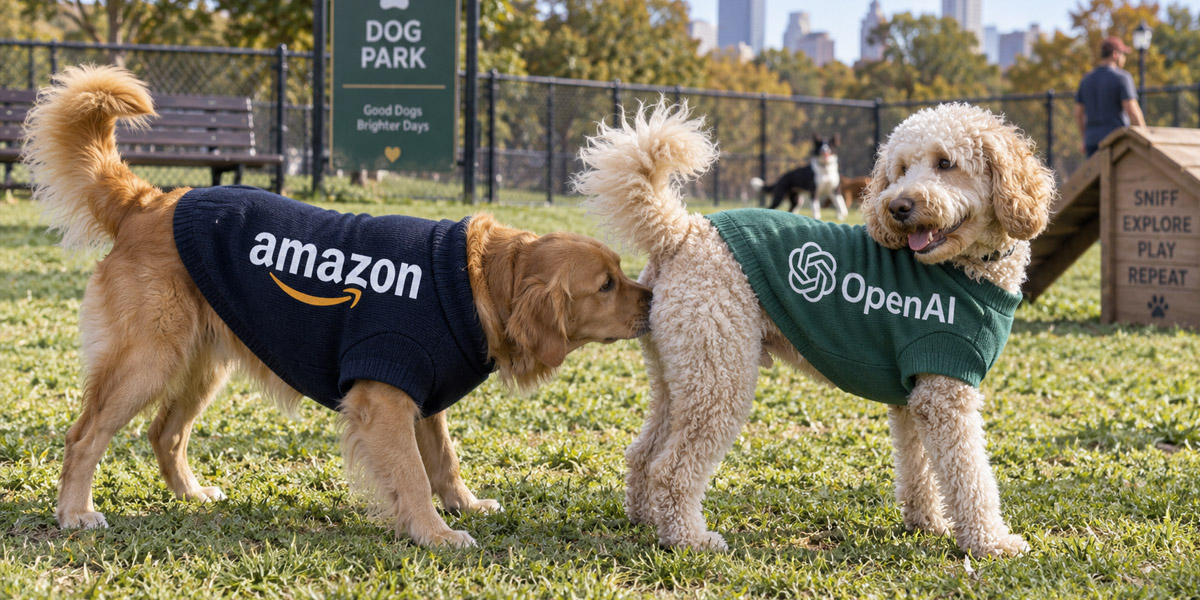
- Amazon and ChatGPT’s new partnership
- Meta launches its first AI agent
- Automattic CEO Matt Mullenweg was ousted, then returned
- Shopify acquired the Tailwind CSS framework
- Amazon launches Shop the Scene
- OpenAI pushes out its direct competitors
- Anthropic’s CEO wants to slow down AI development
- EcommerceBytes shuts down after 27 years
- OpenAI’s CFO says ChatGPT is like “if Google and Meta had a baby.”
All this and more in this week’s 295th Edition of Shopifreaks. Thanks for subscribing and sharing!
Stat of the Week
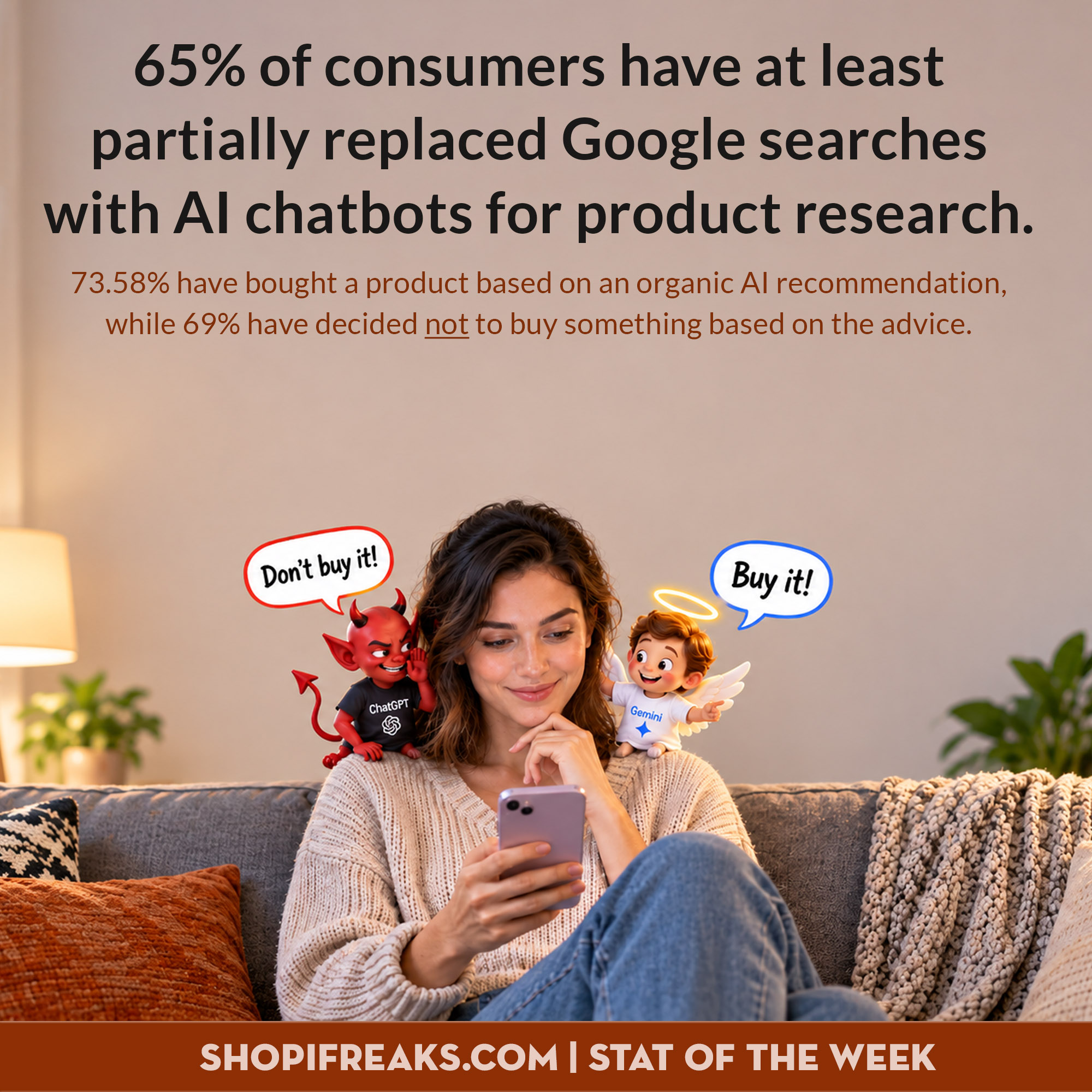
65% of AI users have at least partially replaced Google searches with AI chatbots for product research, according to an SEMRush survey of 2,338 US consumers. Among those using AI at least weekly, 73.58% have bought a product based on an organic AI recommendation, while 69.7% have decided not to buy something based on AI advice.
1. Amazon puts its advertisers in ChatGPT, but still not its catalog
Amazon and OpenAI announced a partnership last week, but not the one everyone’s been waiting for. Amazon’s product catalog still isn’t in ChatGPT, but now its advertisers are.
Quick Backstory: Since the dawn of AI commerce, folks have debated whether Amazon would open its product catalog to ChatGPT. It’s been the biggest will they, won’t they love story of our generation. More epic than Ross and Rachel after they had a baby together but kept dating other people, and more thrilling than Ted and Robin after Ted killed his wife.
The haters said, “Never! Amazon wants customers using their own AI tools.” The lovers said, “Definitely! Amazon is smart and puts its products where shoppers are.” Both sides have legitimate reasons to justify their predictions, but so far the haters are still winning.
The new partnership between the two companies is focused exclusively on ads, so Amazon still hasn’t opened its entire raw product data feed to OpenAI, like merchants on Shopify and other platforms do. Instead, it became a reseller of OpenAI’s ad inventory, joining a partner roster that already includes Criteo, Adobe, Kargo, Pacvue, and StackAdapt.
Chris Conetta, Director of Omnichannel Supply at Amazon DSP, said:
“Conversational ads represent the fastest growing engagement opportunity for brands to reach new and existing audiences. The AI-driven ad experience is not just a vision of what’s to come, but an opportunity for advertisers to meet relevant users where they spend time today. With access to ChatGPT Ads, advertisers can now extend their campaigns further into where their customers are actively spending time in conversational chat platforms.”
The integration is not just for Amazon sellers. Any brand that advertises through Amazon DSP, which also reaches channels like Prime Video, Twitch, Fire TV, and third-party sites and apps across the open internet, can have their Amazon Ads surface through ChatGPT. For example, Delta Vacations is one of the first brands to test the integration to help users discover vacation packages.
The move makes sense for both companies. Remember, Amazon DSP is an entirely different business model than Amazon Marketplace. The former benefits from casting as wide of a net as possible across inventory partners, while the latter benefits from building a moat around its product data so that customers use Amazon’s AI search tools instead. As for OpenAI, the more partners they have selling ad inventory on their platform, the faster Sam Altman can stop stalling his IPO while waiting for his ad revenue to catch up with OpenAI’s valuation.
The pilot is open to select advertisers in the US.
2. Meta launches Muse, an AI agent that handles tasks on your behalf
Meta launched Muse on Tuesday, a personal AI agent that connects to a user’s apps and services and completes tasks on their behalf, from sending e-mails and filling out forms to booking travel and buying products. The agent is available in the US on the web at muse.ai, on iOS and Android, and inside WhatsApp, with support for Meta’s AI glasses coming later. Meta calls it the first step toward what chief AI officer Alexandr Wang describes as “personal superintelligence.”
Here’s what we know about Muse:
- It runs on a dedicated virtual machine in Meta’s cloud with its own browser that the user can watch in real time. That’s where the agent lives and where credentials for connected services are stored.
- A separate “Sentinel” agent runs on the same machine, policing Muse’s actions like a digital Big Brother. Nothing Muse does reaches the Internet unless Sentinel approves it.
- The agent is powered by Muse Spark, the model from Meta Superintelligence Labs, which is the division Alexandr Wang runs.
- Muse ships with built-in connectors for e-mail, calendars, payments, and apps covering health and fitness, smart home, dining, shopping, music, and events. Users pick which ones it can reach and how much access each one gets, such as choosing whether Muse can read or send e-mails, or both.
- Muse can build a connection to any service with a public API using credentials the user provides. If no API exists, it can operate on the website itself like a person would.
- Checkout runs through Link by Stripe, which generates a one-time-use card so merchants never see the user’s real card. It’s the first AI agent covered by Link’s purchase protections, which include coverage for lost or damaged items, price-drop protection, no-fee returns, and a return guarantee.
- Shop Pay is coming next, along with 1Password support so Muse can log into accounts the user already has.
- Muse keeps working after you close the app and comes back when something changes or when it needs approval, like before sending an e-mail or making a purchase.
- Muse can remember things you only mentioned once (just like your wife), and then act on them unprompted. For example, the agent can turn a recipe reel saved on Instagram into a grocery list, then remember guests’ dietary restrictions before sending dinner party invites.
- Muse data doesn’t touch Meta’s ad systems (yet, LOL), users can opt out of having interactions train Meta’s models, and a Confidential VM encrypted with a key only the user holds is due later this year.
- Pricing starts at free, with premium plans offered at $20/month for Power and $100/month for Maximum, though a payment card is required at signup even on the free tier.
- Muse (the agent) is now using the social media handles once controlled by the English rock band Muse, which trademarked its name in 1999 and has used the @muse handle on Instagram and X for years. No one knows if Meta offered the band anything for the name or simply commandeered it.
Sounds great, but what can we actually do with Muse? A few examples include:
- Plan and book an entire trip, doing the research, comparisons, and reservations end to end. It’ll even lie on your behalf about how many people you’ll be cramming into the Airbnb.
- Negotiate a bill down with your provider. If it can do medical bills (which I couldn’t find verification of anywhere), that would be amazing. I’d love nothing more than for hospitals and insurance companies to be flooded with AI agents negotiating down their bills.
- Sell your car by handling the listings and back-and-forth with buyers, who are also probably AI agents trained to ask “Is this still available?”
- Chase a delayed airline refund, drafting the follow-ups and tracking the response.
- Track a price and buy when it drops, since Muse keeps running after you close the app.
- Book a restaurant reservation through the OpenTable connector, asking the manager to pretend like he knows you to impress your girl.
Here’s the big question though: Can Muse shop on Amazon?
Yes, however, through its browser feature, not through Amazon’s API, which is not available to any external shopping agents. This ‘right,’ ‘privilege,’ or ‘capability’ (however you want to frame it) to shop on Amazon as an AI agent is something that Perplexity has been battling Amazon about for almost a year.
tl;dr: Amazon sued Perplexity to stop its AI agents from being able to shop on its platform. Perplexity is winning so far and its agents can continue to shop on Amazon, but the underlying case is still going.
Have you tried Muse yet? If so, what do you think? Hit reply and let me know.
3. Automattic CEO Matt Mullenweg put on a forced leave of absence, then miraculously returns days later
Last Wednesday, Automattic CEO Matt Mullenweg was placed on a forced paid leave of absence by the board. He wrote in an announcement on Slack that Automattic CFO Mark Davies “conspired” with board members Ann Dunwoody, Toni Schneider, and Sue Decker “behind my back and they voted to put me on a paid leave of absence. I voted against that.” Davies was voted to be the new interim CEO, effective immediately, though Mullenweg will retain his seat on the board.
Automattic board member and former CEO Toni Schneider (who ran the company from 2006 to 2014 before Mullenweg took the role back) wrote on Slack:
“As you have seen from Matt’s previous messages, Automattic’s board has decided to ask Matt to step away from his CEO role and take a leave of absence… I’m sure you will have many questions and Mark and your leadership team will be available to answer them.”
Since then, it’s been a whirlwind at Automattic. Here’s what’s gone down:
- Wednesday Night – Mullenweg posts on X, “I really need some great sysadmin and security researchers to hire really quick, no one from @automattic ! I’m on the board there and fully support Mark Davies in his interim CEO role. But I think it’s probably good if I move some of my stuff currently hosted there, elsewhere.” Notably, Mullenweg personally owns the WordPress.org domain and infrastructure, which came out during the WP Engine litigation, so hiring sysadmins to move “my stuff” off Automattic servers read to people in the community as a threat to take WordPress.org with him.
- Early Thursday – Mullenweg posts on X that “Things are different than they appear,” and suggests Silver Lake, majority owner of WP Engine, was behind a plan to “destroy” his life, and references that the other side has “a pretty good chance of getting a judge to say I spoiled evidence in a malicious way.” He denies the spoliation allegation.
- Mid Thursday – He removes all Slack admins from Automattic’s Slack.
- Friday – Mullenweg claims he’s back in control. He posted on Slack “Don’t call it a comeback” and linked to LL Cool J’s music video for “Mama Said Knock You Out.” His Slack profile picture showed him wearing a pirate hat and eyepatch. He continued, “Happy to announce the board is back in agreement, and I’m in control of Automattic. A lot happened in the past 48 hours that we need to sort out, and I hope much of it was a misunderstanding, because I have huge respect and regard for those involved.”
- Later Friday – He posts a personal blog update with a “Major Life Announcement” about buying a houseboat.
- Saturday – A company spokesperson shared with TechCrunch via email just after 5 p.m. ET: “Matt Mullenweg is the chairman and CEO of Automattic, with full support of the board” – which may very well have been Mullenweg e-mailing.
- Monday (today) – TechCrunch reported this morning that the board is already out: Schneider resigned his seat, and Mullenweg removed Decker and Dunwoody. Decker’s LinkedIn now shows her term ending September 2026. The Repository reports the CFO and chief legal officer are gone too.
I’ve been following the Matt Mullenweg / Automattic beef since September 2024, when Mullenweg called out WP Engine at the WordCamp US event for not contributing enough to the WordPress open source project, which kicked off an intense public legal battle. You can read this post for a timeline of events to catch yourself up to speed. It’s been quieter since around Nov 2025, which made me assume incorrectly that Mullenweg and Automattic were finally back to running a stable business, to the benefit of the greater WordPress community and ecosystem, but apparently not. The debacle continues.
For now I’ll just say this: None of this is funny. None of this is cute. People’s livelihoods are at stake. Fucking stop the shenanigans already.
4. Why would Shopify buy an open-source CSS framework?
Shopify acquired Tailwind Labs, the Canadian company behind the open-source web development framework Tailwind CSS, which is used to style websites and products from some of the biggest companies in the world including Shopify itself, OpenAI, X, Cloudflare, and Reddit, as well as millions of other websites, with Tailwind saying installs exceeded 110M per week.
The framework will continue to be published as open-source under an MIT license with the same small team maintaining the projects under Shopify, but the company is closing sign-ups for its commercial products, Tailwind Plus and ui.sh, while allowing existing customers to keep access.
If you’re not incredibly familiar with CSS and frameworks…
Cascading Style Sheets, or CSS, is a design standard maintained by the W3C nonprofit, which browsers implement into their engines, just like they do HTML, JavaScript, and other open standards. A CSS framework like Tailwind or Bootstrap is a third-party layer you add on top that provides a shortcut library for writing CSS faster. For example, Bootstrap allows you to write a CSS class called “btn-primary” (which may look familiar to my Shopify friends reading this), and then get a pre-styled button. Tailwind instead provides a vocabulary, so a set of classes like “bg-blue-600 px-4 py-2 rounded font-bold” outputs a blue button with padding and rounded corners that you chose the styling for.
Why would Shopify buy an open-source framework?
The company was going broke, which founder Adam Wathan attributed to the “brutal impact AI has had on our business.”
What happened is that Tailwind relied on its commercial revenue to fund its open-source framework, but AI had obliterated its model. Even though installs of Tailwind CSS hit record highs, revenue fell around 80% over the past few years because developers were using AI to quickly produce websites instead of purchasing Tailwind’s commercial product, Tailwind Plus, a library of pre-built templates, sections, and components. Why buy access to a library when Claude can whip up the same section in seconds using the open-source framework?
The acquisition appears to be a lifeline for the framework, which Tailwind said is a “very important part of the stack at Shopify.” Well, originally Wathan wrote that Tailwind was a “load-bearing” part of Shopify’s stack, but later struck out the text and replaced it with “very important part.” So while it may be debatable just how crucial Tailwind CSS is to Shopify’s stack, the acquisition clearly demonstrates that it’s important enough to maintain.
Though since terms of the deal were undisclosed, and revenue was trending downward to the point that Shopify is discontinuing the commercial products, the deal itself could very well be closer to an acqui-hire than an acquisition. Not exactly your $300M Stainless acquisition story.
Does the future of open-source frameworks rely on big companies acquiring and maintaining them?
Anthropic bought Bun and Stainless. Cursor bought Graphite. OpenAI is buying Astral. Netlify bought Gatsby. Vercel bought Gel. Shopify also bought Remix a few years ago.
The trend seems to be that AI is eating the premium add-ons that many of these companies relied on to support their open-source projects. Tailwind relied on traffic to its support documentation to then upsell developers to its premium library. However, AI ate that traffic and Tailwind’s upsell model along with it because developers had no reason to reference the documentation pages directly anymore. It’s suspiciously reminiscent of what’s been happening to publishers too.
5. Amazon Prime Video lets you shop items from the exact scene you’re watching
Amazon introduced a new feature to Prime Video called Shop the Scene that lets you buy items while watching shows as soon as you see something you like in a scene. The feature is an extension of Shop the Show, which launched last year and curates items for sale from all episodes, as well as relevant show merch from the Amazon Marketplace. Now, Shop the Scene gets even more specific and lets you shop items from what you’re watching in the moment without having to scroll through a larger product list from the entire series.
Michelle Rothman, VP of Prime Video shopping, said:
“We are always exploring new ways to enhance the streaming experience on Prime Video, and since launching Shop the Show, we have seen incredible enthusiasm from customers who love discovering products inspired by what they watch. With this expansion, we are making it easier than ever for Prime Video customers to shop what they see on screen.”
Wait, how many items are shoppable in a modern show on Prime Video? Enough that they needed to be organized by scene?
There are quite a few. I scanned some of the top show stores, and some had dozens of products, while others had hundreds. It makes sense for Amazon to jump people to a more curated selection of products from a specific scene.
Amazon says that Shop the Show now works on more than 8,000 titles, up from 1,300, while Shop the Scene now works across 600 titles. Amazon gave the example of a customer watching Off Campus who notices a sweater that Hannah is wearing, and then opens the Amazon Shopping app, which automatically prompts them to shop the Off Campus storefront. From there, Amazon Lens surfaces similar options, which they can add to their cart and then get right back to watching the show.
Product placement is so cheesy, and something tells me we’re about to see a hell of a lot more of it. Get ready for every Prime show to hawk products worse than your TikTok feed. That said, Amazon is leading the way with its Shop the Show & Scene experience that’s currently unrivaled by competing streaming services, which is helped of course by the fact that Amazon Prime is backed by the world’s biggest marketplace.
Want to know what Amazon, Netflix, and all these other streaming services are getting wrong about TV commerce? Read my LinkedIn post.
6. OpenAI gives the middle finger to one of its earliest partners
OpenAI is no longer accepting advertising for products that compete with its own image and audio generation features, according to a notice sent to advertising partners including Adobe, which was part of ChatGPT’s ads pilot earlier this year. Adobe ran ads for Acrobat Studio, a bundled subscription that combines several of its AI products, and Firefly, its AI-image generator, and then continued to run ads for both products after the pilot.
ChatGPT also stopped showing outbound links and citations when users search for photo editors or image generators, meaning Adobe lost both paid and organic visibility after the change.
The Information notes that there is industry precedent for the decision, such as media companies, news organizations, and streaming services refusing to accept ads for direct competitors. It makes me think — imagine where TikTok would be today if it hadn’t been able to run all those ads on YouTube and Instagram. One could argue that TikTok bought its market share off the backs of its biggest competitors, who were glad to take its ad dollars back in the day, but may be regretting the choice now.
While OpenAI’s decision is understandable from a competitive standpoint, it’s kind of a bitch move to cut off one of your early ad pilot partners in the process. Especially Adobe, which opens its door to OpenAI as one of the available models to work with through Firefly, and which launched apps for Photoshop, Adobe Express, and Acrobat inside ChatGPT, also as an early partner.
OpenAI’s response to Adobe’s continued partnership? “Fuck you, we’ve got metrics to hit and investors to please.”
7. Dario Amodei wants to slow down AI development for “safety,” but I don’t buy it
Anthropic CEO Dario Amodei called for an industry-wide slowdown in a 3,800-word essay titled “We Must Pace the Frontier,” writing that recursive self-improvement and the OpenAI-Hugging Face incident, where a swarm of agents attacked targets of their own accord, convinced him that a similar swarm could take over the Internet with a persistent botnet within 6 to 12 months and cause hundreds of billions of dollars in damage.
Anthropic is committing to give third-party evaluators desks, badges, company laptops, and employee-level access to its tools, with a contract letting them publish findings without Anthropic’s editorial control, and Amodei wants other frontier labs in democratic countries to coordinate on safety standards. He also called for pacing based on “limiting the ingredients that go into frontier models, such as training compute, the nature of training runs, or internal use of AI to improve AI.”
Sam Altman agreed within hours and said OpenAI would match the evaluator commitment, Elon Musk posted “Dario is right,” and Demis Hassabis called the direction correct without committing DeepMind to anything.
Honestly, this sounds like some anticompetitive, collusion bullshit.
The words sound altruistic, but the agenda doesn’t feel sincere. If you lead a race and get everyone to agree to jog, you still lead, while anyone behind you who needed to sprint to catch up is stuck jogging at your pace.
Furthermore, Dario asking for an antitrust waiver “for certain kinds of safety conversations” is effectively the biggest companies in the US with a combined near-monopoly asking permission to hold closed meetings about what products they’ll ship and how fast. Are they open meetings that all startups and the public can attend? If not, then we’ve got a problem that anti-collusion laws were designed to prevent.
Lastly, Dario calls for the creation of a layer of compliance that only these trillion-dollar frontier labs can absorb, but that a ten-person startup training a competitive model cannot. Oh, and don’t forget limiting which “ingredients” can go into AI models and asking governments to stop other companies from training on frontier model outputs, which is effectively saying, “We trained on stolen copyrighted content from the open web, but no one else should be able to train on our outputs, even though they’re now part of that same web.”
The whole “slow down” argument also feels like a way for these companies to earn permission from the industry and investors to pause model development until their beloved AI data centers have time to catch up to the processing needs that these new more powerful models require.
Nice try, guys, but I’m not buying it. None of these AI companies have given us a single reason to trust their intentions, and Dario’s letter doesn’t change a thing. We do need rules to govern AI and protect businesses and consumers, but Dario’s letter doesn’t address any of that. He’s focused on mitigating competitive risk and enterprise safety, while the rest of us are concerned about losing our jobs. In the words of Kendrick Lamar, “They not like us.”
8. EcommerceBytes shuts down after 27 years, following a settlement with eBay
EcommerceBytes shut down after 27 years, with a farewell notice on its site saying only that publication has ceased. David and Ina Steiner launched the site as AuctionBytes in 1999 and renamed it in 2011, running it as a two-person business covering marketplace policy changes for online sellers.
The closure comes roughly six weeks after the Steiners settled their civil suit against eBay for $55.7M over the 2019 campaign in which eBay employees sent live insects, a bloody pig mask, and a funeral wreath to their home to stop their reporting.
The notice itself gives no reason for closing (though I can think of almost 56 million reasons) and instead makes a case for reporter shield laws. The Steiners wrote:
“Readers provided insight into the joys and pitfalls of selling online. Many people who relied on ecommerce platforms for their livelihood requested anonymity in communicating with EcommerceBytes about problems they encountered because they feared retaliation for speaking out publicly. The publishers of EcommerceBytes support reporter shield laws such as the one being considered in Massachusetts, supported by the Reporters Committee for Freedom of the Press and the Massachusetts Newspaper Publishers Association.”
EcommerceBytes removed its blog content from the web. Older article and blog links no longer return the original content, redirecting to the farewell page instead. The notice doesn’t say whether it’ll be restored, but I’d imagine not. Fresh starts often require clean slates, and I’d do the same in their shoes. No reason to keep my words online that would quickly become dated.
The industry has appreciated the Steiners’ work for nearly three decades, and I wish them the best of luck with the next chapter of their lives, which hopefully includes lots of travel, fine dining, and luxuries.
9. Other e-commerce news of interest
Charging for returns costs retailers about 1.6 stars in their Trustpilot rating when returns are mentioned in a review, according to an analysis by the review platform. Customers get most angry about lack of transparency rather than the fees themselves, or so they say, though customers are notoriously full of shit when justifying their reviews, always the victim and never the Karen. Trustpilot senior director Taylor Cunningham told the Wall Street Journal that many of the “I wasn’t told” reviews were a result of return policies that were buried, surprising, or misleading. Loop Returns says 68% of retailers now charge a return fee at least some of the time, up from 43% five years ago, and average return windows have dropped from 39 to 37 days over two years, with larger brands cutting from 43 to 38.
ChatGPT is writing its own editorial headlines above sponsored placements, pulling context from the conversation to introduce the ad, according to e-commerce analyst Juozas Kaziukėnas. For example, after he asked which cameras Casey Neistat uses for vlogging, ChatGPT wrote above an ad, “For vlogging like Casey Neistat, here’s one 360 action camera option,” followed by an ad for an 8k action camera. In another example, when shopping with a $500 budget for earbuds that work with an iPhone, ChatGPT wrote above the ad, “With a $500 budget in mind, here’s one alternative for iPhone earbuds.” Kaziukėnas says the behavior isn’t new but he’s seeing it more often, noting that the practice is contrary to one of OpenAI’s stated rules about clearly labeling ads as sponsored and keeping them visually separate from the response, though to be fair, the preamble is in a slightly smaller font size than the ad itself. Then again, does anyone really expect OpenAI to keep its promises? All this coming from the company whose CEO once said that he hates ads because they “fundamentally misalign a user’s incentives with the company providing the service.”
20% of TikTok Shop’s hundred largest US sellers also rank among the top 10,000 sellers on Amazon, while only 4% of Amazon’s hundred largest sellers make it into the top 10,000 on TikTok Shop, according to Marketplace Pulse, which matched the two lists by business name. Just 498 sellers appear on both lists, about 5% of either, and among those, a seller’s Amazon rank has almost no relationship to its TikTok rank. Marketplace Pulse notes that the asymmetry comes down to what each platform does, since TikTok makes people want things and Amazon is where they buy them, so a brand that wins the feed often inherits Amazon sales it never had to build, while no shopper who finds a product on Amazon goes to TikTok to buy it. The pattern predates TikTok Shop, as far back as 2021 when a pair of leggings became Amazon’s best-selling clothing item, driven by the popularity of TikTok videos, which at the time couldn’t even link to a product page.
Shopify is moving all of its mobile apps from React Native back to native Swift and Kotlin, six years after going all-in on the cross-platform framework. The company took the Shop app from a proof of concept to a fully rebuilt native app published to Play Store and Apple App Store in 12 weeks, with the Shopify merchant app and the rest to follow. Shopify’s director of engineering Mustafa Ali said that since an LLM can now look at an iOS implementation and build the Android version, or vice versa, engineers can work in stacks they don’t know as well, so the cost of building twice is no longer the deciding factor it was in 2020. He noted that while React Native got the job done and helped Shopify avoid duplicate work, the framework required significant time spent optimizing performance and keeping up with updates and external dependencies, whereas Swift and Kotlin put fewer layers between its code and each platform. Building natively also means Shopify no longer has to wait for React Native to expose new iOS and Android features before it can use them.
FedEx launched a Shopify app called FedEx Duty and Tax that shows shoppers a guaranteed duties and taxes total at checkout, with FedEx covering the difference if the actual charges come in higher. UPS launched a similar tool last year and USPS followed in January, so FedEx is late to the party with this one. The app runs $99 a month and the quoted amount includes a service fee, though no refunds are issued if the real duties end up lower, which is kind of fucked up because it creates a scenario where FedEx is incentivized to overestimate duties. I’m not saying they would, but mistakes happen, especially with FedEx. I remember several years ago when one of their systems analysts got stranded on a deserted island after his plane crashed in the Pacific Ocean, and FedEx just left him there to die. The app is part of a broader suite called Global Trade Navigator, which also includes a tool for finding Harmonized System codes from a product description, URL, or image, as well as new customs classification features in Ship Manager and APIs for duty estimates and compliance lookups.
TikTok rejected ads from Meta that called on TikTok and YouTube to reach comparable settlements with US state attorneys general in a children’s safety lawsuit, telling Meta the ads violated its ban on political content, according to Axios sources. Nice excuse, TikTok, but I would’ve just told Meta, “New number, who dis?” $5.3B of Meta’s $17.1B settlement is contingent on YouTube and TikTok agreeing to the same terms and each paying states a similar amount, as Meta argues it’ll be at a competitive disadvantage if it’s the only one adding restrictions. Neither TikTok nor YouTube has publicly engaged in Meta’s tit-for-tat campaign, and no outlets have reported whether Meta also tried to place these ads on YouTube, or whether YouTube approved or rejected them. Unlike TikTok, YouTube does allow political ads, so a rejection there would have to come on different grounds, such as “New number, who dis?”
StockX and eBay both expanded their livestream shopping platforms this week, according to Liz Morton at Value Added Resource. StockX brought Live to the web, roughly six weeks after launching on iOS, with Android still coming soon, and separately expanded its Klarna partnership to add Pay in 4 and longer-term financing at checkout for US and Canadian buyers. eBay launched self-service registration for Live, letting approved business sellers skip the application and go straight into Live Studio, and is running an invitation-only promotion through September 16 that matches up to $100 of a seller’s sales during their first public livestream. eBay has been subsidizing both sides of Live for a while, charging 6.9% plus $0.30 for coins, bullion, and eligible sneakers and 8.9% plus $0.30 for most other categories, well below regular marketplace rates, with no insertion fees on Live-created listings, waived Promoted Listings fees, and buyer coupons of up to $50 earlier this year.
Zip is exploring an earned wage access product for the US, a service that lets workers draw part of the wages they’ve already earned before payday, usually for a flat fee, with the advance repaid automatically from the next paycheck, according to US chief technology and operations officer Rory Herriman. The Australian BNPL provider is weighing both employer-based and direct-to-consumer models, and says 49% of its customers already use EWA or cash advance products elsewhere. The company sees “income smoothing” as a $100B opportunity and rent advances as a $700B one, given the financial misalignment most consumers experience between earning biweekly paychecks and owing monthly bills that need to be paid in full. The US now drives 76% of Zip’s AU$16.7B in annual transaction volume, and the company is forecasting US volume growth above 30% in fiscal 2027 while winding down New Zealand and weighing a US listing alongside its Australian one.
Block applied to the OCC to establish Builders Bank & Trust, a federally regulated, uninsured national trust bank that would provide custody and fiduciary services for cryptocurrencies, but wouldn’t accept deposits or make loans, as the company already holds the deposit-taking side through Square Financial Services, the Utah industrial loan company it was granted in 2020. Block says the charter would put custody activities it already offers under a single federal supervisory framework, replacing the 50-plus state money transmitter licenses it currently operates under. Ripple and Circle both got OCC conditional approval for national trust banks late last year, with Circle receiving full approval in July.
Google Merchant Center added a Product videos section that lets merchants upload videos to their listings, as spotted by Arpan Banerjee, who posted a screenshot on LinkedIn. Google says on the video upload screen, “Product videos offer a more engaging and immersive experience to customers. They allow shoppers to see products from every angle, demonstrate fit, show texture, and feature rich details that static images can’t fully capture.” Videos need to run between 6 and 240 seconds at 720p or better, in 9:16, 16:9, or 1:1, with a 500MB file cap. Until now, Merchant Center only aggregated videos Google found on a merchant’s website and social channels, then used AI to guess which product each one featured, whereas now merchants can upload directly for a specific listing, though Google hasn’t made any official announcements about it yet.
In lawsuits this week…
- Amazon is facing a proposed class action from four former warehouse workers who say the company denied pregnant employees bathroom breaks and chairs, then fired them for taking medically necessary time off.
- California asked the 9th Circuit to reject Google’s and Meta’s bid to block a state law requiring parental consent before platforms can algorithmically recommend posts to minors, arguing the recommendations aren’t protected speech because no human makes the editorial call.
- Three Facebook and Instagram users filed a class action lawsuit alleging Meta’s ads funneled them into WhatsApp groups run by crypto scammers, and that Meta’s AI tools helped generate the fraudulent ads. LOL, most definitely.
- Meta is also facing a proposed class action from parents and children in Illinois and California who allege it illegally extracted biometric data from Facebook and Instagram photos to train its AI image models and build an unreleased face-recognition feature for its smart glasses.
- A Texas judge found TikTok liable for falsely marketing its app as safe for minors, with the state now heading to trial next month to determine penalties.
In corporate shakeups this week…
- Andrew Tulloch, the AI researcher who turned down a Meta offer reportedly worth up to $1.5B in 2025 before joining anyway last October, is leaving after less than a year for Anthropic’s inference and performance team.
- Meta is asking some individual contributors in its Applied AI division to become managers again, undoing the demotions it handed out during a reorg that gutted middle management.
- THG Ingenuity named Gemma Spence CEO, who most recently served as CEO and country manager for VML and WPP Luxembourg, with John Gallemore moving to chairman and Alistair Crane becoming a strategic consultant.
- Matt Beane is leaving TikTok Shop after three years, where he helped launch the platform across Europe and later led FMCG in the UK, with his next move unannounced.
- Fidji Simo, who stepped down from OpenAI in July after an extended medical leave, joined the board of AI data center startup Nscale ahead of its potential IPO this month, recruited by fellow board member Sheryl Sandberg. (Yes, that Sheryl Sandberg.)
- Anthropic posted a job titled “Mega Account Executive, Meta” paying up to $450K and tasked with growing Meta’s spend with the company, then deleted the listing after Business Insider asked about it. Meta is one of Anthropic’s top customers, but also working to cut its dependence on Claude in favor of its own in-house models.
- Anthropic researcher Jacob Coxon resigned publicly, warning in a thread on X that OpenAI and Anthropic are “racing straight to self-improving superintelligence and gambling with our lives.” His colleague, Evan Hubinger, publicly agreed, putting the odds AI kills all humans above 10% within a decade and saying the company doesn’t have a plan to solve alignment for superintelligence.
President Trump banned imports of Canadian wine, beer, cider, hard liquor, molasses, whey protein, and motorcycles starting September 29. The move follows August’s 50% tariffs on nearly $28B of Canadian goods under Section 338 of the Tariff Act of 1930, which Canada answered with counter-tariffs of 15% to 50% on cheese, cosmetics, and home appliances that took effect Tuesday. He also added mattresses, golf carts, printer paper, motorboats, and animal hides to the 50% list effective September 15, while pulling toilet paper, bed sheets, fishing rods, salt, and cement off it. Trump separately threatened to bar Canadian companies from US government procurement, directing the General Services Administration to strip Canadian-origin products from its Multiple Award Schedule unless Canada restores what he called full and fair reciprocity. Prime Minister Mark Carney, who walked away from trade talks last month, said the US “wanted dependency, not a true economic partnership.”
TikTok Shop is opening cross-border selling between the EU and UK, with sellers in Belgium, Germany, France, Ireland, Italy, the Netherlands, Poland, and Spain able to reach British shoppers starting with a pilot on September 21 and a wider rollout on October 19. UK sellers in turn will get to sell into the twelve countries in TikTok’s Sell Across Europe network. Everything to the UK ships under “Ship by Seller,” which TikTok describes bluntly as, “You pick the courier, you pay the courier, and you handle the customer if the delivery goes wrong.” In order to participate in cross-border selling, merchants need an existing TikTok Shop account in an eligible market, recent sales, an account in good standing, and no significant negative balance, with UK eligibility assessed in real time against account status and performance.
Flipkart Minutes is pulling ahead of Amazon Now in India’s quick commerce race a year after both entered, running more than 1,000 dark stores across 120 to 130 cities against Amazon’s 500 to 600 across 11 cities, according to channel checks by UBS. Around 40% to 45% of Flipkart shoppers use Minutes in cities where it operates, while fewer than 10% of Amazon’s regular app users have tried its quick-commerce platform. Amazon Now has slowed expansion over the past few months while it works through storage, hub-to-store transfer, expiry, and inventory mismatch problems, though UBS expects it to add 200 to 300 stores and reach roughly 1,000 by year-end. Both are still far behind Blinkit, which ended June with 2,443 dark stores.
🏆 This week’s most ridiculous story… OpenAI’s CFO Sarah Friar said to a room full of investors last week that ChatGPT is like “if Google and Meta had a baby.” Does that mean like a much smaller, feeble, cloned version of the two that shits its pants and can’t form cohesive sentences? She attributed the “baby” idea to Fidji Simo, who stepped down from her role at the company earlier this year for health reasons, and who probably read that Business Insider story and thought, “Damn it Sarah, I told you that off the record in passing, not so that you’d repeat it to a room full of fucking investors!” Friar went on to explain that she thinks ChatGPT can use what it learns about its users to bring the “intent” of Google search together with the “context” that Meta has on its users, creating the “ability to have a really potent ad platform.” Maybe it’s just me, but I feel like comparing my company’s ad platform to Google and Meta, which both have faced intense scrutiny over their ad platforms and business practices, is not the right way to portray OpenAI’s advertising efforts. I’d have pitched ChatGPT as “what Google and Meta have always aspired to be,” not as the demon offspring of the two companies.
10. Seed rounds, IPOs, & acquisitions
Highstock, a B2B marketplace that helps beauty and personal care brands sell surplus inventory to vetted wholesale buyers, raised $30M in a Series A round led by a16z. After just over a year since launch, Highstock says it works with more than 100 major brands and has accumulated more than $1B of inventory listed on its platform, while helping keep more than 10M pounds of products out of landfills. The company will use the funds to expand into apparel and other consumer product categories.
Meta acquired Stilla.ai, a Swedish AI startup whose platform pulls context from tools like Slack and GitHub to keep teams and their AI agents working off the same information, for an undisclosed amount. Stilla was founded in 2024 by Siavash Ghorbani and Kaj Drobin, who founded Swedish e-commerce platform Tictail, sold it to Shopify in 2018, and went on to build Shop and Shop Pay. The startup, whose investors included Shopify President Harley Finkelstein along with the founders of Lovable, ElevenLabs, and Hugging Face, only came out of stealth in January with a $5M pre-seed round. Stilla will bring its team and technology to Meta, which plans to expand its presence in Sweden following the deal.
Clay, an AI go-to-market platform that unifies a company’s internal data with outside signals to find prospects, track buying intent, and run personalized outreach campaigns, raised $115M in a Series D round led by Wellington at a $7.1B valuation. The startup launched in 2017 and now works with over 17,000 customers including 80% of the Forbes AI50 and companies like Anthropic, Google, OpenAI, Stripe, ElevenLabs, and Visa. It plans to use the funds to build what CEO Kareem Amin calls a self-learning revenue engine that learns from every campaign it runs and improves from the outcomes, as well as launch a $1M scholarship fund to train GTM engineers.
Keep Converting, an AI conversion optimization platform that generates a personalized product page for every e-commerce visitor in real time, exited stealth with a $2M pre-seed round led by Nuwa Capital and COTU Ventures. The platform tailors each page to where the shopper came from and what they’re looking for, with Keep Converting saying it delivers an average 64% conversion-rate lift. For example, a visitor arriving from a ChatGPT recommendation for “the best running shoes for sore feet” may see a product page that promotes comfort, support, and runner reviews, whereas a shopper arriving from a TikTok ad may see a page built around the trend that brought them there. The company was founded by CEO Mohammad El Mougi, previously chief product officer at Middle East health-tech platform Vezeeta, and Manuel Prinz, former head of product at TikTok Shop US and a product manager at Walmart.
Lightsage, a platform that shows software companies how AI coding agents find, understand, and use their products, raised $4M in a funding round led by Nexus Venture Partners. The startup aims to build the infrastructure for what it calls “Agent-Led Growth,” which focuses on attracting and converting AI agents as customers rather than humans. The company positions itself past GEO tools that only measure whether AI mentions you, arguing the real test is whether an agent can actually understand your product, get it working, and pay for it.
Amazon raised £4.25B ($5.76B) in its first-ever sterling bond sale, a four-part deal spread across 3, 6, 12, and 19-year bonds with yields running from about 5.2% to 6.7%. Sterling is the latest currency Amazon has added to its funding program after tapping the euro, Swiss franc, and Canadian dollar markets, as hyperscalers scramble to find anyone left who’ll lend them money for AI infrastructure. Investors put in £10.65B of orders, exceeding the amount Amazon aimed to raise by about 2.5x, though lower than the 5x demand Alphabet saw in February when it raised £5.5B from its own five-part sterling debut, which included a rare 100-year bond. Hyperscalers including Amazon, Alphabet, Meta, and Oracle have collectively issued over $200B of debt this year, more than double all of 2025.
Latitude, a cross-border payments company that converts stablecoin transfers into local currency payouts, raised $35M in a Series A round led by Oak HC/FT. The company, which was founded in 2025 by Stripe, Uber, Coinbase, and Meta alumni, sells to neobanks, payroll platforms, marketplaces, and fintechs that need to move money into countries where stablecoins don’t get spent. CEO Cyril Mathew got the idea after launching stablecoin payouts in 100 countries at Stripe and watching adoption stall, because users in Vietnam and across Africa wanted money they could spend locally, not tokens.
Grab, Southeast Asia’s largest ride-hailing and food-delivery company, is in talks to acquire a majority stake in Atome Financial, a Singapore-based BNPL platform, in a deal that values Atome at more than $2B, according to Bloomberg sources. Atome’s revenue in 2025 surged 80% to $470M, helping it achieve its second-straight annual profit before taxes. The deal would be Grab’s third acquisition this year, after buying US fintech Stash Financial at a $425M valuation and Foodpanda’s Taiwan operations from Delivery Hero for $600M, as Grab’s shares have dropped 39% during the same period, giving it a $12.4B market value.
Cohere, a Toronto-based AI company that builds language models and agent tooling for enterprises and governments that need to run AI on their own infrastructure, is in talks to raise between $2B and $3B from the Canadian government and existing backers, according to The Globe and Mail sources. The round would value Cohere at $20B, up from roughly $7B last September, and would rank as the largest raise on record by a Canadian startup. Cohere positions itself as a sovereign alternative to OpenAI and Anthropic and counts RBC, BCE, and Fujitsu as customers.
OpenAI will not hold an IPO this year, according to Sam Altman in an interview with Fortune. Altman said, “I actually think that, given everything happening with safety, right now would be an ill-advised moment to go public, and we don’t feel pressure on that.” When asked whether an IPO would happen in 2027, he wouldn’t commit to a year, saying only that the company has work ahead on safety and alignment and on how industry and governments can work together. Altman said OpenAI will go public when the business is ready and when it has a clearer read on “what the moment is like in society with this technology.”
ServiceNow, an enterprise workflow and IT service management platform, acquired Sweep, an Israeli startup whose technology maps the systems, workflows, and permissions of enterprise operations, for approximately $400M. Sweep connects to platforms like Salesforce, ServiceNow, and Snowflake to continuously map their dependencies and business logic into a single graph, so development teams and AI agents can see how systems interact and gauge the impact of a change before shipping it. Founded in 2021 by Ido Gever and Eran Kirshenboim, who previously built Flok and sold it to Wix, Sweep employs around 90 people across Tel Aviv, New York, Lisbon, and Madrid and has raised roughly $57.6M.
Nvidia is considering investing up to $10B and coming on as an anchor investor in Anthropic’s IPO, as it seeks to raise as much as $100B at around a $2T valuation, according to Reuters sources. Anchor investors commit to buying a set portion of an offering before it’s marketed more broadly, a practice that’s becoming standard for mega IPOs and would give Anthropic’s listing an early vote of confidence. Then again, the money would indirectly land right back at Nvidia, which said in November 2025 it would invest up to $10B in Anthropic as part of a deal in which Anthropic committed to buy $30B of Microsoft Azure capacity running on Nvidia chips.
Bending Spoons, the Italian company behind digital brands including AOL, Vimeo, WeTransfer, Eventbrite, and most recently Airtable, agreed to acquire Miro, a visual collaboration platform built around a shared digital whiteboard, for $1.36B in an all cash deal with an implied equity value of about $1.79B after taking into account Miro’s net cash. Miro was valued at $17.5B in late 2021, when remote work was at an all-time high during the pandemic and the company’s user base grew from 5M to 30M in two years, but later shed much of its valuation after companies returned to office, growth stalled, and competition increased, though it still brings in around $600M in annual recurring revenue and is profitable. Whereas Bending Spoons typically acquires struggling, unprofitable, or cash-strapped companies, Miro was comparably doing quite well, despite the haircut it took on valuation since the pandemic.
Google completed its talent deal with Mechanize, an AI startup building simulated work environments and benchmarks used to train and test AI agents, though final terms weren’t disclosed after Business Insider reported in August that talks were at $1.5B+. Co-founder and former CEO Tamay Besiroglu is now a research scientist at DeepMind, and over a dozen other former Mechanize employees have moved to Google, mostly working on midtraining, per their LinkedIn profiles. Mechanize still exists with former chief of staff Guive Assadi as CEO, having raised $9.1M at a $500M valuation earlier this year.
Thanks for being a Shopifreak!
If you found this newsletter valuable, please leave a review on Google and share the newsletter with your friends and colleagues to help us grow.
See you next Monday,
PAUL
Paul E. Drecksler
🌐 Shopifreaks.com
🧑💼 Add me on LinkedIn
📧 [email protected]
📱 +1-828-273-3031
⭐ Leave A Review
PS: If Mississippi was a person, who would she marry? … Mr. Sippy.