

Hi Shopifreaks
Guess where I’m headed tomorrow? Lima, Peru!
I’ve spent several months in Lima over the years, and it’s one of my favorite cities in South America, but this is the first time I’ve gone back with a wife and three-year-old, so I’ll be exploring the city from a new perspective. We’re meeting up with my old travel buddy, Stephanie, who also has a family now. Oh, how the times have changed…
Mia (my daughter) is excited about the trip and the flight to get there. (She loves planes.) If you have any recommendations for “must do” activities in Lima for kids, please let me know. Right now the Cat Park, Magic Water Fountain, and Zoo are top of her list. I haven’t yet shown her Palomino Islands — that’ll be a surprise.
Now, let’s talk e-commerce. I’ve got a great edition for you this week where I cover:
- Canada is the future
- Amazon wants even more from sellers
- Meta’s “maybe $18B” settlement
- Meta wants TikTok and YouTube to go down with it
- Amazon and YouTube team up against a common enemy
- Salesforce pushes users to Claude
- Meta employees test a personal agent
- Amazon is developing fully automated delivery stations
- Turns out Anthropic is NOT a ‘supply chain risk’
- Affirm returns to Australia
- Prices are fueling e-commerce growth, not orders
- Best Buy welcomes international sellers
All this and more in this week’s 293rd Edition of Shopifreaks. Thanks for subscribing and sharing!
Stat of the Week
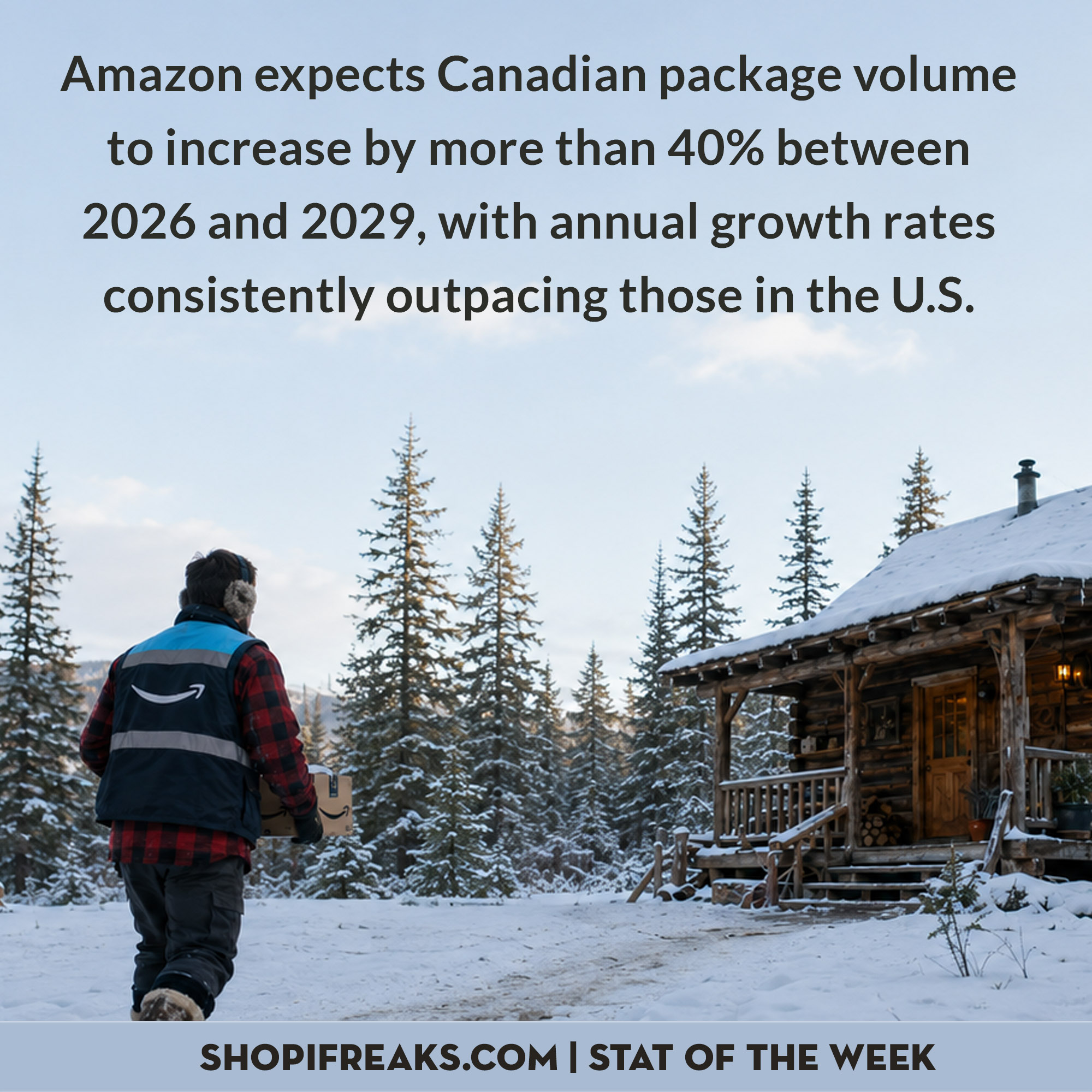
Amazon expects Canadian package volume to increase by more than 40% between 2026 and 2029, with annual growth rates consistently outpacing those in the U.S., according to internal documents reviewed by Business Insider. The company plans to expand its fulfillment capacity, same-day delivery, and its logistics network heavily in the country during the next several years. Amazon was still planning the expansion as recently as July, after President Trump announced additional 50% tariffs on certain Canadian imports.
1. Amazon tells sellers to bid for faster delivery
Amazon is asking FBA sellers to bid per unit to be eligible for “sub-Same Day” delivery, where packages arrive in two hours or less, according to an e-mail sent to sellers earlier this month. The e-mail says that sub-Same Day deliveries “have experienced 12% higher sales on average” than those delivered through regular FBA service, or “Poor Man’s FBA,” as we’ll have to start referring to it moving forward.
The e-mail read:
“You pay only for units that actually ship through Sub Same Day, at the per-unit price you bid. Participation is optional, and you’re never charged more than the price per unit you set.”
Amazon, of course, tried to spin this as a good thing for sellers, with a spokesperson telling Business Insider:
“For the first time, sellers can choose which additional products to offer at faster speeds based on their own business expertise and customer insights. [Amazon] will continue to place a wide variety of products from independent sellers throughout our Same Day network at no additional cost to sellers.”
In last week’s edition, I wrote about Amazon expanding its drone delivery service and predicted:
“I imagine that Amazon will push prices and free thresholds higher as time goes on, as they have a habit of introducing new logistics services at a loss and then later raising prices or forcing sellers to subsidize the cost. ‘Optional: Enable drone delivery for just $0.30 per FBA delivery and reach customers who are looking to get their items delivered fast.’ — and that’s how some items in the future will have an ‘Available For Drone Delivery’ badge and others won’t.”
Turns out that charging sellers extra to be eligible for drone delivery isn’t so far fetched after all. Amazon has already introduced a bidding system for sub-Same Day delivery that we’ll likely see a similar version of for drone delivery in the future.
I have a question: Does Amazon hate sellers? And also customers?
As an Amazon seller, you have to pay commissions on sales, advertising to get discovered, FBA fees to qualify for Prime Shipping and convert, and now more delivery fees to be eligible for the faster shipping that Amazon is pushing on customers. Basically it’s an FBA-specific advertising fee. On top of that, Amazon wants you to offer the lowest prices on your products across the web.
Amazon has created an environment where making money requires products with 90% margins to survive, which means either poor quality, reduced quantity (shrinkflation), higher consumer prices (on and off Amazon), or all the above. And where opting out of Amazon means ignoring half the e-commerce market in the US.
This is a problem. This has been a problem, but now it’s really a problem. There’s a $100B+ tax on US e-commerce (and growing). Amazon is charging it. And you’re paying it.
2. Meta settles with the U.S. states for “maybe $18B” and a few teen restrictions
Last week I reported that Meta went to trial against dozens of U.S. states that accuse it of building Instagram and Facebook to hook children and hiding what it knew about the damage. The states were seeking both damages and changes to Facebook and Instagram including getting rid of likes and infinite scroll from both apps, capping screen time for younger users, and ordering Meta to delete the data it collected from under-13 users.
Well, the lawsuit is already over. Meta agreed to settle the case for as much as $18B and impose restrictions on teen accounts, though there are some major caveats. Here’s a breakdown of the settlement:
- Meta said it would only pay 70% of the settlement, or around $12.7B, to the states over a period of 10 years. Seriously, 10 freaking years? So like $1.27B a year, a rounding error, divided by 47 states?
- The other $5.3B is conditional on TikTok and YouTube ponying up a collective $5.3B and making similar changes to their apps for teens. In other words, Meta wants an even playing field across the social media landscape.
- Outside of financial damages, Meta will add a two-hour daily limit for teens, restrict access to Facebook and Instagram at night, and mute push notifications during school hours.
- Meta will also implement better age verification methods for users under 18 and implement stronger, more user-friendly parental controls.
The settlement was approved on Wednesday by Judge Yvonne Gonzalez Rogers, so this is officially a done deal.
I have a message for all 47 states involved in this lawsuit: Y’all are a bunch of pussies!
Why in the world would you settle this lawsuit for “maybe $18B” over 10 years? That’s like $38M each year per state on average, which isn’t even the case because some states receive a disproportional amount of the settlement. I thought the purpose of this case was to send a message? The only message you’ve reinforced was, “Do what you want, Big Tech, and then pay a nominal fee for the privilege.”
Are y’all broke or something? Did you really need this pocket change for your state? Meta previously estimated that damages could reach as high as $1.4T, and your own lawyers were shooting for $200B, but the number you landed on was “maybe $18B”? Effectively, Mark Zuckerberg doesn’t have to testify to his crimes for the equivalent of around half a percent of annual revenue? That’s not a settlement. It’s a license to kill.
The attorneys general that ran this case should be ashamed of themselves, as should Judge Rogers for immediately approving the settlement.
I’m not alone in feeling this way either. Florida Attorney General James Uthmeier refused to join the settlement, calling it “a slap on the wrist for a trillion-dollar company,” and saying that the payouts are “peanuts compared to the profound harms.” He added, “Trying to wipe out a decade of harm to the nation’s youth with one month’s cash flow is an insult. We’ll see them at trial.”
What are your thoughts on the settlement? Hit reply and let me know.
One more story about this settlement below…
3. Meta is taking its fight to traditional media with full-page newspaper ads
Meta really, really, really doesn’t want to be alone with implementing these teen restrictions! The company began running full-page ads Thursday and Friday in the national editions of The New York Times, Washington Post, Los Angeles Times, Wall Street Journal, and New York Post, calling on TikTok and YouTube to adopt the teen safety measures it agreed to in the settlement.
The ads are an “Open Letter to TikTok and YouTube to join us in supporting teens,” arguing Meta can’t set an industry standard by itself and that the protections work only if its rivals adopt them too.
The letter wrote:
“We want to ensure teens benefit from this new industry standard, but we cannot do it alone. These protections will only be truly effective if we work with our peers — TikTok and YouTube — to put the same measures in place. All platforms should empower parents and support teens in these ways because we know that when teens are restricted on one app, they simply move to another. For meaningful progress to happen, we urge our peers to join us.”
Notably, Snap wasn’t mentioned, which is kind of hilarious and also suggests Meta doesn’t see them as a true competitor, even though it tried to acquire the company years ago. You know Snap CEO Evan Spiegel is fuming right now that Snapchat wasn’t mentioned, but also knows he better keep his damn mouth shut and stay out of this one.
On one hand, I agree with Meta that Facebook, Instagram, Snapchat, YouTube, TikTok, and whatever platform comes next should all play on a level field. However, this shouldn’t have anything to do with the lawsuit or settlement. The lawsuit was supposed to be about paying restitution for the damages already done, not about creating national regulation or evening a playing field that Meta spent years unevening through acquisitions and anticompetitive practices.
Yes, the U.S. desperately needs to regulate social media, user data, and AI to protect users. However, Meta absolutely deserves no seat at the table in developing that regulation or pushing it on competitors.
4. Amazon joined the YouTube Shopping Affiliate Program
Amazon officially joined the YouTube Shopping Affiliate Program, allowing creators in the U.S. to tag Amazon products in their videos and earn a commission on sales. Previously, creators had to drop Amazon Associates links in the descriptions of their videos and hope that viewers used them, but now the links appear embedded directly on top of the videos themselves through a shopping panel or overlay, so they’re hard to miss.
The partnership also includes an auto-tagging feature that, if enabled, will scan a creator’s videos for product-related content and automatically add affiliate links to relevant products, which is pretty cool. Additionally, while only U.S. creators are eligible to join right now, YouTube will automatically link to the same or similar products on a trusted local marketplace so that the creators can earn on those sales too.
Creators must be enrolled in the YouTube Partner Program, the YouTube Shopping Affiliate Program in the U.S., as well as part of the Amazon Influencer Program or Amazon Associates Program, and then link their accounts together.
Are all Amazon products available for linking?
Not quite. YouTube said it will provide creators with a curated catalog of highly requested and trending products that they can tag in their videos, and that they can request to add products that aren’t available by reaching out to YouTube Support. (YouTube has support?) That’s unfortunate, as it sounds like it prohibits smaller or startup Amazon sellers from having their products automatically included in the selection.
Why didn’t this happen years ago?
It should have. Though to be fair, the YouTube Shopping Affiliate Program only launched in 2022 as an invite-only program. Plus, Amazon already had millions of creators pushing products in the descriptions of their videos, so it’s not like they were missing out completely.
However, I’ve got one guess why it’s happening now: TikTok. Suddenly the enemy of my enemy is my friend. TikTok is taking search share from Google, particularly among Gen Z and Gen Alpha, while simultaneously driving sales and creator commissions through its integrated marketplace and affiliate program.
TikTok’s got the best of all worlds — social media, search, and commerce. Neither YouTube nor Amazon has all three on its own, but the partnership brings all three together. It’s a match made in heaven. Most of all, it’s good for YouTube creators, so for that reason, I support the partnership.
Despite the newfound friendship, the data hostility between the two companies is evident through the partnership. YouTube disclosed that creators will only be able to see their overall daily earnings within YouTube Studio, and not a breakdown of specific products or videos in their analytics, which suggests that Amazon isn’t providing that data to YouTube. I’m not yet sure if creators will be able to see the breakdown in their Amazon dashboards.
5. Salesforce and Anthropic partner to steal Salesforce’s clients
Salesforce and Anthropic launched a partnership called Claudeforce, starting with a plugin called Salesforce in Claude that carries 37 prebuilt sales skills covering meeting prep, deal health review, and pipeline review. The integration lets sellers pull live pipeline and deal data into Claude, update records, and take action from inside it, with those actions routing through Salesforce so business rules stay enforced, and one admin connecting the plugin for an entire team rather than setting it up seller by seller.
The two companies plan to introduce more integrations across Claude, Salesforce, and Slack, expanding use of the other’s technologies, all powered by AIforce, which is Salesforce’s bridge that makes business data and workflows available to agents through MCP servers, APIs, and CLI tools.
CEO Marc Benioff said:
“We’re bringing together the world’s #1 AI and #1 CRM — the best of both worlds… Probabilistic intelligence alone doesn’t run a company, and deterministic systems don’t reason. By fusing Claude’s extraordinary reasoning with the trusted data, workflows, and governance every enterprise runs on, we’re delivering a dynamic interface that thinks, reasons, and acts. This is how every business will run.”
Salesforce in Claude is only in pilot with select customers now, with open beta expected September 2026 and additional skills in late 2026.
I’m calling this right now: This was a mistake.
The press release said that Claude brings “intelligence and judgment, reasoning, adapting, and deciding in real time,” while Salesforce provides the “data, rules, and trusted workflows that turn that judgment into enterprise-ready action.”
Let me ask you something. What’s easier to build yourself — intelligence & reason or data & rules? The trend of companies voluntarily giving up their proprietary data and workflows to these frontier AI firms is insane to me, especially as these same AI firms actively compete against their partners.
Not to mention the fact that the Salesforce in Claude plugin effectively pushes customers away from engaging with Salesforce as the entry hub of their business toward Claude being the starting point. That’s like Amazon partnering with Google to let customers start their Amazon product searches through Gemini.
The whole era of SaaS companies partnering with OpenAI and Claude is reminiscent of retailers partnering with Amazon to power their e-commerce operations two decades ago. They’re training users to engage with their software through the chatbots of these AI firms that are ultimately aiming to replace said software.
Frontier AI should be white label that powers SaaS, not a portal for accessing it. As Will Smith famously said to Chris Rock, “Keep my SaaS out of your fucking AI!”
6. Meta is testing its personal agent Hatch with employees
Meta is preparing to internally release Hatch, a consumer AI agent trained to work across sites including DoorDash, Etsy, Reddit, Yelp, and Outlook, as early as September, according to internal documents reviewed by Business Insider and The Information. The company has been testing Hatch with employees in its Superintelligence Labs since last month, but now plans on making it available to employees outside the group for testing.
Meta says that Hatch “can do anything you can do online.” (Remember when a Meta employee downloaded terabytes of porn at the office? LOL. I can only imagine how they’re using Hatch right now internally.)
A memo to employees said:
- Hatch is “a personal agent that’s always working on your behalf to help achieve your goals and improve your life, your health, your relationships, your personal finances and more.”
- “It has its own computer so it can do anything you can do online, like filling out forms, buying something, or performing deep research.”
- “You design your agent, so no two are alike. You name it, shape how it talks and decide what it pays attention to. If it gets something wrong, tell it and it adjusts.”
I’m going to name my agent “Mark Zuckerberg” and tell it to make decisions that benefit humanity.
Hatch is Meta’s answer to OpenClaw, the autonomous AI assistant that went viral earlier this year, whose creator Peter Steinberger was hired by OpenAI in February. Google launched a similar tool called Gemini Spark earlier this year, and OpenAI and Anthropic have also built out their personal agentic capabilities.
At the moment, it’s unclear how Meta will monetize Hatch, but The Information has previously reported that Meta has considered a tiered pricing system, including charging up to $199.99/month for a premium subscription that would include higher usage limits.
7. Amazon is developing fully automated last-mile delivery stations
Amazon is developing fully automated warehouse stations that use AI and robotics to process packages before being loaded up on trucks (or bikes or drones) for delivery, at roughly 2.5x the speed of its current delivery-station design, according to internal documents viewed by Business Insider. The initiative is internally known as “Project Tetromino” — which is a geometric shape made of four equal-sized squares joined edge-to-edge, like those in the game Tetris.
The document reveals that Amazon is planning to invest $103M into the initial pilot warehouse in 2028, followed by five more sites in 2029 at around $85M each and 10 more in 2030, putting planned spending above $530M by the end of 2029. One of the key technologies that power Tetromino could come from Boxbot, an AI and robotics supply chain startup whose system moves packages from conveyors onto trays for storage and then uses AI to retrieve them for delivery, according to the document.
An Amazon spokesperson told Business Insider:
“We’re always exploring and testing new technologies across our operations to improve safety and the delivery experience for customers. The details cited here are inaccurate and don’t reflect our current plans. Like any early-stage concept, this is one of many initiatives we regularly evaluate, and plans evolve significantly as we learn.”
I mean, we don’t really need a spokesperson to confirm the fact that Amazon has been moving towards a future that relies on fewer humans to power its fulfillment and delivery. The future itself is inevitable, while Project Tetromino is just one potential means to that end.
Robotic fulfillment centers. Driverless vehicles and drones. Autonomous delivery robots that bring the package to your door. The future of fulfillment is human-less, and Amazon is leading the way towards it.
8. Anthropic is not a “supply chain risk” according to a federal judge
The Pentagon violated Anthropic’s First Amendment rights when it designated Anthropic as a “supply chain risk” earlier this year, according to District Judge Rita Lin in a ruling last week. Lin found the designation also denied Anthropic due process, and ordered the Pentagon to remove it.
Quick Backstory: Anthropic had been working with the Department of Defense under a contract that included guardrails preventing its AI from being used for mass surveillance of Americans or fully autonomous weapons systems. The DOD pushed back, arguing it should be able to use AI for any “lawful” purpose without restrictions imposed by a private contractor, and when Anthropic refused to remove those limits, the Pentagon labeled the company a “supply-chain risk,” which is a designation typically reserved for foreign adversaries like China.
The Trump administration ordered all federal agencies to cease using Claude and begin a six-month phaseout, after which OpenAI immediately stepped in to sign a deal with the DOD to fill the gap faster than your ex-wife’s “best guy friend” after the divorce.
In response, Anthropic filed two federal lawsuits challenging the designation and contract cancellations, arguing the Pentagon exceeded its authority and was retaliating against the company, which it definitely was. Anthropic warned that the moves could cost it billions of dollars in 2026 revenue, citing specific contracts already being paused or reduced by private sector clients spooked by the designation.
Flash forward to last week and Anthropic won its first case against the Pentagon.
Judge Lin wrote:
“The empty invocation of national security is not a blank check to punish and retaliate against government critics… Though the Department of War is undisputedly free to select the AI vendor of its choice, the evidence demonstrates that the broad measures imposed on Anthropic were illegal and baseless.”
The decision supports her earlier opinion in March when she called the designation “classic illegal First Amendment retaliation.”
The ruling wraps up Anthropic’s suit in Northern California, but the company still has a separate petition pending before a federal appeals court in Washington DC challenging a second designation, with no ruling date announced.
9. Other e-commerce news of interest
Walmart doubled the number of units it delivers to customers in less than 30 minutes year over year this quarter, while taking the service into 38 U.S. markets, up from 33 in May, according to CEO John Furner and CFO John David Rainey. Fast delivery of fashion, general merchandise, groceries, and medicine grew 48% in Q2, store-fulfilled delivery rose more than 40%, and orders customers paid extra to have shipped faster hit an all-time high of 37% of what stores shipped. Rainey said stores now carry the last mile on 80% of Walmart’s e-commerce orders and 100% of its fast deliveries, with inventory within 10 miles of 95% of the country.
Canada said it will impose or increase retaliatory tariffs on C$27.6B worth of U.S. goods in September to match “dollar-for-dollar” the tariffs that President Trump put on Canadian imports earlier this month. Existing counter-tariffs on U.S. steel and aluminum will double to 50%, while more than 700 products will pick up duties of 15%, 25%, or 50%, including cosmetics, clothing, furniture, home appliances, video game consoles, seafood, plywood, golf clubs, and toilet paper. Yay for everyone in Canada and the U.S.! It’s fun to pay for the needless feuds of your government leaders. The Canadian government is also adding C$7.5B in support for businesses and workers, on top of the C$25B already committed, to help weather the storm.
OpenAI is testing negative targeting guidance in ChatGPT ads with a handful of advertisers, giving them a way to opt out of appearing alongside certain types of conversations, according to ADWEEK. The company confirmed the test but said that the tools were still in development and didn’t provide a timeline for a broader rollout. Advertisers have complained they can’t describe their audience to ChatGPT, can’t steer placement, and can’t see where their ads ended up, despite the premium they pay for ads on the platform. An SE Ranking study in July across more than 50,000 queries found that ads appeared on 26% of commercial prompts, one in seven of which had nothing to do with the question, particularly among convos relating to news, politics, and relationship chats.
Affirm and Shopify launched Shop Pay Installments in Australia, allowing shoppers to split a purchase into bi-weekly or monthly payments on either an interest-free or an interest-bearing plan, with no late fees. The move puts Affirm back into a country it walked away from in February 2023, when it wound down its Australian business barely a year after entering through a deal with Peloton. Fun Fact: Affirm actually forgave the outstanding balances on all active Peloton loans in Australia rather than continue to service them after the exit, but they never disclosed exactly how much they forgave. Australia is now Shop Pay Installments’ fourth market after the U.S., Canada, and the UK.
Google confirmed to Search Engine Roundtable that it’s rolling out google.com/goto redirect links across search results, sending clicks through its own servers on the way to the destination site. Nobody outside Google can decode the parameter, so anyone harvesting links has to follow every redirect rather than read the destination URL off the page. A spokesperson pointed to Google’s record of technical countermeasures against abuse, but didn’t directly say that it was aiming to combat scrapers like SerpApi, which Google is suing for selling scraped search results.
About a third of the acceleration in U.S. e-commerce has come from higher prices rather than additional orders, putting real growth near 8%, according to Marketplace Pulse. Online sales grew 12.2% in Q2, the fastest in five years, and took a record 17.1% of retail, but total retail, including brick-and-mortar sales, also sped up, rising 6.7%, the highest retail growth since 2022. Walmart, Shopify, and Amazon are outpacing the rest of the market, with sales up 24%, 28%, and 15% respectively. Marketplace Pulse says that the growth makes 2025 “look less like the arrival of maturity and more like a pause,” during a time when tariffs and the end of the de minimis exemption hit some of the fastest-growing categories online.
Best Buy will allow international sellers onto its third-party marketplace in September, according to incoming CEO Jason Bonfig. Best Buy opened its marketplace in the U.S. a year ago with a rule that every seller must have a physical presence in the country, which kept foreign merchants out of it, but it’s now apparently getting a hard-on over its growth and wants to invite more sellers to the platform. The marketplace did roughly $300M in GMV in Q2, and Best Buy raised its full-year forecast to $1.3B on stronger-than-expected performance. The company also announced that it is rolling out a new conversational AI assistant called Ask Blue, which can compare products, check fit or compatibility, and offer support for common issues.
“Good news everyone! Prices are going up this holiday season,” said delivery companies across the U.S. UPS and FedEx published their 2026 holiday demand surcharges, with basic residential Ground fees running roughly 23% to 25% above last year’s. Meanwhile, the USPS Board of Governors approved temporary holiday surcharges covering Priority Mail Express, Priority Mail, Ground Advantage, and Parcel Select from October 4 through January 17, subject to Postal Regulatory Commission review. The surcharges will sit on top of the 8% transportation surcharge USPS imposed in April, which is scheduled to expire the same day the holiday one does.
Bath & Body Works grew its e-commerce business in the second quarter for the first time since 2021, up 3% YoY. Unfortunately for the company though, even though e-commerce sales grew, overall sales fell 2.3% YoY to $1.5B. CEO Daniel Heaf said “one quarter doesn’t make a digital turnaround,” though he expects the channel to keep growing into 2027 and argues a better online experience eventually pulls traffic through every channel. Bath & Body Works spent years avoiding Amazon while third-party resellers moved an estimated $60M to $80M of its product, but finally gave in and started selling on the marketplace through its own authorized storefront in February, which the company credited, alongside its Ulta expansion, as partly responsible for the uptick in e-commerce sales.
OpenAI opened commercial operations in Brazil with a São Paulo team that will work with local companies, developers, universities, and government bodies. The company ranks Brazil among ChatGPT’s three biggest markets by weekly active users and says the user base has nearly doubled in a year, with daily message volume at roughly 215M. OpenAI also started running ads for ChatGPT’s Free and Go users in India, beginning with 50 brands and working through the agencies WPP and Omnicom. It plans to launch a self-serve ad manager this week, with a daily minimum of ₹725, or about $7.60, low enough to put campaigns within reach of small local businesses.
Block added 30,000 sellers to Neighborhoods, the program that puts Square merchants on a map inside Cash App, taking the network to nearly 10x its June size. Shoppers who buy from a participating seller earn Local Cash worth 10% of the subtotal, capped at $10 an order, and can spend it on a return visit. Cash App is covering that reward for an introductory period, so sellers get the benefit of giving it away without paying for it, while being able to send marketing campaigns to anyone who follows the business inside Cash App. Block says Neighborhoods sellers accounted for $1B in annualized gross payment volume as of June, up 220% since March, and that follower spending averages 10% of a seller’s GPV after three quarters on the program. Auto-enablement into Neighborhoods is now rolling out nationally.
eBay put a Depop banner above the fold on its homepage and over fashion searches, which takes the shopper to the same search query on Depop.com, according to Liz Morton at Value Added Resource. The slot above search is one eBay sells to its own sellers as a cost-per-click ad under Promoted Stores, though it forbids them from steering buyers to external sites. (Rules for thee, but not for me.) eBay has run this play twice already, competing against sellers through a TCGPlayer-branded account that carried “Direct From Brand” badging without disclosing its ownership of the company (which it acquired in 2022), then dropping “Find It On Goldin” modules carrying no Sponsored label into search results that took buyers to Goldin.com after buying the marketplace from Collectors in 2024.
Amazon will shut down Mechanical Turk entirely on September 30, according to a notice on the site, six weeks after it stopped taking new customers for the 21-year-old task outsourcing platform. MTurk paid workers a few cents apiece to label data, transcribe audio, and fill out surveys, the kind of work Jeff Bezos once called “artificial artificial intelligence” because it handed people jobs computers couldn’t do. Amazon served more than 500,000 turkers at its peak, but the company had been putting less attention into it for years as Scale AI, Mercor, and Prolific took more of the data-labeling business. And funny enough, a Swiss study found that up to 46% of MTurk workers were using AI models to complete their tasks, meaning the platform meant to supply human judgment was already half-automated by the thing replacing it. Some insurance and travel firms still run on MTurk and are hunting for a replacement, and as for the turkers who relied on MTurk for income — “fuck ’em” Amazon didn’t say, but likely thought.
Operation Bluebird, a Virginia startup that’s relaunching Twitter after claiming that X abandoned the trademark, launched Twitter.now last week with the old bird logo, replies, and retweets, as X’s trademark suit over the name sits unresolved. Two trademark attorneys, Michael Peroff and Stephen Coates, who was Twitter’s trademark lawyer before Musk bought it, founded the company. Bluebird petitioned the USPTO in December to cancel the Twitter and tweet marks, arguing Musk abandoned them by rebranding to X, and X immediately sued to block the launch, which is still pending. To be honest, the world doesn’t need yet another Twitter clone, including one called Twitter, as the market has become saturated. However, it’s nice to see two lawyers challenging Elon Musk and his practically unlimited finances and legal intimidation tactics, though TechCrunch believes the lawyers just want the trademark and have no intention of actually running a viable service.
Meta is testing a Reply to Keywords option in its Instagram ad setup tools that fires off a private message to anyone who comments a chosen word on a promoted post, according to Meta ads specialist Jon Loomer. You know the posts, right? Those annoying people who post shit like “Comment SUCCESS to get a copy of my proven system.” We all hate them, but we understand why they do it. So woohoo, we’ll be seeing even more of them! Advertisers can pick up to five keywords and write the DM that goes out. Meta already sells keyword auto-replies in the inbox automation and Business Agent tools, but this brings the same mechanic inside the ad buy. Loomer says the option is showing up only in Instagram ad setup so far.
Google confirmed that AI Overviews now expand on their own for some queries, loading the full AI answer along with the Ask anything prompt box that feeds AI Mode, according to Search Engine Roundtable. Searchers previously just got a snippet with a Show more button to open the rest of the AI response, but now practically the entire results page is taken up with the AI Overview, pushing the ten organic links much further down the page. Robby Stein of Google said the expansion happens only on topics its systems judge most useful, and that it stops if a searcher has already started scrolling so they keep their place. A Google spokesperson said the company’s research shows the dynamic version makes Search more helpful and draws people deeper into follow-up exploration.
Poland is urging the European Commission to impose a €250M fine on Meta for failing to remove 106 of 122 fraudulent ads on its platform that the country’s cybersecurity team CERT Polska flagged. Polish digital affairs minister Krzysztof Gawkowski said, “We have hard evidence that the platform isn’t acting in the best interests of users, but rather in its own self-interest, which allows it to monetize deceptive advertising.” He also called on Meta to immediately introduce tools (that actually work) to eliminate scams, false advertising, and the promotion of illegal apps. Meta said scammers keep getting more sophisticated and pointed to its work alongside law enforcement and other companies to catch them.
TikTok added six media partners to Out of Phone, its program for running TikTok content on screens outside the app, extending it into the UK, France, Belgium, Spain, and Italy. Via the partnerships, Alight Media, DooH it, Powerpill, Zoom Media, Next-Gen Media, and C-Screens will begin displaying organic creator content on screens in shopping malls, supermarkets, bars, wellness centers, universities, and outdoor screens. TikTok started the program in 2023 with billboards, in-store displays, and cinema promos, and has since let marketers include user-generated content in the placements. It brought in Vistar Media earlier this year, and separately runs a deal with Atmosphere that puts curated TikTok streams on TVs in restaurants, bars, and gyms.
OpenAI announced that it is ending Cursor’s access to its models on November 12, following the acquisition of the company by SpaceX earlier this month. To clarify, developers will still be able to use OpenAI models in Cursor via their own API keys or the Codex extension, just not through their Cursor subscription. OpenAI wrote, in a whiny little bitch voice, “We are making this choice because we cannot be confident that SpaceX will use our technology within our terms of service, based on our experience with Elon Musk’s companies violating contracts.” Musk responded on X by saying, “I couldn’t care less. Scam Altman and Greg Stockman are utterly untrustworthy assholes who stole an open source nonprofit.” Good lord, Musk and Altman. Just fuck and get it over with already! Cursor CEO Michael Truell said OpenAI models serve about 5% of Cursor traffic and the two companies are in talks to resolve it.
Around 26% of Australian children aged 13 to 15 were on TikTok last month, just one point below where it stood before the country’s under-16 ban took effect in December, according to Qustodio, which sells parental control software. Meaning the ban was relatively worthless in keeping kids off the app. Use among 10- to 12-year-olds now runs higher than it did before the ban, and Instagram and Snapchat have started climbing back after their own initial drops, likely a result of kids faking their ages, running VPNs to hide their locations, or never hitting a working age check at all. Australia said in June that the platforms weren’t doing enough and pledged to double the maximum penalty to A$99M, though nobody has been fined yet.
In lawsuits this week…
- X lost its First Amendment challenge to New York’s Stop Hiding Hate Act, which requires platforms with at least $100M in annual revenue to file reports twice a year detailing how they define and handle hate speech, extremism, disinformation, harassment, and foreign political interference. X was arguing that the law forced it to take positions on politically charged topics under threat of lawsuits and heavy fines, but Judge John Cronan dismissed the case with prejudice, writing that the reports ask only for purely factual information and comparing them to calorie counts on a menu.
- SerpApi asked a judge to dismiss Google’s revised scraping lawsuit, arguing that Google is pointing to four contracts that supposedly let it block bots but never actually showed the court three of them. Google rewrote the suit after Chief Judge Yvonne Gonzalez Rogers tossed the original in July, ruling that the anti-copying law Google sued under only applies when the copyright holders themselves authorized the block, and Google hadn’t shown they did.
- Google agreed to pay £260M to settle a UK class action over whether its 30% Play Store commissions were excessive and unfair, roughly a quarter of the £1.04B the claim had been valued at. Anyone in the UK who sold digital content through the store from August 2018 and doesn’t opt out would share £160M, and the remaining £100M covers legal costs and the litigation funder, though Google admitted nothing and the Competition Appeal Tribunal still has to approve the deal at a September 15 hearing.
- Amazon was sued by a 71-year-old man who says one of its delivery drivers punched him in the head at an Elk Grove, California gas station in March after deciding the man had taken his parking spot. The driver was arrested and charged with felony battery and elder abuse, according to attorney Tony Buzbee, who released the surveillance video. Amazon said the driver worked for an independent contractor (of course he fucking does, that’s the point of Amazon’s contractor model, right?) and is no longer eligible to deliver its packages.
- Alabama Attorney General Steve Marshall subpoenaed OpenAI as part of an investigation into whether the company’s handling of the Hugging Face breach violated state consumer protection law. Marshall had already joined 14 other attorneys general this month in a letter telling Sam Altman to preserve records tied to the incident and to cease and desist from internal cybersecurity evaluations, while OpenAI says it’s reviewing the incident with outside advisers and will share a technical report with government authorities and publish its findings.
- The US Chamber of Commerce filed a brief backing Meta against the FTC’s attempt to revive its monopoly case over Instagram and WhatsApp, arguing that a court can only order a company broken up over a problem that exists now, not one that existed years ago. The group argued that under the FTC’s theory, an acquisition might never truly be final, since a company could spend a decade integrating a deal, watch the market change around it, and still get broken up over competitive conditions that no longer exist.
- A San Francisco judge tentatively denied California’s request for an emergency order halting Amazon’s alleged price fixing before the case goes to trial, saying he was skeptical because the state built its request on evidence from 2023 about conduct from years earlier. Attorney General Rob Bonta said in April his office had found evidence Amazon got brands including Levi Strauss, Allergan, and Hanes to push Walmart and Target into raising their own prices so Amazon wouldn’t be undercut, which will be addressed at trial in January 2027, but in the meantime, California wasn’t able to convince the judge that the practice was still happening.
- Pennsylvania Attorney General Dave Sunday sued Snap for allegedly understating how often sexual content, nudity, drug use, and suicidal ideation appear on the app so it can keep a 13+ rating in the app stores, in violation of state consumer protection law. Sunday also went after Snap Streaks and disappearing messages as features built to drive compulsive use, while Snap said the allegations fundamentally misrepresent its platform and its approach to teen safety.
In corporate shakeups this week…
- OpenAI is hiring a San Francisco head of ads enterprise marketing at $374K to $415K plus equity, pitching ChatGPT to agencies and large advertisers, per a careers-page listing spotted by Digiday.
- OpenAI’s head of data centers Chris Malone left last week, months after a reorganization moved him from reporting directly to president Greg Brockman to co-leading a narrower engineering and design team.
- Hightouch hired Jitendra Kumar, a 20-year Google veteran who most recently ran U.S. agency partnerships for Google Customer Solutions, as its first head of commercial for advertising, tasked with winning over the ad holding companies that decide where budgets go.
- Walmart hired Sonia Wadhawan, a nearly 21-year Google veteran most recently working in generative AI commerce partnerships, as VP of partnerships on its AI Acceleration, Product and Design team.
- Gap Inc. hired Justin Breton, who spent six years running partnerships, content, and emerging experiences at Walmart, as VP of development to produce original content across its brands.
- Google is moving DeepMind’s roughly 90-person AI responsibility unit, which runs chemical, biological, radiological, and nuclear risk testing on its models, into the global affairs organization that handles lobbying and public policy, saying only that grouping its responsibility teams together helps them shape safety across its products.
- Google hired Barret Zoph, who ran post-training at OpenAI before co-founding Thinking Machines Lab with Mira Murati, as a VP of research working on reinforcement learning and post-training for Gemini.
- eBay is hiring an Electronics Specialist and a warehouse associate in London to run diagnostic software on used devices and flag counterfeits, extending verification to a category its Authenticity Guarantee program doesn’t currently cover.
- Meta explored cutting some teams by as much as 60% in two waves as part of an “AI native” future for the company, according to internal documents viewed by Reuters. However, Mark Zuckerberg called off the second wave of 2026 layoffs hours before the company’s first round in May, which cut 10% of staff. I’d bet it’s just a matter of time though.
🏆 This week’s most ridiculous story… Anthropic is expected to tell investors that its potential revenue opportunities exceed $30 trillion (with a “t”), topping SpaceX’s $28.5 trillion estimate, according to the Wall Street Journal. To quantify its total addressable market, Anthropic is looking at the full scope of work that could be completed with AI models in the future. The AI firm more than doubled its revenue to $11.6 billion (with a “b”) in Q2, so it’s only got to grow its annualized revenue by 64,555% to reach its goal. To further put $30 trillion in context, the Wall Street Journal shared that 191 tech companies in the S&P 1500 collectively brought in $2.4 trillion in revenue last year, so Anthropic thinks it can eat all of them and then grow the pie. Of course, it’s always possible that the USD becomes completely worthless during the next decade, and that $30 trillion is arrived at through hyperinflation instead of capturing actual addressable market. It’s happened in Venezuela, Zimbabwe, and Hungary in the past, and we’re certainly not immune, especially when there doesn’t seem to be an off button on our money printer.
10. Seed rounds, IPOs, & acquisitions
Levanta, an affiliate network that connects brands with creators across retail marketplaces, raised $22M in a Series B round led by Volition Capital, the firm that also led its $20M Series A in 2024, bringing its total amount raised past $43M. The platform began by exclusively serving Amazon sellers and affiliates, and now reaches Walmart, Shopify, and other marketplaces, with plans to use the funds to add dozens more. Following the close of the round, Levanta offered cash liquidity to eligible employees so that they could cash out some equity without having to wait for an exit.
Atorie, a D2C fashion brand that sells handbags and clothing made in the same Italian factories as luxury labels, but priced at a fraction of the brands’ markup, raised $9.5M in a seed round that included a16z speedrun, Night Capital, and Lightspeed Ventures’ Jeremy Liew. An Italian leather bag that runs a few hundred dollars on its site costs several thousand for a similar quality bag from Prada or Louis Vuitton, and co-founder Redouane Ramdani says these aren’t dupes because the material, craftsmanship, and factory are the same. Atorie, which works with over 40 factories, attributes the model to factories now being able to design and develop products in small batches, instead of solely relying on large orders from a few big brands.
Amazon signed a definitive agreement to acquire DuckLabs, the Amsterdam company that builds the open-source analytics database DuckDB, for undisclosed terms, with the team joining AWS in early September. Hannes Mühleisen and Mark Raasveldt, who built DuckDB at the Dutch research institute CWI and founded DuckLabs to house it, have refused venture money in the past to stay founder-owned, but the two wrote that a project pulling more than a million downloads a day was outgrowing a company their size. Amazon isn’t buying the code, since DuckDB, DuckLake, and Quack all stay MIT-licensed under the nonprofit DuckDB Foundation, and is just acquiring the 30-plus person engineering team, which will stay together in Amsterdam.
Runable, an AI agent platform that builds websites and apps for SMBs and then runs their marketing and customer acquisition, raised $21M in a Series A round co-led by Susquehanna Venture Capital and Nexus Venture Partners. The round follows the company’s commercial launch in which it went from zero to $2M in ARR within three weeks and reached approximately 1.5M users with a team of just 15 people. The platform can create websites, apps, pitch decks, market research, prospect lists, and marketing videos, and then manage marketing and customer acquisition activities with campaigns across ChatGPT Ads, Meta, Google, LinkedIn, and TikTok, as well as schedule social content, send DMs, and make voice calls.
Descartes Systems Group, a logistics software company that provides routing, customs compliance, and supply chain execution tools to shippers and carriers, acquired Tai Software, a transportation management software company that runs quoting, carrier sourcing, execution, and billing for freight brokers, for roughly $100M in cash. Descartes said the deal feeds Tai’s transaction, carrier, and shipment data into its Global Logistics Network, where it sits alongside the carrier onboarding, compliance, and fraud prevention tools it already sells. The deal marks Descartes’ third acquisition since April, after buying Drivin, a last-mile delivery management software company, for $30M in July and Idelic, a fleet safety software company, for $28M in April.
OpenAI raised $400M for a second startup fund focused on early-stage AI companies and is the only investor in it so far. The company’s first fund from 2021 raised $175M from outside backers including Microsoft, and OpenAI itself wasn’t an investor, though it was set up in a way so that OpenAI took a cut of the profits while the limited partners kept most of the upside. OpenAI said the new fund will make concentrated bets on 8-10 companies a year and try to lead those rounds, with checks ranging from the low millions up to $50M or $100M for the right opportunity. The first fund is fully deployed across 24 companies, one of which is Cursor, which just got acquired by SpaceX.
Gatik, an autonomous trucking company that runs driverless freight on predefined routes between distribution centers and retail stores, raised $200M in a Series D round co-led by the Qatar Investment Authority and Koch Disruptive Technologies. The funds will be used to grow its driverless truck fleet from dozens of vehicles to thousands in the coming years. Gatik runs routes as long as 400 miles in Texas, Arizona, Arkansas, and Canada, and says it has completed 85,000 fully driverless orders with 99% on-time delivery.
Nvidia agreed to acquire Hugging Face, an AI platform that hosts open-source models, datasets, and demo apps for developers, for $12.9B, roughly 86x its $150M ARR, according to The Information. If the name sounds familiar, Hugging Face has been making headlines recently after two OpenAI models hacked into its systems last month. Hugging Face runs the world’s largest open-model repository, which Nvidia aims to leverage to preserve its AI hardware dominance against closed-source AI developers like Google and OpenAI, which are developing their own server chips to lessen their reliance on Nvidia. Deal talks began with Nvidia after a different suitor expressed interest in acquiring Hugging Face.
Nvidia is also in talks to join Perplexity’s upcoming funding round worth billions of dollars that would value the AI search company above $30B, up 50% from its valuation a year ago, according to The Information. Perplexity’s annualized revenue has climbed past $750M from under $250M at the start of the year, helped by the launch of Perplexity Computer, an agent that runs tasks locally for office workers. Nvidia had already looked at paying Perplexity billions to license its technology and hire some of its staff to develop its own AI models and software.
Authentic Brands Group acquired 51% of the intellectual property behind OVO, the Toronto streetwear label Drake co-founded in 2008, for an undisclosed amount. Drake keeps 44% of the business and will continue directing the brand’s creative side, while Vince Holding takes the remaining 5% and separately bought OVO’s operating business, making it the core apparel and retail licensee responsible for design, product development, merchandising, and the stores. Authentic already owns part of Vince, so the deal hands one of its own operators a second label and its first streetwear apparel business.
SoftBank is lining up debt to cover its OpenAI commitment. Last week, the company began planning a record ¥1T ($6.3B) retail bond sale, the largest any Japanese issuer has ever attempted, with proceeds to cover ¥400B in retail bonds that come due next month and fund its AI investments. Four days later, SoftBank went looking for a separate $10B two-year loan partly to repay the $40B bridge loan it took out earlier this year. SoftBank, which is slated to invest nearly $65B in OpenAI by October, is also weighing a further bond offering of $10B to $20B on top of that. Bloomberg Intelligence estimates that SoftBank will still be more than $20B short on its commitment even after the retail bond prices.
Assuming SoftBank has any money to spare… The company is reportedly in talks to acquire a majority stake in 1X Technologies, the OpenAI-backed humanoid robot maker, at a roughly $6B valuation, according to The Information. The valuation sits below the $10B 1X was asking for last fall, when it set out to raise $1B and came away with under half of it, though it is far above the $820M the company was worth in January 2025. 1X opened $20,000 pre-orders in October for Neo, a soft-bodied robot built to do chores around the house, and says more than 10,000 came in during the first week, none of which have shipped.
Anthropic is considering letting existing shareholders sell some stock in its upcoming IPO, while simultaneously considering longer-than-usual lockup periods for sales after its public debut, according to The Information. The move would separate Anthropic from SpaceX and Cerebras, which didn’t allow existing stockholders to sell shares in their IPOs earlier this year. Anthropic plans to unveil its prospectus publicly after Labor Day and hold an investor day in mid-September, with the listing likely landing in late September or early October.
Thanks for being a Shopifreak!
If you found this newsletter valuable, please leave a review on Google and share the newsletter with your friends and colleagues to help us grow.
See you next Monday,
PAUL
Paul E. Drecksler
🌐 Shopifreaks.com
🧑💼 Add me on LinkedIn
📧 paul@shopifreaks.com
📱 +1-828-273-3031
⭐ Leave A Review
PS: Did you read about the terrorist who became an influencer? He’s blowing up the Internet.