

Hi Shopifreaks
I’ve got a BIG edition for you today with feature stories about Amazon’s new Supply Chain Services, WTO deadlocks, ChatGPT ads managers, and more, so I’ll keep this intro short. However, I did want to ask you a quick favor…
Are you enjoying Shopifreaks? Do you get value from my weekly editions?
If so, please write a Google Review and share the newsletter sign-up page with your colleagues and social network. Your reviews and referrals go a long way in helping me reach new readers, which I greatly appreciate. Plus, why keep Shopifreaks a secret? Let the world know how much you love Shopifreaks so that they can love it too!
Also, thanks for watching my first AMA Series with Commerce CEO Travis Hess.
Last week I shared the first five parts, which you can view below, and this week I’ll share the rest. (I actually meant to share more parts last week, but we took off for a couple days to spend time in nature and go horseback riding. Mia loved it!)

- Part 1: Was Travis brought on to facilitate an acquisition?
- Part 2: Where does BigCommerce fit in the market today?
- Part 3: What does BigCommerce do better than Shopify?
- Part 4: Do you have the personal numbers of Tobi Lütke, Matt Mullenweg, & Marc Benioff in your phone? If so, what do you text about?
- Part 5: What’s up with BigCommerce Payments? How’s the launch going?
And now, onto this week’s edition where I cover:
- The World Trade Organization is deadlocked
- Amazon launches Supply Chain Services
- OpenAI launches an Ads Manager & CPC bidding
- Shopify introduces AI connectors and llms.txt files
- Meta is building an OpenClaw alternative
- Google ships AI updates across Search, Shopping, & Ads
- New juicy testimony in the Musk vs Altman trial
- CEOs realize that Americans are struggling
- Regular people want to buy Spirit Airlines
- Etsy is back on ChatGPT with an app
All this and more in this week’s 277th Edition of Shopifreaks. Thanks for subscribing and sharing!
Stat of the Week
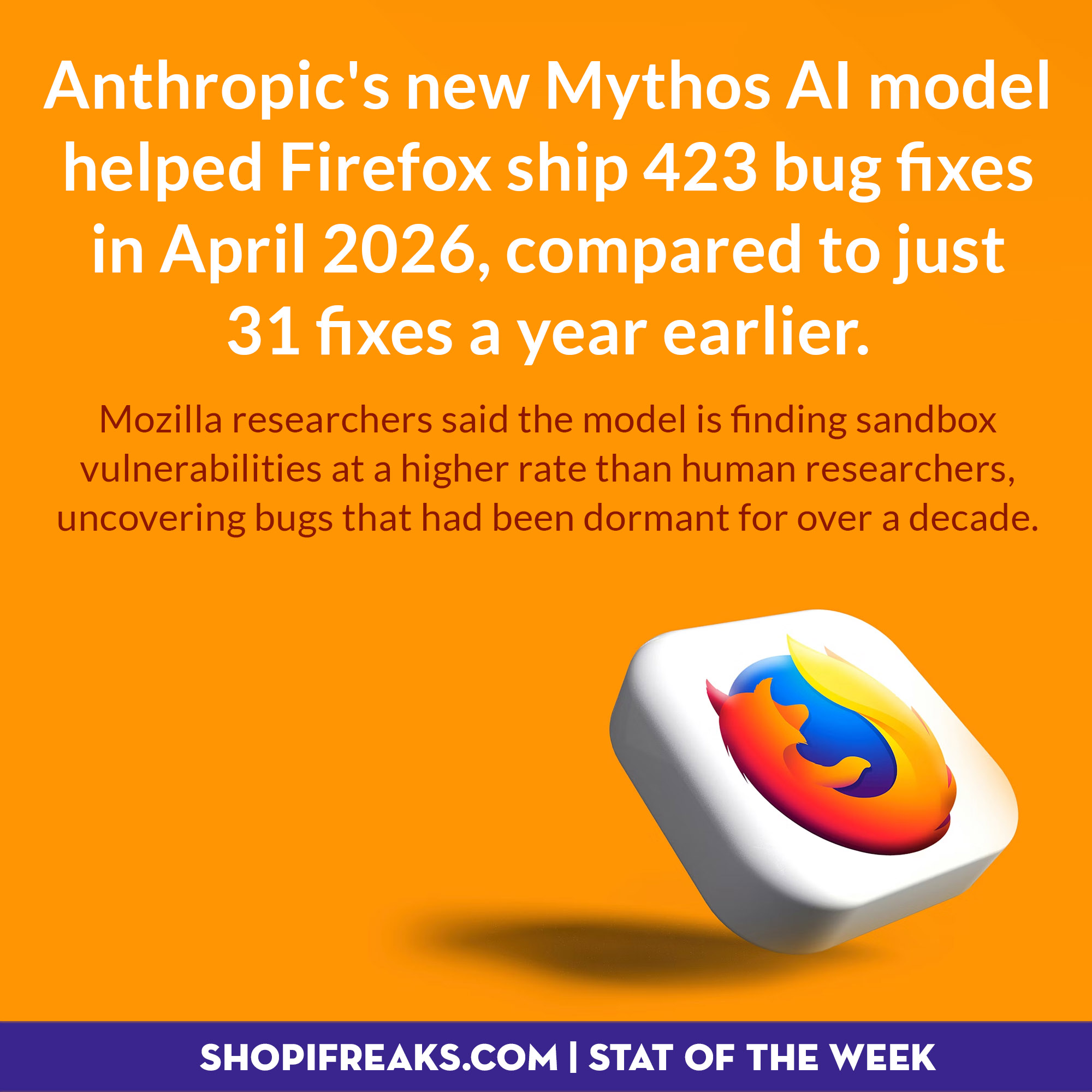
Anthropic’s new Mythos AI model helped Firefox ship 423 bug fixes in April 2026, compared to just 31 fixes a year earlier. Mozilla researchers said the model is finding sandbox vulnerabilities at a higher rate than human researchers, with Mythos uncovering some bugs that had been dormant in the code for over a decade.
1. WTO e-commerce tariff deadlock continues as Brazil holds firm
Last month I reported that the World Trade Organization’s 28-year global moratorium on e-commerce tariffs expired without renewal at the organization’s 14th ministerial conference in Yaoundé, Cameroon, after Brazil and Turkey blocked an extension.
Quick History: Back in 1998, when e-commerce was relatively new, WTO members agreed to a moratorium preventing any member nation from imposing customs duties on digital purchases like software downloads, music and movie streaming, e-books, and video games. The idea was to “temporarily” not tax the new digital economy while it was finding its footing. However, the moratorium ended up getting renewed every two years for almost three decades… until recently.
What changed? As digital commerce exploded, developing nations like India, Brazil, Indonesia, and South Africa began pushing back, arguing that the moratorium was costing them billions in foregone tariff revenue each year, while primarily benefiting U.S. and European tech giants, which is a fair argument to make. The 2024 renewal in Abu Dhabi was positioned to be the final extension on the “temporary” moratorium, with the expectation that the next meeting would produce a longer-term or permanent solution.
Last month: The U.S. was pushing for a permanent moratorium, obviously, as that would greatly benefit U.S. Big Tech, and most other countries were willing to accept a five-year extension. However, Brazil wanted a two-year maximum, and Turkey ended up siding with Brazil. The WTO requires full consensus between its 166-member body for any global deal, so ultimately the deal collapsed. The WTO planned to revisit the issue at an upcoming meeting in Geneva, but in the meantime, 23 countries including the U.S., U.K., Japan, and Mexico formed their own temporary agreement to keep digital trade tariff-free among themselves.
Last week: The WTO General Council met in Geneva to try and break the deadlock, but Brazil held firm in its opposition to a four-year extension, though Turkey finally dropped its objection. With full consensus still not reached, 19 countries including the U.S., Japan, South Korea, Singapore, Australia, Norway, and Argentina launched a plurilateral pact among themselves not to impose duties on electronic transmissions for an unspecified period, which took effect May 8. The agreement invited other countries to join the pact.
Sabina Ciofu, the international policy and strategy lead at techUK, said that the inability of the WTO to come to a consensus raises “serious questions” about “the organisation’s relevance.” John Denton, the International Chamber of Commerce Secretary General, said that “no one should pretend this is a substitute for a clear WTO-wide agreement,” adding that governments should use it as a bridge back to a full restoration of the multilateral moratorium.
My thoughts: Brazil is not being unreasonable. The country is losing real money. Brazil, India, Indonesia, and South Africa have been pointing out for years that the moratorium costs developing nations somewhere between $10-50B annually in foregone customs revenues, while the U.S. and EU don’t lose much because they’re mostly the ones producing the digital goods, not importing them. The 1998 moratorium was designed to be a temporary protection while the digital economy was in its infancy, but no one could argue today that the $5+ trillion digital economy has not reached a mature threshold.
U.S. Big Tech is by far the largest exporter of digital goods in the world, giving American companies like Microsoft, Apple, Google, Amazon, Netflix, and Meta a massive advantage under the moratorium by allowing them to sell digital goods tax-free in 166 countries. Brazil’s argument is essentially: why should developing countries subsidize U.S. tech while taxing their own homegrown solutions? Although I’m an American, I tend to agree with them.
I wouldn’t necessarily go as far as Sabina Ciofu in suggesting that the inability for the WTO to come to a full consensus calls its “relevance” into question. It just may be that the moratorium on digital tariffs is what’s no longer relevant. The digital economy is well past the “developing” stage, and I believe that sovereign countries should have the right to tax the imported digital goods that compete against their own domestic tech.
What are your thoughts? Hit reply and let me know or join the conversation on LinkedIn.
2. Amazon opens its global logistics network to all businesses
Amazon launched Amazon Supply Chain Services, a new service that opens its full portfolio of freight, distribution, fulfillment, and parcel shipping capabilities to all businesses, regardless of whether they sell on Amazon Marketplace. The move to tie together all of its supply-chain services in one place puts Amazon in direct competition with international transportation and warehousing giants like DSV, DHL Group, and Kuehne + Nagel International, and positions the company to take a chunk of the $1.3 trillion global market for third-party logistics services.
Peter Larsen, VP of Amazon Supply Chain Services, said:
“We first built this network over 20 years for ourselves. We then made it available to Amazon sellers. Now we’re making it available to any business of any shape or size. We think it’s a very large opportunity.”
What changed? Hasn’t Amazon offered supply chain services for a while now?
Yes, but previously, Amazon offered independently packaged services, allowing customers to hire the company specifically for e-commerce order fulfillment or shipping freight. Whereas now, Amazon is offering a fully unified service that lets businesses handle freight, warehousing, fulfillment, and last-mile delivery through a single contract and console, rather than juggling separate contracts and providers.
Additionally, Amazon is seeking to attract industries far beyond retail into its logistics ecosystem such as healthcare, automotive, and manufacturing. For example:
- Procter & Gamble is using Amazon’s freight network to ship raw materials to production facilities.
- 3M is moving products from manufacturing sites to distribution centers worldwide.
- Lands’ End is fulfilling orders on its own website and other non-Amazon marketplaces.
- American Eagle and Aerie are relying on its parcel service to handle last-mile delivery to customers.
Can Amazon be trusted with your operations data? Or will they eventually use it to compete against you?
Larsen says the company prohibits using data from its supply-chain customers to make decisions for its own marketplace and that the number of companies already using Amazon to fulfill online orders on rival marketplaces is proof of how much their customers trust them. Though I would imagine it’s hard not to pay attention when 30 crates of 3M double-sided tape get shipped through one of your planes.
What does the market think?
The markets reacted to the news with UPS and FedEx share prices dropping 10% and 9% respectively, plus double-digit declines for GXO Logistics and Forward Air, but maybe they overreacted, as Amazon has already offered many of these services for years now.
Though Amazon likely won’t take over the entire fragmented supply chain industry, the consolidated offering will bring fresh attention and investment to the space. I imagine we’ll see more consolidation across the supply chain in the coming years, as companies merge to create an end-to-end logistics and fulfillment network that can compete with what Amazon now offers under one roof.
3. OpenAI launches an Ads Manager, offers CPC bidding, & expands internationally
OpenAI expanded its ChatGPT ads platform with a new cost-per-click bidding option and a self-service Ads Manager in beta that allows advertisers to sign up and purchase ads directly.
The new Ads Manager allows businesses to register as advertisers, set budgets, bids, and pacing, launch and manage campaigns, and view performance in the portal. Previously, advertisers had to work directly with OpenAI’s sales team or go through agency partners like Dentsu, Omnicom, Publicis, or WPP to buy and manage ChatGPT ads, with limited reporting or insights available to advertisers.
OpenAI says it’ll be gradually opening Ads Manager to more businesses as it continues to test and refine the experience, but did not offer a specific timeline for a broad rollout. You can sign up for an account here.
Additionally, OpenAI added CPC bidding to its offering, whereas the company previously only offered ads on a CPM basis during the pilot. The company wrote in its announcement:
“That matters because many ChatGPT conversations are active and decision-oriented. People are often learning about a category, comparing options, or deciding what to do next. In those moments, a click can be a meaningful signal that an ad was relevant and helped someone move forward. Advertisers are only charged based on a click outcome.”
For the time being, OpenAI says it will continue to support both CPM and CPC bid types.
Two days after the Ads Manager and CPC news, OpenAI announced that it would expand its ChatGPT ads pilot to the UK, Mexico, Brazil, Japan, and South Korea in the coming weeks. Entonces, prepárate para anuncios en español pronto. Y también… konnichiwa!
4. Shopify launches ChatGPT and Claude connector apps and introduces native llms.txt files
Shopify is embracing AI on all fronts! The company announced new apps to connect to your favorite coding tool and quietly rolled out a native llms.txt file for merchants.
The new ChatGPT and Claude connector apps let merchants manage their entire store from within either AI assistant, including the ability to do things like look up orders, update product prices, and ask how new collections are selling. The launch follows last month’s release of the Shopify AI Toolkit, which lets developers manage a store through agents like Claude Code and Cursor, while these new connectors are designed for merchants working in ChatGPT or Claude on their phones.
Through the connector apps, merchants can perform tasks like uploading a product photo and asking the AI assistants to add the product to their store, requesting custom reporting on demand, or quickly applying discounts across a particular collection.
Really cool stuff, but I’m personally hesitant to connect either AI assistant to my live Shopify store yet. I’ll be testing the waters on a development store to begin with, which you should probably do too. Don’t say I didn’t warn you!
What about Sidekick? Is it getting kicked to the side?
Nah, it’ll stick around. Shopify President Harley Finkelstein wrote on LinkedIn that Shopify Sidekick is continuing as the company’s native AI agent, noting that “no agent out there understands commerce like Sidekick does.” At least for now, I guess.
In other Shopify AI news… the company has begun quietly rolling out native llms.txt files to stores without an official announcement yet, as spotted by Anton Ekström. The file, which is accessible at yourstore.com/llms.txt, includes store metadata like currency and contact details, direct links to product listings and search, agent instructions via dedicated endpoints, and UCP support and MCP endpoints for programmatic commerce. Funny enough, the file also contains a direct advertisement for Shopify and a call to action to create your own store! LOL, who are they advertising that to? The LLMs?
5. Meta is building an AI shopping tool in Instagram and an AI agent called “Hatch”
Meta is building a consumer version of the AI agent OpenClaw and a new agentic shopping tool, according to The Information sources. Meta tried to acquire OpenClaw earlier this year, but its creator, Peter Steinberger, ended up being acqui-hired by OpenAI instead, so this is apparently the company’s response.
The goal of the OpenClaw-inspired agent, which the company is internally calling “Hatch,” is to be able to perform a range of tasks for users such as ordering food on DoorDash, buying gifts on Etsy, scrolling Reddit, finding restaurants on Yelp, or managing e-mail in Outlook.
Meta has already built a “sandboxed” web environment where the agent can be tested on simulations of real websites, with the goal of doing live internal testing by the end of June. Meta also plans to integrate the agentic shopping tool into Instagram and is targeting a launch before Q4 this year, according to sources.
A kind of funny detail about this news story is that Hatch is currently being powered by Anthropic’s Claude Opus 4.6 and Claude Sonnet 4.6 models, instead of a Meta AI model, but the company plans to power the agent with Meta’s Muse Spark when it actually launches.
Last week Mark Zuckerberg said on an earnings call that Meta’s goal is “to deliver agents that can understand your goals and then work day and night to help you achieve them,” while noting that the company is increasing its capital spend on AI infrastructure this year to as much as $145B.
Alongside the agentic push, Meta officially announced that it will be changing its company name from “Meta” to “Agentic,” recognizing that the company completely botched the last rebrand. (j/k)
6. Google announces AI updates to Search, Shopping, and Ads ahead of Marketing Live
Google released a wave of AI-driven updates to Search, Shopping, and Ads last week ahead of its Marketing Live event on May 20, where the company is expected to announce even more. Recent updates include:
1) Google rolled out five changes to AI Mode and AI Overviews to make links more visible and clickable to users, including:
- Suggested angles at the end of AI responses linking to deeper articles
- “Subscribed” labels on links from a user’s news subscriptions
- Firsthand perspectives pulled from Reddit and social media with creator names attached
- Inline links placed directly next to relevant text in AI responses
- Hover previews on desktop that show the website title before clicking
The changes are a direct response to publisher complaints about AI Overviews killing referral traffic, with some studies finding click-through rate declines of up to 61% on pages affected.
2) Google announced three updates to AI Max, its AI-powered Search ads product:
- AI Max for Shopping campaigns – lets Google generate ad copy from Merchant Center feed attributes and run ads in AI Overviews and AI Mode
- AI Brief – a new feature that lets advertisers describe campaign preferences in natural language (e.g., “include pricing” or “do not show ads for queries that include ‘inexpensive'”)
- Text disclaimers – up to 90 characters of required legal language that appear in ads without affecting ad strength scores
AI Max has been the fastest-growing AI-powered Search ads product since launching last year, with Search campaigns using Smart Bidding Exploration seeing an average of 27% more unique converting users.
3) Google Merchant Center quietly rolled out a beta “Use AI to add products” feature.
The tool lets advertisers populate product listings by running a one-time AI scan of their website, bypassing the need to prepare a structured product feed before launching Shopping campaigns. The feature removes a major and often costly technical barrier for small and mid-sized merchants who haven’t built feed infrastructure, allowing them to onboard faster into Shopping ads, AI Mode shopping, and the Gemini shopping experience.
But, but, what about all that time and energy we spent cleaning up our product data feeds?!? Does that mean nothing to you Google?! 😂
4) Google announced three new AI-powered bidding and budgeting innovations:
- Journey-aware bidding – a beta feature for lead-gen campaigns that learns from both biddable and non-biddable conversion goals
- Smart Bidding Exploration expansion – coming to PMax and Shopping campaigns to capture more “long tail” queries
- Demand-led pacing – automatically follows consumer demand spikes in Search and Shopping budgets rather than spreading budget evenly across days
These updates build on Google’s broader push to automate the manual work of bidding and budgeting, with advertisers trading targeting control for AI-driven optimization. Like most ad networks, Google is moving towards the “black box” mentality of “just give us your money and we’ll handle the rest.”
7. Musk v. Altman trial continues with shocking testimony from Brockman, Murati, and Microsoft
Last week I reported that Elon Musk spent more than seven hours on the witness stand across three days during the first week in his federal lawsuit against OpenAI, which accuses CEO Sam Altman and President Greg Brockman of betraying the company’s original nonprofit mission when they converted it into a for-profit venture.
I shared some highlights from the trial which included Musk repeating throughout the trial that “it’s not OK to steal a charity,” but that he never had a written agreement with OpenAI about how his donation would be spent or if the organization could pivot into a for-profit in the future.
Since then, more witnesses have taken the stand and revealed shocking new information about OpenAI. Highlights include:
- OpenAI President Greg Brockman testified that the company is exploring an IPO and that his personal stake in the business will be worth nearly $30B, placing him among the 100 wealthiest people in the world. Brockman also revealed a $471M investment in Stripe, where he used to work, a stake in CoreWeave, and a financial interest in Sam Altman’s family office, which Musk’s attorneys used to suggest Brockman was financially motivated to side with Altman.
- Brockman also testified that during a key August 2017 meeting, Elon Musk demanded full control of the company’s planned for-profit conversion, and that when the co-founders refused to give Musk unequivocal control, he said, “I decline,” and stormed out of the room.
- Lastly, Brockman admitted that OpenAI expects to burn $50B on computing power before the end of the year. They better start selling some ads!
- OpenAI’s former CTO Mira Murati testified in a video deposition that Sam Altman lied to her about the safety standards for a new AI model, falsely telling her that OpenAI’s legal department had determined a new AI model did not need to go through the company’s deployment safety board. However, when she checked with general counsel Jason Kwon, she “confirmed that what Jason was saying and what Sam was saying were not the same thing.” Murati said that Altman made her work more difficult.
- Other former OpenAI employees and a former board member also testified that the company’s push to launch AI products compromised its commitment to safety. Former board member Tasha McCauley shared that Altman was not forthcoming enough with the board and demonstrated a pattern of misleading board members and failing to inform them about the decision to launch ChatGPT publicly.
- Emails between more than a dozen Microsoft executives, including CEO Satya Nadella, were shown in court revealing that Microsoft was skeptical of investing in OpenAI in 2018 but worried about pushing the lab into Amazon’s arms if they didn’t. The emails showed that Microsoft’s AI team saw “no value in engaging” with OpenAI, the research team thought its own work was “more advanced,” and the PR team didn’t like supporting a group pushing the idea of “machines beating humans.” However, ultimately the company invested $1B in OpenAI in 2019 to avoid the PR downsides of “having them storm off to Amazon in a huff and shit-talk us and Azure on the way out.” WTF Microsoft? Can I have $1B to avoid the PR downsides of me shit-talking you?
Ooo Weee this case is getting juicy! Stay tuned for more. Next week it may be revealed that Sam Altman and Elon Musk were lovers and that the romance ended bitterly, which is what spurred the breakup. Or was that the story of how Anthropic got started? I cover a lot of news and can’t remember.
8. CEOs confidently declare what the rest of us already knew
CEOs across retail, restaurants, and packaged goods have stepped out of their ivory towers to affirmatively declare that consumers are “running out of money” and cutting back on discretionary spending, as gas prices hit $4.56/gal on average, the highest levels since July 2022.
- Kraft Heinz CEO Steve Cahillane said consumers are “literally running out of money at the end of the month,” with negative cash flows in lower-income brackets where shoppers are dipping into savings.
- Whirlpool CEO Marc Bitzer said “the war in Iran amplified consumer concerns about the cost of living” and described a 15% hit to industry demand as similar to the global financial crisis.
- McDonald’s CEO Chris Kempczinski took a break from consuming his product to say that confidence among shoppers is worsening, citing “heightened anxiety” and gas prices that disproportionately impact low-income households.
- Dine Brands CEO John Peyton blamed lower visits at Applebee’s and IHOP on “price-sensitive, more value-oriented guests” who “seem to be staying home a bit more.”
- Planet Fitness CEO Colleen Keating forgot to wipe down her machine before saying, “the consumer and economic backdrop have shifted,” noting that the gym paused the national rollout of a price increase to its top-tier membership.
- Comerica Bank chief economist Bill Adams noted that “in the near term, Americans can draw down savings or tap credit cards, but the longer gas prices stay high, the more consumers will change their spending patterns to balance their budgets.”
Bloomberg reports that the average American’s savings rate dropped in March to the lowest in three years, and that low-income consumers have already cut back on gasoline consumption and discretionary spending. So if your sales drop a little this summer over last year, that might be one reason why. Americans have officially run out of stimulus money.
9. Other e-commerce news of interest
A crowdfunding effort to buy and revive Spirit Airlines is picking up steam, with more than 371k travelers pledging more than $337M to acquire the now-defunct airline. Hunter Peterson, a content creator who started the letsbuyspiritair.com website, said that “this started as a joke and this is rapidly going out of control in the best possible way,” and is now seeking developers, public relations professionals, aviation lawyers, and airline executives to help advance the plan. The effort is unlikely to succeed because Spirit is already going through formal liquidation and its assets will be allocated by the bankruptcy court, but as an avid traveler, I support the campaign entirely and made a pledge myself. Though it probably won’t lead to the purchase of Spirit, perhaps the campaign will kickstart the launch of a new homegrown traveler-led airline. Let’s start with one plane and one route and see where it goes! btw, despite the rumors, Elon Musk is NOT swooping in to buy the airline and change its name to SpiritX.
Klaviyo expanded its integration with Anthropic to bring new agentic marketing workflows to Claude’s products, allowing marketers to ask Claude to generate performance summaries, identify customer segments, analyze marketing flows, or propose new campaigns using natural language without having to export data or rebuild dashboards. The updated Klaviyo MCP Connector lets marketers describe an outcome in Claude Cowork like “audit my flows,” “build weekly reports,” or “draft re-engagement campaigns,” with Claude pulling Klaviyo data, generating copy, and saving formatted files to the right folders in a single session. Klaviyo co-founder and co-CEO Andrew Bialecki said that “marketing teams are drowning in reporting and repetitive production work” and that the integration turns Claude into “an agentic surface for Klaviyo.”
AWS launched Amazon Bedrock AgentCore payments in preview, a new set of features that lets AI agents instantly access and pay for what they use, including web content, APIs, MCP servers, and other agents. For example, an AI agent could pay for paywalled articles while doing research, buy access to a tool it needs to complete a coding task, or book a flight or hotel on behalf of a user. The capabilities were built in partnership with Coinbase and Stripe, who provide the wallet infrastructure and payment rails, with developers able to choose between a Coinbase wallet or a Stripe Privy wallet. The first use case enabled in preview is micropayments using the x402 protocol, an open HTTP-native payment standard for instant stablecoin transactions, with end users able to fund wallets using a debit card and set spending limits per session.
DoorDash launched a new set of AI tools that speeds up the onboarding process for new merchants by automatically pulling photos, store hours, and menu items from their website, as well as a feature that lets merchants spin up a website based on existing DoorDash content. The platform also added photo-editing tools including AI Retouch, which replaces backgrounds, sharpens images, and optimizes lighting, and AI Replate, which manipulates dish photos to look professionally plated. Lastly, DoorDash revamped its video library, now letting merchants tag dishes in videos so that customers can order them directly.
Amazon Business is bringing same-day delivery of fresh, perishable groceries to business customers in more than 2,300 U.S. cities and towns, allowing organizations to add items like fresh produce, dairy, meat and seafood, baked goods, frozen foods, and pantry staples to their existing Amazon Business orders. If you thought that staff stealing office supplies was costly, wait until they can purchase their household groceries on your dime! LOL. Business Prime members get free same-day delivery on grocery orders over $25 in most areas, with a $2.99 fee for orders below the minimum, while customers without a Prime membership pay a $12.99 fee regardless of order size, and orders are delivered within set delivery windows businesses choose at checkout. The move puts Amazon Business in more direct competition with Costco, Walmart, and Instacart, which all already offer B2B grocery delivery.
Etsy launched a beta version of a shopping app in ChatGPT that allows users to search and compare products on its marketplace within the chatbot and then complete purchases on Etsy. For example, a user can write, “@Etsy help me find a Mother’s Day gift under $200 for a Jewish mom with red hair and glasses who loves to write stories,” and the Etsy app will provide relevant listings that the user can browse from within the chat or click into to go to Etsy and learn more. The launch follows Etsy’s previous integration with ChatGPT’s Instant Checkout feature, which launched in September 2025 with Etsy as the first partner, but was later shut down in March 2026 because OpenAI didn’t know the first thing about e-commerce. Etsy is also beta testing a conversational Gifting Assistant on its own website, powered by OpenAI, which offers a guided, conversational way to discover items on its platform.
Prime Video launched Clips, a scrollable TikTok-esque short-form video feed that lets users browse snippets of movies and shows within the app. The feature first launched with NBA highlights during the 2025-26 season and has now expanded to include moments from movies and series across the platform, with users able to click over to watch, rent, or buy the full title, save it to a watchlist, or share the clip with friends. Meh, I already get enough spoilers for The Boys on TikTok. If I’m on Prime Video, I’ll just watch the full episode. Prime Video joins Netflix, Disney+, Peacock, and Tubi in adding a vertical video feed to their streaming apps, with Netflix’s feature also called “Clips.”
Google will no longer support FAQ rich results as of May 7, 2026, and users will no longer see them within search results moving forward. Additionally, Google Search Console will no longer report on FAQ structured data starting in June. Google provided no reason for the change, but noted that webmasters are welcome to leave their current FAQ structured data on their websites, as other search engines may still use it. However, my guess is that 1) people started abusing the schema type so much after it was introduced in 2019 that it became worthless, and 2) Google is moving away from displaying your word-for-word answers to questions in favor of regurgitating your answers with its AI. Most AI Overview answers now contain answers that consolidate information from multiple sources, making the rich snippet an archaic form of answering questions.
Qualcomm CEO Cristiano Amon told Fortune that the company is working with “pretty much all” of the major AI companies, including OpenAI and Meta, on top-secret hardware devices designed to replace the smartphone. Amon described future devices as “things you wear” like glasses, jewelry, pins, and pendants, all designed to center digital life around an autonomous AI agent rather than a phone, calling this concept the “ecosystem of you.” Oh man, the makers of the Humane pin are going to be so pissed! Seriously though, for the foreseeable future, all these devices are going to do is complement your smartphone, not replace it. Any conversation about “replacing your smartphone” that happens in the next 5-10 years is strictly from hype men pushing their next “game changing” device. Smartphones sold themselves because they’re amazing and genuinely useful — no hype needed. As a general rule of thumb, if it needs to be hyped, it’s not a smartphone killer.
A group of Democratic senators led by Elizabeth Warren and Richard Blumenthal are probing Experian, Equifax, and TransUnion about how they incorporate data from BNPL loans into consumer credit reports. The senators asked the agencies to detail how they treat BNPL loans versus longer-term installment products, how they handle purchases involving returns, and their standards for reporting multiple loans with the same lender. Many BNPL companies have resisted reporting to the bureaus, claiming the information would be harmful to consumer credit scores. However, a recent study by FICO of loans issued by Affirm showed that the opposite was true. The senators wrote in their letter that “the credit reporting industry has been very secretive about its scoring models, which presents major, potential consumer protection issues.” Next they should look into how the cost of BNPL is being subsidized by the rest of us non-BNPL using consumers, which is contributing to the rising cost of goods!
Canada just got its first CAD-backed stablecoin issued by a regulated financial institution and approved by the Alberta Treasury Board and Finance. The new CADD stablecoin, which was launched by Tetra Trust Company, is live on Base, Ethereum, and Tempo and is backed by Shopify, Wealthsimple, Urbana, which holds a majority stake, and several other major institutions and fintechs. Tetra positioned CADD for institutional use cases including 24/7 cross-border settlement, real-time corporate treasury transfers, programmable marketplace payouts, and direct fintech-to-fintech settlement without the delays of moving money across legacy rails dependent on batch infrastructure first deployed in the 1980s. So rather than update those “legacy” rails, Canada has officially hopped on the stablecoin bandwagon, which is one of the dumbest bandwagons to hit the financial system since NFTs. Bless their Canadian hearts.
A U.S.-flagged ship called the Alliance Fairfax, operated by a Maersk subsidiary, transited the Strait of Hormuz last Monday under U.S. military protection, with U.S. forces shooting down cruise missiles and drones and destroying six Iranian speedboats that threatened the vessel. The ship became one of only several hundred to have crossed the strait during the past month since the U.S. began its blockade, which is about how many used to cross the strait daily before the war. There are currently more than 1,600 ships stranded with roughly 20,000 seafarers on board, with most ships unwilling to pass due to the risks of making an attempt. So is this what winning looks like?
Google rebranded its Fitbit app as Google Health and launched a new AI health coach as a subscription service, which uses Gemini AI to serve as a combination fitness coach, sleep expert, and health and wellness advisor. Alongside the rebrand, the company launched the Fitbit Air, a new screenless tracker bracelet that offers up to a week of battery life and includes 24/7 heart rate tracking, heart rhythm monitoring with AFib alerts, sleep tracking, and automatic workout detection. The device is available for pre-order starting at $99.99 and includes a three-month trial of Google Health Premium. The Google Health app will be globally available on May 19 as part of a Google Health Premium subscription (previously Fitbit Premium), costing $9.99 per month or $99 per year, with the coach accessible to select Fitbit and Pixel Watch users first, while Google AI Pro and Ultra subscribers will have access to Google Health Premium at no extra cost.
In lawsuits this week…
- An award-winning Canadian fiddler named Ashley MacIsaac filed a civil claim against Google seeking $1.5M in damages after its AI Overview falsely identified him as a convicted sex offender, which resulted in one of his concerts being canceled by a promoter. I guess Google’s AI confused “fiddler” with “diddler.” The suit argues that “Google should not have lesser liability because the defamatory statements were published by software that Google created and controls.”
- Elon Musk agreed to pay a $1.5M civil penalty to settle a U.S. Securities and Exchange Commission lawsuit accusing him of failing to properly disclose stock he was amassing in Twitter ahead of his $44B acquisition of the company in 2022 — a penalty he probably audibly laughed at behind closed doors. The SEC sued Musk in January 2025, alleging that his undisclosed stock purchases cost other Twitter shareholders at least $150M because they sold shares at lower prices without knowing Musk was amassing shares in the company.
- Perplexity is pushing federal appellate judges to reverse an order banning its AI browser, Comet, from accessing Amazon. The ban was handed down by a judge in March, who ruled that Amazon provided “strong evidence” that Perplexity was accessing users’ password-protected accounts without Amazon’s permission, claims that Perplexity says are “fundamentally misfit” for the federal anti-hacking law Amazon is accusing it of violating. For more details on the case, read my previous coverage of Amazon’s lawsuit filing in November, its temporary federal injunction win in March, and the subsequent suspension of that order.
- Meta asked a Los Angeles judge to throw out a jury’s $4.2M verdict that found the company liable for a woman’s depression in a landmark trial over whether Meta and Google’s platforms harmed young users with their addictive design. In its filing, Meta argued that Section 230 of the Communications Decency Act shields it from the claims and that evidence presented at trial tied the plaintiff’s mental health challenges to the content she viewed rather than to design features like autoplay and infinite scroll. Google said it also plans to appeal, and has asked the court to either set aside the $1.8M verdict against it or order a new trial.
- Trivago, a German-based online travel platform majority-owned by Expedia Group that lets users compare prices across hundreds of booking sites, filed an antitrust lawsuit against Google for allegedly engaging in anticompetitive conduct for more than a decade by unfairly promoting its own hotel metasearch offering. The company is seeking financial compensation covering the period from Jan 2014 through December 2025, as well as asking the court to order the disclosure of traffic and revenue data that it says is controlled by Google and relevant to the case, plus a declaratory judgment that would establish Google’s liability for potential damages beginning in January 2026 and thereafter.
In layoffs (and not layoffs) this week…
- Shopify laid off at least 30 people in April as part of a reorganization of its operations team, affecting staff in Canada and the U.S. working in operations and customer support, according to multiple sources who spoke to The Logic. Ben McConaghy, Shopify’s director of communications, told The Logic the changes will “sharpen focus on our highest priorities” and give teams “clearer ownership, more consistency,” following CEO Tobi Lütke’s directive last year that “reflexive AI usage is now a baseline expectation” at the firm.
- Meanwhile, Affirm CEO Max Levchin told analysts on the company’s most recent earnings call that the BNPL firm is “not planning AI-related layoffs, full stop,” even though it was regularly using the technology for software engineering. Does reporting on a company NOT making AI-related layoffs mean that the new norm has become the opposite, and going against the norm is newsworthy?
In corporate shakeups this week…
- OpenAI lost two more senior staffers last week including its head of private equity, Paul Zimmerman, who was hired by Google to lead its efforts to sell AI to private equity firms, and James Dyett, the company’s head of sales, who is leaving to work for Thrive Capital, a major OpenAI backer.
- The Trade Desk Chief Strategy Officer Samantha Jacobson is leaving the company to join OpenAI as VP of partnerships (Monetization), where she’ll lead OpenAI’s advertising, distribution, and platform partnerships, the latest in a series of high-profile exits at The Trade Desk.
- Chewy named Yunyan Wang, a 12-year Amazon veteran who most recently served as VP of Commerce & Supply Chain Services, as its new CTO.
- XRP Evernorth, the Ripple-backed treasury company prepping a Nasdaq listing, named OpenAI Foundation CFO Robert Kaiden and Antalpha COO Derar Islim as independent directors, giving the company a mix of AI finance leadership and crypto infrastructure expertise ahead of its public market debut.
- Fast Simon, a platform-agnostic e-commerce search and discovery provider, named Shaun Lin as director of partnerships, tasking him with expanding the company’s agency and technology partner network across the U.S. and Australia.
Amazon is officially allowing all corporate employees to use Claude Code and OpenAI Codex in addition to its in-house Kiro tool, following internal complaints over the company’s previous restriction on external coding tools. Both tools will run on Amazon Bedrock and be managed through AWS, which keeps usage within its own cloud environment and maintains tighter control over data security and compliance, according to a note to staff viewed by Business Insider. An Amazon spokesperson said that 83% of internal teams are still primarily using Kiro, but hey, give them time to adapt their workflow to Claude and I’m sure that’ll change.
Snap’s $400M deal with Perplexity to integrate the company’s AI search engine directly into Snapchat is dead, with the two companies having “amicably” ended the relationship in Q1, according to Snap’s latest earnings report. The partnership was first announced last November, with Snap expecting to start seeing revenue in early 2026. However, the feature never made it past early testing because the two sides had “yet to mutually agree on a path to a broader roll out.” Remember back when Perplexity news was exciting and an “alternative AI search” was novel? Flash forward a few years since its launch, and I predict that Perplexity will be the first heavily-funded AI firm to fall in the near future, or at best get acquired for a fraction of its all-time high valuation.
Google shut down Project Mariner, an experimental agent first revealed in December 2024 that was designed to perform tasks across the web on a user’s behalf. The Project Mariner landing page now states that the project was shut down on May 4, 2026 and “its technology voyaged to other Google products,” including Gemini Agent, which can archive emails or book hotels, and AI Mode, Google’s AI-powered search feature. Earlier this year, Google also launched an “auto-browse” feature in Chrome that can perform multi-step tasks like researching flight costs, a response to agentic web browsing tools offered by OpenAI, Perplexity, and OpenClaw.
OpenAI was found by the Privacy Commissioner of Canada to be “not compliant with” Canadian federal and provincial privacy laws in the training of its AI models. The investigation identified multiple issues including that OpenAI “gathered vast amounts of personal information without adequate safeguards,” failed to acquire consent to collect and use that information, and did not give ChatGPT users a way to access, correct, or delete data that was used in training. The company has agreed to make multiple changes to comply with Canadian privacy laws, including retiring earlier non-compliant models, deploying a filtering tool to detect and mask personal information in training datasets, and adding new notices to the signed-out version of ChatGPT within the next three to six months. Wow, what a penalty!
Revolut, the UK-based fintech with more than 1M customers in Australia, shut down its PayTo service in Australia following an “unexplained incident,” according to a report from PayDay News, with regulators and Revolut’s banking partners all declining to say what happened. PayTo, which lets Australian users authorize and manage recurring payments like subscriptions and bill payments in real time, had only been live on Revolut for about two months before getting shut down. The move follows a $187,800 AUD fine from AUSTRAC in September 2025 for late anti-money laundering reporting, and broader fraud concerns at Revolut, which topped UK fraud complaints in 2023 with nearly 10,000 reports.
Amazon launched the UK’s first retailer drone delivery service in Darlington, County Durham, with the MK30 drone delivering packages under 5 lbs within a 7.5-mile radius of Amazon’s fulfillment center. The service can carry out a maximum of ten flights an hour or up to 100 deliveries a day on weekdays, with eligible customers needing a garden or yard to receive deliveries dropped from a height of 12 feet. Current UK delivery time is two hours, compared to a 36-minute average in the US, where Amazon already operates drone deliveries in five states. Darlington was chosen because it has a mix of residential areas, major roads, and an airport all close to each other, according to the company.
🏆 This week’s most ridiculous story… Christian Smalls, the former Amazon warehouse worker who in 2022 led a successful effort to unionize a warehouse on Staten Island, was arrested at the Met Gala after jumping a police barricade carrying a protest sign that called out Amazon for refusing to negotiate with its Staten Island warehouse union and accused the company of “investing in genocide” in Israel. Smalls said in a phone interview that he had hoped to “shine a bright light on Jeff Bezos,” one of the event’s sponsors, and on Amazon’s unethical business practices. He then spent 24 hours in custody before accepting an offer from prosecutors to consider dismissing the charges if he is not arrested again for six months. Is there a Kalshi or Polymarket bet on whether he is arrested again during the next six months? If so, I’d put money on “yes.” That man is going to end up in prison while Jeff Bezos flies around in a spaceship. The Amazon Labor Union, which Smalls once led but left in 2024 amid internal divisions, disavowed his actions, saying that it doesn’t condone “lone-wolf direct actions which aim to center one individual as the focus of what must be a collective struggle.”
10. Seed rounds, IPOs, & acquisitions
ReFiBuy, an agentic commerce optimization startup founded by ChannelAdvisor alumni including CEO Scot Wingo, raised $13.6M in an oversubscribed seed round led by New Road Capital Partners, including participation from Ridge Ventures, Silicon Road Ventures, and Commerce Ventures. The company will use the funds to accelerate product development, expand go-to-market efforts, and continue defining the agentic commerce optimization category as AI shopping changes how consumers research, find, and buy products. Wingo wrote in the company’s announcement that all four early-stage RetailTech/EcommTech investors have now invested in ReFiBuy, which he believes is a first.
Sierra, the AI customer service agent startup co-founded by OpenAI chair Bret Taylor and former Google executive Clay Bavor, raised $950M in a Series E round led by Tiger Global and Google’s GV at a $15.8B valuation, up from $10B in the fall. The round comes as the company topped $150M in annual recurring revenue with customers including Prudential, Cigna, Blue Cross Blue Shield, Rocket Mortgage, and more than 40% of the Fortune 50. Taylor told CNBC that “there’s just a lot of competition” in the customer service AI space and the company is “trying to invest aggressively so that we can continue to expand our lead,” with Taylor estimating that $400B is spent annually on customer service and a bulk of that moving to AI agents.
OpenAI raised more than $4B for a new joint venture called The Deployment Company, which is focused on helping businesses leverage its AI software, from investors including TPG, Brookfield Asset Management, Advent, and Bain Capital at a $10B valuation. Within minutes of the news breaking, Anthropic announced its own similar joint venture partnering with Blackstone, Hellman & Friedman, Goldman Sachs, Apollo Global Management, General Atlantic, Leonard Green & Partners, GIC, and Sequoia Capital. The goal of both ventures is to accelerate the adoption of AI across enterprise companies, with investment partners collectively having access to thousands of portfolio companies and clients.
Worldly, a sustainability and supply chain intelligence platform that helps retailers and manufacturers turn data into insights on environmental and social performance, acquired Bendi Software, a UK-based supply chain mapping and supplier risk intelligence company, for an undisclosed amount. Bendi’s technology will be integrated across the Worldly platform over the coming months, with customers gaining access to deep-tier supplier visibility, continuously updated supplier risk scoring, and AI-powered assessment automation, which are capabilities that Worldly says have required brands to assemble multiple vendors in the past. The deal coincides with a wave of regulation requiring large companies to conduct due diligence across their value chains, such as the EU’s Corporate Sustainability Due Diligence Directive, which requires companies to identify and address human rights and environmental impacts across their supply chains and goes into effect July 2029.
Astrocade, a San Francisco-based AI gaming startup that lets users create games using natural language prompts, raised a combined $56M in a Series A round led by Sea and a Series B led by Sequoia Capital. Eight months after its launch, the platform has 5M monthly active users, clocks more than 140M game plays each month, and hosts more than 75k games built by creators from 80 countries. The company claims that its top creators are making thousands of dollars a month through their games and that its user base skews unexpectedly toward women aged 20 to 40, rather than the traditional young male gaming demographic.
Vori, an AI grocery startup that processes payments, tracks inventory, reads supplier invoices, adjusts shelf prices, and creates purchase orders for independent grocery stores, raised $22M in a Series B round led by Cherryrock Capital, bringing its total amount raised to $32M. The company, which calls itself the “self-driving operating system for supermarkets,” is pitching its platform to the 45k supermarkets in the U.S. that collectively compete against Walmart and Amazon, which hold a 25% share in the market. Payments account for roughly 70% of the company’s revenue, which the company says helps keep its software and hardware costs lower for grocery stores — ie: the Shopify model.
a16z crypto, the digital assets arm of venture capital firm Andreessen Horowitz, raised $2.2B for its fifth venture fund, bringing its total amount raised across five funds to $9.8B. The company says it plans to back “the part of the cycle that gets less attention and produces more of the lasting value: turning new infrastructure into products people use every day” such as stablecoin payments, on-chain lending, prediction markets, and tokenized assets. a16z crypto has previously made bets on crypto startups including crypto custodian Anchorage Digital, decentralized exchange Uniswap, and prediction market Kalshi.
Nova Intelligence, a San Francisco-based startup that builds an agentic AI platform for SAP to analyze, modernize, and generate the custom code that runs payroll, supply chains, and finance functions inside Fortune 500 environments, raised $31.5M in a Series A round led by Chemistry, bringing its total amount raised to more than $40M. The timing capitalizes on SAP’s mandatory deadline for customers to migrate from legacy systems to its modern S/4HANA platform by 2030, which is estimated to be an $89B market opportunity when implementation, upgrades, and ongoing support are included. An April 2025 case study with Kyndryl showed Nova’s system led to a 75% reduction in manual effort and a 50% cost reduction in modernizing a company’s SAP platform.
ZyG, a Tel Aviv-based startup building an AI platform that helps D2C brands scale, raised $60M in a Series A round led by Accel. The company, which describes itself as an “agentic operating system for e-commerce scale,” automates business functions like campaign creation and optimization, customer retention, support, and inventory forecasting, primarily serving businesses doing between $2M and $15M in annual revenue. ZyG was built by the founders of ironSource, a mobile advertising and monetization platform that went public on the NYSE at an $11B valuation and later merged with Unity in 2022.
Payward Inc., the parent company of crypto exchange Kraken, agreed to acquire Reap Technologies, a Hong Kong-based stablecoin payments provider, for $600M in cash and stock, marking the company’s largest acquisition to date. Reap operates as a cross-border payments provider that uses stablecoins to facilitate international business transactions, with infrastructure specifically designed for Asian markets. The deal follows Payward’s $550M acquisition of Bitnomial, a Chicago-based derivatives exchange, in April.
Saltbox, an Atlanta-based startup that builds operations hubs for retail businesses by combining flexible warehouse space, logistics infrastructure, co-working amenities, and on-site operational support, raised an undisclosed amount in a Series C round led by Packard Capital. The company will use the funds to continue expanding its national footprint including opening a third Atlanta-area location and a new Chicago location, invest in logistics infrastructure, and grow its operational support services. Saltbox currently operates twelve facilities across eight U.S. markets.
Zepto, an Indian quick-commerce startup that delivers groceries and everyday essentials within 10 minutes through a network of dark stores, received approval from the Securities and Exchange Board of India for its long-awaited IPO, which is expected to raise between $800M and $1B. The company is targeting a public listing during Q3, which would make it one of the youngest venture-backed Indian startups to hit the public markets, just four years after its launch. Zepto most recently raised $450M at a $7B valuation this past October.
SoftBank Group downsized its plans for a $10B margin loan backed by its OpenAI stake after facing pushback from some creditors over OpenAI’s valuation. The Japanese conglomerate is now targeting a loan as low as $6B, according to Bloomberg sources. The move comes after OpenAI fell short of several monthly sales targets earlier in 2026 as rival Anthropic gained ground in the coding and enterprise markets, and after the company missed an internal goal of reaching 1B weekly active users for ChatGPT by the end of last year. SoftBank’s shares have surged 39% this year even as the cost of insuring its debt against credit risks has risen.
Thanks for being a Shopifreak!
If you found this newsletter valuable, please leave a review on Google and share the newsletter with your friends and colleagues to help us grow.
See you next Monday,
PAUL
Paul E. Drecksler
🌐 Shopifreaks.com
🧑💼 Add me on LinkedIn
📧 [email protected]
📱 +1-828-273-3031
⭐ Leave A Review
PS: I was addicted to soap once… Now I’m clean.