
Hi Shopifreaks
I’d like to give a quick shoutout to my sponsors before we get started, including Go Fish Digital, Doola, TaxCloud, Cloudways, Napster, and Seguno, as well as the companies that have participated in my new 90 Second Pitch series. Your financial support helps cover the time and costs of running this newsletter, which include thousands of dollars in annual subscriptions to premium news publications, support staff, website hosting, software, and growth expenses. (Who knew a simple newsletter could be so expensive to operate!)
A lot of folks don’t know this, but each edition personally takes me over 20 hours per week to put together, not including general time that I spend engaging with members of the industry each day in order to best serve you with the most important e-commerce news each week.
The curation, follow-up research, fact-checking, writing, and editing involved with each edition is no easy task — and there’s no getting ahead. It’s not like I can pre-write the next 10 editions and publish them on autopilot! I work on them in real-time each week, and I’m proud to say that in the 5+ years since I started Shopifreaks, I’ve never missed an edition.
Thank you to everyone reading this for your support with the newsletter and for validating my work with your readership. If you get value from this newsletter, I’d certainly appreciate if you could write a Google Review.
In this week’s edition I cover:
- Anthropic’s risky ad payoff
- Google’s first entry into agentic commerce
- TikTok’s new Local feed
- OpenAI’s struggle with e-commerce basics
- The UK’s new BNPL rules
- Amazon’s AI content marketplace
- Ring’s Super Bowl commercial backlash
- Scott Galloway’s economic strike
- FedEx’s retreat from general e-commerce
- AI hallucinating investor reports
All this and more in this week’s 265th Edition of Shopifreaks. Thanks for subscribing and sharing!
Stat of the Week
Anthropic saw its daily active users grow by 11% after its Super Bowl ad, which threw shade at OpenAI’s choice to put advertisements in ChatGPT. Following game day, the Claude app entered into the top 10 free apps on the Apple App store, surpassing OpenAI’s ChatGPT, Google Gemini, and Meta AI for the first time.

1. Google launches agentic commerce features with Etsy and Wayfair
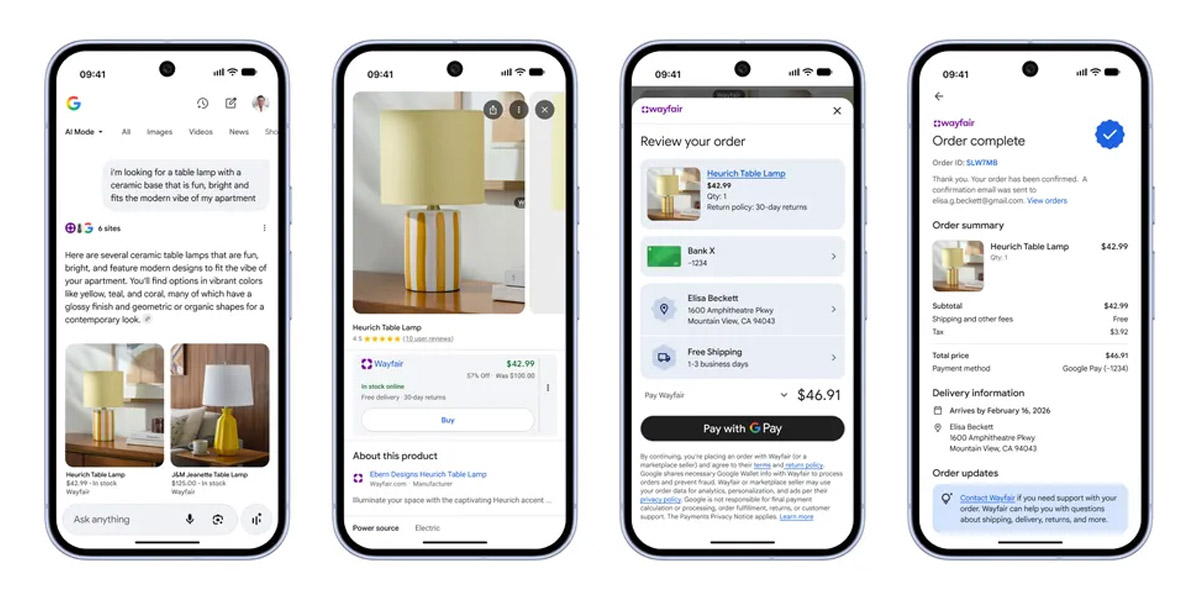
Google rolled out agentic commerce features that allow US shoppers to purchase items from Etsy and Wayfair directly within AI Mode in Search and the Gemini app, with Shopify, Walmart, and Target coming soon. Basically it’s Google’s answer to OpenAI’s Instant Checkout, which launched in October.
To power the transactions, Google is utilizing its Universal Commerce Protocol, an open-source standard for agentic commerce it developed in partnership with Shopify and major retailers that launched last month.
Here’s how it works:
- Shopper searches for an item on Google.
- If an Etsy or Wayfair listing surfaces in results, it may include a “Buy” button beneath the price.
- Clicking the Buy button reveals a popup that displays the item, shipping address, shipping rate, total price, and a Pay with Google Pay button.
- The shopper can then complete the purchase without ever visiting Etsy or Wayfair’s site.
Brodie Clark, an independent SEO consultant, notes that the Buy button only triggers if you are signed into your Google account and that it already has your Google-linked payment method queued up in the experience. He wrote:
“Unlike ChatGPT’s Instant Checkout feature, because you’re already signed in to your Google account to see the feature, it is highly likely that your card is already attached to your Google Pay account. This means you can essentially pay for the product in only one click – compared to ChatGPT, which likely involves more clicks.”
Remember when Google offered a “Buy On Google” button?
Google initially launched the program, which was originally called Buy on Google and later renamed to Purchases on Google, in 2015 on mobile shopping ads in the US. It allowed shoppers to tap a “Buy on Google” button on a shopping ad and complete checkout inside Google without ever visiting the merchant’s website. So like, basically what it’s doing with Etsy and Wayfair through UCP.
Google abandoned the concept a few years later in July 2023, ironically just eight months after ChatGPT made its public debut, due to low user adoption, limited merchant usage, and because it wasn’t as profitable as its product advertising endeavors.
Was Buy with Google ahead of its time? Or is the industry repeating history?
Are consumers ready to purchase an $800 leather sofa from Wayfair without even clicking on the listing?
As for merchants, they didn’t seem ready to put Google or any other product discovery layer in between them and their customers a few short years ago. Are they ready now?
Do merchants actually want this, or is agentic hype creating FOMO in the market?
Will NOT participating in agentic commerce become a deliberate choice by some premium brands to differentiate themselves?
Still lots of unanswered questions.
2. TikTok launches a dedicated Local feed in the US
TikTok introduced “Local Feeds” in the US, a feature that helps users discover nearby content, businesses, and services using their precise location. The featured first launched in the UK, Italy, and Germany this past December under the name “Nearby Feed.”
TikTok wrote in its announcement:
“The Local Feed makes it easier to live like a local. Whether you’re rediscovering your own neighborhood or in a new city for the first time, it’s now even easier to get the inside scoop on must-try restaurants, shops, museums, and events from creators on TikTok.”
The feed appears in a new dedicated Local Tab, which displays posts based on a user’s location and interests, and when the content was posted. TikTok didn’t say specifically that it prioritizes newer content, but I can imagine that the freshness of a post will play a role in whether it surfaces in the Local tab, as no one wants to discover an event that’s already taken place or a coffee shop that’s already gone out of business.
Remember when everyone freaked out a few weeks ago after the TikTok US transition because the app updated its privacy policy to allow for the collection of your precise location? Well, this is what that update was all about.
Honestly I think TikTok Local is going to be a gamechanger for small businesses, which have lacked an impactful organic way to reach people in their own communities for over a decade.
A long time ago, Facebook and Instagram pushed businesses to grow their following on their platforms, and then made it impossible (or expensive) to actually reach them afterwards. All the while, Facebook Events became a sad wasteland of bar trivia nights and fake product launches.
The local discovery market is open for the taking, and TikTok’s Local feed is the best thing to come to it in years. No offense, Nextdoor.
(Unrelated, but is anyone else tired of Nirav Tolia constantly talking about Nextdoor on Shark Tank? Even Shark Tank exposure won’t make that platform cool.)
Back in December when I covered the launch of Nearby Feed in Europe, I wrote:
“What should Instagram call their Nearby Feed after they swipe this idea? Instagram Local?”
It isn’t a matter of if Meta steals this idea, only a matter of when they do it. Who guesses Q2 2026?
Regardless of who copies who, TikTok Local and the inevitable Instagram Local will give small businesses a well-deserved boost in reach this year, and I support that.
3. OpenAI is having trouble with e-commerce basics like sales tax
OpenAI still isn’t sure how it should handle the collection of sales taxes for purchases made through its site, according to two insiders who spoke to The Information. They should probably figure that out soon, right?
Currently ChatGPT can facilitate the sale of goods inside its app from merchants on Etsy and Shopify, which handle the processing of the transactions, including sales taxes. However Ann Gehan of The Information wrote:
“For its shopping expansion to really take off, however, ChatGPT would likely need to list a wider range of goods, including big brands, potentially forcing it to handle more of the transaction processing itself—including the collection of sales taxes. That could mean building its own capabilities to collect and remit taxes, as well as adding tax compliance staff. And if OpenAI does build a significant shopping business down the road, it could be the target of state audits.”
OpenAI says in its terms of service that merchants are the ones facilitating the transactions and thus are responsible for the sales they make through ChatGPT, however, many state marketplace tax laws supersede that rule and become especially relevant given that OpenAI is processing the payments and taking a cut of the sale. That’s a “marketplace” by any definition of the word.
I see OpenAI’s lack of e-commerce discipline as a symptom of a bigger problem: it’s simply doing too much.
In the past 3 years, OpenAI has launched an incredibly vast array of seemingly disparate services, including:
- Ads
- Health
- Instant Checkout
- Sora
- Stargate
- Frontier
- Codex
- Prism
- Deep Discovery
- Pulse
- Harvey
- Atlas Browser
- ChatGPT Apps
- Operator
- ChatGPT Edu
- Canvas
- GPT Store
Now it’s also entering the capital intensive hardware device business with Jony Ive, building data centers and other AI infrastructure, and reportedly entering the AI smut business with an “Adult” model.
How can one company — especially one that’s still so relatively new, dependent on ongoing investor capital infusion to survive, and deals with ongoing employee turnover — think it can do so much, and do it well?
OpenAI’s mission right now feels like that of a child who says, “When I grow up, I want to own the world’s biggest tech company, and we’ll do AI and movies and make cool gadgets and go to space and…”
The company seriously lacks discipline, both financially and directionally, and ultimately its products will suffer as a result.
4. The UK finalizes new regulations for BNPL lenders
The U.K.’s Financial Conduct Authority finalized new regulations for BNPL lenders to enforce stricter transparency, affordability, and support for customers who fall behind on payments.
Under the new Consumer Duty rules:
- Lenders must provide clear, upfront details about their agreement, including when payments will be due, amounts, and what happens if the borrower misses a payment.
- Lenders are required to ensure that customers can afford to repay what they borrow before offering BNPL.
- They must provide support for customers facing financial difficulty.
- Consumers will be able to complain to the Financial Ombudsman Service if something goes wrong.
- All lenders providing BNPL will need to be authorized by the FCA to operate.
It’s wild to me that this wasn’t already the case for BNPL providers! Better late than never though.
Sarah Pritchard, deputy chief executive at the FCA, said:
“We want the Buy Now Pay Later sector to thrive – it provides an important source of credit to many – and we will continue to support firms who want to develop innovative new products. But crucially, no one should be lent to if they’re unable to repay, because that could worsen their financial situation. Now Parliament has given us the powers, we’re putting in place proportionate protections for the 11 million people who use it.”
As a result of the new rules, BNPL providers will need to invest further in credit risk processes, compliance infrastructure, and customer communication processes in order to meet the requirements, which come at a difficult time when higher interest rates are already increasing funding costs.
The new regulatory protections will come into force on July 15, 2026.
5. Amazon is building an AI content marketplace for publishers
Amazon is planning to launch a marketplace where publishers can license their content directly to AI firms, according to publishing industry executives who spoke with the company about the project.
Publishers have increasingly raised concerns that the growing use of AI chats and search summaries is resulting in fewer people actually visiting their sites, affecting their readership and ad revenue. Amazon thinks it can help solve that issue.
Amazon has not officially announced the project, but the company confirmed that it is actively collaborating with publishers across AWS, advertising, and its AI initiatives.
An Amazon spokesperson told TechCrunch:
“Amazon has built long-lasting, innovative relationships with publishers across many areas of our business, including AWS, Retail, Advertising, AGI, and Alexa. We are always innovating together to best serve our customers, but we have nothing specific to share on this subject at this time.”
Microsoft also recently launched a project called Publisher Content Marketplace that aims to address these problems for publishers as well.
Microsoft wrote:
“PCM is designed to empower publishers with a transparent economic framework for licensing premium content into AI products. The result is a direct value exchange: publishers will be paid on delivered value, and AI builders gain scalable access to licensed premium content that improves their products.”
The publishing industry has changed drastically in my lifetime.
When I was a kid, my parents subscribed to paper newspapers and magazines! Then it shifted to digital format, with the norm becoming that content was free and ad-supported. After a while, the ad revenue began to dry up, and some publications like New York Times began to own their revenue again through subscriptions. (I should know. I pay for a lot of them!)
Now the industry is about to face another major evolution as publishers figure out the best way to form relationships with AI firms.
6. Ring’s Super Bowl commercial did not go as expected
Remember Ring’s Super Bowl ad showcasing its doorbells and cameras’ abilities to use AI to help find lost pets? The ad portrayed a family’s search for their lost dog, with Ring coming to the rescue by showing additional smart doorbells around the neighborhood scanning for the pet and using AI to identify it. Heartwarming, right?
Well, it turns out that most customers didn’t know that their Ring devices could be used for that type of surveillance, and when they found out from the commercial, they didn’t like it!
Even I wasn’t aware of the feature. Last week, my commentary about the ad was, “Boring commercial, but a cool feature I didn’t know about.”
The ability to find lost pets was a positive spin on the new abilities that Ring devices would receive following a planned integration with Flock Safety, which also would have reportedly provided law enforcement the ability to read license plates and request video footage from users for investigations. It turns out finding lost pets is one thing, but assisting ICE with investigations is another. Can’t have one without the other though.
After receiving a ton of backlash from customers over the features, Ring has decided to cancel its partnership with Flock. The company wrote in a statement:
“Following a comprehensive review, we determined the planned Flock Safety integration would require significantly more time and resources than anticipated. As a result, we have made the joint decision to cancel the planned integration. The integration never launched, so no Ring customer videos were ever sent to Flock Safety.”
LOL, why bullshit?
Why not just say, “We received a ton of backlash from customers. They don’t like it. We listened.” Why try and make it sound like they’ve coincidentally decided to cancel the partnership for a totally unrelated reason? Do companies think we’re fucking stupid?
The consumer backlash surrounding this incident and subsequent response from Ring is a great example of how consumers can vote with their dollars, which leads me to our next story…
7. Scott Galloway launches an economic strike on Big Tech
Scott Galloway, the Internet-famous marketing professor and host of Pivot and Prof G podcasts, has launched a month-long economic strike campaign called Resist and Unsubscribe that encourages people to cancel the tech subscriptions they use for work and entertainment.
Galloway believes that the primary way to get President Trump’s attention about issues our country is facing is by influencing the market. He notes that a single canceled ChatGPT Plus subscription at $240/year translates at a 40x revenue multiple to roughly $10,000 of lost market cap for OpenAI.
The campaign primarily targets big tech companies including Amazon, Apple, Google, Microsoft, Meta, Netflix, OpenAI, AT&T, Comcast, and more, with links made available to their various services on the website for easy cancellation.
Galloway says that Americans “have a powerful weapon that has been hiding in plain sight,” and that President Trump only “responds to one thing: the market.” He says that the “shortest path to change without hurting consumers is an economic strike targeted at the companies driving the markets and enabling our president.”
The Resist and Unsubscribe campaign has been publicly endorsed by Don Lemon, Jon Steward, Chelsea Handler, and other high-profile journalists and celebrities, and has been growing in momentum during the first half of the month.
However Adweek’s Mark Ritson doesn’t think it’ll work. He wrote:
“The uncomfortable truth, which any marketing professor with access to a university library should have known before going on CNN, is that Resist and Unsubscribe won’t work. Not because boycotts sometimes fail. Because boycotts almost always fail, and the academic record on this is consistent, comprehensive and apparently invisible to everyone who has ever launched one.”
He went on to give several examples of what he called “failed boycotts,” including the American boycott of French wine during the Iraq war, where “wine sales returned to pre-boycott levels within eight months, as though nothing happened.”
I don’t know Scott Galloway personally, but I would imagine he’s not thinking that consumers will end their subscriptions indefinitely. The month-long campaign seems like a way to do two things: 1) Demonstrate that economic boycotts work and consumers hold the power, and 2) Bring the message to where CEO’s are looking — their bottom lines. If things return to normal in eight months, that doesn’t necessarily make the boycott a failure in my opinion.
Galloway said in a Mashable interview:
“What I’m really trying to highlight is something we all forget: in a capitalist society, the most radical thing you can do is stop participating. Whether that’s canceling the subscription or just stopping usage, the point is opting out.”
8. FedEx moves towards specialized e-commerce deliveries
FedEx is pulling back from chasing general e-commerce volume to focus on more profitable “specialized” B2C and B2B segments such as healthcare, automotive, aerospace, data centers, and the premium end of e-commerce.
The company said it expects only low single-digit growth in B2C volume through 2029, but that it’s intentionally growing slower than the overall e-commerce market as it avoids competing heavily in low-margin, lightweight package shipments that are easily handled by USPS, Amazon, and other competitors.
To be clear, FedEx isn’t abandoning consumer deliveries entirely, it simply plans to target heavier, higher-value, and longer-distance shipments that it has a network in place to handle well.
Why the pivot? FedEx says:
- Its US network is already at high volume levels relative to overall capacity. Chief Customer Officer Brie Carere said, “We have not seen this utilization since the pandemic.”
- The company sees an opportunity to grab share in more profitable verticals than home deliveries to consumers. Carere said that the priority verticals it wants to focus on represent a combined $130B market opportunity.
- A healthy portion of its B2C volume already fits within its priority areas. Carere noted that 70% of FedEx’s ground shipping service revenue comes from shipments traveling more than 300 miles.
Last year in May, UPS initiated moves to slash its Amazon volume by half, close 73 facilities, and cut 20,000 roles. Both companies appear to be moving away from high-volume, low-margin general e-commerce delivery towards more specialized courier services, which is a great opportunity for USPS to step in and regain some market share.
9. Other e-commerce news of interest
Amazon Pharmacy is expanding same-day and next-day prescription delivery to nearly 4,500 U.S. cities and towns by the end of 2026, adding Idaho and Massachusetts to its list of states covered. Amazon says it will use a mix of delivery methods throughout the expansion including e-bikes in urban areas, electric vehicles in suburbs, ferries, and even horses in some remote areas to deliver medication. It also plans to continue growing its in-person kiosk network to additional locations throughout the year.
Wizard, an AI-native shopping agent cofounded by Marc Lore, who founded Jet.com and sold it Walmart, and CEO Melissa Bridgeford, launched publicly 4 years after its $50M Series A round. Initially the company focused on B2B conversational commerce, helping brands convert shoppers via text interactions, but later pivoted toward a consumer agent and entered a private beta to test engagement and conversion. The platform differentiates itself in the AI product discovery space by returning just five results, rather than thousands, and plans to monetize through transaction fees and affiliate revenue instead of selling sponsored product placements. A lot has changed since they raised that $50M!
Shopify updated its Sidekick AI assistant to allow merchants to generate customer and company profiles using plain language prompts. Shopify gave the example, “Create a customer named John Smith with email [email protected] and tag VIP.” The feature aims to streamline administrative tasks by processing any field on the creation forms through conversational input. Is writing a full sentence actually faster than typing a name and e-mail directly into a form field? In isolation, maybe not, but I imagine that the update is more about integrating customer creation into the Sidekick workflow so that you can then do things like create draft orders or trigger automated workflows for that customer through conversational prompts.
Ernst & Young issued a cautionary note regarding the accounting treatment of Meta’s $27B Hyperion data center project, identifying the joint venture with Blue Owl Capital as a “critical audit matter” due to the steps Meta took to keep the project off its balance sheet. Through the venture, Blue Owl Capital owns 80% and Meta only owns 20%, which means Meta technically doesn’t control the venture under accounting rules, and therefore it doesn’t have to put the project and its related debt on its balance sheet. This makes Meta look less leveraged, while not giving investors the full picture in regards to Meta’s financial exposure tied to the project, which has ignited regulators to look into the project.
Amazon employees aren’t allowed to use Anthropic’s Claude Code for production code or for live products without formal approval, despite Amazon being one of Anthropic’s largest investors and a key partner in bringing its AI models and products to customers. Amazon instead encourages its developers to use the company’s in-house tool, Kiro, for production code, which runs on Claude models, but with AWS-built tooling. The internal policy has drawn criticism from engineers, including those responsible for selling AWS Bedrock, which offers customers access to Claude Code. In internal forums, roughly 1,500 employees endorsed formally adopting Claude Code, with some questioning how they can credibly promote a tool they are not permitted to use for official work.
Meta was granted a patent for an AI system capable of simulating a user’s social media activity after their death or during long absences from the platform, however the company says it doesn’t plan on using it. So why patent hoard then? In the patent, Meta says that during a user’s long absence from social media or death, their “followers’ user experience will be affected. In short, they’ll miss you.” So to fill that void, Meta could create a digital clone of their social media presence to understand how they would (or did) behave, which could then like, comment, and send messages. That’s not exactly the type of immortality most people are looking for, and also doesn’t seem like a healthy way for living users to grieve.
Google is expanding its “results about you” feature, which allows users to track the appearance of their personal information online, to include monitoring of their passport, driver’s license, and Social Security numbers. Previously the monitoring was limited to a person’s name, home address, e-mail address, and phone number. If this type of personal information shows up online, a person can request that Google remove the links from its search results. While Google can’t takedown the site itself, it can remove the ability for other users to find it through their search and AI tools. The update is launching initially in the US before expanding to additional regions. Of course, the only catch is that in order for Google to monitor this personal information, you’ll need to give it to them first, which some people might not want to do.
Square unveiled a new AI-powered data assistant built directly into its dashboard that allows business owners to ask questions about their sales, customer, and labor data, analyze sales and customer trends, and receive guidance on Square products using natural language. Square says the assistant is designed to surface actionable insights faster by translating business data into conversational responses rather than requiring manual report building, expanding its earlier AI features into deeper analytics and product recommendations. (Although be sure to fact check those numbers! Scroll down to read this week’s “Most Ridiculous Story” to learn why.) The tool is included at no additional cost within the Square Dashboard and POS app.
Poshmark is simplifying its shipping upgrades for heavier packages, cutting the number of seller-paid tiers from five to two and raising the maximum weight from 10 lbs to 15 lbs. Under the new system, sellers pay a flat $5 upgrade for 5.1–10 lb packages and $10 for 10.1–15 lb packages, while the buyer base rate of $6.49 for up to 5 lbs remains unchanged. The change lowers costs for many heavier shipments but slightly increases costs for sellers shipping 5.1–6 lb packages, which now cost $0.50 more per order than before.
OpenAI warned US lawmakers that DeepSeek, a Chinese AI startup, is targeting its platform and other domestic AI companies to replicate their models and use them for its own training. The company claims that DeepSeek employees have developed methods to circumvent its restrictions and access models by obfuscating their source and that its models are “actively cutting corners when it comes to safely training and deploying new models.” Well isn’t that the pot calling the kettle black! Google also brought similar issues to light in a recent report, though it didn’t name any particular companies when referencing the attacks.
OpenAI officially retired its controversial GPT-4o model on Feb 13th, alongside other models including 4.1, 4.1 mini, o4-mini, and the original GPT-5 Instant and Thinking variants. The company originally sunset the GPT-4o model last August when it released GPT-5, however it brought the model back a week later after intense user backlash. I predicted last year that it would only be a matter of time before they sunset the model again. Was it for the better? Users were forming intensely close relationships with 4o, which couldn’t have been healthy. However, the problem is that they had already formed the relationships, and OpenAI snatched them away, which also doesn’t feel healthy. Either way, I guess it’s time to mourn and move on.
Albertsons joined an OpenAI pilot to test sponsored placements inside ChatGPT, starting with Valentine’s Day-related prompts like “best flowers for Valentine’s Day” that surfaced ads from local Albertsons stores. The ads appeared only for logged-in Free and Go tier users, were clearly labeled as sponsored, and OpenAI says that they did not influence ChatGPT’s organic responses. If shoppers chose to engage with the ad, they were directed to a Valentine’s Day destination featuring Albertsons deals, gifts and recipes including fresh flowers, chocolates, and gifts that could be delivered in as little as 30 minutes. Perfect for every guy that forgot it was Valentine’s Day!
In corporate shakeups this week…
- An Anthropic researcher named Mrinank Sharma, who led the company’s Safeguards Research Team since it was formed early last year and has been at Anthropic since 2023, announced his resignation through a letter that said, “The world is in peril. And not just from AI, or bioweapons, but from a whole series of interconnected crises unfolding in this very moment.”
- OpenAI recruited OpenClaw founder Peter Steinberger and a handful of other team members to join the company and work on personal agents within its labs. Meta was also wooing Steinberger, but ultimately he went with OpenAI.
- OpenAI disbanded its Mission Alignment team, a group formed in 2024 to promote the company’s goal of ensuring artificial general intelligence benefits humanity, and reassigned the team’s six members to other departments.
- Elon Musk overhauled xAI’s leadership structure following its merger with SpaceX, coinciding with an exodus of half of its 12 founding staffers.
- Target CEO Michael Fiddelke appointed its now-former chief guest experience offer, Cara Sylvester, as its chief merchandising officer, and its former chief merchandising officer of food, essentials, and beauty, Lisa Roath, as its chief operating officer, moving towards a single chief merchandising officer structure. It’s now on the hunt for a new chief guest experience and marketing officer.
- eBay appointed Michelle Warvel as its new VP of AI Transformation to lead the company’s AI endeavors. Warvel joined eBay in 2022 and most recently served as its VP of Product Transformation & PMO.
- WPP is rumored to be moving its creative agencies under an umbrella called WPP Creative, in a move that Adweek calls “too little, too late” in reviving its business.
- Anthropic appointed Chris Liddell, a former Microsoft and GM executive who helped take the automaker public, to its board.
In layoffs this week…
- Google offered voluntary exit packages to employees in its business unit who are unprepared for the company’s AI-driven transformation, letting employees who choose to remain know that they need to be “embracing AI to have even greater impact.”
- OpenAI fired one of its top safety executives, Ryan Beiermeister, citing sexual discrimination, after she voiced opposition towards the planned AI erotica feature in ChatGPT. Beiermeister said that the allegations are “absolutely false,” while OpenAI insists that her departure was not related to any issues she raised while at the company.
In lawsuits this week…
- Estée Lauder filed a federal lawsuit against Walmart, alleging that counterfeit versions of its luxury brands were sold through Walmart’s third-party marketplace. The complaint alleges trademark infringement and unfair competition, claiming Walmart failed to adequately vet marketplace sellers, and seeks to hold the retailer liable for facilitating the sales.
- Autodesk is suing Google for allegedly infringing on its “Flow” trademark to market competing AI video production tools used to make movies, TV shows and video games. Autodesk began using Flow in Sep 2022 for visual effects, production management, and other products, and Google launched Flow software in May 2025 aimed at the same market. Autodesk is seeking compensatory and punitive damages for the consumer confusion and alleged irreparable harm caused by Google.
- The International Brotherhood of Teamsters filed a lawsuit against UPS to seek a temporary restraining order against the company’s next planned round of driver buyouts. The buyouts come as UPS continues its plan to downsize its network in the wake of lower volume from Amazon.
- UPS is suing Temu for €37M for unpaid delivery bills, alleging that the retailer continued placing orders without making meaningful payments between September 2024 and September 2025. Why did UPS let it go on for that long?
- In other bad news for Temu, the estate of MF Doom received judicial approval to proceed with its trademark infringement lawsuit against the company regarding the sale of counterfeit merchandise. A federal judge ruled that the amended complaint plausibly alleges the e-commerce platform is exercising direct control over the distribution and pricing of infringing goods.
- Scale AI filed a lawsuit against the Department of Defense, but it’s unclear why as most of the case documents are classified. However Business Insider notes that Scale lost a bid for a contract worth up to $708M from the DoD to Enabled Intelligence last all and later filed a bid protest with the Government Accountability Office, which was dismissed in January, so it’s likely related to that.
Google gained unconditional EU antitrust approval for its $32B acquisition of Wiz, its biggest acquisition to date, after regulators said the deal would not raise any competition concerns. EU antitrust chief Teresa Ribera said, “Google stands behind Amazon and Microsoft in terms of market shares in cloud infrastructure, and our assessment confirmed that customers will continue to have credible alternatives and the ability to switch providers.”
Pinterest CEO Bill Ready blamed Trump tariffs as the reason why ad revenue dropped at the company during the past year. He said, “Many of the largest retailers have been disproportionately impacted by tariffs and have been pulling back on advertising spend across the industry as they seek to protect their margins.” Ready said that he’s not satisfied with Pinterest’s Q4 performance, during which it fell short of Wall Street’s expectations, and laid out plans to “further broaden our revenue mix and accelerate the next phase of our sales and go to market transformation.”
Amazon, Microsoft, and Google are looking to skirt President Trump’s $100,000 H-1B visa fee by finding workers in categories that don’t have to pay the fee including existing H-1B visa holders, students, and workers in the US on other types of visas. The firms are also leaning on programs like Optional Practical Training, which gives foreign graduates at US universities temporary employment after graduation, and prioritizing higher-paid applicants to improve lottery odds, which are strategies that smaller startups say they can’t easily replicate, leaving them at a disadvantage under the new rules.
Apple and Google agreed to modify their UK app store practices to improve fairness and transparency for developers following an investigation by the Competition and Markets Authority. The changes include fairer ranking and review processes, safeguards around developer data, and expanded iOS feature access for competing products such as digital wallets and live translation. The commitments do not address the companies’ commission fees on app sales, which can range as high as 30%, but the CMA said steering users to alternative payment methods remains under discussion. The regulator also noted that it’s choosing to negotiate commitments rather than impose formal requirements under its new digital markets regime because it delivers quicker results.
Canadian institutional investors are reconsidering their heavy allocation to U.S. assets due to rising political instability and market volatility. The Ontario Teachers’ Pension Plan, one of Canada’s largest pension funds, cut its U.S. dollar exposure by 56% last year while national foreign direct investment into the U.S. dropped by 69%. Fund managers are increasingly diversifying into alternative currencies like the Swiss franc and Japanese yen to hedge against USD fluctuation.
Flipkart is evaluating a launch into the online food delivery market to challenge leaders like Zomato and Swiggy in India. The company is planning to pilot a program in Bengaluru for mid-2026, with a full-scale launch likely by the end of this year, and weighing whether to launch the service as a standalone platform or roll out a buyer-side application on the ONDC, according to ET sources. Flipkart narrowed its losses during its last fiscal year and is planning for an IPO later this year.
JD.com launched JoyExpress, a proprietary logistics service, in the UK and Europe in anticipation of launching the Joybuy e-commerce platform next month. The company is deploying a fleet of uniformed drivers and electric vehicles to facilitate same-day delivery in major cities throughout the UK, Germany, the Netherlands, and France, aiming to challenge competitors by managing its own inventory in local warehouses rather than relying solely on third-party sellers. Unlike other Chinese e-commerce giants like Temu and Alibaba, Joybuy operates as a retailer, holding stock in its own warehouses, rather than operate as a marketplace where goods are shipped directly from sellers.
The European Commission is investigating Google for “artificially increasing the clearing price” of ad auctions “to the detriment of advertisers,” according to a letter seen by Bloomberg. The suspected conduct could violate the region’s competition rules, which could trigger fines as high as 10% of global annual sales. The commission has already fined Google €9.5B for violating the Digital Markets Act, and being found guilty of anticompetitive behavior in online advertising could add to that total. However the Commission has yet to announce a formal investigation.
🏆 This week’s most ridiculous story… A Redditor shared a story on r/analytics about how his company’s AI has been making up analytics data for 3 months when answering leadership questions about metrics. He wrote, “It seemed amazing at first fast answers, detailed explanations, everyone loved it. I just found out it’s been hallucinating numbers this entire time. Our VP of sales made territory decisions based on data that didn’t exist. Our CFO showed the board a deck with fake insights. The AI was just inventing plausible sounding percentages. I only caught it by accident when someone asked me to double check something. I started digging, and holy shit, it’s bad.” The original post has since been removed by moderators, but you can still read through the comments where users share similar stories. I have a few of my own. I’ve caught ChatGPT messing up basic addition before! I would never trust AI to process data or insights that I submitted to investors, but apparently people are doing it.
Want even more e-commerce news? Follow Shopifreaks on LinkedIn, X, and Bluesky for additional daily coverage.
10. Seed rounds, IPOs, & acquisitions
Salesforce signed a definitive agreement to acquire Cimulate, a Tel Aviv-based AI commerce optimization platform focused on real-time personalization for e-commerce brands, for an undisclosed amount. Salesforce plans to integrate Cimulate’s intent-aware search and simulated shopper journey data into Agentforce Commerce to move beyond keyword search toward real-time, context-driven product discovery. The deal is expected to close in Q1 of Salesforce’s fiscal 2027.
FedEx and an Advent-led consortium agreed to acquire InPost, a Poland-based parcel locker operator, for €7.8B ($9.2B), representing a 17% premium over the company’s most recent closing share price. FedEx and Advent are each taking 37% stakes while existing investors A&R and PPF retain minority ownership. After the deal closes, InPost will remain independent, keep its brand and Polish headquarters, and expand further across France, Spain, Portugal, Italy, Benelux, and the UK under private ownership, while FedEx gains access to its European locker network. The deal requires 80% shareholder acceptance, with 48% already committed.
ByteDance is in talks to sell Moonton, a Shanghai-based video game developer that it acquired in 2021, to Savvy Games Group, a Saudi Arabian gaming conglomerate, in a deal that values the company between $6B and $7B, according to Reuters sources. The deal would be part of ByteDance’s major retreat from online gaming, following its decision in 2023 to restructure its gaming business. ByteDance bought Moonton in 2021 via its gaming unit Nuverse for $4B, so the exit would at least be profitable.
Anthropic raised $30B in a Series G round led by Singapore’s sovereign wealth fund GIC and Coatue at a $380B valuation, marking the largest raise in private tech history. The company says its run-rate revenue has reached $14B, growing more than 10x annually over the past three years, with more than 500 customers now spending over $1M per year and eight out of the Fortune 10 using Claude. Anthropic will use the funds to accelerate its data-center expansion, product engineering, and global sales efforts as it prepares for a potential IPO later this year.
Stripe is arranging a tender offer to give employees the opportunity to sell shares at a $140B valuation, up from $107B last year, without having to wait for the company to go public, which it may never do. Stripe processed $1.4T in payment volume in 2024, up 38% YoY, and reached full-year profitability. The company has used recurring tenders since 2024 to manage employee liquidity, given its historic resistance to go public.
Shopify announced a $2B share buyback program following record fourth-quarter revenue of $3.67B, marking its first-ever share buyback. The repurchase authorization gives Shopify flexibility to buy back shares with no fixed timeline, funded in part by more than $2B in free cash flow generated in 2025. Shopify GMV surged 29% YoY to $123.8B in 2025, surpassing analysts’ estimated $121.3B, while revenue rose from $8.88B to $11.56B.
Beast Industries, the entertainment conglomerate founded by Jimmy “MrBeast” Donaldson, agreed to acquire Step Mobile, a teen-focused banking app backed by General Catalyst, for an undisclosed amount. The acquisition is expanding MrBeast’s reach into financial services following previous ventures in food with Feastables and MrBeast Burger, and premium streaming media with Beast Games. Step Mobile will continue to operate as a standalone business, while leveraging MrBeast’s celebrity to promote its financial products, which include free FDIC-backed accounts and Visa cards that help users establish credit before they turn 18.
Alphabet is set to raise $32B in its largest-ever U.S. bond sale, up from the $20B it raised last Monday, according to CNBC sources. The debt comes as the company plans up to $185B in capital expenditures this year to fund AI infrastructure and follows a $25B bond sale in November. Alphabet’s long-term debt quadrupled in 2025 to $46.5B, up from around $12B the prior year. CFO Anat Ashkenazi said that with regard to increasing capex, “we want to make sure we do it in a fiscally responsible way, and that we invest appropriately, but we do it in a way that maintains a very healthy financial position for the organization.”
Tesco, a UK-based supermarket chain, acquired five former Amazon Fresh locations in London to convert them into Express stores before the summer. The retailer is planning to open over 70 new Express shops by March 2027 following the launch of 60 sites last year. The acquisition comes as Tesco pushes growth in ultra-fast grocery delivery, with its Whoosh service now operating from roughly 1,600 stores and covering 70% of UK households.
Rezolve Ai, a UK-based AI commerce and retail media platform, acquired Reward, a UK fintech focused on card-linked offers and transaction-based loyalty programs that connect banks, retailers, and brands through data-driven promotions, for $230M in an all-cash deal. The acquisition is combining Rezolve’s conversational AI with Reward’s transaction data to help brands personalize shopping experiences from discovery to purchase. The combined entity plans to leverage Rezolve’s American presence to expand Reward’s operations beyond its current markets in the U.K., Europe, and Asia.
Wonder, a US food delivery platform that operates chef-driven kitchens and multi-restaurant hubs that fulfill meals from a single location, acquired Blue Ribbon Fried Chicken, a NYC-based fast-casual brand, for an undisclosed amount. The deal gives Wonder full ownership of the brand, its Manhattan location, and employees, with the East Village restaurant continuing to operate as is. Wonder plans to introduce Blue Ribbon Fried Chicken into its own locations starting in 2026, allowing customers to combine its menu items with other chef-backed concepts in a single order.
Runway, an AI video generation startup developing text-to-video and multimodal creative tools for filmmakers, marketers, and media teams, raised $315M in a Series E round led by General Atlantic, nearly doubling its valuation to $5.3B and bringing its total amount raised to $860M. The round comes less than a year after the company raised $308M at a $3B valuation. Runway plans to use the funds for more AI research and to expand its 140-person workforce.
Gather AI, a warehouse inventory intelligence platform that uses autonomous drones and computer vision to automate stock counts and generate real-time inventory data, raised $40M in a Series B round led by Smith Point Capital Management, bringing its total amount raised to $74M. The company doubled its operational footprint last year and is currently managing inventory for major clients like GEODIS and NFI Industries using drone-powered computer vision. The new capital will be used to accelerate global expansion and support the development of predictive capabilities for proactive inventory management.
Databricks, a data and AI platform that enables enterprises to manage data engineering, analytics, and machine learning in a unified environment, raised $5B in equity and $2B in debt capacity at a $134B valuation. The company’s annualized revenue exceeded $5.4B in its most recent quarter, up 65% YoY, with $1.4B of that tied to AI products. CEO Ali Ghodsi told CNBC that the company is prepared to go public “when the time is right.”
Apollo Global Management, one of Wall Street’s biggest private credit firms, is nearing a deal to lend $3.4B to a special purpose vehicle that will purchase Nvidia chips and lease them to Elon Musk’s xAI, which just merged with SpaceX. The loan would be Apollo’s second major financing tied to leasing chips to xAI, following a similar $3.5B deal in November, and is part of a broader $5.3B equity and debt raise for the vehicle. The financing comes as xAI burned more than $1B per month through last fall while spending $7.8B on property and equipment during the first nine months of 2025.
Ever, an AI electric vehicle retail marketplace focused on matching consumers with EV inventory using data-driven search, pricing, and financing tools, raised $31M in a Series A round led by Eclipse. The company currently has a live operation in San Francisco and says it has served thousands of customers across 40 states. It plans to use the new funds to scale its engineering team and accelerate growth in the US.
Uber acquired Getir’s food delivery operations in Türkiye, including food, grocery, retail, and water delivery, for $335M. Following the closing of the deal, which is subject to regulatory approval, Uber plans to combine the best of Getir with Trendyol Go, another Turkish food delivery platform that it acquired a majority share of in May 2025. Getir users will retain access to the Getir Super App, now with more restaurants from Trendyol Go, while Trendyol Go users will gain access to Getir’s grocery offerings directly within their app.
Thanks for being a Shopifreak!
If you found this newsletter valuable, please leave a review on Google and share the newsletter with your friends and colleagues to help us grow.
See you next Monday,
PAUL
Paul E. Drecksler
🌐 Shopifreaks.com
🧑💼 Add me on LinkedIn
📧 [email protected]
📱 +1-828-273-3031
⭐ Leave A Review
PS: My wife said I never listen to her. At least that’s what I think she said.