
Hi Shopifreaks
I’ve got another big edition for you today, so let’s keep this intro short and dive right in!
As a reminder, feel free to forward my newsletter editions to your colleagues and encourage them to subscribe at Shopifreaks.com. Your referrals go a long way in helping me grow my readership, so thank you for that.
In this week’s edition I cover:
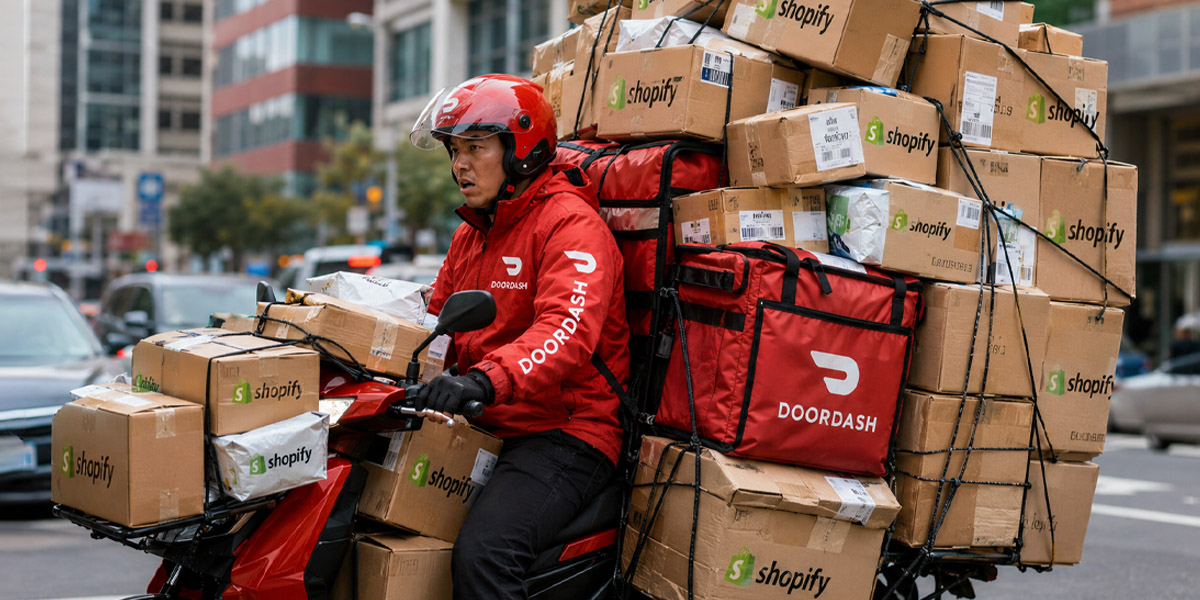
- DoorDash partners with Shopify for product discovery
- TikTok Shop offers a fully managed selling experience
- Amazon warehouse managers are being rebellious
- Shopify finally fixed its archaic Collections logic
- New York moves closer to BNPL regulation
- Squarespace embraces limited edition drops
- Stripe and Advent International want to buy PayPal
- BNPL may cost you money if you don’t use it
- commercetools begins breaking up its modules
- Phia may have defrauded creators
- Enterprise SaaS companies are being pressured to sell
- Uber wants to take over Delivery Hero
- Plus, a $1.5 trillion dollar charge from Amazon Web Services?!
All this and more in this week’s 287th Edition of Shopifreaks. Thanks for subscribing and sharing!
Stat of the Week
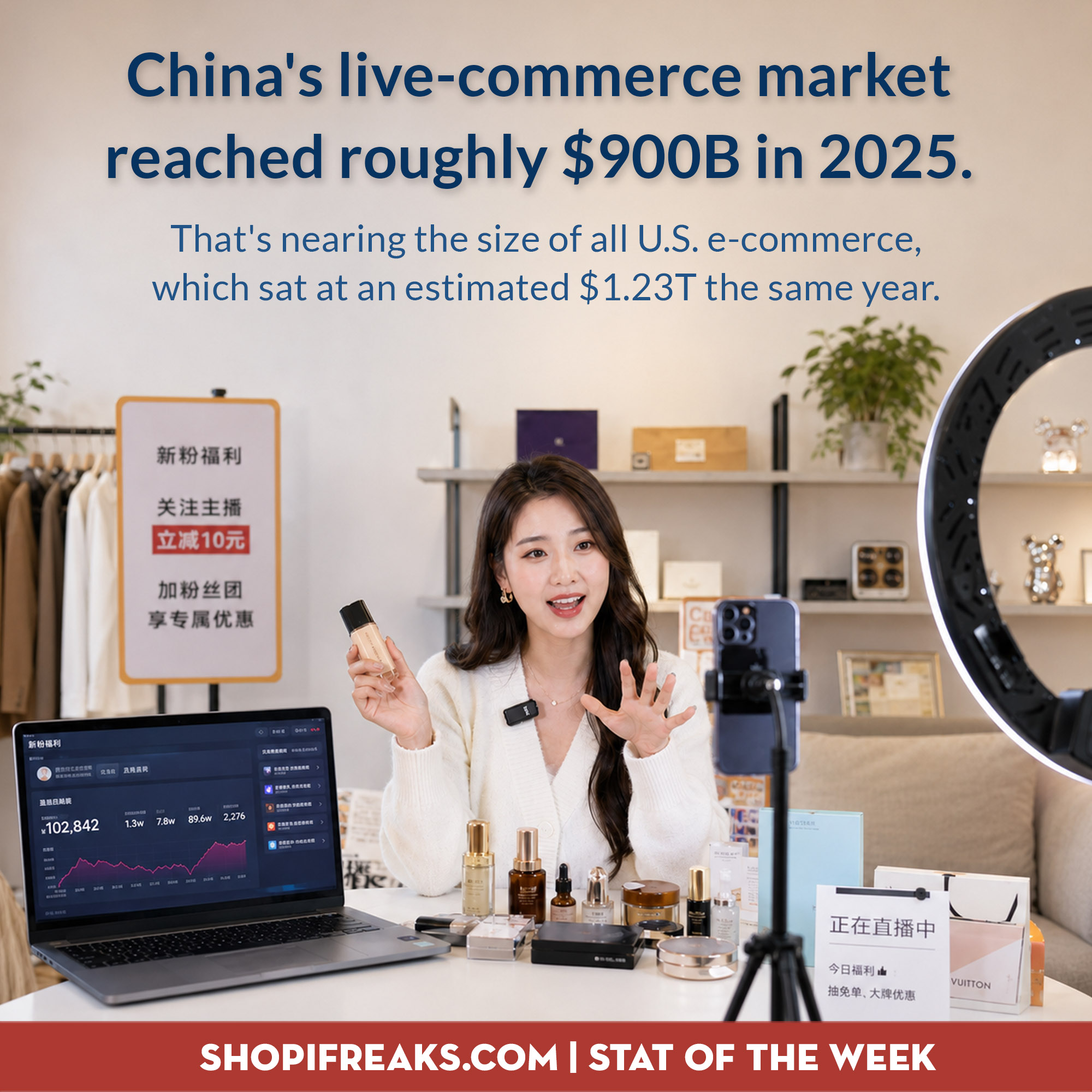
China’s live-commerce market reached roughly $900B in 2025, according to a report from consumer-intelligence firm NIQ. That’s nearing the size of all U.S. e-commerce, which sat at an estimated $1.23T the same year.
1. DoorDash offers a native Shopify app for local merchants to list on its marketplace
DoorDash launched a direct integration with Shopify, available as a native sales channel in the Shopify App Store, that lets U.S. merchants with a brick-and-mortar presence add their product catalog to the DoorDash marketplace. For example, a local sporting goods store can leverage the integration to sell tennis balls and other sports equipment via the DoorDash marketplace, and then have the orders picked up and delivered same-day by a DoorDash driver.
Here’s what it cannot do: The integration does not enable merchants to offer local fulfillment by DoorDash on orders processed through their Shopify stores. This still requires third-party middleware applications like LionWheel or Shipday, which plug into the DoorDash Drive API. (Or merchants can of course tap into the API themselves through a custom solution.)
Offering new sales channels for merchants and providing more local reach is always a positive in my book, but the lack of ability to fulfill Shopify orders through DoorDash makes it feel like a half-baked solution. All the pieces of the puzzle are in place: local merchants, product catalogs, a fulfillment network. I wish they had built the integration as a two-way street so that merchants can offer DoorDash delivery through all of their channels. Maybe that’s coming down the road.
One other thing to note is that although DoorDash bills the app and integration as “Free” — they do of course take a commission on marketplace orders, which can range from 15% to 30%. That said, merchants are allowed to set channel-specific pricing through the app to offset DoorDash’s commission, without changing the pricing in their main storefront.
The integration is now live in the U.S., with international expansion planned in the coming months.
Didn’t Uber already do this?
Yes and no. If this sounds familiar, you might be remembering when Uber Direct launched as a native Shopify integration in December 2025. There are a major differences though:
- Uber Direct is white-label fulfillment. Customers order on your own Shopify storefront and an Uber driver handles the delivery. You are not natively discoverable on the Uber Eats marketplace. (However, businesses can join outside of Shopify through Uber’s normal onboarding process.)
- DoorDash is a sales channel. Your product catalog is listed on the DoorDash marketplace, and customers discover and order your products there. DoorDash does not offer white-label fulfillment on your Shopify orders, as noted earlier.
- DoorDash is open to any U.S. Shopify merchant with a physical store. Uber Direct is Shopify Plus only.
- Uber Direct covers the U.S., Canada, and France. DoorDash is currently U.S. only, with international planned.
- DoorDash charges a commission on marketplace orders. Uber Direct charges per delivery, with no commission taken on orders, given that they happen on your own website.
tldr: Uber gave Shopify merchants its drivers. DoorDash is giving them its drivers and its shoppers, but only as a bundle deal.
Overall, a win for local businesses running on Shopify. Though I do hope that DoorDash begins offering fulfillment on Shopify orders too in the future.
2. TikTok will soon sell your items on TikTok Shop for you
TikTok is piloting a managed-services program in the U.S. that hands it control over most of a seller’s Shop operations for a fee, according to documentation viewed by Business Insider.
The program will handle key marketing tasks like hiring creators, running ad campaigns, testing ad creatives through its GMV Max tool, and optimizing product listings. Sellers will only be responsible for listing their products and sending free samples to influencers, while TikTok does most of the other heavy lifting.
How much does this dream service cost?
Just a mere $10,000 non-refundable flat fee investment plus a 10% to 20% commission per sale, depending on the brand’s product category. Plus ad spend, I’d imagine? Business Insider didn’t specifically mention who pays ad spend (the seller or TikTok), but given the commission range, I can only guess that it’s charged separately.
The program, which is set to kick off in August, is open to both U.S. sellers and international sellers who market and ship to the U.S., and puts TikTok in direct competition with its own Shop agency partners — the same ones it leaned on heavily to get the U.S. business off the ground since 2023.
TikTok Shop is tracking toward more than $23B in U.S. sales this year, still small next to Amazon’s projected $500B, per Emarketer.
3. Amazon warehouse managers don’t like an algorithm dictating their jobs
Amazon warehouse managers are overriding, disabling, or dodging the company’s new automated staffing software, prompting plans for stricter enforcement, according to internal documents and Slack messages seen by Business Insider.
Quick Backstory: Last month, I reported that Amazon is testing software that reassigns warehouse workers to different sections of the facility in real time as package volumes shift. The tool, called Full Facility Load Balancing, rechecks staffing every few minutes and flags workers to move from overstaffed spots to locations that need more attention, which the documents project could save nearly 7M labor hours and $193M a year — while simultaneously helping to ensure that employees never get a single moment of reprieve while on the clock.
Well, as predicted, no one really likes having a computer algorithm tell them how to do their job. So the managers have not been using it, much to the dismay of Amazon.
Business Insider wrote:
“The documents reveal two competing philosophies of warehouse management. Some managers believe warehouses are still too dynamic for algorithms to understand every situation. Amazon, however, saw that too much human judgment prevented those algorithms from working as intended.”
It turns out that getting managers to trust software to make decisions, while still holding the managers accountable for those decisions, is a difficult ask. Plus, what manager wants to give preference to an algorithm that is likely being positioned to take their jobs? I feel like companies aren’t even hiding it anymore.
Also, apparently the software isn’t that great. Some managers said it lacked the context they had on the warehouse floor, giving examples of times the system overreacted to a brief slowdown in package volume and recommended staffing cuts that didn’t reflect the real conditions. Others complained that the system pulled workers away from urgent areas or that it caused packages to repeatedly circulate through the warehouse instead of being processed the first time.
One manager asked in Slack, “Does it understand 6 foot three Henry that weighs 250 pounds is way better at chasing than 67-year old Henrietta that weighs under 100 pounds and doesn’t reach 5 foot?”
Regardless, the days of ignoring your algorithmic overlords are over. Amazon wrote in one planning document, “Enforcement is our highest-leverage mechanism and we’re doubling down… Hard enforcement is the end goal for 2026.”
Amazon called the story’s premise wrong, saying it’s piloting the tools at a small number of U.S. sites to give managers better information rather than replace their judgment, and that the quotes came from an early-stage planning document. I guess we’ll see though.
4. Shopify finally overhauled its archaic Collections logic
Shopify rebuilt its Collections tool to give merchants more granular control over which products are listed. In the old days (last week LOL), you could only “Include” items based on their product type, tag, status, and other properties. Now, you can also “Exclude” items based on their properties. The small difference is huge for merchants.
For example, imagine if you wanted to create a Collection for a specific promotion that offered 50% off items that weren’t currently on sale (ie: not slashed down in price), but you also didn’t want to include your Kits or Bundles in the promotion. In the old days, you’d have to sacrifice your firstborn to make something like that happen. Well, more realistically, you’d have to create a Tag for all your non-Bundle items so that your final collection could “Include items not on sale AND items tagged Not Bundle.” A workaround or a third-party app was always required, and it was so damn frustrating!
Now, with the new Collection interface, you can easily set two different parameters to “Include Items Not On Sale” and “Exclude Product Type equals Bundles” — or whatever your particular use case may be.
In addition to the ability to Exclude items from Collections, Shopify opened up the ability to use multiple sources, target specific variants, connect to apps and external workflows, and hand-pick items alongside your automation rules. The ability to pull sources from apps, not just your product catalog, is an especially big feature. You can now, for example, rely on apps to track bestsellers or trending products and feed that data into your Collection to populate it with products, instead of having to do it manually.
The new Collections API technically rolled out in June, so you might have seen developers talking about it during the past month, but Shopify just now launched the merchant-facing admin experience.
Do you want to know the one thing you STILL can’t do though?
Include or Exclude items based on their Stock Levels from ONE particular fulfillment location! Here’s a problem that’s been happening for years on Shopify (and is still happening after the Collection overhaul):
- Merchant sets the Collection to only display if an item is in stock.
- However, the Collection still displays items and shows them as “OUT OF STOCK” — why?
- The reason: Your store may only fulfill online orders from ONE fulfillment location, but if a Shopify Collection sees inventory in ANY of your fulfillment locations, it’ll still show the item in the Collection, albeit marked as “OUT OF STOCK”.
- The situation happens a lot, for example, if a merchant keeps dedicated inventory for sale through their brick-and-mortar store, pop-up locations, or for influencer gifting. Even though the primary Online Warehouse shows “0” units (and should thus be considered OUT OF STOCK and not appear in the Collection), Shopify still counts the other inventory units that are not sellable online as “In Stock” and shows the item.
- Shopify, please fix this! All it takes is one simple condition: “If fulfillment location equals ________.”
Overall, the new Collection interface offers a huge win for Shopify merchants, and I’m grateful for it. Now I just also need that fulfillment location filtering feature above. I’ll never be happy…
5. New York State proposes BNPL licensing rules and fee caps
New York’s Department of Financial Services proposed rules to license and supervise BNPL providers operating in the state, opening a 60-day public comment period through September 14. The proposal would require BNPL lenders to get licensed, send monthly billing statements, cap late fees at $8, and set up dispute-resolution processes, according to Bloomberg Law.
This sounds familiar…
I’ve covered the proposal of these new rules on several occasions during the past year or so. Here’s a brief timeline of events:
- New York Governor Kathy Hochul signed the BNPL Act into law back in May 2025 as part of her FY26 budget, but the statute wasn’t self-executing. It handed NYDFS the job of writing the actual rules before any of it could take effect.
- NYDFS floated a preproposal draft in February, took informal feedback through March 5, and has spent the months since reworking it into the version published last week. February was a trial run, and this is the formal proposal that actually gets adopted.
- From here, comments close September 14, NYDFS reviews them and publishes a final Notice of Adoption, and the rules take effect 180 days after that.
- Once they do, BNPL lenders already operating in New York get 45 days to file a license application if they want to keep serving customers while it’s pending. So Klarna, Affirm, Afterpay, and Block are now on a clock that runs out sometime in 2027.
The Financial Technology Association, the lobby that represents several of the major BNPL providers, put out a statement welcoming “appropriate regulation that reflects the consumer protections and standards already in place at the leading firms” the same day the comment window opened.
It’s easy to read that statement as meaning, “We’ll endorse rules that codify what we already do voluntarily, and we’ll fight anything that goes beyond it.” But maybe I’m being too pessimistic towards an industry I hate (BNPL).
U.S. states have been stepping in to fill the gap the CFPB left in May 2025, when it announced it would stop prioritizing enforcement of its own 2024 rule extending Truth in Lending protections to pay-in-four loans, then rescinded the rule outright. Illinois became the second state with a BNPL-specific law when Governor Pritzker signed its version on June 25.
6. Squarespace launches new tools for merchants offering limited releases
Squarespace launched a new set of tools aimed at helping merchants create demand for their limited edition product drops and capped-capacity service bookings. For example, a hot sauce maker could release 200 bottles of a seasonal batch that he wants to build hype around, or a barber might open up eight chairs for a Saturday they don’t normally work.
New tools include:
- A Reserved Cart that holds items for a set time with a built-in countdown before releasing them back to the storefront.
- Low-inventory scarcity badges to display on PDPs and Collections.
- Quantity limits that stop a single buyer from wiping out the entire stock.
- A Mini Cart checkout shortcut that lets customers view their cart and start checkout without navigating away from the store page.
- Express Checkout, which surfaces available digital wallets for one-click purchase.
- Pay Links, which let merchants share a direct path to checkout via text, social, e-mail, or QR code.
- E-mail campaign support that lets merchants build anticipation ahead of a release, working alongside the low-inventory badges to signal scarcity.
Squarespace President Kevin Doerr said:
“We’re seeing entrepreneurs shifting away from always-on discount models and toward highly curated, exclusive releases that celebrate the value of their work. With our new limited release selling tools, we are putting entrepreneurs in control of when and how they sell – reducing the operational burden and giving them everything they need to build hype, handle surges in demand, and deliver a seamless checkout experience.”
The new tools are native to Squarespace’s platform and don’t require any external plugins to manage the frontend features, inventory, or checkout. They’re available globally now, though which ones you get depends on your subscription plan.
7. Stripe and Advent International offer $53B to acquire PayPal
Last Tuesday, Stripe and private equity firm Advent International made a joint offer to buy PayPal for $60.50 a share (more than $53B), a roughly 28% premium to PayPal’s most recent closing price before the offer was made. If approved, the two companies would jointly own PayPal with equal stakes rather than break it up.
Two days later, Reuters reported that PayPal’s board saw the $53B takeover bid as undervaluing the company, noting that it would also likely face regulatory and financing hurdles. The board is expected to meet today (Monday) to discuss the offer, though sources say acceptance isn’t likely.
I first reported on the potential offer in March, back when it was just a rumor reported by Bloomberg. This was about one month after PayPal announced the appointment of Enrique Lores as its new President and CEO, right as he was taking the reins.
As mentioned earlier this year, I’m highly against the acquisition for several reasons:
- The offer seriously undervalues PayPal. Even at a 28% premium, Stripe would be getting a steal in my opinion.
- PayPal / Venmo have a combined 540M wallet users and bring an entire peer-to-peer ecosystem to Stripe that would otherwise take it years to build.
- PayPal is at the beginning stages of growing an ad network, a high-margin vertical that Stripe would also inherit, alongside the decades of consumer purchase behavior data that PayPal brings to the table to power that ad network.
- I don’t want a payment processing monopoly. I want competition in the market, which Stripe and PayPal currently bring to each other. It’s already hard enough for a startup payment processor to compete in the market with either Stripe or PayPal, let alone the combination of the two.
- It’d also be a loss for merchants, who, in many cases, would have nowhere to go if their relationship with Stripe went sour (which it’s known to do).
- And on a personal note… I’m way too invested in PYPL because I have high aspirations for the company. I don’t want cash for my PYPL stock, which I would most likely receive as a retail investor. I want Stripe equity, which there’s no way I would get.
- I also don’t want a 28% premium on my PYPL. I want to see the 10+ year upside to PayPal’s valuation, which is why I heavily invested in the stock in the first place.
The merger of Stripe and PayPal is bad for merchants, bad for consumers, and overall bad for the market. PayPal should outright reject the offer (which they might have already done by the time this edition publishes). And if they were to accept this or a subsequent better offer, it should be blocked by antitrust regulators in the U.S. and EU as anticompetitive.
What are your thoughts on a Stripe-PayPal merger? Hit reply and let me know.
8. Does BNPL cost you money, even when you don’t use it?
BNPL merchant fees get passed to all U.S. consumers through higher prices, regardless of whether they use the financing, according to a report by Protect Borrowers, a consumer-debt advocacy group formed in 2018 by former CFPB officials.
Fees on BNPL purchases can run as high as 3x what a credit card transaction would cost, and 10x what a debit card transaction runs, and those transaction fees are a big way the BNPL companies make money. How else would they when offering zero-interest installment loans on purchases? The merchant pays for the privilege of offering that highly converting payment type, the tradeoff being more closed sales.
The report states:
“The costs borne by merchants for BNPL partnerships are ultimately passed onto all Americans, regardless of whether or not they use BNPL, through higher prices. These costs may only increase as BNPL adoption becomes more widespread among sellers and more deeply ingrained in the payments ecosystem.”
A few other points of interest from the report include:
- In 2024, merchant fees were 57% of Klarna’s revenue, 36% of Affirm’s, and 32% of Sezzle’s. The rest typically comes from interest, interchange fees, late fees, and membership subscriptions.
- 58% of small businesses and over 40% of online retailers now accept BNPL.
- BNPL lenders earn interchange from merchants who never signed a partnership, because customers pay with one-time Visa cards, hybrid debit cards, or digital wallet integrations. A merchant who deliberately declined BNPL is still paying into the ecosystem and has no idea.
- Affirm and Klarna both have OpenAI and Google partnerships. PayPal has OpenAI, Google, and Perplexity. The report’s worry is that embedding financing into chatbots invites users to disclose financial data to a system that also hallucinates loan terms.
- Walmart, Kroger, Instacart, DoorDash, Amazon, and Target all have BNPL partnerships, and the report notes they collectively hold 84% of the online grocery market. Meanwhile 46% of BNPL users have financed groceries.
The only problem with the report claiming that BNPL raises prices across the board: it’s based on observation, not data.
Trade groups including the American Fintech Council and Financial Technology Association dismissed the claims as unsubstantiated opinions, and Protect Borrowers’ own executive director conceded it had no transaction data to build its case and relied on superficial observation.
I’ve long made the argument that BNPL raises prices for everyone, but never had the stats to back it. I’ve only had the anecdotal evidence working with merchants to know that they’re definitely baking BNPL fees into the cost of doing business. As it turns out, I still don’t have the stats to back it, as this new report doesn’t offer any either.
However, Visa and Mastercard have long defended that their interchange fees don’t get passed on to consumers, but countless studies have proven otherwise as credit and debit card adoption increased over the past few decades. I’d imagine it’s only a matter of time before similar information is discovered about BNPL.
The problem is — BNPL fees, inflation, tariffs, corporate greed — who can tell anymore what’s specifically contributing to prices rising? With or without BNPL, they seem to be going up and up and up either way.
9. Other e-commerce news of interest
commercetools launched two standalone modules, Core Commerce, which handles enterprise cart, order management, checkout, and B2B, and Product Catalog, which spans product modeling, pricing, inventory, and catalog across millions of SKUs. The move unbundles its core transactional and data engines for the first time to offer independent modules, both of which run on commercetools Sphere, the API-native, headless foundation layer the company unveiled in June to govern autonomous AI shopping agents and handle machine-to-machine transactions. This allows brands running on legacy stacks like SAP Hybris or Oracle ATG to keep their current backend logic and ERP integrations, but leverage commercetools to replace their likely slow and cumbersome catalog or checkout flows. Took them long enough!
Phia, the AI shopping startup co-founded by Phoebe Gates and her former college roommate Sophia Kianni, is taking heat after a Bloomberg investigation accused it of stealing creator commissions. The browser extension allegedly overrode other affiliates’ referral codes during checkout and inserted its own, claiming credit and commissions on purchases that it played no part in driving, which is a tactic that other extensions like PayPal’s Honey have been accused of doing in the past as well. Impact.com suspended Phia’s account after finding its conduct inconsistent with platform policies and is now reviewing affected transactions, while Awin says it’s reviewing the case. The company blamed a recent code release for the commission misattributions, which it says only impacted a subset of users, and said that its team worked overnight to mitigate and resolve the problem once notified. Given the high profile of the founders, I can only imagine that this will result in a class-action lawsuit against Phia from creators it wronged, unless the affiliate networks themselves step in to correct the misattributed commissions.
U.S. importers got back $49.2B in tariff refunds in June, more than double the $22B returned in May, pushing the federal budget deficit to $120B for the month and reversing the $27B surplus the administration touted a year earlier as proof the tariffs were working. Gross customs collections came in at $23.6B against those refunds for a net outflow of $25.6B, and total June receipts fell 6% to $496B in a month that’s normally flush with quarterly tax payments. CBP told the Court of International Trade it had repaid $86.3B of the roughly $166B owed as of July 10, with another $121.75B accepted for processing. Over 8,000 approved refund declarations are still sitting unpaid because CBP doesn’t have working bank details for the importers. Refunds started flowing in May after the Supreme Court struck down Trump’s IEEPA tariffs back in February, and unpaid balances accrue interest at 6% for corporations and 7% for individuals, compounded daily.
More than 160 privately held U.S. enterprise software companies worth at least $1B are now under pressure to sell, nearly double the number on the same list a year ago, according to The Information. Venture firms have shifted their money into AI, while public software stocks like Atlassian, ServiceNow, and Asana have seen their market cap nearly cut in half in a year. Meanwhile, mega-IPOs from OpenAI and Anthropic threaten to absorb investor demand, leaving these startups with a sale as their likeliest exit to deliver cash returns to their investors. Ryan Lund of Houlihan Lokey said, “Buyers are struggling to really understand what is the terminal value of some of these businesses, so the market is stuck. The attractive acquisition targets for [major buyers] are those accelerating on AI.” This was demonstrated by Salesforce’s recent $3.6B acquisition of Fin, formerly Intercom, after it launched AI agents that answer customer questions and handle tasks like refunds.
Alexa for Shopping doesn’t care about Amazon product rankings or ads, according to a study of 12,810 recommendations across 1,963 non-branded queries run by AI-optimization vendor Autopilotbrand.com and reported by Marketplace Pulse. Researchers posed “best of” questions like “what is the best queen mattress?” against the bare category search, and found 63.9% of Alexa’s picks fell outside the organic top 10 for the matched term, with 40.9% not appearing on the visible results page at all. Only 14.3% of picks were running a sponsored listing on that search page, and 83% of those already ranked organically anyway, indicating that buying ads isn’t a first-class ticket to AI recommendations, at least for now.
eBay made its eBay Live rate card public for the first time, pricing the invite-only livestream format in the U.S. at a combined 8.9% plus $0.30 per order in most categories and 6.9% for coins, bullion, and eligible sneakers, according to Liz Morton at Value Added Resource. Both rates fold in a 2.9% payment processing fee and sit below the 13.6% final value fee that non-Store sellers pay on standard listings, with Live commission capped at $100 per item, no insertion fees, and a Promoted Listings General waiver. UK rates run slightly lower at 6.42% and 8.42% plus £0.30, and both markets are temporarily cutting the fixed fee to $0.10 or £0.10 on orders of $10 or less through December 31, 2026. eBay’s rate undercuts Whatnot, which charges 8% commission plus an additional 2.9% + $0.30 processing fee, but comes in higher than TikTok Shop, which charges a flat 6% that includes payment processing.
Google added personal AI avatars to Vids, its Workspace video tool, letting users generate a digital double that mirrors their appearance and voice from an uploaded selfie and voice recording. It also brought Gemini Omni to Vids, allowing users to turn a written prompt and reference images into video with background swaps, lighting fixes, effects, and step-by-step edits instead of restarts. To prevent people from making videos of public figures or other random people, the avatars are bound to the user’s own likeness and Google account, carry invisible SynthID watermarks, and reach only users 18 and older in certain regions. The updates push Vids past its original workplace-presentation role toward an all-in-one video platform, putting it in closer competition with AI-avatar startups like HeyGen, Synthesia, Captions, and D-ID, months after OpenAI shut down its video app Sora.
In other Google news… The company is expanding connected apps in AI Mode for Search, letting users in the U.S. securely link and act on external services directly inside AI Mode, an option it previously offered only in the Gemini app. For example, a shopper planning a dinner party can push an AI-built grocery list straight into an Instacart cart and check out in a few taps on Instacart’s app or site. Or a merchant prepping a weekend promo can ask Canva for banner templates with their theme and dates already filled in, then tap through to finish the design in the app. Rollout begins this week and stays limited to the U.S. for now, though Google says it is working with a range of partners and expects to add more apps and reach more countries soon.
A 24-year-old Philadelphia entrepreneur named Mohamed Coulibaly allegedly took more than $1M from three former NFL players by persuading them to invest in fake Shopify stores, according to a Barron’s investigation by Jacob Adelman. Investors put in at least $50,000 each for prebuilt online stores, which Coulibaly promised would return their principal after six months, plus 80% of any profits from the sites. However, the investigation found that many orders shown to investors were manually entered into Shopify, creating the appearance of successful online stores despite having little customer traffic. One site logged over 360 orders against 90 visitors, including a $5,000 order from a supposed Luxembourg customer for 100 desktop humidifiers and 120 USB cup warmers, but the guy living at that shipping address told Barron’s he never bought a thing. Isn’t that the oldest trick in the book — the old “ready-made Shopify store” scam? But usually, it targets little old ladies and other retirees. This is the first I’ve heard of anyone tricking millionaire pro athletes with it. Coulibaly denies any fraud and says the article presents disputed allegations as established fact.
Apple Maps is barring home services like plumbing, electrical, HVAC, pest control, roofing, locksmiths, and general contracting from its upcoming ads program, along with crypto ATMs and bail bonds providers, with medical-services ads evaluated case-by-case, according to its newly published Advertising Services policy effective July 14. The exclusions suggest Apple is limiting Maps ads, which are expected to launch this summer in the U.S. and Canada, to businesses with a physical location customers actually visit, such as restaurants, shops, hotels, and salons, unlike Google, where Local Services Ads are one of its largest local categories. Also unlike Google, Apple Maps ads will only show a single ad per search, marked with a blue halo around the location pin and labeled as an ad in the list of Suggested Places, with interaction data kept on the user’s device.
TikTok Shop is being flooded with AI-generated product demos, avatars, and creator duplicates, creating friction between creators, brands, and TikTok itself, according to The Wall Street Journal. The platform’s AI Video Maker lets sellers and creators auto-generate shoppable video clips, and TikTok’s policy permits fully AI content as long as creators add an on-screen disclosure tag and avoid false claims. Affiliate creators who demo real products say the easily generated AI clips are siphoning ad spend and sales, prompting brands like SharkNinja to ban AI content and strip commissions from affiliates who use it. The challenge for brands is that TikTok Shop’s open affiliate setup lets any creator promote any product without brand approval, meaning brands can’t stop the original post, regardless of their own AI policies.
Google Images launched a new Pinterest-style gallery UI that lets users save images to collections, similar to how Pinterest lets you save images to boards. It also launched a new feature in AI Overviews that turns a text prompt into a custom visual that users can then use as the basis for discovery, letting them skip writing out a description of the concept. For example, a shopper who wants a pair of khaki travel pants with built-in plastic lining to defend against their Cyclospora-induced explosive diarrhea can generate that exact pair and then use the AI-generated image to hunt down the closest real product. Both features roll out over the coming weeks, with the gallery starting on U.S. desktop and image generation reaching all regions that already support AI Mode image creation.
OpenAI’s chatbot advertising is projected to fall about 90% short of its own 2030 revenue target, according to Emarketer. OpenAI projects ad revenue of $2.5B this year and $100B by 2030, figures it shares with investors to demonstrate how ads and subscriptions can eventually cover its heavy capital spending. However, Emarketer instead expects all U.S. standalone chatbots combined, including ChatGPT, Microsoft Copilot, Google AI Mode, and Amazon Alexa for Shopping, to generate under $1B in ad income this year and just $5.41B by 2030, a far cry from OpenAI’s own projections just for itself — though Emarketer scopes its number to the U.S. while OpenAI’s target doesn’t mention a region, which suggests OpenAI’s is a global figure. ChatGPT Ads are still in trial mode, so there’s not a lot of data to go on for either OpenAI or Emarketer to make projections, other than OpenAI recently saying that its U.S. ads pilot surpassed $100M in ARR six weeks after launch. If I had to choose, I’d bet that in four years the true number will land closer to OpenAI’s projection than Emarketer’s estimate. These AI companies will make sure of it. What’s your prediction?
In lawsuits this week…
- OpenAI asked a federal judge to dismiss a proposed class action lawsuit that accuses it of passing private user data about health and finances to Meta and Google via their advertising and analytics pixels. The company argues that lead plaintiff Amargo Couture consented to the disclosures by accepting its privacy policy when creating an account.
- Google search users are urging a federal judge to let their antitrust suit proceed, arguing that Google’s deals to be the default search engine on Apple’s Safari and Android devices blocked rivals offering more privacy, fewer ads, or payment for users’ searches and data. The filing responds to Judge Rita Lin’s order that they show real injury or face dismissal, with plaintiffs now claiming that Google monetized their queries, data, time, and attention without paying them, and cut off their access to those alternatives.
- X Corp and a group of music publishers led by Sony, Universal, and Warner Chappell ended their three-year music licensing battle, filing joint stipulations to dismiss both the publishers’ copyright suit and X’s antitrust countersuit with prejudice, meaning they cannot be refiled. Back in June 2023, the music publishers sued X for more than $250M over infringement of roughly 1,700 works, while X countersued in January 2024 accusing them of colluding through the NMPA to force industrywide licenses at inflated rates. Neither filing discloses settlement terms or whether X will now license their music.
- Temu is facing a proposed class action in California federal court alleging it sent spam e-mails that used forged headers, spoofed sender domains, and misleading subject lines to lure consumers to its site, where it planted tracking pixels without consent. The case claims violations of California’s anti-spam and Trap and Trace laws and seeks $1,000 per spam e-mail plus punitive damages and an injunction.
- Google is facing a class action lawsuit from book publishers and authors that accuses it of training Gemini on works they had supplied for limited uses like Google Books and Google Scholar, not AI training. Plaintiffs, who include Hachette Book Group, Cengage Learning, Elsevier, and novelist Scott Turow, claim Google knowingly engaged in the practice and stripped copyright management information from the works to conceal its training sources.
- Meta is facing a federal lawsuit from 26 current and former employees alleging it used a “constellation of internal AI systems,” including its Metamate assistant, keystroke monitoring, and AI token usage dashboards, to build the termination list for the roughly 8,000 jobs it cut starting May 20, disproportionately hitting workers with disabilities or on protected medical or parental leave. Plaintiffs, all notified of termination after taking or requesting leave or a disability accommodation, say those systems relied on metrics like performance ratings, productivity, and AI-token consumption that someone on protected leave cannot accumulate.
- TikTok is facing a proposed class action lawsuit alleging that it exposed the personal information of 2.4B users in a June 2026 data breach, including names, usernames, e-mail addresses, phone numbers, dates of birth, gender, language, and location. The case accuses TikTok of negligence, invasion of privacy, and unjust enrichment, arguing that the company failed to implement adequate security despite knowing it was a high-value target.
In layoff news this week…
- Two Amazon delivery companies in the San Francisco Bay Area are shutting down operations and laying off nearly 170 drivers. Neither company stated a reason for closing, and the notices don’t say whether Amazon is closing those delivery stations outright or simply bringing in different contractors. DSP shutdowns like these are routine, with Amazon contractors in Virginia, Tennessee, and Quebec filing similar notices over the past year.
- Alphabet Workers Union led more than 100 Google employees in a rally at the company’s Mountain View headquarters, handing CEO Sundar Pichai and three other senior executives a 4,500-signature petition for stronger job protections. Petition demands include guaranteed payouts for anyone cut, a chance to leave voluntarily before forced layoffs, scrapping forced-distribution performance ratings, and letting workers convert severance into extended paid leave.
In corporate shakeups this week…
- Meta is hiring AWS senior VP Dave Brown, who is ending a nearly 19-year run at Amazon, to work on its data center build-out, according to the WSJ. Brown joins Meta Compute, Zuckerberg’s infrastructure initiative, as the company aims to spend up to $145B in 2026 capex. Dave Treadwell, a top executive from Amazon’s e-commerce division, will take over the AWS group.
- Anthropic hired Tom Blomfield, co-founder and former CEO of UK neobank Monzo, as a member of technical staff on its compute team, with Blomfield taking a leave of absence from his partner role at Y Combinator. He reports to co-founder and chief compute officer Tom Brown to work on compute availability, joining a 2026 hiring run that also pulled Andrej Karpathy from OpenAI and John Jumper from Google DeepMind.
- Anthropic posted a job for a director of investor relations at a base salary of $425K to $600K to build the company’s “investment narrative” ahead of its fall IPO. The director will serve as a primary point of contact for institutional investors and advise leadership on how major decisions are likely to be received, working alongside IR head Kenneth Dorell, who joined from Meta in June.
- Microsoft security chief Hayete Gallot has replaced at least eight senior executives and cut several hundred roles from the 10,000-person security group since taking over in February, according to The Information. Gallot is reorganizing the business around AI security products to capitalize on corporate fears of AI-powered hacking, telling staff in a memo that the industry is being reimagined from the ground up.
Sen. Mark Warner released a discussion draft of the AI AGENT Act, which would require large online platforms with at least 50M U.S. customers, like Amazon, Google, Meta, and Apple, to build an interoperable interface so any outside AI agent a consumer picks can operate on the platform. For example, the law would require that Amazon allow third-party agents to shop on its marketplace, instead of pushing users to Alexa, which is exactly what Perplexity is fighting for. The second part of the law would require providers to register their agents with the FTC, as well as protect user data, keep real-time records of their activities, and avoid acting against the user’s interests. One could argue that allowing third-party agents into their system goes against acting in the user’s best interests, which puts the two parts of the law at odds with one another, and I’m sure Amazon and others will use that argument. The act remains a discussion draft, not a bill headed for a vote.
Remember when Coupang had a data leak that exposed personal information of 33M customers? And how South Korean regulators fined the U.S.-listed company $409M over the incident? Well, U.S. Republicans are pissed about the fine and are accusing South Korea of discriminating against American firms, weaponizing rules against Coupang, and putting disproportionate burdens on U.S. companies, according to Reuters. The House Judiciary report ties the fine to a broader pattern, citing previous actions against Google, Apple, Microsoft, and Qualcomm, and takes aim at South Korea’s proposed platform legislation modeled on the EU’s Digital Markets Act. The U.S. also points to a trade agreement clause requiring Seoul not to discriminate against American firms on digital services. South Korea’s position is that it enforced its own privacy law against a company that broke it, noting the fine covered illegal data collection and reporting failures beyond the breach itself, and that its regulator has fined Korean firms and U.S. firms alike.
PayPal launched Pay in 30 Days in the UK, letting eligible customers pay the full amount for an online purchase up to 30 days later with no interest, sign-up fees, or additional charges on eligible purchases between £1 and £900. The payment option complements PayPal’s existing Pay in 3, which splits a purchase into three payments at checkout and over the following two months. The move came a day before UK BNPL came under FCA regulation on July 15, which now requires lenders to be FCA-authorized, run affordability checks on every purchase even under £50, notify customers immediately when they miss a payment, and offer support to anyone falling into financial difficulty. Consumers also gain access to the Financial Ombudsman Service and Section 75 protection on purchases over £100, making the lender jointly liable with the merchant if something goes wrong.
The European Commission issued Google two sets of binding specification measures under the Digital Markets Act, spelling out how the company must open its platforms to competing search and AI services. The first measure requires that Google let rival AI assistants tap the same Android device features it reserves for Gemini, so competitors can actually challenge Google’s AI services, feature for feature. The second measure requires Google to hand rival search engines the large-scale query, ranking, and click data that only its search engine can amass. I previously reported these remedies as pending, tied to a binding decision expected this month, but now they’re official. Google faces daily penalties or fines up to 10% of global annual revenue if it fails to comply. Google can now appeal to the EU General Court, though it hasn’t announced plans to do so yet. However, doing so wouldn’t pause compliance anyway, with search data sharing due by January 2027 and Android interoperability by August 2027.
Speaking of troubles in the EU for Google… Germany’s media regulator, ZAK, ruled that Google’s AI Overviews and Perplexity are subject to the country’s media laws, treating AI-generated summaries and chatbot answers as content the providers create themselves rather than third-party material. ZAK, which represents Germany’s 14 state media authorities, said the EU Digital Services Act’s liability shield does not apply and that prominently displayed AI Overviews unfairly disadvantage third-party media by pushing traditional link lists down the page. The decision follows a Munich court ruling that Google could be directly liable for false statements from AI Overviews, which Google plans to appeal. The ruling, which came from investigations already in progress, doesn’t currently include OpenAI, Anthropic, or other AI chatbots, but ZAK chairman Thorsten Schmiege’s language puts them squarely in scope, saying the regulator “will consistently apply German media law to them from now on.”
🏆 This week’s most ridiculous story… What would you do if you received a $16 million invoice from Anthropic for your AI usage? Or how about a $1.5 trillion charge estimate from Amazon Web Services?! That’s what happened to users last week after both platforms experienced insane billing issues that sent erroneous bills and charge estimates to customers worldwide. Anthropic confirmed that it sent invoices ranging from $1.67M to $16.6M to a South Korean Claude user, despite being on the free tier with no billable API usage. The company made so many repeated charge attempts that his bank blocked his primary credit card, which took days to resolve. Meanwhile, AWS started showing users estimated charges for tens or hundreds of billions of dollars in their dashboards, with one as high as $1.5 trillion. Question: If these billing errors were only caught because of how ridiculous they were, what about the other smaller ones? Is it possible users are spending exponentially more for AI usage than they should be, with no way to audit their bills?
10. Seed rounds, IPOs, & acquisitions
Whatnot acquired Shaped, a machine-learning startup that pairs a company’s own data with large language models to power personalized search and discovery, for an undisclosed amount. The deal aims to help Whatnot improve its product discovery and personalization tools after launching 80 new categories in the past year and a half, with new subcategories continuing to roll out each month. Shaped founder and CEO Tullie Murrell, a former Meta engineer, will join Whatnot with nearly a dozen staff to lead a new Applied AI Research group.
Uber agreed to acquire Delivery Hero, a Germany-based food delivery app that operates in over 60 global markets, for €41.50 per share, or roughly €13B, representing a 34% premium to Delivery Hero’s three-month average share price. The deal would double Uber’s number of food markets served to create the largest food-delivery group outside of China, which would help the company better compete with domestic rivals like DoorDash and international competitors like Just Eat. Uber has built a roughly 36.8% stake in Delivery Hero in a matter of months, up from 2.5% prior to April 2026, by buying shares and instruments from tech investor Prosus and activist shareholder Aspex Management, as well as open-market shares, all while keeping its voting shares under the 30% level that would have triggered a mandatory takeover offer under German law. Delivery Hero rejected Uber’s first takeover offer, made in May, which valued it at €10B, or €33 a share.
Instacart acquired Arpalus, a computer-vision company that builds shelf-intelligence technology for grocery retail, for an undisclosed amount. Arpalus’s tech enables shoppers to grab a quick video recording of a grocery shelf and identify what’s actually in stock with more than 95% accuracy, and the acquisition aims to improve Instacart’s inventory data behind online orders and in-store fulfillment. Arpalus’s video scans also feed Store View, Storefront Pro, and camera-equipped Caper Carts, part of Instacart’s Physical AI push to link in-store and online grocery.
Emergent, an AI software-creation platform that builds full-stack apps through autonomous agents, raised $130M in a Series C round led by Creaegis, Claypond Capital, and Sentinel Global at a $1.5B valuation, bringing its total amount raised to $230M. The round 5xed Emergent’s valuation from $300M in January and made it a unicorn in the year since its public launch, during which it helped founders build over 12M apps. The company will put the funds toward building stronger AI agents, expanding its infrastructure, and international growth.
eBay now expects its $1.2B acquisition of Depop from Etsy to close July 30, following a July 12 amendment that limits eBay’s grounds for walking away and raises its potential Business Disruption Fee to $158M. That date was set three days before eBay secured UK antitrust approval, which removed a final obstacle to the closing. The companies had already received deal approval from the U.S., Australia, and Germany.
Flex, an AI-native private bank built for high-net-worth business owners running mid-market companies, raised $70M in a Series B1 round led by Halo Fund, bringing its total equity raised to $180M. Alongside the round, the company launched Flex Global, a cross-border division that runs on stablecoin rails in more than 100 countries and allows business owners to quickly move money across borders. Halo Fund co-founder Ryan Smith, the Qualtrics founder and Utah Jazz owner who started the fund with Accel general partner Ryan Sweeney, brings distribution into Halo’s NBA, NHL, and Formula 1 audiences, which include millions of mid-market business owners.
Wonder, the meal-prep and delivery company that owns GrubHub and Blue Apron, raised $650M in a Series D round at a $9B pre-money valuation, with existing investors Accel, GV, and NEA joined by new backers including ARK Invest and AllianceBernstein. The funds will be used to grow beyond its roughly 140 commercial kitchen locations and expand its robots, AI, and logistics infrastructure. Right before closing the round, Wonder acquired Mighty Quinn’s BBQ, an eight-unit fast-casual restaurant chain based out of New York City, for an undisclosed amount, adding to its restaurant portfolio of 30 brands. Mighty Quinn’s BBQ is Wonder’s second outright restaurant acquisition, after purchasing Blue Ribbon Fried Chicken in February.
Whale, a Singapore-based enterprise AI company, raised $40M in its second Series C extension led by CMB International and SMBC’s Asia Rising Fund, bringing its total Series C to $100M. The company’s AI operating system for enterprise brands is centered on a proprietary Business World Model that reads signals from cameras, sensors, and audio the way large language models read text, powering tools that track foot traffic in physical locations and analyze frontline sales conversations. Whale plans to use the funds to scale its teams, deepen enterprise partnerships, and expand platform integrations across Asia Pacific and North America before entering the Middle East and Europe.
ORA Technologies, a Moroccan super app combining food delivery, digital payments, and e-commerce, raised $2M from local investors in a Series A extension that brings the total round to $10M. The company will use the funds to grow KOUL, its food-delivery arm, and ORA Cash, its digital wallet for tap-to-pay and online purchases, while building out last-mile delivery and cash-collection infrastructure. Local investors financed the entire $10M round, making it one of Morocco’s largest locally funded early-stage tech rounds and a rarity for African startups that usually rely on foreign venture capital.
Tailored Brands, the parent of menswear chains Men’s Wearhouse, Jos. A. Bank, Moores, and K&G Fashion Superstore, filed to go public again under the ticker MENW, without yet setting a share count or price. The company plans to open more than 500 stores over the next decade, starting with 20 this year and over 35 in 2027, just six years after shuttering more than 400 locations in a 2020 bankruptcy. Its filing shows a post-bankruptcy turnaround, with sales climbing roughly 4.4% a year since 2021 to $2.5B, net income hitting $217M in 2025, and gross margin widening to 48.2%.
Shein is facing investor pressure to price its upcoming Hong Kong IPO below the $40B-$50B valuation it targets, as new EU parcel fees weigh on its sales growth. Eddie Tam of Hong Kong’s Central Asset Investments called $40B still steep and pegged something nearer $30B as more attractive, citing fierce competition and the EU fees, which would position it well below the $100B valuation Shein was reportedly given in a 2022 round. EU fees of €3 per customs code on parcels under €150 took effect this month, so a five-item order can draw €15 in duties in Europe, which accounts for roughly a third of Shein’s revenue.
Anthropic is setting up investor meetings in the coming weeks in preparation for its upcoming IPO, according to Bloomberg sources. The company is aiming to go public as soon as October, ahead of OpenAI, which has also filed confidentially and pushed its own debut to 2027, and DeepSeek, which is preparing to file as soon as this year. Anthropic is also reportedly in talks with banks to add a few billion dollars to its credit line ahead of the IPO, building on its $2.5B revolving facility from last year, according to The Information.
Podean, a marketplace-focused growth agency, acquired Social Commerce Club, a TikTok Shop-focused social commerce agency, for an undisclosed amount, marking its sixth acquisition in nine months. Social Commerce Club handles TikTok Shop strategy, store setup, creator-driven sales, and rapid “blitz” campaigns for brands such as HeyDude, Hanes, Maidenform, and Playtex. The company’s “Halo” platform, which tracks how TikTok Shop content drives cross-channel sales, will fold into Podean’s Purvey.AI system, extending attribution to marketplaces like Amazon and Walmart.
Augmodo, a spatial AI startup whose wearable Smartbadges let store employees track shelf inventory in real time as they work, raised $21M in an unplanned round led by TQ Ventures at a $350M valuation. The technology was originally built for grocery and retail stores, but it’s now spreading into warehouses, factories, hospitals, and automotive and maintenance work, prompting CEO Ross Finman to recast Augmodo as a “Physical AI” company for the hands-on workforce. Finman says that Augmodo wasn’t planning to raise again after its $37.5M Series A in July 2025, but customer demand for applying its tech to new use cases was strong enough that it decided to take the money and put it toward expanding the platform.
Klarna completed a $518M significant risk transfer that offloads credit risk on a pool of loans and frees capital to support $12B in additional lending over three years. By paying investors to absorb the losses if borrowers don’t pay, Klarna releases the cash regulators require it to hold in reserve and can lend that money out again without going back to shareholders. The company is pushing hard into the U.S., where it currently runs through a partner bank and has applied for its own banking license. This is Klarna’s seventh similar deal, following a $1.7B transfer in April led by Värde Partners.
Tencent is in talks to become the largest external shareholder in Manus, in a deal that would further unwind Meta’s earlier acquisition, according to Reuters sources. Meta had agreed to buy Manus for roughly $2B, but the two companies began dismantling the deal in April after the Chinese government blocked it on national-security grounds, with the original agreement drawing criticism in China as handing critical technology to a geopolitical rival. Original Manus backers ZhenFund and HSG are also part of the new deal, which extends Tencent’s recent AI push after it backed DeepSeek’s $7.4B raise at a $50B-plus valuation and began testing its Xiaowei agent in WeChat.
Thanks for being a Shopifreak!
If you found this newsletter valuable, please leave a review on Google and share the newsletter with your friends and colleagues to help us grow.
See you next Monday,
PAUL
Paul E. Drecksler
🌐 Shopifreaks.com
🧑💼 Add me on LinkedIn
📧 [email protected]
📱 +1-828-273-3031
⭐ Leave A Review
PS: Four Karens were having lunch out together. After the meals were served, the waiter returned and asked, “Is anything alright, ladies?”